

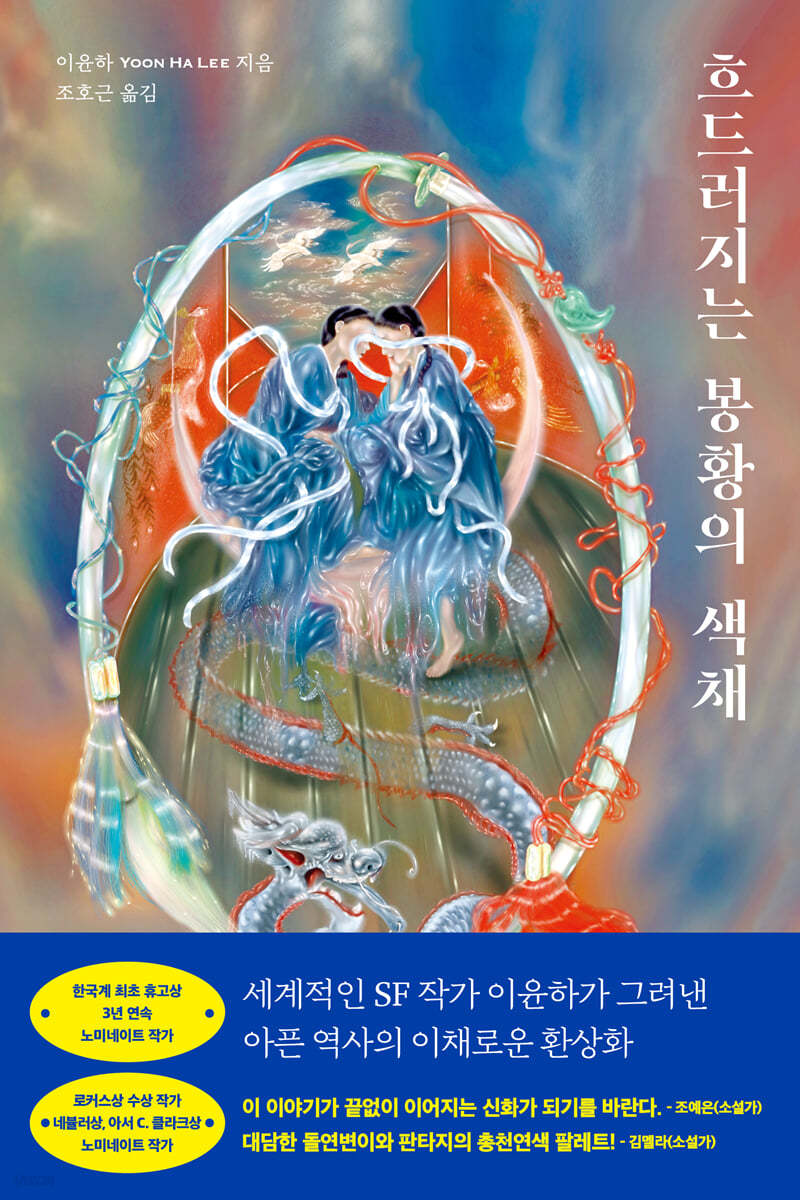
The colors of the phoenix flowing
 |
Description
Book Introduction
- A word from MD
-
A virtual historical science fiction novel that breaks all boundariesA new novel by Lee Yoon-ha, the first Korean-American to be nominated for the Hugo Award three times in a row.
The protagonist, a citizen of a colonized country, becomes embroiled in a turbulent period in history as he begins to work for the empire.
Although it is a fictional history, it does a great job of incorporating elements reminiscent of the Japanese colonial period into the framework of science fiction.
Don't miss the main character's growth and love story.
January 31, 2023. Novel/Poetry PD Kim Yu-ri
The first Korean-American writer to be nominated for the Hugo Award three times in a row
Lee Yoon-ha's SF inspired by the Japanese colonial period: a unique fantasy drawn with scars.
"Pachinko," "Beasts of a Small Land," "The Forest of Lost Girls"... What do these novels have in common? They are all written by Korean authors and were first known overseas before they were published in Korea.
Writers who live in foreign countries while keeping their Korean names.
There are Lee Min-jin, Kim Joo-hye, Heo Joo-eun… and Lee Yoon-ha.
However, there is a clear difference between Lee Yoon-ha and these three writers.
While Lee Min-jin, Kim Joo-hye, and Heo Joo-eun have written a thrilling and tumultuous history based on the country of Korea itself, Lee Yoon-ha has added Korean elements after wrapping it in a layer of fantasy called science fiction.
The two core elements that support Lee Yoon-ha's world of work are 'SF' and 'Korean elements.'
Korean customs and culture are combined with science fiction and fantasy to create a new and unique worldview that is clearly ours, yet never before seen.
In Lee Yoon-ha's work, Korea suddenly becomes something strange and fantastic.
(Just like his previous work, The Ninefox Gambit, which featured a space-faring 'gumiho general' and an astronaut obsessed with 'kimchi'!)
The Hugo Award, which is called the Nobel Prize of science fiction literature and draws attention from all over the world just by being nominated, is a Korean writer who has shown off her power by becoming the first Korean writer to be nominated for the Hugo Award three times in a row with her debut series, The Ninefox Gambit. This time, she has returned with the science fiction novel, The Color of the Phoenix, which is based on the motif of our history, the Japanese colonial period.
Born and raised in Korea until the age of nine, Lee Yoon-ha never forgot that her roots and origins are in Korea even during her time as an immigrant in the United States.
On Lunar New Year's Day, he ate tteokguk at his grandmother's house, and on Chuseok, the whole family gathered together to pick jujubes from the jujube tree.
Perhaps thanks to his childhood in Korea, Lee Yoon-ha was able to maintain a continued interest in and affection for Korea even in the United States.
If the motif of the 'Gumiho General' and 'pickled vegetables' (which refers to 'kimchi' according to the preface to the Korean edition of the 'Ninefox Gambit' series written by Lee Yoon-ha) were fleeting in the previous work, 'The Colors of the Phoenix' introduces elements that are more reminiscent of Korea.
These are familiar words that any Korean would recognize, such as ‘gumiho’, ‘kimchi’, ‘kimchi pot’, ‘red and blue Taegeuk pattern’, and ‘farmers of Gyeongsang Province’.
In an interview with Hubble, Lee Yoon-ha said, “The Japanese colonial period was a sensitive topic, so I wanted to handle it carefully.
“It must have been a painful time for Koreans,” he said.
He cautiously said, “My grandfather went to university in Japan, and I think he was pro-Japanese.
This is a burden my family carries.
“So, I also wanted to make more people aware of this period (the Japanese colonial period) that was unknown to the West,” he said.
The setting of 『The Colors of the Phoenix』 is the fictional country of ‘Hwaguk.’
The country is depicted as if it were a reproduction of the late Joseon Dynasty period in our country.
The country of China is under colonial rule, occupied by an empire, and has just opened its doors to the West, allowing Western civilization to flood in.
Naturally, it brings to mind Gyeongseong (present-day Seoul) in the late Joseon Dynasty, a city of chaos and turmoil, yet with its own unique atmosphere.
The 'Razan Empire' that occupied the country of Hwa is reminiscent of Japan during the imperialist era in many ways, including the cherry blossom as its national flower and the use of the 'sun' as its symbol.
In this way, 『The Colors of the Phoenix』 is a fictional historical piece and metafiction that looks back on our history based on a fictional worldview, and the Japanese colonial period is used as a motif and powerful metaphor.
The protagonist of 『The Colors of the Flooded Phoenix』, 'Jevi', initially works for the Rajan Empire at the Rajan Defense Ministry to make a living, but is swept up in the waves of the times and eventually joins the independence movement of the Chinese nation.
Lee Yoon-ha's SF inspired by the Japanese colonial period: a unique fantasy drawn with scars.
"Pachinko," "Beasts of a Small Land," "The Forest of Lost Girls"... What do these novels have in common? They are all written by Korean authors and were first known overseas before they were published in Korea.
Writers who live in foreign countries while keeping their Korean names.
There are Lee Min-jin, Kim Joo-hye, Heo Joo-eun… and Lee Yoon-ha.
However, there is a clear difference between Lee Yoon-ha and these three writers.
While Lee Min-jin, Kim Joo-hye, and Heo Joo-eun have written a thrilling and tumultuous history based on the country of Korea itself, Lee Yoon-ha has added Korean elements after wrapping it in a layer of fantasy called science fiction.
The two core elements that support Lee Yoon-ha's world of work are 'SF' and 'Korean elements.'
Korean customs and culture are combined with science fiction and fantasy to create a new and unique worldview that is clearly ours, yet never before seen.
In Lee Yoon-ha's work, Korea suddenly becomes something strange and fantastic.
(Just like his previous work, The Ninefox Gambit, which featured a space-faring 'gumiho general' and an astronaut obsessed with 'kimchi'!)
The Hugo Award, which is called the Nobel Prize of science fiction literature and draws attention from all over the world just by being nominated, is a Korean writer who has shown off her power by becoming the first Korean writer to be nominated for the Hugo Award three times in a row with her debut series, The Ninefox Gambit. This time, she has returned with the science fiction novel, The Color of the Phoenix, which is based on the motif of our history, the Japanese colonial period.
Born and raised in Korea until the age of nine, Lee Yoon-ha never forgot that her roots and origins are in Korea even during her time as an immigrant in the United States.
On Lunar New Year's Day, he ate tteokguk at his grandmother's house, and on Chuseok, the whole family gathered together to pick jujubes from the jujube tree.
Perhaps thanks to his childhood in Korea, Lee Yoon-ha was able to maintain a continued interest in and affection for Korea even in the United States.
If the motif of the 'Gumiho General' and 'pickled vegetables' (which refers to 'kimchi' according to the preface to the Korean edition of the 'Ninefox Gambit' series written by Lee Yoon-ha) were fleeting in the previous work, 'The Colors of the Phoenix' introduces elements that are more reminiscent of Korea.
These are familiar words that any Korean would recognize, such as ‘gumiho’, ‘kimchi’, ‘kimchi pot’, ‘red and blue Taegeuk pattern’, and ‘farmers of Gyeongsang Province’.
In an interview with Hubble, Lee Yoon-ha said, “The Japanese colonial period was a sensitive topic, so I wanted to handle it carefully.
“It must have been a painful time for Koreans,” he said.
He cautiously said, “My grandfather went to university in Japan, and I think he was pro-Japanese.
This is a burden my family carries.
“So, I also wanted to make more people aware of this period (the Japanese colonial period) that was unknown to the West,” he said.
The setting of 『The Colors of the Phoenix』 is the fictional country of ‘Hwaguk.’
The country is depicted as if it were a reproduction of the late Joseon Dynasty period in our country.
The country of China is under colonial rule, occupied by an empire, and has just opened its doors to the West, allowing Western civilization to flood in.
Naturally, it brings to mind Gyeongseong (present-day Seoul) in the late Joseon Dynasty, a city of chaos and turmoil, yet with its own unique atmosphere.
The 'Razan Empire' that occupied the country of Hwa is reminiscent of Japan during the imperialist era in many ways, including the cherry blossom as its national flower and the use of the 'sun' as its symbol.
In this way, 『The Colors of the Phoenix』 is a fictional historical piece and metafiction that looks back on our history based on a fictional worldview, and the Japanese colonial period is used as a motif and powerful metaphor.
The protagonist of 『The Colors of the Flooded Phoenix』, 'Jevi', initially works for the Rajan Empire at the Rajan Defense Ministry to make a living, but is swept up in the waves of the times and eventually joins the independence movement of the Chinese nation.
- You can preview some of the book's contents.
Preview
index
Chapter 1 · 5
Chapter 2 · 23
Chapter 3 · 42
Chapter 4 ·61
Chapter 5 ·83
Chapter 6 ·103
Chapter 7 · 120
Chapter 8 · 129
Chapter 9 · 145
Chapter 10 · 167
Chapter 11 · 187
Chapter 12 · 198
Chapter 13 · 215
Chapter 14 · 233
Chapter 15 · 250
Chapter 16 · 267
Chapter 17 · 285
Chapter 18 · 302
Chapter 19 · 322
Chapter 20 · 333
Chapter 21 · 349
Chapter 22 · 369
Chapter 2 · 23
Chapter 3 · 42
Chapter 4 ·61
Chapter 5 ·83
Chapter 6 ·103
Chapter 7 · 120
Chapter 8 · 129
Chapter 9 · 145
Chapter 10 · 167
Chapter 11 · 187
Chapter 12 · 198
Chapter 13 · 215
Chapter 14 · 233
Chapter 15 · 250
Chapter 16 · 267
Chapter 17 · 285
Chapter 18 · 302
Chapter 19 · 322
Chapter 20 · 333
Chapter 21 · 349
Chapter 22 · 369
Detailed image
Into the book
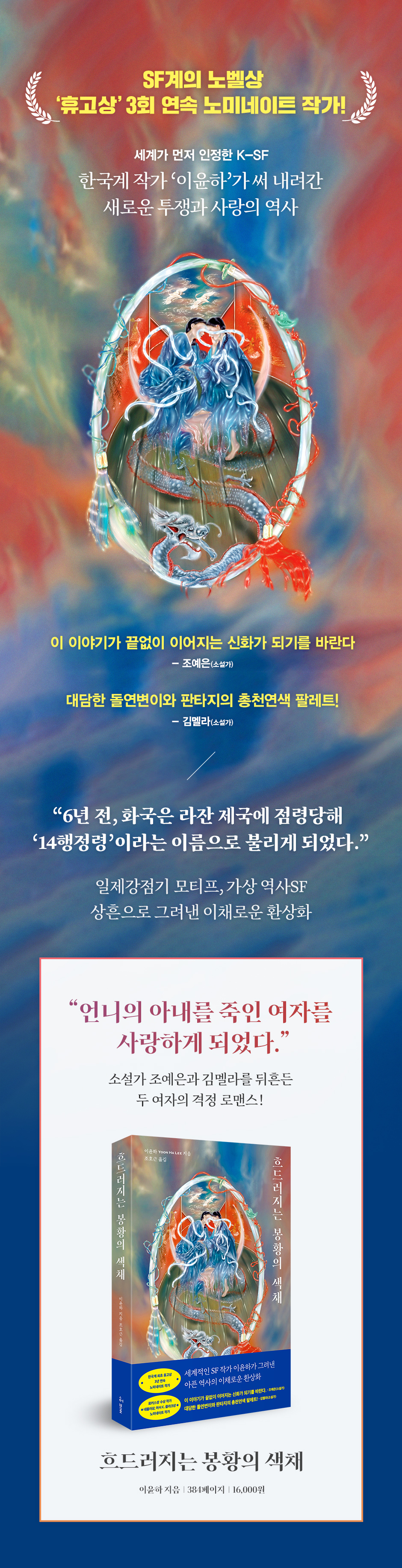
Six years ago, the Hwaguk was occupied by the Rajan Empire and came to be known as the '14 Administrative Territories'.
--- p.6
The swallow did not wear the talisman openly.
Most Rajans just laugh at the superstitions of the Hua people.
Even though a talisman is as effective as magic.
But the red and blue knots are another matter.
Because it reminds me of the yin-yang Taegeuk pattern of the old country.
--- p.8
Because the old-fashioned army of the Fire Nation, armed with swords and spears, was no match for the Rajang army equipped with tanks and modern rifles.
--- p.21
Her sister's wife, Zia, was sent to fight against the Rajan invasion and was killed by a duelist on the battlefield.
He was said to have been wearing a splendid red and blue patterned outfit, the symbolic colors of the country, but also to have worn the Sun of Glory wrist ornament, the symbol of Rajan, and to have wielded a Rajan-style curved sword.
--- p.21
“The pattern drawn on the mask was important.
“Right? So you’re bringing life to that mask?”
--- p.63
“I try not to use the term ‘14th District Residents.’
Your people have their own identity, and that identity has value in itself.
Of course, from your perspective, you can't trust what I say.
That attitude may not be wrong either.
But… think about it this way.
You too have witnessed firsthand the infiltration of Western art, books, and ideas.”
--- p.65
“It contains the secret of the automaton’s movements.
This paint gives the automaton the illusion of life.
“Specific qualities we desire, such as loyalty or courage, are also imparted through paint.”
--- p.79
Even though he knew it wasn't right, the swallow was already drawn to Bay.
She smelled of salt, sweat, and sandalwood.
The swallow was gripped by a longing to run his fingers through her hair and see how soft it was.
I tried not to think about it because it was a desire that could never be realized, but every time I hovered around her, it became harder and harder to suppress the feelings that drew me to her.
--- p.85
She pressed her fingers against the swallow's palm.
It was the most intense kiss he had ever experienced.
Her fingers picked up the red knot.
“If it’s a duel, I have no choice but to choose this.
“May luck be saved for you.”
--- p.108
Even though it was her first time seeing her in such attire, the swallow could recognize her dueling outfit.
Red and blue outfit.
Bay was the duelist who killed his brother-in-law, Zia.
--- p.117
The dragon's voice rang in the swallow's head.
It was a soft, metallic sound, like crashing waves and howling wind.
There must be a reason you gave me a voice.
Feel free to ask questions.
--- p.141
The swallow froze for a moment.
Not because I don't want it, but because I realized that I do want it.
Because I never thought I would ever have the opportunity to express my innermost desires.
--- p.173
“I want to make you remember me even when I’m gone.”
--- p.185
“I will do my best to prevent the enemies from attacking you.
“I will cut off anyone who touches even a single hair on your head.”
--- p.293
Don't forget that I am always watching you.
Araji made a promise to the swallow passing by.
--- p.315
“You should always cherish your lover.
“I can’t understand dating someone like that, and I would never admit it…” She paused, choosing her words calmly.
“Even if I don’t understand, if you can make each other happy, then maybe that’s all that matters.”
--- p.6
The swallow did not wear the talisman openly.
Most Rajans just laugh at the superstitions of the Hua people.
Even though a talisman is as effective as magic.
But the red and blue knots are another matter.
Because it reminds me of the yin-yang Taegeuk pattern of the old country.
--- p.8
Because the old-fashioned army of the Fire Nation, armed with swords and spears, was no match for the Rajang army equipped with tanks and modern rifles.
--- p.21
Her sister's wife, Zia, was sent to fight against the Rajan invasion and was killed by a duelist on the battlefield.
He was said to have been wearing a splendid red and blue patterned outfit, the symbolic colors of the country, but also to have worn the Sun of Glory wrist ornament, the symbol of Rajan, and to have wielded a Rajan-style curved sword.
--- p.21
“The pattern drawn on the mask was important.
“Right? So you’re bringing life to that mask?”
--- p.63
“I try not to use the term ‘14th District Residents.’
Your people have their own identity, and that identity has value in itself.
Of course, from your perspective, you can't trust what I say.
That attitude may not be wrong either.
But… think about it this way.
You too have witnessed firsthand the infiltration of Western art, books, and ideas.”
--- p.65
“It contains the secret of the automaton’s movements.
This paint gives the automaton the illusion of life.
“Specific qualities we desire, such as loyalty or courage, are also imparted through paint.”
--- p.79
Even though he knew it wasn't right, the swallow was already drawn to Bay.
She smelled of salt, sweat, and sandalwood.
The swallow was gripped by a longing to run his fingers through her hair and see how soft it was.
I tried not to think about it because it was a desire that could never be realized, but every time I hovered around her, it became harder and harder to suppress the feelings that drew me to her.
--- p.85
She pressed her fingers against the swallow's palm.
It was the most intense kiss he had ever experienced.
Her fingers picked up the red knot.
“If it’s a duel, I have no choice but to choose this.
“May luck be saved for you.”
--- p.108
Even though it was her first time seeing her in such attire, the swallow could recognize her dueling outfit.
Red and blue outfit.
Bay was the duelist who killed his brother-in-law, Zia.
--- p.117
The dragon's voice rang in the swallow's head.
It was a soft, metallic sound, like crashing waves and howling wind.
There must be a reason you gave me a voice.
Feel free to ask questions.
--- p.141
The swallow froze for a moment.
Not because I don't want it, but because I realized that I do want it.
Because I never thought I would ever have the opportunity to express my innermost desires.
--- p.173
“I want to make you remember me even when I’m gone.”
--- p.185
“I will do my best to prevent the enemies from attacking you.
“I will cut off anyone who touches even a single hair on your head.”
--- p.293
Don't forget that I am always watching you.
Araji made a promise to the swallow passing by.
--- p.315
“You should always cherish your lover.
“I can’t understand dating someone like that, and I would never admit it…” She paused, choosing her words calmly.
“Even if I don’t understand, if you can make each other happy, then maybe that’s all that matters.”
--- p.378
Publisher's Review
Brushes and swords, nine-tailed foxes, automata, mechanical dragons, magical patterns…
A mechanical dragon that flies freely within the four gates in the city center
A unique and fantastic Korean sentiment that only Lee Yoon-ha can express.
The charm of 『The Colors of the Phoenix』 is not limited to its Korean elements.
Heterogeneous and fantastical ingredients such as 'nine-tailed fox', 'automatic doll', 'mechanical dragon', and 'magic pattern' come together to create a beautiful table setting.
The protagonist Jebi's close friend, 'Hak', is a self-proclaimed 'modern' nine-tailed fox species with nine tails but who can make a living in a better way without eating human livers, and the 'automatic' soldiers that make up Rajang's army can be brought to life and move when Jebi, an artist, draws magical patterns on them.
Likewise, the dragon 'Araji', a steadfast helper and friend of the swallow, and a secret weapon of Rajang used in war, but in reality a pacifist who cannot harm a single human hair, is also a mechanical dragon that has gained voice and life thanks to the magical pattern drawn by the swallow and can fly freely.
Therefore, the country of Hwa, the setting of the novel, resembles our country, but also has its own unique worldview that comes to life in the novel.
"The Colors of the Phoenix" invites us to a fantastical landscape that seems familiar yet nowhere else: a magically created mechanical dragon flies in the middle of the four great gates of the capital city, where streetlights powered by electricity, a symbol of modernization, are dotted with lights, yet where palaces and old houses of the old dynasty still remain.
Also, 'Bay', who appears as the other main character and lover of the swallow, is a swordsman with excellent swordsmanship, just like the incarnation of a swordsman in a martial arts novel.
The magnificent battle scenes between Jebi and the Rajan anti-tank unit, who create a massive earthquake with their magic circles, and Bay's dazzling swordsmanship against the enemy, present a captivating spectacle for readers. Lee Yoon-ha, who freely navigates genres such as science fiction, fantasy, martial arts, and romance, has become even more solid in her writing, combining her signature solemn and flowing style to deeply evoke the sensibility of Eastern science fiction.
“The moment has finally come when love conquers all.”
A passionate romance between two women that shook novelist Cho Ye-eun and Kim Mela.
Our protagonists draw their swords, commit crimes, and run away just to be together.
The important thing is that they don't stop flying even though they know there is no paradise.
-Jo Ye-eun (novelist)
The love and devotion of two women, each armed with a brush and a sword, move forward, drawing a star trail.
How much more wonderfully can we overcome boundaries as we ride this storm of love?
-Kim Mela (novelist)
The slogan for the 2015 Queer Culture Festival in Seoul was 'Love, wins.'
Since then, 'Love, wins' has become an iconic phrase in queer culture.
Former US President Obama also congratulated the ruling legalizing same-sex marriage on Twitter with the hashtag #lovewins.
『The Colors of the Phoenix』 is also a novel in which love ultimately conquers everything.
The passionate romance between the two main characters, Jevi and Bay, is also an unmissable point of attraction in this novel.
The inevitable fate of Jevi, who falls in love with Bay, a gladiator from the enemy country of Rajan who beheaded his sister's wife, and the romance of Bay, who eventually gives up his beliefs and devotes himself to the independence movement of the Chinese nation after falling in love with Jevi, are depicted in a way that is sometimes lovely, and sometimes heartbreaking.
Although Jevi and Bay appear as characters who love the same sex, in Lee Yoon-ha's world, the two do not occupy a minority position.
Because in 『The Colors of the Phoenix』, a free world unfolds where people are not discriminated against for loving the same sex.
In this world, love is free for everyone, and so the love of the protagonists is not confined to the frame of a minority.
Although Swallow and Bay may suffer and be in pain because of their respective circumstances, they do not give up on love because of gender.
Rather, they very naturally accept each other's feelings and move forward loving each other to their heart's content.
Jebi's older sister, Bongsungah, is also a character who overcomes the sorrow of losing her 'wife' to Rajan and devotes herself to the independence movement of the country, and Bay's father and mother are also in a 'polyamorous' relationship.
Additionally, although Swallow's assigned gender is female, he is a character with a 'non-binary' gender identity that is not restricted by gender.
The non-binary people who appear in 『The Colors of the Phoenix』 are referred to as "that girl" and can be recognized by their unique hairstyles.
In this way, 『The Colors of the Phoenix』, various forms of love, including homosexuality, heterosexuality, and polyamory, appear, and all of these loves are equal and free.
There are also characters with non-binary identities who resist the gender binary.
They exist with all their might in their place, no matter who they are or what their identity is, and they love with all their might.
And in the end, love conquers all.
A mechanical dragon that flies freely within the four gates in the city center
A unique and fantastic Korean sentiment that only Lee Yoon-ha can express.
The charm of 『The Colors of the Phoenix』 is not limited to its Korean elements.
Heterogeneous and fantastical ingredients such as 'nine-tailed fox', 'automatic doll', 'mechanical dragon', and 'magic pattern' come together to create a beautiful table setting.
The protagonist Jebi's close friend, 'Hak', is a self-proclaimed 'modern' nine-tailed fox species with nine tails but who can make a living in a better way without eating human livers, and the 'automatic' soldiers that make up Rajang's army can be brought to life and move when Jebi, an artist, draws magical patterns on them.
Likewise, the dragon 'Araji', a steadfast helper and friend of the swallow, and a secret weapon of Rajang used in war, but in reality a pacifist who cannot harm a single human hair, is also a mechanical dragon that has gained voice and life thanks to the magical pattern drawn by the swallow and can fly freely.
Therefore, the country of Hwa, the setting of the novel, resembles our country, but also has its own unique worldview that comes to life in the novel.
"The Colors of the Phoenix" invites us to a fantastical landscape that seems familiar yet nowhere else: a magically created mechanical dragon flies in the middle of the four great gates of the capital city, where streetlights powered by electricity, a symbol of modernization, are dotted with lights, yet where palaces and old houses of the old dynasty still remain.
Also, 'Bay', who appears as the other main character and lover of the swallow, is a swordsman with excellent swordsmanship, just like the incarnation of a swordsman in a martial arts novel.
The magnificent battle scenes between Jebi and the Rajan anti-tank unit, who create a massive earthquake with their magic circles, and Bay's dazzling swordsmanship against the enemy, present a captivating spectacle for readers. Lee Yoon-ha, who freely navigates genres such as science fiction, fantasy, martial arts, and romance, has become even more solid in her writing, combining her signature solemn and flowing style to deeply evoke the sensibility of Eastern science fiction.
“The moment has finally come when love conquers all.”
A passionate romance between two women that shook novelist Cho Ye-eun and Kim Mela.
Our protagonists draw their swords, commit crimes, and run away just to be together.
The important thing is that they don't stop flying even though they know there is no paradise.
-Jo Ye-eun (novelist)
The love and devotion of two women, each armed with a brush and a sword, move forward, drawing a star trail.
How much more wonderfully can we overcome boundaries as we ride this storm of love?
-Kim Mela (novelist)
The slogan for the 2015 Queer Culture Festival in Seoul was 'Love, wins.'
Since then, 'Love, wins' has become an iconic phrase in queer culture.
Former US President Obama also congratulated the ruling legalizing same-sex marriage on Twitter with the hashtag #lovewins.
『The Colors of the Phoenix』 is also a novel in which love ultimately conquers everything.
The passionate romance between the two main characters, Jevi and Bay, is also an unmissable point of attraction in this novel.
The inevitable fate of Jevi, who falls in love with Bay, a gladiator from the enemy country of Rajan who beheaded his sister's wife, and the romance of Bay, who eventually gives up his beliefs and devotes himself to the independence movement of the Chinese nation after falling in love with Jevi, are depicted in a way that is sometimes lovely, and sometimes heartbreaking.
Although Jevi and Bay appear as characters who love the same sex, in Lee Yoon-ha's world, the two do not occupy a minority position.
Because in 『The Colors of the Phoenix』, a free world unfolds where people are not discriminated against for loving the same sex.
In this world, love is free for everyone, and so the love of the protagonists is not confined to the frame of a minority.
Although Swallow and Bay may suffer and be in pain because of their respective circumstances, they do not give up on love because of gender.
Rather, they very naturally accept each other's feelings and move forward loving each other to their heart's content.
Jebi's older sister, Bongsungah, is also a character who overcomes the sorrow of losing her 'wife' to Rajan and devotes herself to the independence movement of the country, and Bay's father and mother are also in a 'polyamorous' relationship.
Additionally, although Swallow's assigned gender is female, he is a character with a 'non-binary' gender identity that is not restricted by gender.
The non-binary people who appear in 『The Colors of the Phoenix』 are referred to as "that girl" and can be recognized by their unique hairstyles.
In this way, 『The Colors of the Phoenix』, various forms of love, including homosexuality, heterosexuality, and polyamory, appear, and all of these loves are equal and free.
There are also characters with non-binary identities who resist the gender binary.
They exist with all their might in their place, no matter who they are or what their identity is, and they love with all their might.
And in the end, love conquers all.
GOODS SPECIFICS
- Date of issue: January 17, 2023
- Page count, weight, size: 384 pages | 484g | 140*210*30mm
- ISBN13: 9791190090834
- ISBN10: 119009083X
You may also like
카테고리
korean


korean

![GQ KOREA Mark (Monthly): December [2025]](http://librairie.coreenne.fr/cdn/shop/files/8ef265dbbfbf186523ed75ba7319009d.jpg?v=1765340328&width=3840)


