

Korean History: The Truth They Hid
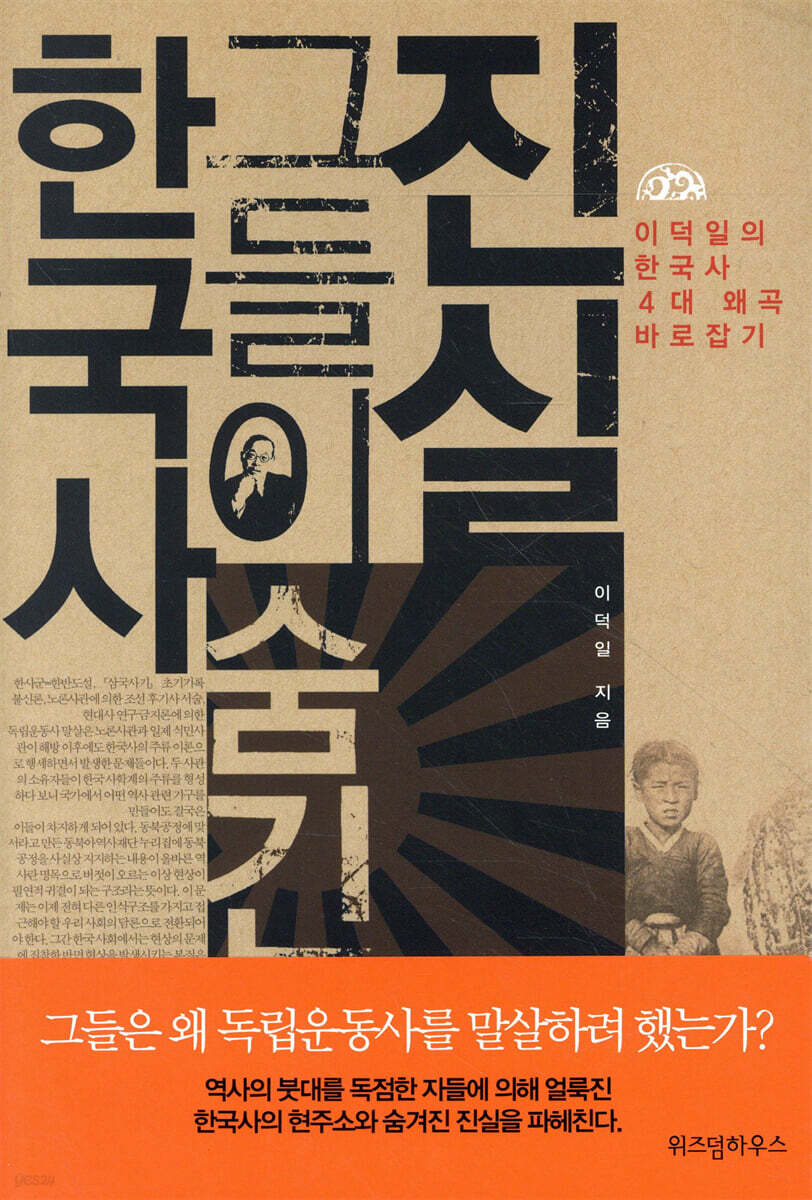 |
Description
Book Introduction
Why did they try to erase the history of the independence movement?
"Korean History, the Truth They Hidden" is a book written by Lee Deok-il, a leading historian of our time, who examines the fundamental and structural problems of the mainstream Korean historical academia and, through a comprehensive review and critique of the system of understanding Korean history, seeks to present our true history and a correct view of history.
In this book, the author examines whether the Han Commandery, a colonial ruling body established by the ancient Chinese Han Dynasty after destroying Gojoseon, actually existed on the Korean Peninsula, and verifies the historical consensus that the early records of the Samguk Sagi (History of the Three Kingdoms) from the 3rd to 4th centuries AD are fakes fabricated by Kim Bu-sik.
In addition, he fabricated Yulgok Yi I's theory of raising 100,000 troops, described Uam Song Si-yeol, who consistently hindered King Hyojong's northern expedition, as if he were the embodiment of the northern expedition, described the Silhak school of Yonghwisaeng (utility and welfare school), or the school of mercantile affairs, as if Noron was leading it, and revealed the true nature of the Noron historical view that blamed Jeongjo for the politics of sedoism.
Lastly, it was pointed out in detail whether the independence army's armed struggle against Japanese colonial rule actually existed, and if it did, why it was eradicated, and then corrected.
History never tells the truth as it is.
History is reconstructed depending on what you want to convey.
We have clearly seen this distortion of history during the Japanese colonial period.
This book seeks to put the brakes on the deliberate distortion of history that has been rampant, and to restore correct historical values within the context of the times and spirit.
The work of changing misunderstood history and incorrect historical views will be fundamental to establishing a correct identity.
"Korean History, the Truth They Hidden" is a book written by Lee Deok-il, a leading historian of our time, who examines the fundamental and structural problems of the mainstream Korean historical academia and, through a comprehensive review and critique of the system of understanding Korean history, seeks to present our true history and a correct view of history.
In this book, the author examines whether the Han Commandery, a colonial ruling body established by the ancient Chinese Han Dynasty after destroying Gojoseon, actually existed on the Korean Peninsula, and verifies the historical consensus that the early records of the Samguk Sagi (History of the Three Kingdoms) from the 3rd to 4th centuries AD are fakes fabricated by Kim Bu-sik.
In addition, he fabricated Yulgok Yi I's theory of raising 100,000 troops, described Uam Song Si-yeol, who consistently hindered King Hyojong's northern expedition, as if he were the embodiment of the northern expedition, described the Silhak school of Yonghwisaeng (utility and welfare school), or the school of mercantile affairs, as if Noron was leading it, and revealed the true nature of the Noron historical view that blamed Jeongjo for the politics of sedoism.
Lastly, it was pointed out in detail whether the independence army's armed struggle against Japanese colonial rule actually existed, and if it did, why it was eradicated, and then corrected.
History never tells the truth as it is.
History is reconstructed depending on what you want to convey.
We have clearly seen this distortion of history during the Japanese colonial period.
This book seeks to put the brakes on the deliberate distortion of history that has been rampant, and to restore correct historical values within the context of the times and spirit.
The work of changing misunderstood history and incorrect historical views will be fundamental to establishing a correct identity.
- You can preview some of the book's contents.
Preview
index
Author's Note
Part 1: Did the Han Dynasty exist on the Korean Peninsula?
1.
The war between Gojoseon and the Han Dynasty (The Gojoseon Problem Again/The Colonial History Survived by Taxpayers' Money/Why Did the Han Dynasty Invade Gojoseon?)
2.
Was the Lelang Commandery in Pyongyang? (Goguryeo relics fabricated as Lelang Commandery/The tragedy of the Republic of Korea's failure to overcome colonial history/Was the Han Four Commanderies a blessing in national history?)
3.
Where were the Han commanderies? (Location of the Han commanderies/Name and location of the Lelang commanderies/Attack and retreat routes of the Wei Guanqiu Jian/Galseok Mountain in Suseong County, Lelang Commandery/In search of Galseok Mountain/Is Changryeo County Suseong County?/Where was Heumdok, the capital of Gojoseon?/The end of the Great Wall)
4.
Was Daebang Commandery in Hwanghae Province? (Location of Hyundo Commandery/Where is Daebang Commandery?/Daebang Commandery and Jinbeon Commandery/Gongsun Du, who became the governor of Liaodong)
5.
The Han Four Commanderies as Examined through Relics and Sites (Chinese relics excavated from the Korean Peninsula/Chinese people who came to Goguryeo/North Korean academics' views on Chinese relics and sites/Bongni excavated in North Korea/Mainstream academic circles that still cite only Japanese research/Jinxi City, Liaoning Province, where the Imdun Taesujang Bongni was excavated)
Part 2: Were the early records of the Samguk Sagi fabricated?
6.
Theory of Disbelief in Early Records of 『Samguk Sagi』 (The Four Han Commanderies Omitted from Textbooks/Theory of Disbelief in Early Records of 『Samguk Sagi』 and 『National History Textbooks』/Who is the Founder of Goguryeo?/Who is the Founder of Baekje?/『Samguk Sagi』 and the 「Gwanggaeto the Great Stele Inscription」/Who is the Founder of Silla?/『Manchu Wonryu Gao』 and the Location of the Three Hans/Was Silla Founded During the Time of King Naemul?
7.
The Korea-Japan Joint History Research Committee, Putting Colonial History to shame (Korea-Japan Joint History Research Committee/Tsuda Soukichi's Concerns and Kim Bu-sik)
Part 3: How did the Noron faction distort the history of the late Joseon Dynasty?
8.
Myths created by scholars descended from the Noron faction (Four alterations to the theory of raising 100,000 troops/Did Yu Seong-ryong oppose raising 100,000 troops?/Were Song Si-yeol and Song Jun-gil advocates of the Northern Expedition?/Did the Noron faction lead the reform theory centered on commerce and industry?/The Namin faction disappeared along with the Noron faction)
9.
The Truth and Falsehood of the Poisoning Theory of King Jeongjo (Is the 『Jeongjo Eochalcheop』 a historical document denying the poisoning theory of King Jeongjo? / King Jeongjo and Sim Hwan-ji before sending the royal edict / The timing of sending the royal edict and the loyalty of the Jeongjo era / The operation of the hotline between King Jeongjo and Sim Hwan-ji / King Jeongjo's illness and death / King Jeongjo's sudden death and the poisoning theory / Betraying King Jeongjo on the day of his ascension to the throne / The structure of the reproduction of the worldview of the Noron Byeokpa faction)
Didn't the 4th Independence Army's armed struggle against Japan exist?
10.
The policy of eradicating the history of the independence movement (Noron, which led the fall of the Korean Empire / The history of armed struggle that has disappeared / The armed struggle of the three factions / Problems that arose after liberation / The path to true peace in Northeast Asia)
Search
Part 1: Did the Han Dynasty exist on the Korean Peninsula?
1.
The war between Gojoseon and the Han Dynasty (The Gojoseon Problem Again/The Colonial History Survived by Taxpayers' Money/Why Did the Han Dynasty Invade Gojoseon?)
2.
Was the Lelang Commandery in Pyongyang? (Goguryeo relics fabricated as Lelang Commandery/The tragedy of the Republic of Korea's failure to overcome colonial history/Was the Han Four Commanderies a blessing in national history?)
3.
Where were the Han commanderies? (Location of the Han commanderies/Name and location of the Lelang commanderies/Attack and retreat routes of the Wei Guanqiu Jian/Galseok Mountain in Suseong County, Lelang Commandery/In search of Galseok Mountain/Is Changryeo County Suseong County?/Where was Heumdok, the capital of Gojoseon?/The end of the Great Wall)
4.
Was Daebang Commandery in Hwanghae Province? (Location of Hyundo Commandery/Where is Daebang Commandery?/Daebang Commandery and Jinbeon Commandery/Gongsun Du, who became the governor of Liaodong)
5.
The Han Four Commanderies as Examined through Relics and Sites (Chinese relics excavated from the Korean Peninsula/Chinese people who came to Goguryeo/North Korean academics' views on Chinese relics and sites/Bongni excavated in North Korea/Mainstream academic circles that still cite only Japanese research/Jinxi City, Liaoning Province, where the Imdun Taesujang Bongni was excavated)
Part 2: Were the early records of the Samguk Sagi fabricated?
6.
Theory of Disbelief in Early Records of 『Samguk Sagi』 (The Four Han Commanderies Omitted from Textbooks/Theory of Disbelief in Early Records of 『Samguk Sagi』 and 『National History Textbooks』/Who is the Founder of Goguryeo?/Who is the Founder of Baekje?/『Samguk Sagi』 and the 「Gwanggaeto the Great Stele Inscription」/Who is the Founder of Silla?/『Manchu Wonryu Gao』 and the Location of the Three Hans/Was Silla Founded During the Time of King Naemul?
7.
The Korea-Japan Joint History Research Committee, Putting Colonial History to shame (Korea-Japan Joint History Research Committee/Tsuda Soukichi's Concerns and Kim Bu-sik)
Part 3: How did the Noron faction distort the history of the late Joseon Dynasty?
8.
Myths created by scholars descended from the Noron faction (Four alterations to the theory of raising 100,000 troops/Did Yu Seong-ryong oppose raising 100,000 troops?/Were Song Si-yeol and Song Jun-gil advocates of the Northern Expedition?/Did the Noron faction lead the reform theory centered on commerce and industry?/The Namin faction disappeared along with the Noron faction)
9.
The Truth and Falsehood of the Poisoning Theory of King Jeongjo (Is the 『Jeongjo Eochalcheop』 a historical document denying the poisoning theory of King Jeongjo? / King Jeongjo and Sim Hwan-ji before sending the royal edict / The timing of sending the royal edict and the loyalty of the Jeongjo era / The operation of the hotline between King Jeongjo and Sim Hwan-ji / King Jeongjo's illness and death / King Jeongjo's sudden death and the poisoning theory / Betraying King Jeongjo on the day of his ascension to the throne / The structure of the reproduction of the worldview of the Noron Byeokpa faction)
Didn't the 4th Independence Army's armed struggle against Japan exist?
10.
The policy of eradicating the history of the independence movement (Noron, which led the fall of the Korean Empire / The history of armed struggle that has disappeared / The armed struggle of the three factions / Problems that arose after liberation / The path to true peace in Northeast Asia)
Search
Into the book
To correct the problems of Korea's mainstream history academia, we have no choice but to start again.
Because the starting point was wrong.
Starting over means two things.
One is to review the history of Gojoseon created by Japanese colonial history.
The current mainstream Korean historical academia's established theory on Gojoseon history is the same theory created by Japanese colonial history.
Therefore, we must go through the process of examining from a historical perspective how Japanese colonial history created the history of Gojoseon.
Another is to remove the veil over the image of Gojoseon created by Japanese colonial history and restore the original image of Gojoseon.
The image of Gojoseon has been distorted by two historical views.
These are the Chinese view of history and the Japanese view of history.
Only by removing the veil hidden by these two views can the true image of Gojoseon be revealed.
--- p.19, '1.
From the 'War between Gojoseon and Han'
In 1997, when China was accelerating the Northeast Project, one seal with the inscription "Imdun Taesujang" and another with the character "Seung" were recovered from the old castle site in Xiaohuangchi, Taijitun, Yeojaga, Yanshan District, Jinxi City, Liaoning Province.
Geumseo-si is a coastal city in western Manchuria, located along the coast of Balhae from Galseok Mountain and bordering Geumju Bay.
While the Bongni that Japanese colonial historians discovered in the northern part of the Korean Peninsula is constantly being debated as being fabricated and forged, the Bongni discovered in Geumseo-si is free from controversy over being a forgery.
This is because the 『Chinese Historical Atlas』 published by the Chinese Academy of Social Sciences states that the Imdun Commandery is located within the Korean Peninsula, but the place where the Imdun Taesujang Bongni was discovered is the Liaoxi region of China.
Since the historical materials that are unfavorable to China were discovered by China, there can be no controversy over forgery.
--- p.159, '5.
Among the Han Four Commanderies examined through relics and ruins,
However, in the process of examining the abundant records related to Wa in the Samguk Sagi, Tsuda Sokichi discovered that it differed significantly from the Kojiki and Nihon Shoki. This is because the Samguk Sagi viewed Silla as a powerful ancient state and Wa as a small political power, whereas the Kojiki and Nihon Shoki wrote that Wa operated a colonial government agency called the Imna Japanfu in the southern part of the Korean Peninsula.
It was clear that one of the two had made a false statement.
Tsuda Soukichi thought that in order to save the Imna Japanese prefecture, the early records of the Samguk Sagi had to be denied.
So he created the so-called 'theory of distrust in the early records of the Samguk Sagi'.
Tsuda Sokichi claimed that the emperors up to the 14th Emperor Chuai in the Nihon Shoki were mythical emperors fabricated by later generations, and that the 15th Emperor Ojin was a real king. He applied the same standard to the Samguk Sagi.
--- p.232, from '6. Theory of Distrust in Early Records of the Samguk Sagi'
The phenomenon of Jeongjo's royal chronicles suddenly being disguised as historical material denying the theory of Jeongjo's poisoning should serve as an opportunity to recognize the deep-rooted structural problems in our society's historical research.
When researchers of the Jeongjo Eochal spoke of this as if it were historical material denying the poisoning theory, some professors who specialized in this field added it as if it were fact, and various media outlets took it up and made a big deal about it. This shows that the Noron Byeokpa's perspective is more dominant in the field of historical interpretation than it was at the time of Jeongjo's death.
This is because the study of history in our society is deeply connected to the problems of the reproduction structure.
--- p.313, '9.
From 'The Truth and Lies of the Poisoning of King Jeongjo'
From immediately after liberation until the 1980s, modern history was a kind of taboo area for most history students.
The principle of prohibiting the study of modern history, which was supposedly created by the so-called leading figure in the field of Korean history, was ostensibly based on the argument that modern history is difficult to be objective.
Just as we belatedly realized that the formula in the National History Textbook that ancient nations began only in the Bronze Age was intended to deny Dangun Joseon, it was only much later that we realized that the principle of prohibiting the study of modern history, which exists only in Korea, was also intended to erase the history of the independence movement.
Because the starting point was wrong.
Starting over means two things.
One is to review the history of Gojoseon created by Japanese colonial history.
The current mainstream Korean historical academia's established theory on Gojoseon history is the same theory created by Japanese colonial history.
Therefore, we must go through the process of examining from a historical perspective how Japanese colonial history created the history of Gojoseon.
Another is to remove the veil over the image of Gojoseon created by Japanese colonial history and restore the original image of Gojoseon.
The image of Gojoseon has been distorted by two historical views.
These are the Chinese view of history and the Japanese view of history.
Only by removing the veil hidden by these two views can the true image of Gojoseon be revealed.
--- p.19, '1.
From the 'War between Gojoseon and Han'
In 1997, when China was accelerating the Northeast Project, one seal with the inscription "Imdun Taesujang" and another with the character "Seung" were recovered from the old castle site in Xiaohuangchi, Taijitun, Yeojaga, Yanshan District, Jinxi City, Liaoning Province.
Geumseo-si is a coastal city in western Manchuria, located along the coast of Balhae from Galseok Mountain and bordering Geumju Bay.
While the Bongni that Japanese colonial historians discovered in the northern part of the Korean Peninsula is constantly being debated as being fabricated and forged, the Bongni discovered in Geumseo-si is free from controversy over being a forgery.
This is because the 『Chinese Historical Atlas』 published by the Chinese Academy of Social Sciences states that the Imdun Commandery is located within the Korean Peninsula, but the place where the Imdun Taesujang Bongni was discovered is the Liaoxi region of China.
Since the historical materials that are unfavorable to China were discovered by China, there can be no controversy over forgery.
--- p.159, '5.
Among the Han Four Commanderies examined through relics and ruins,
However, in the process of examining the abundant records related to Wa in the Samguk Sagi, Tsuda Sokichi discovered that it differed significantly from the Kojiki and Nihon Shoki. This is because the Samguk Sagi viewed Silla as a powerful ancient state and Wa as a small political power, whereas the Kojiki and Nihon Shoki wrote that Wa operated a colonial government agency called the Imna Japanfu in the southern part of the Korean Peninsula.
It was clear that one of the two had made a false statement.
Tsuda Soukichi thought that in order to save the Imna Japanese prefecture, the early records of the Samguk Sagi had to be denied.
So he created the so-called 'theory of distrust in the early records of the Samguk Sagi'.
Tsuda Sokichi claimed that the emperors up to the 14th Emperor Chuai in the Nihon Shoki were mythical emperors fabricated by later generations, and that the 15th Emperor Ojin was a real king. He applied the same standard to the Samguk Sagi.
--- p.232, from '6. Theory of Distrust in Early Records of the Samguk Sagi'
The phenomenon of Jeongjo's royal chronicles suddenly being disguised as historical material denying the theory of Jeongjo's poisoning should serve as an opportunity to recognize the deep-rooted structural problems in our society's historical research.
When researchers of the Jeongjo Eochal spoke of this as if it were historical material denying the poisoning theory, some professors who specialized in this field added it as if it were fact, and various media outlets took it up and made a big deal about it. This shows that the Noron Byeokpa's perspective is more dominant in the field of historical interpretation than it was at the time of Jeongjo's death.
This is because the study of history in our society is deeply connected to the problems of the reproduction structure.
--- p.313, '9.
From 'The Truth and Lies of the Poisoning of King Jeongjo'
From immediately after liberation until the 1980s, modern history was a kind of taboo area for most history students.
The principle of prohibiting the study of modern history, which was supposedly created by the so-called leading figure in the field of Korean history, was ostensibly based on the argument that modern history is difficult to be objective.
Just as we belatedly realized that the formula in the National History Textbook that ancient nations began only in the Bronze Age was intended to deny Dangun Joseon, it was only much later that we realized that the principle of prohibiting the study of modern history, which exists only in Korea, was also intended to erase the history of the independence movement.
--- p.325, '10.
From the 'Policy to Eradicate the History of the Independence Movement'
From the 'Policy to Eradicate the History of the Independence Movement'
Publisher's Review
Correcting the Four Major Distortions in Korean History by Lee Deok-il, a leading historian of our time!
“Korean History, the Truth They Hidden” is largely composed of four themes.
First is the problem of Gojoseon and the Han Commanderies.
The issue of territory between Gojoseon and the Han Commandery is central.
The second is the theory of distrust in the early records of the Samguk Sagi. The first person to propose this theory was the Japanese colonial historian Tsuda Sokichi. Surprisingly, his theory has never been subject to fundamental review, only partial revision, and has become the mainstream theory in Korean historical circles.
Third, there is the problem of describing the history of the late Joseon Dynasty from the perspective of the Noron faction.
He fabricated Yulgok Yi I's theory of raising 100,000 troops, described Song Si-yeol, who consistently obstructed Hyojong's northern expedition, as if he were the embodiment of the northern expedition, described the Silhak school of utilitarianism, or the school of mercantile affairs, as if Noron was leading it, and examined the reality of techniques that blamed Jeongjo for the politics of sedoism and verified whether they were indeed correct.
The fourth is the part that erased the history of the independence movement.
The mainstream Korean historical academia erased the history of the independence army's armed struggle against Japan with the outrageous logic that "historians should not study modern history."
It was pointed out in detail whether the independence army's armed struggle against Japan actually existed, and if it did, why it was eradicated.
The issues addressed in this book must be brought into the discourse of our society as soon as possible.
Korean society has long been fixated on phenomena, while the essence that gives rise to them has been relatively ignored. "Korean History: The Truth They Hidden" addresses precisely these fundamental questions.
There is probably no one who thinks that our second generation, who will live in the 21st century, will have to continue to be educated on a distorted history based on colonial and Noron views.
The colonial view of history, including China's Northeast Project, is an invasion view of history, and the Noron view of history is a closed view of history that is closed to the other side. The aggressive and closed nature of the two views is currently a major obstacle to the establishment of a reconciliation and peace system in Northeast Asia.
If South Korea is to become a pioneer in establishing a true peace system in Northeast Asia, the starting point should be overcoming the colonial view of history and the Noron faction.
Did the Han Dynasty exist on the Korean Peninsula?
The Han Four Commanderies, a colonial ruling body established by the Han Dynasty after destroying Gojoseon.
The war between Gojoseon and the Han Dynasty began when Emperor Wu of Han sent an envoy, She He, to appease King Ugeo of Gojoseon, who refused.
Seop, who could not return without any gain, stabbed and killed Jang, the vice-king of Gojoseon, who had seen him off at Paesu, the border between the two countries, and fled to Han.
Instead of punishing Xie He, Emperor Wu of Han commended him by giving him the title of Liaodong Eastern Commander-in-Chief.
Then, King Ugeo raised an army and attacked Liaodong, killing Seop-ha, and Emperor Wu of Han gathered prisoners and organized an army to attack Gojoseon.
However, the view of Korean historians is that the Paesu River, the border between Gojoseon and the Han Dynasty, is either the Yalu River, as argued by Japanese colonial historian Tsuda Soukichi, or the Cheongcheon River, which flows between North and South Pyongan Provinces, as seen by Lee Byeong-do.
However, if the location of the Paesu River was the current Yalu River or Cheongcheon River, Gojoseon and Han would not have fought a war.
In this way, the image of Gojoseon has been distorted by two historical views.
These are the Chinese history and the Japanese colonial history.
Only by removing the veil hidden by these two views can the true image of Gojoseon be revealed.
Therefore, this book precisely analyzed not only primary sources such as the Records of the Grand Historian, the Book of Changes, the Book of Han, the Samguk Sagi, and the Records of the Three Kingdoms, but also Chinese relics and artifacts excavated on the Korean Peninsula, revealing that the current mainstream Korean historical academia's established theory of Gojoseon history has been distorted by Japanese colonial historiography and China's Northeast Project, and vividly reconstructed the original image of Gojoseon.
Were the early records of the Samguk Sagi fabricated?
There is something called the 'theory of distrust in the early records of the Samguk Sagi'.
The current mainstream academic consensus is that the early records of the Samguk Sagi (History of the Three Kingdoms) up to the 3rd to 4th centuries AD are fakes fabricated by Kim Bu-sik.
The founder of this theory is also the Japanese colonial historian Tsuda Soukichi.
Tsuda Soukichi's view of ancient Korean history is simple.
In his books such as “Joseon Historical Geography,” which he wrote in the 1910s at the request of the South Manchuria Railway Company, he wrote that in the northern part of the ancient Korean Peninsula, there were four Han commanderies, including the Lelang Commandery, and that south of the Han River, there were 78 small states called the Three Hans.
This was because only then could the Imna Japanese government, an ancient version of the Japanese Government-General of Korea, be preserved in the southern part of the Korean Peninsula.
However, the Samguk Sagi only describes the existence of powerful ancient states called Silla and Baekje in the southern part of the Korean Peninsula during the same period, not the Samhan, and does not describe anything about the Imna Japanese Empire.
So, they created the 'theory of distrust in the early records of the Samguk Sagi', which claims that the early records of the Samguk Sagi were fabricated. Although the theory of distrust in the early records of the Samguk Sagi and the Imna Japan are like two sides of the same coin, after liberation, the mainstream Korean historical academia denied the Imna Japan while maintaining the theory of distrust in the early records of the Samguk Sagi and made it the established theory.
In this way, in this book, the author points out in detail the background of the theory of distrust in the early records of the Samguk Sagi, as well as how this theory was reflected in the current national history textbooks in our country.
We also thoroughly investigated the reality of national research institutes that are run with taxpayer money.
How did the Noron faction distort the history of the late Joseon Dynasty?
The Noron faction, which had its roots in the Seoin faction that led the Injo Restoration, held power until the fall of Joseon, except for a brief period during the reign of King Sukjong when it lost power to the Namin faction due to the appointment of Jang Hui-bin as queen, and a brief period when it lost power to the Soron faction while attempting to weaken the royal authority of King Gyeongjong.
During the reign of King Jeongjo, the Soron and Namin factions briefly entered politics, but they were only a minority, and the Noron faction continued to dominate.
The ideological background of the Noron faction was extreme pro-Ming servility and the sole ideology of Neo-Confucianism.
They rejected all openness externally, and socially, they went against the social trend of demanding the relaxation or abolition of the caste system, strengthening the caste system and maximizing discrimination based on illegitimate children and gender.
Even if it was a Confucian school of thought that differed from Zhu Xi's, he attacked it in a sacrilegious manner, and he extremely suppressed other ideologies, including Catholicism, and rejected social change.
The problem, however, is that these Noron views had a great influence on the history of the late Joseon Dynasty.
For example, they fabricated the idea that Yulgok Yi I advocated the theory of raising 100,000 troops, described Song Si-yeol, who most strongly opposed King Hyojong's northern expedition policy, as the embodiment of the northern expedition, described the Silhak school of Yonghwi (Jungsanghak school), which is bound to be at odds with the Noron party doctrine, as if the Noron party was leading it, and recently claimed that the Noron Byeokpa, who is suspected of poisoning King Jeongjo, was King Jeongjo's right-wing party.
These are all the results of looking at the history of the late Joseon Dynasty from the perspective of the Noron faction.
If the mainstream Korean historical academia's perception of ancient history is deeply oriented toward the Japanese colonial view of history, then the perception of late Joseon history is deeply oriented toward the Noron view of history.
Didn't the independence army's armed struggle against Japan exist?
When a country achieves independence after countless hardships and establishes a new government, research on the history of the independence movement tends to boom immediately thereafter.
However, in Korea, the history of the independence movement and socialist history boomed in the 1980s, and until the principle of prohibiting research on modern history was nullified, the history of the independence movement was not studied professionally except by a small number of researchers.
And up until now, the 『National History Textbook』 has focused on patriotic enlightenment movements and capacity-building movements within the colonial system rather than armed struggles, and the history of armed struggles has been reluctantly mentioned to the extent of just giving names.
For example, the current high school history textbook contains almost no information about the three central organizations of the anti-Japanese armed struggle in the 1920s: the Chamuibu, the Jeonguibu, and the Shinminbu.
However, the three branches are not an organization that should be described in such a reduced way.
The Sambu (Korean Provisional Government Army Manchurian Chamuibu) was an administrative and military organization with 600 armed soldiers in 5 companies when it was formed in 1924. Just from what was announced by Japanese organizations, it had a brilliant record of 78 engagements, 56 raids on police stations, 20 burnings of township offices and Yeongnimseo, and 95 killings of Japanese military and police officers. In 1924, it even fired hundreds of bullets at the boat of Governor-General Saito Makoto of the Government-General of Korea, who was inspecting Hyesan in Hamgyeong Province and coming down the Yalu River to Sinuiju, sending him into a state of panic.
The Justice Department and the New People's Department also carried out anti-Japanese armed struggles by carrying out several domestic invasion operations, but the 'National History Textbook' completely silenced this fact and only described the establishment of the Korean Liberation Army under the Provisional Government in 1940.
Because Japan was defeated before the Korean Liberation Army could engage in full-scale combat, students cannot help but perceive Korea as a byproduct of the Allied victory without any significant armed struggle other than the Battles of Cheongsan-ri and Bongodong in 1920, and in fact, most perceive it that way.
What is the hidden intention behind the independence army's armed struggle against Japan being reduced to this extent?
“Korean History, the Truth They Hidden” is largely composed of four themes.
First is the problem of Gojoseon and the Han Commanderies.
The issue of territory between Gojoseon and the Han Commandery is central.
The second is the theory of distrust in the early records of the Samguk Sagi. The first person to propose this theory was the Japanese colonial historian Tsuda Sokichi. Surprisingly, his theory has never been subject to fundamental review, only partial revision, and has become the mainstream theory in Korean historical circles.
Third, there is the problem of describing the history of the late Joseon Dynasty from the perspective of the Noron faction.
He fabricated Yulgok Yi I's theory of raising 100,000 troops, described Song Si-yeol, who consistently obstructed Hyojong's northern expedition, as if he were the embodiment of the northern expedition, described the Silhak school of utilitarianism, or the school of mercantile affairs, as if Noron was leading it, and examined the reality of techniques that blamed Jeongjo for the politics of sedoism and verified whether they were indeed correct.
The fourth is the part that erased the history of the independence movement.
The mainstream Korean historical academia erased the history of the independence army's armed struggle against Japan with the outrageous logic that "historians should not study modern history."
It was pointed out in detail whether the independence army's armed struggle against Japan actually existed, and if it did, why it was eradicated.
The issues addressed in this book must be brought into the discourse of our society as soon as possible.
Korean society has long been fixated on phenomena, while the essence that gives rise to them has been relatively ignored. "Korean History: The Truth They Hidden" addresses precisely these fundamental questions.
There is probably no one who thinks that our second generation, who will live in the 21st century, will have to continue to be educated on a distorted history based on colonial and Noron views.
The colonial view of history, including China's Northeast Project, is an invasion view of history, and the Noron view of history is a closed view of history that is closed to the other side. The aggressive and closed nature of the two views is currently a major obstacle to the establishment of a reconciliation and peace system in Northeast Asia.
If South Korea is to become a pioneer in establishing a true peace system in Northeast Asia, the starting point should be overcoming the colonial view of history and the Noron faction.
Did the Han Dynasty exist on the Korean Peninsula?
The Han Four Commanderies, a colonial ruling body established by the Han Dynasty after destroying Gojoseon.
The war between Gojoseon and the Han Dynasty began when Emperor Wu of Han sent an envoy, She He, to appease King Ugeo of Gojoseon, who refused.
Seop, who could not return without any gain, stabbed and killed Jang, the vice-king of Gojoseon, who had seen him off at Paesu, the border between the two countries, and fled to Han.
Instead of punishing Xie He, Emperor Wu of Han commended him by giving him the title of Liaodong Eastern Commander-in-Chief.
Then, King Ugeo raised an army and attacked Liaodong, killing Seop-ha, and Emperor Wu of Han gathered prisoners and organized an army to attack Gojoseon.
However, the view of Korean historians is that the Paesu River, the border between Gojoseon and the Han Dynasty, is either the Yalu River, as argued by Japanese colonial historian Tsuda Soukichi, or the Cheongcheon River, which flows between North and South Pyongan Provinces, as seen by Lee Byeong-do.
However, if the location of the Paesu River was the current Yalu River or Cheongcheon River, Gojoseon and Han would not have fought a war.
In this way, the image of Gojoseon has been distorted by two historical views.
These are the Chinese history and the Japanese colonial history.
Only by removing the veil hidden by these two views can the true image of Gojoseon be revealed.
Therefore, this book precisely analyzed not only primary sources such as the Records of the Grand Historian, the Book of Changes, the Book of Han, the Samguk Sagi, and the Records of the Three Kingdoms, but also Chinese relics and artifacts excavated on the Korean Peninsula, revealing that the current mainstream Korean historical academia's established theory of Gojoseon history has been distorted by Japanese colonial historiography and China's Northeast Project, and vividly reconstructed the original image of Gojoseon.
Were the early records of the Samguk Sagi fabricated?
There is something called the 'theory of distrust in the early records of the Samguk Sagi'.
The current mainstream academic consensus is that the early records of the Samguk Sagi (History of the Three Kingdoms) up to the 3rd to 4th centuries AD are fakes fabricated by Kim Bu-sik.
The founder of this theory is also the Japanese colonial historian Tsuda Soukichi.
Tsuda Soukichi's view of ancient Korean history is simple.
In his books such as “Joseon Historical Geography,” which he wrote in the 1910s at the request of the South Manchuria Railway Company, he wrote that in the northern part of the ancient Korean Peninsula, there were four Han commanderies, including the Lelang Commandery, and that south of the Han River, there were 78 small states called the Three Hans.
This was because only then could the Imna Japanese government, an ancient version of the Japanese Government-General of Korea, be preserved in the southern part of the Korean Peninsula.
However, the Samguk Sagi only describes the existence of powerful ancient states called Silla and Baekje in the southern part of the Korean Peninsula during the same period, not the Samhan, and does not describe anything about the Imna Japanese Empire.
So, they created the 'theory of distrust in the early records of the Samguk Sagi', which claims that the early records of the Samguk Sagi were fabricated. Although the theory of distrust in the early records of the Samguk Sagi and the Imna Japan are like two sides of the same coin, after liberation, the mainstream Korean historical academia denied the Imna Japan while maintaining the theory of distrust in the early records of the Samguk Sagi and made it the established theory.
In this way, in this book, the author points out in detail the background of the theory of distrust in the early records of the Samguk Sagi, as well as how this theory was reflected in the current national history textbooks in our country.
We also thoroughly investigated the reality of national research institutes that are run with taxpayer money.
How did the Noron faction distort the history of the late Joseon Dynasty?
The Noron faction, which had its roots in the Seoin faction that led the Injo Restoration, held power until the fall of Joseon, except for a brief period during the reign of King Sukjong when it lost power to the Namin faction due to the appointment of Jang Hui-bin as queen, and a brief period when it lost power to the Soron faction while attempting to weaken the royal authority of King Gyeongjong.
During the reign of King Jeongjo, the Soron and Namin factions briefly entered politics, but they were only a minority, and the Noron faction continued to dominate.
The ideological background of the Noron faction was extreme pro-Ming servility and the sole ideology of Neo-Confucianism.
They rejected all openness externally, and socially, they went against the social trend of demanding the relaxation or abolition of the caste system, strengthening the caste system and maximizing discrimination based on illegitimate children and gender.
Even if it was a Confucian school of thought that differed from Zhu Xi's, he attacked it in a sacrilegious manner, and he extremely suppressed other ideologies, including Catholicism, and rejected social change.
The problem, however, is that these Noron views had a great influence on the history of the late Joseon Dynasty.
For example, they fabricated the idea that Yulgok Yi I advocated the theory of raising 100,000 troops, described Song Si-yeol, who most strongly opposed King Hyojong's northern expedition policy, as the embodiment of the northern expedition, described the Silhak school of Yonghwi (Jungsanghak school), which is bound to be at odds with the Noron party doctrine, as if the Noron party was leading it, and recently claimed that the Noron Byeokpa, who is suspected of poisoning King Jeongjo, was King Jeongjo's right-wing party.
These are all the results of looking at the history of the late Joseon Dynasty from the perspective of the Noron faction.
If the mainstream Korean historical academia's perception of ancient history is deeply oriented toward the Japanese colonial view of history, then the perception of late Joseon history is deeply oriented toward the Noron view of history.
Didn't the independence army's armed struggle against Japan exist?
When a country achieves independence after countless hardships and establishes a new government, research on the history of the independence movement tends to boom immediately thereafter.
However, in Korea, the history of the independence movement and socialist history boomed in the 1980s, and until the principle of prohibiting research on modern history was nullified, the history of the independence movement was not studied professionally except by a small number of researchers.
And up until now, the 『National History Textbook』 has focused on patriotic enlightenment movements and capacity-building movements within the colonial system rather than armed struggles, and the history of armed struggles has been reluctantly mentioned to the extent of just giving names.
For example, the current high school history textbook contains almost no information about the three central organizations of the anti-Japanese armed struggle in the 1920s: the Chamuibu, the Jeonguibu, and the Shinminbu.
However, the three branches are not an organization that should be described in such a reduced way.
The Sambu (Korean Provisional Government Army Manchurian Chamuibu) was an administrative and military organization with 600 armed soldiers in 5 companies when it was formed in 1924. Just from what was announced by Japanese organizations, it had a brilliant record of 78 engagements, 56 raids on police stations, 20 burnings of township offices and Yeongnimseo, and 95 killings of Japanese military and police officers. In 1924, it even fired hundreds of bullets at the boat of Governor-General Saito Makoto of the Government-General of Korea, who was inspecting Hyesan in Hamgyeong Province and coming down the Yalu River to Sinuiju, sending him into a state of panic.
The Justice Department and the New People's Department also carried out anti-Japanese armed struggles by carrying out several domestic invasion operations, but the 'National History Textbook' completely silenced this fact and only described the establishment of the Korean Liberation Army under the Provisional Government in 1940.
Because Japan was defeated before the Korean Liberation Army could engage in full-scale combat, students cannot help but perceive Korea as a byproduct of the Allied victory without any significant armed struggle other than the Battles of Cheongsan-ri and Bongodong in 1920, and in fact, most perceive it that way.
What is the hidden intention behind the independence army's armed struggle against Japan being reduced to this extent?
GOODS SPECIFICS
- Date of issue: September 4, 2009
- Page count, weight, size: 355 pages | 600g | 153*224*30mm
- ISBN13: 9788993119114
- ISBN10: 8993119112
You may also like
카테고리
korean


korean

![GQ KOREA Mark (Monthly): December [2025]](http://librairie.coreenne.fr/cdn/shop/files/8ef265dbbfbf186523ed75ba7319009d.jpg?v=1765340328&width=3840)


