

west wind
 |
Description
Book Introduction
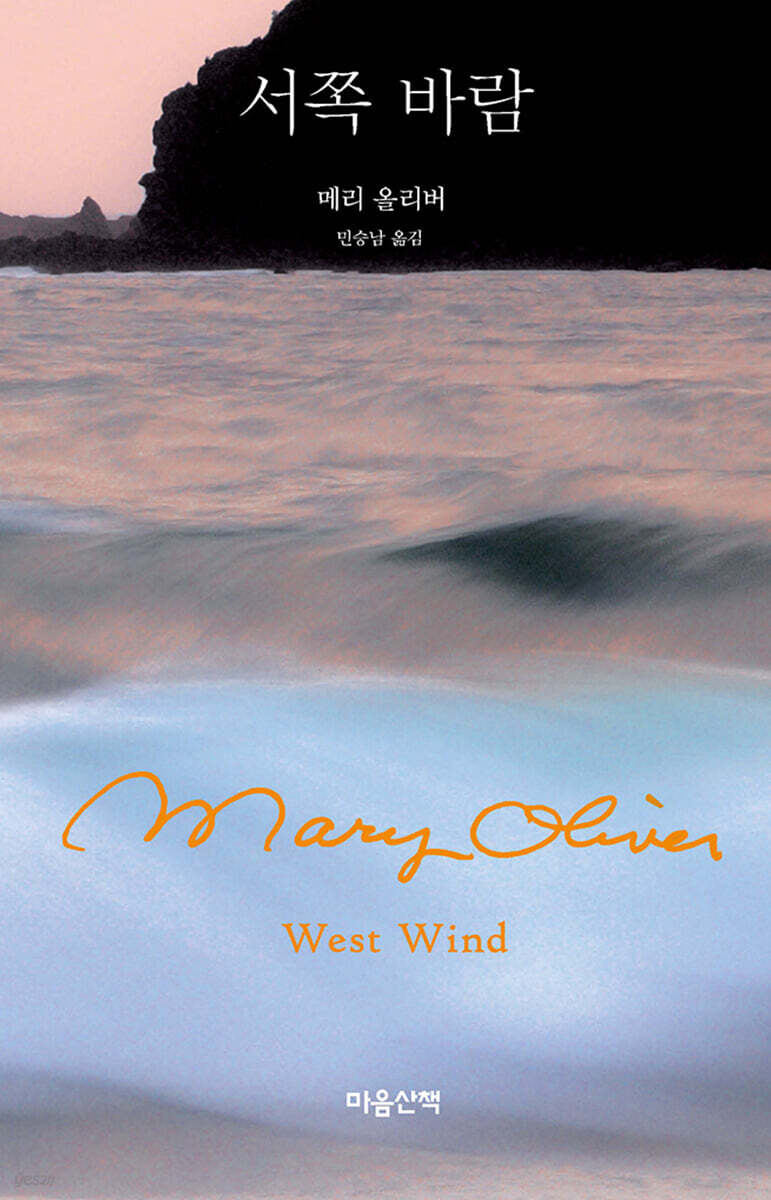
The limit of beauty that language can reach A devoted observer of nature and a reporter poet Mary Oliver's poetry collection, "West Wind," published Maumsanchaek, a steady companion of Mary Oliver and a publisher of works that have been steadily introducing her work to the domestic market, is publishing a poetry collection titled “West Wind.” Mary Oliver, who won the National Book Award in 1992 for her poetry collection, “Wild Geese,” and earned the honorable title of “the greatest poet of our time” ([New York Times]). "West Wind" was published at a time when he was establishing himself as one of America's most beloved poets. The poetry collection, which came out around the time he began writing prose and prose poetry in earnest, contains 40 poems of varying length and form. Thanks to this, we can encounter Mary Oliver's early prose poems and at the same time look into the diverse world of poetry. What is especially welcome is that the serial poem "Flounder" ("Flounder, Three") is included. A small, spiny, and not very important, but harmonious fish. In a series of poems entitled 'The Flounder', Mary Oliver inscribed aphoristic aphorisms linking the spirit of Thoreau and Emerson. Maumsanchaek has introduced eight of the nine poems in the series "Flounder" through "Long Breath," "The Whistler," and "Perfect Days," and with the publication of "West Wind," the entire series is now available. In this collection of poems, the poet diligently walks around the outside world, meticulously observing and recording the details of the scenery. Furthermore, by witnessing external events such as forests, lakes, flora and fauna, and weather, we embody our internal dialogue with the natural world. His poetry, which translates the wonders found in seemingly ordinary moments into simple, clear words, can be said to be the pinnacle of beauty that can be achieved through language. As readers read the poem, they will experience being placed in the landscape where he played. |
- You can preview some of the book's contents.
Preview
index
1
Seven white butterflies
At the round pond
black oak
The dog ran away again
Aren't I an early riser?
Western python
so
spring
stars
Three songs
Shelley
maple tree
osprey
Sweet Flute John Clare
flounder, three
forty years
This time it's a black snake
Morning walk
rain, trees, thunder and lightning
trance
fox
thanks
A little summer poem about faith
dogs
At the beach
At the Great Pond
2 West wind
west wind
3
I've been between the long, black branches
Acknowledgements
Translator's Note
Author's chronology
Tributes to Mary Oliver
Seven white butterflies
At the round pond
black oak
The dog ran away again
Aren't I an early riser?
Western python
so
spring
stars
Three songs
Shelley
maple tree
osprey
Sweet Flute John Clare
flounder, three
forty years
This time it's a black snake
Morning walk
rain, trees, thunder and lightning
trance
fox
thanks
A little summer poem about faith
dogs
At the beach
At the Great Pond
2 West wind
west wind
3
I've been between the long, black branches
Acknowledgements
Translator's Note
Author's chronology
Tributes to Mary Oliver
Detailed image
.jpg)
Into the book
Hey, ambition shifts its weight alternately on both feet in boots.
Speaking anxiously─how about we begin now?
Because I am there, under the trees, in the mossy shade.
And to be honest, I find it hard to let go of the hand of laziness.
I don't like it, I don't like selling my life for money,
I don't even want to go inside to avoid the rain.
---From "Black Oak"
Any country, any spectacle,
Any minister
On a sunny morning or in the rain
Could anything give me as complete satisfaction as the Blackwater Forest?
The amazing thing is when I was twenty years old
Sweet peace in every movement of my body
Every movement of the green earth
As if there was a hint of paradise,
Even now that I'm sixty years old, it's still the same.
---From "Aren't I an early riser?"
Language is
It's not even a river
Neither trees nor green fields
Not even black ants
Day after day
On the golden page
Move forward bravely and humbly.
---From "Forty Years"
Under long eyelashes
shining like a planet
Dogs' eyes
Look, look inside
When you call my name, my eyes overflow with happiness!
Those eyes are full of love that naturally comes from within!
---From "Dogs"
A rose is a rose all day long
Responsibly reach the sky above the sand
I was busy looking at the blue sea
now
small comforts
There is no need to not enjoy the ripples of joy.
---From "West Wind 6"
Do you think this world only offers you pleasure?
When you enter the sea, the water accepts you.
Note the parting with perfect courtesy!
When you lie down in the grass, become the grass yourself!
When you jump into the air, above the black acorn that is your heart
Spread your wings!
Speaking anxiously─how about we begin now?
Because I am there, under the trees, in the mossy shade.
And to be honest, I find it hard to let go of the hand of laziness.
I don't like it, I don't like selling my life for money,
I don't even want to go inside to avoid the rain.
---From "Black Oak"
Any country, any spectacle,
Any minister
On a sunny morning or in the rain
Could anything give me as complete satisfaction as the Blackwater Forest?
The amazing thing is when I was twenty years old
Sweet peace in every movement of my body
Every movement of the green earth
As if there was a hint of paradise,
Even now that I'm sixty years old, it's still the same.
---From "Aren't I an early riser?"
Language is
It's not even a river
Neither trees nor green fields
Not even black ants
Day after day
On the golden page
Move forward bravely and humbly.
---From "Forty Years"
Under long eyelashes
shining like a planet
Dogs' eyes
Look, look inside
When you call my name, my eyes overflow with happiness!
Those eyes are full of love that naturally comes from within!
---From "Dogs"
A rose is a rose all day long
Responsibly reach the sky above the sand
I was busy looking at the blue sea
now
small comforts
There is no need to not enjoy the ripples of joy.
---From "West Wind 6"
Do you think this world only offers you pleasure?
When you enter the sea, the water accepts you.
Note the parting with perfect courtesy!
When you lie down in the grass, become the grass yourself!
When you jump into the air, above the black acorn that is your heart
Spread your wings!
---From "I've Goin' Between the Long, Black Branches"
Publisher's Review
“I bow my head and bow.”
Singing of the unchanging wonders of the world and the endless cycle of life
『West Wind』 is divided into three chapters.
Chapter 1 is filled with poems observing and exploring plants and animals such as butterflies, snakes, foxes, oak trees, and maple trees, as well as natural phenomena such as stars, spring, and thunder and lightning.
The poet vividly describes Provincetown, which has had a profound spiritual and poetic influence on him over the years.
And yet, over the decades, he has been receiving constant comfort from the wild world, and he sends them his utmost love and reverence.
The wondrous thing is that, just as when I was twenty,/ there was a sweet peace in every movement of my body,/ and a hint of paradise in every movement of the green earth,/ so it is now, at sixty.
─From "Aren't I an early riser?"
Mary Oliver has always written poems that reflect on life and death, and in "The West Wind," the allusions and images of death are particularly prominent.
The bodies of the western pythons that did not survive were left as “soft black structures” of death, and the owls, the birds of darkness, were nothing but “angels of death.”
However, as in “even in the comfortable summer/ I often think of death,” death is not a fearful and negative concept in his poetry.
The poet, who says that dying is as important and wonderful as living, sings of the sense of life continuing from death, saying, “From the pitch-black darkness / A white snow field of light will emerge.”
In the sacred cycle of life, where life continues infinitely from death to resurrection, to extinction, and then to rebirth, this moment is eternity, this is the whole world, and I am all things in the world.
And Mary Oliver, who walks and walks in nature every day, witnesses this wonder of cosmic unity again and again and sings with joy and gratitude.
─From the Translator's Note
“If we’re going to be something, we better be together.”
The poet's message about the joy and necessity of surrendering to nature
Chapter 2 contains the first part of the title work, “West Wind.” The poems, numbered 1 to 13, can be read as a series or as individual works.
The title 'The West Wind' is said to have been inspired by 'Ode to the West Wind' by Percy Bysshe Shelley, a poet whom Mary Oliver admired throughout her life, which reveals the cyclical worldview of nature and life.
In "The West Wind," Mary Oliver explores a wide range of perspectives on the afterlife, the state of unity with nature, and the concept of love.
If there's a next life, will you come with me? Until then? If we're meant to be something, it's better if we're together.
Imagine! Two small pebbles, two fleas clinging to the wing of a seagull and flying through the fog! Or ten blades of grass.
Tangled vines at the edge of the race road! Beach plums! Gliding into the winter forest, they join the dusty, rigid pines, tiny // sooo ...
─From "West Wind 1"
Chapter 3 consists of only one poem, “I have entered between the long, black branches.”
The poet actively encourages us to get out into nature, saying, “So, get up, put on your coat, and leave your desk!”
It constantly pours out encouraging encouragement so that we can merge seamlessly with the forests, fields, and seas that exude primal energy.
The poet's message, which preaches the importance of "the value of seeing and hearing in nature" ([Library Journal]), will provide readers with a new perspective on all things in the world.
Hey, you just breathe little by little and call that life? // After all, the soul is just a window,/ and opening a window is no more difficult than waking up from a light sleep.
─From "I've Goin' Between the Long Black Branches"
Singing of the unchanging wonders of the world and the endless cycle of life
『West Wind』 is divided into three chapters.
Chapter 1 is filled with poems observing and exploring plants and animals such as butterflies, snakes, foxes, oak trees, and maple trees, as well as natural phenomena such as stars, spring, and thunder and lightning.
The poet vividly describes Provincetown, which has had a profound spiritual and poetic influence on him over the years.
And yet, over the decades, he has been receiving constant comfort from the wild world, and he sends them his utmost love and reverence.
The wondrous thing is that, just as when I was twenty,/ there was a sweet peace in every movement of my body,/ and a hint of paradise in every movement of the green earth,/ so it is now, at sixty.
─From "Aren't I an early riser?"
Mary Oliver has always written poems that reflect on life and death, and in "The West Wind," the allusions and images of death are particularly prominent.
The bodies of the western pythons that did not survive were left as “soft black structures” of death, and the owls, the birds of darkness, were nothing but “angels of death.”
However, as in “even in the comfortable summer/ I often think of death,” death is not a fearful and negative concept in his poetry.
The poet, who says that dying is as important and wonderful as living, sings of the sense of life continuing from death, saying, “From the pitch-black darkness / A white snow field of light will emerge.”
In the sacred cycle of life, where life continues infinitely from death to resurrection, to extinction, and then to rebirth, this moment is eternity, this is the whole world, and I am all things in the world.
And Mary Oliver, who walks and walks in nature every day, witnesses this wonder of cosmic unity again and again and sings with joy and gratitude.
─From the Translator's Note
“If we’re going to be something, we better be together.”
The poet's message about the joy and necessity of surrendering to nature
Chapter 2 contains the first part of the title work, “West Wind.” The poems, numbered 1 to 13, can be read as a series or as individual works.
The title 'The West Wind' is said to have been inspired by 'Ode to the West Wind' by Percy Bysshe Shelley, a poet whom Mary Oliver admired throughout her life, which reveals the cyclical worldview of nature and life.
In "The West Wind," Mary Oliver explores a wide range of perspectives on the afterlife, the state of unity with nature, and the concept of love.
If there's a next life, will you come with me? Until then? If we're meant to be something, it's better if we're together.
Imagine! Two small pebbles, two fleas clinging to the wing of a seagull and flying through the fog! Or ten blades of grass.
Tangled vines at the edge of the race road! Beach plums! Gliding into the winter forest, they join the dusty, rigid pines, tiny // sooo ...
─From "West Wind 1"
Chapter 3 consists of only one poem, “I have entered between the long, black branches.”
The poet actively encourages us to get out into nature, saying, “So, get up, put on your coat, and leave your desk!”
It constantly pours out encouraging encouragement so that we can merge seamlessly with the forests, fields, and seas that exude primal energy.
The poet's message, which preaches the importance of "the value of seeing and hearing in nature" ([Library Journal]), will provide readers with a new perspective on all things in the world.
Hey, you just breathe little by little and call that life? // After all, the soul is just a window,/ and opening a window is no more difficult than waking up from a light sleep.
─From "I've Goin' Between the Long Black Branches"
GOODS SPECIFICS
- Date of issue: January 10, 2023
- Page count, weight, size: 212 pages | 364g | 130*204*20mm
- ISBN13: 9788960907904
- ISBN10: 8960907901
You may also like
카테고리
korean


korean

![GQ KOREA Mark (Monthly): December [2025]](http://librairie.coreenne.fr/cdn/shop/files/8ef265dbbfbf186523ed75ba7319009d.jpg?v=1765340328&width=3840)


