

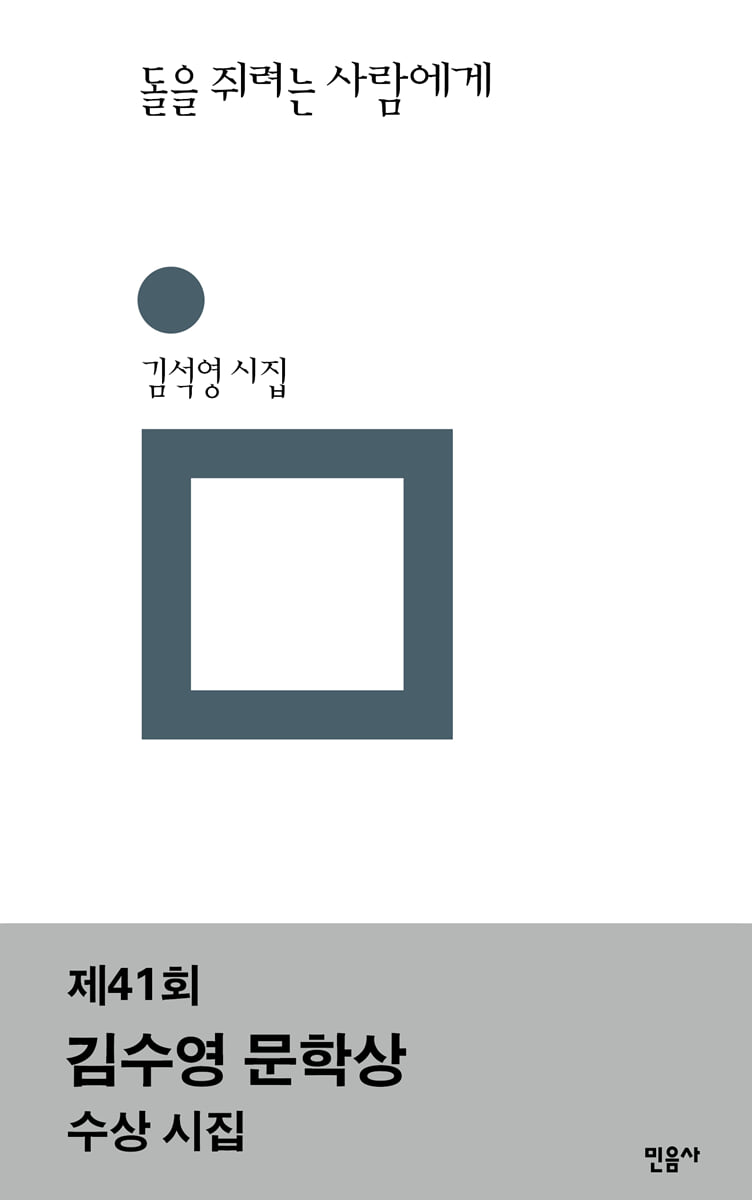
To the person who wants to grab a stone
 |
Description
Book Introduction
- A word from MD
- [41st Kim Su-young Literary Award-winning Poetry Collection] A collection of poetry that welcomes the discovery of the unexpected, the subversion of symbols, and the expansion of meaning that begins with certain words or objects that are often confined to specific images or roles.
He was awarded the Kim Su-young Literary Award for his completeness in each poem and the meticulous structure between the poems.
- City PD Park Hyung-wook
The 41st [Kim Su-yeong Literary Award] winning poetry collection, “To the Person Who Wants to Hold a Stone,” by poet Kim Seok-yeong, has been published as Minum’s Poetry No. 306.
At the time of the review, 『To the One Who Wants to Hold a Stone』 was praised as a "one-of-a-kind poetry collection" rich in charm and completeness, with the poet solving the questions he himself raised in each poem, poetic sentences that create emotions and sentiments that immerse the reader, and the fun of assembling the poems through the meticulous structure between the poems.
The poetry collection, which has a trailer and is divided into A and B shots, and even has ending credits and cookie videos, is like 'a single movie'.
In that case, 『To the One Who Wants to Hold a Stone』 would probably be closer to a movie shown in theaters.
Where Kim Seok-young's poetry is screened, the audience and readers always arrive about 30 minutes late.
Late entry is the strength of this poetry collection.
Because it's late, I quickly enter the poetic situation and immerse myself faithfully so as not to miss the characters, setting, and lines.
After a late entry, when the readers' inner adaptation begins, the poet's sentences stand out clearly like white subtitles.
The poet places the reader at the cross-section of the situation, making him wait for the next seam to come.
The poetic energy of 『To the One Who Wants to Hold a Stone』 comes from the middle.
The poet moves on to the next, holding the freedom that a beginning or an ending may come after the middle.
At the time of the review, 『To the One Who Wants to Hold a Stone』 was praised as a "one-of-a-kind poetry collection" rich in charm and completeness, with the poet solving the questions he himself raised in each poem, poetic sentences that create emotions and sentiments that immerse the reader, and the fun of assembling the poems through the meticulous structure between the poems.
The poetry collection, which has a trailer and is divided into A and B shots, and even has ending credits and cookie videos, is like 'a single movie'.
In that case, 『To the One Who Wants to Hold a Stone』 would probably be closer to a movie shown in theaters.
Where Kim Seok-young's poetry is screened, the audience and readers always arrive about 30 minutes late.
Late entry is the strength of this poetry collection.
Because it's late, I quickly enter the poetic situation and immerse myself faithfully so as not to miss the characters, setting, and lines.
After a late entry, when the readers' inner adaptation begins, the poet's sentences stand out clearly like white subtitles.
The poet places the reader at the cross-section of the situation, making him wait for the next seam to come.
The poetic energy of 『To the One Who Wants to Hold a Stone』 comes from the middle.
The poet moves on to the next, holding the freedom that a beginning or an ending may come after the middle.
- You can preview some of the book's contents.
Preview
index
Full - Trailer 13
A short
Flashback 15
Polyomino 16
Animated Anti-animal 18
Three Incomplete Images 19
21 to get closer
Prayer 24
Silence 26
Dictionary 28: Death Missing
Judgement 30
Collision and Rebound 32
Real Stone 34
Master of Black and White 36
White letters on a purple background 38
Footage 39
Monologue 40
Tail of the Day 42
Black and dry 44
Crank in 46
Shape of Recovery 48
Choice 50
Sangsangseon 52
B short
Option 58
Two Summers and Two Results 60
Polyomino 62
66 to build a flat surface
Three Incomplete Images 38
The Dog in the Drawer, Part 70
Prayer 72
Insert song 73
Sitting like a still life 74
Petals float away in a nap 76
Ventilation 80
Dried Plant 82
Fake Stone 84
Lead Cloud 86
Purple letters on a white background 88
Edit 90
Hand's Prediction 92
Running 94
Affectionate Smell 96
Flashback 98
Use 99
Mineral 102
Destruction 104
Acting Theory 106
Dark Box 108
Ending credits
You will evolve 113
Burns and Illusions 115
Pareidolia 118
Noise 120
Tsunami 122
124 to the person who wants to grab the stone
Cookie - There are a lot of pigeons 126
Commentary on the work - Jo Dae-han (literary critic) 127
A short
Flashback 15
Polyomino 16
Animated Anti-animal 18
Three Incomplete Images 19
21 to get closer
Prayer 24
Silence 26
Dictionary 28: Death Missing
Judgement 30
Collision and Rebound 32
Real Stone 34
Master of Black and White 36
White letters on a purple background 38
Footage 39
Monologue 40
Tail of the Day 42
Black and dry 44
Crank in 46
Shape of Recovery 48
Choice 50
Sangsangseon 52
B short
Option 58
Two Summers and Two Results 60
Polyomino 62
66 to build a flat surface
Three Incomplete Images 38
The Dog in the Drawer, Part 70
Prayer 72
Insert song 73
Sitting like a still life 74
Petals float away in a nap 76
Ventilation 80
Dried Plant 82
Fake Stone 84
Lead Cloud 86
Purple letters on a white background 88
Edit 90
Hand's Prediction 92
Running 94
Affectionate Smell 96
Flashback 98
Use 99
Mineral 102
Destruction 104
Acting Theory 106
Dark Box 108
Ending credits
You will evolve 113
Burns and Illusions 115
Pareidolia 118
Noise 120
Tsunami 122
124 to the person who wants to grab the stone
Cookie - There are a lot of pigeons 126
Commentary on the work - Jo Dae-han (literary critic) 127
Into the book
The stone reflected in the water is like a tree branch
The branch has a dog's face
Do
As if saying goodbye
As if I couldn't help but say goodbye
The stone to the tree, the tree to the dog
Because I was shaken
I waved my hand
To the dog that resembles a stone
To the stone that resembles a dog
Do
---From "Trying to Get Closer"
The stone repeats.
Because my grandmother is in a frame.
The old woman holding the stone looked at the picture frame.
The two will never be able to meet each other again.
A place where two picture frames are hung side by side.
First the dead grandmother, then the just-dead grandmother, then the heavy stone, then the heavier stone.
Heaviness is simply holding an object.
There was a time when it was a superstition.
Shamans, who believed that the spirits of the dead wandered around, had to lift stones.
Now the stone is in the frame
---From "Conflict and Reaction"
Am I an outsider or an insider?
If it goes through weathering
You won't be able to tell what's hurt and what's real.
To the person who wants to grab a stone
To the person who collects stones
To the one who throws stones
Since when did I have myself
The branch has a dog's face
Do
As if saying goodbye
As if I couldn't help but say goodbye
The stone to the tree, the tree to the dog
Because I was shaken
I waved my hand
To the dog that resembles a stone
To the stone that resembles a dog
Do
---From "Trying to Get Closer"
The stone repeats.
Because my grandmother is in a frame.
The old woman holding the stone looked at the picture frame.
The two will never be able to meet each other again.
A place where two picture frames are hung side by side.
First the dead grandmother, then the just-dead grandmother, then the heavy stone, then the heavier stone.
Heaviness is simply holding an object.
There was a time when it was a superstition.
Shamans, who believed that the spirits of the dead wandered around, had to lift stones.
Now the stone is in the frame
---From "Conflict and Reaction"
Am I an outsider or an insider?
If it goes through weathering
You won't be able to tell what's hurt and what's real.
To the person who wants to grab a stone
To the person who collects stones
To the one who throws stones
Since when did I have myself
---From "Real Stone"
Publisher's Review
■A poem of small things that connect different worlds
The stone reflected in the water is like a tree branch
The branch has a dog's face
Do
-From "To Get Closer"
In Kim Seok-young's poetry, scenes appear where landscapes or objects that seem like still lifes suddenly move, or words we know shed their familiar meanings and become broader or overturned.
This is the case in the poem “Mineral,” which describes the experience of “picking up” a grave after the shells become a “grave” while “picking up shells without knowing they are shells” on the beach, or in the poem “Black and Dry,” which looks at the sea like “a candle remembering a place that melted” in a temple on the shore that “was once a burnt place,” and then leads to the transformation that this was really a “candle.”
The story of the clam becoming a grave feels like a time leap, and the scenery that was thought to be like melted candles really was melted candles, like a dream passed down like a butterfly's dream.
Kim Seok-young leaps from side to side like the most flexible long jumper.
Find the cross-section of two different worlds and connect them.
At this time, the poet's imagination and reasoning, which boldly and boldly graft even the seemingly rough cross-sections, make the reader regard the cross-sections as connecting lines, and make them feel more bold than the rough surfaces.
This awareness can also be seen in the poet's autobiography.
The poet who says, “The moon is the moon because it rotates/If it doesn’t rotate, it’s a stone,” expands the image of a stone, which we think of as small and immobile, to mean the moon, which is closer to something larger and eternally moving.
From what can be picked up from the surface of the Earth, that is, the bottom of the ground, to the moon that orbits far away, Kim Seok-young's poetic (weightlessness) is so possible and infinite.
■ A story outside the screen that has been deleted but is still in progress
Only that scene is missing
On the screen
(……)
My independent film has finally been screened.
-In "Selection"
In "To the One Who Wants to Hold a Stone," it often starts in the middle.
This is the case with the poem “Dry Plants,” which begins with “When I spilled the pie/ I was standing at the kitchen table.”
When the reader witnesses the scene, the pie has already been overturned, and the narrator, 'I', is standing at the table.
The poem does not explain how 'I' accidentally spilled the pie before that scene, or why I had to bake the pie much earlier.
The only scene that appears is a later scene in which “a woman wearing a crown and holding a candle stands still, surrounded by people, with a grotesque expression” in a “living room with a picture frame of the sea.”
The same goes for sentences like “Since then/ I couldn’t breathe properly” (“Shape of Recovery”).
We don't know when or what event caused the speaker of the poem to have difficulty breathing, but we are immediately drawn into the speaker's situation and feelings.
Just as one cannot readily ask someone who holds a secret what the secret is, but instead listens intently to get as many hints as possible from the person's words out of curiosity about the secret, one finds oneself listening intently to Kim Seok-yeong's poetry.
Just as shadows make objects appear more vivid, Kim Seok-young's introduction makes us imagine what lies beyond the cut-off screen, creating the other side of the poem, its shadow.
By reading poetry that makes us want to see what is invisible, we can imagine things we do not know.
It is also a property of love to imagine what cannot be seen and to estimate what is unknown.
『To the One Who Wants to Hold a Stone』 is also a poetry collection that teaches a specific way to love poetry.
The stone reflected in the water is like a tree branch
The branch has a dog's face
Do
-From "To Get Closer"
In Kim Seok-young's poetry, scenes appear where landscapes or objects that seem like still lifes suddenly move, or words we know shed their familiar meanings and become broader or overturned.
This is the case in the poem “Mineral,” which describes the experience of “picking up” a grave after the shells become a “grave” while “picking up shells without knowing they are shells” on the beach, or in the poem “Black and Dry,” which looks at the sea like “a candle remembering a place that melted” in a temple on the shore that “was once a burnt place,” and then leads to the transformation that this was really a “candle.”
The story of the clam becoming a grave feels like a time leap, and the scenery that was thought to be like melted candles really was melted candles, like a dream passed down like a butterfly's dream.
Kim Seok-young leaps from side to side like the most flexible long jumper.
Find the cross-section of two different worlds and connect them.
At this time, the poet's imagination and reasoning, which boldly and boldly graft even the seemingly rough cross-sections, make the reader regard the cross-sections as connecting lines, and make them feel more bold than the rough surfaces.
This awareness can also be seen in the poet's autobiography.
The poet who says, “The moon is the moon because it rotates/If it doesn’t rotate, it’s a stone,” expands the image of a stone, which we think of as small and immobile, to mean the moon, which is closer to something larger and eternally moving.
From what can be picked up from the surface of the Earth, that is, the bottom of the ground, to the moon that orbits far away, Kim Seok-young's poetic (weightlessness) is so possible and infinite.
■ A story outside the screen that has been deleted but is still in progress
Only that scene is missing
On the screen
(……)
My independent film has finally been screened.
-In "Selection"
In "To the One Who Wants to Hold a Stone," it often starts in the middle.
This is the case with the poem “Dry Plants,” which begins with “When I spilled the pie/ I was standing at the kitchen table.”
When the reader witnesses the scene, the pie has already been overturned, and the narrator, 'I', is standing at the table.
The poem does not explain how 'I' accidentally spilled the pie before that scene, or why I had to bake the pie much earlier.
The only scene that appears is a later scene in which “a woman wearing a crown and holding a candle stands still, surrounded by people, with a grotesque expression” in a “living room with a picture frame of the sea.”
The same goes for sentences like “Since then/ I couldn’t breathe properly” (“Shape of Recovery”).
We don't know when or what event caused the speaker of the poem to have difficulty breathing, but we are immediately drawn into the speaker's situation and feelings.
Just as one cannot readily ask someone who holds a secret what the secret is, but instead listens intently to get as many hints as possible from the person's words out of curiosity about the secret, one finds oneself listening intently to Kim Seok-yeong's poetry.
Just as shadows make objects appear more vivid, Kim Seok-young's introduction makes us imagine what lies beyond the cut-off screen, creating the other side of the poem, its shadow.
By reading poetry that makes us want to see what is invisible, we can imagine things we do not know.
It is also a property of love to imagine what cannot be seen and to estimate what is unknown.
『To the One Who Wants to Hold a Stone』 is also a poetry collection that teaches a specific way to love poetry.
GOODS SPECIFICS
- Publication date: December 20, 2022
- Format: Hardcover book binding method guide
- Page count, weight, size: 152 pages | 312g | 124*210*20mm
- ISBN13: 9788937409264
- ISBN10: 8937409267
You may also like
카테고리
korean


korean

![GQ KOREA Mark (Monthly): December [2025]](http://librairie.coreenne.fr/cdn/shop/files/8ef265dbbfbf186523ed75ba7319009d.jpg?v=1765340328&width=3840)


