

Quarantine
 |
Description
Book Introduction
- A word from MD
-
The genre-transcending "science fiction bible"A shocking debut that heralded the arrival of Greg Egan, the "writer's writer."
The night sky of Earth has lost all stars, the universe has been isolated from humanity, and an alien race has isolated humanity, the 'beings of cosmic destruction'.
What kind of story is there between them?
A science fiction film that combines intellectual satisfaction and irresistible fun.December 30, 2022. Novel/Poetry PD Park Hyung-wook
The Science Fiction Bible, recommended by Dr. Kim Sang-wook and Booktuber Kim Gyul-woo.
Republished in a new translation, 30 years after the original publication and 20 years after its domestic publication.
Lowest price 27,000 won, highest price 80,000 won.
It seems like a price too high to be paid for with books.
But there were people willing to pay that amount of money: those who bought used copies of Quarantine, which had been out of print for 10 years.
Among them is Kim Sang-wook, who is well-known as a “science doctor who kindly teaches physics” through his appearances on “Know-it-alls” and “Know-it-alls.” He starts his book, “Quarantine,” by saying the following:
“Greg Egan’s ‘Quarantine’ is already out of print in our country, but is being sold at high prices among enthusiasts.
“It is common to ask for twice the original price, and it is not uncommon to ask for three or four times the original price.”
- Kim Sang-wook, 『Kim Sang-wook’s Science Study』, East Asia (2016), p.
198
Are SF enthusiasts who covet "Quarantine" only in Korea? Since its publication in 1992, "Quarantine" has been exported to 14 countries and has been republished consistently until recently.
Even the original English version is republished twice every ten years.
Why has "Quarantine" been so universally acclaimed for so long? Perhaps it's because of its immense literary value and historical significance, but as Kim Sang-wook explains in his recommendation, it's also because it's so captivating that it's almost mysterious.
“While reading this book, I reached a truly mysterious state where I couldn’t put it down because I couldn’t understand it but it was so interesting.”
Again, I have a question.
Why did a book with such "mysterious powers" go out of print? There are likely many reasons for this, but anyone who has read "Quarantine" will agree that it's an ill-fated masterpiece born in the wrong era.
In 2003, when 『Quarantine』 was first introduced in Korea, it was safe to say that only “intellectual” readers like Kim Sang-wook read science fiction.
But as of 2022, even “hip” readers like Kim Gyul-wool, who are not picky readers, and even “general” literary readers who are still unfamiliar with the genre, are reading science fiction.
As Kim Gyul-wool explains in her recommendation, Quarantine has the power to satisfy all these readers because it “covers mystery, espionage, physiology, quantum mechanics, determinism, and metaphysics all while remaining entertaining.”
That is why now is the most appropriate time for Korean readers to meet Greg Egan, and this has been confirmed through the much-loved book, “Why I’m Happy,” published in August of this year.
Just because a work is loved by science fiction fans around the world doesn't mean it needs to be republished.
Therefore, when explaining why 『Quarantine』 should be read again now, we cannot leave out the literary value and historical significance of the work.
Greg Egan is a “writer’s writer” who influenced Ted Chiang, currently the most beloved foreign writer in Korea, and Korean writer Kim Cho-yeop.
Moreover, considering his awards and sales, Greg Egan's authority worldwide is no less than that of Korea.
That is, no one would disagree that Greg Egan is one of the great streams of science fiction recognized worldwide.
So, what about his debut work, "Quarantine"? It's where that mighty river begins.
This is why "Quarantine" is called "the bible of science fiction." It's a classic work of science fiction, and at the same time, it heralds the beginning of a remarkable writer.
That is why we need to republish Quarantine, even if it means translating it again after 20 years.
"Quarantine" meets readers after 20 years, following a revised translation by Sanghoon Kim, the planner and translator who first introduced and translated Greg Egan's work in Korea.
To remove the dust that had accumulated over the past 20 years, the translation was completely revised with refined expressions suited to the literary sensibilities of today.
At the same time, reflecting the reader feedback that has been accumulated over the past 20 years that it is 'difficult to understand', we have reorganized the scientific explanation section, which was somewhat complicated and explained using somewhat unfamiliar terminology, to make it easier to read.
As a result, a completely new version of 『Quarantine』 was born, to the point that Sangwook Kim, who read both the old and new versions, exclaimed, “It’s completely changed.”
"Quarantine" is the first part of the "Subjective Cosmology" trilogy.
By publishing Greg Egan's entire collection of short stories, including "Why I'm Happy," as well as the second part, "Permutation City," and the third part, "Sorrow," following "Quarantine," Hubble aims to create a larger and more distinct river named Greg Egan in Korea.
Republished in a new translation, 30 years after the original publication and 20 years after its domestic publication.
Lowest price 27,000 won, highest price 80,000 won.
It seems like a price too high to be paid for with books.
But there were people willing to pay that amount of money: those who bought used copies of Quarantine, which had been out of print for 10 years.
Among them is Kim Sang-wook, who is well-known as a “science doctor who kindly teaches physics” through his appearances on “Know-it-alls” and “Know-it-alls.” He starts his book, “Quarantine,” by saying the following:
“Greg Egan’s ‘Quarantine’ is already out of print in our country, but is being sold at high prices among enthusiasts.
“It is common to ask for twice the original price, and it is not uncommon to ask for three or four times the original price.”
- Kim Sang-wook, 『Kim Sang-wook’s Science Study』, East Asia (2016), p.
198
Are SF enthusiasts who covet "Quarantine" only in Korea? Since its publication in 1992, "Quarantine" has been exported to 14 countries and has been republished consistently until recently.
Even the original English version is republished twice every ten years.
Why has "Quarantine" been so universally acclaimed for so long? Perhaps it's because of its immense literary value and historical significance, but as Kim Sang-wook explains in his recommendation, it's also because it's so captivating that it's almost mysterious.
“While reading this book, I reached a truly mysterious state where I couldn’t put it down because I couldn’t understand it but it was so interesting.”
Again, I have a question.
Why did a book with such "mysterious powers" go out of print? There are likely many reasons for this, but anyone who has read "Quarantine" will agree that it's an ill-fated masterpiece born in the wrong era.
In 2003, when 『Quarantine』 was first introduced in Korea, it was safe to say that only “intellectual” readers like Kim Sang-wook read science fiction.
But as of 2022, even “hip” readers like Kim Gyul-wool, who are not picky readers, and even “general” literary readers who are still unfamiliar with the genre, are reading science fiction.
As Kim Gyul-wool explains in her recommendation, Quarantine has the power to satisfy all these readers because it “covers mystery, espionage, physiology, quantum mechanics, determinism, and metaphysics all while remaining entertaining.”
That is why now is the most appropriate time for Korean readers to meet Greg Egan, and this has been confirmed through the much-loved book, “Why I’m Happy,” published in August of this year.
Just because a work is loved by science fiction fans around the world doesn't mean it needs to be republished.
Therefore, when explaining why 『Quarantine』 should be read again now, we cannot leave out the literary value and historical significance of the work.
Greg Egan is a “writer’s writer” who influenced Ted Chiang, currently the most beloved foreign writer in Korea, and Korean writer Kim Cho-yeop.
Moreover, considering his awards and sales, Greg Egan's authority worldwide is no less than that of Korea.
That is, no one would disagree that Greg Egan is one of the great streams of science fiction recognized worldwide.
So, what about his debut work, "Quarantine"? It's where that mighty river begins.
This is why "Quarantine" is called "the bible of science fiction." It's a classic work of science fiction, and at the same time, it heralds the beginning of a remarkable writer.
That is why we need to republish Quarantine, even if it means translating it again after 20 years.
"Quarantine" meets readers after 20 years, following a revised translation by Sanghoon Kim, the planner and translator who first introduced and translated Greg Egan's work in Korea.
To remove the dust that had accumulated over the past 20 years, the translation was completely revised with refined expressions suited to the literary sensibilities of today.
At the same time, reflecting the reader feedback that has been accumulated over the past 20 years that it is 'difficult to understand', we have reorganized the scientific explanation section, which was somewhat complicated and explained using somewhat unfamiliar terminology, to make it easier to read.
As a result, a completely new version of 『Quarantine』 was born, to the point that Sangwook Kim, who read both the old and new versions, exclaimed, “It’s completely changed.”
"Quarantine" is the first part of the "Subjective Cosmology" trilogy.
By publishing Greg Egan's entire collection of short stories, including "Why I'm Happy," as well as the second part, "Permutation City," and the third part, "Sorrow," following "Quarantine," Hubble aims to create a larger and more distinct river named Greg Egan in Korea.
- You can preview some of the book's contents.
Preview
index
Part 1 ·007
Part 2 ·139
Epilogue ·443
Translator's Note ·448
Part 2 ·139
Epilogue ·443
Translator's Note ·448
Detailed image

Into the book
The stars are gone, but they were never ours to begin with.
What humanity has really lost is the illusion that the stars are close enough to touch.
--- p.40
Now that so many aspects of daily life have become subject to personal choice, the brain cannot tolerate that fact.
Perhaps people are adding a new layer to their thought processes because they can literally acquire so many things just by wishing for them.
If only to protect themselves from this immense power and freedom.
Such thinking is close to infinite regression.
It's like you're trying to decide what you really want.
--- p.49
“So, are you saying that people’s values don’t change?”
“It changes slowly.
“For good reason.”
“Or maybe it’s for a bad reason.
Or maybe there is no reason at all.
Are you thinking along these lines? The average person sits down at their desk one day, deliberates and deliberates, creates a rational ethics, and then makes appropriate corrections when they discover flaws? That's pure fantasy.
Most people are just going through life, tossed around by the things they experience, and their personalities are shaped by influences beyond their control.
So what's wrong with changing yourself? If you want to do it and it makes you happy?
--- p.172
“It may not be easy to accept, but that’s just how we are, so what can we do?
“We are not only a universe that ‘knows itself’… but also a universe that, through the very process of acquiring that knowledge, annihilates most of itself.”
--- p.207
Everything eventually comes back to the ordinary routine of daily life.
What humanity has really lost is the illusion that the stars are close enough to touch.
--- p.40
Now that so many aspects of daily life have become subject to personal choice, the brain cannot tolerate that fact.
Perhaps people are adding a new layer to their thought processes because they can literally acquire so many things just by wishing for them.
If only to protect themselves from this immense power and freedom.
Such thinking is close to infinite regression.
It's like you're trying to decide what you really want.
--- p.49
“So, are you saying that people’s values don’t change?”
“It changes slowly.
“For good reason.”
“Or maybe it’s for a bad reason.
Or maybe there is no reason at all.
Are you thinking along these lines? The average person sits down at their desk one day, deliberates and deliberates, creates a rational ethics, and then makes appropriate corrections when they discover flaws? That's pure fantasy.
Most people are just going through life, tossed around by the things they experience, and their personalities are shaped by influences beyond their control.
So what's wrong with changing yourself? If you want to do it and it makes you happy?
--- p.172
“It may not be easy to accept, but that’s just how we are, so what can we do?
“We are not only a universe that ‘knows itself’… but also a universe that, through the very process of acquiring that knowledge, annihilates most of itself.”
--- p.207
Everything eventually comes back to the ordinary routine of daily life.
--- p.447
Publisher's Review
Humanity is 'quarantined' by an alien black sphere.
A shocking imagination that builds humanity into a being of "cosmic destruction" based on quantum mechanics.
The title of the work, 'Quarantine', means 'isolation', 'quarantine', and 'blockade'.
COVID-19? This is a word that has been mentioned frequently in Korea during the pandemic, but in "Quarantine," it's used a little differently.
In reality, it is used to mean isolating humans from infectious diseases, but in 『Quarantine』, it is used to mean 'isolating the universe from humans.'
Could it be that humans are hosts to a cosmic plague? While that's not entirely wrong, the initial premise suggests humanity was isolated because they possessed a special ability that could lead the universe to destruction.
While some knowledge of quantum mechanics is necessary to understand exactly how that "special ability" works, it's not necessary to enjoy "Quarantine" as a work of literature.
It is interesting enough to read about the reactions of alien species when humanity becomes a being of 'cosmic destruction', the reactions of humanity who are forced to isolate that alien species without knowing why, and the changes and conflicts experienced by each individual on Earth in chaos.
And if you follow the narrative steadily, you will naturally learn about quantum mechanics.
After reading "Quarantine," I guess a high-level understanding of quantum mechanics was necessary to write this work.
Because quantum mechanics was explained so easily and accurately in a novel.
As Einstein said, “If you can’t explain it simply, you don’t understand it well enough.” Greg Egan wrote Quarantine based on a thorough understanding of quantum mechanics.
In the same context, Kim Sang-wook stated in his lecture that “this is a book that any physicist would read while crying (out of awe).”
Quantum mechanics is not a word that we often use in real life, and because it often goes against the classical mechanics we are familiar with, it often feels somewhat unfamiliar and difficult.
As I explained earlier, there is absolutely no problem reading Quarantine even if you only seek narrative enjoyment without delving into quantum mechanics.
However, in 『Quarantine』, quantum mechanics is not treated as difficult as it could be, and if you understand it even a little, you can feel the unique "sense of wonder" of science fiction, so I recommend reading it with the mindset of experiencing quantum mechanics rather than studying it.
In 『Quarantine』, an understanding of quantum mechanics is necessary when trying to understand the operating principles of the 'special abilities' possessed by humans.
In the world of 『Quarantine』, the entire universe exists in a state of ‘quantum superposition.’
However, humans are inherently capable of breaking the quantum superposition of the existence they 'observe' and consequently resolving it into a single state.
Any being that is touched by human gaze loses the infinite possibilities that were overlapping and exists as only one possibility.
That is, in the world of 『Quarantine』, everything that humans see (including humans) is being destroyed.
Quantum mechanical explanations are trivial in the face of this enormous worldview.
But understanding this little explanation makes this unrealistic world feel very real.
Disaster/Dystopia, Posthuman/Superhuman, Mystery/Hardboiled
A masterpiece by the "writers' writer," transcending all eras and literary genres.
When Quarantine was first published in 2003, the shock it caused science fiction readers must have been truly enormous.
Even recently, 20 years later, readers continued to request a republication.
The power of 『Quarantine』, which received such continuous requests and praise and was eventually republished, lies, as mentioned earlier, above all else, in its literary enjoyment.
As 『Quarantine』 has the high hurdle of combining quantum mechanics and hard science fiction, it borrows narratives and atmospheres from various literary genres to keep readers from getting bored while overcoming that hurdle.
The three representative genres in 『Quarantine』 are “Disaster/Dystopia,” “Posthuman/Superhuman,” and “Detective/Mystery/Hardboiled.”
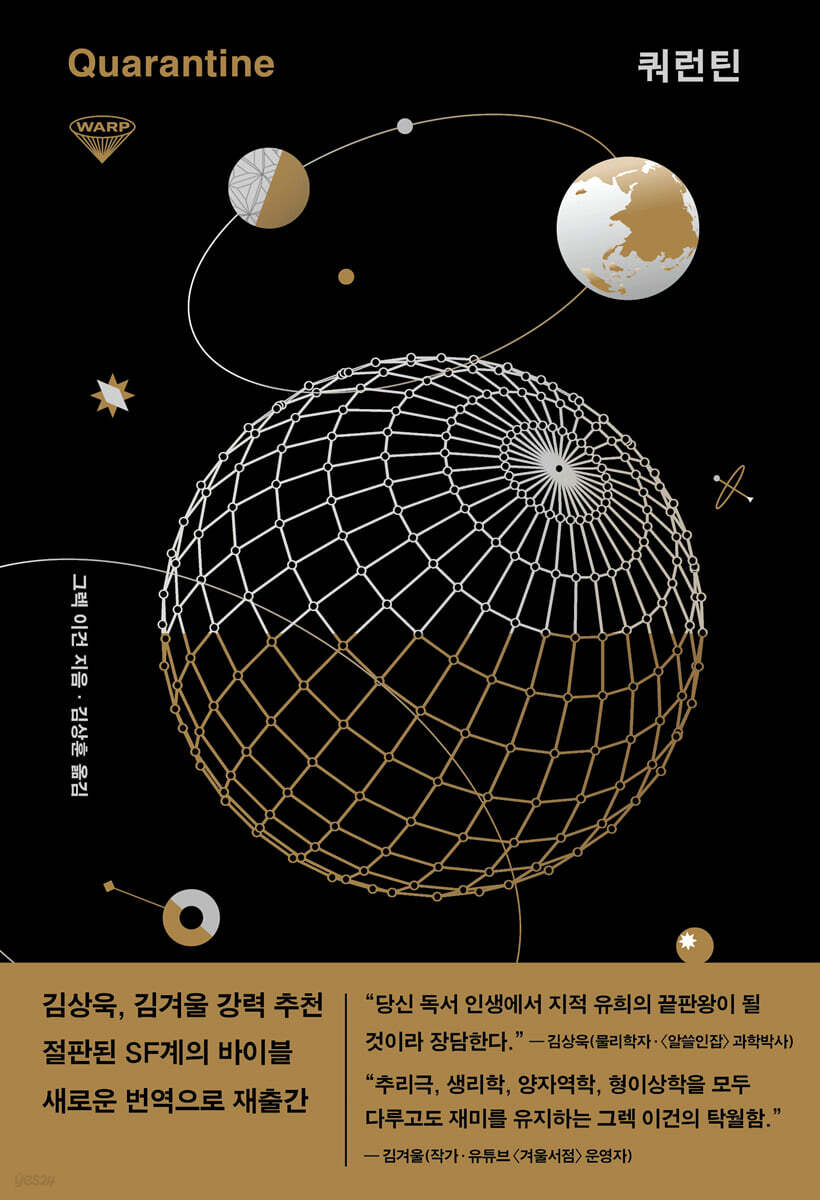
As it can be interpreted from at least three perspectives, the covers of the 14 countries that imported 『Quarantine』 are all different.
The introduction of 'Quarantine' captures the 'disaster narrative' and 'dystopian worldview' well.
One day in 2034, the stars completely disappear from Earth's night sky.
This is because the solar system has been completely enveloped by a mysterious black sphere, the 'bubble', whose diameter is twice the orbit of Pluto.
This naturally led to global chaos, but surprisingly, 30 years passed without any major problems, with the only countermeasure being a bizarre and oppressive government worthy of a dystopian novel.
People naturally accept the starless night sky as a part of their daily lives.
The characters and early narrative of 'Quarantine' are a good combination of 'mystery narrative' and 'hard-boiled characters.'
2066, 30 years after the emergence of the 'bubble'.
Nick, a former police officer and private investigator, is asked to find a missing woman.
What's interesting here is that this woman had an intellectual disability that made it difficult for her to even move around on her own, and the hospital she was staying in was under 24-hour surveillance.
As Nick tracks down this woman, he learns about the true identity of 'Bubble'.
The character of the protagonist, Nick, fully reflects the ‘posthuman-specific reflections’ and ‘superhuman worldview.’
In "Quarantine," there is a science fiction element that is treated as important as the alien black sphere "Bubble": "Mods," the product of cutting-edge genetic engineering and nanotechnology.
By installing a type of neural circuit called a mode into the brain, it is possible to rewire the nervous system through nanorobots, which will soon lead to the control of the human body and consciousness at will.
Nick, equipped with the mod, becomes loyal to the enemy I was just chasing, and is not sad at all when his beloved wife dies.
As Kim Gyul-wool said in her recommendation, “Following this exciting mystery, readers will find themselves pondering profound topics like the relationship between the brain and the mind and the infinite possibilities of life.”
As Kim Gyul-wool puts it, “Quarantine” is truly like a “roller coaster.”
Once you start reading, you will never have a headache over difficult scientific theories.
Because you'll be busy admiring this timeless masterpiece.
A shocking imagination that builds humanity into a being of "cosmic destruction" based on quantum mechanics.
The title of the work, 'Quarantine', means 'isolation', 'quarantine', and 'blockade'.
COVID-19? This is a word that has been mentioned frequently in Korea during the pandemic, but in "Quarantine," it's used a little differently.
In reality, it is used to mean isolating humans from infectious diseases, but in 『Quarantine』, it is used to mean 'isolating the universe from humans.'
Could it be that humans are hosts to a cosmic plague? While that's not entirely wrong, the initial premise suggests humanity was isolated because they possessed a special ability that could lead the universe to destruction.
While some knowledge of quantum mechanics is necessary to understand exactly how that "special ability" works, it's not necessary to enjoy "Quarantine" as a work of literature.
It is interesting enough to read about the reactions of alien species when humanity becomes a being of 'cosmic destruction', the reactions of humanity who are forced to isolate that alien species without knowing why, and the changes and conflicts experienced by each individual on Earth in chaos.
And if you follow the narrative steadily, you will naturally learn about quantum mechanics.
After reading "Quarantine," I guess a high-level understanding of quantum mechanics was necessary to write this work.
Because quantum mechanics was explained so easily and accurately in a novel.
As Einstein said, “If you can’t explain it simply, you don’t understand it well enough.” Greg Egan wrote Quarantine based on a thorough understanding of quantum mechanics.
In the same context, Kim Sang-wook stated in his lecture that “this is a book that any physicist would read while crying (out of awe).”
Quantum mechanics is not a word that we often use in real life, and because it often goes against the classical mechanics we are familiar with, it often feels somewhat unfamiliar and difficult.
As I explained earlier, there is absolutely no problem reading Quarantine even if you only seek narrative enjoyment without delving into quantum mechanics.
However, in 『Quarantine』, quantum mechanics is not treated as difficult as it could be, and if you understand it even a little, you can feel the unique "sense of wonder" of science fiction, so I recommend reading it with the mindset of experiencing quantum mechanics rather than studying it.
In 『Quarantine』, an understanding of quantum mechanics is necessary when trying to understand the operating principles of the 'special abilities' possessed by humans.
In the world of 『Quarantine』, the entire universe exists in a state of ‘quantum superposition.’
However, humans are inherently capable of breaking the quantum superposition of the existence they 'observe' and consequently resolving it into a single state.
Any being that is touched by human gaze loses the infinite possibilities that were overlapping and exists as only one possibility.
That is, in the world of 『Quarantine』, everything that humans see (including humans) is being destroyed.
Quantum mechanical explanations are trivial in the face of this enormous worldview.
But understanding this little explanation makes this unrealistic world feel very real.
Disaster/Dystopia, Posthuman/Superhuman, Mystery/Hardboiled
A masterpiece by the "writers' writer," transcending all eras and literary genres.
When Quarantine was first published in 2003, the shock it caused science fiction readers must have been truly enormous.
Even recently, 20 years later, readers continued to request a republication.
The power of 『Quarantine』, which received such continuous requests and praise and was eventually republished, lies, as mentioned earlier, above all else, in its literary enjoyment.
As 『Quarantine』 has the high hurdle of combining quantum mechanics and hard science fiction, it borrows narratives and atmospheres from various literary genres to keep readers from getting bored while overcoming that hurdle.
The three representative genres in 『Quarantine』 are “Disaster/Dystopia,” “Posthuman/Superhuman,” and “Detective/Mystery/Hardboiled.”
As it can be interpreted from at least three perspectives, the covers of the 14 countries that imported 『Quarantine』 are all different.
The introduction of 'Quarantine' captures the 'disaster narrative' and 'dystopian worldview' well.
One day in 2034, the stars completely disappear from Earth's night sky.
This is because the solar system has been completely enveloped by a mysterious black sphere, the 'bubble', whose diameter is twice the orbit of Pluto.
This naturally led to global chaos, but surprisingly, 30 years passed without any major problems, with the only countermeasure being a bizarre and oppressive government worthy of a dystopian novel.
People naturally accept the starless night sky as a part of their daily lives.
The characters and early narrative of 'Quarantine' are a good combination of 'mystery narrative' and 'hard-boiled characters.'
2066, 30 years after the emergence of the 'bubble'.
Nick, a former police officer and private investigator, is asked to find a missing woman.
What's interesting here is that this woman had an intellectual disability that made it difficult for her to even move around on her own, and the hospital she was staying in was under 24-hour surveillance.
As Nick tracks down this woman, he learns about the true identity of 'Bubble'.
The character of the protagonist, Nick, fully reflects the ‘posthuman-specific reflections’ and ‘superhuman worldview.’
In "Quarantine," there is a science fiction element that is treated as important as the alien black sphere "Bubble": "Mods," the product of cutting-edge genetic engineering and nanotechnology.
By installing a type of neural circuit called a mode into the brain, it is possible to rewire the nervous system through nanorobots, which will soon lead to the control of the human body and consciousness at will.
Nick, equipped with the mod, becomes loyal to the enemy I was just chasing, and is not sad at all when his beloved wife dies.
As Kim Gyul-wool said in her recommendation, “Following this exciting mystery, readers will find themselves pondering profound topics like the relationship between the brain and the mind and the infinite possibilities of life.”
As Kim Gyul-wool puts it, “Quarantine” is truly like a “roller coaster.”
Once you start reading, you will never have a headache over difficult scientific theories.
Because you'll be busy admiring this timeless masterpiece.
GOODS SPECIFICS
- Publication date: December 21, 2022
- Page count, weight, size: 468 pages | 622g | 145*212*30mm
- ISBN13: 9791190090780
- ISBN10: 1190090783
You may also like
카테고리
korean


korean

![GQ KOREA Mark (Monthly): December [2025]](http://librairie.coreenne.fr/cdn/shop/files/8ef265dbbfbf186523ed75ba7319009d.jpg?v=1765340328&width=3840)


