

isolation
 |
Description
Book Introduction
A collection of short stories, “Insulation,” written by young Asian novelists, has been published by Munhakdongne. "Insulation" is a collection of short stories written by nine authors active in Korea, Japan, China, Taiwan, Hong Kong, Tibet, Vietnam, Thailand, and Singapore, all with a single keyword. Although there have been novel collections published in the past that include works by Korean, Chinese, and Japanese authors, this is the first anthology to include authors from Southeast Asia. This multinational project, titled “Young Writers of Asia,” was uniquely initiated not by a publisher but by novelist Jeong Se-rang. Following Jeong Se-rang's initiative to "slightly broaden the scope of friendship," Japan's Shogakukan and Korea's Munhakdongne responded, and the project has now become a large-scale project with nine Asian authors participating and publications simultaneously in Korea and Japan. Jeong Se-rang's idea of what it would be like if writers from different countries wrote different works using a single keyword easily reached the word 'isolation.' In an era of disconnection brought about by the pandemic and international political conflict, the keyword "isolation" has ironically created new connections between writers and literary readers living in different places. In addition to Korea's Jeong Se-rang, who has received great attention from the public and literary world with works such as "From the Gaze," "Insulation" contains a diverse range of novels by Asian authors, including Japan's Sayaka Murata, who won the Akutagawa Prize for "Convenience Store Human" and established herself as a world-class author with many fans in Korea, and China's Hao Jingfang, who won the Hugo Award, often called the Nobel Prize of science fiction. People who want to leave a society full of 'chaos' and become 'nothing' (Japan); people in 'positive cities' where those who harbor negative emotions are imprisoned in emotional detention centers (China); friends who are cut off due to differences in ethics amidst continuous public debate (Korea); stories of lovers who meet and part ways in the midst of revolution (Thailand); the writers who participated in the project vividly depicted our lives, sometimes by borrowing the power of imagination, and sometimes by recreating the fierce reality. The aspects of Asia that we live with, yet are still familiar yet unfamiliar. "Insulation" will be a rare and precious opportunity to encounter Asian literature of the here and now, presented by writers of our time. The Korean edition ends with a conversation between Jeong Se-rang and Sayaka Murata in Seoul about the topic of "isolation," their identity as Asians, and the included works. |
- You can preview some of the book's contents.
Preview
index
Planning Note_Jeong Se-rang
Sayaka Murata (Japan)─No
Translator's Note
Alfian Saat (Singapore) - Wife
Translator's Note
Hao Jingfang (China) - Positive Brick
Author's Note
Wiwat Rutwiwat Wongsa (Thailand) - Burn
Translator's Note
Hong Lai Chu (Hong Kong) - Secret Police
Translator's Note
La Shamja (Tibet) - Snow lotuses bloom in the pits.
Translator's Note
Nguyen Ngoc Tu (Vietnam) - Escape
Author's Note
Lian Mingwei (Taiwan)─Aunt Cherie's Afternoon Tea
Translator's Note
Jeong Se-rang (Korea) - Insulation
Bold | Jeong Se-rang x Sayaka Murata: A Breakup with the Past
Sayaka Murata (Japan)─No
Translator's Note
Alfian Saat (Singapore) - Wife
Translator's Note
Hao Jingfang (China) - Positive Brick
Author's Note
Wiwat Rutwiwat Wongsa (Thailand) - Burn
Translator's Note
Hong Lai Chu (Hong Kong) - Secret Police
Translator's Note
La Shamja (Tibet) - Snow lotuses bloom in the pits.
Translator's Note
Nguyen Ngoc Tu (Vietnam) - Escape
Author's Note
Lian Mingwei (Taiwan)─Aunt Cherie's Afternoon Tea
Translator's Note
Jeong Se-rang (Korea) - Insulation
Bold | Jeong Se-rang x Sayaka Murata: A Breakup with the Past
Into the book
My green girl, my Sangbok girl, and Rich Natural will be 'nothing' to my daughter's generation.
Compared to our generation, it seems quite frugal and boring, so you might wonder what fun there is in it, but when 'nothing' is all the rage, there's nothing more enjoyable than living as 'nothing'.
I had a typical childhood and adolescence for my generation, had typical values, dated and married typicalally, and lived a typical life for my generation.
If I were born in a different generation, I'm sure I would be a typical example of that generation.
So there was absolutely no question that my daughter would live a typical life for her generation.
---From "Nothing"
Every time I talked to my family, Sauda felt drained.
Isn't it pointless to try to convince someone who can only think of Harlem or a cult?
The more my family voiced their warnings and objections, the more I saw how clear and perfectly elegant the situation was.
The second lover becomes the first wife.
Your first lover becomes your second wife.
On that symmetry, an intimate entanglement of female comrades will one day mature.
---From "Wife"
The whole area around him was illuminated with brilliant colors.
The bricks on the ground shimmered with gold and orange, or were tinted a soft rose.
Zhou Chu glanced at the ground throughout the performance, and was particularly inspired when a refreshing yellow-green color appeared.
This is a truly amazing brick.
The smooth texture and glossy surface make it look like a divine instrument descending into the world to reveal wisdom.
---From "Positive Bricks"
The flames rise silently, and the pungent, stinging smell mixes with the foul stench of the dirty city.
Small or big, paper, plastic, wood, everything catches fire.
Orange flames flash and flicker in the darkness.
Anywhere, any place.
---From "Burning"
I secretly copied my husband's cell phone data and reported the messages exchanged between him and his friend to the secret police.
That was how I killed myself.
---From "Secret Police"
The streets of Beijing will probably never be completely shrouded in darkness.
How wonderfully this city embodies the human desire to escape from darkness.
How many people, like me, are lost and bewildered in this city enveloped in light?
---From “Lotus flowers bloom in the pit”
She remembers several times pounding the blue-and-white walls, making small holes and reaching out to her young son who was trapped inside.
He was a son who was born with great difficulty.
I wanted to bring you back to my arms somehow.
The son didn't move an inch.
No amount of teasing or complaining would help, and tears wouldn't work either.
Sometimes I even begged God.
I've done enough, what more can I do?
I slowly gave up as I watched my son inevitably take a step back whenever I took a step closer.
---From "Escape"
“Then you’re leaving here too.” Shuri seemed a little disappointed.
“You’ll probably leave first.
And they'll forget all about us," Ander said.
“But to be honest, there’s not much to remember.
“All the kids here will leave the island someday.”
---From "Aunt Cherie's Afternoon Tea"
I used to think I was good at accepting things that didn't seem likely to happen as if they were likely to happen.
But when I became the one who committed the act that I believed would never happen, I couldn't help but feel shaken.
It was decided not to meet Seonjeong and Hyeongwoo, who had been seeing each other for eighteen years, any longer.
I never imagined that I would end a relationship that had lasted half a lifetime, a relationship I believed would continue into middle age and old age.
I thought I had slipped through life's paces.
It was like the glass was out of sync and could never be put back together again.
Compared to our generation, it seems quite frugal and boring, so you might wonder what fun there is in it, but when 'nothing' is all the rage, there's nothing more enjoyable than living as 'nothing'.
I had a typical childhood and adolescence for my generation, had typical values, dated and married typicalally, and lived a typical life for my generation.
If I were born in a different generation, I'm sure I would be a typical example of that generation.
So there was absolutely no question that my daughter would live a typical life for her generation.
---From "Nothing"
Every time I talked to my family, Sauda felt drained.
Isn't it pointless to try to convince someone who can only think of Harlem or a cult?
The more my family voiced their warnings and objections, the more I saw how clear and perfectly elegant the situation was.
The second lover becomes the first wife.
Your first lover becomes your second wife.
On that symmetry, an intimate entanglement of female comrades will one day mature.
---From "Wife"
The whole area around him was illuminated with brilliant colors.
The bricks on the ground shimmered with gold and orange, or were tinted a soft rose.
Zhou Chu glanced at the ground throughout the performance, and was particularly inspired when a refreshing yellow-green color appeared.
This is a truly amazing brick.
The smooth texture and glossy surface make it look like a divine instrument descending into the world to reveal wisdom.
---From "Positive Bricks"
The flames rise silently, and the pungent, stinging smell mixes with the foul stench of the dirty city.
Small or big, paper, plastic, wood, everything catches fire.
Orange flames flash and flicker in the darkness.
Anywhere, any place.
---From "Burning"
I secretly copied my husband's cell phone data and reported the messages exchanged between him and his friend to the secret police.
That was how I killed myself.
---From "Secret Police"
The streets of Beijing will probably never be completely shrouded in darkness.
How wonderfully this city embodies the human desire to escape from darkness.
How many people, like me, are lost and bewildered in this city enveloped in light?
---From “Lotus flowers bloom in the pit”
She remembers several times pounding the blue-and-white walls, making small holes and reaching out to her young son who was trapped inside.
He was a son who was born with great difficulty.
I wanted to bring you back to my arms somehow.
The son didn't move an inch.
No amount of teasing or complaining would help, and tears wouldn't work either.
Sometimes I even begged God.
I've done enough, what more can I do?
I slowly gave up as I watched my son inevitably take a step back whenever I took a step closer.
---From "Escape"
“Then you’re leaving here too.” Shuri seemed a little disappointed.
“You’ll probably leave first.
And they'll forget all about us," Ander said.
“But to be honest, there’s not much to remember.
“All the kids here will leave the island someday.”
---From "Aunt Cherie's Afternoon Tea"
I used to think I was good at accepting things that didn't seem likely to happen as if they were likely to happen.
But when I became the one who committed the act that I believed would never happen, I couldn't help but feel shaken.
It was decided not to meet Seonjeong and Hyeongwoo, who had been seeing each other for eighteen years, any longer.
I never imagined that I would end a relationship that had lasted half a lifetime, a relationship I believed would continue into middle age and old age.
I thought I had slipped through life's paces.
It was like the glass was out of sync and could never be put back together again.
---From "Insulation"
Publisher's Review
Nine stories through the prism of 'isolation'
The seething imaginations of Asia, now and here, disconnected and connected, moving forward
The nine works included in "Insulation" take on a variety of forms. From stories inspired by science fiction, to mysteries, social novels, family dramas, and even diaspora literature... The keyword "insulation"—isolation from objects, isolation from people, isolation from society, isolation from the times—is expressed in a completely different way by each writer.
Conversely, they also make the concept of insulation more evident through unexpected combinations.
The diverse forms of 'isolation' presented by various writers like this make us realize that the word 'isolation' does not simply have a negative connotation of disconnection, but also signifies moving toward connection with a new world.
Moreover, as you follow the exciting story, you will discover that each seemingly disparate work addresses the most pressing issues in each country.
In a society where true individuals are disappearing and people are being swept away by trends, stories of people who actively choose alienation (「Nothing」, Japan), the violence of a totalitarian society that tries to control even individual emotions (「Positive Brick」, China), the agony of young people who have to survive after a failed revolution (「Burn」, Thailand), a novel that sharply depicts a cross-section of a surveillance society (「Secret Police」, Hong Kong), and even a story that directly addresses the debate that is reproduced in another way in countless public discussions (「Insulation」, Korea)... ... If literary works are windows that reflect reality, then 『Insulation』 can be said to be the text that most clearly shows the lives of people living in Asia today.
Through the works included in 『Insulation』, we come to realize that Asia is not simply a collection of independent countries, but a broad community sharing a spirit and identity.
In the work, we meet young people from Thailand and Hong Kong who are going through their own revolutions, a Muslim woman from Singapore who watches Korean dramas to soothe her mind, and young Thai people dancing K-pop on the streets of Bangkok.
Thai writer Wiwat Rutwiwatwongsa's work "Burning" was inspired by director Lee Chang-dong's film "Burning," and the fact that "Burning" was based on a work by Japanese novelist Haruki Murakami pleasantly hints at our subtle connection.
It may still feel strange, but we are more connected than we think.
So perhaps it's even more surprising that this is the first such project.
I hope this book will be the starting point for other connections we will make in the future.
Nine novelists, eight translators
From a multinational project to a book
Whenever I hear gloomy news, I often think about how much better things could be if friendship were global.
So, I wanted to slightly broaden the scope of the strong friendship I have already experienced and cherished.
_Jeong Se-rang, from 'Planning's Words'
The work of 『Insulation』 was carried out by translating the works of nine authors who spoke different languages by seven Japanese translators who specialized in each language, and then translating them into Korean by Eunju Hong, a translator living in Tokyo.
If any questions were raised during the editing process, they would be relayed to the author through the Japanese editor and the translator of the relevant language. When the feedback was returned in reverse order, it would be discussed again between translator Hong Eun-ju and the editorial staff of Munhakdongne.
The editors of Shogakukan and Munhakdongne were each in charge of domestic literature, and neither was fluent in Korean or Japanese. This is when a web translator was mobilized.
The Korean editors exchanged opinions in dozens of emails written in Korean, and the Japanese editors exchanged opinions in Japanese.
Authors from each country sent greetings through videos they shot themselves.
Since the pandemic, rapidly developing technologies have been utilized to facilitate simultaneous communication, so the work of "Isolation" was literally a break from the previous era.
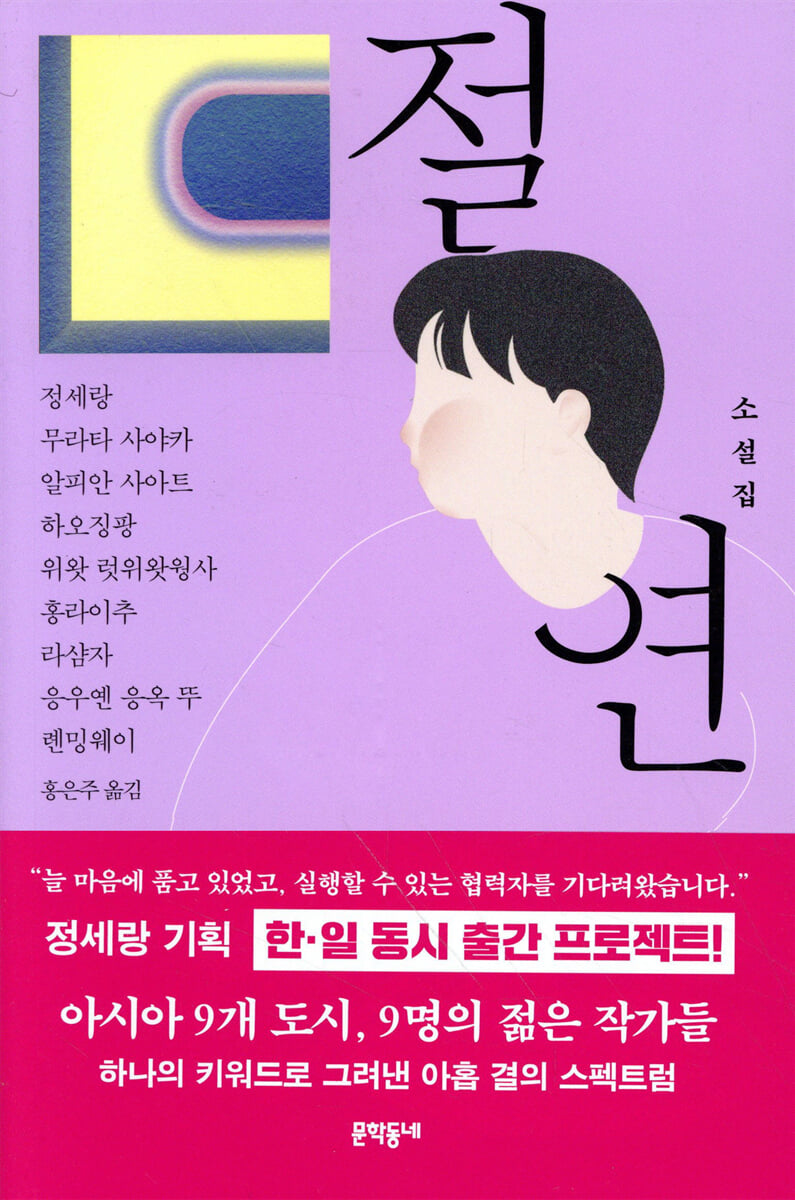
The cover illustration is by Shanghai-based illustrator Zhao Wenxin.
It is also worth noting that the same picture was reinterpreted and designed by Japanese and Korean designers to suit the sentiments of each country.
『Insulation』, which was published simultaneously in Korea and Japan, is scheduled to be translated and published in other countries that participated in the collection in the future.
■ Author's Note
When I heard the topic of 'isolation', I got goosebumps.
When I read the 'isolation' of other authors who worked together, there was a world beyond imagination, a vivid writhing of language and humanity.
_Sayaka Murata
Holding this book in your hands also means embracing change.
I am grateful to be able to embark on this adventure with courageous readers.
_Jeong Se-rang
The seething imaginations of Asia, now and here, disconnected and connected, moving forward
The nine works included in "Insulation" take on a variety of forms. From stories inspired by science fiction, to mysteries, social novels, family dramas, and even diaspora literature... The keyword "insulation"—isolation from objects, isolation from people, isolation from society, isolation from the times—is expressed in a completely different way by each writer.
Conversely, they also make the concept of insulation more evident through unexpected combinations.
The diverse forms of 'isolation' presented by various writers like this make us realize that the word 'isolation' does not simply have a negative connotation of disconnection, but also signifies moving toward connection with a new world.
Moreover, as you follow the exciting story, you will discover that each seemingly disparate work addresses the most pressing issues in each country.
In a society where true individuals are disappearing and people are being swept away by trends, stories of people who actively choose alienation (「Nothing」, Japan), the violence of a totalitarian society that tries to control even individual emotions (「Positive Brick」, China), the agony of young people who have to survive after a failed revolution (「Burn」, Thailand), a novel that sharply depicts a cross-section of a surveillance society (「Secret Police」, Hong Kong), and even a story that directly addresses the debate that is reproduced in another way in countless public discussions (「Insulation」, Korea)... ... If literary works are windows that reflect reality, then 『Insulation』 can be said to be the text that most clearly shows the lives of people living in Asia today.
Through the works included in 『Insulation』, we come to realize that Asia is not simply a collection of independent countries, but a broad community sharing a spirit and identity.
In the work, we meet young people from Thailand and Hong Kong who are going through their own revolutions, a Muslim woman from Singapore who watches Korean dramas to soothe her mind, and young Thai people dancing K-pop on the streets of Bangkok.
Thai writer Wiwat Rutwiwatwongsa's work "Burning" was inspired by director Lee Chang-dong's film "Burning," and the fact that "Burning" was based on a work by Japanese novelist Haruki Murakami pleasantly hints at our subtle connection.
It may still feel strange, but we are more connected than we think.
So perhaps it's even more surprising that this is the first such project.
I hope this book will be the starting point for other connections we will make in the future.
Nine novelists, eight translators
From a multinational project to a book
Whenever I hear gloomy news, I often think about how much better things could be if friendship were global.
So, I wanted to slightly broaden the scope of the strong friendship I have already experienced and cherished.
_Jeong Se-rang, from 'Planning's Words'
The work of 『Insulation』 was carried out by translating the works of nine authors who spoke different languages by seven Japanese translators who specialized in each language, and then translating them into Korean by Eunju Hong, a translator living in Tokyo.
If any questions were raised during the editing process, they would be relayed to the author through the Japanese editor and the translator of the relevant language. When the feedback was returned in reverse order, it would be discussed again between translator Hong Eun-ju and the editorial staff of Munhakdongne.
The editors of Shogakukan and Munhakdongne were each in charge of domestic literature, and neither was fluent in Korean or Japanese. This is when a web translator was mobilized.
The Korean editors exchanged opinions in dozens of emails written in Korean, and the Japanese editors exchanged opinions in Japanese.
Authors from each country sent greetings through videos they shot themselves.
Since the pandemic, rapidly developing technologies have been utilized to facilitate simultaneous communication, so the work of "Isolation" was literally a break from the previous era.
The cover illustration is by Shanghai-based illustrator Zhao Wenxin.
It is also worth noting that the same picture was reinterpreted and designed by Japanese and Korean designers to suit the sentiments of each country.
『Insulation』, which was published simultaneously in Korea and Japan, is scheduled to be translated and published in other countries that participated in the collection in the future.
■ Author's Note
When I heard the topic of 'isolation', I got goosebumps.
When I read the 'isolation' of other authors who worked together, there was a world beyond imagination, a vivid writhing of language and humanity.
_Sayaka Murata
Holding this book in your hands also means embracing change.
I am grateful to be able to embark on this adventure with courageous readers.
_Jeong Se-rang
GOODS SPECIFICS
- Publication date: December 5, 2022
- Page count, weight, size: 412 pages | 476g | 133*200*30mm
- ISBN13: 9788954689496
- ISBN10: 8954689493
You may also like
카테고리
korean


korean

![GQ KOREA Mark (Monthly): December [2025]](http://librairie.coreenne.fr/cdn/shop/files/8ef265dbbfbf186523ed75ba7319009d.jpg?v=1765340328&width=3840)


