

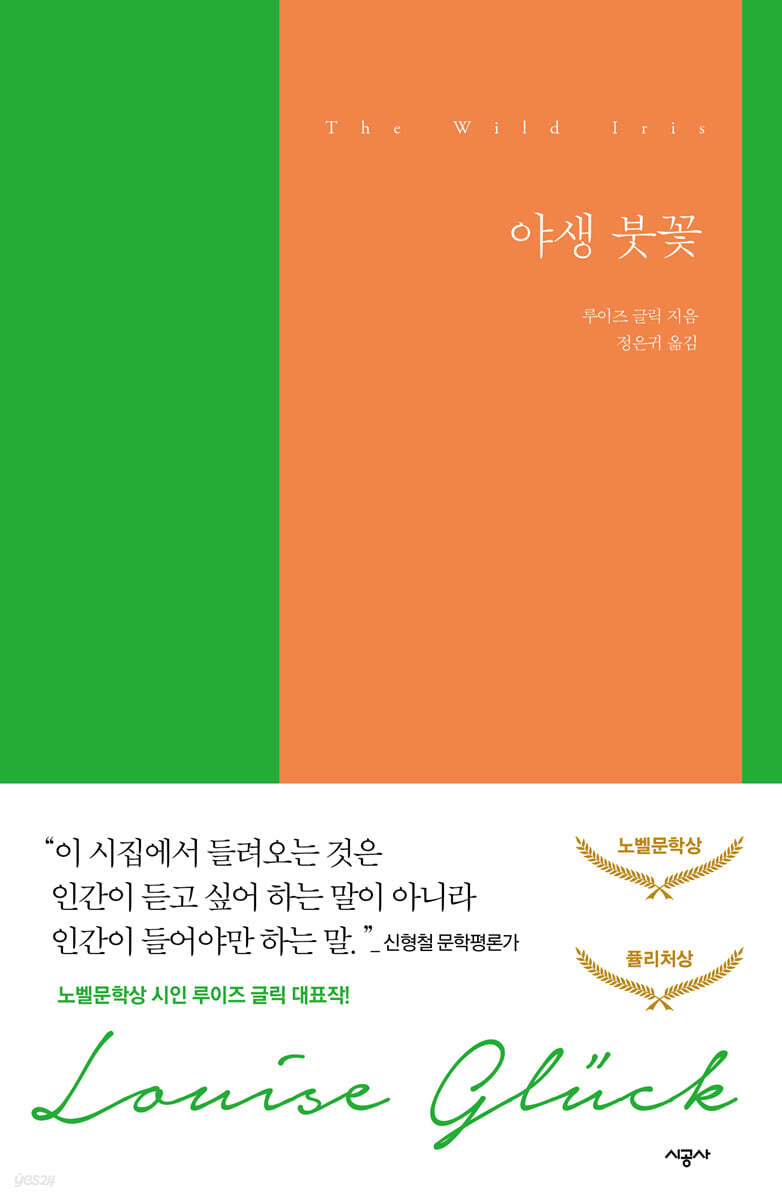
wild iris
 |
Description
Book Introduction
- A word from MD
-
Discovering inner strength in natureA collection of poems by Louise Glück, the first female poet to win the 21st-century Nobel Prize in Literature.
Glick's poetic experimentation with the voice of plants stands out.
The way the story moves from observing plants to one's own experience makes the resonance of personification even more powerful.
A poem made even stronger by the commentary of translator Jeong Eun-gwi and critic Shin Hyeong-cheol, who have been in contact with Glick for a long time.
November 22, 2022. Novel/Poetry PD Lee Na-young
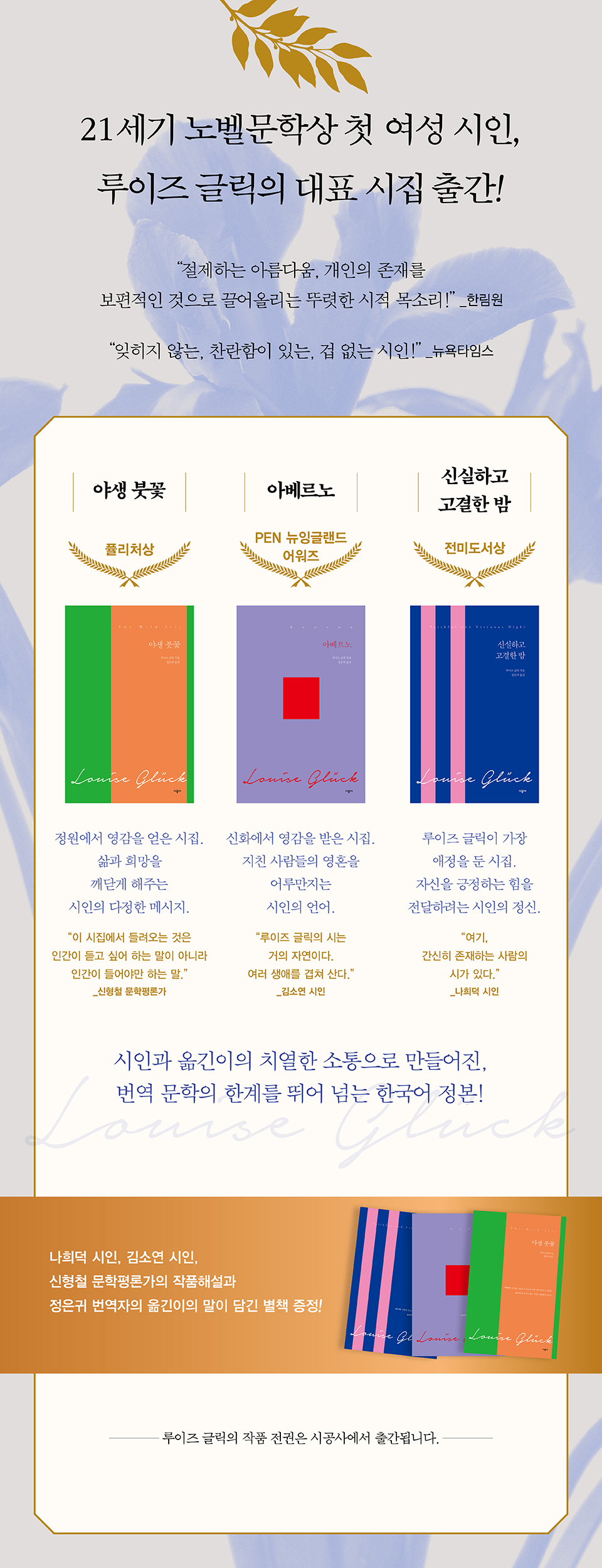
Representative poetry collection by Nobel Prize-winning author Louise Glück
★ Nobel Prize in Literature · Pulitzer Prize ★
“With a poetic voice of unadorned beauty,
“A writer who universally portrays individual existence” _ Hanrimwon
“Yes, let’s take a chance on joy.
“In the sharp wind of the new world.”
Louise Glick, the first female poet to win the 21st-century Nobel Prize in Literature
The 2020 Nobel Prize in Literature went to American poet Louise Glück.
This is the first time for a female poet since 2000.
Considering that she is the 16th female writer to receive the Nobel Prize in Literature after Selma Lagerlöf in 1909 for “The Adventures of Niels” and the second female poet after Wisława Szymborska in 1996, it can be seen that the biggest topic in the world of literature in the 21st century is “women.”
Women's voices rise to the surface.
Sometimes it is resistance, sometimes it is solidarity, and sometimes it is a form of memoir written after observing the tragedy experienced as a woman to the end, like Louise Glick.
“From Wild Irises (1993) to Faithful and Noble Night (2014), Glück’s twelve volumes of poetry are characterized by a striving for clarity,” says the writer Anders Olsson, a member of the Academy.
In addition, he compared Glick's world of work to that of 19th-century American poet Emily Dickinson, describing it as "a rigor and resistance to accepting simple tenets of faith."
Pulitzer Prize, National Book Award, U.S. Poet Laureate, National Humanities Medal, National Book Critics Circle, Bollingen Award, Los Angeles Times Book Award, Wallace Stevens Award.
And even the Nobel Prize in Literature.
Louise Glick has been a central figure in American poetry for 50 years.
In Korea, he is known only for his poem “Snowdrops,” which includes the line, “Yes, let’s take a chance on joy / In the bitter wind of a new world.” However, in the United States, he is considered one of the representative lyric poets of the modern literary world.
Her work is consistently praised for its elegance, sobriety, sensitivity to common human emotions, lyricism, and the almost visionary insight that permeates her work.
He is currently a professor of English literature at Yale University.
★ Nobel Prize in Literature · Pulitzer Prize ★
“With a poetic voice of unadorned beauty,
“A writer who universally portrays individual existence” _ Hanrimwon
“Yes, let’s take a chance on joy.
“In the sharp wind of the new world.”
Louise Glick, the first female poet to win the 21st-century Nobel Prize in Literature
The 2020 Nobel Prize in Literature went to American poet Louise Glück.
This is the first time for a female poet since 2000.
Considering that she is the 16th female writer to receive the Nobel Prize in Literature after Selma Lagerlöf in 1909 for “The Adventures of Niels” and the second female poet after Wisława Szymborska in 1996, it can be seen that the biggest topic in the world of literature in the 21st century is “women.”
Women's voices rise to the surface.
Sometimes it is resistance, sometimes it is solidarity, and sometimes it is a form of memoir written after observing the tragedy experienced as a woman to the end, like Louise Glick.
“From Wild Irises (1993) to Faithful and Noble Night (2014), Glück’s twelve volumes of poetry are characterized by a striving for clarity,” says the writer Anders Olsson, a member of the Academy.
In addition, he compared Glick's world of work to that of 19th-century American poet Emily Dickinson, describing it as "a rigor and resistance to accepting simple tenets of faith."
Pulitzer Prize, National Book Award, U.S. Poet Laureate, National Humanities Medal, National Book Critics Circle, Bollingen Award, Los Angeles Times Book Award, Wallace Stevens Award.
And even the Nobel Prize in Literature.
Louise Glick has been a central figure in American poetry for 50 years.
In Korea, he is known only for his poem “Snowdrops,” which includes the line, “Yes, let’s take a chance on joy / In the bitter wind of a new world.” However, in the United States, he is considered one of the representative lyric poets of the modern literary world.
Her work is consistently praised for its elegance, sobriety, sensitivity to common human emotions, lyricism, and the almost visionary insight that permeates her work.
He is currently a professor of English literature at Yale University.
- You can preview some of the book's contents.
Preview
index
THE WILD IRIS | MATINS | MATINS | TRILLIUM | LAMIUM | SNOWDROPS | CLEAR MORNING | SPRING SNOW | END OF WINTER | MATINS | MATINS | SCILLA | RETREATING WIND | THE GARDEN | THE HAWTHORN TREE | LOVE IN MOONLIGHT | APRIL | VIOLETS | WITCHGRASS | THE JACOB'S LADDER | MATINS | MATINS | SONG | FIELD FLOWERS | THE RED POPPY | CLOVER | MATINS | HEAVEN AND EARTH | THE DOORWAY | MIDSUMMER | Vespers | Vespers | Vespers | Vespers | Daisies | End of Summer | Vespers | Vespers | Vespers | Early Darkness | Harvest | The White Rose | Ipomoea | Presque Isle | Retreating Light | Vespers | Vespers: Parousia | Vespers | Vespers | Vespers | Sunset | Lullaby | The Silver Lily | September Twilight | The Gold Lily | The White Lilies | Commentary on the Works Three Monologues or a Trilogue_Shin Hyung-cheol | Translator's Note In the Poet's Garden Without Bees
Detailed image
Publisher's Review
A collection of poems inspired by gardens
The poet's sixth collection of poems, Wild Irises, published in 1992, is a masterpiece that won him the Pulitzer Prize and the William Carlos Williams Poetry Society Award.
No poet before or since in American history has given plants such a diverse and vivid voice of their own.
Emily Dickinson (1830-1886), whose hobby was gardening, wrote many poems about nature, especially poems that observe and describe flowers with great delicacy, but she did not directly use the voice of flowers as fully as Gleick did.
Contemporary poet Mary Oliver (1935-2019) also wrote many poems about other beings while being close to nature, but many of her poems closely observed the subjects through a human perspective.
For Glick, the flower finally becomes a flower itself.
"Wild Irises" is a collection of poems that vividly demonstrates Glick's poetic experiments.
The poetry collection is a world of gardens where flowers, gardeners, and the poet's prayers and God coexist.
It is a garden where you can go out in the morning and evening to look at the flowers, talk to the flowers, check the weather, and feel the sunlight and wind, but strangely, it is a garden without bees.
Dickinson, Glick's favorite poet, had a garden full of bees, but Glick's garden had no bees.
So, it is sometimes read as an imaginary garden rather than an actual garden.
Louise Glick in American poetry
Why he's been a living legend for 50 years
In 『Wild Irises』, there are several layers of speakers.
It clearly proves how pioneering her work was as an artist who writes lyric poetry.
This work is dreamlike yet contains keen observations about human existence.
Her poetic style, which closely observes nature and reflects on her own painful experiences, transcends the limited framework of 'personal history' and reaches readers with universal resonance.
Set in a garden and divided into three parts, the book skillfully uses three voices.
The first is a flower speaking to the gardener (poet).
The second is the voice of the speaker (poet).
The third is the voice of an omnipotent god.
It contains stories, myths, folktales, and flowers with individuality, implying human emotions and characteristics.
"Wild Irises" shows how powerful and resonant this type of personification can be in poetry.
Although it seems to leave readers in a labyrinth with a somewhat difficult word arrangement, it exquisitely draws the reader's soul deep into the work.
Intense communication between poet and translator
Korean text that transcends the limitations of translated literature
The task of matching the subtle results of English with the sentiment of Korean was taken on by Professor Jeong Eun-gyu, who teaches English and American poetry at Hankuk University of Foreign Studies.
Professor Jeong Eun-gwi, who translated the poetry of Anne Sexton and Amanda Gorman into Korean, is a passionate researcher who reads and promotes Gleick's poetry in university lecture halls, in academic papers, and in public lectures.
She founded the Louise Glick Research Foundation and is actively researching her poetic world academically through various papers.
Louise Glick, moved by Professor Jeong Eun-gwi's passion, carefully observed the vivid process of her poetry being translated into a completely different language.
After intense and long communication between the poet and the translator, the only Korean-language edition that will allow Korean readers to fully embrace Gleick's world of poetry has been completed.
Here, poets Na Hee-deok and Kim So-yeon, and literary critic Professor Shin Hyeong-cheol, congratulated the publication in Korea and included commentary on their respective works.
The writings of these three writers serve as a valuable guide for passionate readers seeking to fully understand the world of Gleick's poetry.
A message that awakens us to life and hope
"Wild Irises" awakens a sense of life, hope, and the eternal cycle of existence.
Her masterpiece tells the story of a year until flowers bloom in the garden, a life that is both temporary and cyclical, and thus eternal.
This collection of poems, which brings together author and reader, awakens the courage to live, deep hope, and the righteousness of existence.
The act of 'someone noticing existence', which is the eternal essence of life, is accomplished in this collection of poems.
The poet's sixth collection of poems, Wild Irises, published in 1992, is a masterpiece that won him the Pulitzer Prize and the William Carlos Williams Poetry Society Award.
No poet before or since in American history has given plants such a diverse and vivid voice of their own.
Emily Dickinson (1830-1886), whose hobby was gardening, wrote many poems about nature, especially poems that observe and describe flowers with great delicacy, but she did not directly use the voice of flowers as fully as Gleick did.
Contemporary poet Mary Oliver (1935-2019) also wrote many poems about other beings while being close to nature, but many of her poems closely observed the subjects through a human perspective.
For Glick, the flower finally becomes a flower itself.
"Wild Irises" is a collection of poems that vividly demonstrates Glick's poetic experiments.
The poetry collection is a world of gardens where flowers, gardeners, and the poet's prayers and God coexist.
It is a garden where you can go out in the morning and evening to look at the flowers, talk to the flowers, check the weather, and feel the sunlight and wind, but strangely, it is a garden without bees.
Dickinson, Glick's favorite poet, had a garden full of bees, but Glick's garden had no bees.
So, it is sometimes read as an imaginary garden rather than an actual garden.
Louise Glick in American poetry
Why he's been a living legend for 50 years
In 『Wild Irises』, there are several layers of speakers.
It clearly proves how pioneering her work was as an artist who writes lyric poetry.
This work is dreamlike yet contains keen observations about human existence.
Her poetic style, which closely observes nature and reflects on her own painful experiences, transcends the limited framework of 'personal history' and reaches readers with universal resonance.
Set in a garden and divided into three parts, the book skillfully uses three voices.
The first is a flower speaking to the gardener (poet).
The second is the voice of the speaker (poet).
The third is the voice of an omnipotent god.
It contains stories, myths, folktales, and flowers with individuality, implying human emotions and characteristics.
"Wild Irises" shows how powerful and resonant this type of personification can be in poetry.
Although it seems to leave readers in a labyrinth with a somewhat difficult word arrangement, it exquisitely draws the reader's soul deep into the work.
Intense communication between poet and translator
Korean text that transcends the limitations of translated literature
The task of matching the subtle results of English with the sentiment of Korean was taken on by Professor Jeong Eun-gyu, who teaches English and American poetry at Hankuk University of Foreign Studies.
Professor Jeong Eun-gwi, who translated the poetry of Anne Sexton and Amanda Gorman into Korean, is a passionate researcher who reads and promotes Gleick's poetry in university lecture halls, in academic papers, and in public lectures.
She founded the Louise Glick Research Foundation and is actively researching her poetic world academically through various papers.
Louise Glick, moved by Professor Jeong Eun-gwi's passion, carefully observed the vivid process of her poetry being translated into a completely different language.
After intense and long communication between the poet and the translator, the only Korean-language edition that will allow Korean readers to fully embrace Gleick's world of poetry has been completed.
Here, poets Na Hee-deok and Kim So-yeon, and literary critic Professor Shin Hyeong-cheol, congratulated the publication in Korea and included commentary on their respective works.
The writings of these three writers serve as a valuable guide for passionate readers seeking to fully understand the world of Gleick's poetry.
A message that awakens us to life and hope
"Wild Irises" awakens a sense of life, hope, and the eternal cycle of existence.
Her masterpiece tells the story of a year until flowers bloom in the garden, a life that is both temporary and cyclical, and thus eternal.
This collection of poems, which brings together author and reader, awakens the courage to live, deep hope, and the righteousness of existence.
The act of 'someone noticing existence', which is the eternal essence of life, is accomplished in this collection of poems.
GOODS SPECIFICS
- Publication date: November 7, 2022
- Page count, weight, size: 96 pages | 254g | 148*210*15mm
- ISBN13: 9791169252737
- ISBN10: 1169252737
You may also like
카테고리
korean


korean

![GQ KOREA Mark (Monthly): December [2025]](http://librairie.coreenne.fr/cdn/shop/files/8ef265dbbfbf186523ed75ba7319009d.jpg?v=1765340328&width=3840)


