

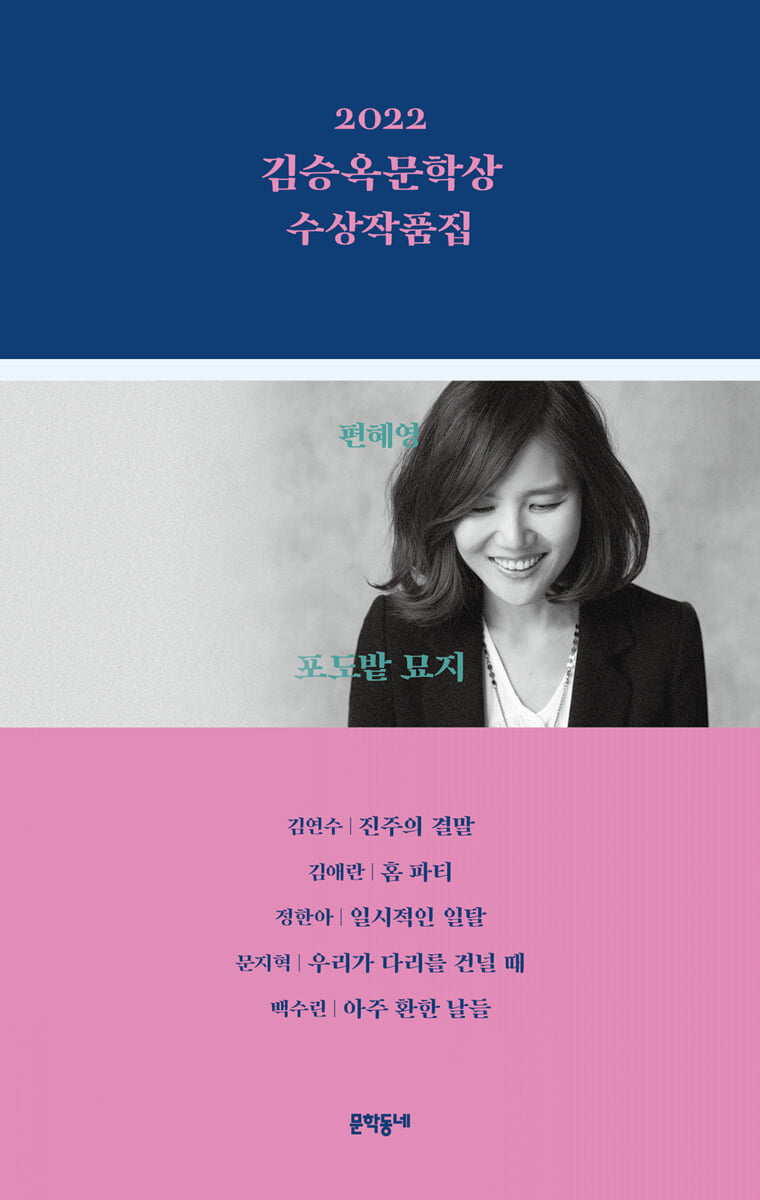
2022 Kim Seung-ok Literary Award Winners Collection
 |
Description
Book Introduction
- A word from MD
-
Novels that testify to us todayDiscover six worlds solidly built by leading Korean literary authors.
This collection includes award-winning works by Pyeon Hye-young, including the grand prize-winning work “Vineyard Cemetery,” as well as award-winning works by Kim Yeon-su, Kim Ae-ran, Jeong Han-ah, Moon Ji-hyeok, and Baek Su-rin.
These are novels that will later on testify to us today more clearly than anything else.
September 30, 2022. Novel/Poetry PD Park Hyung-wook
"Precise detail, appropriate symbolism, empathetic perspective, and deep lingering impact."
Seven crystals that have deepened over the year
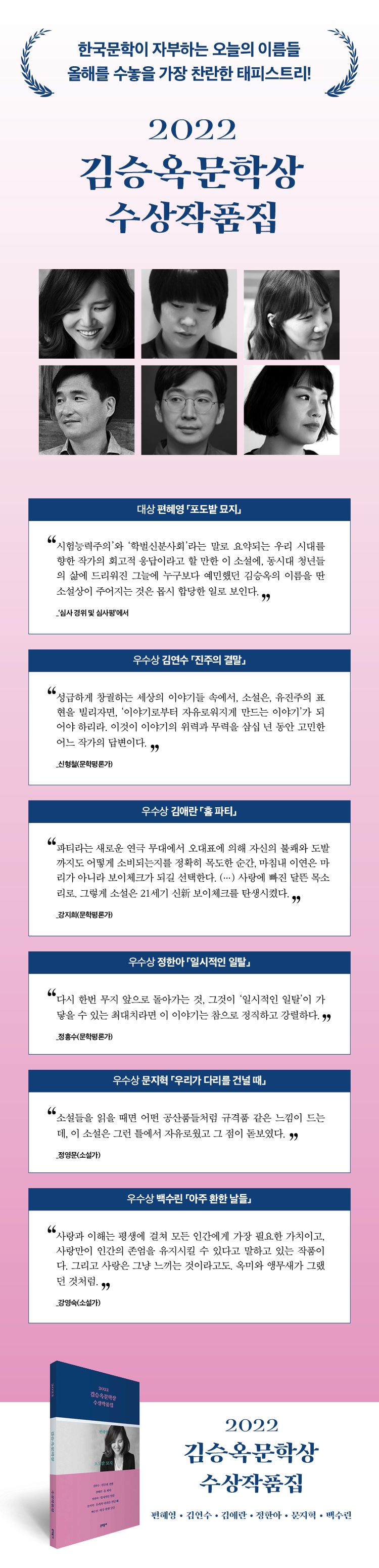
Today's names that Korean literature is proud of
The Kim Seung-ok Literary Award, which selects the seven best short stories published in the past year by authors who have been writing for over ten years, has firmly established itself as a journey to explore the essence of Korean literature.
This year, from July 2021 to June 2022, a total of 171 works from 26 literary magazines, including major literary magazines, webzines, and independent literary magazines, were reviewed.
The winners of the 2022 Kim Seung-ok Literary Award are Pyeon Hye-young, Kim Yeon-su, Kim Ae-ran, Jeong Han-ah, Gu Byeong-mo, Moon Ji-hyeok, and Baek Su-rin.
Among these writers who are becoming known as classics of Korean literature, Pyeon Hye-young's short story "Vineyard Cemetery" "received the most votes in the first round of voting" and "gained stable support until the end, ultimately winning the grand prize."
Author Jeong Han-ah has demonstrated her solid experience by winning the Excellence Award for the second time in the Kim Seung-ok Literary Award, and newcomers to the Kim Seung-ok Literary Award, Kim Yeon-su, Kim Ae-ran, Gu Byeong-mo, Moon Ji-hyeok, and Baek Su-rin, are today's leading names in Korean literature, and their novels reveal a future we can look forward to.
The award-winning novel, “The Vineyard Cemetery” by Hye-young Pyeon, is a novel that evokes “the impulse of rebellion and protest that wells up within us all” (Hwa-young Kim), as if vividly feeling the flow of blood in our veins.
The four friends who graduated from 'Yeosang High School' each set out into the world with bright dreams.
However, 'Sooyoung' endures the humiliation imposed by the shackles of being a 'unskilled person' and goes from part-time job to civil service exam preparation, and 'Yoonju', who has escaped the structure of the company that shifts responsibility to the powerless youngest sibling, is once again put in a difficult situation within the family she created.
Even 'Han-oh', who had the "feeling of a general" and was enterprising in planning for the future, collapsed without being able to enjoy the fruits of his endless self-development.
My realization that “we all spent similar times while we were not together” expands the present of these four into our appearance in 2022.
At this time, the line “No one should die” will be the most desperate and earnest message the author sends to those living in this era.
Seven crystals that have deepened over the year
Today's names that Korean literature is proud of
The Kim Seung-ok Literary Award, which selects the seven best short stories published in the past year by authors who have been writing for over ten years, has firmly established itself as a journey to explore the essence of Korean literature.
This year, from July 2021 to June 2022, a total of 171 works from 26 literary magazines, including major literary magazines, webzines, and independent literary magazines, were reviewed.
The winners of the 2022 Kim Seung-ok Literary Award are Pyeon Hye-young, Kim Yeon-su, Kim Ae-ran, Jeong Han-ah, Gu Byeong-mo, Moon Ji-hyeok, and Baek Su-rin.
Among these writers who are becoming known as classics of Korean literature, Pyeon Hye-young's short story "Vineyard Cemetery" "received the most votes in the first round of voting" and "gained stable support until the end, ultimately winning the grand prize."
Author Jeong Han-ah has demonstrated her solid experience by winning the Excellence Award for the second time in the Kim Seung-ok Literary Award, and newcomers to the Kim Seung-ok Literary Award, Kim Yeon-su, Kim Ae-ran, Gu Byeong-mo, Moon Ji-hyeok, and Baek Su-rin, are today's leading names in Korean literature, and their novels reveal a future we can look forward to.
The award-winning novel, “The Vineyard Cemetery” by Hye-young Pyeon, is a novel that evokes “the impulse of rebellion and protest that wells up within us all” (Hwa-young Kim), as if vividly feeling the flow of blood in our veins.
The four friends who graduated from 'Yeosang High School' each set out into the world with bright dreams.
However, 'Sooyoung' endures the humiliation imposed by the shackles of being a 'unskilled person' and goes from part-time job to civil service exam preparation, and 'Yoonju', who has escaped the structure of the company that shifts responsibility to the powerless youngest sibling, is once again put in a difficult situation within the family she created.
Even 'Han-oh', who had the "feeling of a general" and was enterprising in planning for the future, collapsed without being able to enjoy the fruits of his endless self-development.
My realization that “we all spent similar times while we were not together” expands the present of these four into our appearance in 2022.
At this time, the line “No one should die” will be the most desperate and earnest message the author sends to those living in this era.
- You can preview some of the book's contents.
Preview
index
|Table of Contents|
Target
Pyeon Hye-young's "Vineyard Cemetery"
Author's Note | The Taste of Black Grapes
Review | The Mathematics of Destiny (Kim Hwa-young)
Kim Yeon-su's "The End of Pearl"
Author's Note | Like a Man Walking to the Moon
Review | Freedom from All Stories (Shin Hyeong-cheol)
Kim Ae-ran's "Home Party"
Author's Note | Curtain Call
Review | Evolving Vulgarities and the New Wojciech's Counterattack (Kang Ji-hee)
Jeong Han-ah's "Temporary Deviation"
Author's Note | Ghosts in the Studio
Review | The Power of "A Story Nobody Wants" (Jeong Hong-su)
Moon Ji-hyuk, "When We Cross the Bridge"
Author's Note | The Fortress on the Hill
Review | Cracks in Life (Jeong Young-moon)
Baek Su-rin, "Very Bright Days"
Author's Note | Looking into the Heart
Review | Quiet and Dignified (Kang Young-sook)
2022 Kim Seung-ok Literary Award
- Purpose of the Kim Seung-ok Literary Award
- Review process and review comments
Target
Pyeon Hye-young's "Vineyard Cemetery"
Author's Note | The Taste of Black Grapes
Review | The Mathematics of Destiny (Kim Hwa-young)
Kim Yeon-su's "The End of Pearl"
Author's Note | Like a Man Walking to the Moon
Review | Freedom from All Stories (Shin Hyeong-cheol)
Kim Ae-ran's "Home Party"
Author's Note | Curtain Call
Review | Evolving Vulgarities and the New Wojciech's Counterattack (Kang Ji-hee)
Jeong Han-ah's "Temporary Deviation"
Author's Note | Ghosts in the Studio
Review | The Power of "A Story Nobody Wants" (Jeong Hong-su)
Moon Ji-hyuk, "When We Cross the Bridge"
Author's Note | The Fortress on the Hill
Review | Cracks in Life (Jeong Young-moon)
Baek Su-rin, "Very Bright Days"
Author's Note | Looking into the Heart
Review | Quiet and Dignified (Kang Young-sook)
2022 Kim Seung-ok Literary Award
- Purpose of the Kim Seung-ok Literary Award
- Review process and review comments
Detailed image
Publisher's Review
The award-winning work, "Vineyard Cemetery" by Hye-young Pyeon, follows the lives of four people who graduated from "Yeosang" (Girls' Commercial High School) together in the 1990s and had to live as "young women high school graduates" in the field of life thereafter.
One friend, who was more passionate than anyone else to pursue the life he believed he wanted, lived believing that abusing himself was effort, and was the first to arrive at a lonely death rather than the future he had dreamed of, and the other three are still thrown into the reality of their friend being brought to his knees, unable to fully express their anger or mourn. The line “Don’t let anyone die” heard from somewhere at that moment may be the author’s own urgent intervention.
This novel, with its precise details, appropriate symbolism, empathetic perspective, and profound lingering impact, surprisingly reveals that we still have many moments left to marvel at the author Pyeon Hye-young.
It seems very fitting that this novel, which can be said to be the author's retrospective response to our times, which can be summarized as "test-based meritocracy" and "academic class society," be awarded a novel award named after Kim Seung-ok, who was more sensitive than anyone else to the shadow cast on the lives of young people of his time.
_In 'Review Process and Review Comments'
★
Kim Yeon-su's "The End of Pearl" is "the answer of a writer who has pondered the power and powerlessness of stories for thirty years" (Shin Hyeong-cheol). It is a novel in which a criminal psychologist, who analyzes the mind of the "wicked woman" Yoo Jin-ju, who is accused of killing her father, reaches a realm of humanity that analysis can never reach.
Only by attempting to see into the true heart of humanity, rather than through conventional approaches that lack humanity, can we finally reveal the horizon of understanding that can be achieved.
Kim Ae-ran's "Home Party" exposes the deception of the upper class, which greedily observes those without capital while wearing a mask of concern and sympathy.
Like Woyzeck, which was the first work in German literature to feature a lower-class protagonist, "Home Party" depicts a refreshing counterattack by those who have been pushed out of Korea in the 2020s, a time marked by youth frustration and deepening polarization, as they rise again as protagonists.
Jeong Han-ah's "Temporary Deviation" takes a surprising leap forward by adding fantasy to the structure of a female narrative in which a wandering woman searches for her identity.
At the end of the novel, the figure of the person going his own way shines brightly like the morning sunlight, symbolizing the liberation from daily life that begins at zero degrees.
In Moon Ji-hyeok's "When We Cross the Bridge," the narrator, who narrowly escaped the collapse of the Seongsu Bridge as a child, encounters a dilemma as he tries to write a novel and an essay about the traces the accident left on himself and Korean society, but ends up in a situation where he ends up neither here nor there.
However, through this “story about the cracks in life” (Jeong Young-moon), it is revealed that novels can show people the path to true sublimation when they do not give up on their efforts to tell stories and empathize despite the trauma that befalls them.
Baek Su-rin's "Very Bright Days" is the story of an elderly woman who takes care of her daughter's family's parrot, and is a novel that could become "the expression of our times" (Kang Young-sook).
When the discomfort of living with a stranger gradually develops into a manageable responsibility, a willing exchange, and a clear love that considers the other person "everything," any reader will be unable to help but feel a tingle in their nose as they recall the person who was uniquely precious to them.
★
Hye-Young Pyeon, “The Vineyard Graveyard” However, what is certain is that after reading this story, which begins with the image of an “excellent boxer” and a “bird” and ends with the image of a passive “plant” that grew and died relying on a pipe support “inserted like a tombstone,” the impulse of rebellion and protest that wells up within all of us cannot help but remind us of the “fist” that Tyson throws “for the first time” in the introduction of the novel.
For some people, happiness might be a compassionate kick at unhappiness.
Kim Hwa-young (French literature scholar and literary critic)
“Seeing the piles of plastic thrown away everywhere reminded me of the cushion I left in my high school classroom.
Who threw away that pillow with all the cotton gone?
In those days, we all sat close together on similarly shaped cushions.
I thought that at some point in life, you would find your own place.
Where did all the lives we thought were possible back then go?
“Was there even such a thing in the first place?”
Kim Yeon-su, "The End of Pearl" Is Yu Jin-ju truly the villain who killed her father? (...) Rather than seeking an answer to that question, someone should seek out and ask another question that will lead to an answer more important than that question.
In a world where stories are running rampantly, a novel must become, to borrow Eugene's expression, "a story that frees us from stories."
This is the answer of a writer who has been pondering the power and powerlessness of story for thirty years.
Shin Hyeong-cheol (literary critic)
“When you say you are trying to understand someone, are you really trying to understand them, or are you trying to understand yourself, who cannot understand them?”
Kim Ae-ran, "Home Party" The moment she witnesses exactly how her discomfort and even provocation are consumed by Representative Oh on the new stage of the play called "Home Party," Lee Yeon finally chooses to become Wojciek, not Marie.
Unlike Wojciech in the original who killed Marie because “when your body is cold, you don’t freeze anymore,” Lee Yeon feels his “mind becoming clearer and colder” and succeeds in accurately stabbing his real enemy, Representative Oh.
In a voice that is excited by love.
In this way, the novel gave birth to a new Wojciech of the 21st century.
Kang Ji-hee (literary critic)
“Lee Yeon came to love ‘the rest’ people as much as the heroes of Greek mythology or modern-day commoners.
I began to look deeply into those who could not overcome themselves, those who made wrong choices, those who made excuses and were weak, and those who repeated the same mistakes.
First of all, it was because Lee Yeon was that kind of person.
Now, Lee Yeon was more attracted to mature people than good people.
And I wanted to be that kind of person too.”
Jeonghan, "Temporary Deviation" If we were to talk about this novel, the space would be between the story of K that 'I' cannot write, and the story of 'I' that K cannot write.
Or perhaps the origin of fear lies in the unfathomable strangeness of the frog that appears and disappears in the pouring rain.
If returning to the past once again is the maximum that a 'temporary deviation' can reach, then this story is truly honest and powerful.
Jeong Hong-su (literary critic)
“I thought the main character of the novel was the husband.
But that was my wife's story.
A woman who fell asleep without being able to fathom the hatred and malice directed at her, a woman who could not wake up even after her body was set on fire.
The ghost was right here.
But can we call these ghosts?
I didn't know what else to call it.
“Beings so deeply consumed by fatigue and resentment.”
Moon Ji-hyeok, “When We Cross the Bridge” I think that the form of a novel is something that the writer can create, and that a novel is the medium that allows for the greatest freedom, and that through it, the writer can also become free, and that the things that people say about what a novel should be or how a novel should be, including the novel’s structure, are not determined by anything, and in fact have no basis, and are forced in themselves, and when I read novels that faithfully follow those principles, they feel like standardized products, like some industrial products, but this novel was free from that framework, and that was what stood out.
_Jeong Young-moon (novelist)
"Is that what a novel is? Showing scenes of someone throwing themselves, but not actually doing it? Self-murder, not suicide? Being forced to stay 'on the bridge,' neither here nor there, only to jump off somewhere and disappear into the dark water?"
Baek Su-rin, "Very Bright Days" Baek Su-rin's novels are enough to become the expression of our times, and "Very Bright Days" is likely to become her representative work.
(…) So, this work says that love and understanding are the most necessary values for all humans throughout life, and that only love can maintain human dignity.
And love is just a feeling.
Just like Okmi and the Parrot did.
_Kang Young-sook (novelist)
"How could such a thing happen?" A small but distinct surprise slowly spread from deep within her old, weary body.
It's unbelievable that something like this could happen to her, who has lost so many things.
People inevitably fall in love.
As if you don't know the pain that comes with loss.
And when it comes down to it, growing older doesn't matter.”
* Please be informed
Among the award-winning works, “Ninicolacciupunta” by Gu Byeong-mo will not be included in the collection out of respect for the author’s wishes.
One friend, who was more passionate than anyone else to pursue the life he believed he wanted, lived believing that abusing himself was effort, and was the first to arrive at a lonely death rather than the future he had dreamed of, and the other three are still thrown into the reality of their friend being brought to his knees, unable to fully express their anger or mourn. The line “Don’t let anyone die” heard from somewhere at that moment may be the author’s own urgent intervention.
This novel, with its precise details, appropriate symbolism, empathetic perspective, and profound lingering impact, surprisingly reveals that we still have many moments left to marvel at the author Pyeon Hye-young.
It seems very fitting that this novel, which can be said to be the author's retrospective response to our times, which can be summarized as "test-based meritocracy" and "academic class society," be awarded a novel award named after Kim Seung-ok, who was more sensitive than anyone else to the shadow cast on the lives of young people of his time.
_In 'Review Process and Review Comments'
★
Kim Yeon-su's "The End of Pearl" is "the answer of a writer who has pondered the power and powerlessness of stories for thirty years" (Shin Hyeong-cheol). It is a novel in which a criminal psychologist, who analyzes the mind of the "wicked woman" Yoo Jin-ju, who is accused of killing her father, reaches a realm of humanity that analysis can never reach.
Only by attempting to see into the true heart of humanity, rather than through conventional approaches that lack humanity, can we finally reveal the horizon of understanding that can be achieved.
Kim Ae-ran's "Home Party" exposes the deception of the upper class, which greedily observes those without capital while wearing a mask of concern and sympathy.
Like Woyzeck, which was the first work in German literature to feature a lower-class protagonist, "Home Party" depicts a refreshing counterattack by those who have been pushed out of Korea in the 2020s, a time marked by youth frustration and deepening polarization, as they rise again as protagonists.
Jeong Han-ah's "Temporary Deviation" takes a surprising leap forward by adding fantasy to the structure of a female narrative in which a wandering woman searches for her identity.
At the end of the novel, the figure of the person going his own way shines brightly like the morning sunlight, symbolizing the liberation from daily life that begins at zero degrees.
In Moon Ji-hyeok's "When We Cross the Bridge," the narrator, who narrowly escaped the collapse of the Seongsu Bridge as a child, encounters a dilemma as he tries to write a novel and an essay about the traces the accident left on himself and Korean society, but ends up in a situation where he ends up neither here nor there.
However, through this “story about the cracks in life” (Jeong Young-moon), it is revealed that novels can show people the path to true sublimation when they do not give up on their efforts to tell stories and empathize despite the trauma that befalls them.
Baek Su-rin's "Very Bright Days" is the story of an elderly woman who takes care of her daughter's family's parrot, and is a novel that could become "the expression of our times" (Kang Young-sook).
When the discomfort of living with a stranger gradually develops into a manageable responsibility, a willing exchange, and a clear love that considers the other person "everything," any reader will be unable to help but feel a tingle in their nose as they recall the person who was uniquely precious to them.
★
Hye-Young Pyeon, “The Vineyard Graveyard” However, what is certain is that after reading this story, which begins with the image of an “excellent boxer” and a “bird” and ends with the image of a passive “plant” that grew and died relying on a pipe support “inserted like a tombstone,” the impulse of rebellion and protest that wells up within all of us cannot help but remind us of the “fist” that Tyson throws “for the first time” in the introduction of the novel.
For some people, happiness might be a compassionate kick at unhappiness.
Kim Hwa-young (French literature scholar and literary critic)
“Seeing the piles of plastic thrown away everywhere reminded me of the cushion I left in my high school classroom.
Who threw away that pillow with all the cotton gone?
In those days, we all sat close together on similarly shaped cushions.
I thought that at some point in life, you would find your own place.
Where did all the lives we thought were possible back then go?
“Was there even such a thing in the first place?”
Kim Yeon-su, "The End of Pearl" Is Yu Jin-ju truly the villain who killed her father? (...) Rather than seeking an answer to that question, someone should seek out and ask another question that will lead to an answer more important than that question.
In a world where stories are running rampantly, a novel must become, to borrow Eugene's expression, "a story that frees us from stories."
This is the answer of a writer who has been pondering the power and powerlessness of story for thirty years.
Shin Hyeong-cheol (literary critic)
“When you say you are trying to understand someone, are you really trying to understand them, or are you trying to understand yourself, who cannot understand them?”
Kim Ae-ran, "Home Party" The moment she witnesses exactly how her discomfort and even provocation are consumed by Representative Oh on the new stage of the play called "Home Party," Lee Yeon finally chooses to become Wojciek, not Marie.
Unlike Wojciech in the original who killed Marie because “when your body is cold, you don’t freeze anymore,” Lee Yeon feels his “mind becoming clearer and colder” and succeeds in accurately stabbing his real enemy, Representative Oh.
In a voice that is excited by love.
In this way, the novel gave birth to a new Wojciech of the 21st century.
Kang Ji-hee (literary critic)
“Lee Yeon came to love ‘the rest’ people as much as the heroes of Greek mythology or modern-day commoners.
I began to look deeply into those who could not overcome themselves, those who made wrong choices, those who made excuses and were weak, and those who repeated the same mistakes.
First of all, it was because Lee Yeon was that kind of person.
Now, Lee Yeon was more attracted to mature people than good people.
And I wanted to be that kind of person too.”
Jeonghan, "Temporary Deviation" If we were to talk about this novel, the space would be between the story of K that 'I' cannot write, and the story of 'I' that K cannot write.
Or perhaps the origin of fear lies in the unfathomable strangeness of the frog that appears and disappears in the pouring rain.
If returning to the past once again is the maximum that a 'temporary deviation' can reach, then this story is truly honest and powerful.
Jeong Hong-su (literary critic)
“I thought the main character of the novel was the husband.
But that was my wife's story.
A woman who fell asleep without being able to fathom the hatred and malice directed at her, a woman who could not wake up even after her body was set on fire.
The ghost was right here.
But can we call these ghosts?
I didn't know what else to call it.
“Beings so deeply consumed by fatigue and resentment.”
Moon Ji-hyeok, “When We Cross the Bridge” I think that the form of a novel is something that the writer can create, and that a novel is the medium that allows for the greatest freedom, and that through it, the writer can also become free, and that the things that people say about what a novel should be or how a novel should be, including the novel’s structure, are not determined by anything, and in fact have no basis, and are forced in themselves, and when I read novels that faithfully follow those principles, they feel like standardized products, like some industrial products, but this novel was free from that framework, and that was what stood out.
_Jeong Young-moon (novelist)
"Is that what a novel is? Showing scenes of someone throwing themselves, but not actually doing it? Self-murder, not suicide? Being forced to stay 'on the bridge,' neither here nor there, only to jump off somewhere and disappear into the dark water?"
Baek Su-rin, "Very Bright Days" Baek Su-rin's novels are enough to become the expression of our times, and "Very Bright Days" is likely to become her representative work.
(…) So, this work says that love and understanding are the most necessary values for all humans throughout life, and that only love can maintain human dignity.
And love is just a feeling.
Just like Okmi and the Parrot did.
_Kang Young-sook (novelist)
"How could such a thing happen?" A small but distinct surprise slowly spread from deep within her old, weary body.
It's unbelievable that something like this could happen to her, who has lost so many things.
People inevitably fall in love.
As if you don't know the pain that comes with loss.
And when it comes down to it, growing older doesn't matter.”
* Please be informed
Among the award-winning works, “Ninicolacciupunta” by Gu Byeong-mo will not be included in the collection out of respect for the author’s wishes.
GOODS SPECIFICS
- Publication date: September 30, 2022
- Page count, weight, size: 256 pages | 326g | 130*205*20mm
- ISBN13: 9788954688697
- ISBN10: 8954688691
You may also like
카테고리
korean


korean

![GQ KOREA Mark (Monthly): December [2025]](http://librairie.coreenne.fr/cdn/shop/files/8ef265dbbfbf186523ed75ba7319009d.jpg?v=1765340328&width=3840)


