

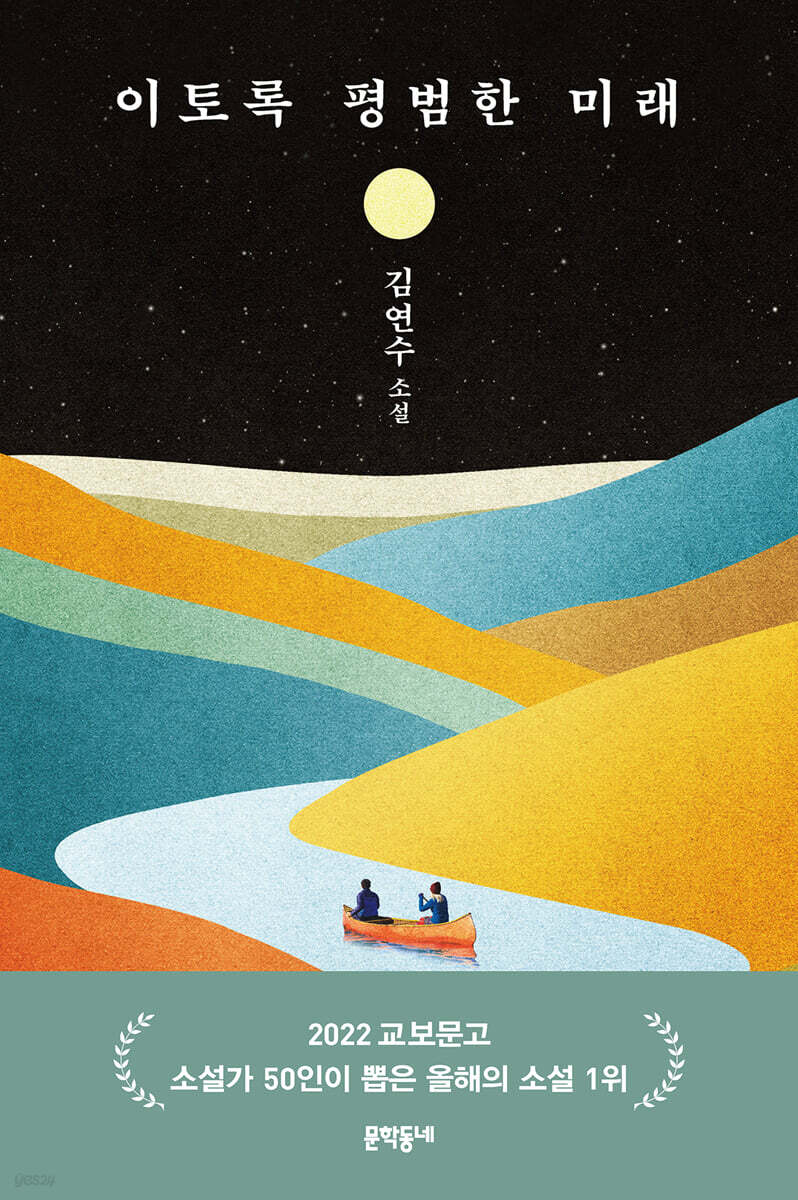
Such an ordinary future
 |
Description
Book Introduction
- A word from MD
-
It's our time to move towards the lightAuthor Kim Yeon-su's new novel collection after nine years.
The phrase 'remembering the future' may sound unfamiliar, but after reading these eight short stories, I think it will make sense.
As I follow the path of time expanding through various stories, I find myself wanting to live a 'third life'.
Looking forward to our times when a 'new wind' will blow.
October 7, 2022. Novel/Poetry PD Lee Na-young
Kim Yeon-su's new novel collection, her first in nine years
Eight Stories of Post-Apocalyptic Love
Author Kim Yeon-su breaks her long silence by publishing a new collection of short stories, “Such an Ordinary Future.”
This is the sixth collection of short stories published nine years after 『April Beauty, July Sol』(2013).
For him, who had been known as a prolific writer, consistently publishing novels every two to four years, the past nine years have been a time of “a strong internal desire to change” and “things that had to change externally” (as stated in an interview included in the special booklet “Attention Book”).
In a situation where things are constantly driving change both internally and externally, Kim Yeon-su has been carefully spending her time focusing on writing other than novels.
Where did the inner desire for change and the external demands take the writer?
"Such an Ordinary Future" is a collection of short stories that the author has been focusing on for the past two to three years, and it allows us to see Kim Yeon-su's changed perspective on the perception of "time."
By redefining time, which is often perceived as simply flowing from the past to the future, Kim Yeon-su uses beautiful, lyrical language to convince us of the possibility of reimagining present time, and thus life.
What's special is that the possibility is conveyed in the form of a 'story'.
In the summer of 1999, when the world was in an uproar over Nostradamus' prophecy that the end of the world would come, two twenty-one-year-old college students who decided to commit suicide together unexpectedly come across the time-travel novel "Ashes and Dust" and make an unexpected choice ("Such an Ordinary Future"), and a person who lost a child and was trapped in a distant darkness recalls the story of "Jeong Nan-ju," a historical figure who crossed the sea two hundred years ago in front of the sea that fills him with fear ("In Front of Nanju's Sea").
Moreover, in the eight stories included in this collection, the characters constantly tell stories to one another and create their own stories.
As if he were a careful observer experimenting with how the story might affect himself and others in the present.
By experiencing the process in which stories and life beautifully intertwine and permeate each other, we come to understand why some lives begin anew after encountering a story, and why loving stories makes us faithful to life.
This is the special result of Kim Yeon-su, who, after questioning the power of stories to the end, is, to borrow the expression of the novel, “a story addict who believes that one day everything in the world will turn into stories, and when that happens, there will be nothing that we cannot understand” (“What He Saw in Bayanzag”).
Eight Stories of Post-Apocalyptic Love
Author Kim Yeon-su breaks her long silence by publishing a new collection of short stories, “Such an Ordinary Future.”
This is the sixth collection of short stories published nine years after 『April Beauty, July Sol』(2013).
For him, who had been known as a prolific writer, consistently publishing novels every two to four years, the past nine years have been a time of “a strong internal desire to change” and “things that had to change externally” (as stated in an interview included in the special booklet “Attention Book”).
In a situation where things are constantly driving change both internally and externally, Kim Yeon-su has been carefully spending her time focusing on writing other than novels.
Where did the inner desire for change and the external demands take the writer?
"Such an Ordinary Future" is a collection of short stories that the author has been focusing on for the past two to three years, and it allows us to see Kim Yeon-su's changed perspective on the perception of "time."
By redefining time, which is often perceived as simply flowing from the past to the future, Kim Yeon-su uses beautiful, lyrical language to convince us of the possibility of reimagining present time, and thus life.
What's special is that the possibility is conveyed in the form of a 'story'.
In the summer of 1999, when the world was in an uproar over Nostradamus' prophecy that the end of the world would come, two twenty-one-year-old college students who decided to commit suicide together unexpectedly come across the time-travel novel "Ashes and Dust" and make an unexpected choice ("Such an Ordinary Future"), and a person who lost a child and was trapped in a distant darkness recalls the story of "Jeong Nan-ju," a historical figure who crossed the sea two hundred years ago in front of the sea that fills him with fear ("In Front of Nanju's Sea").
Moreover, in the eight stories included in this collection, the characters constantly tell stories to one another and create their own stories.
As if he were a careful observer experimenting with how the story might affect himself and others in the present.
By experiencing the process in which stories and life beautifully intertwine and permeate each other, we come to understand why some lives begin anew after encountering a story, and why loving stories makes us faithful to life.
This is the special result of Kim Yeon-su, who, after questioning the power of stories to the end, is, to borrow the expression of the novel, “a story addict who believes that one day everything in the world will turn into stories, and when that happens, there will be nothing that we cannot understand” (“What He Saw in Bayanzag”).
- You can preview some of the book's contents.
Preview
index
Such an ordinary future 007
In front of the sea of Nanju 037
Pearl's Ending 067
What he saw in Bayanzag 099
Motherless Children 129
I remember only one person 157
Love's Thoughts 2014 183
Again, to Barbara in 2100, 215
Commentary | Park Hye-jin (literary critic)
The Wind Blows 247
Author's Note 269
In front of the sea of Nanju 037
Pearl's Ending 067
What he saw in Bayanzag 099
Motherless Children 129
I remember only one person 157
Love's Thoughts 2014 183
Again, to Barbara in 2100, 215
Commentary | Park Hye-jin (literary critic)
The Wind Blows 247
Author's Note 269
Into the book
“The past is something we have already experienced, so we can fully imagine it, but the future exists only as a possibility, so we cannot imagine it at all.
That kind of thinking is where human tragedy lies.
“It is not the past that we must remember, but rather the future.”
---From "Such an Ordinary Future"
Now I know.
That this ordinary future is the one we must choose, even if it means continuing to lose.
And as long as you don't give up, the probability of that future coming is close to 100 percent.
---From "Such an Ordinary Future"
'It's all the same whether you hold on and hold on and fall.
But falling down doesn't mean it's over.
There's a next one.
You'll know when you get knocked out and lie on the ring floor.
When you fall like that, you can feel with your whole body that the air is different from before.
As the world slowly recedes, the disappointment of those who supported me is palpable, and I feel like I'm alone in this world.
Just then the wind blew.
To me.
---From "In Front of the Sea of Nanju"
We can't go to the moon, but we can walk as if we could.
If only I could find where the moon is.
Likewise, we can live as if we were walking to the moon.
If only I could find a direction of hope.
---From "The End of the Pearl"
There are countless stories within humans.
Sometimes I fall asleep full of hope that everything will be okay, only to wake up in the morning so terrified that I don't even want to get out of bed.
Human existence is an illogical story that doesn't make sense.
Still, I have chosen only the best ideas among them.
---From "The End of the Pearl"
The sky seen from the Gobi Desert also contained the vastness of time.
As night fell, the ancient sky emerged from the darkness.
Prehistoric times, or the primitive sky before humans appeared on Earth.
A sky full of stars.
Like the vast expanse of space, time also continued to stretch out.
Back to the past, back to the distant past, to the moment when time began.
In this way, time piled up and piled up, becoming infinitely deeper.
During his flight, he remembered the term "deep time" he had read in a book about understanding the desert.
That deep time was spread out before his eyes.
---From "What He Saw in Bayanzag"
At that time, Jeongmi was a storyteller who believed that one day everything in the world would turn into stories, and that when that happened, there would be nothing that they couldn't understand.
---From "What He Saw in Bayanzag"
“There comes a time when all faith withers.
There are times when I want to give up trusting in humanity and it seems like nothing will get better.
That's when you have no choice but to become an optimist.
“Like the Indian people on the bus with their heads bowed, believing that no matter how strong the sandstorm is, it will pass.”
---From "What He Saw in Bayanzag"
The actor compresses that temporal gap with his facial expression and reveals it under the light.
The present face contains both the past and the future.
Acting is impossible if you don't believe in the fluidity of the face.
Before going on stage, an actor's face must be like a blank canvas.
The face of possibility where youth and old age, man and woman, human and animal, living and inanimate things coexist.
Then, as if a face in the darkness is suddenly revealed by a flash of lightning, an expression is revealed through the smoke.
Perceptual close-up.
And I found out.
The embryology of all that love.
---From "Children Without Mothers"
Heejin wanted to stop crying right away, but that wasn't the kind of thing that could be done just by making up her mind.
The initiative of crying was held by crying.
---From "I Remember Only One Person"
So, could that memory have even the slightest influence on me, on my life, on the world I live in? Could this universe change even a little when we strive to remember someone?
---From "I Remember Only One Person"
The reason flowers fall is because their season has passed.
And the love ends because neither of them has the courage anymore.
---From "Love's Short Stories 2014"
I 100% agreed with my grandfather's words that since the physical life is too short to perceive this universe by experiencing everything firsthand, humans must shorten the time to perfect themselves by cooperating with one another through speech and writing.
Thanks to this, books have become a bridge that transcends our age difference.
---From "Again, to Barbara in 2100"
“I used to think that as people got older, they all became pessimistic.
That was another pessimism for me.
(…) I think it would be terrible if I became an old man who thought the world was getting worse as I got older.”
---From "Again, to Barbara in 2100"
“What we discover after we move away from individuality is that our minds are somewhat overlapping.
They overlap temporally and spatially.
That is why the life of the mind continues a little longer after the life of the body ends.
If we live eighty years physically, we can live another eighty years mentally into the past and eighty years into the future.
Therefore, we can say that our spiritual life lasts for two hundred and forty years.
“If anyone could experience two hundred and forty years, they would be optimistic about the future.”
---From "Again, to Barbara in 2100"
As my grandfather said, if we can think so clearly about our past selves, why is it impossible to think about our future selves? And yet, we must.
And being able to think.
That was my grandfather's final realization.
That kind of thinking is where human tragedy lies.
“It is not the past that we must remember, but rather the future.”
---From "Such an Ordinary Future"
Now I know.
That this ordinary future is the one we must choose, even if it means continuing to lose.
And as long as you don't give up, the probability of that future coming is close to 100 percent.
---From "Such an Ordinary Future"
'It's all the same whether you hold on and hold on and fall.
But falling down doesn't mean it's over.
There's a next one.
You'll know when you get knocked out and lie on the ring floor.
When you fall like that, you can feel with your whole body that the air is different from before.
As the world slowly recedes, the disappointment of those who supported me is palpable, and I feel like I'm alone in this world.
Just then the wind blew.
To me.
---From "In Front of the Sea of Nanju"
We can't go to the moon, but we can walk as if we could.
If only I could find where the moon is.
Likewise, we can live as if we were walking to the moon.
If only I could find a direction of hope.
---From "The End of the Pearl"
There are countless stories within humans.
Sometimes I fall asleep full of hope that everything will be okay, only to wake up in the morning so terrified that I don't even want to get out of bed.
Human existence is an illogical story that doesn't make sense.
Still, I have chosen only the best ideas among them.
---From "The End of the Pearl"
The sky seen from the Gobi Desert also contained the vastness of time.
As night fell, the ancient sky emerged from the darkness.
Prehistoric times, or the primitive sky before humans appeared on Earth.
A sky full of stars.
Like the vast expanse of space, time also continued to stretch out.
Back to the past, back to the distant past, to the moment when time began.
In this way, time piled up and piled up, becoming infinitely deeper.
During his flight, he remembered the term "deep time" he had read in a book about understanding the desert.
That deep time was spread out before his eyes.
---From "What He Saw in Bayanzag"
At that time, Jeongmi was a storyteller who believed that one day everything in the world would turn into stories, and that when that happened, there would be nothing that they couldn't understand.
---From "What He Saw in Bayanzag"
“There comes a time when all faith withers.
There are times when I want to give up trusting in humanity and it seems like nothing will get better.
That's when you have no choice but to become an optimist.
“Like the Indian people on the bus with their heads bowed, believing that no matter how strong the sandstorm is, it will pass.”
---From "What He Saw in Bayanzag"
The actor compresses that temporal gap with his facial expression and reveals it under the light.
The present face contains both the past and the future.
Acting is impossible if you don't believe in the fluidity of the face.
Before going on stage, an actor's face must be like a blank canvas.
The face of possibility where youth and old age, man and woman, human and animal, living and inanimate things coexist.
Then, as if a face in the darkness is suddenly revealed by a flash of lightning, an expression is revealed through the smoke.
Perceptual close-up.
And I found out.
The embryology of all that love.
---From "Children Without Mothers"
Heejin wanted to stop crying right away, but that wasn't the kind of thing that could be done just by making up her mind.
The initiative of crying was held by crying.
---From "I Remember Only One Person"
So, could that memory have even the slightest influence on me, on my life, on the world I live in? Could this universe change even a little when we strive to remember someone?
---From "I Remember Only One Person"
The reason flowers fall is because their season has passed.
And the love ends because neither of them has the courage anymore.
---From "Love's Short Stories 2014"
I 100% agreed with my grandfather's words that since the physical life is too short to perceive this universe by experiencing everything firsthand, humans must shorten the time to perfect themselves by cooperating with one another through speech and writing.
Thanks to this, books have become a bridge that transcends our age difference.
---From "Again, to Barbara in 2100"
“I used to think that as people got older, they all became pessimistic.
That was another pessimism for me.
(…) I think it would be terrible if I became an old man who thought the world was getting worse as I got older.”
---From "Again, to Barbara in 2100"
“What we discover after we move away from individuality is that our minds are somewhat overlapping.
They overlap temporally and spatially.
That is why the life of the mind continues a little longer after the life of the body ends.
If we live eighty years physically, we can live another eighty years mentally into the past and eighty years into the future.
Therefore, we can say that our spiritual life lasts for two hundred and forty years.
“If anyone could experience two hundred and forty years, they would be optimistic about the future.”
---From "Again, to Barbara in 2100"
As my grandfather said, if we can think so clearly about our past selves, why is it impossible to think about our future selves? And yet, we must.
And being able to think.
That was my grandfather's final realization.
---From "Again, to Barbara in 2100"
Publisher's Review
When you reach the point where you think everything is over
The best future, that is
If you can imagine such an ordinary future
Eight ways in which novels imagine time
The wondrous moment when a story changes our lives
"This Ordinary Future," which shows how the end of the world and the beginning of love can coexist, unfolds as two stories intertwine with the keyword "future."
The first is the story of 'me' and 'Jimin' that happened in the summer of 1999.
Not long after the end-of-semester party, the twenty-one-year-old 'I' heads to the publishing company where my uncle works as an editor with Jimin.
To find out what kind of book 『Ashes and Dust』, a full-length novel that is banned from publication and impossible to obtain, was written by Jimin's mother before she committed suicide.
My maternal uncle, who has only read books his entire life, recalls a book that came out in the 1970s and explains its contents. The two are shocked when they hear the plot.
This is where the second story begins.
There is a lover in the novel.
They realize that the end of their time together, the end of their love, is approaching and choose to commit suicide together.
But at that moment, the life you have lived so far unfolds before your eyes, and a new life begins.
This time, not in the forward direction from the past to the future, but in the reverse direction.
The day you commit suicide together becomes the first day of a new life, and when you wake up, it becomes the day before.
The reason why Jimin and I were surprised when we heard our uncle's story was because the plot seemed to predict their future.
The two planned to commit suicide together that summer.
After hearing the two people's plan, the uncle continues to explain about "Ashes and Dust."
In the novel, the lovers discover that if they travel back in time, they will find themselves back at the moment they first met.
How happy and excited they were at that time.
In their second life, which progresses from the future to the past, they first experience the events that resulted from that encounter.
While actively imagining the future, or rather the past as it was, the two realize “how imagining the best comes last changes the present” (p. 23), and in the end, time begins to flow again as it did from the past to the future.
After a long conversation, the uncle speaks to the two people.
“The past is something we have already experienced, so we can fully imagine it, but the future exists only as a possibility, so we cannot imagine it at all.
That kind of thinking is where human tragedy lies.
“What we must remember is not the past, but rather the future.” (p. 29)
“Back to Barbara in 2100” explores the task of imagining the future in a slightly longer time dimension.
'I' recalls an old memory when I hear that my grandfather, who was hospitalized, talks to himself as if he were talking to someone after his condition worsened, and that the baptismal name 'Barbara' appears repeatedly in his conversation.
I, who works at a publishing company, once had a plan to record my grandfather's story and make it into a book, but it all fell through.
'I' wondered if 'Barbara' was in my grandfather's story, so I opened the transcript and searched for it, and found out that the Barbara my grandfather was talking about was none other than his youngest sister, who was taken away by the Political Security Service agents and unjustly killed in 1949 when my grandfather was in a monastery in North Korea.
Because of that, my grandfather suffered from a 'complete closure of his soul' and became a different person than before.
But life goes on even after the pain, and Grandpa finds the strength to continue living through the stories of other Barbaras.
It is about another Barbara who decided to remain a virgin all her life and received the sacrament 'even to the point of accepting illness', and died in 1850.
The story is told in a book published in 1980, but my grandfather had heard about Barbara directly from his own grandfather 50 years earlier.
Grandfather, realizing that Barbara of 1850 is directly connected to Barbara of 1949 and to himself through conversation, comes to the following conclusion:
“If we live eighty years physically, we can live another eighty years in the past and eighty years in the future mentally.
Therefore, we can say that our spiritual life lasts for two hundred and forty years.
“If anyone could experience two hundred and forty years, they would be optimistic about the future.” (p. 231) The novel does not stop there, but sets up a situation where, a long time later, the grandfather encounters a character involved in the younger brother’s death.
In a situation where he is within arm's reach, yet the grandfather does nothing.
No, to be precise, I try my best not to do anything.
This was possible because my grandfather was a person who ‘must think and believe that he can think’ even when it was impossible to ‘think about the future of us’ (p. 240).
As if putting into practice the uncle's words in "Such an Ordinary Future" that "we must remember the future," and as if showing us what will unfold before us if we do so, the difficult decision that the grandfather made leaves a deep and moving impression, making us think about the meaning of "remembering the future" in terms of action.
“When we try to understand others, our lives
You said it was worth living for,
“Is it really possible to understand someone?”
“It shows how far we have come in reflecting on ‘understanding others,’ a theme that is like Kim Yeon-su’s signature.
(…) “The author’s efforts to expand his own novelistic territory are felt,” and “The End of Pearl,” which was selected as the 2022 Kim Seung-ok Literary Award Excellence Award winner, is a novel that explores the truth of the case by dealing with the story of a criminal psychologist, “I,” and the suspect, “Yu Jin-ju.”
'I', who appeared on the current affairs program 'End of the Incident', analyzed Eugene Joo, a single woman in her late thirties who is suspected of murdering her father who suffered from dementia and setting fire to her house.
He is not an active criminal, but rather a passive victim who accidentally committed a crime because he suppressed his emotions while living while caring for his father after his mother passed away.
And after the broadcast, the next morning, an email from Eugene Joo arrives to me.
Eugene Joo says:
It's true that I wanted my father to die, and it's also true that I feel guilty about his death.
But he said he didn't kill his father.
And from this point on, a tense chapter of interpretation between 'me' and Eugene Joo surrounding the incident opens.
“I don’t think there could be a hidden truth in humans” (page 75) and the teacher’s premise that “I was driven into a situation where I had no choice but to kill my father” is wrong from the start.
As the tension builds as Eugene Joo continues to argue, saying, “So, the subsequent analyses are bound to be wrong as well” (page 84), we find ourselves meaningfully pondering the following sentence from the beginning of the novel.
“A time traveler can decide which events to observe and which to ignore.
Whatever happens, happens and the ending is the same.
However, each person can choose which stepping stones to take to reach the conclusion.” (Page 71) The story about the time traveler mentioned in the first email that Eugene Joo sent to me also means that when an event occurs, we each create a story by choosing the process through which we reach the conclusion.
When I, the criminal psychologist, can decide for myself what to watch and what to ignore, what did I choose and what did I ignore, and what did Eugene, the suspect, choose and what did I ignore?
Even if each person passes through different stepping stones and reaches the same ending, can that ending really be the same ending?
If "The End of Pearl" explores the (im)possibility of "understanding someone" through a murder case, "I Only Remember One Person" examines the meaning of "remembering someone" through the relationship between lovers.
Among the included works, the first one written, “I Remember Only One Person,” begins in April 2014 when “I” receives an email from his former lover, “Heejin.”
In the email, which seems to go on forever, Heejin explains the chain of coincidences that happened to her.
He came to Japan as a representative of Korean indie singers, and while singing his self-composed song “I Remember One Person” during a performance, he ended up crying.
At the after-party after the performance, he met a man in his fifties named Jun Fukuda, who said that he had gone to great lengths to invite him to this performance.
When she asks why he was looking for her like that, Fukuda explains what happened to him 10 years ago. It was related to an incident when he went to a Japanese cafe when Heejin and 'I' were still a couple, and gave the owner a CD of the song "White Grave" that Heejin enjoyed listening to at the time, asking him to play it, but he forgot and left the CD in the cafe.
At the time, Fukuda, who was contemplating suicide after a series of failures, happened to go to that cafe and heard the very song he had loved as a child, which gave him back the meaning of life.
And he discovered the initials 'H.J' written along with the lyrics of 'White Grave' in the cafe guestbook.
So from then on, I was looking for a Korean indie singer with the initials HJ.
After a lengthy explanation, Heejin adds:
“At some point, I started thinking about how I started to remember myself, even though I had never met him and didn’t even know his face.
I'm talking about someone who remembered me even when I didn't even know that such a person lived in this world.
“Then, can that memory have even a little influence on me, on my life, on this world I live in? Can this universe change even a little when we try to remember someone?” (p. 181) Although it was asked in a questioning tone, through the story of Fukuda Jun told by Heejin, we come to understand that ‘when we try to remember someone, this universe can change even a little’, and considering that this work was written in the winter of the year the Sewol Ferry disaster occurred, we come to understand that these words contain a certain earnestness.
"Love's Fragments, 2014" also shows how changes on a personal level can be connected to changes on a social level.
Ji-hoon, who broke up with his lover three years ago, believed that “eternal summer was an illusion, and that everything has an end” (p. 196), but when he happened to search for “I love you” on a news site and saw a list of articles, he realized that “a love that has begun never ends, (…) you just forget, so you have to remember, and when you remember that love was there, you can love forever” (p. 211).
The list of articles is a love letter sent by parents and friends to the children who died in the Sewol Ferry disaster, along with the words, "We will not forget."
No one can deny the eternity of love before him.
If Kim Yeon-su in 2014 pondered what a writer could do when a major social incident occurred, Kim Yeon-su in the 2020s seems to be pondering what a writer can do in the face of an unavoidable disaster.
The novelist 'Jeong Hyeon' of 'In Front of the Sea of Nanju' goes to Chujado Island after receiving a lecture request and meets his college classmate 'Son Yu-mi' by chance after 30 years.
Son Yu-mi, who dreamed of writing mystery novels during her college years, is now living her dream of writing mystery novels.
The only difference from those days is that a few years ago, I lost a child and my life was thrown into disarray.
One of the things that helped Son Yu-mi get back on her feet in a situation where she “could never go back to her previous life” (page 58) was the word “second wind” that Jeong-hyeon had once told her.
This sports term, which refers to a state where 'pain is reduced during exercise and the desire to continue exercising arises', is, according to Jeong Hyeon, a 'breath of fresh air' that blows when extreme pain is reached.
It's all the same whether you hold on and hold on and fall.
But falling down doesn't mean it's over.
There's a next one.
You'll know when you get knocked out and lie on the ring floor.
When you fall like that, you can feel with your whole body that the air is different from before.
As the world slowly recedes, the disappointment of those who supported me is palpable, and I feel like I'm alone in this world.
Just then the wind blew.
To me. (Page 60)
And the story that Son Yu-mi recalled with Second Wind is about Jeong Nan-ju.
It is said that Jeong Nan-ju, who was exiled to Jeju Island with her newborn baby after her family was wiped out 200 years ago, survived the extreme suffering and became a grandmother.
After pondering how Jeong Nan-ju was able to live for so long without giving up her life, Son Yu-mi came to the conclusion that Jeong Nan-ju must have held on to the belief that 'her child can live only if she lives.'
Here we again see in "The Ending of the Pearl" that "what is meant to happen will happen and the ending is the same.
It reminds me of the sentence, “However, each person can choose which stepping stones to pass through to reach the end.”
The ending doesn't change, but it's up to each person to choose which story to follow.
And that choice obviously affects who you are today.
It's as if Son Yu-mi created her own story, a little different from the story of Jeong Nan-ju that has been passed down to us today.
And just like that story, it was at a crucial moment that Son Yu-mi woke up.
Therefore, after reading the eight novels included in 『Such an Ordinary Future』, we will feel that the saying, "We must imagine the future" also means, "We must actively imagine the story."
Just as the words spoken by Jeong-Hyeon 30 years ago in “In Front of the Sea of Nanju” reached Son Yu-Mi after a long time, at a middle school in Chujado, Jeong-Hyeon said to the children, “I hope that your future will be a little better.
But as you get older, there will be times when things get tough.
Because I was like that too.
Just as we can imagine without a doubt that Kenji Miyazawa's poem, which he shared with the words, "When you feel like dying because it's hard, I hope you remember today" (p. 48), will reach someone at an unexpected moment, Kim Yeon-su's new novel seems to awaken us to the beauty of imagining the future, of sensing time on a broader and deeper level, and ultimately, of finding the "direction of hope" (p. 73) through storytelling, the best way a novel can do this.
Author's Note
I haven't written a short story for a long time.
When you don't have anything to write about, you can't write about it.
Then, in 2020, as the COVID-19 virus swept the world, I felt like writing something.
If you ask me what kind of story I wanted to write, I would have to tell you a line from another of Mary Oliver's poems, "The Golden Road."
“What better place could there be than these bodies filled with light?” he wrote.
I now know very well what happened before this wonderful sentence.
The previous verse is as follows:
“Isn’t the hard work of our lives/full of dark times?”
‘Dark times’ create ‘this body filled with light.’
This is the story I want to write now.
And these stories will one day become our lives.
The best future, that is
If you can imagine such an ordinary future
Eight ways in which novels imagine time
The wondrous moment when a story changes our lives
"This Ordinary Future," which shows how the end of the world and the beginning of love can coexist, unfolds as two stories intertwine with the keyword "future."
The first is the story of 'me' and 'Jimin' that happened in the summer of 1999.
Not long after the end-of-semester party, the twenty-one-year-old 'I' heads to the publishing company where my uncle works as an editor with Jimin.
To find out what kind of book 『Ashes and Dust』, a full-length novel that is banned from publication and impossible to obtain, was written by Jimin's mother before she committed suicide.
My maternal uncle, who has only read books his entire life, recalls a book that came out in the 1970s and explains its contents. The two are shocked when they hear the plot.
This is where the second story begins.
There is a lover in the novel.
They realize that the end of their time together, the end of their love, is approaching and choose to commit suicide together.
But at that moment, the life you have lived so far unfolds before your eyes, and a new life begins.
This time, not in the forward direction from the past to the future, but in the reverse direction.
The day you commit suicide together becomes the first day of a new life, and when you wake up, it becomes the day before.
The reason why Jimin and I were surprised when we heard our uncle's story was because the plot seemed to predict their future.
The two planned to commit suicide together that summer.
After hearing the two people's plan, the uncle continues to explain about "Ashes and Dust."
In the novel, the lovers discover that if they travel back in time, they will find themselves back at the moment they first met.
How happy and excited they were at that time.
In their second life, which progresses from the future to the past, they first experience the events that resulted from that encounter.
While actively imagining the future, or rather the past as it was, the two realize “how imagining the best comes last changes the present” (p. 23), and in the end, time begins to flow again as it did from the past to the future.
After a long conversation, the uncle speaks to the two people.
“The past is something we have already experienced, so we can fully imagine it, but the future exists only as a possibility, so we cannot imagine it at all.
That kind of thinking is where human tragedy lies.
“What we must remember is not the past, but rather the future.” (p. 29)
“Back to Barbara in 2100” explores the task of imagining the future in a slightly longer time dimension.
'I' recalls an old memory when I hear that my grandfather, who was hospitalized, talks to himself as if he were talking to someone after his condition worsened, and that the baptismal name 'Barbara' appears repeatedly in his conversation.
I, who works at a publishing company, once had a plan to record my grandfather's story and make it into a book, but it all fell through.
'I' wondered if 'Barbara' was in my grandfather's story, so I opened the transcript and searched for it, and found out that the Barbara my grandfather was talking about was none other than his youngest sister, who was taken away by the Political Security Service agents and unjustly killed in 1949 when my grandfather was in a monastery in North Korea.
Because of that, my grandfather suffered from a 'complete closure of his soul' and became a different person than before.
But life goes on even after the pain, and Grandpa finds the strength to continue living through the stories of other Barbaras.
It is about another Barbara who decided to remain a virgin all her life and received the sacrament 'even to the point of accepting illness', and died in 1850.
The story is told in a book published in 1980, but my grandfather had heard about Barbara directly from his own grandfather 50 years earlier.
Grandfather, realizing that Barbara of 1850 is directly connected to Barbara of 1949 and to himself through conversation, comes to the following conclusion:
“If we live eighty years physically, we can live another eighty years in the past and eighty years in the future mentally.
Therefore, we can say that our spiritual life lasts for two hundred and forty years.
“If anyone could experience two hundred and forty years, they would be optimistic about the future.” (p. 231) The novel does not stop there, but sets up a situation where, a long time later, the grandfather encounters a character involved in the younger brother’s death.
In a situation where he is within arm's reach, yet the grandfather does nothing.
No, to be precise, I try my best not to do anything.
This was possible because my grandfather was a person who ‘must think and believe that he can think’ even when it was impossible to ‘think about the future of us’ (p. 240).
As if putting into practice the uncle's words in "Such an Ordinary Future" that "we must remember the future," and as if showing us what will unfold before us if we do so, the difficult decision that the grandfather made leaves a deep and moving impression, making us think about the meaning of "remembering the future" in terms of action.
“When we try to understand others, our lives
You said it was worth living for,
“Is it really possible to understand someone?”
“It shows how far we have come in reflecting on ‘understanding others,’ a theme that is like Kim Yeon-su’s signature.
(…) “The author’s efforts to expand his own novelistic territory are felt,” and “The End of Pearl,” which was selected as the 2022 Kim Seung-ok Literary Award Excellence Award winner, is a novel that explores the truth of the case by dealing with the story of a criminal psychologist, “I,” and the suspect, “Yu Jin-ju.”
'I', who appeared on the current affairs program 'End of the Incident', analyzed Eugene Joo, a single woman in her late thirties who is suspected of murdering her father who suffered from dementia and setting fire to her house.
He is not an active criminal, but rather a passive victim who accidentally committed a crime because he suppressed his emotions while living while caring for his father after his mother passed away.
And after the broadcast, the next morning, an email from Eugene Joo arrives to me.
Eugene Joo says:
It's true that I wanted my father to die, and it's also true that I feel guilty about his death.
But he said he didn't kill his father.
And from this point on, a tense chapter of interpretation between 'me' and Eugene Joo surrounding the incident opens.
“I don’t think there could be a hidden truth in humans” (page 75) and the teacher’s premise that “I was driven into a situation where I had no choice but to kill my father” is wrong from the start.
As the tension builds as Eugene Joo continues to argue, saying, “So, the subsequent analyses are bound to be wrong as well” (page 84), we find ourselves meaningfully pondering the following sentence from the beginning of the novel.
“A time traveler can decide which events to observe and which to ignore.
Whatever happens, happens and the ending is the same.
However, each person can choose which stepping stones to take to reach the conclusion.” (Page 71) The story about the time traveler mentioned in the first email that Eugene Joo sent to me also means that when an event occurs, we each create a story by choosing the process through which we reach the conclusion.
When I, the criminal psychologist, can decide for myself what to watch and what to ignore, what did I choose and what did I ignore, and what did Eugene, the suspect, choose and what did I ignore?
Even if each person passes through different stepping stones and reaches the same ending, can that ending really be the same ending?
If "The End of Pearl" explores the (im)possibility of "understanding someone" through a murder case, "I Only Remember One Person" examines the meaning of "remembering someone" through the relationship between lovers.
Among the included works, the first one written, “I Remember Only One Person,” begins in April 2014 when “I” receives an email from his former lover, “Heejin.”
In the email, which seems to go on forever, Heejin explains the chain of coincidences that happened to her.
He came to Japan as a representative of Korean indie singers, and while singing his self-composed song “I Remember One Person” during a performance, he ended up crying.
At the after-party after the performance, he met a man in his fifties named Jun Fukuda, who said that he had gone to great lengths to invite him to this performance.
When she asks why he was looking for her like that, Fukuda explains what happened to him 10 years ago. It was related to an incident when he went to a Japanese cafe when Heejin and 'I' were still a couple, and gave the owner a CD of the song "White Grave" that Heejin enjoyed listening to at the time, asking him to play it, but he forgot and left the CD in the cafe.
At the time, Fukuda, who was contemplating suicide after a series of failures, happened to go to that cafe and heard the very song he had loved as a child, which gave him back the meaning of life.
And he discovered the initials 'H.J' written along with the lyrics of 'White Grave' in the cafe guestbook.
So from then on, I was looking for a Korean indie singer with the initials HJ.
After a lengthy explanation, Heejin adds:
“At some point, I started thinking about how I started to remember myself, even though I had never met him and didn’t even know his face.
I'm talking about someone who remembered me even when I didn't even know that such a person lived in this world.
“Then, can that memory have even a little influence on me, on my life, on this world I live in? Can this universe change even a little when we try to remember someone?” (p. 181) Although it was asked in a questioning tone, through the story of Fukuda Jun told by Heejin, we come to understand that ‘when we try to remember someone, this universe can change even a little’, and considering that this work was written in the winter of the year the Sewol Ferry disaster occurred, we come to understand that these words contain a certain earnestness.
"Love's Fragments, 2014" also shows how changes on a personal level can be connected to changes on a social level.
Ji-hoon, who broke up with his lover three years ago, believed that “eternal summer was an illusion, and that everything has an end” (p. 196), but when he happened to search for “I love you” on a news site and saw a list of articles, he realized that “a love that has begun never ends, (…) you just forget, so you have to remember, and when you remember that love was there, you can love forever” (p. 211).
The list of articles is a love letter sent by parents and friends to the children who died in the Sewol Ferry disaster, along with the words, "We will not forget."
No one can deny the eternity of love before him.
If Kim Yeon-su in 2014 pondered what a writer could do when a major social incident occurred, Kim Yeon-su in the 2020s seems to be pondering what a writer can do in the face of an unavoidable disaster.
The novelist 'Jeong Hyeon' of 'In Front of the Sea of Nanju' goes to Chujado Island after receiving a lecture request and meets his college classmate 'Son Yu-mi' by chance after 30 years.
Son Yu-mi, who dreamed of writing mystery novels during her college years, is now living her dream of writing mystery novels.
The only difference from those days is that a few years ago, I lost a child and my life was thrown into disarray.
One of the things that helped Son Yu-mi get back on her feet in a situation where she “could never go back to her previous life” (page 58) was the word “second wind” that Jeong-hyeon had once told her.
This sports term, which refers to a state where 'pain is reduced during exercise and the desire to continue exercising arises', is, according to Jeong Hyeon, a 'breath of fresh air' that blows when extreme pain is reached.
It's all the same whether you hold on and hold on and fall.
But falling down doesn't mean it's over.
There's a next one.
You'll know when you get knocked out and lie on the ring floor.
When you fall like that, you can feel with your whole body that the air is different from before.
As the world slowly recedes, the disappointment of those who supported me is palpable, and I feel like I'm alone in this world.
Just then the wind blew.
To me. (Page 60)
And the story that Son Yu-mi recalled with Second Wind is about Jeong Nan-ju.
It is said that Jeong Nan-ju, who was exiled to Jeju Island with her newborn baby after her family was wiped out 200 years ago, survived the extreme suffering and became a grandmother.
After pondering how Jeong Nan-ju was able to live for so long without giving up her life, Son Yu-mi came to the conclusion that Jeong Nan-ju must have held on to the belief that 'her child can live only if she lives.'
Here we again see in "The Ending of the Pearl" that "what is meant to happen will happen and the ending is the same.
It reminds me of the sentence, “However, each person can choose which stepping stones to pass through to reach the end.”
The ending doesn't change, but it's up to each person to choose which story to follow.
And that choice obviously affects who you are today.
It's as if Son Yu-mi created her own story, a little different from the story of Jeong Nan-ju that has been passed down to us today.
And just like that story, it was at a crucial moment that Son Yu-mi woke up.
Therefore, after reading the eight novels included in 『Such an Ordinary Future』, we will feel that the saying, "We must imagine the future" also means, "We must actively imagine the story."
Just as the words spoken by Jeong-Hyeon 30 years ago in “In Front of the Sea of Nanju” reached Son Yu-Mi after a long time, at a middle school in Chujado, Jeong-Hyeon said to the children, “I hope that your future will be a little better.
But as you get older, there will be times when things get tough.
Because I was like that too.
Just as we can imagine without a doubt that Kenji Miyazawa's poem, which he shared with the words, "When you feel like dying because it's hard, I hope you remember today" (p. 48), will reach someone at an unexpected moment, Kim Yeon-su's new novel seems to awaken us to the beauty of imagining the future, of sensing time on a broader and deeper level, and ultimately, of finding the "direction of hope" (p. 73) through storytelling, the best way a novel can do this.
Author's Note
I haven't written a short story for a long time.
When you don't have anything to write about, you can't write about it.
Then, in 2020, as the COVID-19 virus swept the world, I felt like writing something.
If you ask me what kind of story I wanted to write, I would have to tell you a line from another of Mary Oliver's poems, "The Golden Road."
“What better place could there be than these bodies filled with light?” he wrote.
I now know very well what happened before this wonderful sentence.
The previous verse is as follows:
“Isn’t the hard work of our lives/full of dark times?”
‘Dark times’ create ‘this body filled with light.’
This is the story I want to write now.
And these stories will one day become our lives.
GOODS SPECIFICS
- Publication date: October 7, 2022
- Page count, weight, size: 276 pages | 406g | 133*200*20mm
- ISBN13: 9788954680004
- ISBN10: 8954680003
You may also like
카테고리
korean


korean

![GQ KOREA Mark (Monthly): December [2025]](http://librairie.coreenne.fr/cdn/shop/files/8ef265dbbfbf186523ed75ba7319009d.jpg?v=1765340328&width=3840)


