

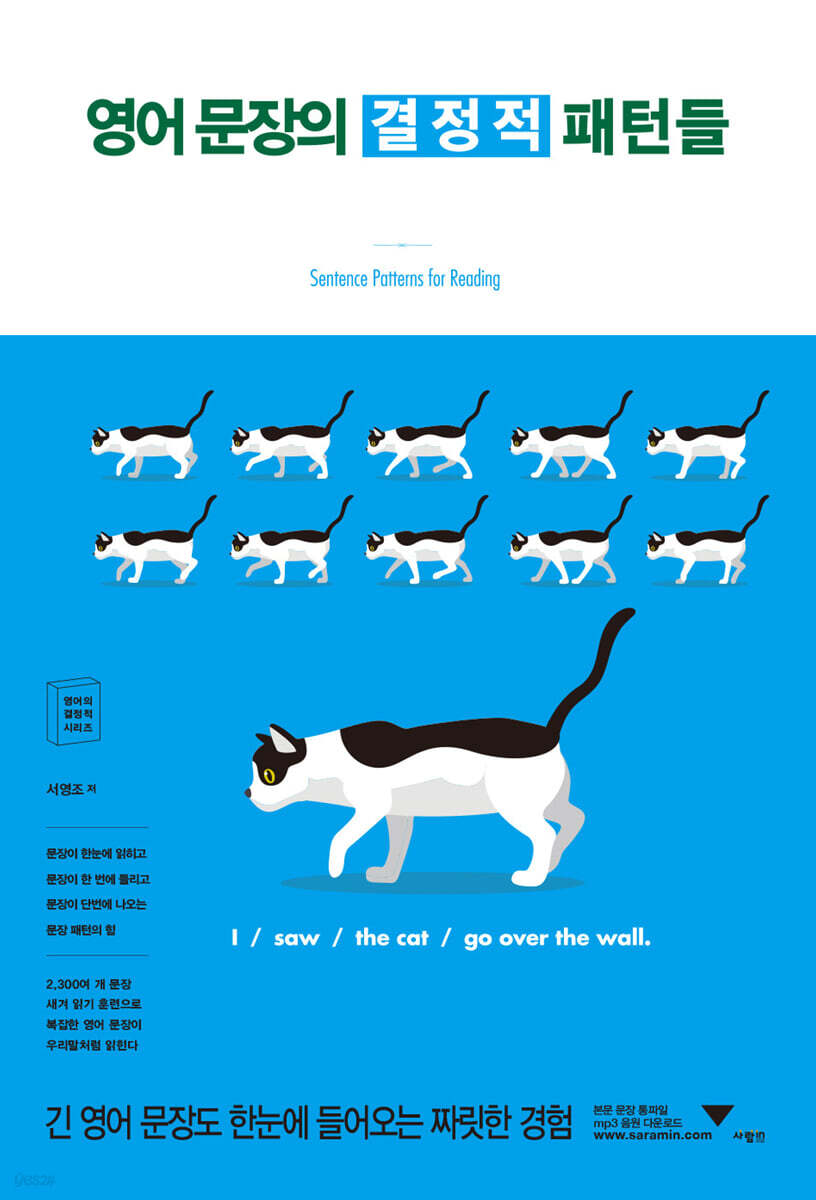
Critical patterns in English sentences
 |
Description
Book Introduction
195 sentence patterns that help you understand even long English sentences at a glance!
The key to understanding English sentences is being able to accurately grasp the sentence pattern, that is, knowing where the subject ends, what the verb is, and where the modifier ends.
This book improves reading comprehension by selecting 195 sentence patterns that help you read English sentences at a glance and providing intensive reading training for approximately 2,300 sentences.
The reason why it is necessary to improve English reading comprehension is because reading text is the most basic action that allows you to acquire information faster than others.
This ranges from quickly reading long passages on official exams, understanding English newspapers that provide updates on the ever-changing world situation, to reading the labels on imported goods.
When you combine your vocabulary skills with sentence patterns that accurately tell you the coordinates of sentence components, you can read long English sentences accurately at a glance and get information one step ahead.
The key to understanding English sentences is being able to accurately grasp the sentence pattern, that is, knowing where the subject ends, what the verb is, and where the modifier ends.
This book improves reading comprehension by selecting 195 sentence patterns that help you read English sentences at a glance and providing intensive reading training for approximately 2,300 sentences.
The reason why it is necessary to improve English reading comprehension is because reading text is the most basic action that allows you to acquire information faster than others.
This ranges from quickly reading long passages on official exams, understanding English newspapers that provide updates on the ever-changing world situation, to reading the labels on imported goods.
When you combine your vocabulary skills with sentence patterns that accurately tell you the coordinates of sentence components, you can read long English sentences accurately at a glance and get information one step ahead.
- You can preview some of the book's contents.
Preview
index
Introduction: Why should we know sentence patterns?
Structure and Use of This Book
Let's know in advance
PART 1 Patterns you need to know in advance
CHAPTER 1 Various combinations of sentence elements
SENTENCE PATTERN 001 Form 1: Subject + Verb
SENTENCE PATTERN 002 Form 1: Subject + be verb (+ place)
SENTENCE PATTERN 003 Form 1: There is + subject (singular noun) / There are + subject (plural noun)
SENTENCE PATTERN 004 Form 1: There + regular verb + subject
SENTENCE PATTERN 005 Form 2: Subject + Verb "be" + Complement (Noun (Phrase)/Adjective)
SENTENCE PATTERN 006 Form 2: Subject + become-type verb + complement (noun (phrase)/adjective)
SENTENCE PATTERN 007 Form 2: Subject + Verb + Complement (to-infinitive/gerund)
SENTENCE PATTERN 008 Form 2: Subject + Verb + Complement (Interrogative Word + To-Infinitive)
SENTENCE PATTERN 009 Form 2: Subject + Verb + Complement (Conjunction that-clause)
SENTENCE PATTERN 010 Type 2: Subject + Verb + Complement (Interrogative Clause)
SENTENCE PATTERN 011 Form 2: Subject + Verb + Complement (Relative Pronoun What Clause)
SENTENCE PATTERN 012 2nd Form: Subject + look/feel + adjective
Subject + look like/feel like + noun
Subject + look like/feel like + subject + verb
SENTENCE PATTERN 013 2nd Form: Subject + sound/smell/taste + adjective
Subject + sound/smell/taste like + noun
SENTENCE PATTERN 014 Form 2: It is + complement + to-infinitive / It is + complement + that clause
SENTENCE PATTERN 015 3rd Form: Subject + Verb + Object (Noun/Pronoun)
SENTENCE PATTERN 016 3rd Form: Subject + Verb + Object (Gerund)
SENTENCE PATTERN 017 3rd Form: Subject + Verb + Object (to-infinitive)
SENTENCE PATTERN 018 3rd Form: Subject + Verb + Object (Interrogative Phrase)
SENTENCE PATTERN 019 3rd Form: Subject + Verb + Object (that/if/whether clause)
SENTENCE PATTERN 020 3rd Form: Subject + Verb + Object (Interrogative Clause)
SENTENCE PATTERN 021 3rd Form: Subject + Verb + Relative Pronoun what + Subject + Verb
Subject + Verb + Relative Pronoun what + Verb
SENTENCE PATTERN 022 4-Format: Subject + Verb + Indirect Object + Direct Object
SENTENCE PATTERN 023 Sentences in which the 4th form is converted into the 3rd form: Subject + Verb + Direct Object + to + Indirect Object
SENTENCE PATTERN 024 Sentences in which the 4th form is converted into the 3rd form: Subject + Verb + Direct Object + For/Of + Indirect Object
SENTENCE PATTERN 025 5th Form: Subject + Verb + Object + Objective Complement (Noun/Adjective)
SENTENCE PATTERN 026 Form 5: Subject + Perceptual Verb + Object + Objective Complement (Verb Infinitive/-ing/-ed)
SENTENCE PATTERN 027 Form 5: Subject + causative verb + object + objective complement (verb infinitive/-ed)
SENTENCE PATTERN 028 Form 5: Subject + Verb + Object + Objective Complement (to-infinitive)
SENTENCE PATTERN 029 Form 5: Subject + Verb + it (pseudo-object) + Objective Complement + Real Object (to-infinitive/that clause)
CHAPTER 2 Different Types of Sentences
SENTENCE PATTERN 030 Negative Sentences (1): Negative Sentences with the Verb "Be"
SENTENCE PATTERN 031 Negative Sentences (2): Negative Sentences with Regular Verbs
SENTENCE PATTERN 032 Negative Sentences (3): Auxiliary Verb Negative Sentences
SENTENCE PATTERN 033 Interrogative Sentences (1): Be Verb Interrogative Sentences
SENTENCE PATTERN 034 Interrogative Sentence (2): Interrogative Word + Be Verb Interrogative Sentence
SENTENCE PATTERN 035 Interrogative Sentences (3): Regular Verb Interrogative Sentences
SENTENCE PATTERN 036 Interrogative Sentence (4): Interrogative Word + Verb Interrogative Sentence
SENTENCE PATTERN 037 Interrogative Sentence (5): Present Perfect Interrogative Sentence ①
SENTENCE PATTERN 038 Interrogative Sentence (6): Present Perfect Interrogative Sentence ②
SENTENCE PATTERN 039 Interrogative Sentence (7): Auxiliary Verb Interrogative Sentence
SENTENCE PATTERN 040 Interrogative Sentence (8): Interrogative Word + Auxiliary Verb Interrogative Sentence
SENTENCE PATTERN 041 Exclamation (1): Exclamations starting with "What"
SENTENCE PATTERN 042 Exclamation (2): Exclamations starting with "How"
PART 2 A previously invisible sentence comes into view
CHAPTER 1 Subjects in various forms
SENTENCE PATTERN 043 Various Subjects (1): Noun + Modifier
SENTENCE PATTERN 044 Various Subjects (2): Gerund, to-infinitive
SENTENCE PATTERN 045 Various Subjects (3): Subject it, Object to-infinitive
SENTENCE PATTERN 046 Various Subjects (4): Whether Clause, That Clause
SENTENCE PATTERN 047 Various Subjects (5): Subject it, Object that-clause/whether-clause
SENTENCE PATTERN 048 Various Subjects (6): Interrogative Phrases, Interrogative Clauses
SENTENCE PATTERN 049 Various Subjects (7): Relative Pronoun What Clause
CHAPTER 2 Various forms of modifiers
SENTENCE PATTERN 050 Prepositional phrases modifying nouns
SENTENCE PATTERN 051 Present participle phrases and past participle phrases modifying nouns
SENTENCE PATTERN 052 To-infinitive (phrase) modifying nouns
SENTENCE PATTERN 053 Relative clauses modifying nouns
SENTENCE PATTERN 054 The clause led by the relative pronoun who modifies the preceding noun ①
SENTENCE PATTERN 055 The clause led by the relative pronoun which modifies the noun ①
SENTENCE PATTERN 056 The clause led by the relative pronoun that modifies the preceding noun ①
SENTENCE PATTERN 057 The clause led by the relative pronoun who(m) modifies the preceding noun ②
SENTENCE PATTERN 058 The clause led by the relative pronoun which modifies the preceding noun ②
SENTENCE PATTERN 059 The clause led by the relative pronoun that modifies the preceding noun ②
SENTENCE PATTERN 060 When the relative pronoun in a relative clause is omitted ①
SENTENCE PATTERN 061 The clause led by the relative pronoun who modifies the preceding noun ③
SENTENCE PATTERN 062 The clause led by the relative pronoun which/that modifies the preceding noun ③
SENTENCE PATTERN 063 The clause led by the relative pronoun who(m)/that modifies the preceding noun ④
SENTENCE PATTERN 064 The clause led by the relative pronoun which modifies the preceding noun ④
SENTENCE PATTERN 065 When the relative pronoun in a relative clause is omitted ②
SENTENCE PATTERN 066 those who + verb
SENTENCE PATTERN 067 Preposition + Relative Pronoun whom
SENTENCE PATTERN 068 Preposition + Relative Pronoun which
SENTENCE PATTERN 069 The clause led by the relative adverb where modifies the preceding noun ①
SENTENCE PATTERN 070 Clause led by relative adverb where ②
SENTENCE PATTERN 071 The clause led by the relative adverb when modifies the preceding noun
SENTENCE PATTERN 072 Clause led by the relative adverb how
SENTENCE PATTERN 073 Clause led by the relative adverb why
SENTENCE PATTERN 074 Prepositional phrases used as adverbs
SENTENCE PATTERN 075 Adverbs of Frequency
CHAPTER 3 The Reason for the Subtle Nuances of Tense
SENTENCE PATTERN 076 Tense (1): Present
SENTENCE PATTERN 077 Tense (2): Present Continuous
SENTENCE PATTERN 078 Tense (3): Past
SENTENCE PATTERN 079 Tense (4): Past Progressive
SENTENCE PATTERN 080 Tense (5): Future will
SENTENCE PATTERN 081 Tense (6): Future be going to
SENTENCE PATTERN 082 Tense (7): Present Perfect - Experience
SENTENCE PATTERN 083 Tense (8): Present Perfect - Continuous
SENTENCE PATTERN 084 Tense (9): Present Perfect - Perfect
SENTENCE PATTERN 085 Tense (10): Present Perfect Continuous
SENTENCE PATTERN 086 Tense (11): Past Perfect
SENTENCE PATTERN 087 Tense (12): When using the present tense in an adverbial clause of time and condition, even though it is future in meaning
CHAPTER 4: The Best Friend of Nuance, Auxiliary Verbs
SENTENCE PATTERN 088 Auxiliary verb (1): can, could
SENTENCE PATTERN 089 Auxiliary verb (2): will
SENTENCE PATTERN 090 Auxiliary verb (3): would
SENTENCE PATTERN 091 Auxiliary Verb (4): may
SENTENCE PATTERN 092 Auxiliary verb (5): should
SENTENCE PATTERN 093 Auxiliary verb (6): must, have to
SENTENCE PATTERN 094 Auxiliary verb (7): must
CHAPTER 5 Passive Voice: The Focus of the Action Changes
SENTENCE PATTERN 095 Passive Voice (1): Passive + by + agent
SENTENCE PATTERN 096 Passive Voice (2): Passive Voice Without an Actor
SENTENCE PATTERN 097 Passive Voice (3): Auxiliary Verb + Passive Voice
SENTENCE PATTERN 098 Passive Voice (4): Passive Question
SENTENCE PATTERN 099 Passive Voice (5): When to Use Passive Voice Mainly
PART 3: Accelerating Reading
CHAPTER 1 To-Infinitive and Participle Phrases
SENTENCE PATTERN 100 to-infinitive (1): to-infinitive used as an adverb ①
SENTENCE PATTERN 101 to-infinitive (2): to-infinitive used as an adverb ②
SENTENCE PATTERN 102 Participle Phrase (1): ~while (simultaneous action)
SENTENCE PATTERN 103 Participle Phrase (2): When, During
SENTENCE PATTERN 104 Participle Phrase (3): ~because/~because (reason)
SENTENCE PATTERN 105 Participle Phrase (4): If (condition)
SENTENCE PATTERN 106 Participle Phrase (5): Participle Phrase with Subject or Conjunction
CHAPTER 2 CONDITIONAL MOVEMENT
SENTENCE PATTERN 107 Subjunctive Mood (1): Past Subjunctive Mood ①
- Assume the opposite of the current fact (the verb in the if clause is the verb be)
SENTENCE PATTERN 108 Subjunctive Mood (2): Past Subjunctive Mood ②
- Assume the opposite of the current fact (the verb in the if clause is a regular verb)
SENTENCE PATTERN 109 Subjunctive Mood (3): Past Perfect Subjunctive Mood
- Assuming the opposite of the past facts
SENTENCE PATTERN 110 Subjunctive Mood (4): Simply assuming present or future events
SENTENCE PATTERN 111 Subjunctive Mood (5): Mixed Subjunctive Mood
SENTENCE PATTERN 112 Subjunctive Mood (6): I wish subjunctive mood
SENTENCE PATTERN 113 Subjunctive Mood (7): as if subjunctive mood
SENTENCE PATTERN 114 Conditional Mood (8): Substitute for if
CHAPTER 3 Connecting Sentences
SENTENCE PATTERN 115 Connecting sentences with conjunctions A (1): and
SENTENCE PATTERN 116 Connecting sentences with conjunctions A (2): but
SENTENCE PATTERN 117 Connecting sentences with conjunctions A (3): so, for, yet
SENTENCE PATTERN 118 Connecting sentences with conjunctions B (1): when
SENTENCE PATTERN 119 Connecting sentences with conjunctions B (2): before, after
SENTENCE PATTERN 120 Connecting sentences with conjunctions B (3): while
SENTENCE PATTERN 121 Connecting sentences with conjunctions B (4): because
SENTENCE PATTERN 122 Connecting sentences with conjunctions B (5): since
SENTENCE PATTERN 123 Connecting sentences with conjunctions B (6): as
SENTENCE PATTERN 124 Connecting sentences with conjunctions B (7): if
SENTENCE PATTERN 125 Connecting sentences with conjunctions B (8): though/although/even though
SENTENCE PATTERN 126 no matter what
SENTENCE PATTERN 127 no matter how
SENTENCE PATTERN 128 no matter who
SENTENCE PATTERN 129 no matter where
SENTENCE PATTERN 130 no matter when
SENTENCE PATTERN 131 however
SENTENCE PATTERN 132 whatever
SENTENCE PATTERN 133 whoever
SENTENCE PATTERN 134 whenever
SENTENCE PATTERN 135 wherever
PART 4 Reading Made Easy
CHAPTER 1 Idioms that make English easy to understand
SENTENCE PATTERN 136 · Subject + be likely + to-infinitive: ~ seems likely, ~ is likely
· It is likely (that) + subject + verb: ~ seems likely, ~ is likely
SENTENCE PATTERN 137 · Subject + seem/appear + to-infinitive: seems to be, seems to be
· It seems/appears that + subject + verb: It seems to be, seems to be
SENTENCE PATTERN 138 · Subject + feel like + noun / Subject + feel like + subject + verb
: to feel like ~
· It feels like + noun / It feels like + subject + verb
: I feel like ~, I feel like ~
SENTENCE PATTERN 139 · Subject + turn out + to-infinitive: The subject is revealed/found to be ~
· It turns out (that) + subject + verb: to be revealed/turned out to be ~ SENTENCE PATTERN 140 It is no wonder (that) + subject + verb
: It is not surprising, it is natural
SENTENCE PATTERN 141 That's why + subject + verb: That's why ~ happened, that's why ~ happened
SENTENCE PATTERN 142 That's because + subject + verb: That's because ~, That's because ~
SENTENCE PATTERN 143 · be supposed to + verb infinitive: is supposed to do ~, must ~
· be about to + verb infinitive: to try to do something
SENTENCE PATTERN 144 · Adjective + enough to + verb infinitive
: enough to be able to do ~, enough to do ~
· have no choice but to + verb infinitive
: I have no choice but to do ~, there is no other way
SENTENCE PATTERN 145 · get[come] to + verb infinitive: to become ~
· have only to + verb infinitive: Just do ~
· know better than to + verb infinitive: not foolish enough to do ~
SENTENCE PATTERN 146 · have something to do with ~ : have a relationship with ~
· have much[a lot]/little/nothing to do with ~
: ~ has a lot to do with/little to do with/not at all to do with
SENTENCE PATTERN 147 used to + verb infinitive: used to/was/did in the past
SENTENCE PATTERN 148 · cannot (help) but + verb infinitive: cannot help but do ~
· may well + verb infinitive: ~ is natural, ~ is worth doing
SENTENCE PATTERN 149 · do nothing but + verb infinitive: ~only
· do anything but + verb infinitive: do everything except ~
SENTENCE PATTERN 150 had better + verb infinitive: It is better to do ~, you have to ~
SENTENCE PATTERN 151 would rather A(verb infinitive) than B(verb infinitive)
: I'd rather do A than B
SENTENCE PATTERN 152 · be worth + verb -ing: worth doing
· be busy + verb -ing: busy doing ~
SENTENCE PATTERN 153 be used to + verb -ing/noun: be used to doing/doing something
SENTENCE PATTERN 154 · cannot help + verb -ing: cannot help doing ~, cannot help doing ~
· come near (to) + verb -ing: almost ~
SENTENCE PATTERN 155 · feel like + verb -ing: want to do ~, feel like doing ~
· end up + verb -ing: to end up doing something
SENTENCE PATTERN 156 · go + verb -ing: go to do something
· have difficulty[trouble] + verb -ing
: It is difficult to do ~, it is hard to do ~
SENTENCE PATTERN 157 · It goes without saying that + subject + verb: ~ goes without saying
· There is no + verb -ing: ~ is impossible, ~ cannot be done
SENTENCE PATTERN 158 It is no use [good] + verb -ing : ~ is no use 215
SENTENCE PATTERN 159 · keep[prevent] A from+ verb -ing
: Prevent A from doing ~, (because of the subject) A cannot do ~
· look forward to + verb -ing: look forward to doing something [wait very much for]
SENTENCE PATTERN 160 On/Upon + Verb -ing/Noun: ~as soon as 217
SENTENCE PATTERN 161 What if + subject + verb ~? : What would happen if ~ happened?/How would it be? SENTENCE PATTERN 162 · if ever : Even if ~ happens (almost never happens)
· if any: even if there is (almost none) 219
SENTENCE PATTERN 163 · as long as + subject + verb ~ : as long as ~
· as far as + subject + verb ~ : as far as ~ is done, to ~ is done
SENTENCE PATTERN 164 · the comparative (+ subject + verb ~), the comparative (+ subject + verb ~)
: The more you do ~, the more ~ you get
· Comparative + and + comparative / more and more + adjective/adverb
: More and more ~, more and more ~
SENTENCE PATTERN 165 · as + adjective/adverb + as possible: as much as possible/as much as possible
· as + adjective/adverb + as any + noun: as much as any ~
· as + adjective/adverb original grade + as ever lived
: The most ~ in history, as never before
SENTENCE PATTERN 166 · as + adjective primary + as can be: extremely ~, very ~
· not so much as + verb infinitive: not even ~
· not so much A(adjective/noun/verb) as B(adjective/noun/verb)
: It's B rather than A
SENTENCE PATTERN 167 · twice/~ times as + salary + as …
· twice/~ times + comparative + than … : twice as much/~ times as much/as much as … SENTENCE PATTERN 168 · no less than + noun : ~(as much) as much as, as much as ~ (= as many as, as much as)
· A is no less + adjective + than B: A is no less than B
· not less than + noun: at least ~ (= at least) 225
SENTENCE PATTERN 169 · no more than + noun: only
· A + verb + no more B than + C + verb + D
: A is not B, just as C is not D.
· not more than + noun: at most, at most (= at most)
CHAPTER 2 SPECIAL SYNTAX
SENTENCE PATTERN 170 Various Negative Expressions (1): Partial Negation
SENTENCE PATTERN 171 Various negative expressions (2): not ~ until/till …
SENTENCE PATTERN 172 Various Negative Expressions (3)
: not because ~ but because … = not that ~ but that …
SENTENCE PATTERN 173 Various Negative Expressions (4): not A but B
SENTENCE PATTERN 174 Various Negative Expressions (5): too adjective/adverb ~ to-infinitive
SENTENCE PATTERN 175 Inversion (1): When a negative word comes before a sentence
SENTENCE PATTERN 176 Inversion (2): Only when an adverb/adverbial phrase/adverbial clause comes before a sentence
SENTENCE PATTERN 177 Inversion (3): Omission of if in the if clause of a conditional sentence
SENTENCE PATTERN 178 Emphasis (1): It is ~ that Emphasis structure
SENTENCE PATTERN 179 Emphasis (2): Verb Emphasis
SENTENCE PATTERN 180 Emphasis (3): Noun Emphasis
SENTENCE PATTERN 181 Emphasis (4): Emphasis of reflexive pronouns
SENTENCE PATTERN 182 Emphasis (5): Emphasis on the comparative degree of adjectives and adverbs
SENTENCE PATTERN 183 Appositive (1): Noun Noun / Noun, Noun
SENTENCE PATTERN 184 Appositive (2): Appositive that
SENTENCE PATTERN 185 Appositive (3): Noun + to-infinitive / Noun + of + noun/gerund
SENTENCE PATTERN 186 Insertion (1): When ‘subject + verb’ is inserted
SENTENCE PATTERN 187 Insertion (2): Inserting a subordinate clause or relative clause
Insert SENTENCE PATTERN 188 (3): Insert an idiom
SENTENCE PATTERN 189 Omitted (1): Omitted conjunction that
SENTENCE PATTERN 190 Omission (2): Omission of noun following possessive case
SENTENCE PATTERN 191 Omission (3): Omission in comparative constructions / Omission of verbs to avoid repetition SENTENCE PATTERN 192 Sentences with inanimate objects as subjects
SENTENCE PATTERN 193 Complex Sentence Interpretation Practice (1)
SENTENCE PATTERN 194 Complex Sentence Interpretation Practice (2)
SENTENCE PATTERN 195 Complex Sentence Interpretation Practice (3)
supplement
Reading the passage 1 From "The Happy Prince"
Reading the passage 2 from "A Tale of Two Cities"
Reading the passage 3 from Pride and Prejudice
Reading the passage 4 from “The Great Gatsby”
Structure and Use of This Book
Let's know in advance
PART 1 Patterns you need to know in advance
CHAPTER 1 Various combinations of sentence elements
SENTENCE PATTERN 001 Form 1: Subject + Verb
SENTENCE PATTERN 002 Form 1: Subject + be verb (+ place)
SENTENCE PATTERN 003 Form 1: There is + subject (singular noun) / There are + subject (plural noun)
SENTENCE PATTERN 004 Form 1: There + regular verb + subject
SENTENCE PATTERN 005 Form 2: Subject + Verb "be" + Complement (Noun (Phrase)/Adjective)
SENTENCE PATTERN 006 Form 2: Subject + become-type verb + complement (noun (phrase)/adjective)
SENTENCE PATTERN 007 Form 2: Subject + Verb + Complement (to-infinitive/gerund)
SENTENCE PATTERN 008 Form 2: Subject + Verb + Complement (Interrogative Word + To-Infinitive)
SENTENCE PATTERN 009 Form 2: Subject + Verb + Complement (Conjunction that-clause)
SENTENCE PATTERN 010 Type 2: Subject + Verb + Complement (Interrogative Clause)
SENTENCE PATTERN 011 Form 2: Subject + Verb + Complement (Relative Pronoun What Clause)
SENTENCE PATTERN 012 2nd Form: Subject + look/feel + adjective
Subject + look like/feel like + noun
Subject + look like/feel like + subject + verb
SENTENCE PATTERN 013 2nd Form: Subject + sound/smell/taste + adjective
Subject + sound/smell/taste like + noun
SENTENCE PATTERN 014 Form 2: It is + complement + to-infinitive / It is + complement + that clause
SENTENCE PATTERN 015 3rd Form: Subject + Verb + Object (Noun/Pronoun)
SENTENCE PATTERN 016 3rd Form: Subject + Verb + Object (Gerund)
SENTENCE PATTERN 017 3rd Form: Subject + Verb + Object (to-infinitive)
SENTENCE PATTERN 018 3rd Form: Subject + Verb + Object (Interrogative Phrase)
SENTENCE PATTERN 019 3rd Form: Subject + Verb + Object (that/if/whether clause)
SENTENCE PATTERN 020 3rd Form: Subject + Verb + Object (Interrogative Clause)
SENTENCE PATTERN 021 3rd Form: Subject + Verb + Relative Pronoun what + Subject + Verb
Subject + Verb + Relative Pronoun what + Verb
SENTENCE PATTERN 022 4-Format: Subject + Verb + Indirect Object + Direct Object
SENTENCE PATTERN 023 Sentences in which the 4th form is converted into the 3rd form: Subject + Verb + Direct Object + to + Indirect Object
SENTENCE PATTERN 024 Sentences in which the 4th form is converted into the 3rd form: Subject + Verb + Direct Object + For/Of + Indirect Object
SENTENCE PATTERN 025 5th Form: Subject + Verb + Object + Objective Complement (Noun/Adjective)
SENTENCE PATTERN 026 Form 5: Subject + Perceptual Verb + Object + Objective Complement (Verb Infinitive/-ing/-ed)
SENTENCE PATTERN 027 Form 5: Subject + causative verb + object + objective complement (verb infinitive/-ed)
SENTENCE PATTERN 028 Form 5: Subject + Verb + Object + Objective Complement (to-infinitive)
SENTENCE PATTERN 029 Form 5: Subject + Verb + it (pseudo-object) + Objective Complement + Real Object (to-infinitive/that clause)
CHAPTER 2 Different Types of Sentences
SENTENCE PATTERN 030 Negative Sentences (1): Negative Sentences with the Verb "Be"
SENTENCE PATTERN 031 Negative Sentences (2): Negative Sentences with Regular Verbs
SENTENCE PATTERN 032 Negative Sentences (3): Auxiliary Verb Negative Sentences
SENTENCE PATTERN 033 Interrogative Sentences (1): Be Verb Interrogative Sentences
SENTENCE PATTERN 034 Interrogative Sentence (2): Interrogative Word + Be Verb Interrogative Sentence
SENTENCE PATTERN 035 Interrogative Sentences (3): Regular Verb Interrogative Sentences
SENTENCE PATTERN 036 Interrogative Sentence (4): Interrogative Word + Verb Interrogative Sentence
SENTENCE PATTERN 037 Interrogative Sentence (5): Present Perfect Interrogative Sentence ①
SENTENCE PATTERN 038 Interrogative Sentence (6): Present Perfect Interrogative Sentence ②
SENTENCE PATTERN 039 Interrogative Sentence (7): Auxiliary Verb Interrogative Sentence
SENTENCE PATTERN 040 Interrogative Sentence (8): Interrogative Word + Auxiliary Verb Interrogative Sentence
SENTENCE PATTERN 041 Exclamation (1): Exclamations starting with "What"
SENTENCE PATTERN 042 Exclamation (2): Exclamations starting with "How"
PART 2 A previously invisible sentence comes into view
CHAPTER 1 Subjects in various forms
SENTENCE PATTERN 043 Various Subjects (1): Noun + Modifier
SENTENCE PATTERN 044 Various Subjects (2): Gerund, to-infinitive
SENTENCE PATTERN 045 Various Subjects (3): Subject it, Object to-infinitive
SENTENCE PATTERN 046 Various Subjects (4): Whether Clause, That Clause
SENTENCE PATTERN 047 Various Subjects (5): Subject it, Object that-clause/whether-clause
SENTENCE PATTERN 048 Various Subjects (6): Interrogative Phrases, Interrogative Clauses
SENTENCE PATTERN 049 Various Subjects (7): Relative Pronoun What Clause
CHAPTER 2 Various forms of modifiers
SENTENCE PATTERN 050 Prepositional phrases modifying nouns
SENTENCE PATTERN 051 Present participle phrases and past participle phrases modifying nouns
SENTENCE PATTERN 052 To-infinitive (phrase) modifying nouns
SENTENCE PATTERN 053 Relative clauses modifying nouns
SENTENCE PATTERN 054 The clause led by the relative pronoun who modifies the preceding noun ①
SENTENCE PATTERN 055 The clause led by the relative pronoun which modifies the noun ①
SENTENCE PATTERN 056 The clause led by the relative pronoun that modifies the preceding noun ①
SENTENCE PATTERN 057 The clause led by the relative pronoun who(m) modifies the preceding noun ②
SENTENCE PATTERN 058 The clause led by the relative pronoun which modifies the preceding noun ②
SENTENCE PATTERN 059 The clause led by the relative pronoun that modifies the preceding noun ②
SENTENCE PATTERN 060 When the relative pronoun in a relative clause is omitted ①
SENTENCE PATTERN 061 The clause led by the relative pronoun who modifies the preceding noun ③
SENTENCE PATTERN 062 The clause led by the relative pronoun which/that modifies the preceding noun ③
SENTENCE PATTERN 063 The clause led by the relative pronoun who(m)/that modifies the preceding noun ④
SENTENCE PATTERN 064 The clause led by the relative pronoun which modifies the preceding noun ④
SENTENCE PATTERN 065 When the relative pronoun in a relative clause is omitted ②
SENTENCE PATTERN 066 those who + verb
SENTENCE PATTERN 067 Preposition + Relative Pronoun whom
SENTENCE PATTERN 068 Preposition + Relative Pronoun which
SENTENCE PATTERN 069 The clause led by the relative adverb where modifies the preceding noun ①
SENTENCE PATTERN 070 Clause led by relative adverb where ②
SENTENCE PATTERN 071 The clause led by the relative adverb when modifies the preceding noun
SENTENCE PATTERN 072 Clause led by the relative adverb how
SENTENCE PATTERN 073 Clause led by the relative adverb why
SENTENCE PATTERN 074 Prepositional phrases used as adverbs
SENTENCE PATTERN 075 Adverbs of Frequency
CHAPTER 3 The Reason for the Subtle Nuances of Tense
SENTENCE PATTERN 076 Tense (1): Present
SENTENCE PATTERN 077 Tense (2): Present Continuous
SENTENCE PATTERN 078 Tense (3): Past
SENTENCE PATTERN 079 Tense (4): Past Progressive
SENTENCE PATTERN 080 Tense (5): Future will
SENTENCE PATTERN 081 Tense (6): Future be going to
SENTENCE PATTERN 082 Tense (7): Present Perfect - Experience
SENTENCE PATTERN 083 Tense (8): Present Perfect - Continuous
SENTENCE PATTERN 084 Tense (9): Present Perfect - Perfect
SENTENCE PATTERN 085 Tense (10): Present Perfect Continuous
SENTENCE PATTERN 086 Tense (11): Past Perfect
SENTENCE PATTERN 087 Tense (12): When using the present tense in an adverbial clause of time and condition, even though it is future in meaning
CHAPTER 4: The Best Friend of Nuance, Auxiliary Verbs
SENTENCE PATTERN 088 Auxiliary verb (1): can, could
SENTENCE PATTERN 089 Auxiliary verb (2): will
SENTENCE PATTERN 090 Auxiliary verb (3): would
SENTENCE PATTERN 091 Auxiliary Verb (4): may
SENTENCE PATTERN 092 Auxiliary verb (5): should
SENTENCE PATTERN 093 Auxiliary verb (6): must, have to
SENTENCE PATTERN 094 Auxiliary verb (7): must
CHAPTER 5 Passive Voice: The Focus of the Action Changes
SENTENCE PATTERN 095 Passive Voice (1): Passive + by + agent
SENTENCE PATTERN 096 Passive Voice (2): Passive Voice Without an Actor
SENTENCE PATTERN 097 Passive Voice (3): Auxiliary Verb + Passive Voice
SENTENCE PATTERN 098 Passive Voice (4): Passive Question
SENTENCE PATTERN 099 Passive Voice (5): When to Use Passive Voice Mainly
PART 3: Accelerating Reading
CHAPTER 1 To-Infinitive and Participle Phrases
SENTENCE PATTERN 100 to-infinitive (1): to-infinitive used as an adverb ①
SENTENCE PATTERN 101 to-infinitive (2): to-infinitive used as an adverb ②
SENTENCE PATTERN 102 Participle Phrase (1): ~while (simultaneous action)
SENTENCE PATTERN 103 Participle Phrase (2): When, During
SENTENCE PATTERN 104 Participle Phrase (3): ~because/~because (reason)
SENTENCE PATTERN 105 Participle Phrase (4): If (condition)
SENTENCE PATTERN 106 Participle Phrase (5): Participle Phrase with Subject or Conjunction
CHAPTER 2 CONDITIONAL MOVEMENT
SENTENCE PATTERN 107 Subjunctive Mood (1): Past Subjunctive Mood ①
- Assume the opposite of the current fact (the verb in the if clause is the verb be)
SENTENCE PATTERN 108 Subjunctive Mood (2): Past Subjunctive Mood ②
- Assume the opposite of the current fact (the verb in the if clause is a regular verb)
SENTENCE PATTERN 109 Subjunctive Mood (3): Past Perfect Subjunctive Mood
- Assuming the opposite of the past facts
SENTENCE PATTERN 110 Subjunctive Mood (4): Simply assuming present or future events
SENTENCE PATTERN 111 Subjunctive Mood (5): Mixed Subjunctive Mood
SENTENCE PATTERN 112 Subjunctive Mood (6): I wish subjunctive mood
SENTENCE PATTERN 113 Subjunctive Mood (7): as if subjunctive mood
SENTENCE PATTERN 114 Conditional Mood (8): Substitute for if
CHAPTER 3 Connecting Sentences
SENTENCE PATTERN 115 Connecting sentences with conjunctions A (1): and
SENTENCE PATTERN 116 Connecting sentences with conjunctions A (2): but
SENTENCE PATTERN 117 Connecting sentences with conjunctions A (3): so, for, yet
SENTENCE PATTERN 118 Connecting sentences with conjunctions B (1): when
SENTENCE PATTERN 119 Connecting sentences with conjunctions B (2): before, after
SENTENCE PATTERN 120 Connecting sentences with conjunctions B (3): while
SENTENCE PATTERN 121 Connecting sentences with conjunctions B (4): because
SENTENCE PATTERN 122 Connecting sentences with conjunctions B (5): since
SENTENCE PATTERN 123 Connecting sentences with conjunctions B (6): as
SENTENCE PATTERN 124 Connecting sentences with conjunctions B (7): if
SENTENCE PATTERN 125 Connecting sentences with conjunctions B (8): though/although/even though
SENTENCE PATTERN 126 no matter what
SENTENCE PATTERN 127 no matter how
SENTENCE PATTERN 128 no matter who
SENTENCE PATTERN 129 no matter where
SENTENCE PATTERN 130 no matter when
SENTENCE PATTERN 131 however
SENTENCE PATTERN 132 whatever
SENTENCE PATTERN 133 whoever
SENTENCE PATTERN 134 whenever
SENTENCE PATTERN 135 wherever
PART 4 Reading Made Easy
CHAPTER 1 Idioms that make English easy to understand
SENTENCE PATTERN 136 · Subject + be likely + to-infinitive: ~ seems likely, ~ is likely
· It is likely (that) + subject + verb: ~ seems likely, ~ is likely
SENTENCE PATTERN 137 · Subject + seem/appear + to-infinitive: seems to be, seems to be
· It seems/appears that + subject + verb: It seems to be, seems to be
SENTENCE PATTERN 138 · Subject + feel like + noun / Subject + feel like + subject + verb
: to feel like ~
· It feels like + noun / It feels like + subject + verb
: I feel like ~, I feel like ~
SENTENCE PATTERN 139 · Subject + turn out + to-infinitive: The subject is revealed/found to be ~
· It turns out (that) + subject + verb: to be revealed/turned out to be ~ SENTENCE PATTERN 140 It is no wonder (that) + subject + verb
: It is not surprising, it is natural
SENTENCE PATTERN 141 That's why + subject + verb: That's why ~ happened, that's why ~ happened
SENTENCE PATTERN 142 That's because + subject + verb: That's because ~, That's because ~
SENTENCE PATTERN 143 · be supposed to + verb infinitive: is supposed to do ~, must ~
· be about to + verb infinitive: to try to do something
SENTENCE PATTERN 144 · Adjective + enough to + verb infinitive
: enough to be able to do ~, enough to do ~
· have no choice but to + verb infinitive
: I have no choice but to do ~, there is no other way
SENTENCE PATTERN 145 · get[come] to + verb infinitive: to become ~
· have only to + verb infinitive: Just do ~
· know better than to + verb infinitive: not foolish enough to do ~
SENTENCE PATTERN 146 · have something to do with ~ : have a relationship with ~
· have much[a lot]/little/nothing to do with ~
: ~ has a lot to do with/little to do with/not at all to do with
SENTENCE PATTERN 147 used to + verb infinitive: used to/was/did in the past
SENTENCE PATTERN 148 · cannot (help) but + verb infinitive: cannot help but do ~
· may well + verb infinitive: ~ is natural, ~ is worth doing
SENTENCE PATTERN 149 · do nothing but + verb infinitive: ~only
· do anything but + verb infinitive: do everything except ~
SENTENCE PATTERN 150 had better + verb infinitive: It is better to do ~, you have to ~
SENTENCE PATTERN 151 would rather A(verb infinitive) than B(verb infinitive)
: I'd rather do A than B
SENTENCE PATTERN 152 · be worth + verb -ing: worth doing
· be busy + verb -ing: busy doing ~
SENTENCE PATTERN 153 be used to + verb -ing/noun: be used to doing/doing something
SENTENCE PATTERN 154 · cannot help + verb -ing: cannot help doing ~, cannot help doing ~
· come near (to) + verb -ing: almost ~
SENTENCE PATTERN 155 · feel like + verb -ing: want to do ~, feel like doing ~
· end up + verb -ing: to end up doing something
SENTENCE PATTERN 156 · go + verb -ing: go to do something
· have difficulty[trouble] + verb -ing
: It is difficult to do ~, it is hard to do ~
SENTENCE PATTERN 157 · It goes without saying that + subject + verb: ~ goes without saying
· There is no + verb -ing: ~ is impossible, ~ cannot be done
SENTENCE PATTERN 158 It is no use [good] + verb -ing : ~ is no use 215
SENTENCE PATTERN 159 · keep[prevent] A from+ verb -ing
: Prevent A from doing ~, (because of the subject) A cannot do ~
· look forward to + verb -ing: look forward to doing something [wait very much for]
SENTENCE PATTERN 160 On/Upon + Verb -ing/Noun: ~as soon as 217
SENTENCE PATTERN 161 What if + subject + verb ~? : What would happen if ~ happened?/How would it be? SENTENCE PATTERN 162 · if ever : Even if ~ happens (almost never happens)
· if any: even if there is (almost none) 219
SENTENCE PATTERN 163 · as long as + subject + verb ~ : as long as ~
· as far as + subject + verb ~ : as far as ~ is done, to ~ is done
SENTENCE PATTERN 164 · the comparative (+ subject + verb ~), the comparative (+ subject + verb ~)
: The more you do ~, the more ~ you get
· Comparative + and + comparative / more and more + adjective/adverb
: More and more ~, more and more ~
SENTENCE PATTERN 165 · as + adjective/adverb + as possible: as much as possible/as much as possible
· as + adjective/adverb + as any + noun: as much as any ~
· as + adjective/adverb original grade + as ever lived
: The most ~ in history, as never before
SENTENCE PATTERN 166 · as + adjective primary + as can be: extremely ~, very ~
· not so much as + verb infinitive: not even ~
· not so much A(adjective/noun/verb) as B(adjective/noun/verb)
: It's B rather than A
SENTENCE PATTERN 167 · twice/~ times as + salary + as …
· twice/~ times + comparative + than … : twice as much/~ times as much/as much as … SENTENCE PATTERN 168 · no less than + noun : ~(as much) as much as, as much as ~ (= as many as, as much as)
· A is no less + adjective + than B: A is no less than B
· not less than + noun: at least ~ (= at least) 225
SENTENCE PATTERN 169 · no more than + noun: only
· A + verb + no more B than + C + verb + D
: A is not B, just as C is not D.
· not more than + noun: at most, at most (= at most)
CHAPTER 2 SPECIAL SYNTAX
SENTENCE PATTERN 170 Various Negative Expressions (1): Partial Negation
SENTENCE PATTERN 171 Various negative expressions (2): not ~ until/till …
SENTENCE PATTERN 172 Various Negative Expressions (3)
: not because ~ but because … = not that ~ but that …
SENTENCE PATTERN 173 Various Negative Expressions (4): not A but B
SENTENCE PATTERN 174 Various Negative Expressions (5): too adjective/adverb ~ to-infinitive
SENTENCE PATTERN 175 Inversion (1): When a negative word comes before a sentence
SENTENCE PATTERN 176 Inversion (2): Only when an adverb/adverbial phrase/adverbial clause comes before a sentence
SENTENCE PATTERN 177 Inversion (3): Omission of if in the if clause of a conditional sentence
SENTENCE PATTERN 178 Emphasis (1): It is ~ that Emphasis structure
SENTENCE PATTERN 179 Emphasis (2): Verb Emphasis
SENTENCE PATTERN 180 Emphasis (3): Noun Emphasis
SENTENCE PATTERN 181 Emphasis (4): Emphasis of reflexive pronouns
SENTENCE PATTERN 182 Emphasis (5): Emphasis on the comparative degree of adjectives and adverbs
SENTENCE PATTERN 183 Appositive (1): Noun Noun / Noun, Noun
SENTENCE PATTERN 184 Appositive (2): Appositive that
SENTENCE PATTERN 185 Appositive (3): Noun + to-infinitive / Noun + of + noun/gerund
SENTENCE PATTERN 186 Insertion (1): When ‘subject + verb’ is inserted
SENTENCE PATTERN 187 Insertion (2): Inserting a subordinate clause or relative clause
Insert SENTENCE PATTERN 188 (3): Insert an idiom
SENTENCE PATTERN 189 Omitted (1): Omitted conjunction that
SENTENCE PATTERN 190 Omission (2): Omission of noun following possessive case
SENTENCE PATTERN 191 Omission (3): Omission in comparative constructions / Omission of verbs to avoid repetition SENTENCE PATTERN 192 Sentences with inanimate objects as subjects
SENTENCE PATTERN 193 Complex Sentence Interpretation Practice (1)
SENTENCE PATTERN 194 Complex Sentence Interpretation Practice (2)
SENTENCE PATTERN 195 Complex Sentence Interpretation Practice (3)
supplement
Reading the passage 1 From "The Happy Prince"
Reading the passage 2 from "A Tale of Two Cities"
Reading the passage 3 from Pride and Prejudice
Reading the passage 4 from “The Great Gatsby”
Detailed image
.jpg)
Publisher's Review
If you know the words but have trouble interpreting them, it's time to get the sentence patterns right!
The Two Axis of English Sentence Understanding: Vocabulary and Sentence Patterns
It is true that knowing a lot of vocabulary is absolutely advantageous for understanding sentences.
However, vocabulary without the support of basic sentence pattern knowledge is like a car without wheels.
For example, if a learner knows the individual meanings of the gorilla, loves, her mother, Jane, has raised, and that (relative pronoun), but does not know the difference in meaning between the following two sentences, then the reading cannot be said to have been completed.
Her mother loves the gorilla that Jane has raised.
(Her mother loves the gorilla Jane raised.)
Her mother has raised the gorilla that loves Jane.
(Her mother raised the gorilla who loved Jane.)
The same words were used, but the meaning changed completely depending on how they were arranged.
The subject is still her mother, but the mother's actions toward the gorilla are different, and the sentence pattern following that changes, so the content modifying the gorilla is also different.
Just looking at this, you can see that reading sentences is not possible just by knowing vocabulary.
In addition to vocabulary proficiency, you need to know sentence patterns that reveal where sentence elements are placed.
195 essential sentence patterns and 2,300 training sentences centered on sentence components
Korean students learn countless things from grammar books during their school days.
However, the main content of grammar books is about using parts of speech, and I have never learned patterns by concentrating on each element that makes up a sentence.
So even though I studied grammar, it's not easy to properly understand what the subject is, what the verb is, and how much of it is a modifier when the sentence gets a little long.
With this in mind, in "Critical Patterns of English Sentences," we've selected 195 of the most frequently used sentence patterns in English sentences from the sporadic sections of grammar books and reclassified them into content that can be immediately utilized in reading.
Starting with identifying the subject, verb, object, and complement in a sentence, we went into more detail about the combination patterns of modifiers and modified phrases that arise due to the different word order from Korean.
The main factors that cause nuance, such as tense and auxiliary verbs, were not left out, and the so-called auxiliary verbs, which are a headache for learners, such as the to-infinitive and participle phrases, also take up a place.
It covers even the most confusing patterns for learners, such as special phrases and idioms, and by reading over 2,300 sentences using these patterns, you will be able to understand most sentences right away.
The Two Axis of English Sentence Understanding: Vocabulary and Sentence Patterns
It is true that knowing a lot of vocabulary is absolutely advantageous for understanding sentences.
However, vocabulary without the support of basic sentence pattern knowledge is like a car without wheels.
For example, if a learner knows the individual meanings of the gorilla, loves, her mother, Jane, has raised, and that (relative pronoun), but does not know the difference in meaning between the following two sentences, then the reading cannot be said to have been completed.
Her mother loves the gorilla that Jane has raised.
(Her mother loves the gorilla Jane raised.)
Her mother has raised the gorilla that loves Jane.
(Her mother raised the gorilla who loved Jane.)
The same words were used, but the meaning changed completely depending on how they were arranged.
The subject is still her mother, but the mother's actions toward the gorilla are different, and the sentence pattern following that changes, so the content modifying the gorilla is also different.
Just looking at this, you can see that reading sentences is not possible just by knowing vocabulary.
In addition to vocabulary proficiency, you need to know sentence patterns that reveal where sentence elements are placed.
195 essential sentence patterns and 2,300 training sentences centered on sentence components
Korean students learn countless things from grammar books during their school days.
However, the main content of grammar books is about using parts of speech, and I have never learned patterns by concentrating on each element that makes up a sentence.
So even though I studied grammar, it's not easy to properly understand what the subject is, what the verb is, and how much of it is a modifier when the sentence gets a little long.
With this in mind, in "Critical Patterns of English Sentences," we've selected 195 of the most frequently used sentence patterns in English sentences from the sporadic sections of grammar books and reclassified them into content that can be immediately utilized in reading.
Starting with identifying the subject, verb, object, and complement in a sentence, we went into more detail about the combination patterns of modifiers and modified phrases that arise due to the different word order from Korean.
The main factors that cause nuance, such as tense and auxiliary verbs, were not left out, and the so-called auxiliary verbs, which are a headache for learners, such as the to-infinitive and participle phrases, also take up a place.
It covers even the most confusing patterns for learners, such as special phrases and idioms, and by reading over 2,300 sentences using these patterns, you will be able to understand most sentences right away.
GOODS SPECIFICS
- Date of issue: August 2, 2021
- Page count, weight, size: 272 pages | 638g | 170*250*15mm
- ISBN13: 9788960499058
- ISBN10: 8960499056
You may also like
카테고리
korean


korean

![GQ KOREA Mark (Monthly): December [2025]](http://librairie.coreenne.fr/cdn/shop/files/8ef265dbbfbf186523ed75ba7319009d.jpg?v=1765340328&width=3840)


