

Gukjajeon
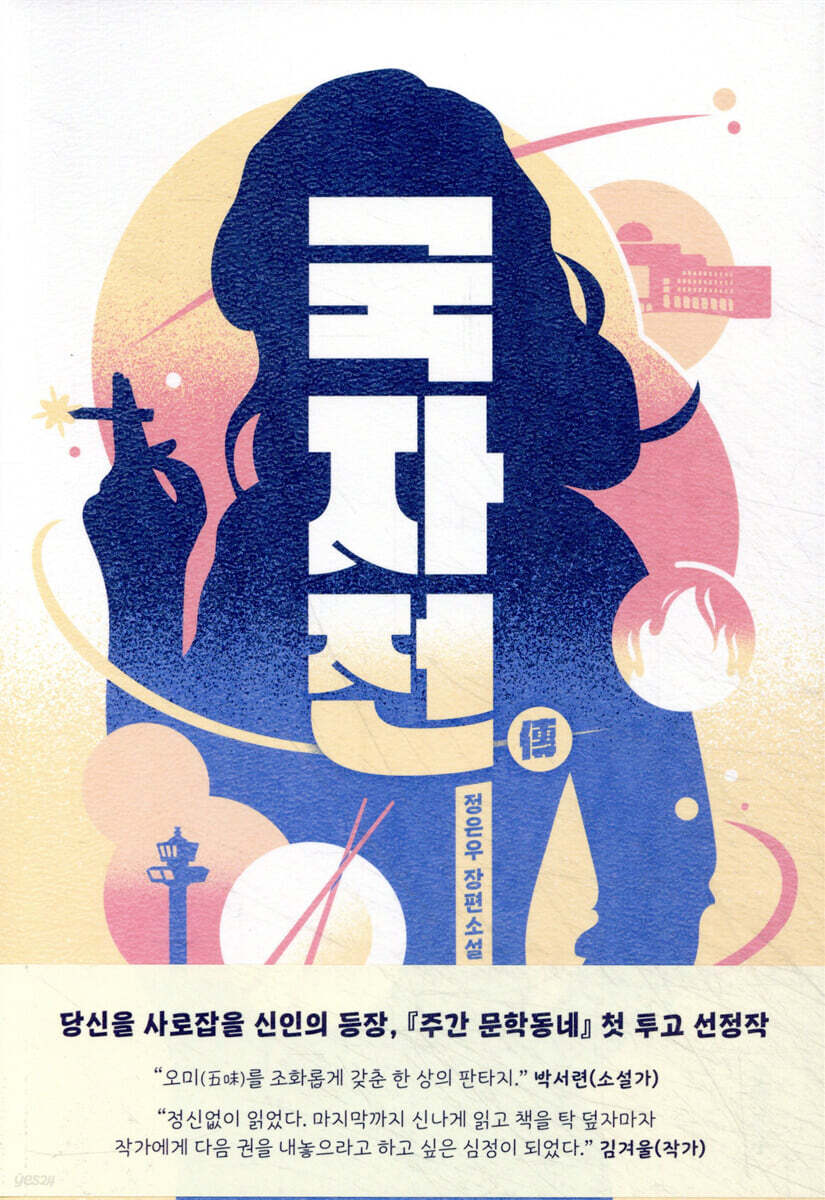 |
Description
Book Introduction
The emergence of a newcomer who will captivate you,
The first work selected for 『Weekly Literature Village』
The first full-length novel by Jeong Eun-woo, who debuted by winning the 2019 Changbi New Writer's Award, has been published.
Set against the backdrop of Korea's politically turbulent modern and contemporary history, "The Tale of the Nine" tells the story of love and struggle experienced by those gifted with special abilities. Its powerful narrative made it the first submission to be selected for the long-form novel serialization webzine "Weekly Literature Village."
In particular, 『The Tale of the Three Kingdoms』 deserves attention for giving birth to a unique Korean female heroine who changes people's thoughts with her "taste."
"The Tale of Gukja" succeeds in capturing two birds with one stone: life-affirming humor and a serious attitude toward the world through the protagonist, Gukja, who possesses a chic yet cute charm. It is the most human story, where the most special ability story ends up in the most ordinary being.
『Gukjajeon』 contains not only warm humor but also cool critical awareness.
The struggles of people who want to live as themselves despite the dichotomous thinking and oppression that divides people into usefulness and non-usefulness painfully criticize the harshness of society towards humans.
The political reality of Korea, sustained by dividing the public, is intertwined with the indiscriminate pursuit of selfish desires, such as turning battlegrounds between heroes and reactionaries into sites of redevelopment, and forces a perspective that regards people merely as tools for exploitation.
Therefore, only when the inhumane world we are so familiar with is satirized in a refreshing way will the path forward be revealed.
The first work selected for 『Weekly Literature Village』
The first full-length novel by Jeong Eun-woo, who debuted by winning the 2019 Changbi New Writer's Award, has been published.
Set against the backdrop of Korea's politically turbulent modern and contemporary history, "The Tale of the Nine" tells the story of love and struggle experienced by those gifted with special abilities. Its powerful narrative made it the first submission to be selected for the long-form novel serialization webzine "Weekly Literature Village."
In particular, 『The Tale of the Three Kingdoms』 deserves attention for giving birth to a unique Korean female heroine who changes people's thoughts with her "taste."
"The Tale of Gukja" succeeds in capturing two birds with one stone: life-affirming humor and a serious attitude toward the world through the protagonist, Gukja, who possesses a chic yet cute charm. It is the most human story, where the most special ability story ends up in the most ordinary being.
『Gukjajeon』 contains not only warm humor but also cool critical awareness.
The struggles of people who want to live as themselves despite the dichotomous thinking and oppression that divides people into usefulness and non-usefulness painfully criticize the harshness of society towards humans.
The political reality of Korea, sustained by dividing the public, is intertwined with the indiscriminate pursuit of selfish desires, such as turning battlegrounds between heroes and reactionaries into sites of redevelopment, and forces a perspective that regards people merely as tools for exploitation.
Therefore, only when the inhumane world we are so familiar with is satirized in a refreshing way will the path forward be revealed.
- You can preview some of the book's contents.
Preview
index
Gukjajeon
Author's Note
Author's Note
Into the book
“Then teach me how to cook.
First, this seaweed soup.”
“Look it up on the internet.”
“No, Mom.
“If only it could be solved that way…” Miji recalled the kimchi stew she had made to celebrate Parents’ Day when she was fifteen.
I made it according to a recipe found online, but the broth was bland, like the water used to rinse kimchi, and the kimchi that had been boiled for a long time was somehow stiff and difficult to cut even with scissors.
My father praised me by saying that a good start is half the work, but he couldn't even finish half of the bowl.
The ladle didn't even touch the spoon.
“What does Mom do?”
“When the water boils, add seaweed and boil thoroughly.”
“It’s really easy.
“For soybean paste stew, boil it with soybean paste, and for green onion pancake, add green onion to the batter and fry it.”
--- p.15
Heroes were tools chosen by the state.
Even if you were selected as a functional civil servant, if you were not very rebellious or pro-government, you were not suitable as a tool.
The country has thoroughly ruled out risk factors.
The old man would change the channel whenever he saw some functional civil servants on television, calling them heroes.
It's not that I hate them.
Their bright smiles, without a single doubt, were uncomfortable.
The ladle hoped that the class president's confidence would not be broken.
Confidence comes from hope, and hope, no matter how strong, can be shattered like an illusion at any time.
So any certainty was nothing more than an unfounded belief.
And the moment confidence becomes powerless, everything is ruined.
--- p.64
“How many good people do you think are incarcerated here?”
“Hmm.” The boy counted, folding his fingers one by one.
There were still ten healthy fingers left.
“Ten people?”
“Then what if someone said that only the good people should be sent out, and the rest of the bad people should die here? Would that be right?”
Father Thomas looked at the boy.
"I don't know."
“What kind?”
“Maybe more than ten,” the boy mumbled.
“So maybe… it would be ten times as many.”
--- pp.69~70
Soon, Su-il rummaged through his coat pockets again, took something out, and handed it to her.
It was a box the size of a finger.
“I received it from someone I know, if that’s okay with you.”
“You got this?” the ladle asked, curling its lips.
I felt like laughing.
Even if you weren't interested in makeup, you could tell it was lipstick.
The lipstick Soo-il gave me was a much lighter pink than the one I got from Gloria, so it was less burdensome.
Somehow, feeling playful, he slipped the lipstick to Soo-il and said.
“I think it would suit you.”
“Even I thought it was a bit of a lame excuse.”
--- pp.158~159
“Let’s say I am.
But there's no need to fool Dad, right?"
“There was no other way.
No, I didn't know.
“What difference would it make if I said it?” There was no sign of regret or remorse in the ladle’s voice.
It was just bland.
“It might be easier for you.
Because I studied more and the world became a better place.
I said I wouldn't live like my mom.
“You must do that, I wish you would.”
--- p.278
Complete peace was impossible.
Even if the backlash disappears, another enemy will quickly emerge to replace them.
The enemy will always be new, but the fight will remain the same.
That was the way of peace this country taught.
It was a fact that everyone knew secretly, but did not try to find out.
Even if I know, I don't know how to change it.
People believed that solid fixation was better than unstable change.
We have been trained to believe that.
The ladle took Suil's hand.
First, this seaweed soup.”
“Look it up on the internet.”
“No, Mom.
“If only it could be solved that way…” Miji recalled the kimchi stew she had made to celebrate Parents’ Day when she was fifteen.
I made it according to a recipe found online, but the broth was bland, like the water used to rinse kimchi, and the kimchi that had been boiled for a long time was somehow stiff and difficult to cut even with scissors.
My father praised me by saying that a good start is half the work, but he couldn't even finish half of the bowl.
The ladle didn't even touch the spoon.
“What does Mom do?”
“When the water boils, add seaweed and boil thoroughly.”
“It’s really easy.
“For soybean paste stew, boil it with soybean paste, and for green onion pancake, add green onion to the batter and fry it.”
--- p.15
Heroes were tools chosen by the state.
Even if you were selected as a functional civil servant, if you were not very rebellious or pro-government, you were not suitable as a tool.
The country has thoroughly ruled out risk factors.
The old man would change the channel whenever he saw some functional civil servants on television, calling them heroes.
It's not that I hate them.
Their bright smiles, without a single doubt, were uncomfortable.
The ladle hoped that the class president's confidence would not be broken.
Confidence comes from hope, and hope, no matter how strong, can be shattered like an illusion at any time.
So any certainty was nothing more than an unfounded belief.
And the moment confidence becomes powerless, everything is ruined.
--- p.64
“How many good people do you think are incarcerated here?”
“Hmm.” The boy counted, folding his fingers one by one.
There were still ten healthy fingers left.
“Ten people?”
“Then what if someone said that only the good people should be sent out, and the rest of the bad people should die here? Would that be right?”
Father Thomas looked at the boy.
"I don't know."
“What kind?”
“Maybe more than ten,” the boy mumbled.
“So maybe… it would be ten times as many.”
--- pp.69~70
Soon, Su-il rummaged through his coat pockets again, took something out, and handed it to her.
It was a box the size of a finger.
“I received it from someone I know, if that’s okay with you.”
“You got this?” the ladle asked, curling its lips.
I felt like laughing.
Even if you weren't interested in makeup, you could tell it was lipstick.
The lipstick Soo-il gave me was a much lighter pink than the one I got from Gloria, so it was less burdensome.
Somehow, feeling playful, he slipped the lipstick to Soo-il and said.
“I think it would suit you.”
“Even I thought it was a bit of a lame excuse.”
--- pp.158~159
“Let’s say I am.
But there's no need to fool Dad, right?"
“There was no other way.
No, I didn't know.
“What difference would it make if I said it?” There was no sign of regret or remorse in the ladle’s voice.
It was just bland.
“It might be easier for you.
Because I studied more and the world became a better place.
I said I wouldn't live like my mom.
“You must do that, I wish you would.”
--- p.278
Complete peace was impossible.
Even if the backlash disappears, another enemy will quickly emerge to replace them.
The enemy will always be new, but the fight will remain the same.
That was the way of peace this country taught.
It was a fact that everyone knew secretly, but did not try to find out.
Even if I know, I don't know how to change it.
People believed that solid fixation was better than unstable change.
We have been trained to believe that.
The ladle took Suil's hand.
--- p.335
Publisher's Review
“Anything that goes into the mouth and can be digested is possible.”
The Birth of a Korean-Style Female Hero Who Wins Through Her Hands
'Miji', an elementary school teacher, is on leave from work after being shocked by a bullying incident in her class.
With her reinstatement imminent, she sat down at the table with her mother, Gukja, with a new mindset, determined to achieve independence for the first time.
Strangely enough, whenever the word independence was mentioned, the sight of a ladleful of food melted her will.
But the nature of this declaration of independence is a little different.
At Gukja's confession that he is a civil servant with a functional position and can twist people's hearts with food, Miji's mind goes blank... ... "Have you ever written anything to me?" Miji asks, and Gukja calmly answers that he has, and beyond Miji's astonished expression, Gukja's story finally begins.
Kukja met his first love at the age of nine and became an orphan at the age of ten.
I lost everything in an instant.
Even after so much time had passed, she never forgot that moment.
I couldn't forget it.
So I decided to remember.
If possible, without exception. (Page 22)
The novel's setting, 1980s Korea, is an alternate world where it is widely known that people with supernatural powers exist, but the world's operating logic closely resembles today's reality.
The government promotes the distinction between 'heroes' and 'reactionaries' in order to control the capable.
Those born with superpowers are verified through a 'multi-ability test' and hired by the government. If they receive a high rating, they are called 'heroes' by the public and become objects of envy.
On the other hand, if someone is judged unfit for public office even though he or she has the ability, he or she is branded a 'reactionary' who threatens the country and the people.
Gukja, who lost his entire family in an accident caused by someone with special powers when he was young, aims to live quietly without attracting attention from others for the rest of his life.
However, when it is revealed that she has powers, she unintentionally becomes a functional civil servant.
The older brother she loved was judged unfit and lost control of his powers, leading to the massacre of the villagers. For Gukja, the sole survivor, the future is nothing more than a predetermined punishment.
At the training center entrance ceremony, there are those who linger behind the ladle, who has an indifferent face towards the world.
Gloria, who is dressed in flashy attire and extends her hand, saying that they will become best friends, has the ability to predict the future, and Choi Hoon, who can move faster than anyone and likes to show off like MacGyver, keeps hanging around Gukja.
From Instructor Kang Su-ja, who has telekinetic abilities and skillfully handles trainees, to Lady Kim, a supernatural being with blunt personality who immediately crushes anyone who touches her.
In a literal “world of flying and crawling people,” how will the fate of the ladle unfold?
“Dad, do you know that Mom is a civil servant?”
“I don’t know.
“Because I never said anything.”
“Why didn’t you say anything?”
“That’s the rule.”
“You told me just now.
“Dad is also family, why didn’t you tell me?”
(……)
“Because your father is a reactionary.”
"rebound?"
“Oh, keep this a secret from Dad.” The old man earnestly urged Miji, who was just opening her mouth.
“You understand?” (pp. 134-135)
Kukja, who wants to live freely, free from the shackles of being a tool of the state, conspires with Gloria to deceive the judges and receive the lowest grade.
But somehow, the Agency for National Security Planning places a ladle in a restaurant at Gimpo International Airport, where heroes and reactionaries often come and go.
There, she meets Yoon Su-il, a reactionary who everyone fears like a ghost leading a plague, and as she gradually becomes drawn to him, things take an unexpected turn.
“No, Mr. Gukja, don’t you even watch the news?”
“The dorm only has a television in the lounge.”
“That person is Yoon Su-il.
"Reaction! Just saying that makes people start dying."
The kitchen staff made a gesture of slitting his throat with their hands.
Didn't you just say you were going to split his head open? Gukja shook his head at the sight of Yoon Soo-il even mimicking his hand gestures. (Page 140)
Even though Choi Hoon blew up Yoon Soo-il's table, and even though Yoon Soo-il was seriously injured while demanding that the state treat those deemed unfit as human beings, the relationship between Gukja and Yoon Soo-il remained unshaken.
However, they could not avoid the crisis of the visit of the siblings with powers called “Evil Spirits of the Battlefield” who caused conflict and bloodshed on a national scale wherever they went.
With the global media focusing on the Korean Peninsula and the threat of war looming, the government uses this as an opportunity to root out reactionaries around Gimpo International Airport.
One day, a voice secretly calls Kukja and orders him to withdraw.
After discovering a government plot to plant a bomb at the airport and blame all the victims on reactionary forces, Gukja is forced to choose between his longing for peace and an impossible love.
The date the voice mentioned was two weeks later.
I had to take a day off and get out of the airport that day.
That was all the ladle could tell.
It was all or nothing, just a part of the whole.
The real thing would be so vast and dangerous that it would crush her life, but she wanted to know. (pp. 288-289)
20th century Korea, where people with superpowers are controlled.
People who rejected the dichotomy of 'hero' and 'reactionary'
Hope and despair were a single piece of paper.
The side you read first is the front, and the side you read later is the back.
Reading only the cross-sections and then crumpling them up and throwing them away was a temporary escape.
I couldn't tell which one to read first, Despair or Hope.
I had to read the rest of it someday.
Only after reading it silently and accepting it could I live the rest of my life. (Page 241)
The apartment collapse that struck Gukja and his friends, who had just left the training center, symbolizes the man-made disasters that have occurred in Korea so far.
A country so obsessed with hosting the Olympics that it sends its "heroes" overseas, and adults who use children who don't even know their own abilities as shields.
On the other side, there are civil servants who cannot escape the guilt of losing a friend and who even drive themselves to their deaths; reporters who are worn down by frequent setbacks but still cannot give up their faint hope for the world; and people who possess superpowers but cannot help but be infinitely human in the face of disaster.
As the rescue operation drags on, the nation's failure becomes clearer, and the novel questions the calculation that a new building will be built on the traces of failure, filled only with the desire for success.
“Is success the complete erasure of failure?
“If you erase and erase again, what will be left in the end?” the ladle wondered.
The story of Gukja and Yun Su-il is a moment of honestly facing difficult questions and finding their own path, and it is a scene where they find love in a dead end.
How should we define Yoon Su-il, who took revenge on the unjust death of his maternal uncle, who was judged unfit?
The novel departs from the state-mandated dichotomies of heroes and reactionaries, victims and perpetrators, and faithfully portrays the diverse aspects of human nature and the rich range of emotions they evoke.
It was still full of questions.
For example, how could Yoon Soo-il, who couldn't even think of shaking off his own hand and was having a hard time carefully removing his fingers one by one, explode the lieutenant colonel's brain?
“I don’t know you very well,” the ladle said honestly.
Then he grabbed Yoon Soo-il's hand.
“I have no idea what kind of person he is.
But… … ”(pp. 337-338)
The novel's format, where present and past intersect, is also a dialogue between Gukja, a capable man of the established generation, and the unknown children who are not yet aware of their own abilities.
The similar events and concerns that persist across generations remind us that the most urgent tasks are the ones that remain unresolved.
And the ability to solve unsolvable problems really depends not on 'ability' but on the 'will' to turn the unknown into possibility.
“Now the choice is ours, and we will bear it.” When that happens, the time left for us will not be a continuation of suffering, but the leisure of savoring the table life has prepared for us. That is the true gift that novels can bestow upon humanity.
Readers who sit down with a spoon in their hand at a table filled with humor, tears, sincerity, and love will be absorbed in the story of the ladle without even realizing it, and will not be able to leave.
That day, the ladle continued to talk, unlike usual.
We kept talking while drinking several cups of coffee and eating snacks.
Occasionally, he paused and rolled his eyes here and there, as if trying to guess if he had missed anything.
And then it started again.
The life of a ladle could be seen as an explanatory note to its own answer.
Of course, the commentary wasn't perfect.
There were misjudgments, leaps of faith, and contradictions.
But as far as the ladle knew, it was the best answer. (pp. 388-389)
■ Author's Note
Stories keep someone alive and keep them alive.
Because it proves that you and I existed, whether long or short, and it makes readers realize what kind of world they live in.
You cannot prove your existence by thinking alone.
I think that only when you see, hear, or read a story and experience something that is not your own can you truly realize who you are.
Even if nothing changes because of it, it's something you don't know right away.
The past that has already passed was once the present, and the distant future will soon be right before our eyes.
(……)
As we pass through 2022
Jung Eun-woo uploaded
The Birth of a Korean-Style Female Hero Who Wins Through Her Hands
'Miji', an elementary school teacher, is on leave from work after being shocked by a bullying incident in her class.
With her reinstatement imminent, she sat down at the table with her mother, Gukja, with a new mindset, determined to achieve independence for the first time.
Strangely enough, whenever the word independence was mentioned, the sight of a ladleful of food melted her will.
But the nature of this declaration of independence is a little different.
At Gukja's confession that he is a civil servant with a functional position and can twist people's hearts with food, Miji's mind goes blank... ... "Have you ever written anything to me?" Miji asks, and Gukja calmly answers that he has, and beyond Miji's astonished expression, Gukja's story finally begins.
Kukja met his first love at the age of nine and became an orphan at the age of ten.
I lost everything in an instant.
Even after so much time had passed, she never forgot that moment.
I couldn't forget it.
So I decided to remember.
If possible, without exception. (Page 22)
The novel's setting, 1980s Korea, is an alternate world where it is widely known that people with supernatural powers exist, but the world's operating logic closely resembles today's reality.
The government promotes the distinction between 'heroes' and 'reactionaries' in order to control the capable.
Those born with superpowers are verified through a 'multi-ability test' and hired by the government. If they receive a high rating, they are called 'heroes' by the public and become objects of envy.
On the other hand, if someone is judged unfit for public office even though he or she has the ability, he or she is branded a 'reactionary' who threatens the country and the people.
Gukja, who lost his entire family in an accident caused by someone with special powers when he was young, aims to live quietly without attracting attention from others for the rest of his life.
However, when it is revealed that she has powers, she unintentionally becomes a functional civil servant.
The older brother she loved was judged unfit and lost control of his powers, leading to the massacre of the villagers. For Gukja, the sole survivor, the future is nothing more than a predetermined punishment.
At the training center entrance ceremony, there are those who linger behind the ladle, who has an indifferent face towards the world.
Gloria, who is dressed in flashy attire and extends her hand, saying that they will become best friends, has the ability to predict the future, and Choi Hoon, who can move faster than anyone and likes to show off like MacGyver, keeps hanging around Gukja.
From Instructor Kang Su-ja, who has telekinetic abilities and skillfully handles trainees, to Lady Kim, a supernatural being with blunt personality who immediately crushes anyone who touches her.
In a literal “world of flying and crawling people,” how will the fate of the ladle unfold?
“Dad, do you know that Mom is a civil servant?”
“I don’t know.
“Because I never said anything.”
“Why didn’t you say anything?”
“That’s the rule.”
“You told me just now.
“Dad is also family, why didn’t you tell me?”
(……)
“Because your father is a reactionary.”
"rebound?"
“Oh, keep this a secret from Dad.” The old man earnestly urged Miji, who was just opening her mouth.
“You understand?” (pp. 134-135)
Kukja, who wants to live freely, free from the shackles of being a tool of the state, conspires with Gloria to deceive the judges and receive the lowest grade.
But somehow, the Agency for National Security Planning places a ladle in a restaurant at Gimpo International Airport, where heroes and reactionaries often come and go.
There, she meets Yoon Su-il, a reactionary who everyone fears like a ghost leading a plague, and as she gradually becomes drawn to him, things take an unexpected turn.
“No, Mr. Gukja, don’t you even watch the news?”
“The dorm only has a television in the lounge.”
“That person is Yoon Su-il.
"Reaction! Just saying that makes people start dying."
The kitchen staff made a gesture of slitting his throat with their hands.
Didn't you just say you were going to split his head open? Gukja shook his head at the sight of Yoon Soo-il even mimicking his hand gestures. (Page 140)
Even though Choi Hoon blew up Yoon Soo-il's table, and even though Yoon Soo-il was seriously injured while demanding that the state treat those deemed unfit as human beings, the relationship between Gukja and Yoon Soo-il remained unshaken.
However, they could not avoid the crisis of the visit of the siblings with powers called “Evil Spirits of the Battlefield” who caused conflict and bloodshed on a national scale wherever they went.
With the global media focusing on the Korean Peninsula and the threat of war looming, the government uses this as an opportunity to root out reactionaries around Gimpo International Airport.
One day, a voice secretly calls Kukja and orders him to withdraw.
After discovering a government plot to plant a bomb at the airport and blame all the victims on reactionary forces, Gukja is forced to choose between his longing for peace and an impossible love.
The date the voice mentioned was two weeks later.
I had to take a day off and get out of the airport that day.
That was all the ladle could tell.
It was all or nothing, just a part of the whole.
The real thing would be so vast and dangerous that it would crush her life, but she wanted to know. (pp. 288-289)
20th century Korea, where people with superpowers are controlled.
People who rejected the dichotomy of 'hero' and 'reactionary'
Hope and despair were a single piece of paper.
The side you read first is the front, and the side you read later is the back.
Reading only the cross-sections and then crumpling them up and throwing them away was a temporary escape.
I couldn't tell which one to read first, Despair or Hope.
I had to read the rest of it someday.
Only after reading it silently and accepting it could I live the rest of my life. (Page 241)
The apartment collapse that struck Gukja and his friends, who had just left the training center, symbolizes the man-made disasters that have occurred in Korea so far.
A country so obsessed with hosting the Olympics that it sends its "heroes" overseas, and adults who use children who don't even know their own abilities as shields.
On the other side, there are civil servants who cannot escape the guilt of losing a friend and who even drive themselves to their deaths; reporters who are worn down by frequent setbacks but still cannot give up their faint hope for the world; and people who possess superpowers but cannot help but be infinitely human in the face of disaster.
As the rescue operation drags on, the nation's failure becomes clearer, and the novel questions the calculation that a new building will be built on the traces of failure, filled only with the desire for success.
“Is success the complete erasure of failure?
“If you erase and erase again, what will be left in the end?” the ladle wondered.
The story of Gukja and Yun Su-il is a moment of honestly facing difficult questions and finding their own path, and it is a scene where they find love in a dead end.
How should we define Yoon Su-il, who took revenge on the unjust death of his maternal uncle, who was judged unfit?
The novel departs from the state-mandated dichotomies of heroes and reactionaries, victims and perpetrators, and faithfully portrays the diverse aspects of human nature and the rich range of emotions they evoke.
It was still full of questions.
For example, how could Yoon Soo-il, who couldn't even think of shaking off his own hand and was having a hard time carefully removing his fingers one by one, explode the lieutenant colonel's brain?
“I don’t know you very well,” the ladle said honestly.
Then he grabbed Yoon Soo-il's hand.
“I have no idea what kind of person he is.
But… … ”(pp. 337-338)
The novel's format, where present and past intersect, is also a dialogue between Gukja, a capable man of the established generation, and the unknown children who are not yet aware of their own abilities.
The similar events and concerns that persist across generations remind us that the most urgent tasks are the ones that remain unresolved.
And the ability to solve unsolvable problems really depends not on 'ability' but on the 'will' to turn the unknown into possibility.
“Now the choice is ours, and we will bear it.” When that happens, the time left for us will not be a continuation of suffering, but the leisure of savoring the table life has prepared for us. That is the true gift that novels can bestow upon humanity.
Readers who sit down with a spoon in their hand at a table filled with humor, tears, sincerity, and love will be absorbed in the story of the ladle without even realizing it, and will not be able to leave.
That day, the ladle continued to talk, unlike usual.
We kept talking while drinking several cups of coffee and eating snacks.
Occasionally, he paused and rolled his eyes here and there, as if trying to guess if he had missed anything.
And then it started again.
The life of a ladle could be seen as an explanatory note to its own answer.
Of course, the commentary wasn't perfect.
There were misjudgments, leaps of faith, and contradictions.
But as far as the ladle knew, it was the best answer. (pp. 388-389)
■ Author's Note
Stories keep someone alive and keep them alive.
Because it proves that you and I existed, whether long or short, and it makes readers realize what kind of world they live in.
You cannot prove your existence by thinking alone.
I think that only when you see, hear, or read a story and experience something that is not your own can you truly realize who you are.
Even if nothing changes because of it, it's something you don't know right away.
The past that has already passed was once the present, and the distant future will soon be right before our eyes.
(……)
As we pass through 2022
Jung Eun-woo uploaded
GOODS SPECIFICS
- Date of issue: September 5, 2022
- Page count, weight, size: 400 pages | 538g | 145*210*24mm
- ISBN13: 9788954688031
- ISBN10: 8954688039
You may also like
카테고리
korean


korean

![GQ KOREA Mark (Monthly): December [2025]](http://librairie.coreenne.fr/cdn/shop/files/8ef265dbbfbf186523ed75ba7319009d.jpg?v=1765340328&width=3840)


