

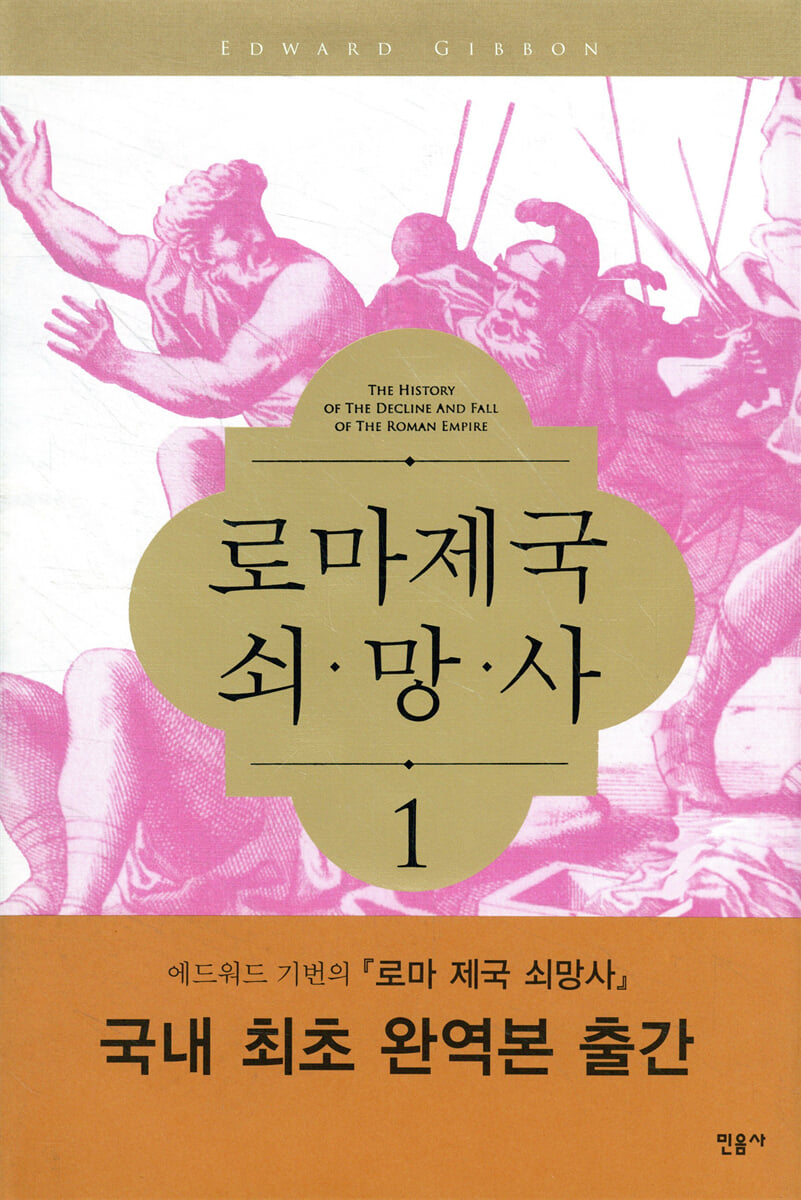
The Decline and Fall of the Roman Empire, Part 1
 |
Description
Book Introduction
It takes courage to decide to write the history of a great empire that, along with Greece, is praised as the prototype of Western civilization and that gradually collapsed over a long period of 1,400 years.
Moreover, if that courage is not to be perceived as a guest by others, it requires more than just courage.
And finally, Rome found a contemporary historian with both courage and skill, and thus Edward Gibbon's The History of the Decline and Fall of the Roman Empire, which has become a classic, was born.
Gibbon deals with the decline of the Roman Empire in a very practical and eloquent style.
Published in six volumes over a period of twelve years from 1776 to 1788, The History of the Decline and Fall of the Roman Empire is a representative work among countless books on Roman history and is also considered a masterpiece in the history of English literature.
This book serves as a bridge between ancient and modern times, covering events spanning a wide area, such as the establishment of Christianity, the migration of the Germanic peoples, the Islamic invasion, the Mongol westward expedition, and the Crusades, and has a vast temporal and spatial scale.
Even in modern times, it is still used as a basic source of information on Roman history, the origin of the Western world.
It is difficult to find any point of negligence in covering such a long period of time and space, and this is entirely the author's fault.
Although by today's standards it might often be said that objective and critical analysis of the sources is lacking, Gibbon diligently pursued a writing process that required thorough research of available sources, detailed verification, and a long and patient writing process, resulting in a meticulous narrative unparalleled in his time.
What is even more interesting is that in an era when it was generally thought that the primary role of the historian was to derive moral lessons, there was no attempt to discover universal laws that determined the fate of societies or to assert inevitable cycles of rise and fall.
This is all the more noteworthy in a situation where the modern, linear view of history, such as “history progresses” and “history has universal laws, directions, and stages,” is no longer supported.
Gibbon's efforts to understand and explain the past and its diverse and complex events simply by exploring humanity and history have enjoyed a proud status regardless of the changes in the field of history and its role.
Moreover, if that courage is not to be perceived as a guest by others, it requires more than just courage.
And finally, Rome found a contemporary historian with both courage and skill, and thus Edward Gibbon's The History of the Decline and Fall of the Roman Empire, which has become a classic, was born.
Gibbon deals with the decline of the Roman Empire in a very practical and eloquent style.
Published in six volumes over a period of twelve years from 1776 to 1788, The History of the Decline and Fall of the Roman Empire is a representative work among countless books on Roman history and is also considered a masterpiece in the history of English literature.
This book serves as a bridge between ancient and modern times, covering events spanning a wide area, such as the establishment of Christianity, the migration of the Germanic peoples, the Islamic invasion, the Mongol westward expedition, and the Crusades, and has a vast temporal and spatial scale.
Even in modern times, it is still used as a basic source of information on Roman history, the origin of the Western world.
It is difficult to find any point of negligence in covering such a long period of time and space, and this is entirely the author's fault.
Although by today's standards it might often be said that objective and critical analysis of the sources is lacking, Gibbon diligently pursued a writing process that required thorough research of available sources, detailed verification, and a long and patient writing process, resulting in a meticulous narrative unparalleled in his time.
What is even more interesting is that in an era when it was generally thought that the primary role of the historian was to derive moral lessons, there was no attempt to discover universal laws that determined the fate of societies or to assert inevitable cycles of rise and fall.
This is all the more noteworthy in a situation where the modern, linear view of history, such as “history progresses” and “history has universal laws, directions, and stages,” is no longer supported.
Gibbon's efforts to understand and explain the past and its diverse and complex events simply by exploring humanity and history have enjoyed a proud status regardless of the changes in the field of history and its role.
- You can preview some of the book's contents.
Preview
index
clear
Preface by Edward Gibbon
Note
1 The extent and military power of the Roman Empire during the reign of the Antonine emperors, AD 98–180
2 The unification and internal prosperity of the Roman Empire during the Antonine era, art, and people
3 The political system of the Roman Empire during the Antonine era
4. Commodus's cruelty, folly, and murder; Pertinax's accession to the throne; his attempts at reform; assassination by the Praetorian Guard; and his wrath.
5 The Praetorian Guard sells the throne to Didius Julianus at auction. Clodius Albinus of Britain, Pescennius Niger of Syria, and Septimius Severus of Pannonia avenge the Emperor Pertinax. Civil war and Severus's victory. Disorder of the army. New principles.
6 The death of the Emperor Severus, the tyranny of the Emperor Caracalla, the usurpation of the Emperor Macrinus, the folly of the Emperor Elagabalus, the virtues of the Emperor Alexander Severus, the licentiousness of the army, and the general state of the Roman finances.
7 The accession and tyranny of Emperor Maximinus; revolts in Africa and Italy; the authority of the Senate; civil wars and revolts; the deaths of Emperor Maximinus and his son; Emperors Maximus and Balbinus; the third emperor, Gordianus; the usurpation of Emperor Philip and the centennial system.
8 The Persian situation after the restoration of the monarchy by Artaxerxes, his character and principles
9 The situation in Germania before the beginning of the barbarian invasions, during the reign of Emperor Decius, 248 AD
10 Emperors Decius, Gallus, Aemilian, Valerian, and Gallienus, large-scale invasions by barbarians, 30 tyrants, 19 real tyrants
11 The reign of Emperor Claudius, the defeat of the Goths, the victory, triumph, and death of Aurelian, and the character of Zenobia
12 The movements of the army and the Senate after the death of Emperor Aurelian, and the reigns of Emperor Tacitus, Emperor Probus, and Emperor Carus
13 The reign of Diocletian and his three fellow emperors, Maximian, Galerius, and Constantius; the full restoration of order and tranquility; the Persian Wars, victories, and reforms; the new way of governing; the abdication of Diocletian and Maximian.
14 The chaos after the abdication of Diocletian, the death of Constantius, the accession of Constantine and Maxentius, the simultaneous reign of six emperors, the deaths of Maximian and Galerius, Constantine's victory over Maxentius and Licinius, the unification of the empire under Constantine, the laws, and general peace.
15 The development of Christianity and the thoughts, customs, religious practices and situations of the early Christians, various ceremonies, arts and festivals
16 The Roman government's Christian policies from Emperor Nero to Emperor Constantine, and Emperor Domitian's persecution of Judaism and Christianity
Reviews
Preface by Edward Gibbon
Note
1 The extent and military power of the Roman Empire during the reign of the Antonine emperors, AD 98–180
2 The unification and internal prosperity of the Roman Empire during the Antonine era, art, and people
3 The political system of the Roman Empire during the Antonine era
4. Commodus's cruelty, folly, and murder; Pertinax's accession to the throne; his attempts at reform; assassination by the Praetorian Guard; and his wrath.
5 The Praetorian Guard sells the throne to Didius Julianus at auction. Clodius Albinus of Britain, Pescennius Niger of Syria, and Septimius Severus of Pannonia avenge the Emperor Pertinax. Civil war and Severus's victory. Disorder of the army. New principles.
6 The death of the Emperor Severus, the tyranny of the Emperor Caracalla, the usurpation of the Emperor Macrinus, the folly of the Emperor Elagabalus, the virtues of the Emperor Alexander Severus, the licentiousness of the army, and the general state of the Roman finances.
7 The accession and tyranny of Emperor Maximinus; revolts in Africa and Italy; the authority of the Senate; civil wars and revolts; the deaths of Emperor Maximinus and his son; Emperors Maximus and Balbinus; the third emperor, Gordianus; the usurpation of Emperor Philip and the centennial system.
8 The Persian situation after the restoration of the monarchy by Artaxerxes, his character and principles
9 The situation in Germania before the beginning of the barbarian invasions, during the reign of Emperor Decius, 248 AD
10 Emperors Decius, Gallus, Aemilian, Valerian, and Gallienus, large-scale invasions by barbarians, 30 tyrants, 19 real tyrants
11 The reign of Emperor Claudius, the defeat of the Goths, the victory, triumph, and death of Aurelian, and the character of Zenobia
12 The movements of the army and the Senate after the death of Emperor Aurelian, and the reigns of Emperor Tacitus, Emperor Probus, and Emperor Carus
13 The reign of Diocletian and his three fellow emperors, Maximian, Galerius, and Constantius; the full restoration of order and tranquility; the Persian Wars, victories, and reforms; the new way of governing; the abdication of Diocletian and Maximian.
14 The chaos after the abdication of Diocletian, the death of Constantius, the accession of Constantine and Maxentius, the simultaneous reign of six emperors, the deaths of Maximian and Galerius, Constantine's victory over Maxentius and Licinius, the unification of the empire under Constantine, the laws, and general peace.
15 The development of Christianity and the thoughts, customs, religious practices and situations of the early Christians, various ceremonies, arts and festivals
16 The Roman government's Christian policies from Emperor Nero to Emperor Constantine, and Emperor Domitian's persecution of Judaism and Christianity
Reviews
Publisher's Review
An eternal classic that shows a unique view of humanity and the world as a historical book and literary work.
Gibbon is called a first-class historian and a great writer.
Toynbee, himself a first-rate historian, said, “Gibbon’s mind is unparalleled among all the eminent Western historians in its power and brilliance.”
Virginia Woolf said, “Gibbon gives us a balanced view of what we need to see.
Compress here, expand there.
He is the entertainer with the most resources,” he writes.
These are all comments made after reading Gibbon's 『The History of the Decline and Fall of the Roman Empire』.
The following are the words of Lee In-hwa, the author of 'Eternal Empire'.
Edward Gibbon's The Decline and Fall of the Roman Empire is a unique historical work written with boundless affection for human imperfection. This magnificent work, meticulously detailed and brilliantly interpreted, traces the gradual decline of a great empire over 1,400 years, step by step. Innumerable human vices unfold like the waves of a vast river.
Gibbon views Roman history as the greatest glory in human history, built by imperfect humans despite their own imperfections.
Therefore, this book is a work of literature that transcends mere historical narrative, and is an immortal classic that shows a unique perspective on humanity and the world.”
Greece and Rome are the prototypes of Western civilization.
As is often said, if we want to break away from the Western-centric narrative of history, shouldn't we learn more about Greece and Rome, the prototypes of modern Western civilization?
In that respect, Gibbon's The History of the Decline and Fall of the Roman Empire has the optimal conditions.
(The story of Greece, which was not at all small compared to the vast empire of Rome, will be told on another occasion.) Gibbon had prepared much for this book, and much had already been prepared.
As a British man, he had already prepared himself for dealing with Roman history by translating Cicero into French, keeping it for a while, then translating it back into Latin and comparing the results with the original text.
He spoke this language and wrote that language.
(It is said that he also had a knack for Greek, Spanish, and Hebrew.)
Based on this ability, he was able to read original sources rather than the research results of others, and he prepared a lot according to his beliefs as a historian.
His conviction as a historian was integrity.
Gibbon skillfully utilized a variety of works, not limited to the field of history. To describe his history richly and accurately, he first systematically collected primary and secondary sources, and then studied various other materials, which he presented throughout the book.
I think the fun of reading Gibbon probably comes from here.
From today's perspective, with its vast accumulated research output, it might be said that objective and critical analysis of the sources is often lacking. However, Gibbon made great efforts to provide readers with a wide range of knowledge, opinions, and information by using a vast amount of data as accurately as possible, as is clearly demonstrated by the numerous footnotes that approach the text.
In this way, Gibbon diligently carried out the writing process that required thorough research of available sources, detailed verification, and a long period of time and patience, and the result, The History of the Decline and Fall of the Roman Empire, is also evaluated as a book that made a major advancement in the writing of British history.
This book, which occupies a special place in the history of English literature, might have been nothing more than a boast of its elegant style if it had not been for Gibbon's sincerity as a historian.
The Decline and Fall of the Roman Empire - The Origin of Numerous Books on Roman History
One thing that is always mentioned in connection with The Decline and Fall of the Roman Empire is the scale of its narrative.
Rome was a small city-state.
The description of the process through which this small city-state achieved immortal success, built a great empire, and then collapsed was a task that required a great deal of time and effort, so it took twelve years from the publication of the first volume in 1776 until the publication of the final volume, the sixth volume. (Including the preparation and writing period, it is said that the total period took about twenty years.) Beginning in 98 AD, the book covers the history of the West from around 100 AD to about 1400 AD, including the fall of the Western Roman Empire, the Eastern Roman Empire that lasted another thousand years, all the civilized countries bordering the empire, the so-called 'barbarian nations' and their members, the rise of Islam, the Holy Roman Empire, the Crusades, and so on, and the history of the East that had a significant influence on the West (Gibbon read every book on Eastern history that had been translated into English at the time).
The long history and extensive geographical area have been interwoven and combined through Gibbon's long-honed insight and balanced perspective, resulting in a vast scale.
As is well known, Gibbon's main interest was the history of the Western Roman Empire.
Gibbon wrote up to the third volume of The History of the Decline and Fall of the Roman Empire, and then, after some hesitation, proceeded to describe the fall of the Eastern Roman Empire in 1453. Therefore, his work is divided into two parts.
The first part, Books I to IV, covers the period from the 2nd century AD to the death of Emperor Heraclius in 641 AD (chapters 1 to 47), while the remaining two books cover the period from the 7th to the 15th century (chapters 48 to 71). As a result, the first four books cover about 500 years of history, while the last two books cover almost 1,000 years, revealing an imbalance.
However, considering the research climate of the time and the fact that it outlined the history of the Eastern Roman Empire based on much more meager data than that of the Western Roman Empire and provided an unbiased account of Islam, it is already a significant undertaking.
The Roman Empire is commonly considered to have ended with the fall of the Western Roman Empire in 476 AD.
However, today's academic world does not recognize the rapid transformation called the 'Fall of Rome'.
In other words, they do not place much historical significance on the fall of the Western Roman Empire in 476, and they argue that the transition from ancient times to the Middle Ages was gradual over several centuries, and they place greater importance on the significance of the survival of the Eastern Roman Empire.
What is important is not the history of ‘discontinuity’ that rises and falls at any given moment, but the history of ‘continuity.’
The first complete English-Korean translation published in Korea
Several features of Gibbon's The History of the Decline and Fall of the Roman Empire show its status and influence as distinct from other historical works. First of all, its style is often mentioned.
As Gibbon himself revealed, he put considerable effort into finding the right expressions and narrative style for this book, to the point that he wrote Chapter 1 three times and Chapter 2 twice.
His usual writing style is said to have been “putting long paragraphs into a single sentence, savoring them with his ears, storing them in his head, and then putting the final touches on them before moving his pen.”
For this reason, even if Gibbon's sentences are not read aloud, their clear and bright melody can be heard, and it can be said that it makes good use of the colloquial style, which is the greatest strength of the English language.
This is connected to the trend of historical writing in Britain at the time. Unlike continental Europe, Britain experienced revolution early and enjoyed relative political stability in the 18th century, and the British people were generally satisfied with the institutions they had created.
Therefore, in historical writing, he showed a tendency to focus on rather superficial thinking, preferring explanations rather than analysis of facts, and paying much attention to rhetorical expressions and aesthetic descriptions.
This tendency, in addition to Gibbon's personal interest in unique methods of expression, probably influenced his historical writing.
What makes Gibbon, a great writer and historian at the same time, stand out is his coolness and originality.
Although he was not afraid to express his likes and dislikes in The Decline and Fall of the Roman Empire, he still tried to present a balanced view while maintaining as much coolness as possible.
Gibbon's bold and precise standards, his wisdom in grasping the issue holistically, his wise reservations and appropriate skepticism, etc. have become topics that later historians have constantly pondered when writing history.
Another thing that was unusual about Gibbon was that, in an age when the primary role of the historian was generally thought to be to derive moral lessons, he did not try to discover universal laws that determined the fate of societies or to assert inevitable cycles of rise and fall.
However, by exploring humans and history, we have attempted to understand and explain the past and its diverse and complex events.
Edward Gibbon, on a long-planned trip to Europe, arrived in Rome in the autumn of 1764.
He decided to write the history of Rome after looking at the ruins of Rome, and after many years of hardship, he created a masterpiece that no one dared to surpass.
Gibbon is both sophisticated and entertaining.
Although the History of Decline and Fall was published and many critical works criticizing its rigid structure were published, no one has dealt with the decline of the Roman Empire as persuasively as Gibbon, and it would not be an exaggeration to say that no one has yet been able to overturn him or break his momentum.
“You do not know the suffering of a monarch.
There's always a sword hanging above his head.
The monarch fears even his own guards, and does not trust his own colleagues.
The choice to move or rest is no longer at the sovereign's discretion.
Moreover, neither age, nor virtue, nor character can protect one from the reproaches that come from jealousy.
By placing me on the throne, you have doomed me to a life of worry and an untimely death.
“The only consolation that remains is the certainty that I will not die alone.”
It's the Roman Emperor's turn.
In fact, in our cultural background, where Roman history is fundamentally unfamiliar, we hesitate to readily participate in this vast and comprehensive historical journey. However, it is no exaggeration to say that this book contains everything.
Power and betrayal, honor, war, people, events, institutions, economics, art, culture, religion, superstition, the non-European world, the struggles of the people, love, transience, the problem of global warming, etc. (Chapter 26 contains 'Corea') This eternal classic, which covers almost every field of human history, is a scary but instructive lesson for us.
* In Japan, two translators, including Yoshio Nakano, who was a professor of English literature at the University of Tokyo and passed away in 1985, translated 『The History of Decay』 between 1976 and 1993.
However, this book is not a complete translation.
The translators themselves have made it abundantly clear that the quality of their translation is not as good as Gibbon's (they have been frank in stating that they were taken aback by his linguistic ability and vast knowledge), and have omitted most of the numerous footnotes.
The original version had about 8,300 footnotes, also known as Gibbon's 'Miscellaneous Notes', and is recognized as the best edition, and the one we used as our translation script this time was Bury's (J.
In the B. Bury edition, the number is reduced to about 4700.
In Japan, this version of Bury's work was also translated, but the footnotes were omitted, perhaps because they judged that they were not very helpful in understanding the main text.
In this Minumsa edition, we have made every effort to preserve as many footnotes as possible, and we would like to inform you that out of the approximately 4,700 footnotes, approximately 350 have been omitted from translation to the extent that they do not interfere with the understanding of the text.
However, the Minumsa edition boasts of being a complete translation because it has translated more footnotes than any other edition except the English edition.
There are six volumes in total, with volumes 1 and 2 being published first, and then two volumes published every two to three months to complete the series.
Gibbon is called a first-class historian and a great writer.
Toynbee, himself a first-rate historian, said, “Gibbon’s mind is unparalleled among all the eminent Western historians in its power and brilliance.”
Virginia Woolf said, “Gibbon gives us a balanced view of what we need to see.
Compress here, expand there.
He is the entertainer with the most resources,” he writes.
These are all comments made after reading Gibbon's 『The History of the Decline and Fall of the Roman Empire』.
The following are the words of Lee In-hwa, the author of 'Eternal Empire'.
Edward Gibbon's The Decline and Fall of the Roman Empire is a unique historical work written with boundless affection for human imperfection. This magnificent work, meticulously detailed and brilliantly interpreted, traces the gradual decline of a great empire over 1,400 years, step by step. Innumerable human vices unfold like the waves of a vast river.
Gibbon views Roman history as the greatest glory in human history, built by imperfect humans despite their own imperfections.
Therefore, this book is a work of literature that transcends mere historical narrative, and is an immortal classic that shows a unique perspective on humanity and the world.”
Greece and Rome are the prototypes of Western civilization.
As is often said, if we want to break away from the Western-centric narrative of history, shouldn't we learn more about Greece and Rome, the prototypes of modern Western civilization?
In that respect, Gibbon's The History of the Decline and Fall of the Roman Empire has the optimal conditions.
(The story of Greece, which was not at all small compared to the vast empire of Rome, will be told on another occasion.) Gibbon had prepared much for this book, and much had already been prepared.
As a British man, he had already prepared himself for dealing with Roman history by translating Cicero into French, keeping it for a while, then translating it back into Latin and comparing the results with the original text.
He spoke this language and wrote that language.
(It is said that he also had a knack for Greek, Spanish, and Hebrew.)
Based on this ability, he was able to read original sources rather than the research results of others, and he prepared a lot according to his beliefs as a historian.
His conviction as a historian was integrity.
Gibbon skillfully utilized a variety of works, not limited to the field of history. To describe his history richly and accurately, he first systematically collected primary and secondary sources, and then studied various other materials, which he presented throughout the book.
I think the fun of reading Gibbon probably comes from here.
From today's perspective, with its vast accumulated research output, it might be said that objective and critical analysis of the sources is often lacking. However, Gibbon made great efforts to provide readers with a wide range of knowledge, opinions, and information by using a vast amount of data as accurately as possible, as is clearly demonstrated by the numerous footnotes that approach the text.
In this way, Gibbon diligently carried out the writing process that required thorough research of available sources, detailed verification, and a long period of time and patience, and the result, The History of the Decline and Fall of the Roman Empire, is also evaluated as a book that made a major advancement in the writing of British history.
This book, which occupies a special place in the history of English literature, might have been nothing more than a boast of its elegant style if it had not been for Gibbon's sincerity as a historian.
The Decline and Fall of the Roman Empire - The Origin of Numerous Books on Roman History
One thing that is always mentioned in connection with The Decline and Fall of the Roman Empire is the scale of its narrative.
Rome was a small city-state.
The description of the process through which this small city-state achieved immortal success, built a great empire, and then collapsed was a task that required a great deal of time and effort, so it took twelve years from the publication of the first volume in 1776 until the publication of the final volume, the sixth volume. (Including the preparation and writing period, it is said that the total period took about twenty years.) Beginning in 98 AD, the book covers the history of the West from around 100 AD to about 1400 AD, including the fall of the Western Roman Empire, the Eastern Roman Empire that lasted another thousand years, all the civilized countries bordering the empire, the so-called 'barbarian nations' and their members, the rise of Islam, the Holy Roman Empire, the Crusades, and so on, and the history of the East that had a significant influence on the West (Gibbon read every book on Eastern history that had been translated into English at the time).
The long history and extensive geographical area have been interwoven and combined through Gibbon's long-honed insight and balanced perspective, resulting in a vast scale.
As is well known, Gibbon's main interest was the history of the Western Roman Empire.
Gibbon wrote up to the third volume of The History of the Decline and Fall of the Roman Empire, and then, after some hesitation, proceeded to describe the fall of the Eastern Roman Empire in 1453. Therefore, his work is divided into two parts.
The first part, Books I to IV, covers the period from the 2nd century AD to the death of Emperor Heraclius in 641 AD (chapters 1 to 47), while the remaining two books cover the period from the 7th to the 15th century (chapters 48 to 71). As a result, the first four books cover about 500 years of history, while the last two books cover almost 1,000 years, revealing an imbalance.
However, considering the research climate of the time and the fact that it outlined the history of the Eastern Roman Empire based on much more meager data than that of the Western Roman Empire and provided an unbiased account of Islam, it is already a significant undertaking.
The Roman Empire is commonly considered to have ended with the fall of the Western Roman Empire in 476 AD.
However, today's academic world does not recognize the rapid transformation called the 'Fall of Rome'.
In other words, they do not place much historical significance on the fall of the Western Roman Empire in 476, and they argue that the transition from ancient times to the Middle Ages was gradual over several centuries, and they place greater importance on the significance of the survival of the Eastern Roman Empire.
What is important is not the history of ‘discontinuity’ that rises and falls at any given moment, but the history of ‘continuity.’
The first complete English-Korean translation published in Korea
Several features of Gibbon's The History of the Decline and Fall of the Roman Empire show its status and influence as distinct from other historical works. First of all, its style is often mentioned.
As Gibbon himself revealed, he put considerable effort into finding the right expressions and narrative style for this book, to the point that he wrote Chapter 1 three times and Chapter 2 twice.
His usual writing style is said to have been “putting long paragraphs into a single sentence, savoring them with his ears, storing them in his head, and then putting the final touches on them before moving his pen.”
For this reason, even if Gibbon's sentences are not read aloud, their clear and bright melody can be heard, and it can be said that it makes good use of the colloquial style, which is the greatest strength of the English language.
This is connected to the trend of historical writing in Britain at the time. Unlike continental Europe, Britain experienced revolution early and enjoyed relative political stability in the 18th century, and the British people were generally satisfied with the institutions they had created.
Therefore, in historical writing, he showed a tendency to focus on rather superficial thinking, preferring explanations rather than analysis of facts, and paying much attention to rhetorical expressions and aesthetic descriptions.
This tendency, in addition to Gibbon's personal interest in unique methods of expression, probably influenced his historical writing.
What makes Gibbon, a great writer and historian at the same time, stand out is his coolness and originality.
Although he was not afraid to express his likes and dislikes in The Decline and Fall of the Roman Empire, he still tried to present a balanced view while maintaining as much coolness as possible.
Gibbon's bold and precise standards, his wisdom in grasping the issue holistically, his wise reservations and appropriate skepticism, etc. have become topics that later historians have constantly pondered when writing history.
Another thing that was unusual about Gibbon was that, in an age when the primary role of the historian was generally thought to be to derive moral lessons, he did not try to discover universal laws that determined the fate of societies or to assert inevitable cycles of rise and fall.
However, by exploring humans and history, we have attempted to understand and explain the past and its diverse and complex events.
Edward Gibbon, on a long-planned trip to Europe, arrived in Rome in the autumn of 1764.
He decided to write the history of Rome after looking at the ruins of Rome, and after many years of hardship, he created a masterpiece that no one dared to surpass.
Gibbon is both sophisticated and entertaining.
Although the History of Decline and Fall was published and many critical works criticizing its rigid structure were published, no one has dealt with the decline of the Roman Empire as persuasively as Gibbon, and it would not be an exaggeration to say that no one has yet been able to overturn him or break his momentum.
“You do not know the suffering of a monarch.
There's always a sword hanging above his head.
The monarch fears even his own guards, and does not trust his own colleagues.
The choice to move or rest is no longer at the sovereign's discretion.
Moreover, neither age, nor virtue, nor character can protect one from the reproaches that come from jealousy.
By placing me on the throne, you have doomed me to a life of worry and an untimely death.
“The only consolation that remains is the certainty that I will not die alone.”
It's the Roman Emperor's turn.
In fact, in our cultural background, where Roman history is fundamentally unfamiliar, we hesitate to readily participate in this vast and comprehensive historical journey. However, it is no exaggeration to say that this book contains everything.
Power and betrayal, honor, war, people, events, institutions, economics, art, culture, religion, superstition, the non-European world, the struggles of the people, love, transience, the problem of global warming, etc. (Chapter 26 contains 'Corea') This eternal classic, which covers almost every field of human history, is a scary but instructive lesson for us.
* In Japan, two translators, including Yoshio Nakano, who was a professor of English literature at the University of Tokyo and passed away in 1985, translated 『The History of Decay』 between 1976 and 1993.
However, this book is not a complete translation.
The translators themselves have made it abundantly clear that the quality of their translation is not as good as Gibbon's (they have been frank in stating that they were taken aback by his linguistic ability and vast knowledge), and have omitted most of the numerous footnotes.
The original version had about 8,300 footnotes, also known as Gibbon's 'Miscellaneous Notes', and is recognized as the best edition, and the one we used as our translation script this time was Bury's (J.
In the B. Bury edition, the number is reduced to about 4700.
In Japan, this version of Bury's work was also translated, but the footnotes were omitted, perhaps because they judged that they were not very helpful in understanding the main text.
In this Minumsa edition, we have made every effort to preserve as many footnotes as possible, and we would like to inform you that out of the approximately 4,700 footnotes, approximately 350 have been omitted from translation to the extent that they do not interfere with the understanding of the text.
However, the Minumsa edition boasts of being a complete translation because it has translated more footnotes than any other edition except the English edition.
There are six volumes in total, with volumes 1 and 2 being published first, and then two volumes published every two to three months to complete the series.
GOODS SPECIFICS
- Date of issue: July 21, 2008
- Format: Hardcover book binding method guide
- Page count, weight, size: 694 pages | 1,220g | 162*238*35mm
- ISBN13: 9788937426315
- ISBN10: 8937426315
You may also like
카테고리
korean


korean

![GQ KOREA Mark (Monthly): December [2025]](http://librairie.coreenne.fr/cdn/shop/files/8ef265dbbfbf186523ed75ba7319009d.jpg?v=1765340328&width=3840)


