

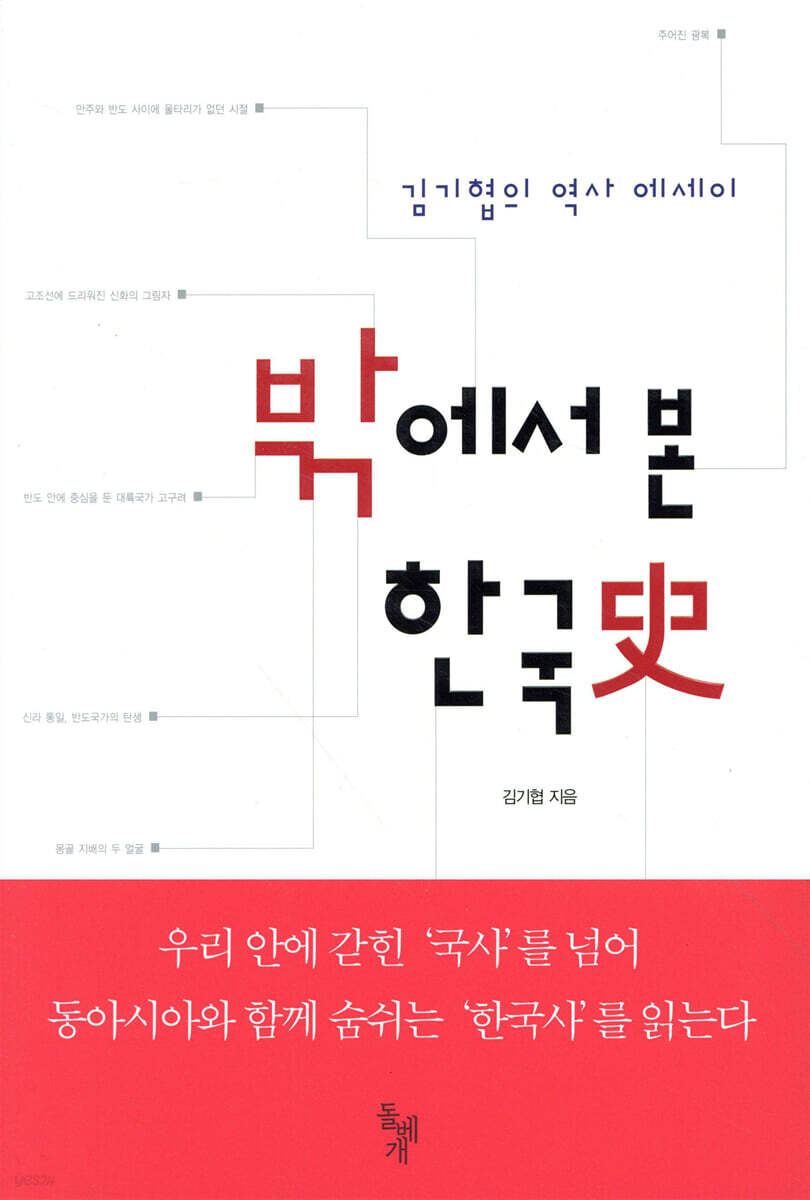
Korean history seen from the outside
 |
Description
Book Introduction
"Korean History Seen from Outside" is a book on Korean history written by author Kim Ki-hyeop, who has long contemplated Korean history from outside academia and the Korean Peninsula.
Author Kim Ki-hyeop suggests that the 'Korean history' needed in the new era must encompass both inside and outside the Korean Peninsula.
The book depicts Bronze Age Manchuria and the Korean Peninsula as a place where diverse ethnic groups with different cultures lived together.
Gaya and Wa, which had close ties, are also understood as a kind of complex aspect. Rather than emphasizing a fixed ethnicity, this reflects the perspective on the nation in the process of groups sharing a social culture based on agricultural civilization centered on the Korean Peninsula adopting civilization and technology through exchange with the outside world while maintaining independence.
The author points out that efforts to promote national identity and preserve the glorious history of our people, which had been suppressed by the colonial perspective, were certainly meaningful in the past, but the author points out that even today, 60 years after liberation, we are still caught up in the same sense of entitlement and exclusively emphasize the excellence of our people, which is nothing but an immature historical awareness trapped within “us.”
Based on this recognition, this book suggests that we broaden our understanding of Korean history, which has been confined to an internal perspective, through an 'outside' perspective.
Author Kim Ki-hyeop suggests that the 'Korean history' needed in the new era must encompass both inside and outside the Korean Peninsula.
The book depicts Bronze Age Manchuria and the Korean Peninsula as a place where diverse ethnic groups with different cultures lived together.
Gaya and Wa, which had close ties, are also understood as a kind of complex aspect. Rather than emphasizing a fixed ethnicity, this reflects the perspective on the nation in the process of groups sharing a social culture based on agricultural civilization centered on the Korean Peninsula adopting civilization and technology through exchange with the outside world while maintaining independence.
The author points out that efforts to promote national identity and preserve the glorious history of our people, which had been suppressed by the colonial perspective, were certainly meaningful in the past, but the author points out that even today, 60 years after liberation, we are still caught up in the same sense of entitlement and exclusively emphasize the excellence of our people, which is nothing but an immature historical awareness trapped within “us.”
Based on this recognition, this book suggests that we broaden our understanding of Korean history, which has been confined to an internal perspective, through an 'outside' perspective.
- You can preview some of the book's contents.
Preview
index
1
Space of the Korean people
A time when there was no fence between Manchuria and the Korean Peninsula
The Temptation of the Bronze Age on the Korean Peninsula
The Emergence of China, the Black Hole of Civilization
The tradition of Hwaibudong
2
The shadow of mythology cast over Gojoseon
A preventive war without a title
Lelang Commandery, the pipeline of Chinese civilization
The Samhan region, a new foundation for agricultural civilization
Gaya-Wa complex formed across the strait
Goguryeo, a continental state centered on the peninsula
3
Unification of Silla and the Birth of a Peninsular State
Goguryeo's Legacy and the Rise of a Peninsular State
The Great Wall, the Completion of a Peninsular Nation
Misunderstandings about the military regime
From state Buddhism to a Buddhist nation
4
The Two Faces of Mongol Rule
King Gongmin, a hero ignored by history
New wine in new wineskins, the founding of Joseon
A word that cannot be considered a curse, 'Four Great Kings'
The Dragon's Tears, the Foundation of a New Dynasty
A Confucian state built on the past system
5
The emergence of the Northern Route and Southern Route
Gwanghaegun, incompetence is also a crime for a king
The transition from the Ming to the Qing Dynasty required coordination between the four great powers.
The Hwan-guk-do factional strife, the Tangpyeong-do factional strife
Silhak, an academic style that seeks to embrace changes in reality
6
Western learning has become a debt of history
How Joseon fell into decline
The dichotomy of isolation and opening of ports
Is it national sovereignty or royal sovereignty?
The Many Faces of the Independence Movement
7
Between the Cold War and the Hot War
given liberation
Rice and subjectivity
Liquidation of the violent state
New world
Conclusion - Back to East Asia
Reviews
Space of the Korean people
A time when there was no fence between Manchuria and the Korean Peninsula
The Temptation of the Bronze Age on the Korean Peninsula
The Emergence of China, the Black Hole of Civilization
The tradition of Hwaibudong
2
The shadow of mythology cast over Gojoseon
A preventive war without a title
Lelang Commandery, the pipeline of Chinese civilization
The Samhan region, a new foundation for agricultural civilization
Gaya-Wa complex formed across the strait
Goguryeo, a continental state centered on the peninsula
3
Unification of Silla and the Birth of a Peninsular State
Goguryeo's Legacy and the Rise of a Peninsular State
The Great Wall, the Completion of a Peninsular Nation
Misunderstandings about the military regime
From state Buddhism to a Buddhist nation
4
The Two Faces of Mongol Rule
King Gongmin, a hero ignored by history
New wine in new wineskins, the founding of Joseon
A word that cannot be considered a curse, 'Four Great Kings'
The Dragon's Tears, the Foundation of a New Dynasty
A Confucian state built on the past system
5
The emergence of the Northern Route and Southern Route
Gwanghaegun, incompetence is also a crime for a king
The transition from the Ming to the Qing Dynasty required coordination between the four great powers.
The Hwan-guk-do factional strife, the Tangpyeong-do factional strife
Silhak, an academic style that seeks to embrace changes in reality
6
Western learning has become a debt of history
How Joseon fell into decline
The dichotomy of isolation and opening of ports
Is it national sovereignty or royal sovereignty?
The Many Faces of the Independence Movement
7
Between the Cold War and the Hot War
given liberation
Rice and subjectivity
Liquidation of the violent state
New world
Conclusion - Back to East Asia
Reviews
Publisher's Review
Stop reading history like a frog in a well!!
Reading Korean History with Open Eyes Inside and Out
“I wanted to capture in this book the spirit of ‘culture’: finding virtues worthy of cherishing in our roots without looking down on others, and respecting our neighbors without losing our integrity.
“We seek to find in history a source of enlightenment rather than a weapon of struggle, with the hope that an era is coming in which cooperation among neighbors will be more important than competition.”
―From the text
Sixty years after liberation, how mature has our view of history become? "Korean History Seen from Outside" offers an open perspective on Korean history, looking beyond the confines of our own "national history." It rejects narrow, linear historical narratives and instead offers a rational and flexible reading of history.
A broad perspective that examines the flow of East Asian world history and emphasizes the material conditions of history allows us to think more objectively and comprehensively about the flow of Korean history.
Today, I am writing 'Korean History'
This book is a 'Korean History' written by an author who has long been contemplating Korean history outside of academia and outside of the Korean Peninsula.
Writing Korean history properly today is not an easy task.
While the relationship between the three Northeast Asian countries is becoming increasingly closer due to world historical trends and political and economic needs, their historical perceptions have reached a point where communication is nearly impossible due to past conflicts and tensions.
Familiar issues of conflict, such as the Dokdo dispute and the Northeast Project, still occasionally appear in newspapers without proper historical explanations or interpretations.
In this situation, the understanding of Korean history inevitably drifts between the nationalistic desire to understand Korean history as a proud heroic narrative that has continued for five thousand years since Dangun, and the critical desire to point out the irrationality of such a mechanical and linear historical understanding (the latter is now escalating to the point of calling for the "dismantling of national history").
Moreover, recently, a right-wing nationalist Korean modern and contemporary history textbook from the so-called 'New Right' camp has appeared under the name of 'alternative', sparking controversy.
Moreover, amidst this controversy, the emotional overload surrounding nationalism is swallowing up objective facts and evaluations, blocking proper reflection.
Under these conditions, writing Korean history is both a question and an answer to the question, "Is (Korean) national history possible, and if so, how?"
Reading Korean history with open eyes, both inside and out
Author Kim Ki-hyeop suggests that the 'Korean history' needed in the new era must encompass both inside and outside the Korean Peninsula.
The idea is to broaden the narrow-minded perception of Korean history, which has been confined to an internal perspective, through an ‘outside’ perspective.
What was the perspective that was seen only from ‘inside’?
The author points out that efforts to promote national identity and preserve the glorious history of our people, which had been suppressed by the colonial perspective, were certainly meaningful in the past, but the author points out that even today, 60 years after liberation, we are still caught up in the same sense of entitlement and exclusively emphasize the excellence of our people, which is nothing but an immature historical awareness trapped within “us.”
This is still manifested in the national/anti-national schema, hegemony, and obsession with quantitative measures.
Therefore, the author says that Korean history viewed from the 'outside' must be viewed within the context of foreign history, excluding exclusive and self-righteous nationalism, and maintaining self-esteem without disparaging others.
It emphasizes a perspective that is free from ideological debates surrounding national identity, as well as from absolute advocacy and extreme denial of nationalism.
A comprehensive and rational narrative that goes beyond the limitations of conventional Korean history narratives.
Much of the strength of the narrative in “Korean History Seen from the Outside” stems from the author’s colorful background.
Author Kim Ki-hyeop studied physics and history in college, and studied the history of Eastern science and modern East-West relations at Kyungpook National University and Yonsei University graduate school.
His father, the late Kim Seong-chil, was also a leading figure in the field of history who wrote 『Joseon History』, which contains a clear national consciousness, and 『Before History』, which is an objective and reflective record of the Korean War.
The author has been active in various fields as a historian, translator, and columnist. In the 1990s, he focused on the United States and examined the American-centered international order in a historical context. In the 2000s, while living in Yanbian, China, he worked on organizing the history of East Asia through China from the perspective of the history of civilization.
"Korean History Seen from the Outside" is also a work that organizes these achievements into a single volume, and thanks to this, it has many strengths not found in typical descriptions of Korean history.
- First, based on a wealth of knowledge about the flow of world history and Chinese history, it appropriately positions Korean history within the overall history of East Asia.
As a result, it became possible to describe Korean history that encompasses the history of Korea-China relations and the history of Korea-Japan relations.
- Second, it focuses on the material basis and changes that historical facts are based on, and does not fall into idealistic spiritualism.
Thanks to this, when describing the formation of ancient states in Manchuria and the Korean Peninsula, for example, weight is placed on the macroscopic context of the development of East Asian metal civilization and the establishment of agricultural civilization.
- Third, it enabled the writing of contemporary history through a current awareness of the issues that connect past history with the current problems.
Another characteristic is that even when it presents weighty opinions, it reads like a clear and fast-paced current affairs column.
- Fourth, the narrative style emphasizes the breadth and depth of perspective rather than being bound by individual historical facts.
Rather than going through important events one by one like a textbook, it is structured so that readers can think about the overall flow.
When you look inside and out, it looks different
- Identity as a peninsular nation
Therefore, we must consider that the unique identity that we can call the Korean people was secured after the framework of the peninsula nation was formed through the unification of Silla.
The legacy of Goguryeo, a complex continental state spanning Manchuria and the Korean Peninsula, was divided and absorbed by China, Balhae, and Silla after the fall of Goguryeo, and the fact that the Korean people remained as its most prominent successor was the result of Goryeo's northern policy, symbolized by the Great Wall and the negotiations between Seohui and the Great Han Dynasty.
- The tradition of Hwaibudong
Many ethnic groups in Manchuria and the Korean Peninsula were sometimes conquered by China, or sometimes conquered by China, but ultimately took the path of being absorbed into Chinese civilization.
In contrast, the reason the Korean people have maintained their unique identity for a long time is because they have followed the path of 'Hwa-i-bu-dong', which is based on cultural power rather than military power, without rejecting Chinese civilization, but without being immersed in it.
The creation of Hangul can also be understood through the principle of hwa-i-bu-dong.
Rather than being an independent writing system, the main purpose of 『Hunminjeongeum』 was to pair with 『Donggukjeongun』 and effectively connect the Korean language and Chinese writing.
It can be said to be a route that harmonizes cultural universality and individuality.
- The limits of growth and the era of suburbanization
Furthermore, when looking at the modern world, the author persuasively presents the macro-level basis of civilization's map and productivity.
While the argument for strengthening regional blocs and emphasizing East Asian solidarity in the post-Cold War era is common, the author likens it to the Jin Dynasty's "Gyeonggyo-won-goo" policy during the Warring States period, linking it to the condition of slowing growth due to resource limitations.
In short, the order of unlimited competition is only possible under the condition of expansion of productive power, and it is predicted that a different order will be needed in the era of austerity that the world will face in the future.
Reading Korean History with Open Eyes Inside and Out
“I wanted to capture in this book the spirit of ‘culture’: finding virtues worthy of cherishing in our roots without looking down on others, and respecting our neighbors without losing our integrity.
“We seek to find in history a source of enlightenment rather than a weapon of struggle, with the hope that an era is coming in which cooperation among neighbors will be more important than competition.”
―From the text
Sixty years after liberation, how mature has our view of history become? "Korean History Seen from Outside" offers an open perspective on Korean history, looking beyond the confines of our own "national history." It rejects narrow, linear historical narratives and instead offers a rational and flexible reading of history.
A broad perspective that examines the flow of East Asian world history and emphasizes the material conditions of history allows us to think more objectively and comprehensively about the flow of Korean history.
Today, I am writing 'Korean History'
This book is a 'Korean History' written by an author who has long been contemplating Korean history outside of academia and outside of the Korean Peninsula.
Writing Korean history properly today is not an easy task.
While the relationship between the three Northeast Asian countries is becoming increasingly closer due to world historical trends and political and economic needs, their historical perceptions have reached a point where communication is nearly impossible due to past conflicts and tensions.
Familiar issues of conflict, such as the Dokdo dispute and the Northeast Project, still occasionally appear in newspapers without proper historical explanations or interpretations.
In this situation, the understanding of Korean history inevitably drifts between the nationalistic desire to understand Korean history as a proud heroic narrative that has continued for five thousand years since Dangun, and the critical desire to point out the irrationality of such a mechanical and linear historical understanding (the latter is now escalating to the point of calling for the "dismantling of national history").
Moreover, recently, a right-wing nationalist Korean modern and contemporary history textbook from the so-called 'New Right' camp has appeared under the name of 'alternative', sparking controversy.
Moreover, amidst this controversy, the emotional overload surrounding nationalism is swallowing up objective facts and evaluations, blocking proper reflection.
Under these conditions, writing Korean history is both a question and an answer to the question, "Is (Korean) national history possible, and if so, how?"
Reading Korean history with open eyes, both inside and out
Author Kim Ki-hyeop suggests that the 'Korean history' needed in the new era must encompass both inside and outside the Korean Peninsula.
The idea is to broaden the narrow-minded perception of Korean history, which has been confined to an internal perspective, through an ‘outside’ perspective.
What was the perspective that was seen only from ‘inside’?
The author points out that efforts to promote national identity and preserve the glorious history of our people, which had been suppressed by the colonial perspective, were certainly meaningful in the past, but the author points out that even today, 60 years after liberation, we are still caught up in the same sense of entitlement and exclusively emphasize the excellence of our people, which is nothing but an immature historical awareness trapped within “us.”
This is still manifested in the national/anti-national schema, hegemony, and obsession with quantitative measures.
Therefore, the author says that Korean history viewed from the 'outside' must be viewed within the context of foreign history, excluding exclusive and self-righteous nationalism, and maintaining self-esteem without disparaging others.
It emphasizes a perspective that is free from ideological debates surrounding national identity, as well as from absolute advocacy and extreme denial of nationalism.
A comprehensive and rational narrative that goes beyond the limitations of conventional Korean history narratives.
Much of the strength of the narrative in “Korean History Seen from the Outside” stems from the author’s colorful background.
Author Kim Ki-hyeop studied physics and history in college, and studied the history of Eastern science and modern East-West relations at Kyungpook National University and Yonsei University graduate school.
His father, the late Kim Seong-chil, was also a leading figure in the field of history who wrote 『Joseon History』, which contains a clear national consciousness, and 『Before History』, which is an objective and reflective record of the Korean War.
The author has been active in various fields as a historian, translator, and columnist. In the 1990s, he focused on the United States and examined the American-centered international order in a historical context. In the 2000s, while living in Yanbian, China, he worked on organizing the history of East Asia through China from the perspective of the history of civilization.
"Korean History Seen from the Outside" is also a work that organizes these achievements into a single volume, and thanks to this, it has many strengths not found in typical descriptions of Korean history.
- First, based on a wealth of knowledge about the flow of world history and Chinese history, it appropriately positions Korean history within the overall history of East Asia.
As a result, it became possible to describe Korean history that encompasses the history of Korea-China relations and the history of Korea-Japan relations.
- Second, it focuses on the material basis and changes that historical facts are based on, and does not fall into idealistic spiritualism.
Thanks to this, when describing the formation of ancient states in Manchuria and the Korean Peninsula, for example, weight is placed on the macroscopic context of the development of East Asian metal civilization and the establishment of agricultural civilization.
- Third, it enabled the writing of contemporary history through a current awareness of the issues that connect past history with the current problems.
Another characteristic is that even when it presents weighty opinions, it reads like a clear and fast-paced current affairs column.
- Fourth, the narrative style emphasizes the breadth and depth of perspective rather than being bound by individual historical facts.
Rather than going through important events one by one like a textbook, it is structured so that readers can think about the overall flow.
When you look inside and out, it looks different
- Identity as a peninsular nation
Therefore, we must consider that the unique identity that we can call the Korean people was secured after the framework of the peninsula nation was formed through the unification of Silla.
The legacy of Goguryeo, a complex continental state spanning Manchuria and the Korean Peninsula, was divided and absorbed by China, Balhae, and Silla after the fall of Goguryeo, and the fact that the Korean people remained as its most prominent successor was the result of Goryeo's northern policy, symbolized by the Great Wall and the negotiations between Seohui and the Great Han Dynasty.
- The tradition of Hwaibudong
Many ethnic groups in Manchuria and the Korean Peninsula were sometimes conquered by China, or sometimes conquered by China, but ultimately took the path of being absorbed into Chinese civilization.
In contrast, the reason the Korean people have maintained their unique identity for a long time is because they have followed the path of 'Hwa-i-bu-dong', which is based on cultural power rather than military power, without rejecting Chinese civilization, but without being immersed in it.
The creation of Hangul can also be understood through the principle of hwa-i-bu-dong.
Rather than being an independent writing system, the main purpose of 『Hunminjeongeum』 was to pair with 『Donggukjeongun』 and effectively connect the Korean language and Chinese writing.
It can be said to be a route that harmonizes cultural universality and individuality.
- The limits of growth and the era of suburbanization
Furthermore, when looking at the modern world, the author persuasively presents the macro-level basis of civilization's map and productivity.
While the argument for strengthening regional blocs and emphasizing East Asian solidarity in the post-Cold War era is common, the author likens it to the Jin Dynasty's "Gyeonggyo-won-goo" policy during the Warring States period, linking it to the condition of slowing growth due to resource limitations.
In short, the order of unlimited competition is only possible under the condition of expansion of productive power, and it is predicted that a different order will be needed in the era of austerity that the world will face in the future.
GOODS SPECIFICS
- Date of issue: March 31, 2008
- Page count, weight, size: 343 pages | 624g | 153*224*30mm
- ISBN13: 9788971993071
- ISBN10: 8971993073
You may also like
카테고리
korean


korean

![GQ KOREA Mark (Monthly): December [2025]](http://librairie.coreenne.fr/cdn/shop/files/8ef265dbbfbf186523ed75ba7319009d.jpg?v=1765340328&width=3840)


