

Harbin
 |
Description
Book Introduction
- A word from MD
-
Ahn Jung-geun as depicted by novelist Kim Hoon“An Jung-geun cannot be confined to his era,” says author Kim Hoon, presenting another masterpiece.
"Harbin" focuses on the moment when Ahn Jung-geun shot Ito Hirobumi and the time before and after, depicting Ahn Jung-geun as a young man who held "peace in the East" in his heart, and Ahn Jung-geun as a person.
A novel that allows us to look beyond recorded history to see Ahn Jung-geun.August 5, 2022. Novel/Poetry PD Park Hyung-wook
Kim Hoon's new masterpiece, "Harbin," has already surpassed 300,000 copies in cumulative sales thanks to the support of readers.
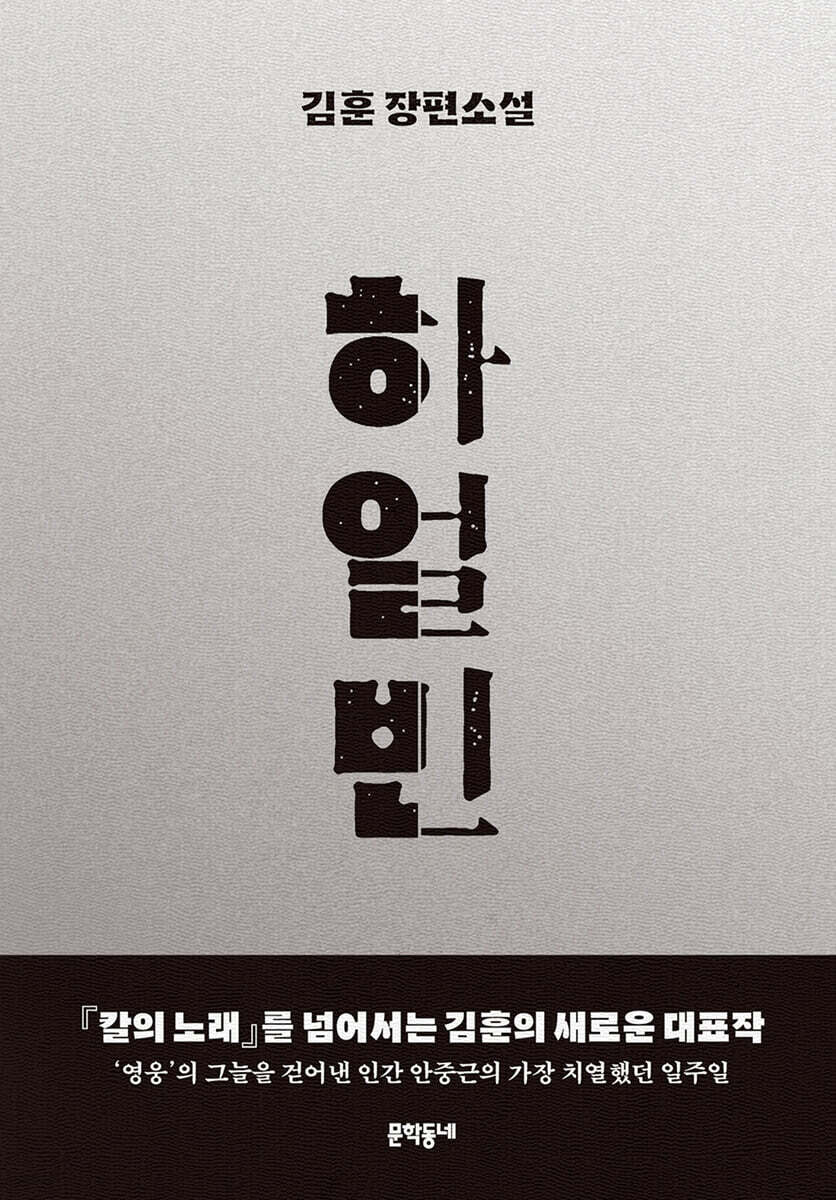
To commemorate this, this Recover Edition features a cover depicting the weight of a train, symbolizing Japanese imperialism, approaching from the far side of the continent.
In this day and age, when countless wars based on each person's interests and camps are waged daily, Kim Hoon's novel, which focuses on Ahn Jung-geun's living body, words, and youth rather than his "cause," still holds great relevance.
The path of Ahn Jung-geun, who risked committing the heinous crime of murdering another human being as a human being to proclaim "peace in the East" to the entire world, awakens our yearning for peace of mind and body more urgently than ever before.
Depth and emotion beyond "Song of the Sword"
The lifelong task that Kim Hoon had to accomplish
The new full-length novel 『Harbin』 by novelist Kim Hoon, known as ‘the greatest writer of our time’ and ‘the writer’s writer,’ has been published.
"Harbin" is a special work that Kim Hoon has considered his life's work throughout his career as a writer.
Since his youth, the author had conceived the idea of writing a novel about Ahn Jung-geun's short but intense life, and he spent a long time deeply understanding 'the human Ahn Jung-geun' in order to capture the energy of Ahn Jung-geun's actions in writing.
And in the summer of 2022, after intense and desperate writing, the result was finally released to the world.
In "Harbin," Kim Hoon's writing style shines, solidly reconstructing the lives of real people through thorough imagination rather than through historical records, which can be easily summarized simply.
This narrative naturally brings to mind Kim Hoon's masterpiece, "The Song of the Sword." While "The Song of the Sword" depicted Yi Sun-sin's turbulent inner self, overshadowed by his achievements as a great general, "Harbin" removes the shadow of heroism cast over Ahn Jung-geun and brings to life his most passionate and chaotic time in the present.
Kim Hoon's gaze, which focuses on the inner world of a weak human being who faces the fate of having to navigate turbulent times, weaves even deeper and more mysterious scenes in "Harbin."
In the novel, the waves of imperialism symbolized by Ito Hirobumi collide with the pure passion of youth symbolized by Ahn Jung-geun, the cause and ethics of a man facing the serious crime of murder collide, and Ahn Jung-geun's faith as a Catholic collide with his hatred as a worldly man.
This work, which nimbly handles the complex conflicts unfolding on such diverse levels and elevates the perspective on the character of Ahn Jung-geun, is worthy of being introduced as Kim Hoon's new masterpiece.
To commemorate this, this Recover Edition features a cover depicting the weight of a train, symbolizing Japanese imperialism, approaching from the far side of the continent.
In this day and age, when countless wars based on each person's interests and camps are waged daily, Kim Hoon's novel, which focuses on Ahn Jung-geun's living body, words, and youth rather than his "cause," still holds great relevance.
The path of Ahn Jung-geun, who risked committing the heinous crime of murdering another human being as a human being to proclaim "peace in the East" to the entire world, awakens our yearning for peace of mind and body more urgently than ever before.
Depth and emotion beyond "Song of the Sword"
The lifelong task that Kim Hoon had to accomplish
The new full-length novel 『Harbin』 by novelist Kim Hoon, known as ‘the greatest writer of our time’ and ‘the writer’s writer,’ has been published.
"Harbin" is a special work that Kim Hoon has considered his life's work throughout his career as a writer.
Since his youth, the author had conceived the idea of writing a novel about Ahn Jung-geun's short but intense life, and he spent a long time deeply understanding 'the human Ahn Jung-geun' in order to capture the energy of Ahn Jung-geun's actions in writing.
And in the summer of 2022, after intense and desperate writing, the result was finally released to the world.
In "Harbin," Kim Hoon's writing style shines, solidly reconstructing the lives of real people through thorough imagination rather than through historical records, which can be easily summarized simply.
This narrative naturally brings to mind Kim Hoon's masterpiece, "The Song of the Sword." While "The Song of the Sword" depicted Yi Sun-sin's turbulent inner self, overshadowed by his achievements as a great general, "Harbin" removes the shadow of heroism cast over Ahn Jung-geun and brings to life his most passionate and chaotic time in the present.
Kim Hoon's gaze, which focuses on the inner world of a weak human being who faces the fate of having to navigate turbulent times, weaves even deeper and more mysterious scenes in "Harbin."
In the novel, the waves of imperialism symbolized by Ito Hirobumi collide with the pure passion of youth symbolized by Ahn Jung-geun, the cause and ethics of a man facing the serious crime of murder collide, and Ahn Jung-geun's faith as a Catholic collide with his hatred as a worldly man.
This work, which nimbly handles the complex conflicts unfolding on such diverse levels and elevates the perspective on the character of Ahn Jung-geun, is worthy of being introduced as Kim Hoon's new masterpiece.
- You can preview some of the book's contents.
Preview
index
Harbin _007
Postscript and Notes _281
Author's Note│Catcher, Unemployed, Cigarette Seller _301
Postscript and Notes _281
Author's Note│Catcher, Unemployed, Cigarette Seller _301
Into the book
Iron is making its way into this world.
When the path opens, the world continues to move along that path.
Once a path is made, another path is made, and no one can go against the path.
Power makes the way and the way makes power.
---p.40
On a dark night, while trying to sleep, Ahn Jung-geun found it difficult to bear the fact that Ito's body was alive and functioning.
Rather than killing Ito and eliminating him, Ahn Jung-geun thought that his heart was telling him to erase Ito's existence so that he would not be able to wander the world alive and stir up trouble.
---pp.88~89
Woo Deok-sun said.
-Are you saying Ito is coming?
-That's right.
Coming to Harbin.
-You're coming?
The lighthouse lights on Russky Island in front of the harbor stirred up the darkness.
The light came into the bar.
When the light passed by, Woo Deok-sun's face turned bright red.
---p.104
The two sat on chairs in the photo studio.
The photographer shouted something in Russian from behind the camera and pressed the shutter.
The two people in new clothes and their facial features with new hair were captured in the photo.
An Jung-geun paid this ruble for the photo.
The Russian photographer held up five fingers and told me to come back in five days to get the photos.
Knowing that he wouldn't be able to come for five days, An Jung-geun nodded.
---p.142
It was always impossible to keep the muzzle fixed.
Since the person holding the gun was a living human, the muzzle was always shaking.
The target was clearly present beyond the sights, but the more I focused my sight on it, the fainter it became.
A single ray of vision, unable to reach the target, was obscured by fog beyond the sight.
The gun barrel was constantly shaking between the visible crosshairs and the invisible target, and the second joint of the right index finger hesitated while gripping the trigger.
---p.159
When there were four rounds left in the magazine, An Jung-geun woke up from the silence.
… … I have never seen Ito… … That might not be Ito… …
---pp.166~167
If Ito had not died but been taken to the hospital and survived, Ito's world would have become even more cruel.
If Ito wasn't dead, would there be any room to tell Ito why he was shot?
Three shots went in exactly, but is Ito dead?
Are you coming back to life?
Are you dying?
---p.193
An Jung-geun looked at Woo Deok-sun with his naked eyes.
Woo Deok-sun was also looking at Ahn Jung-geun.
Their eyes met, and Ahn Jung-geun looked into Woo Deok-sun's eyes.
It seemed as if his dry eyes were trembling.
---p.227
William knelt before Jesus in Gethsemane.
Since his arrival in Joseon, Willem had been thinking about the deaths and killings that had taken place on this small peninsula.
William asked God if the outside of the church was not the kingdom of God.
God did not answer.
Since Ahn Jung-geun killed Ito, Ito's people would kill Ahn Jung-geun again, but there would still be a few days left before Ahn Jung-geun was executed.
Willem thought about the few days An Jung-geun was still alive.
When the path opens, the world continues to move along that path.
Once a path is made, another path is made, and no one can go against the path.
Power makes the way and the way makes power.
---p.40
On a dark night, while trying to sleep, Ahn Jung-geun found it difficult to bear the fact that Ito's body was alive and functioning.
Rather than killing Ito and eliminating him, Ahn Jung-geun thought that his heart was telling him to erase Ito's existence so that he would not be able to wander the world alive and stir up trouble.
---pp.88~89
Woo Deok-sun said.
-Are you saying Ito is coming?
-That's right.
Coming to Harbin.
-You're coming?
The lighthouse lights on Russky Island in front of the harbor stirred up the darkness.
The light came into the bar.
When the light passed by, Woo Deok-sun's face turned bright red.
---p.104
The two sat on chairs in the photo studio.
The photographer shouted something in Russian from behind the camera and pressed the shutter.
The two people in new clothes and their facial features with new hair were captured in the photo.
An Jung-geun paid this ruble for the photo.
The Russian photographer held up five fingers and told me to come back in five days to get the photos.
Knowing that he wouldn't be able to come for five days, An Jung-geun nodded.
---p.142
It was always impossible to keep the muzzle fixed.
Since the person holding the gun was a living human, the muzzle was always shaking.
The target was clearly present beyond the sights, but the more I focused my sight on it, the fainter it became.
A single ray of vision, unable to reach the target, was obscured by fog beyond the sight.
The gun barrel was constantly shaking between the visible crosshairs and the invisible target, and the second joint of the right index finger hesitated while gripping the trigger.
---p.159
When there were four rounds left in the magazine, An Jung-geun woke up from the silence.
… … I have never seen Ito… … That might not be Ito… …
---pp.166~167
If Ito had not died but been taken to the hospital and survived, Ito's world would have become even more cruel.
If Ito wasn't dead, would there be any room to tell Ito why he was shot?
Three shots went in exactly, but is Ito dead?
Are you coming back to life?
Are you dying?
---p.193
An Jung-geun looked at Woo Deok-sun with his naked eyes.
Woo Deok-sun was also looking at Ahn Jung-geun.
Their eyes met, and Ahn Jung-geun looked into Woo Deok-sun's eyes.
It seemed as if his dry eyes were trembling.
---p.227
William knelt before Jesus in Gethsemane.
Since his arrival in Joseon, Willem had been thinking about the deaths and killings that had taken place on this small peninsula.
William asked God if the outside of the church was not the kingdom of God.
God did not answer.
Since Ahn Jung-geun killed Ito, Ito's people would kill Ahn Jung-geun again, but there would still be a few days left before Ahn Jung-geun was executed.
Willem thought about the few days An Jung-geun was still alive.
---p.248
Publisher's Review
“It was the wish of my difficult youth to write a novel about Ahn Jung-geun’s brilliant youth.
I looked for data and records in between working,
I looked around various places in Japan to find traces of Ito Hirobumi's life.
Then I got old without even starting that manuscript.
I couldn't handle the energy that Ahn Jung-geun's short life gave off.
I spent my time trying to forget that incident.
To make an excuse, it wasn't that I was lazy, it was that I was just procrastinating because I didn't have the courage.
I became ill in 2021 and recovered in the spring of 2022.
After I got out of bed, I thought about the rest of my life.
The urgency that I could no longer put it off hit me like a bolt from the blue.
“I started right away.” _Kim Hoon, from ‘Author’s Note’
An era filled with violence and barbarism,
Kim Hoon-sik's hard-boiled novel depicting the short and intense lives of young people.
Unlike previous books on Ahn Jung-geun, which focused on recording the great man's life from beginning to end, Kim Hoon focuses on the moment when Ahn Jung-geun shot Ito on October 26, 1909, and the brief days before and after, tracing the paths of Ahn and Ito as they each headed to Harbin.
In this way, the most intense days of Ahn Jung-geun's life are vividly reconstructed in Harbin with dramatic tension.
The dark times of the late Joseon Dynasty, when the determination of young people who could not just watch their country weakening was seething, and the people who were colliding with the flow of the world and collapsing in emptiness, are also depicted in Kim Hoon's characteristically hard-boiled short sentences.
In this tragic situation, the cause Ahn Jung-geun pursues and the human fear he feels are contrasted even more effectively.
While he is willing to sacrifice himself and others for the peace of the East, his identity as the eldest son, head of the household, and a baptized Catholic, and his hesitation at times, is an unfamiliar aspect of him that has been relatively unnoticed until now.
A vision floated above the ashes, of Willem praying in a distant place at the end of the world, of Ito stroking his white beard at the far end, and of the endless plain between them, filled with corpses.
The corpses were like stepping stones connecting the two extremes.
… …Is the priest here? An Jung-geun held back the question. (pp. 66-67)
The moment when Ahn Jung-geun decides to shoot Ito is filled with thrill, a mixture of coincidence and fate.
As Ahn Jung-geun wandered through Gando and the Maritime Province, agonizing over a bleak future, a piece of newspaper drifted into his boarding house. On it was a picture of Emperor Sunjong, cleverly staged by Resident-General Duke Ito to downgrade the status of the Korean Empire and flaunt the power of the Japanese Empire.
Sensing the Japanese ambitions implied in the photo, Ahn Jung-geun immediately makes up his mind and sets out on the last journey of his life to Harbin, where Ito will visit.
An Jung-geun immediately goes to find his comrade Woo Deok-sun, who had been with him in the volunteer army, and upon meeting An Jung-geun, Woo Deok-sun also sees through An Jung-geun's intentions and decides to accompany him without a second thought.
The unhesitating unity of two young men who share the same goal is conveyed through concise dialogue, leaving a lasting impression.
- You shoot Ito with the bullets left over from shooting the pheasant.
Woo Deok-sun laughed silently.
A faint smile spread across his face.
- It's funny, but that's what happened.
Isn't it the same as aiming and shooting?
- Have you shot a lot of guns?
- I didn't shoot much.
I'm no hunter, but Ito is bigger than a pheasant, so it won't be difficult.
An Jung-geun laughed out loud.
- I see.
I guess so.
I thought it would be difficult because Ito is so small.
- That's not a good idea.
The two looked at each other and smiled.
The laughter was blurred, and the sound was lost in the darkness. (Page 115)
The interrogation reports and trial records left behind by Japanese prosecutors and judges while investigating Ahn Jung-geun and his group who carried out the uprising are also used appropriately to enhance the novel's sense of realism.
One of Kim Hoon's specialties is reading the tragedy of human history behind extremely refined official documents.
These documents, which at first glance appear dry, are exquisitely placed within the context of the novel, and are reread as poignant records testifying to the heated situation at the time.
- Are you following the orders from within?
- no.
I have no obligation to take orders from An.
Even if there is a duty to follow orders, this is not something that can be done by order.
I did it with my heart.
- Lord Ito is a high-ranking official with many attendants and bodyguards. Did you think you could successfully assassinate him?
- It is something that can be done with one person's determination.
I believed that if you are determined, you can succeed no matter how many security guards you have. (p. 232)
These statements are so perfectly tense that they do not allow for a novelistic adaptation, and the answers of Ahn Jung-geun and Woo Deok-sun are simple and precise, leaving no room for alternative interpretations.
In these records, Kim Hoon reads the language of youth, which speaks without hesitation, regardless of pros and cons, only to reveal their own beliefs.
The image of young people who have dedicated their short lives to what they believe is right evokes complex and subtle emotions such as admiration, sadness, and regret.
The difficulty of keeping one's beliefs
The pure light emitted by those who have overcome it
In the novel, as much as the conflict between Ahn Jung-geun and Ito, the conflict between Father Willem, who baptized Ahn Jung-geun, and Bishop Mutel, who leads the Korean church, is worth noting.
An Jung-geun, who was sentenced to death in a trial based on Japanese criminal law, wishes to confess his sins to God before his death.
Willem tries to give the sacrament of confession to Ahn Jung-geun, but Mutel opposes Willem's wishes in order to prevent the roots of Catholicism, which has just taken root in Korea, from being shaken.
The confrontation between Willem, who strives to save a human soul, and Mutel, who paradoxically colludes with the secular world for the safety of the church, adds to the conflict between the sacred and the secular, enriching the novel's ending.
Like Ahn Jung-geun, Willem does not yield to Mutel's authority and goes to prison to meet Ahn Jung-geun according to his own convictions.
This courage of Willem creates a famous scene that leads Ahn Jung-geun's rough soul to peaceful rest.
An Jung-geun bent forward and spoke in a low voice.
Willem leaned forward and listened.
An Jung-geun's voice gradually became smaller.
The condemned man's head and the priest's head came close.
An Jung-geun's voice sounded like breathing.
The guards heard nothing.
The voice broke off and there was a long silence.
Willem confessed to An Jung-geun in silence. (pp. 273-274)
Kim Hoon's portrayal of Ahn Jung-geun forges a path with his whole body in an era where there is no hope.
In the process, Ahn Jung-geun's youthful spirit and his hopes and illusions that he could change the world were shattered along with his life.
The wall that Ahn Jung-geun ran into seems to still be intact even after more than a hundred years.
Young people still struggle to find an invisible path, sometimes being asked to compromise with the times and abandon their personal values and beliefs.
That is why the life of Ahn Jung-geun, who stood alone against the vast world, transcends time and evokes sympathy and sighs.
The 'postscript' at the end of the book unfolds the humiliation and betrayal suffered by those left behind after Ahn Jung-geun's execution.
This epilogue, which calmly describes the changes brought about by Ahn Jung-geun's lonely struggle and the tragedy that continued despite it all, touches on the reality outside of the novel and resonates with another dimension.
"Harbin" does not judge right or wrong regarding the paths chosen by people like Ahn Jung-geun to achieve the cause of peace in the East.
However, the many people in the book who tried to keep their own beliefs shine purely in the famous scenes they each created.
*
The young Korean man, Ahn Jung-geun, stood alone against the violence and barbarism of a world-historical scale that was the trend of the entire era.
His cause was 'peace in the East', and the only physical force he had secured was a pistol.
All he had was a single magazine with seven rounds of live ammunition and a hundred rubles for travel expenses that had been 'forcibly borrowed (or taken away).'
At that time, he was a young man of thirty-one years old.
(…)
An Jung-geun cannot be confined within his era.
An Jung-geun, who is unemployed and a hunter, constantly speaks to the fate of humanity in the survival of the fittest.
An Jung-geun speaks and speaks again.
An Jung-geun's gun is no different from his words.
_From the author's note
I looked for data and records in between working,
I looked around various places in Japan to find traces of Ito Hirobumi's life.
Then I got old without even starting that manuscript.
I couldn't handle the energy that Ahn Jung-geun's short life gave off.
I spent my time trying to forget that incident.
To make an excuse, it wasn't that I was lazy, it was that I was just procrastinating because I didn't have the courage.
I became ill in 2021 and recovered in the spring of 2022.
After I got out of bed, I thought about the rest of my life.
The urgency that I could no longer put it off hit me like a bolt from the blue.
“I started right away.” _Kim Hoon, from ‘Author’s Note’
An era filled with violence and barbarism,
Kim Hoon-sik's hard-boiled novel depicting the short and intense lives of young people.
Unlike previous books on Ahn Jung-geun, which focused on recording the great man's life from beginning to end, Kim Hoon focuses on the moment when Ahn Jung-geun shot Ito on October 26, 1909, and the brief days before and after, tracing the paths of Ahn and Ito as they each headed to Harbin.
In this way, the most intense days of Ahn Jung-geun's life are vividly reconstructed in Harbin with dramatic tension.
The dark times of the late Joseon Dynasty, when the determination of young people who could not just watch their country weakening was seething, and the people who were colliding with the flow of the world and collapsing in emptiness, are also depicted in Kim Hoon's characteristically hard-boiled short sentences.
In this tragic situation, the cause Ahn Jung-geun pursues and the human fear he feels are contrasted even more effectively.
While he is willing to sacrifice himself and others for the peace of the East, his identity as the eldest son, head of the household, and a baptized Catholic, and his hesitation at times, is an unfamiliar aspect of him that has been relatively unnoticed until now.
A vision floated above the ashes, of Willem praying in a distant place at the end of the world, of Ito stroking his white beard at the far end, and of the endless plain between them, filled with corpses.
The corpses were like stepping stones connecting the two extremes.
… …Is the priest here? An Jung-geun held back the question. (pp. 66-67)
The moment when Ahn Jung-geun decides to shoot Ito is filled with thrill, a mixture of coincidence and fate.
As Ahn Jung-geun wandered through Gando and the Maritime Province, agonizing over a bleak future, a piece of newspaper drifted into his boarding house. On it was a picture of Emperor Sunjong, cleverly staged by Resident-General Duke Ito to downgrade the status of the Korean Empire and flaunt the power of the Japanese Empire.
Sensing the Japanese ambitions implied in the photo, Ahn Jung-geun immediately makes up his mind and sets out on the last journey of his life to Harbin, where Ito will visit.
An Jung-geun immediately goes to find his comrade Woo Deok-sun, who had been with him in the volunteer army, and upon meeting An Jung-geun, Woo Deok-sun also sees through An Jung-geun's intentions and decides to accompany him without a second thought.
The unhesitating unity of two young men who share the same goal is conveyed through concise dialogue, leaving a lasting impression.
- You shoot Ito with the bullets left over from shooting the pheasant.
Woo Deok-sun laughed silently.
A faint smile spread across his face.
- It's funny, but that's what happened.
Isn't it the same as aiming and shooting?
- Have you shot a lot of guns?
- I didn't shoot much.
I'm no hunter, but Ito is bigger than a pheasant, so it won't be difficult.
An Jung-geun laughed out loud.
- I see.
I guess so.
I thought it would be difficult because Ito is so small.
- That's not a good idea.
The two looked at each other and smiled.
The laughter was blurred, and the sound was lost in the darkness. (Page 115)
The interrogation reports and trial records left behind by Japanese prosecutors and judges while investigating Ahn Jung-geun and his group who carried out the uprising are also used appropriately to enhance the novel's sense of realism.
One of Kim Hoon's specialties is reading the tragedy of human history behind extremely refined official documents.
These documents, which at first glance appear dry, are exquisitely placed within the context of the novel, and are reread as poignant records testifying to the heated situation at the time.
- Are you following the orders from within?
- no.
I have no obligation to take orders from An.
Even if there is a duty to follow orders, this is not something that can be done by order.
I did it with my heart.
- Lord Ito is a high-ranking official with many attendants and bodyguards. Did you think you could successfully assassinate him?
- It is something that can be done with one person's determination.
I believed that if you are determined, you can succeed no matter how many security guards you have. (p. 232)
These statements are so perfectly tense that they do not allow for a novelistic adaptation, and the answers of Ahn Jung-geun and Woo Deok-sun are simple and precise, leaving no room for alternative interpretations.
In these records, Kim Hoon reads the language of youth, which speaks without hesitation, regardless of pros and cons, only to reveal their own beliefs.
The image of young people who have dedicated their short lives to what they believe is right evokes complex and subtle emotions such as admiration, sadness, and regret.
The difficulty of keeping one's beliefs
The pure light emitted by those who have overcome it
In the novel, as much as the conflict between Ahn Jung-geun and Ito, the conflict between Father Willem, who baptized Ahn Jung-geun, and Bishop Mutel, who leads the Korean church, is worth noting.
An Jung-geun, who was sentenced to death in a trial based on Japanese criminal law, wishes to confess his sins to God before his death.
Willem tries to give the sacrament of confession to Ahn Jung-geun, but Mutel opposes Willem's wishes in order to prevent the roots of Catholicism, which has just taken root in Korea, from being shaken.
The confrontation between Willem, who strives to save a human soul, and Mutel, who paradoxically colludes with the secular world for the safety of the church, adds to the conflict between the sacred and the secular, enriching the novel's ending.
Like Ahn Jung-geun, Willem does not yield to Mutel's authority and goes to prison to meet Ahn Jung-geun according to his own convictions.
This courage of Willem creates a famous scene that leads Ahn Jung-geun's rough soul to peaceful rest.
An Jung-geun bent forward and spoke in a low voice.
Willem leaned forward and listened.
An Jung-geun's voice gradually became smaller.
The condemned man's head and the priest's head came close.
An Jung-geun's voice sounded like breathing.
The guards heard nothing.
The voice broke off and there was a long silence.
Willem confessed to An Jung-geun in silence. (pp. 273-274)
Kim Hoon's portrayal of Ahn Jung-geun forges a path with his whole body in an era where there is no hope.
In the process, Ahn Jung-geun's youthful spirit and his hopes and illusions that he could change the world were shattered along with his life.
The wall that Ahn Jung-geun ran into seems to still be intact even after more than a hundred years.
Young people still struggle to find an invisible path, sometimes being asked to compromise with the times and abandon their personal values and beliefs.
That is why the life of Ahn Jung-geun, who stood alone against the vast world, transcends time and evokes sympathy and sighs.
The 'postscript' at the end of the book unfolds the humiliation and betrayal suffered by those left behind after Ahn Jung-geun's execution.
This epilogue, which calmly describes the changes brought about by Ahn Jung-geun's lonely struggle and the tragedy that continued despite it all, touches on the reality outside of the novel and resonates with another dimension.
"Harbin" does not judge right or wrong regarding the paths chosen by people like Ahn Jung-geun to achieve the cause of peace in the East.
However, the many people in the book who tried to keep their own beliefs shine purely in the famous scenes they each created.
*
The young Korean man, Ahn Jung-geun, stood alone against the violence and barbarism of a world-historical scale that was the trend of the entire era.
His cause was 'peace in the East', and the only physical force he had secured was a pistol.
All he had was a single magazine with seven rounds of live ammunition and a hundred rubles for travel expenses that had been 'forcibly borrowed (or taken away).'
At that time, he was a young man of thirty-one years old.
(…)
An Jung-geun cannot be confined within his era.
An Jung-geun, who is unemployed and a hunter, constantly speaks to the fate of humanity in the survival of the fittest.
An Jung-geun speaks and speaks again.
An Jung-geun's gun is no different from his words.
_From the author's note
GOODS SPECIFICS
- Date of issue: August 3, 2022
- Format: Hardcover book binding method guide
- Page count, weight, size: 308 pages | 400g | 128*188*20mm
- ISBN13: 9788954699914
- ISBN10: 895469991X
You may also like
카테고리
korean


korean

![GQ KOREA Mark (Monthly): December [2025]](http://librairie.coreenne.fr/cdn/shop/files/8ef265dbbfbf186523ed75ba7319009d.jpg?v=1765340328&width=3840)


