

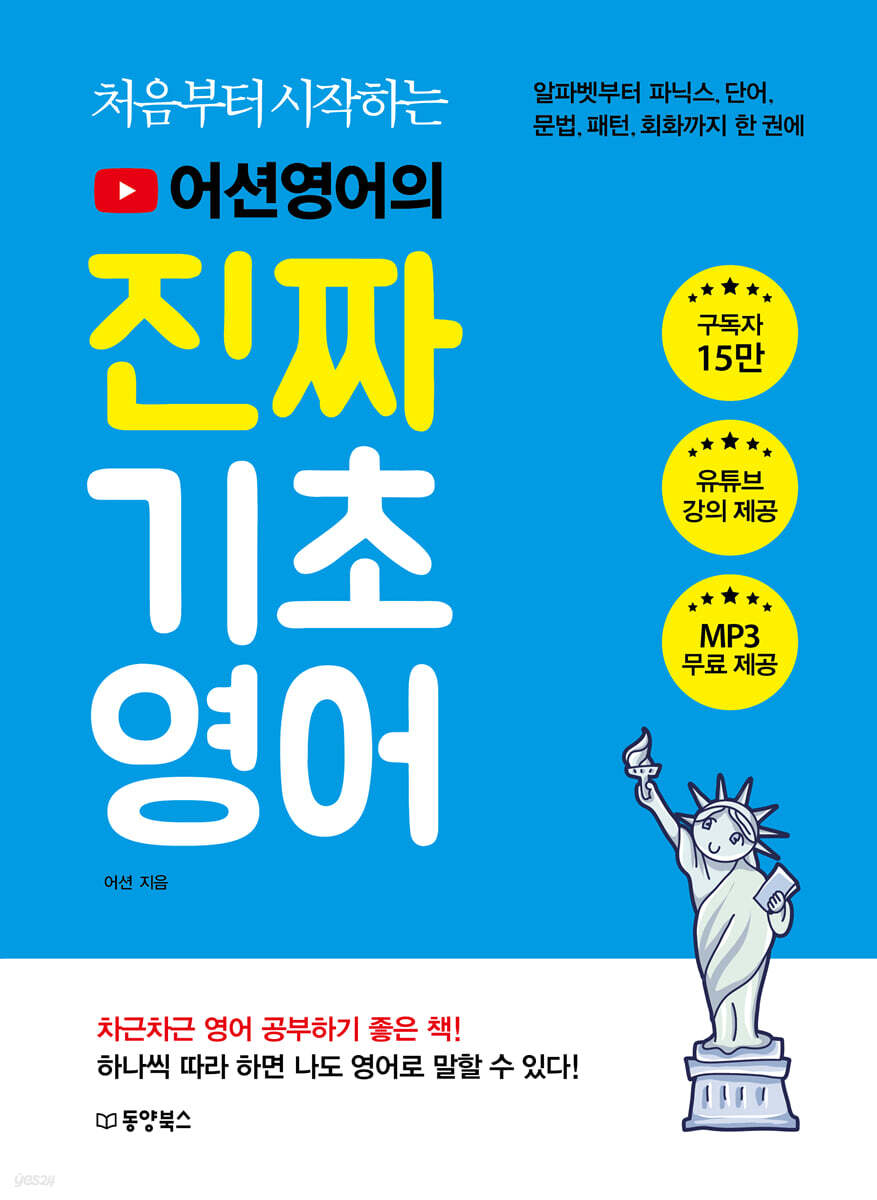
The real basic English of Action English, starting from scratch
 |
Description
Book Introduction
Surpassed 120,000 subscribers in just one and a half years
YouTube's basic English channel [Action English] has finally been published as a book!
"Ashion English's Real Basic English from Scratch" is a real basic English textbook written by Mr. Ashion of YouTube's [Ashion English], who has helped 120,000 subscribers overcome their English difficulties.
This is a must-read basic English book for beginners who want to learn English but don't know where to start, those who studied by writing the pronunciation of each English word and sentence in Korean because they were confused about the alphabet and phonics, and those who gave up on English because they couldn't grasp the basics even after going to an academy. It is structured in an easy-to-understand format that is perfect for those who want to start studying English from the beginning.
Starting with the alphabet and phonics, you can create various sentences through sentence patterns even if you don't know grammar, just with words and expressions.
If you study alone with a book, you may feel limited, so [Action English] YouTube provides lectures for free.
With a burden-free study load of 4 pages per day, I hope you will gradually complete the beginner course - beginner course - basic course - practical conversation course to gain confidence in English.
YouTube's basic English channel [Action English] has finally been published as a book!
"Ashion English's Real Basic English from Scratch" is a real basic English textbook written by Mr. Ashion of YouTube's [Ashion English], who has helped 120,000 subscribers overcome their English difficulties.
This is a must-read basic English book for beginners who want to learn English but don't know where to start, those who studied by writing the pronunciation of each English word and sentence in Korean because they were confused about the alphabet and phonics, and those who gave up on English because they couldn't grasp the basics even after going to an academy. It is structured in an easy-to-understand format that is perfect for those who want to start studying English from the beginning.
Starting with the alphabet and phonics, you can create various sentences through sentence patterns even if you don't know grammar, just with words and expressions.
If you study alone with a book, you may feel limited, so [Action English] YouTube provides lectures for free.
With a burden-free study load of 4 pages per day, I hope you will gradually complete the beginner course - beginner course - basic course - practical conversation course to gain confidence in English.
- You can preview some of the book's contents.
Preview
index
Intro Beginner Course
01.
Learning the alphabet
02.
Learn English Pronunciation Easily with Korean | Phonics
03.
4 Basic Grammar Rules You Must Remember
Part 01 Beginner Course
Chapter 01 Talking about 'me' with the verb 'be'
Unit 01 Talking about my current mood and state | Adjectives
Unit 02 Denying My Current Feelings and Conditions | Adjectives
Unit 03 Speaking with Additional Feelings | Adverbs
Unit 04 Talking about my current job, name, and role | Nouns
Unit 05 Negating My Current Occupation, Name, and Role | Noun
Unit 06 Saying My Current Location | Preposition + Noun
Unit 07 Negating My Current Location | Preposition + Noun
Unit 08 Talking about my past feelings and states | Adjectives
Unit 09 Denying My Past Feelings and States | Adjectives
Unit 10 Talking about my past occupation | Nouns
Unit 11: Speaking in Detail About My Past Role | Adjective + Noun
Unit 12: Denying My Past Role in Detail | Adjective + Noun
Unit 13: Talking about my past location | Preposition + Noun
Unit 14 Negating My Past Position | Preposition + Noun
Plus 1 Sentences to Memorize in Their Entire Form 1 | Verb "be"
Chapter 02 Talking about 'I' with regular verbs
Unit 15 Talking about what I'm doing now | Present progressive tense of regular verbs
Unit 16 Denying What I'm Doing Now | Present Continuous Tense of Regular Verbs
Unit 17 Talking about what I usually do | Present tense of regular verbs
Unit 18 Negating What I Usually Do | Present Tense of Regular Verbs
Unit 19 Saying How Often I Do Something | Adverbs of Frequency
Unit 20 Talking about what I did in the past | Past tense of regular verbs
Unit 21 Denying What I Did in the Past | Past Tense of Regular Verbs
Unit 22 Talking about what I will do in the future | Future tense of regular verbs
Unit 23 Negating What I Will Do in the Future | Future Tense of Regular Verbs
Plus 2.
Good sentences to memorize in their entirety 2 | Regular verbs
Part 02 Basic Course
Chapter 03 Changing the Subject
Unit 24: Talking about the location of objects | Prepositions
Unit 25: Describing/Denying Your Current Mood, State, and Location
Unit 26: Describing/Denying Past Moods, Conditions, and Locations
Unit 27 Talking about what you're doing now
Unit 28 Denying What You Are Doing
Unit 29 Talking about things you usually do
Unit 30: Denying what you usually do
Unit 31 Talking about things you did in the past
Unit 32 Denying Things You Did in the Past
Unit 33 Talking about what to do in the future
Unit 34: Denying Future Actions
Plus 3 will vs. indicating the future
be going to
Part 03 Practical Conversation Course
Chapter 04 Asking and Answering Questions Without Interrogative Words | Yes/No Answers
Unit 35 Asking and answering questions about current mood, status, occupation, and location
Unit 36 Asking and answering questions about past moods, states, occupations, and locations
Unit 37 Asking and answering questions about what you're doing now
Unit 38 Asking and answering questions about usual and general things to do
Unit 39 Asking and answering about present conditions (exceptional regular verbs)
Unit 40: Asking and answering questions about past events
Unit 41: Asking and Answering Future Tasks
Unit 42: Asking and Answering Questions About Experiences
Plus 04.
Essential expressions for traveling abroad
Chapter 05 Asking and Answering Questions with Interrogatives | Basic Conversation with Frequently Used Interrogatives
Unit 43.
Asking and answering questions about interrogative pronouns (Wh-) that are good to know in their entirety
Unit 44.
Asking and answering questions about yourself using interrogative pronouns (Wh-)
Unit 45.
Asking and answering what people are doing now using interrogative pronouns (Wh-)
Unit 46.
Asking and answering about everyday and general things done using interrogative pronouns (Wh-)
Unit 47.
Asking and answering about past events using interrogative pronouns (Wh-)
Unit 48.
Asking and answering about future events using interrogative pronouns (Wh-)
Plus 05 Essential Expressions in the Hospital
supplement
01 Different ways to talk about the future
02 Top 78 Essential Adjectives for Conversation
03 Asking questions with different subjects
04 Auxiliary Verb Patterns
05 Complete Irregular Verbs
01.
Learning the alphabet
02.
Learn English Pronunciation Easily with Korean | Phonics
03.
4 Basic Grammar Rules You Must Remember
Part 01 Beginner Course
Chapter 01 Talking about 'me' with the verb 'be'
Unit 01 Talking about my current mood and state | Adjectives
Unit 02 Denying My Current Feelings and Conditions | Adjectives
Unit 03 Speaking with Additional Feelings | Adverbs
Unit 04 Talking about my current job, name, and role | Nouns
Unit 05 Negating My Current Occupation, Name, and Role | Noun
Unit 06 Saying My Current Location | Preposition + Noun
Unit 07 Negating My Current Location | Preposition + Noun
Unit 08 Talking about my past feelings and states | Adjectives
Unit 09 Denying My Past Feelings and States | Adjectives
Unit 10 Talking about my past occupation | Nouns
Unit 11: Speaking in Detail About My Past Role | Adjective + Noun
Unit 12: Denying My Past Role in Detail | Adjective + Noun
Unit 13: Talking about my past location | Preposition + Noun
Unit 14 Negating My Past Position | Preposition + Noun
Plus 1 Sentences to Memorize in Their Entire Form 1 | Verb "be"
Chapter 02 Talking about 'I' with regular verbs
Unit 15 Talking about what I'm doing now | Present progressive tense of regular verbs
Unit 16 Denying What I'm Doing Now | Present Continuous Tense of Regular Verbs
Unit 17 Talking about what I usually do | Present tense of regular verbs
Unit 18 Negating What I Usually Do | Present Tense of Regular Verbs
Unit 19 Saying How Often I Do Something | Adverbs of Frequency
Unit 20 Talking about what I did in the past | Past tense of regular verbs
Unit 21 Denying What I Did in the Past | Past Tense of Regular Verbs
Unit 22 Talking about what I will do in the future | Future tense of regular verbs
Unit 23 Negating What I Will Do in the Future | Future Tense of Regular Verbs
Plus 2.
Good sentences to memorize in their entirety 2 | Regular verbs
Part 02 Basic Course
Chapter 03 Changing the Subject
Unit 24: Talking about the location of objects | Prepositions
Unit 25: Describing/Denying Your Current Mood, State, and Location
Unit 26: Describing/Denying Past Moods, Conditions, and Locations
Unit 27 Talking about what you're doing now
Unit 28 Denying What You Are Doing
Unit 29 Talking about things you usually do
Unit 30: Denying what you usually do
Unit 31 Talking about things you did in the past
Unit 32 Denying Things You Did in the Past
Unit 33 Talking about what to do in the future
Unit 34: Denying Future Actions
Plus 3 will vs. indicating the future
be going to
Part 03 Practical Conversation Course
Chapter 04 Asking and Answering Questions Without Interrogative Words | Yes/No Answers
Unit 35 Asking and answering questions about current mood, status, occupation, and location
Unit 36 Asking and answering questions about past moods, states, occupations, and locations
Unit 37 Asking and answering questions about what you're doing now
Unit 38 Asking and answering questions about usual and general things to do
Unit 39 Asking and answering about present conditions (exceptional regular verbs)
Unit 40: Asking and answering questions about past events
Unit 41: Asking and Answering Future Tasks
Unit 42: Asking and Answering Questions About Experiences
Plus 04.
Essential expressions for traveling abroad
Chapter 05 Asking and Answering Questions with Interrogatives | Basic Conversation with Frequently Used Interrogatives
Unit 43.
Asking and answering questions about interrogative pronouns (Wh-) that are good to know in their entirety
Unit 44.
Asking and answering questions about yourself using interrogative pronouns (Wh-)
Unit 45.
Asking and answering what people are doing now using interrogative pronouns (Wh-)
Unit 46.
Asking and answering about everyday and general things done using interrogative pronouns (Wh-)
Unit 47.
Asking and answering about past events using interrogative pronouns (Wh-)
Unit 48.
Asking and answering about future events using interrogative pronouns (Wh-)
Plus 05 Essential Expressions in the Hospital
supplement
01 Different ways to talk about the future
02 Top 78 Essential Adjectives for Conversation
03 Asking questions with different subjects
04 Auxiliary Verb Patterns
05 Complete Irregular Verbs
Detailed image

Publisher's Review
1.
Read the book carefully!
We have written the text in large Korean as close to the native speaker's pronunciation as possible so that anyone can read it without any problems, even if they are not good at reading English.
Additionally, rather than just showing you one representative pronunciation, you can also learn pronunciation in more detail by showing other pronunciations as well.
Read the written pronunciation out loud and try to memorize the words and sentences with your eyes.
It will help you become more familiar with difficult English.
2.
Listen carefully to the two MP3 audio files: the Korean-native speaker version and the native speaker version!
We've recorded the words and sentences in the text in Korean and English so you can study anytime, anywhere.
Listen to it repeatedly while doing housework, commuting to and from work, and in your spare time so that your ears can become accustomed to English.
As you become more proficient, try listening to audio recordings of only the native speaker's voice, rather than the Korean and native speaker versions, and interpret them in your head right away.
You can learn just by listening properly.
Free MP3 download www.dongyangbooks.com
3.
Listen to it repeatedly and say it out loud!
You can never speak English naturally by just listening to it.
Try to speak like a native speaker.
In particular, if you listen to and speak step 1 and step 2 of each unit at least 5 times, English will become familiar and natural to you.
And check if you can speak for yourself in step 3 of the beginner and basic courses.
You will feel your skills improving on your own.
Read the book carefully!
We have written the text in large Korean as close to the native speaker's pronunciation as possible so that anyone can read it without any problems, even if they are not good at reading English.
Additionally, rather than just showing you one representative pronunciation, you can also learn pronunciation in more detail by showing other pronunciations as well.
Read the written pronunciation out loud and try to memorize the words and sentences with your eyes.
It will help you become more familiar with difficult English.
2.
Listen carefully to the two MP3 audio files: the Korean-native speaker version and the native speaker version!
We've recorded the words and sentences in the text in Korean and English so you can study anytime, anywhere.
Listen to it repeatedly while doing housework, commuting to and from work, and in your spare time so that your ears can become accustomed to English.
As you become more proficient, try listening to audio recordings of only the native speaker's voice, rather than the Korean and native speaker versions, and interpret them in your head right away.
You can learn just by listening properly.
Free MP3 download www.dongyangbooks.com
3.
Listen to it repeatedly and say it out loud!
You can never speak English naturally by just listening to it.
Try to speak like a native speaker.
In particular, if you listen to and speak step 1 and step 2 of each unit at least 5 times, English will become familiar and natural to you.
And check if you can speak for yourself in step 3 of the beginner and basic courses.
You will feel your skills improving on your own.
GOODS SPECIFICS
- Date of issue: September 1, 2020
- Page count, weight, size: 248 pages | 646g | 188*257*16mm
- ISBN13: 9791157686445
- ISBN10: 1157686443
You may also like
카테고리
korean


korean

![ELLE 엘르 스페셜 에디션 A형 : 12월 [2025]](http://librairie.coreenne.fr/cdn/shop/files/b8e27a3de6c9538896439686c6b0e8fb.jpg?v=1766436872&width=3840)


