

You can leave the flowers there.
 |
Description
Book Introduction
The last days of life spent at the Coclico Sanatorium
How can we live a happy and dignified life?
As of 2022, the average life expectancy in OECD member countries is 80.5 years, and the average life expectancy in Korea is 83.5 years. DNA analysis has confirmed that the natural life expectancy is 38 years, meaning modern people live remarkably long lives.
But is longevity truly a blessing? Does the ancient saying, "Even rolling in dog shit is better than living in this world," still hold true today? The aging, disease, loneliness, and poverty that come with old age have long been social problems.
How can a dignified life be possible for an elderly person whose memory is fading, whose joints creak, and who can no longer control their own body and mind?
As death approaches, living happily and with dignity seems like an utterly difficult task.
"You Can Leave the Flowers There" is a graphic novel that depicts the life of the elderly set in a nursing home.
The elderly people who enter the 'Coclico Nursing Home' are people who cannot live without someone's help and who do not receive adequate care from their families.
If he hadn't been in a wheelchair or suffered from dementia, he would have been able to live independently, eating and showering on his own, and if he had, he wouldn't have had to go to a nursing home.
Children who leave their elderly parents behind to move their belongings may feel a little sorry and guilty, but there is nothing they can do about it.
Because you can't sacrifice your young children's lives to care for your aging parents.
Moreover, leaving the care of the elderly to family members is a harmful practice that must be avoided in modern countries.
Therefore, nursing homes for the elderly, which provide comfortable and affectionate care like home, may be the representative face of social welfare today.
What matters is how the last days of life spent by the elderly in the facility are filled.
Strangely, rather than focusing on the elderly's 'well-dying', 'You Can Leave the Flowers There' shifts the focus of the story slightly to Estelle, the nurse who takes care of them.
Estelle is an ordinary young woman who has a faltering relationship with her boyfriend, flirts with her colleagues during breaks, and occasionally goes to clubs to get drunk. At the same time, she is a caregiver who watches over and cares for people in their final years, and ultimately cleans and sends off the dead.
Estelle is so affectionate and delicate that she comforts the elderly man who was bathing her despite his physical changes. She tries to make sure that the elderly have a peaceful time while caring for them.
When she encounters an older man who is lost in his youth and thinks Estelle is his homosexual lover, or an older man who has been a factory worker all his life and claims to have been the French ambassador to Prague, Estelle readily agrees with their fantasies.
Sometimes you may incur the resentment of your family and receive a warning from your boss, but what is more important: real life, real memories, and the satisfying time you have here and now?
Are the elderly in nursing homes simply supposed to wait helplessly for death? And when they finally leave, will the caregivers simply calmly tidy up the empty beds and welcome new residents?
How can we live a happy and dignified life?
As of 2022, the average life expectancy in OECD member countries is 80.5 years, and the average life expectancy in Korea is 83.5 years. DNA analysis has confirmed that the natural life expectancy is 38 years, meaning modern people live remarkably long lives.
But is longevity truly a blessing? Does the ancient saying, "Even rolling in dog shit is better than living in this world," still hold true today? The aging, disease, loneliness, and poverty that come with old age have long been social problems.
How can a dignified life be possible for an elderly person whose memory is fading, whose joints creak, and who can no longer control their own body and mind?
As death approaches, living happily and with dignity seems like an utterly difficult task.
"You Can Leave the Flowers There" is a graphic novel that depicts the life of the elderly set in a nursing home.
The elderly people who enter the 'Coclico Nursing Home' are people who cannot live without someone's help and who do not receive adequate care from their families.
If he hadn't been in a wheelchair or suffered from dementia, he would have been able to live independently, eating and showering on his own, and if he had, he wouldn't have had to go to a nursing home.
Children who leave their elderly parents behind to move their belongings may feel a little sorry and guilty, but there is nothing they can do about it.
Because you can't sacrifice your young children's lives to care for your aging parents.
Moreover, leaving the care of the elderly to family members is a harmful practice that must be avoided in modern countries.
Therefore, nursing homes for the elderly, which provide comfortable and affectionate care like home, may be the representative face of social welfare today.
What matters is how the last days of life spent by the elderly in the facility are filled.
Strangely, rather than focusing on the elderly's 'well-dying', 'You Can Leave the Flowers There' shifts the focus of the story slightly to Estelle, the nurse who takes care of them.
Estelle is an ordinary young woman who has a faltering relationship with her boyfriend, flirts with her colleagues during breaks, and occasionally goes to clubs to get drunk. At the same time, she is a caregiver who watches over and cares for people in their final years, and ultimately cleans and sends off the dead.
Estelle is so affectionate and delicate that she comforts the elderly man who was bathing her despite his physical changes. She tries to make sure that the elderly have a peaceful time while caring for them.
When she encounters an older man who is lost in his youth and thinks Estelle is his homosexual lover, or an older man who has been a factory worker all his life and claims to have been the French ambassador to Prague, Estelle readily agrees with their fantasies.
Sometimes you may incur the resentment of your family and receive a warning from your boss, but what is more important: real life, real memories, and the satisfying time you have here and now?
Are the elderly in nursing homes simply supposed to wait helplessly for death? And when they finally leave, will the caregivers simply calmly tidy up the empty beds and welcome new residents?
Detailed image

Into the book
really.
What the world looks like through your eyes, and what I look like...
I wish I could know what kind of world you live in...
---p.68
I'm thirty-three years old, and I've already seen hundreds of bodies of people I've been in love with.
No one, really no one, ever took care of us by even saying, "Are you okay?"
So what did I do? Yeah, I started taking care of myself.
I brought back some small memories.
I deserve to receive a keepsake like this!
---p.91
You know...
I understand too.
It's natural for anyone to cry a lot when they lose someone precious.
But you can't just live your whole life crying.
---p.92
I hate it, at least in front of my granddaughter.
The child is worried.
That's why you keep trying to get away from me.
How can you blame that kid?
When I look into that child's eyes...
I feel like you're scared because of me...
---pp.101-102
You can choose the reality you want.
Either reject the unfamiliar appearance or embrace it.
The choice is yours.
Just think about the unchanging truth...
Just think about it.
---p.129
Estelle, we are the last people the elders will see before they die.
They said they knew that fact from the moment they came here.
It's easy to promise ourselves that we'll be family, nannies, or friends...
That can't be happening.
We, who bring them coffee every morning, are merely a daily reminder that they are nearing the end of their lives.
---p.145
I believe this is the mission entrusted to me as a nurse.
Figure out what causes you pain: truth or illusion...
It's about relieving pain.
---p.157
I was also a witch...
And then I became a granddaughter...
He even became an angel...
What the world looks like through your eyes, and what I look like...
I wish I could know what kind of world you live in...
---p.68
I'm thirty-three years old, and I've already seen hundreds of bodies of people I've been in love with.
No one, really no one, ever took care of us by even saying, "Are you okay?"
So what did I do? Yeah, I started taking care of myself.
I brought back some small memories.
I deserve to receive a keepsake like this!
---p.91
You know...
I understand too.
It's natural for anyone to cry a lot when they lose someone precious.
But you can't just live your whole life crying.
---p.92
I hate it, at least in front of my granddaughter.
The child is worried.
That's why you keep trying to get away from me.
How can you blame that kid?
When I look into that child's eyes...
I feel like you're scared because of me...
---pp.101-102
You can choose the reality you want.
Either reject the unfamiliar appearance or embrace it.
The choice is yours.
Just think about the unchanging truth...
Just think about it.
---p.129
Estelle, we are the last people the elders will see before they die.
They said they knew that fact from the moment they came here.
It's easy to promise ourselves that we'll be family, nannies, or friends...
That can't be happening.
We, who bring them coffee every morning, are merely a daily reminder that they are nearing the end of their lives.
---p.145
I believe this is the mission entrusted to me as a nurse.
Figure out what causes you pain: truth or illusion...
It's about relieving pain.
---p.157
I was also a witch...
And then I became a granddaughter...
He even became an angel...
---p.204
Publisher's Review
We all grow old and die someday.
On the cycle of care and its beauty
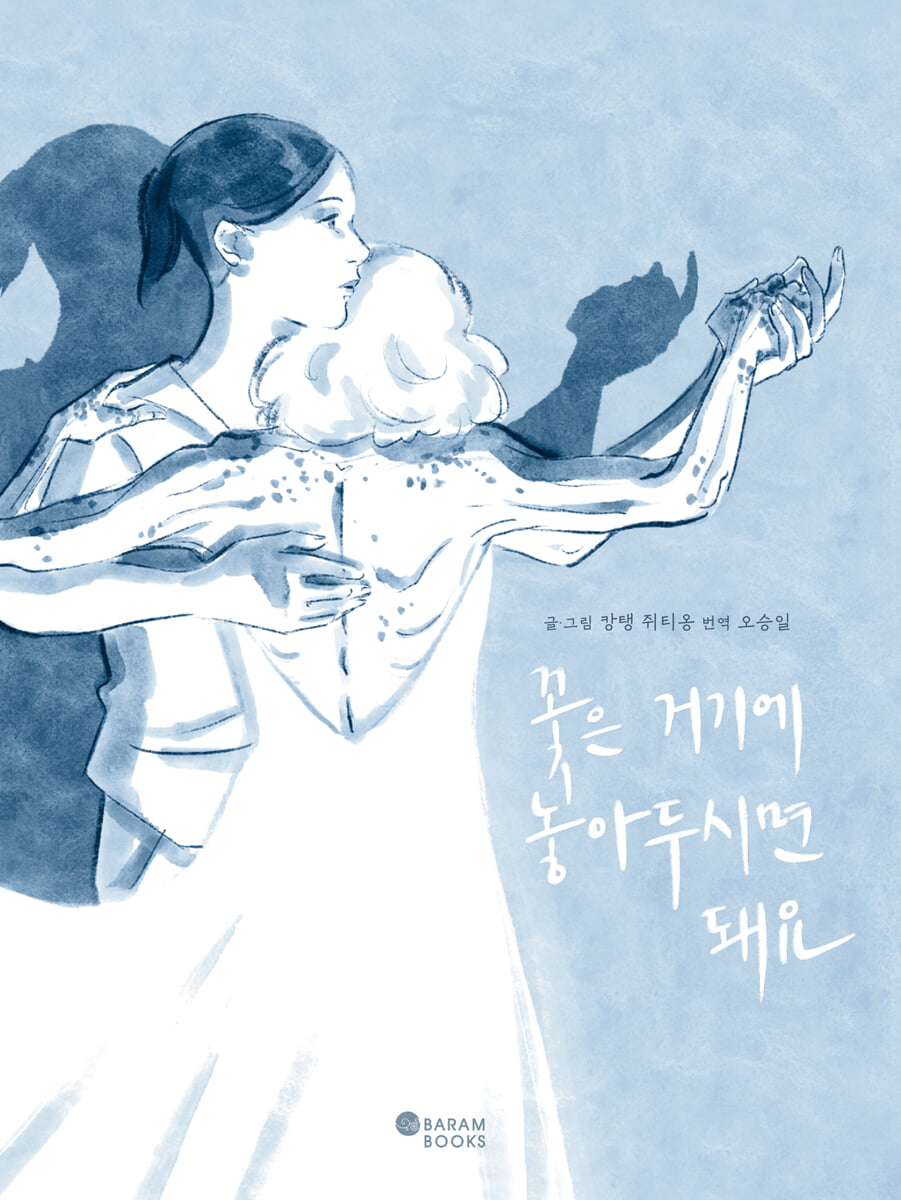
When you open 『You can leave the flowers there』, every page is filled with cool images based on icy blue and white.
The occasional red lips, cigarette butts, and colorful flowers seem like joys and pleasures that only exist occasionally in our lives.
Especially the faces of the elderly, full of wrinkles and freckles, are vivid and real, but at the same time express a tragic beauty.
The elderly people admitted to nursing homes each have their own lives.
There are also family members who visit regularly, like a daughter who shows her mother a family album after she loses her memory, or a granddaughter who willingly becomes a conversationalist for her grandfather.
But as time goes by, the family members come less and less and the elderly are gradually forgotten.
The elderly may also experience decline in energy and fading memories of their families, so it may be the same for everyone.
A life where existence and relationships are slowly disappearing.
But the lives of the elderly still go on, and Estelle is a part of them.
If you can fulfill the dreams you never achieved in your life and the regrets that linger until the day you die, even if only in fantasy, why shouldn't you do so?
The problem is that Estelle must experience repeated separation and loss while caring for the elderly and facing death on a daily basis.
“I have already seen hundreds of corpses of people I was in love with.
“No one, really no one, has ever taken care of us by even saying, ‘Are you okay?’”
What is the right mindset and attitude for a caregiver? As care, once a family domain, becomes a formal occupation, it's sometimes dismissed as a cold, clerical activity.
As if feeding, washing, and talking to someone were possible without any emotion.
Estelle collects the belongings of the dead old people one by one and carefully collects them in a drawer, claiming that she has the right to keep these belongings.
For Estelle, the elderly were not a task to be dealt with, but individual human beings and objects of love.
The sense of loss Estelle experiences while caring for and seeing off countless elderly people is likely not simply due to her overly sensitive and overly involved nature in human relationships.
We all grow old and die someday.
So how can the elderly waiting for death in nursing homes be perfect strangers?
The confusion, sadness, and grief that Estelle feels are universal emotions that anyone can feel at the border between life and death.
Throughout the life cycle, humans inevitably need someone's care.
And caring for the sick, the disabled, the very young, the very old is a responsibility that the community should share.
We all have no choice but to care for one another and be cared for.
Is there anything more important than truly understanding that you are no different from others and empathizing with them?
And that is the true utility of stories and art.
In the final chapter of "Just Leave the Flowers There," readers will encounter a shocking yet perfectly natural scene.
And eventually, we will be able to look back on our lives humbly and diachronically.
"Just Leave the Flowers There" is a graphic novel that encourages serious reflection on life, death, care, and care work through a dense narrative, while also offering the artistic pleasure of appreciating cool and beautiful illustrations.
This is a book that all of us who are facing death should read.
On the cycle of care and its beauty
When you open 『You can leave the flowers there』, every page is filled with cool images based on icy blue and white.
The occasional red lips, cigarette butts, and colorful flowers seem like joys and pleasures that only exist occasionally in our lives.
Especially the faces of the elderly, full of wrinkles and freckles, are vivid and real, but at the same time express a tragic beauty.
The elderly people admitted to nursing homes each have their own lives.
There are also family members who visit regularly, like a daughter who shows her mother a family album after she loses her memory, or a granddaughter who willingly becomes a conversationalist for her grandfather.
But as time goes by, the family members come less and less and the elderly are gradually forgotten.
The elderly may also experience decline in energy and fading memories of their families, so it may be the same for everyone.
A life where existence and relationships are slowly disappearing.
But the lives of the elderly still go on, and Estelle is a part of them.
If you can fulfill the dreams you never achieved in your life and the regrets that linger until the day you die, even if only in fantasy, why shouldn't you do so?
The problem is that Estelle must experience repeated separation and loss while caring for the elderly and facing death on a daily basis.
“I have already seen hundreds of corpses of people I was in love with.
“No one, really no one, has ever taken care of us by even saying, ‘Are you okay?’”
What is the right mindset and attitude for a caregiver? As care, once a family domain, becomes a formal occupation, it's sometimes dismissed as a cold, clerical activity.
As if feeding, washing, and talking to someone were possible without any emotion.
Estelle collects the belongings of the dead old people one by one and carefully collects them in a drawer, claiming that she has the right to keep these belongings.
For Estelle, the elderly were not a task to be dealt with, but individual human beings and objects of love.
The sense of loss Estelle experiences while caring for and seeing off countless elderly people is likely not simply due to her overly sensitive and overly involved nature in human relationships.
We all grow old and die someday.
So how can the elderly waiting for death in nursing homes be perfect strangers?
The confusion, sadness, and grief that Estelle feels are universal emotions that anyone can feel at the border between life and death.
Throughout the life cycle, humans inevitably need someone's care.
And caring for the sick, the disabled, the very young, the very old is a responsibility that the community should share.
We all have no choice but to care for one another and be cared for.
Is there anything more important than truly understanding that you are no different from others and empathizing with them?
And that is the true utility of stories and art.
In the final chapter of "Just Leave the Flowers There," readers will encounter a shocking yet perfectly natural scene.
And eventually, we will be able to look back on our lives humbly and diachronically.
"Just Leave the Flowers There" is a graphic novel that encourages serious reflection on life, death, care, and care work through a dense narrative, while also offering the artistic pleasure of appreciating cool and beautiful illustrations.
This is a book that all of us who are facing death should read.
GOODS SPECIFICS
- Date of issue: November 5, 2023
- Format: Hardcover book binding method guide
- Page count, weight, size: 208 pages | 834g | 200*267*20mm
- ISBN13: 9791197381799
- ISBN10: 1197381791
You may also like
카테고리
korean


korean

![GQ KOREA Mark (Monthly): December [2025]](http://librairie.coreenne.fr/cdn/shop/files/8ef265dbbfbf186523ed75ba7319009d.jpg?v=1765340328&width=3840)


