

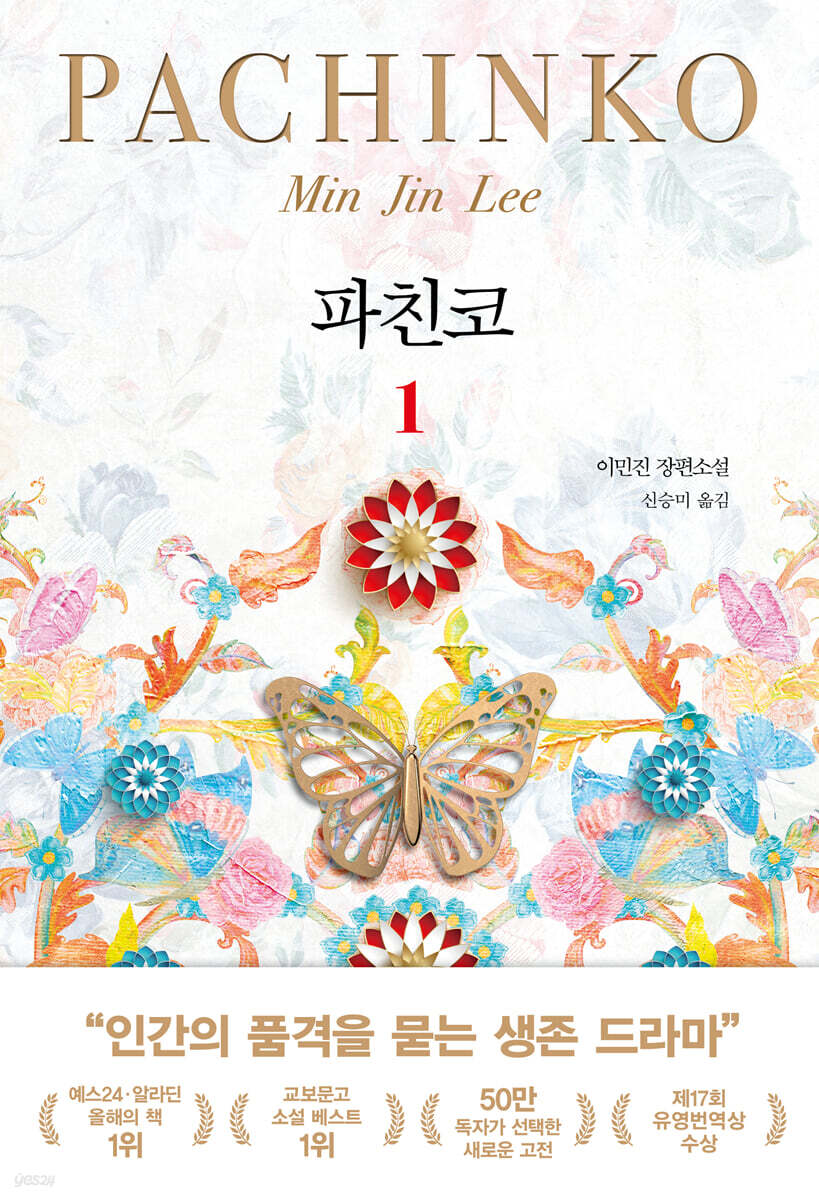
Pachinko 1
 |
Description
Book Introduction
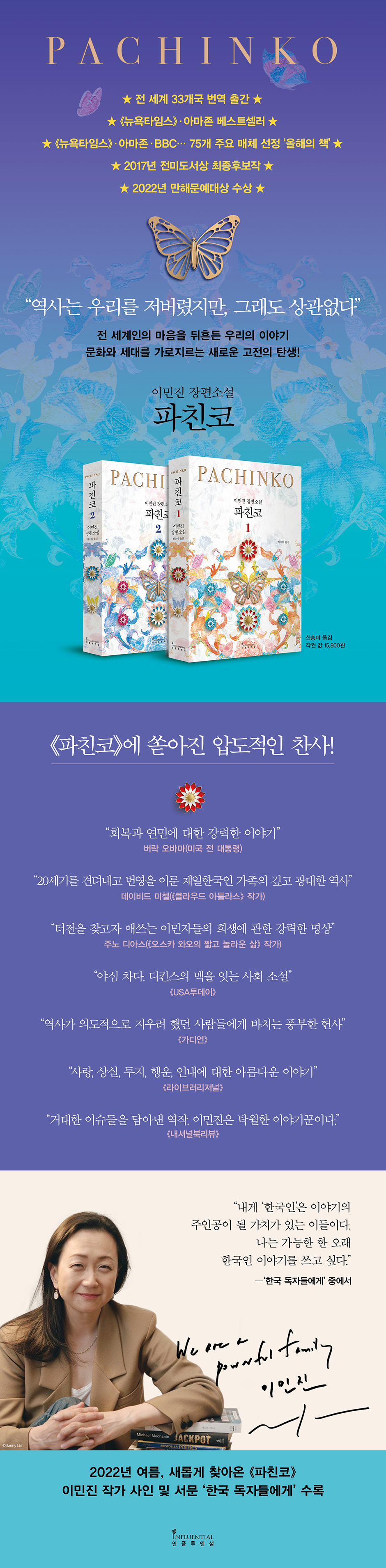
“History has abandoned us, but that doesn’t matter.” The epic tale of a Zainichi Korean family ignored by history Author Lee Min-jin's hit work, "Pachinko," which has moved the world, has been re-released! “To me, ‘Koreans’ are people worthy of being the main characters of a story. “I want to write Korean stories for as long as possible.” - From 'To Korean Readers' The international bestseller, Lee Min-jin's novel "Pachinko," which tells the story of a Zainichi Korean family spanning four generations, has been republished. "Pachinko" is a historical novel written over 30 years by Lee Min-jin, a 1.5 generation Korean-American author. It was published in 2017 and became a New York Times bestseller. To date, it has been translated and exported to 33 countries around the world, and has been selected as a 'Book of the Year' by over 75 major media outlets, including the BBC and Amazon, and has been nominated as a finalist for the National Book Award, captivating both critics and the public. It received attention, receiving praise from former US President Barack Obama, who called it “a powerful story of recovery and compassion.” Pachinko, which went out of print in April after the copyright agreement expired, has returned to Korean readers with a new translation and design. From the first sentence (“History has abandoned us, but that doesn’t matter”), I tried to convey the meaning of the original text more faithfully and to preserve the work’s characteristically fast-paced writing style. Additionally, in order to preserve the structure and flow originally intended by the author, the original book's structure of three parts (Part 1 'Hometown', Part 2 'Motherland', and Part 3 'Pachinko') was followed. In a letter to Korean readers commemorating the new publication, he explained why he continues to write about Koreans. The author expressed special affection for Korean readers, saying, “Because we are attractive,” and “Koreans are worthy of being the protagonists of stories with depth, both intellectually and emotionally,” and that he would like to continue telling Korean stories to the younger generation. |
- You can preview some of the book's contents.
Preview
Detailed image
Into the book
Hoon listened carefully to the men who brought him the news, nodded, then took a deep breath and jumped up to get to work.
“It doesn’t matter,” Hoon would say.
“It doesn’t matter.” Whether China surrendered or repaid, I had to weed the vegetable garden, sew straw sandals for my family to wear, and chase away thieves trying to steal my few chickens.
--- p.30
Hansu talked about his life in Osaka.
He said there was no need to criticize the Japanese.
Now the Japanese are beating the Koreans, but of course no one likes losing.
Hansu thought that if Koreans stopped fighting among themselves, they might one day take over Japan and do much worse things to the Japanese.
“Wherever you go, people are rotten.
They are pathetic people.
Want to see some really bad people? Just make ordinary people more successful than you can imagine.
“When you can do whatever you want, that’s when a person’s true nature is revealed.” Seonja nodded as Hansu spoke, trying to remember everything he said and keep all of Hansu’s appearances in her mind.
I tried to understand whatever Hansoo was trying to say.
Seonja treasured Hansu's story as much as the pieces of sea glass and rose-colored pebbles she collected as a child.
Seonja was surprised by everything Hansu said because Hansu held her hand and showed her a new, unforgettable world.
--- p.74
“I don’t have any rice to sell,” Mr. Cho said repeatedly.
“Just enough to make dinner for the bride and groom.”
“Before you leave home, at least try some white rice.” As tears welled up in Yang Jin’s eyes, the rice shop owner looked away.
(...) It was unimaginable to send my daughters to live far away in a country that treated Koreans like livestock.
It was absurd to lose my blood relatives to those sons of bitches.
Yang Jin counted the bills and placed them on a wooden tray next to the abacus on the table.
“If you have any, please put a small one in a bag.
I want to feed both of you until you're full.
“If there’s any left, I’ll give you Snow White.” Yang Jin pushed the tray of money toward Jo.
But if Mr. Cho said no, I was going to go around to all the rice shops in Busan.
I really wanted to feed my daughter white rice for dinner on her wedding day.
--- pp.143~144
Would the Korean people want Japan to win? That was absurd.
But what would happen to the Koreans if Japan's enemies won? Would they be able to save themselves? Absolutely not.
So, the thought that the Korean people had in mind was that each of them had to figure out a way to survive.
Protect your family.
Fill your belly.
Wake up and don't trust your leaders.
If the Korean nationalists cannot take back their country, teach Japanese to their children and help them succeed.
Adapt.
Isn't it simple? While there were patriots fighting for Korean independence and unfortunate Koreans who sided with Japan, there were countless compatriots struggling to survive, here and elsewhere.
In the end, there was no way to do business in the face of hunger.
--- p.276
Noah thought that if he were an ordinary person and not a Korean, he would have enjoyed school, but he couldn't say this to his father or anyone else.
It was clear that he would never be able to become an ordinary Japanese person.
My grandfather said that they would return to Joseon someday.
Noah thought it would be better to live in Joseon.
Noah, carrying his school bag and lunchbox, wandered around the living room, imprinting his father's affectionate face on his mind.
“Come here, baby,” said Isaac.
Noah went to Isaac and knelt down before him.
'Please God, please.
Please make my dad better.
I'll ask you one more time.
'Please.' Noah closed his eyes tightly.
Isaac took Noah's hand and squeezed it tightly.
“You are very brave, Noah.
Much, much braver than me.
“It takes a lot of courage to live each day among people who don’t accept you as a person.”
--- pp.306~307
The cook continued to stir while the sugar melted and boiled in the pot.
Comparing life in Busan and Osaka, they felt like completely different lives.
Although they had not been able to return for 20 years, their small rocky island of Yeongdo remained vivid and bright in Seonja's memory.
When Isaac tried to describe heaven, the image of heaven that the prophet pictured in his mind was his hometown.
It was the very embodiment of transparent and shining beauty.
My memories of the moon and stars in my hometown seemed quite different from the cold moon and stars here.
No matter how much people complained about the dire situation in his homeland, Seonja could only recall memories of the bright, sturdy house his father had so carefully tended beside the glassy, green sea, the bountiful garden that yielded watermelons, lettuces, and pumpkins, and the market that never ran out of delicious things.
I didn't love it enough when I lived there.
“It doesn’t matter,” Hoon would say.
“It doesn’t matter.” Whether China surrendered or repaid, I had to weed the vegetable garden, sew straw sandals for my family to wear, and chase away thieves trying to steal my few chickens.
--- p.30
Hansu talked about his life in Osaka.
He said there was no need to criticize the Japanese.
Now the Japanese are beating the Koreans, but of course no one likes losing.
Hansu thought that if Koreans stopped fighting among themselves, they might one day take over Japan and do much worse things to the Japanese.
“Wherever you go, people are rotten.
They are pathetic people.
Want to see some really bad people? Just make ordinary people more successful than you can imagine.
“When you can do whatever you want, that’s when a person’s true nature is revealed.” Seonja nodded as Hansu spoke, trying to remember everything he said and keep all of Hansu’s appearances in her mind.
I tried to understand whatever Hansoo was trying to say.
Seonja treasured Hansu's story as much as the pieces of sea glass and rose-colored pebbles she collected as a child.
Seonja was surprised by everything Hansu said because Hansu held her hand and showed her a new, unforgettable world.
--- p.74
“I don’t have any rice to sell,” Mr. Cho said repeatedly.
“Just enough to make dinner for the bride and groom.”
“Before you leave home, at least try some white rice.” As tears welled up in Yang Jin’s eyes, the rice shop owner looked away.
(...) It was unimaginable to send my daughters to live far away in a country that treated Koreans like livestock.
It was absurd to lose my blood relatives to those sons of bitches.
Yang Jin counted the bills and placed them on a wooden tray next to the abacus on the table.
“If you have any, please put a small one in a bag.
I want to feed both of you until you're full.
“If there’s any left, I’ll give you Snow White.” Yang Jin pushed the tray of money toward Jo.
But if Mr. Cho said no, I was going to go around to all the rice shops in Busan.
I really wanted to feed my daughter white rice for dinner on her wedding day.
--- pp.143~144
Would the Korean people want Japan to win? That was absurd.
But what would happen to the Koreans if Japan's enemies won? Would they be able to save themselves? Absolutely not.
So, the thought that the Korean people had in mind was that each of them had to figure out a way to survive.
Protect your family.
Fill your belly.
Wake up and don't trust your leaders.
If the Korean nationalists cannot take back their country, teach Japanese to their children and help them succeed.
Adapt.
Isn't it simple? While there were patriots fighting for Korean independence and unfortunate Koreans who sided with Japan, there were countless compatriots struggling to survive, here and elsewhere.
In the end, there was no way to do business in the face of hunger.
--- p.276
Noah thought that if he were an ordinary person and not a Korean, he would have enjoyed school, but he couldn't say this to his father or anyone else.
It was clear that he would never be able to become an ordinary Japanese person.
My grandfather said that they would return to Joseon someday.
Noah thought it would be better to live in Joseon.
Noah, carrying his school bag and lunchbox, wandered around the living room, imprinting his father's affectionate face on his mind.
“Come here, baby,” said Isaac.
Noah went to Isaac and knelt down before him.
'Please God, please.
Please make my dad better.
I'll ask you one more time.
'Please.' Noah closed his eyes tightly.
Isaac took Noah's hand and squeezed it tightly.
“You are very brave, Noah.
Much, much braver than me.
“It takes a lot of courage to live each day among people who don’t accept you as a person.”
--- pp.306~307
The cook continued to stir while the sugar melted and boiled in the pot.
Comparing life in Busan and Osaka, they felt like completely different lives.
Although they had not been able to return for 20 years, their small rocky island of Yeongdo remained vivid and bright in Seonja's memory.
When Isaac tried to describe heaven, the image of heaven that the prophet pictured in his mind was his hometown.
It was the very embodiment of transparent and shining beauty.
My memories of the moon and stars in my hometown seemed quite different from the cold moon and stars here.
No matter how much people complained about the dire situation in his homeland, Seonja could only recall memories of the bright, sturdy house his father had so carefully tended beside the glassy, green sea, the bountiful garden that yielded watermelons, lettuces, and pumpkins, and the market that never ran out of delicious things.
I didn't love it enough when I lived there.
--- p.376
Publisher's Review
“A powerful story of recovery and compassion.”
―Barack Obama (former US President)
Our story that shook hearts around the world
The birth of a new classic that transcends culture and generations!
Korean-American author Lee Min-jin's hit work, "Pachinko," has been released!
The international bestseller, Lee Min-jin's novel "Pachinko," which tells the story of a Zainichi Korean family spanning four generations, is now available to Korean readers in a new translation by Influential.
"Pachinko" is a historical novel written over 30 years by Lee Min-jin, a 1.5 generation Korean-American author. It was published in 2017 and became a New York Times bestseller.
It has been translated and exported to 33 countries around the world, and has captivated both critics and the public, being selected as a 'Book of the Year' by over 75 major media outlets, including The New York Times, BBC, and Amazon, and as a finalist for the National Book Award.
Now you can experience the new version of 『Pachinko』 (2 volumes), a sensational Korean story that brought the world to tears and established itself as a new 21st century classic.
“History has abandoned us, but that doesn’t matter.”
The epic tale of a Zainichi Korean family ignored by history
The novel unfolds over nearly 100 years, starting in Yeongdo, Busan during the Japanese colonial period and ending in Japan in 1989, at the height of its bubble economy, in Korea and Japan.
Sixteen-year-old Seonja, who lives in a shabby boarding house with her mother, Yangjin, meets Hansu, a fish broker who travels back and forth to Japan, and begins to imagine a wider world outside of Joseon for the first time. However, after having his child, she is heartbroken to realize that he is a man with a wife and child in Osaka.
Meanwhile, Reverend Isaac, who came as a guest at Seonja's boarding house, considers Seonja his destiny and proposes to her. Seonja marries Isaac and moves to Osaka to start a new life.
However, as a Korean and a woman, Seonja's life was difficult and arduous, as she had to endure discrimination and contempt and "work until she could no longer work" (p. 338) to protect herself and her family.
As we follow the turbulent family history surrounding Seonja, it naturally overlaps with modern and contemporary Korean history, including liberation, the Korean War, and division, and our hearts ache as we come into view the lives of the Zainichi (a term referring to Koreans living in Japan) that we had not known about.
The author of this book, Lee Min-jin, is a Korean-American writer who immigrated to the United States with her family when she was seven years old.
As a first-generation immigrant and history major, the author became interested in the unstable international situation and the tragedy of modern and contemporary Korean history brought about by Japanese invasion. He decided to write the stories of “people who history has arbitrarily left aside.”
However, it took a long time of 30 years from the time I first learned about the existence of Zainichi while studying history at Yale University to the publication of this book.
The author, who had met and interviewed countless people while living in Japan with her Japanese-American husband, discarded all of the drafts she had written up to that point and began writing again.
This was because I was convinced that it had to be “a story of ordinary individuals standing up to a historical disaster.”
The protagonist changed from 'Solomon', a third-generation Zainichi Korean, to 'Seonja', and the title changed from 'Motherland' to 'Pachinko'.
After extensive research, interviews, and numerous relentless revisions, “Pachinko,” a masterpiece combining the detail of a documentary with the empathy of a novel, was finally born.
“Pachinko is a stupid game, but life isn’t.”
A Silent Journey Towards a "Korean Diaspora Trilogy"
"Pachinko" is also a story about home.
Because it is a chronicle of an immigrant family that steadfastly built their home without being swayed by the great waves of history.
The author stated that the title of the book, "Pachinko," "signifies the uncertainty of life, like gambling, where the outcome is unpredictable, and at the same time, it symbolizes the tragic lives of Koreans in Japan who had to choose the pachinko business as their only means of survival in a foreign land filled with hatred and prejudice."
The author touches upon the lives of immigrants who must leave their hometown, settle down in a foreign land, and live as permanent foreigners, with his unique insight and empathetic gaze.
"Pachinko," a work that addresses all of life's issues, such as family, love, loss, and money, poses timely questions to readers living in the present age. It has emerged as a cultural icon, proving the power of storytelling to transcend generations and cultures.
This book is the second novel by author Lee Min-jin, following her debut novel, Free Food for Millionaires. She is currently working on her third novel, American Hagwon, about the Korean people's enthusiasm for education.
The author introduces these novels as a 'Korean Diaspora Trilogy'.
In the preface, “To Korean Readers,” he explains why he continues to write about Koreans, saying, “It’s because we are attractive,” and that “Koreans are worthy of being the protagonists of stories with depth, both intellectually and emotionally,” and that he wants to continue telling Korean stories to younger generations.
A new take on Pachinko, with a translation and composition faithful to the original.
Pachinko, which was introduced in Korea in 2017 and went out of print in April after the copyright contract expired, has returned to Korean readers with a new translation and design.
From the first sentence (“History has abandoned us, but that doesn’t matter”), I tried to convey the meaning of the original text more faithfully and to preserve the work’s characteristically fast-paced writing style.
Additionally, in order to preserve the structure and flow originally intended by the author, the original book's structure of three parts (Part 1 'Hometown', Part 2 'Motherland', and Part 3 'Pachinko') was followed.
To commemorate the new publication, the author's autograph and preface, 'To Korean Readers', are included here.
The author expressed his gratitude to the translator for the newly released Korean translation, saying, “Translation is the work of the angels and artists of literature,” and also expressed special affection to the Korean readers who have waited for the book.
Right now, it's time to hear our story that has taken the world by storm.
Characters
Seonja was born in the 1910s as the daughter of a boarding house owner on Yeongdo, a small island in Joseon.
Seonja, who received a lot of love from her deceased father, grows up to be a quiet but honest and strong girl.
At the age of seventeen, while helping his mother run a boarding house, he was led by fate to Japan.
Hansu is a man who followed his father from Jeju to Osaka when he was twelve years old and has achieved success by any means necessary. He is well-versed in the ways of the world and has quick judgment.
While traveling between Busan and Japan as a fish broker, he meets Seonja and is attracted to her at first sight.
Isaac, a pastor from a wealthy Christian family in Pyongyang.
He was born with a weak body and suffered from illness his entire life.
On his way to Osaka, where his older brother Joseph lives, he tries to stay at Seonja's boarding house for a while, but he collapses from tuberculosis and is stranded.
Yang Jin Seonja's mother.
Born as the youngest daughter of a poor family in Yeongdo, she worked tirelessly throughout her life after her arranged marriage to Hoon.
She runs a boarding house with her daughter, Seonja, who is the only surviving child after four births.
Hoon- i Seon-ja's father.
Despite being born with disabilities in his lips and feet, he is respected by those around him as a hard-working and honest man.
He ran a small boarding house in Yeongdo and raised his only daughter, Seonja, with great care.
Joseph Isaac's older brother.
He works at a factory in Osaka and supports his parents in Pyongyang.
Kyunghee Joseph's wife.
Born in Pyongyang, like his brothers Joseph and Isaac, they grew up close from a young age.
The first son of Noah the prophet.
Born in Osaka in the 1930s.
The second son of the hat merchant.
Mozasu is the Japanese name for 'Moses'.
Become the president of a pachinko parlor.
Solomon 's only son and the grandson of the prophet.
Born in Osaka in the 1960s.
―Barack Obama (former US President)
Our story that shook hearts around the world
The birth of a new classic that transcends culture and generations!
Korean-American author Lee Min-jin's hit work, "Pachinko," has been released!
The international bestseller, Lee Min-jin's novel "Pachinko," which tells the story of a Zainichi Korean family spanning four generations, is now available to Korean readers in a new translation by Influential.
"Pachinko" is a historical novel written over 30 years by Lee Min-jin, a 1.5 generation Korean-American author. It was published in 2017 and became a New York Times bestseller.
It has been translated and exported to 33 countries around the world, and has captivated both critics and the public, being selected as a 'Book of the Year' by over 75 major media outlets, including The New York Times, BBC, and Amazon, and as a finalist for the National Book Award.
Now you can experience the new version of 『Pachinko』 (2 volumes), a sensational Korean story that brought the world to tears and established itself as a new 21st century classic.
“History has abandoned us, but that doesn’t matter.”
The epic tale of a Zainichi Korean family ignored by history
The novel unfolds over nearly 100 years, starting in Yeongdo, Busan during the Japanese colonial period and ending in Japan in 1989, at the height of its bubble economy, in Korea and Japan.
Sixteen-year-old Seonja, who lives in a shabby boarding house with her mother, Yangjin, meets Hansu, a fish broker who travels back and forth to Japan, and begins to imagine a wider world outside of Joseon for the first time. However, after having his child, she is heartbroken to realize that he is a man with a wife and child in Osaka.
Meanwhile, Reverend Isaac, who came as a guest at Seonja's boarding house, considers Seonja his destiny and proposes to her. Seonja marries Isaac and moves to Osaka to start a new life.
However, as a Korean and a woman, Seonja's life was difficult and arduous, as she had to endure discrimination and contempt and "work until she could no longer work" (p. 338) to protect herself and her family.
As we follow the turbulent family history surrounding Seonja, it naturally overlaps with modern and contemporary Korean history, including liberation, the Korean War, and division, and our hearts ache as we come into view the lives of the Zainichi (a term referring to Koreans living in Japan) that we had not known about.
The author of this book, Lee Min-jin, is a Korean-American writer who immigrated to the United States with her family when she was seven years old.
As a first-generation immigrant and history major, the author became interested in the unstable international situation and the tragedy of modern and contemporary Korean history brought about by Japanese invasion. He decided to write the stories of “people who history has arbitrarily left aside.”
However, it took a long time of 30 years from the time I first learned about the existence of Zainichi while studying history at Yale University to the publication of this book.
The author, who had met and interviewed countless people while living in Japan with her Japanese-American husband, discarded all of the drafts she had written up to that point and began writing again.
This was because I was convinced that it had to be “a story of ordinary individuals standing up to a historical disaster.”
The protagonist changed from 'Solomon', a third-generation Zainichi Korean, to 'Seonja', and the title changed from 'Motherland' to 'Pachinko'.
After extensive research, interviews, and numerous relentless revisions, “Pachinko,” a masterpiece combining the detail of a documentary with the empathy of a novel, was finally born.
“Pachinko is a stupid game, but life isn’t.”
A Silent Journey Towards a "Korean Diaspora Trilogy"
"Pachinko" is also a story about home.
Because it is a chronicle of an immigrant family that steadfastly built their home without being swayed by the great waves of history.
The author stated that the title of the book, "Pachinko," "signifies the uncertainty of life, like gambling, where the outcome is unpredictable, and at the same time, it symbolizes the tragic lives of Koreans in Japan who had to choose the pachinko business as their only means of survival in a foreign land filled with hatred and prejudice."
The author touches upon the lives of immigrants who must leave their hometown, settle down in a foreign land, and live as permanent foreigners, with his unique insight and empathetic gaze.
"Pachinko," a work that addresses all of life's issues, such as family, love, loss, and money, poses timely questions to readers living in the present age. It has emerged as a cultural icon, proving the power of storytelling to transcend generations and cultures.
This book is the second novel by author Lee Min-jin, following her debut novel, Free Food for Millionaires. She is currently working on her third novel, American Hagwon, about the Korean people's enthusiasm for education.
The author introduces these novels as a 'Korean Diaspora Trilogy'.
In the preface, “To Korean Readers,” he explains why he continues to write about Koreans, saying, “It’s because we are attractive,” and that “Koreans are worthy of being the protagonists of stories with depth, both intellectually and emotionally,” and that he wants to continue telling Korean stories to younger generations.
A new take on Pachinko, with a translation and composition faithful to the original.
Pachinko, which was introduced in Korea in 2017 and went out of print in April after the copyright contract expired, has returned to Korean readers with a new translation and design.
From the first sentence (“History has abandoned us, but that doesn’t matter”), I tried to convey the meaning of the original text more faithfully and to preserve the work’s characteristically fast-paced writing style.
Additionally, in order to preserve the structure and flow originally intended by the author, the original book's structure of three parts (Part 1 'Hometown', Part 2 'Motherland', and Part 3 'Pachinko') was followed.
To commemorate the new publication, the author's autograph and preface, 'To Korean Readers', are included here.
The author expressed his gratitude to the translator for the newly released Korean translation, saying, “Translation is the work of the angels and artists of literature,” and also expressed special affection to the Korean readers who have waited for the book.
Right now, it's time to hear our story that has taken the world by storm.
Characters
Seonja was born in the 1910s as the daughter of a boarding house owner on Yeongdo, a small island in Joseon.
Seonja, who received a lot of love from her deceased father, grows up to be a quiet but honest and strong girl.
At the age of seventeen, while helping his mother run a boarding house, he was led by fate to Japan.
Hansu is a man who followed his father from Jeju to Osaka when he was twelve years old and has achieved success by any means necessary. He is well-versed in the ways of the world and has quick judgment.
While traveling between Busan and Japan as a fish broker, he meets Seonja and is attracted to her at first sight.
Isaac, a pastor from a wealthy Christian family in Pyongyang.
He was born with a weak body and suffered from illness his entire life.
On his way to Osaka, where his older brother Joseph lives, he tries to stay at Seonja's boarding house for a while, but he collapses from tuberculosis and is stranded.
Yang Jin Seonja's mother.
Born as the youngest daughter of a poor family in Yeongdo, she worked tirelessly throughout her life after her arranged marriage to Hoon.
She runs a boarding house with her daughter, Seonja, who is the only surviving child after four births.
Hoon- i Seon-ja's father.
Despite being born with disabilities in his lips and feet, he is respected by those around him as a hard-working and honest man.
He ran a small boarding house in Yeongdo and raised his only daughter, Seonja, with great care.
Joseph Isaac's older brother.
He works at a factory in Osaka and supports his parents in Pyongyang.
Kyunghee Joseph's wife.
Born in Pyongyang, like his brothers Joseph and Isaac, they grew up close from a young age.
The first son of Noah the prophet.
Born in Osaka in the 1930s.
The second son of the hat merchant.
Mozasu is the Japanese name for 'Moses'.
Become the president of a pachinko parlor.
Solomon 's only son and the grandson of the prophet.
Born in Osaka in the 1960s.
GOODS SPECIFICS
- Publication date: July 27, 2022
- Page count, weight, size: 388 pages | 558g | 140*205*30mm
- ISBN13: 9791168340510
- ISBN10: 1168340519
You may also like
카테고리
korean


korean

![GQ KOREA Mark (Monthly): December [2025]](http://librairie.coreenne.fr/cdn/shop/files/8ef265dbbfbf186523ed75ba7319009d.jpg?v=1765340328&width=3840)


