

No Bones
 |
Description
Book Introduction
- A word from MD
-
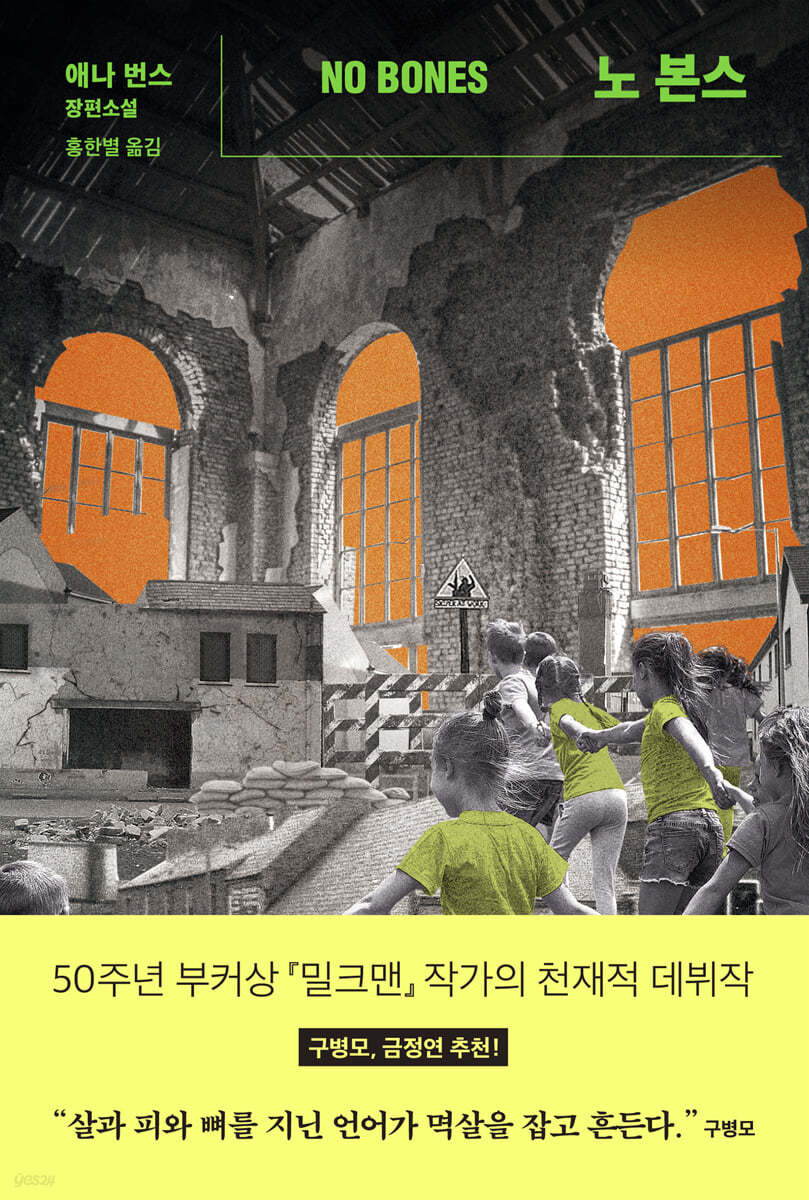
How to survive in an age of violenceThe debut novel by Anna Burns, winner of the Booker Prize for 'The Milkman'.
Set during the Northern Ireland Troubles, like "The Milkman," this novel vividly portrays how hatred and violence destroy the lives of ordinary people through the story of a young girl, Amelia, her family, and her neighbors.
July 8, 2022. Novel/Poetry PD Park Hyung-wook
In a world of hatred and violence where everyday life becomes a struggle,
How Amelia and her 'ordinary' neighbors live
The genius debut of the author of "Milkman," which won the Booker Prize for its 50th anniversary.
Anna Burns, who created international buzz in 2018 by winning the 50th Anniversary Booker Prize for Milkman, has published her debut novel, No Bones, which was praised for “showing how rumors and political allegiances play a role in the movement to expose individual sexual violence.”
This is a work that once again confirms Anna Burns' genius with its bold and skillful narrative, vivid language that is even more raw and natural, and black humor that is hard to believe is her debut work.
Like "The Milkman," this novel is set during the Northern Ireland conflict, known as the "Troubles," and tells the story of Amelia, a girl living in a village in northern Belfast, and her family and neighbors.
In a world where those with different opinions are labeled as 'enemies' in the name of religion and belief, where people are forced to choose between our side and theirs, and where oppression, surveillance, and violence are part of everyday life, the ones who suffer the most are the socially vulnerable, such as children and women like the protagonist Amelia, the sick, sexual minorities, and men who are treated as weak because they do not take sides.
So reading No Bones can be an uncomfortable and sometimes unpleasant experience.
This novel, which depicts how ordinary people's lives and spirits are devastated and local communities crumble in a society rife with hatred and violence, is brutally vivid and chilling, yet never loses compassion or humor, literally drawing readers deep into its world.
It may seem like a story from the distant past, from a distant land that has nothing to do with us, but it also gives us much to think about in the way we live now, in a world that is sick with serious hatred and division.
How Amelia and her 'ordinary' neighbors live
The genius debut of the author of "Milkman," which won the Booker Prize for its 50th anniversary.
Anna Burns, who created international buzz in 2018 by winning the 50th Anniversary Booker Prize for Milkman, has published her debut novel, No Bones, which was praised for “showing how rumors and political allegiances play a role in the movement to expose individual sexual violence.”
This is a work that once again confirms Anna Burns' genius with its bold and skillful narrative, vivid language that is even more raw and natural, and black humor that is hard to believe is her debut work.
Like "The Milkman," this novel is set during the Northern Ireland conflict, known as the "Troubles," and tells the story of Amelia, a girl living in a village in northern Belfast, and her family and neighbors.
In a world where those with different opinions are labeled as 'enemies' in the name of religion and belief, where people are forced to choose between our side and theirs, and where oppression, surveillance, and violence are part of everyday life, the ones who suffer the most are the socially vulnerable, such as children and women like the protagonist Amelia, the sick, sexual minorities, and men who are treated as weak because they do not take sides.
So reading No Bones can be an uncomfortable and sometimes unpleasant experience.
This novel, which depicts how ordinary people's lives and spirits are devastated and local communities crumble in a society rife with hatred and violence, is brutally vivid and chilling, yet never loses compassion or humor, literally drawing readers deep into its world.
It may seem like a story from the distant past, from a distant land that has nothing to do with us, but it also gives us much to think about in the way we live now, in a world that is sick with serious hatred and division.
- You can preview some of the book's contents.
Preview
index
Thursday, 1969
Crimes without a motive, 1969–71
Crossfire, 1971
Treasure Trove, 1972
Practical Uses of Weapons, 1973
Baby, 1974
A Very Small Carelessness, 1975
Something political, 1977
Miscellaneous Things, 1978
Echo, 1978
Trouble, 1979
Mr. Hunchi seizes the opportunity, 1980
No signs of panic, 1981
No villain, no one, 1982
Current conflict, 1983
Infiltration, 1986
Bottle of Liquor, 1987
War Cramps, 1988
First portrait, 1989
Detonator, 1991
No question, 1991-92
Safe House, 1992
Peace negotiations, 1994
Translator's Note
Crimes without a motive, 1969–71
Crossfire, 1971
Treasure Trove, 1972
Practical Uses of Weapons, 1973
Baby, 1974
A Very Small Carelessness, 1975
Something political, 1977
Miscellaneous Things, 1978
Echo, 1978
Trouble, 1979
Mr. Hunchi seizes the opportunity, 1980
No signs of panic, 1981
No villain, no one, 1982
Current conflict, 1983
Infiltration, 1986
Bottle of Liquor, 1987
War Cramps, 1988
First portrait, 1989
Detonator, 1991
No question, 1991-92
Safe House, 1992
Peace negotiations, 1994
Translator's Note
Detailed image

Into the book
No one will tell what happened.
In fact, nothing happened.
It's just another one of those motiveless crimes happening everywhere.
--- p.47
Amelia listened because Roberta was her friend, but in truth she wasn't very interested in stairs anymore.
It used to be there.
Of course it was.
But that was when I was young.
This happened when Amelia was eight years old.
He's nine now and he's long since grown tired of stairs.
Following the natural order, attention now shifted to the button.
Amelia thought that Roberta seemed a little slow in development.
--- p.53
Could it be possible to compete in writing poetry about peace? What was there to say? What did the teachers want? Could anyone give us a hint? And should that peace be a vague, universal term encompassing everyone, even Protestants, or should it be specifically limited to us? (…) Like the other children, Amelia was at a loss.
It wasn't that I was against peace or anything like that.
I just had nothing to say.
What do you know about peace? Who can you ask? There was no one to ask.
No one Amelia knew knew anything about peace.
--- p.55~57
There was no funeral service on Sunday, but a joint funeral was held on Monday for Aloysius Fallon, Robert John McCormick, and Brendan McDade.
The three were buried in Milltown Cemetery that afternoon.
Everyone said it was a terrible thing, a terrible thing, a shameful thing, something they would never forget.
But it wasn't.
That wasn't the case.
Everything, as always, was buried in the next, new, violent death.
In fact, nothing happened.
It's just another one of those motiveless crimes happening everywhere.
--- p.47
Amelia listened because Roberta was her friend, but in truth she wasn't very interested in stairs anymore.
It used to be there.
Of course it was.
But that was when I was young.
This happened when Amelia was eight years old.
He's nine now and he's long since grown tired of stairs.
Following the natural order, attention now shifted to the button.
Amelia thought that Roberta seemed a little slow in development.
--- p.53
Could it be possible to compete in writing poetry about peace? What was there to say? What did the teachers want? Could anyone give us a hint? And should that peace be a vague, universal term encompassing everyone, even Protestants, or should it be specifically limited to us? (…) Like the other children, Amelia was at a loss.
It wasn't that I was against peace or anything like that.
I just had nothing to say.
What do you know about peace? Who can you ask? There was no one to ask.
No one Amelia knew knew anything about peace.
--- p.55~57
There was no funeral service on Sunday, but a joint funeral was held on Monday for Aloysius Fallon, Robert John McCormick, and Brendan McDade.
The three were buried in Milltown Cemetery that afternoon.
Everyone said it was a terrible thing, a terrible thing, a shameful thing, something they would never forget.
But it wasn't.
That wasn't the case.
Everything, as always, was buried in the next, new, violent death.
--- p.152~153
Publisher's Review
The genius debut of the author of "Milkman," which won the Booker Prize for its 50th anniversary.
“Language, with flesh, blood, and bone, grabs you by the collar and shakes you.” Byung-Mo Koo
In a world of hatred and violence where everyday life becomes a struggle,
How Amelia and her 'ordinary' neighbors live
Recommended by Gu Byeong-mo and Geum Jeong-yeon!
★ 2001 Winifred Holtby Memorial Award
★ 2002 Orange Award (now Women's Novel Award) Finalist
In 2018, when the Nobel Prize in Literature itself was canceled due to a series of sexual scandals within the Academy, Anna Burns, who had created a global sensation by winning the 50th Booker Prize for Milkman, was published by Changbi with her debut novel, No Bones, which was reviewed as “showing how rumors and political allegiances can affect the movement to expose individual sexual violence.”
This is a work that once again confirms Anna Burns' genius with its bold and skillful narrative, vivid language that is even more raw and natural, and black humor that is hard to believe is her debut work.
The novel, like "The Milkman," is set during the Northern Ireland conflict, known as the "Troubles," and tells the story of Amelia, a girl living in a village in northern Belfast, and her family and neighbors.
The English word 'trouble', meaning problem, annoyance, or disturbance, has a more special meaning in Britain and Ireland.
The Troubles, with the definite article and plural form, is a great tragedy in modern history that occurred from the late 1960s to the late 1990s in Northern Ireland, which is geographically part of the island of Ireland but is a British territory. The conflict between Catholic forces that wanted to reunite with Ireland, which was once a country, and Protestant forces that wanted to remain in the United Kingdom, which is currently a country, resulted in the destruction of countless homes and the deaths of more than 3,500 people, including civilians, and tens of thousands of injured and missing people.
Director Kenneth Branagh's autobiographical film "Belfast," which was released in Korea in March of this year and won the Academy Award for Best Screenplay, also deals with the early part of this Troubles period.
The town of Ardoin, the main setting of 'No Bones', is a place where Catholic workers mainly live, and it is the town where author Anna Burns was actually born and raised.
In his Booker Prize acceptance speech, Burns described Ardoin as “growing up in a place where violence, distrust, paranoia were rampant, and people had to fend for themselves as best they could.”
In a world where those with different opinions are labeled as 'enemies' in the name of religion and belief, where people are forced to choose between our side and theirs, and where oppression, surveillance, and violence are part of everyday life, the ones who suffer the most are the socially vulnerable, such as children and women like the protagonist Amelia, the sick, sexual minorities, and men who are treated as weak because they do not take sides.
So reading No Bones can be an uncomfortable and sometimes unpleasant experience.
This novel, which depicts how ordinary people's lives and spirits are devastated and local communities crumble in a society rife with hatred and violence, is brutally vivid and chilling, yet never loses compassion or humor, literally drawing readers deep into its world.
It may seem like a story from the distant past, from a distant land that has nothing to do with us, but it also gives us much to think about in the way we live now, in a world that is sick with serious hatred and division.
Novelist Gu Byeong-mo read this novel first and said, “There is a barrage of criticism between the lines.
“The language with flesh, blood, and bones grabs you by the collar and shakes you, leaving you no time to recover from the shock and tragedy,” he said, while author and book critic Geum Jeong-yeon said, “It is a novel that penetrates Northern Ireland’s tragic modern history, but you don’t need any background knowledge to enjoy it.
“For those interested in history, this is a fantastic novel about the Troubles in Northern Ireland; for those not, it’s just a fantastic novel in its own right,” he said. “It’s surprisingly funny, confusing, sad, scary, hopeless, and ultimately beautiful.”
In a world of hatred and violence where everyday life becomes a struggle,
How Amelia and her 'ordinary' neighbors live
“The trouble started on Thursday.
Opening with the line “At 6 o’clock in the evening,” the piece follows the Troubles chronologically, from the day the first riots began in Adoin in 1969 to the day Amelia and her friends gathered together in 1994 to hear about the ceasefire negotiations on the news, showing the events that unfolded scene by scene in a small local community.
Rather than being a single, consistent story from beginning to end, it is made up of fragmented short stories.
Like a serial novel, each chapter can be viewed as a complete work, but these stories are also loosely connected to form an overall structure.
The central character and point of view change in each story, but the character who appears most frequently and importantly is a girl named Amelia.
At the beginning of the novel, Amelia is told that she will no longer be able to go out and play with her friends on the street because of this 'trouble', but she is a naive and ordinary seven-year-old who cannot understand that something so bad as to be unable to play on the street could happen.
But as time goes by, we watch the Troubles continue for nearly 30 years, devastating people and their daily lives.
The stories that follow are full of violence.
State violence, violence by armed groups, violence by teachers, violence among students, and violence within the family all pile up to push Amelia's life to the limit.
But the novel often concludes these gruesome and absurd episodes of violence and death with a somber tone like, “Everything, as always, is buried in the next, new, violent death,” and moves on to the next tragedy.
As Amelia progresses from adolescence to adulthood, it is inevitable that her mind and body will gradually deteriorate, from eating disorders and alcoholism to a mental illness presumed to be schizophrenia.
But this process is far from being described as a third-party observation from the outside.
As a real-life survivor of the Northern Ireland conflict, Burns invites readers to join him on this painful journey.
The dry, stark, and sometimes “evilly funny” tone of the film, depicting extreme violence, has the paradoxical effect of highlighting the broken psyche of those at its center, numb to the shock of decades of violence.
Amelia asks herself, “How many funerals does a person have to go to?”
Even though the woman next door died and his own father was seriously injured and hospitalized, he couldn't understand his boss's consideration to tell him to just ignore work and go quickly. Instead, he was so insensitive that it was annoying.
In the midst of conflict, it is the socially vulnerable who suffer the most.
Women's sexuality under threat
The original title, 'No Bones', was transliterated as it is for the Korean version because 'bone' is used in various ambiguous meanings in the novel.
In the novel, 'bone' is the name of a district in Adoin, and is also a word taken from the idiom 'no bones about it', which appears several times and means 'an undeniable fact'.
Meanwhile, 'bone' also means the emaciated body that the women in this novel are trying to reach, a body without desire or hope, a body with castrated sexuality.
The reason women pursue these bodies is because, in a dark and oppressive society like the one depicted in the novel, violence is particularly concentrated on women's bodies.
Just as in "Milkman," the protagonist is put in danger when he receives sexual attention from the leader of a dangerous anti-state organization, so too in "No Bones," sexuality itself becomes more dangerous to women than anything else, as Amelia is repeatedly exposed to sexual violence and her childhood friend Mary Dolan gives birth to a baby through incest.
In war situations, women's right to self-determination over their bodies is most easily abandoned.
Amelia's anorexia may be a war waged against her own body, wishing it would disappear altogether, amidst the violence that arbitrarily violates the female body.
While stories about war often center around men and follow military movements led by men, "No Bones" tells the story of how the weakest, including Amelia, must bear the brunt of the burden of violence.
This thematic consciousness of 『No Bones』 and the absurdity and tragicomedy reminiscent of Samuel Beckett can also be seen in 『Milkman』.
Amelia from "No Bones" reminds me of the middle daughter of the protagonist of "Milkman" in many ways (Amelia is the third of four siblings).
You can also see characters like the pill girl in "Milkman," the pill girl's younger sister, and the prototype of someone's son, someone.
"No Bones" holds the foundation and seeds for a complete novel, "Milkman," with its unique style and powerful voice, 17 years later.
To commemorate the publication of 『No Bones』, 『Milkman』 was also published as a special cover edition.
If the previous cover expressed the gloomy tone of chapters 1-6, this new cover captures the 'light-breathing' moment of chapter 7.
Unlike "Milkman," where the spatial setting was ambiguous because not all proper nouns were revealed, "No Bones" clearly reveals the historical context by showing even small alleys as actual place names.
Therefore, if you read these two works together, you will be able to read them more richly.
Translator's Note
Stories about war are often narrated by men, following military movements led by men.
However, 『No Bones』 tells the story that the weakest beings, including Amelia, must bear the heaviest burden of violence.
This thematic consciousness of 『No Bones』 and the absurdity and tragicomedy reminiscent of Samuel Beckett can also be seen in 『Milkman』.
"No Bones" was a novel that contained the foundation and seeds that would be reborn 17 years later as the highly accomplished novel "Milkman," with its unique style and powerful voice.
- Hong Han-byeol
“Language, with flesh, blood, and bone, grabs you by the collar and shakes you.” Byung-Mo Koo
In a world of hatred and violence where everyday life becomes a struggle,
How Amelia and her 'ordinary' neighbors live
Recommended by Gu Byeong-mo and Geum Jeong-yeon!
★ 2001 Winifred Holtby Memorial Award
★ 2002 Orange Award (now Women's Novel Award) Finalist
In 2018, when the Nobel Prize in Literature itself was canceled due to a series of sexual scandals within the Academy, Anna Burns, who had created a global sensation by winning the 50th Booker Prize for Milkman, was published by Changbi with her debut novel, No Bones, which was reviewed as “showing how rumors and political allegiances can affect the movement to expose individual sexual violence.”
This is a work that once again confirms Anna Burns' genius with its bold and skillful narrative, vivid language that is even more raw and natural, and black humor that is hard to believe is her debut work.
The novel, like "The Milkman," is set during the Northern Ireland conflict, known as the "Troubles," and tells the story of Amelia, a girl living in a village in northern Belfast, and her family and neighbors.
The English word 'trouble', meaning problem, annoyance, or disturbance, has a more special meaning in Britain and Ireland.
The Troubles, with the definite article and plural form, is a great tragedy in modern history that occurred from the late 1960s to the late 1990s in Northern Ireland, which is geographically part of the island of Ireland but is a British territory. The conflict between Catholic forces that wanted to reunite with Ireland, which was once a country, and Protestant forces that wanted to remain in the United Kingdom, which is currently a country, resulted in the destruction of countless homes and the deaths of more than 3,500 people, including civilians, and tens of thousands of injured and missing people.
Director Kenneth Branagh's autobiographical film "Belfast," which was released in Korea in March of this year and won the Academy Award for Best Screenplay, also deals with the early part of this Troubles period.
The town of Ardoin, the main setting of 'No Bones', is a place where Catholic workers mainly live, and it is the town where author Anna Burns was actually born and raised.
In his Booker Prize acceptance speech, Burns described Ardoin as “growing up in a place where violence, distrust, paranoia were rampant, and people had to fend for themselves as best they could.”
In a world where those with different opinions are labeled as 'enemies' in the name of religion and belief, where people are forced to choose between our side and theirs, and where oppression, surveillance, and violence are part of everyday life, the ones who suffer the most are the socially vulnerable, such as children and women like the protagonist Amelia, the sick, sexual minorities, and men who are treated as weak because they do not take sides.
So reading No Bones can be an uncomfortable and sometimes unpleasant experience.
This novel, which depicts how ordinary people's lives and spirits are devastated and local communities crumble in a society rife with hatred and violence, is brutally vivid and chilling, yet never loses compassion or humor, literally drawing readers deep into its world.
It may seem like a story from the distant past, from a distant land that has nothing to do with us, but it also gives us much to think about in the way we live now, in a world that is sick with serious hatred and division.
Novelist Gu Byeong-mo read this novel first and said, “There is a barrage of criticism between the lines.
“The language with flesh, blood, and bones grabs you by the collar and shakes you, leaving you no time to recover from the shock and tragedy,” he said, while author and book critic Geum Jeong-yeon said, “It is a novel that penetrates Northern Ireland’s tragic modern history, but you don’t need any background knowledge to enjoy it.
“For those interested in history, this is a fantastic novel about the Troubles in Northern Ireland; for those not, it’s just a fantastic novel in its own right,” he said. “It’s surprisingly funny, confusing, sad, scary, hopeless, and ultimately beautiful.”
In a world of hatred and violence where everyday life becomes a struggle,
How Amelia and her 'ordinary' neighbors live
“The trouble started on Thursday.
Opening with the line “At 6 o’clock in the evening,” the piece follows the Troubles chronologically, from the day the first riots began in Adoin in 1969 to the day Amelia and her friends gathered together in 1994 to hear about the ceasefire negotiations on the news, showing the events that unfolded scene by scene in a small local community.
Rather than being a single, consistent story from beginning to end, it is made up of fragmented short stories.
Like a serial novel, each chapter can be viewed as a complete work, but these stories are also loosely connected to form an overall structure.
The central character and point of view change in each story, but the character who appears most frequently and importantly is a girl named Amelia.
At the beginning of the novel, Amelia is told that she will no longer be able to go out and play with her friends on the street because of this 'trouble', but she is a naive and ordinary seven-year-old who cannot understand that something so bad as to be unable to play on the street could happen.
But as time goes by, we watch the Troubles continue for nearly 30 years, devastating people and their daily lives.
The stories that follow are full of violence.
State violence, violence by armed groups, violence by teachers, violence among students, and violence within the family all pile up to push Amelia's life to the limit.
But the novel often concludes these gruesome and absurd episodes of violence and death with a somber tone like, “Everything, as always, is buried in the next, new, violent death,” and moves on to the next tragedy.
As Amelia progresses from adolescence to adulthood, it is inevitable that her mind and body will gradually deteriorate, from eating disorders and alcoholism to a mental illness presumed to be schizophrenia.
But this process is far from being described as a third-party observation from the outside.
As a real-life survivor of the Northern Ireland conflict, Burns invites readers to join him on this painful journey.
The dry, stark, and sometimes “evilly funny” tone of the film, depicting extreme violence, has the paradoxical effect of highlighting the broken psyche of those at its center, numb to the shock of decades of violence.
Amelia asks herself, “How many funerals does a person have to go to?”
Even though the woman next door died and his own father was seriously injured and hospitalized, he couldn't understand his boss's consideration to tell him to just ignore work and go quickly. Instead, he was so insensitive that it was annoying.
In the midst of conflict, it is the socially vulnerable who suffer the most.
Women's sexuality under threat
The original title, 'No Bones', was transliterated as it is for the Korean version because 'bone' is used in various ambiguous meanings in the novel.
In the novel, 'bone' is the name of a district in Adoin, and is also a word taken from the idiom 'no bones about it', which appears several times and means 'an undeniable fact'.
Meanwhile, 'bone' also means the emaciated body that the women in this novel are trying to reach, a body without desire or hope, a body with castrated sexuality.
The reason women pursue these bodies is because, in a dark and oppressive society like the one depicted in the novel, violence is particularly concentrated on women's bodies.
Just as in "Milkman," the protagonist is put in danger when he receives sexual attention from the leader of a dangerous anti-state organization, so too in "No Bones," sexuality itself becomes more dangerous to women than anything else, as Amelia is repeatedly exposed to sexual violence and her childhood friend Mary Dolan gives birth to a baby through incest.
In war situations, women's right to self-determination over their bodies is most easily abandoned.
Amelia's anorexia may be a war waged against her own body, wishing it would disappear altogether, amidst the violence that arbitrarily violates the female body.
While stories about war often center around men and follow military movements led by men, "No Bones" tells the story of how the weakest, including Amelia, must bear the brunt of the burden of violence.
This thematic consciousness of 『No Bones』 and the absurdity and tragicomedy reminiscent of Samuel Beckett can also be seen in 『Milkman』.
Amelia from "No Bones" reminds me of the middle daughter of the protagonist of "Milkman" in many ways (Amelia is the third of four siblings).
You can also see characters like the pill girl in "Milkman," the pill girl's younger sister, and the prototype of someone's son, someone.
"No Bones" holds the foundation and seeds for a complete novel, "Milkman," with its unique style and powerful voice, 17 years later.
To commemorate the publication of 『No Bones』, 『Milkman』 was also published as a special cover edition.
If the previous cover expressed the gloomy tone of chapters 1-6, this new cover captures the 'light-breathing' moment of chapter 7.
Unlike "Milkman," where the spatial setting was ambiguous because not all proper nouns were revealed, "No Bones" clearly reveals the historical context by showing even small alleys as actual place names.
Therefore, if you read these two works together, you will be able to read them more richly.
Translator's Note
Stories about war are often narrated by men, following military movements led by men.
However, 『No Bones』 tells the story that the weakest beings, including Amelia, must bear the heaviest burden of violence.
This thematic consciousness of 『No Bones』 and the absurdity and tragicomedy reminiscent of Samuel Beckett can also be seen in 『Milkman』.
"No Bones" was a novel that contained the foundation and seeds that would be reborn 17 years later as the highly accomplished novel "Milkman," with its unique style and powerful voice.
- Hong Han-byeol
GOODS SPECIFICS
- Publication date: June 20, 2022
- Page count, weight, size: 472 pages | 438g | 128*190*25mm
- ISBN13: 9788936438746
- ISBN10: 8936438743
You may also like
카테고리
korean


korean

![GQ KOREA Mark (Monthly): December [2025]](http://librairie.coreenne.fr/cdn/shop/files/8ef265dbbfbf186523ed75ba7319009d.jpg?v=1765340328&width=3840)


