

Correcting World History Textbooks
 |
Description
Book Introduction
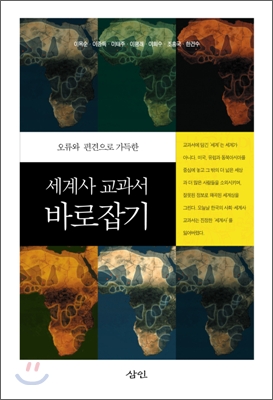
The ‘world’ contained in our textbooks is not the world.
It centers on the United States, Europe, and Northeast Asia, marginalizing the wider world and its wider population, and creating a distorted world view filled with misinformation.
Today, Korean social studies and world history textbooks have lost true ‘world history.’
This book seeks to discover and revive the 'world history' lost in textbooks.
This book was created with the hope that it will serve as a small spark for the creation of better textbooks in the future, and that it will help fellow Koreans understand other cultures more accurately and without prejudice, thereby developing a better global perspective and cultural tolerance.
The writing team included scholars from various fields who possess extensive field research experience as well as theoretical research and can represent the domestic academic community related to the region and culture.
It centers on the United States, Europe, and Northeast Asia, marginalizing the wider world and its wider population, and creating a distorted world view filled with misinformation.
Today, Korean social studies and world history textbooks have lost true ‘world history.’
This book seeks to discover and revive the 'world history' lost in textbooks.
This book was created with the hope that it will serve as a small spark for the creation of better textbooks in the future, and that it will help fellow Koreans understand other cultures more accurately and without prejudice, thereby developing a better global perspective and cultural tolerance.
The writing team included scholars from various fields who possess extensive field research experience as well as theoretical research and can represent the domestic academic community related to the region and culture.
- You can preview some of the book's contents.
Preview
index
Preface _ The World History Lost in Textbooks
The Lost History of Central Eurasia | Lee Pyeong-rae
Empty History / Publicly Discriminated History / Artificially Split and Erased History / Prejudice and Error History / History to Be Restored / References
A Textbook That Muddles Southeast Asia's Vibrancy and Diversity | Cho Heung-guk
Two Attitudes Toward Southeast Asia / Errors in Terminology and Concepts in Textbooks / General History, Culture, Politics, and Economy / Pre-modern History (Up to the 18th Century) / Modern and Contemporary History (Since the 19th Century) / Errors in Maps Included in Textbooks / Suggestions for Improvement and Conclusion / References
Excellent Antiquity, Inferior Present / India | Lee Ok-sun
India, the "Mysterious Unknown Country" / History of India in Social World History Textbooks / Pre-modern History of India / History of Modern India / Errors in Specific Facts in Textbooks / Stereotypes About India / References
West Asia and the Islamic World: Distorted by Hostile Stereotypes | Lee Hee-soo
To embrace other worlds and cultures without prejudice / Analysis of Islamic history and culture in textbooks / Specific examples from "Middle School Social Studies 1" / Specific examples from "Middle School Social Studies 2" / Specific examples from "High School World History" / Conclusion
Koreans' Imagination and Representation of Africa | Han Geon-su
The Historicity of Africa / The Invention of Africa: Imagined Space, Representation as the Other / The Africa We Know / The Africa Distorted by Our Textbooks / The History and Culture of Africa Not Taught in Our Textbooks / References
Latin America: Between Barbarism and Civilization | Lee Jong-deuk
Imaginations and Misconceptions about Latin America / Latin America's Natural Environment / Ancient Civilizations / Conquest Period / Colonial Period / Modern and Contemporary History / Conclusion
Is Oceania a continent of white people and sheep? Oceania | Lee Tae-joo
Prejudices and Errors in Textbooks About Oceania / The Land and Sea of the Indigenous Peoples, Oceania / Oceanian Indigenous Peoples and Colonialism / Australian Aborigines: Who Are They? / Guns, Germs, Steel, and the Bible / Oceanian Indigenous Peoples and Multiethnic Societies Today
The Lost History of Central Eurasia | Lee Pyeong-rae
Empty History / Publicly Discriminated History / Artificially Split and Erased History / Prejudice and Error History / History to Be Restored / References
A Textbook That Muddles Southeast Asia's Vibrancy and Diversity | Cho Heung-guk
Two Attitudes Toward Southeast Asia / Errors in Terminology and Concepts in Textbooks / General History, Culture, Politics, and Economy / Pre-modern History (Up to the 18th Century) / Modern and Contemporary History (Since the 19th Century) / Errors in Maps Included in Textbooks / Suggestions for Improvement and Conclusion / References
Excellent Antiquity, Inferior Present / India | Lee Ok-sun
India, the "Mysterious Unknown Country" / History of India in Social World History Textbooks / Pre-modern History of India / History of Modern India / Errors in Specific Facts in Textbooks / Stereotypes About India / References
West Asia and the Islamic World: Distorted by Hostile Stereotypes | Lee Hee-soo
To embrace other worlds and cultures without prejudice / Analysis of Islamic history and culture in textbooks / Specific examples from "Middle School Social Studies 1" / Specific examples from "Middle School Social Studies 2" / Specific examples from "High School World History" / Conclusion
Koreans' Imagination and Representation of Africa | Han Geon-su
The Historicity of Africa / The Invention of Africa: Imagined Space, Representation as the Other / The Africa We Know / The Africa Distorted by Our Textbooks / The History and Culture of Africa Not Taught in Our Textbooks / References
Latin America: Between Barbarism and Civilization | Lee Jong-deuk
Imaginations and Misconceptions about Latin America / Latin America's Natural Environment / Ancient Civilizations / Conquest Period / Colonial Period / Modern and Contemporary History / Conclusion
Is Oceania a continent of white people and sheep? Oceania | Lee Tae-joo
Prejudices and Errors in Textbooks About Oceania / The Land and Sea of the Indigenous Peoples, Oceania / Oceanian Indigenous Peoples and Colonialism / Australian Aborigines: Who Are They? / Guns, Germs, Steel, and the Bible / Oceanian Indigenous Peoples and Multiethnic Societies Today
Into the book
The Yuan Dynasty's Saekmu people were a shortened form of Jesaekmumin (諸色目人), meaning 'people of all kinds', and were a semi-ruling group that supported Mongolia's rule over China.
This group mainly includes Turkic or Iranian people who cooperated with the Mongol conquest process or Mongol rule after the conquest.
So, it is plausible but wrong to say that they were called that way because of the color of their eyes.
--- p.61
The main players of the Silk Road were China and Rome?
The Silk Road has been primarily understood as a trade route between the East and the West or as a route for cultural transmission.
The term “Silk Road” itself already contains this concept.
It reflects the idea that long ago, Chinese silk was exported to Rome.
In this case, the center would be at the eastern end (China) and the western end (the Mediterranean world), and the Silk Road would be nothing more than a transit point for silk trade.
The same goes for cultural exchange between the East and the West.
The prevailing view is that this road is simply a place where people, goods, and religions pass through.
It's like this in all textbooks.
There is only talk of something going back and forth between the East and the West, and not a single word about the main character of the land that served as the crossroads.
Why would that be? Because that's what Silk Road researchers of the late 19th and early 20th centuries thought.
In their eyes, only the worlds at both ends of the globe were considered civilized.
And based on the idea that the products of that civilization were exchanged through this route, they eagerly searched for Chinese, West Asian, or Greco-Roman things there.
This is the background to the birth of the East-West cultural exchange history without a master.
However, the Silk Road was not simply a region through which goods and cultures from the East and West passed; it was a route through which new cultures were created and then spread to both the East and the West.
The Gandhara art and Sogdian stories mentioned in verse 1 are among them.
Therefore, textbooks should not repeat what was learned half a century ago, but should at least use knowledge from 20 years ago.
--- p.67
Is Buddhism in Southeast Asia Theravada Buddhism?
Many of the concepts adopted in Korean textbooks to introduce Southeast Asian history and culture are inappropriate or have incorrect explanations.
A representative example is the concept of “Theravada Buddhism,” which is commonly used in all textbooks, but this term is currently inadequate to describe religions in Southeast Asia.
First of all, originally there were several sects of Theravada Buddhism, but today only the Theravada Buddhism sect remains.
So, when most Western literature refers to Buddhism in English today, it borrows the concept of Pali, the language of the scriptures of Theravada Buddhism, and calls it “Theravada Buddhism.”
The 'thera' in Theravada means 'senior' or 'upper seat' in a temple, and 'vāda' means 'word' or 'teaching'.
Second, there is a problem with the origin of the term itself.
The most crucial difference between Hinayana and Mahayana Buddhism is that the latter seeks to save all living beings, while the former emphasizes individual practice and liberation. The name "Hinayana," meaning "small vehicle," was unilaterally given by Mahayana Buddhism, which emerged later, in criticism of the individualistic method of seeking enlightenment in Hinayana Buddhism.
For these two reasons alone, Buddhism in Southeast Asia and Sri Lanka is more appropriately called “Theravada Buddhism” rather than “Theravada Buddhism.”
--- pp.88-89
Is modern urban development a uniquely European phenomenon?
The Mughal Empire was a prosperous country with high agricultural productivity and developed commerce and industry.
They amassed great wealth by trading with Portugal, England, France, and the Netherlands via sea and land routes.
The Mughal Empire's main sources of income were land taxes and trade taxes.
As agriculture and commerce developed, markets and cities developed.
In 17th century India, there were nine cities with populations exceeding 200,000, including Delhi, Agra, Surat, and Lahore.
At the same time, there were only three cities in Europe with a population of more than 200,000: London, Paris, and Naples.
Yet textbooks portray urban development as a phenomenon unique to Europe.
--- p.158
In Islam, do you believe in 'Allah'?
Allah means 'God' in Arabic.
It is the same as God in English, Shangdi (上帝), Tianzu (天主) in Chinese, and Yahweh in Hebrew.
Even in the Arabic version of the Bible, the Christian scripture, God is written as 'Allah'.
Therefore, the word 'Allah' is a strange expression, like 'God'.
Moreover, when we say 'Allah', it can be misunderstood as a polytheistic concept, as if it were the name of one of many gods.
Judaism, Christianity, and Islam are monotheistic religions with common roots, accepting the same stories in the Old Testament of the Bible, including the creation of the universe, the creation of Adam and Eve, the story of Noah's Ark and the flood, and the story of Abraham and Moses.
--- pp.201-202
Are there only Australia and New Zealand in Oceania?
In almost all social studies textbooks, as well as in the lingo of our society, 'Oceania' is used synonymously with 'Australia and New Zealand'.
While Australia and New Zealand are covered in detail in the Oceania section of each textbook, the 25,000 islands and 13 independent island nations of the South Pacific are not mentioned at all.
Moreover, there is also an incorrect explanation that Oceania is “located in the western Pacific region of the Southern Hemisphere” (『Middle School Social Studies 1』 Stepping Stone, p. 186).
The Western Pacific is only one end of Oceania, as it is the region where Australia, New Zealand, and the island of New Guinea are located.
Oceania should be described as a vast region stretching from east to west and north to south in the South Pacific.
This group mainly includes Turkic or Iranian people who cooperated with the Mongol conquest process or Mongol rule after the conquest.
So, it is plausible but wrong to say that they were called that way because of the color of their eyes.
--- p.61
The main players of the Silk Road were China and Rome?
The Silk Road has been primarily understood as a trade route between the East and the West or as a route for cultural transmission.
The term “Silk Road” itself already contains this concept.
It reflects the idea that long ago, Chinese silk was exported to Rome.
In this case, the center would be at the eastern end (China) and the western end (the Mediterranean world), and the Silk Road would be nothing more than a transit point for silk trade.
The same goes for cultural exchange between the East and the West.
The prevailing view is that this road is simply a place where people, goods, and religions pass through.
It's like this in all textbooks.
There is only talk of something going back and forth between the East and the West, and not a single word about the main character of the land that served as the crossroads.
Why would that be? Because that's what Silk Road researchers of the late 19th and early 20th centuries thought.
In their eyes, only the worlds at both ends of the globe were considered civilized.
And based on the idea that the products of that civilization were exchanged through this route, they eagerly searched for Chinese, West Asian, or Greco-Roman things there.
This is the background to the birth of the East-West cultural exchange history without a master.
However, the Silk Road was not simply a region through which goods and cultures from the East and West passed; it was a route through which new cultures were created and then spread to both the East and the West.
The Gandhara art and Sogdian stories mentioned in verse 1 are among them.
Therefore, textbooks should not repeat what was learned half a century ago, but should at least use knowledge from 20 years ago.
--- p.67
Is Buddhism in Southeast Asia Theravada Buddhism?
Many of the concepts adopted in Korean textbooks to introduce Southeast Asian history and culture are inappropriate or have incorrect explanations.
A representative example is the concept of “Theravada Buddhism,” which is commonly used in all textbooks, but this term is currently inadequate to describe religions in Southeast Asia.
First of all, originally there were several sects of Theravada Buddhism, but today only the Theravada Buddhism sect remains.
So, when most Western literature refers to Buddhism in English today, it borrows the concept of Pali, the language of the scriptures of Theravada Buddhism, and calls it “Theravada Buddhism.”
The 'thera' in Theravada means 'senior' or 'upper seat' in a temple, and 'vāda' means 'word' or 'teaching'.
Second, there is a problem with the origin of the term itself.
The most crucial difference between Hinayana and Mahayana Buddhism is that the latter seeks to save all living beings, while the former emphasizes individual practice and liberation. The name "Hinayana," meaning "small vehicle," was unilaterally given by Mahayana Buddhism, which emerged later, in criticism of the individualistic method of seeking enlightenment in Hinayana Buddhism.
For these two reasons alone, Buddhism in Southeast Asia and Sri Lanka is more appropriately called “Theravada Buddhism” rather than “Theravada Buddhism.”
--- pp.88-89
Is modern urban development a uniquely European phenomenon?
The Mughal Empire was a prosperous country with high agricultural productivity and developed commerce and industry.
They amassed great wealth by trading with Portugal, England, France, and the Netherlands via sea and land routes.
The Mughal Empire's main sources of income were land taxes and trade taxes.
As agriculture and commerce developed, markets and cities developed.
In 17th century India, there were nine cities with populations exceeding 200,000, including Delhi, Agra, Surat, and Lahore.
At the same time, there were only three cities in Europe with a population of more than 200,000: London, Paris, and Naples.
Yet textbooks portray urban development as a phenomenon unique to Europe.
--- p.158
In Islam, do you believe in 'Allah'?
Allah means 'God' in Arabic.
It is the same as God in English, Shangdi (上帝), Tianzu (天主) in Chinese, and Yahweh in Hebrew.
Even in the Arabic version of the Bible, the Christian scripture, God is written as 'Allah'.
Therefore, the word 'Allah' is a strange expression, like 'God'.
Moreover, when we say 'Allah', it can be misunderstood as a polytheistic concept, as if it were the name of one of many gods.
Judaism, Christianity, and Islam are monotheistic religions with common roots, accepting the same stories in the Old Testament of the Bible, including the creation of the universe, the creation of Adam and Eve, the story of Noah's Ark and the flood, and the story of Abraham and Moses.
--- pp.201-202
Are there only Australia and New Zealand in Oceania?
In almost all social studies textbooks, as well as in the lingo of our society, 'Oceania' is used synonymously with 'Australia and New Zealand'.
While Australia and New Zealand are covered in detail in the Oceania section of each textbook, the 25,000 islands and 13 independent island nations of the South Pacific are not mentioned at all.
Moreover, there is also an incorrect explanation that Oceania is “located in the western Pacific region of the Southern Hemisphere” (『Middle School Social Studies 1』 Stepping Stone, p. 186).
The Western Pacific is only one end of Oceania, as it is the region where Australia, New Zealand, and the island of New Guinea are located.
Oceania should be described as a vast region stretching from east to west and north to south in the South Pacific.
--- p.414
Publisher's Review
“In the 1950s, our country was one of the poorest countries in the world.
But, if we compare Korea with Japan, which had a higher economic level than us at the time, and divide them into ‘poor Korea’ and ‘well-off Japan,’ can we really say that it is valid?” - From the text
We occasionally hear news that textbooks or encyclopedias from other countries still state that Korea is a vassal state of China or a colony of Japan, or that the East Sea is only referred to as the Sea of Japan.
And in China, they claim that Goguryeo was a border regime of China and are trying to make Goguryeo history a part of Chinese history, and in Japan, history textbooks that justify the invasion of Korea are gradually gaining influence.
Every time a story like this is reported in the media, voices of anger rise up in Korean society.
But what if our textbooks are full of errors and biases?
First of all, the ‘world’ in our textbooks is not the world.
It centers on the United States, Europe, and Northeast Asia, while alienating the wider world and its wider population.
The history section of the 『Middle School Social Studies 1』 textbook consists of 9 to 11 chapters under three units: “Human Society and History,” “Origins of Mankind and the Formation of Ancient Civilizations,” and “Development and Changes in Asian Society.”
The history section of the 『Middle School Social Studies 2』 textbook consists of 12 to 15 chapters in four units: "The Formation of the European World," "The Development and Change of Modern Western Society," "The Changes and Modern Growth of Asian Society," and "The Development of the Modern World."
『High School World History』 is composed of 9 units and 35-38 chapters: “Time, Space, and Humans,” “The Dawn of Civilization and Ancient Civilization,” “The Expansion of the Asian World and East-West Exchange,” “Feudal Society in Europe,” “The Growth of Asian Society,” “The Growth and Expansion of Modern European Society,” “Modern Development of the Asian World,” “Imperialism and the Two World Wars,” and “The Development of the Postwar World.”
In these textbooks, the pre-modern section is dominated by China and Europe, while the modern and contemporary sections are dominated by Asia (excluding Central Eurasia), the United States, and Europe.
The American continent and Africa are not given even a single independent section, and Central Eurasia and Oceania do not appear in the textbook at all (Central Eurasia is split into West Asia and East Asia, and treated very fragmentarily, and Oceania is introduced only in the geography section, and centered around Australia and New Zealand).
It's as if history was made only in Asia and Europe.
For many people, social studies and world history textbooks are their first window into the world.
Through textbooks, we first visualize a world map, imagining the sizes, shapes, and colors of the five oceans and six continents. While information channels have diversified through television and the internet, what we learn in school during our youth forms the foundation of our perceptions and forms our stereotypes.
So, for the average Korean, the 'world' is almost entirely comprised of the United States, Europe, and Northeast Asia.
Today, Korean social studies and world history textbooks have lost true ‘world history.’
This is the result of perceiving the world centered on economic power.
An economic-centric worldview groups the world's regions according to a single criterion: the economy.
And this leads to racial discrimination and regional discrimination.
If it is wrong for the United States and Europe to ignore Asia, including Korea, by asserting their economic power, then our textbooks should not divide the world and discriminate against it based on the gap between rich and poor.
Shouldn't the criteria for dividing regions be not economic power, but similarities and differences in diverse cultures, lifestyles, histories, and environments? Shouldn't history education be directed toward a deeper understanding of the world's various regions and the people who live there?
Social Studies? World history textbooks are structured around major powers, creating a biased worldview and instilling incorrect knowledge.
As the authors analyzed the textbooks, they were repeatedly surprised by the amount of incorrect information being published.
Don't they call the Mongolian portable tent, the ger, "pao" in Chinese (which is like calling kimchi "gimuchi")? They gave the Islamic caliphate Umayyad, which existed from 661 to 750 AD, the absurd name "Umayyad Dynasty." They even inserted a chart showing no black people in Brazil, a country with a large black population, and drew a chart showing that black people make up nearly 90 percent of Chile, a country with a large white population and almost no black people.
This seems to be the result of uncritically accepting mainly Western or Japanese materials, especially those from decades ago, rather than creating textbooks based on various local sources and recent research findings.
Seven experts who had studied the cultures of each region recognized the problems in the textbooks and joined forces to provide a desirable guide, thus beginning the two-year project, "Correcting World History Textbooks Filled with Errors and Prejudices."
I hope this book will serve as a spark for the creation of better textbooks in the future, and as a forum for reflection and a channel of communication for fellow Koreans to understand other cultures more accurately and without prejudice, thereby developing a better global perspective and cultural tolerance.
The writing team included scholars from various fields who possess extensive field research experience as well as theoretical research and can represent the domestic academic community related to the region and culture.
Central Eurasia was handled by Lee Pyeong-rae (Hankuk University of Foreign Studies, Institute of History and Culture), Southeast Asia by Cho Heung-guk (Pusan National University, Graduate School of International Studies), India by Lee Ok-sun (Yonsei University, Institute of Humanities Research), West Asia and Islam by Lee Hee-soo (Hanyang University, Department of Cultural Anthropology), Africa by Han Geon-soo (Kangwon National University, Department of Cultural Anthropology), Latin America by Lee Jong-deuk (Duksung Women's University, Department of Spanish), and Oceania by Lee Tae-joo (Hansung University, Department of Liberal Arts, Cultural Anthropology).
The main analysis targets are 10 types of 『Middle School Social Studies 1』, 8 types of 『Middle School Social Studies 2』, and 3 types of 『High School World History』, and in some cases, 8 types of 『Middle School Social Studies Map』, 3 types of 『High School World Geography』, 8 types of 『High School History Map』, and 8 types of 『High School Geography Map』 were also covered.
But, if we compare Korea with Japan, which had a higher economic level than us at the time, and divide them into ‘poor Korea’ and ‘well-off Japan,’ can we really say that it is valid?” - From the text
We occasionally hear news that textbooks or encyclopedias from other countries still state that Korea is a vassal state of China or a colony of Japan, or that the East Sea is only referred to as the Sea of Japan.
And in China, they claim that Goguryeo was a border regime of China and are trying to make Goguryeo history a part of Chinese history, and in Japan, history textbooks that justify the invasion of Korea are gradually gaining influence.
Every time a story like this is reported in the media, voices of anger rise up in Korean society.
But what if our textbooks are full of errors and biases?
First of all, the ‘world’ in our textbooks is not the world.
It centers on the United States, Europe, and Northeast Asia, while alienating the wider world and its wider population.
The history section of the 『Middle School Social Studies 1』 textbook consists of 9 to 11 chapters under three units: “Human Society and History,” “Origins of Mankind and the Formation of Ancient Civilizations,” and “Development and Changes in Asian Society.”
The history section of the 『Middle School Social Studies 2』 textbook consists of 12 to 15 chapters in four units: "The Formation of the European World," "The Development and Change of Modern Western Society," "The Changes and Modern Growth of Asian Society," and "The Development of the Modern World."
『High School World History』 is composed of 9 units and 35-38 chapters: “Time, Space, and Humans,” “The Dawn of Civilization and Ancient Civilization,” “The Expansion of the Asian World and East-West Exchange,” “Feudal Society in Europe,” “The Growth of Asian Society,” “The Growth and Expansion of Modern European Society,” “Modern Development of the Asian World,” “Imperialism and the Two World Wars,” and “The Development of the Postwar World.”
In these textbooks, the pre-modern section is dominated by China and Europe, while the modern and contemporary sections are dominated by Asia (excluding Central Eurasia), the United States, and Europe.
The American continent and Africa are not given even a single independent section, and Central Eurasia and Oceania do not appear in the textbook at all (Central Eurasia is split into West Asia and East Asia, and treated very fragmentarily, and Oceania is introduced only in the geography section, and centered around Australia and New Zealand).
It's as if history was made only in Asia and Europe.
For many people, social studies and world history textbooks are their first window into the world.
Through textbooks, we first visualize a world map, imagining the sizes, shapes, and colors of the five oceans and six continents. While information channels have diversified through television and the internet, what we learn in school during our youth forms the foundation of our perceptions and forms our stereotypes.
So, for the average Korean, the 'world' is almost entirely comprised of the United States, Europe, and Northeast Asia.
Today, Korean social studies and world history textbooks have lost true ‘world history.’
This is the result of perceiving the world centered on economic power.
An economic-centric worldview groups the world's regions according to a single criterion: the economy.
And this leads to racial discrimination and regional discrimination.
If it is wrong for the United States and Europe to ignore Asia, including Korea, by asserting their economic power, then our textbooks should not divide the world and discriminate against it based on the gap between rich and poor.
Shouldn't the criteria for dividing regions be not economic power, but similarities and differences in diverse cultures, lifestyles, histories, and environments? Shouldn't history education be directed toward a deeper understanding of the world's various regions and the people who live there?
Social Studies? World history textbooks are structured around major powers, creating a biased worldview and instilling incorrect knowledge.
As the authors analyzed the textbooks, they were repeatedly surprised by the amount of incorrect information being published.
Don't they call the Mongolian portable tent, the ger, "pao" in Chinese (which is like calling kimchi "gimuchi")? They gave the Islamic caliphate Umayyad, which existed from 661 to 750 AD, the absurd name "Umayyad Dynasty." They even inserted a chart showing no black people in Brazil, a country with a large black population, and drew a chart showing that black people make up nearly 90 percent of Chile, a country with a large white population and almost no black people.
This seems to be the result of uncritically accepting mainly Western or Japanese materials, especially those from decades ago, rather than creating textbooks based on various local sources and recent research findings.
Seven experts who had studied the cultures of each region recognized the problems in the textbooks and joined forces to provide a desirable guide, thus beginning the two-year project, "Correcting World History Textbooks Filled with Errors and Prejudices."
I hope this book will serve as a spark for the creation of better textbooks in the future, and as a forum for reflection and a channel of communication for fellow Koreans to understand other cultures more accurately and without prejudice, thereby developing a better global perspective and cultural tolerance.
The writing team included scholars from various fields who possess extensive field research experience as well as theoretical research and can represent the domestic academic community related to the region and culture.
Central Eurasia was handled by Lee Pyeong-rae (Hankuk University of Foreign Studies, Institute of History and Culture), Southeast Asia by Cho Heung-guk (Pusan National University, Graduate School of International Studies), India by Lee Ok-sun (Yonsei University, Institute of Humanities Research), West Asia and Islam by Lee Hee-soo (Hanyang University, Department of Cultural Anthropology), Africa by Han Geon-soo (Kangwon National University, Department of Cultural Anthropology), Latin America by Lee Jong-deuk (Duksung Women's University, Department of Spanish), and Oceania by Lee Tae-joo (Hansung University, Department of Liberal Arts, Cultural Anthropology).
The main analysis targets are 10 types of 『Middle School Social Studies 1』, 8 types of 『Middle School Social Studies 2』, and 3 types of 『High School World History』, and in some cases, 8 types of 『Middle School Social Studies Map』, 3 types of 『High School World Geography』, 8 types of 『High School History Map』, and 8 types of 『High School Geography Map』 were also covered.
GOODS SPECIFICS
- Date of issue: October 18, 2007
- Page count, weight, size: 451 pages | 794g | 148*210*30mm
- ISBN13: 9788991097742
- ISBN10: 899109774X
You may also like
카테고리
korean


korean

![GQ KOREA Mark (Monthly): December [2025]](http://librairie.coreenne.fr/cdn/shop/files/8ef265dbbfbf186523ed75ba7319009d.jpg?v=1765340328&width=3840)


