

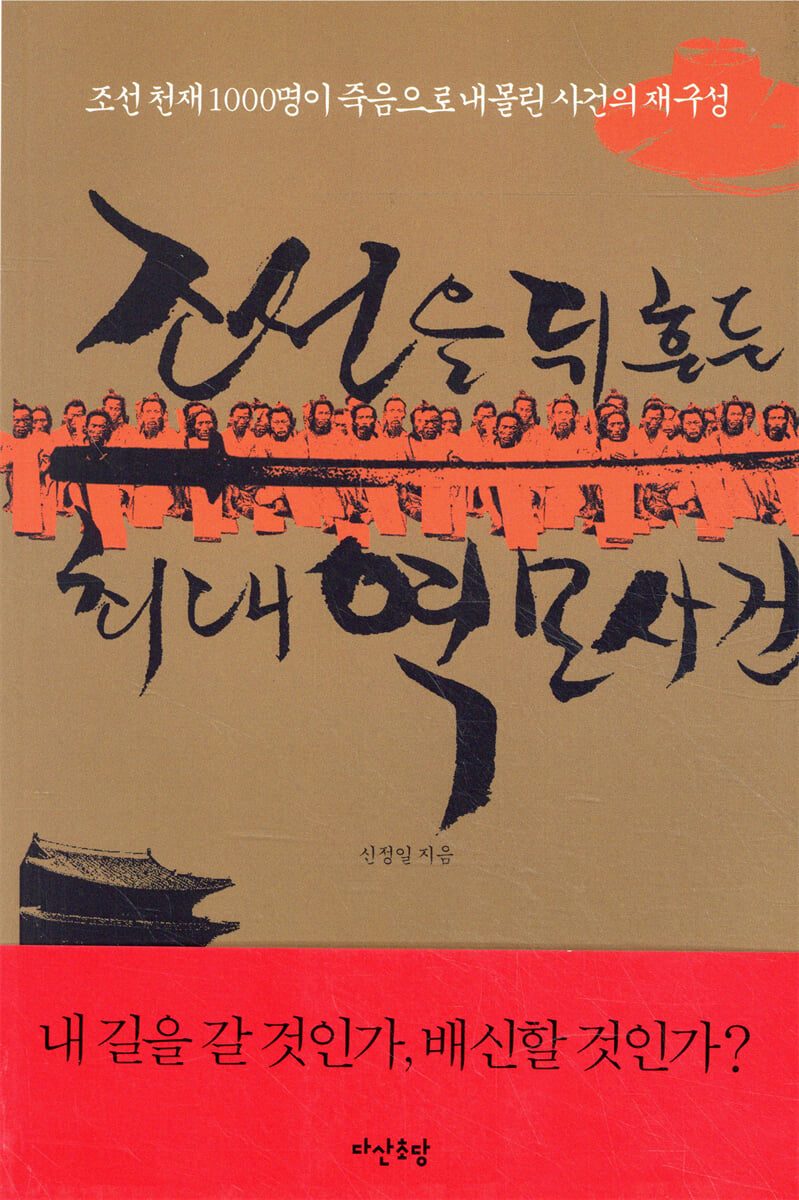
The greatest treason case that shook Joseon
 |
Description
Book Introduction
"The Greatest Treason Case That Shook Joseon" is a work that reconstructs the "Gichuk Oksa," the treason case of Jeong Yeo-rip that led to the deaths of 1,000 Joseon geniuses 400 years ago.
Jeong Yeo-rip and about 1,000 scholars were involved in a treasonous incident called the Gichuk Oksa and were all killed. Afterwards, Jeolla Province was called a rebellious region, and people from Honam were restricted from being promoted.
Cultural historian Shin Jeong-il tells the truth about the conspiracy surrounding the "Gichuk Oksa" and the 1,000 scholars who died as a result of their involvement in Jeong Yeo-rip and his treason.
Jeong Yeo-rip was an innovative thinker who advocated for the theory of tribute to the nation and the theory of military service in the midst of the conflict over different political views in the 16th century. However, he was also criticized by some as a traitor who attempted to overthrow the dynasty by spreading false information in the Jeonggamnok.
Also, the Imjin War broke out just three years after 1,000 Joseon scholars died in the "Gichuk Oksa" incident, and Hwang Jeong-uk, the Minister of War who was retreating after evacuating Pyongyang Castle, lamented why Joseon had to collapse so meaninglessly, and cried out, "If only Jeong Eon-sin had lived during the Gichuk Oksa, it wouldn't have ended up like this!" The "Gichuk Oksa" took the lives of so many young geniuses.
This book tells the truth about the treason case called "Gichuk Oksa" that occurred in Joseon.
King Seonjo, who tried to survive amidst the scholars' reforms, Yu Seong-ryong and Yi Hang-bok, who chose different paths, Jeong Cheol, who killed his political opponents for personal gain, and Choi Yeong-gyeong, who accepted it out of righteousness, and countless others who lost their lives in treason amidst such conflicts are being revived in the history of the 16th century.
Jeong Yeo-rip and about 1,000 scholars were involved in a treasonous incident called the Gichuk Oksa and were all killed. Afterwards, Jeolla Province was called a rebellious region, and people from Honam were restricted from being promoted.
Cultural historian Shin Jeong-il tells the truth about the conspiracy surrounding the "Gichuk Oksa" and the 1,000 scholars who died as a result of their involvement in Jeong Yeo-rip and his treason.
Jeong Yeo-rip was an innovative thinker who advocated for the theory of tribute to the nation and the theory of military service in the midst of the conflict over different political views in the 16th century. However, he was also criticized by some as a traitor who attempted to overthrow the dynasty by spreading false information in the Jeonggamnok.
Also, the Imjin War broke out just three years after 1,000 Joseon scholars died in the "Gichuk Oksa" incident, and Hwang Jeong-uk, the Minister of War who was retreating after evacuating Pyongyang Castle, lamented why Joseon had to collapse so meaninglessly, and cried out, "If only Jeong Eon-sin had lived during the Gichuk Oksa, it wouldn't have ended up like this!" The "Gichuk Oksa" took the lives of so many young geniuses.
This book tells the truth about the treason case called "Gichuk Oksa" that occurred in Joseon.
King Seonjo, who tried to survive amidst the scholars' reforms, Yu Seong-ryong and Yi Hang-bok, who chose different paths, Jeong Cheol, who killed his political opponents for personal gain, and Choi Yeong-gyeong, who accepted it out of righteousness, and countless others who lost their lives in treason amidst such conflicts are being revived in the history of the 16th century.
- You can preview some of the book's contents.
Preview
index
Preface - Beyond the Charyeong River and the Heart of East Asia / Kim Ji-ha
Prologue - Why did Joseon's geniuses dream of a new world?
Part 1: The Disastrous War of Geniuses
1.
A Secret Report - Those Who Died for Shedding Tears, Jo Dae-jung and Kim Bing
2.
The Age of Scholars, the Age of Great Conflict - The Sacrifice of Monks, Seosan Daesa and Samyeongdang
3.
The genius of geniuses, Jeong Yeo-rip - and the tragedy of the two men who recommended him, No Su-sin and Baek Yu-yang.
4.
Irreversible Betrayal - The Two Masters He Betrayed, Lee Yi and Seong Hon
5.
The Two Faces of the Ancestors - The Ancestors' Left and Right Arms, Ryu Seong-ryong and Lee Hang-bok
6.
The Battle of Sangso and the Secret of the Daedonggye: The Killer and the Dying, Jeong Cheol and Choi Yeong-gyeong
7.
The Faceless Protagonist: A Twisted Fate of Ice and Fire, Song Ik-pil and Lee Bal
8.
The Accuser of Death - The Biggest Victims, Jeong Eon-shin and Jeong Eon-ji
9.
Ancestors Issue Instructions - Lee San-hae and Jo Heon Face Off for the Fate of the Party
10.
The Fall of Jeong Cheol - A Tragic Conversation Between Priests, Park Soon, and Jeong Gae-cheong
Part 2: Secret Records - In Search of the Hidden Truth of the Gichuk Oksa
1.
A failed revolution or an unjust death?
2.
Sparks of controversy fly
3.
Stories about the home of rebellion
4.
Beautiful dream, Daedong
Prologue - Why did Joseon's geniuses dream of a new world?
Part 1: The Disastrous War of Geniuses
1.
A Secret Report - Those Who Died for Shedding Tears, Jo Dae-jung and Kim Bing
2.
The Age of Scholars, the Age of Great Conflict - The Sacrifice of Monks, Seosan Daesa and Samyeongdang
3.
The genius of geniuses, Jeong Yeo-rip - and the tragedy of the two men who recommended him, No Su-sin and Baek Yu-yang.
4.
Irreversible Betrayal - The Two Masters He Betrayed, Lee Yi and Seong Hon
5.
The Two Faces of the Ancestors - The Ancestors' Left and Right Arms, Ryu Seong-ryong and Lee Hang-bok
6.
The Battle of Sangso and the Secret of the Daedonggye: The Killer and the Dying, Jeong Cheol and Choi Yeong-gyeong
7.
The Faceless Protagonist: A Twisted Fate of Ice and Fire, Song Ik-pil and Lee Bal
8.
The Accuser of Death - The Biggest Victims, Jeong Eon-shin and Jeong Eon-ji
9.
Ancestors Issue Instructions - Lee San-hae and Jo Heon Face Off for the Fate of the Party
10.
The Fall of Jeong Cheol - A Tragic Conversation Between Priests, Park Soon, and Jeong Gae-cheong
Part 2: Secret Records - In Search of the Hidden Truth of the Gichuk Oksa
1.
A failed revolution or an unjust death?
2.
Sparks of controversy fly
3.
Stories about the home of rebellion
4.
Beautiful dream, Daedong
Into the book
Anyone who had a close relationship with Yeo-rip and exchanged letters with him could not avoid being implicated, and many scholars ended up committing crimes.
Among them, those who were tortured to death include former ambassador Yi Bal, Yi Bal's younger brothers Eung-gyo and Gil, Yi Bal's older brother Yi Gyeop, Byeongjo Chamji and Baek Yu-yang, Yu Yang's son, Saengwon Baek Jin-min, former Jeolla-do magistrate Jo Dae-jung, former Namwon magistrate Yu Mong-jeong, former Chalbang Yi Hwang-jong, former Gamyeok Choi Yeo-gyeong, scholar Yun Gi-sin, Jeong Yeo-rip's nephew Yi Jin-gil, and so on, and there are too many to list them all.
Among them, the families of Yibal and Baek Yu-yang suffered the most severe calamity.
And those who were implicated and exiled were the Prime Minister Jeong Eon-sin, Andong magistrate Kim Woo-ong, Jikjehak Hong Jong-rok, Jiphyeong Shin Sik and Jeong Suk-nam, and scholar Jeong Gae-cheong, and the one who died of illness while imprisoned was the hermit Choi Yeong-gyeong.
The Oksa tangled and spread like vines, and even after three years, it remained unfinished, leaving thousands dead. --- Yu Seong-ryong's remarks on the damage caused by the Gichuk Oksa
“He secretly instigated the wicked Jeong Cheol to kill the virtuous Choi Yeong-gyeong, destroying the nation’s lifeline and humiliating the people. He is a figure like Hideyoshi of Japan.
Only after there are scholars and thieves inside, there are foreign enemies who invade by force outside.
“The Imjin War was actually caused by bandits within.”
Jeong In-hong's remarks on the impact of the Gichuk Oksa incident
“Just as there is no separate seed for the king and queen, there is no separate seed for the common people.
The world belongs to the people, and no king can be its master.
“Whoever serves, isn’t he a king?” ---Jeong Yeo-rip’s remarks on the Great East World
“I have never met Choi Young-kyung, so who would dare to doubt her?”
“The world is something that cannot be measured.
"If things get worse, how can you escape? You have to take care of your precious body."
---A conversation between Lee Hang-bok and Yu Seong-ryong about the rescue of Choi Yeong-gyeong
“Jeongcheol had a strong and jealous nature, and was prone to jealousy. He would always take revenge by framing even the slightest offense. He had the nature of a snake or a lice, and he had the plots of a ghost or a fox. He was born from a mixture of poisonous energy, and he only did things that hurt and harmed people.
Furthermore, Jeong Cheol, resentful of being judged as a truly petty or narrow-minded person, turned Choi Yeong-gyeong into Gil Sam-bong, leading to his death. He also tried to destroy anyone not in his party over the slightest offense, so the harm caused is incalculable.”
---The Office of the Inspector General's Remonstrance on Jeong Cheol
“Do you know the character for ‘right’?”
"It's been 30 years since I forgot about life and death." ---Choi Young-kyung's remarks on her own death
“Jeong Yeo-rip was from Jeonju and his reputation was known from an early age, and he covered the world.
He retired from the court and stayed at home, being noble and self-respecting, neither declined nor accepted official posts, and did not go when summoned by the country.
“The scholars even considered it fortunate to run to see him even once.” --- Jo Gyeong-nam’s remarks on Jeong Yeo-rip’s character
Among them, those who were tortured to death include former ambassador Yi Bal, Yi Bal's younger brothers Eung-gyo and Gil, Yi Bal's older brother Yi Gyeop, Byeongjo Chamji and Baek Yu-yang, Yu Yang's son, Saengwon Baek Jin-min, former Jeolla-do magistrate Jo Dae-jung, former Namwon magistrate Yu Mong-jeong, former Chalbang Yi Hwang-jong, former Gamyeok Choi Yeo-gyeong, scholar Yun Gi-sin, Jeong Yeo-rip's nephew Yi Jin-gil, and so on, and there are too many to list them all.
Among them, the families of Yibal and Baek Yu-yang suffered the most severe calamity.
And those who were implicated and exiled were the Prime Minister Jeong Eon-sin, Andong magistrate Kim Woo-ong, Jikjehak Hong Jong-rok, Jiphyeong Shin Sik and Jeong Suk-nam, and scholar Jeong Gae-cheong, and the one who died of illness while imprisoned was the hermit Choi Yeong-gyeong.
The Oksa tangled and spread like vines, and even after three years, it remained unfinished, leaving thousands dead. --- Yu Seong-ryong's remarks on the damage caused by the Gichuk Oksa
“He secretly instigated the wicked Jeong Cheol to kill the virtuous Choi Yeong-gyeong, destroying the nation’s lifeline and humiliating the people. He is a figure like Hideyoshi of Japan.
Only after there are scholars and thieves inside, there are foreign enemies who invade by force outside.
“The Imjin War was actually caused by bandits within.”
Jeong In-hong's remarks on the impact of the Gichuk Oksa incident
“Just as there is no separate seed for the king and queen, there is no separate seed for the common people.
The world belongs to the people, and no king can be its master.
“Whoever serves, isn’t he a king?” ---Jeong Yeo-rip’s remarks on the Great East World
“I have never met Choi Young-kyung, so who would dare to doubt her?”
“The world is something that cannot be measured.
"If things get worse, how can you escape? You have to take care of your precious body."
---A conversation between Lee Hang-bok and Yu Seong-ryong about the rescue of Choi Yeong-gyeong
“Jeongcheol had a strong and jealous nature, and was prone to jealousy. He would always take revenge by framing even the slightest offense. He had the nature of a snake or a lice, and he had the plots of a ghost or a fox. He was born from a mixture of poisonous energy, and he only did things that hurt and harmed people.
Furthermore, Jeong Cheol, resentful of being judged as a truly petty or narrow-minded person, turned Choi Yeong-gyeong into Gil Sam-bong, leading to his death. He also tried to destroy anyone not in his party over the slightest offense, so the harm caused is incalculable.”
---The Office of the Inspector General's Remonstrance on Jeong Cheol
“Do you know the character for ‘right’?”
"It's been 30 years since I forgot about life and death." ---Choi Young-kyung's remarks on her own death
“Jeong Yeo-rip was from Jeonju and his reputation was known from an early age, and he covered the world.
He retired from the court and stayed at home, being noble and self-respecting, neither declined nor accepted official posts, and did not go when summoned by the country.
“The scholars even considered it fortunate to run to see him even once.” --- Jo Gyeong-nam’s remarks on Jeong Yeo-rip’s character
---From the text
Publisher's Review
Jeong Yeo-rip, a revolutionary whose honor has not yet been restored!
Meet the tragic life of Jeong Yeo-rip, the man of suspicion!
There are two unidentified geniuses in Joseon history.
Heo Gyun, and Jeong Yeo-rip.
A tragic figure who was called a beautiful scholar with both literary and intellectual talents in his time, yet had to be erased from even the family tree.
How has history distorted him? Now is the time to face the truth.
Jeong Yeo-rip's family origin is Dongrae, and his nickname is Inbaek.
He was born as the son of Hee-jeung, who served as a judge in Jeonju, Jeollabuk-do.
He was a man of leadership and intelligence, well versed in the teachings of the Hundred Schools of Thought.
After passing the civil service examination in 1570 (the 3rd year of King Seonjo's reign) with a grade of Eul, he served as a junior official of the Ministry of Rites in 1583 (the 16th year of King Seonjo's reign) and became a Suchan (修撰) the following year.
At first, he belonged to the Seoin faction while studying under Yi I and Seong Hon, but after Yi I's death, he joined the Dongin faction and criticized Yi I and the leaders of the Seoin faction, Park Sun and Seong Hon.
Because of this, he incurred the king's hatred and was forced to resign from his official post, but his popularity was high and many people visited him even after he returned to his hometown.
Afterwards, he built a study room on Jukdo Island in Jinan County, held an archery club, gathered people together, organized Daedonggye, and developed military power.
At that time, he was called Mr. Jukdo because of his connection with Jukdo.
In 1587 (the 20th year of King Seonjo's reign), at the request of Jeonju Magistrate Nam Eon-gyeong, he led the Daedonggye and repelled the Japanese pirates who had invaded Sonjukdo.
Afterwards, he gathered the forces of Byeon Seung-bok of An-ak in Hwanghae Province, Ji Ham-du of Haeju, and the monk Ui-yeon of Unbong, and expanded the organization of the Daedonggye nationwide.
In 1589 (the 22nd year of King Seonjo's reign), Hwanghae-do governor Han Jun, Anak-gun governor Lee Chuk, and Jaeryeong-gun governor Park Chung-gan jointly reported that Jeong Yeo-rip and his group were planning to take advantage of the Han River freezing over to advance on Hanyang and start a rebellion.
As those involved were arrested one after another, Jeong Yeo-rip fled to Jukdo with his son Ok-nam, but committed suicide when surrounded by government troops.
The Seoin faction, including Jeong Cheol, took the lead in handling this incident, and the power of the Dongin faction was greatly weakened as members of the Dongin faction, including Yi Bal, Jeong Eon-sin, and Baek Yu-yang, were executed simply for being close to Jeong Yeo-rip.
This is called the Gichuk Oksa.
As a result of this incident, Jeolla Province came to be called a rebellious region, and from then on, the promotion of people from Honam was restricted.
Regarding Jeong Yeo-rip, he was cruel and vicious from a young age, and is seen as a person who attempted to overthrow the dynasty by spreading the false rumor in the Jeonggamnok that “the Yi clan will fall and the Jeong clan will prosper.”
On the other hand, he is also seen as a thinker who held innovative ideas that could not be tolerated under a monarchical system, such as the theory of public goods under the heavens (天下公物說), which states that "there is no fixed master under the heavens", and the theory of "what is not a king" (何事非君論), which states that "anyone can serve as a king."
For this reason, there is also a theory that Jeong Yeo-rip was a victim of the factional strife between the Westerners and Easterners, and that the treason he led was fabricated.
Meet the tragic life of Jeong Yeo-rip, the man of suspicion!
There are two unidentified geniuses in Joseon history.
Heo Gyun, and Jeong Yeo-rip.
A tragic figure who was called a beautiful scholar with both literary and intellectual talents in his time, yet had to be erased from even the family tree.
How has history distorted him? Now is the time to face the truth.
Jeong Yeo-rip's family origin is Dongrae, and his nickname is Inbaek.
He was born as the son of Hee-jeung, who served as a judge in Jeonju, Jeollabuk-do.
He was a man of leadership and intelligence, well versed in the teachings of the Hundred Schools of Thought.
After passing the civil service examination in 1570 (the 3rd year of King Seonjo's reign) with a grade of Eul, he served as a junior official of the Ministry of Rites in 1583 (the 16th year of King Seonjo's reign) and became a Suchan (修撰) the following year.
At first, he belonged to the Seoin faction while studying under Yi I and Seong Hon, but after Yi I's death, he joined the Dongin faction and criticized Yi I and the leaders of the Seoin faction, Park Sun and Seong Hon.
Because of this, he incurred the king's hatred and was forced to resign from his official post, but his popularity was high and many people visited him even after he returned to his hometown.
Afterwards, he built a study room on Jukdo Island in Jinan County, held an archery club, gathered people together, organized Daedonggye, and developed military power.
At that time, he was called Mr. Jukdo because of his connection with Jukdo.
In 1587 (the 20th year of King Seonjo's reign), at the request of Jeonju Magistrate Nam Eon-gyeong, he led the Daedonggye and repelled the Japanese pirates who had invaded Sonjukdo.
Afterwards, he gathered the forces of Byeon Seung-bok of An-ak in Hwanghae Province, Ji Ham-du of Haeju, and the monk Ui-yeon of Unbong, and expanded the organization of the Daedonggye nationwide.
In 1589 (the 22nd year of King Seonjo's reign), Hwanghae-do governor Han Jun, Anak-gun governor Lee Chuk, and Jaeryeong-gun governor Park Chung-gan jointly reported that Jeong Yeo-rip and his group were planning to take advantage of the Han River freezing over to advance on Hanyang and start a rebellion.
As those involved were arrested one after another, Jeong Yeo-rip fled to Jukdo with his son Ok-nam, but committed suicide when surrounded by government troops.
The Seoin faction, including Jeong Cheol, took the lead in handling this incident, and the power of the Dongin faction was greatly weakened as members of the Dongin faction, including Yi Bal, Jeong Eon-sin, and Baek Yu-yang, were executed simply for being close to Jeong Yeo-rip.
This is called the Gichuk Oksa.
As a result of this incident, Jeolla Province came to be called a rebellious region, and from then on, the promotion of people from Honam was restricted.
Regarding Jeong Yeo-rip, he was cruel and vicious from a young age, and is seen as a person who attempted to overthrow the dynasty by spreading the false rumor in the Jeonggamnok that “the Yi clan will fall and the Jeong clan will prosper.”
On the other hand, he is also seen as a thinker who held innovative ideas that could not be tolerated under a monarchical system, such as the theory of public goods under the heavens (天下公物說), which states that "there is no fixed master under the heavens", and the theory of "what is not a king" (何事非君論), which states that "anyone can serve as a king."
For this reason, there is also a theory that Jeong Yeo-rip was a victim of the factional strife between the Westerners and Easterners, and that the treason he led was fabricated.
GOODS SPECIFICS
- Date of issue: October 8, 2007
- Page count, weight, size: 385 pages | 684g | 153*224*30mm
- ISBN13: 9788992555517
- ISBN10: 8992555512
You may also like
카테고리
korean


korean

![GQ KOREA Mark (Monthly): December [2025]](http://librairie.coreenne.fr/cdn/shop/files/8ef265dbbfbf186523ed75ba7319009d.jpg?v=1765340328&width=3840)


