

Ryu
 |
Description
Book Introduction
- A word from MD
-
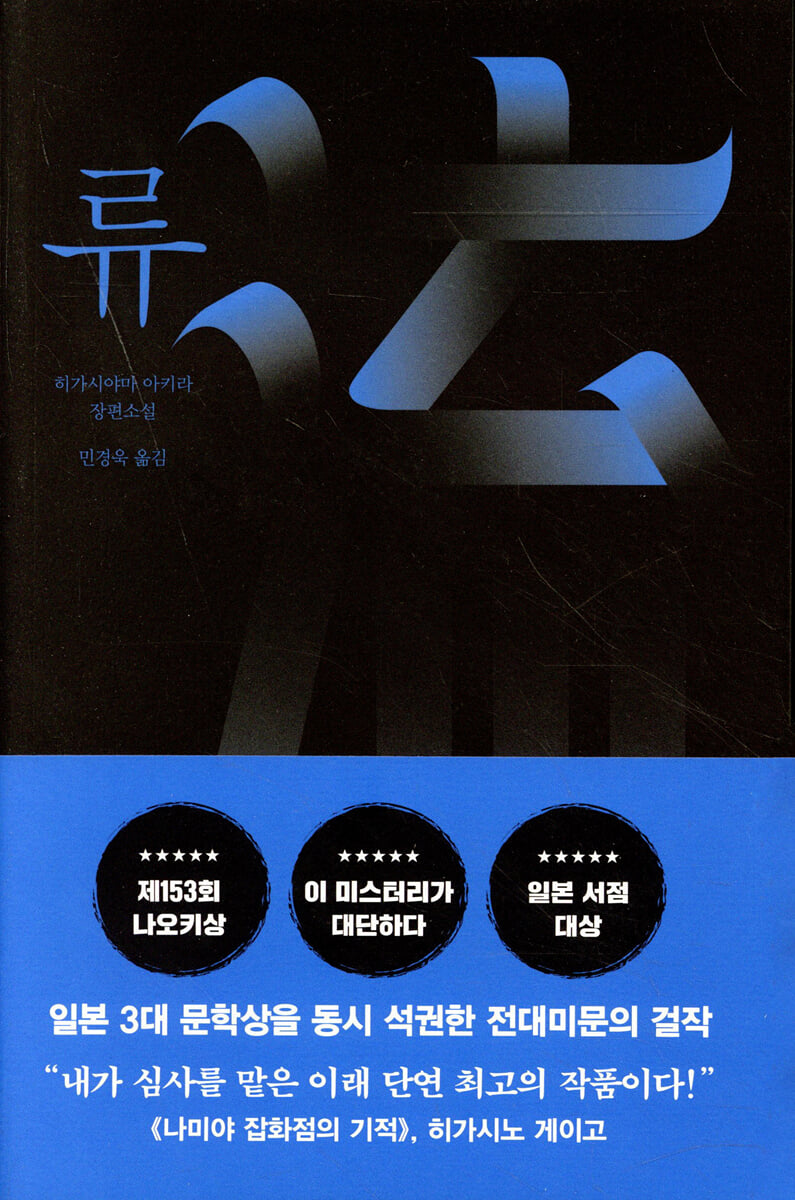
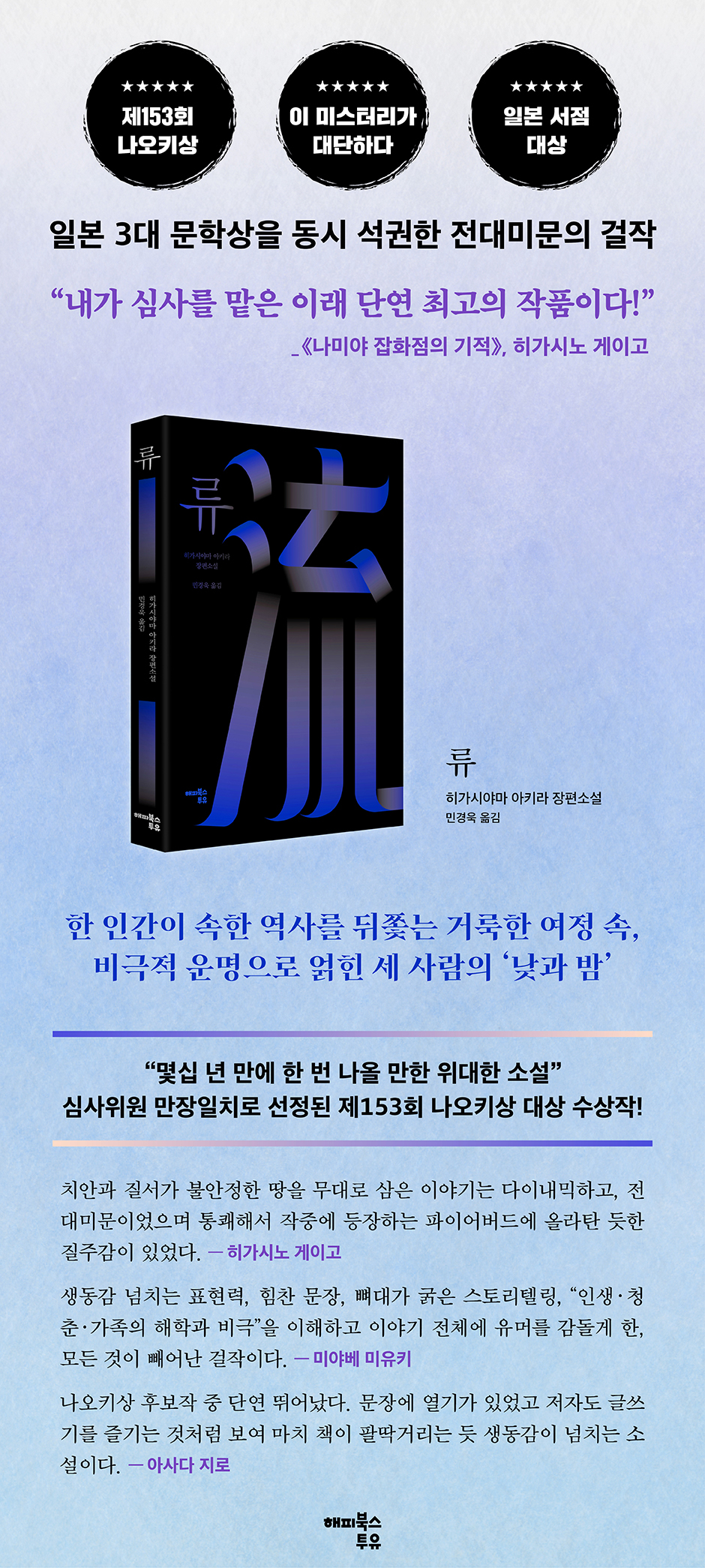
The judges unanimously chose the Naoki Prize winner.A work that won the three major literary awards in Japan, including the Naoki Prize.
Set in the 1970s and 1980s, the novel "Ryu" is a mystery about tracking down the culprit who murdered a grandfather, a story of generations, and a record of the fierce lives of individuals flowing alongside the grand history.
A book with a vivid and powerful story that unfolds powerfully until the very end.Novel/Poetry PD Park Hyung-wook
“A great novel that comes once in a few decades.”
An unprecedented masterpiece that simultaneously won Japan's three major literary awards.
The 153rd Naoki Prize winner was selected unanimously by the judges!
Akira Higashiyama's "Ryu," which swept Japan's top literary awards, including the 153rd Naoki Prize, the "This Mystery is Amazing" award, and the "Japan Booksellers' Award" upon its publication, has finally been published in Korea after a long-awaited request from Korean readers.
This novel, which had been the center of attention among Japanese novel enthusiasts even before its domestic publication was decided, was the first novel to be unanimously selected as the Grand Prize winner of the Naoki Prize, one of Japan's top literary awards, in the 2000s, and also received the highest praise, saying, "This is a great masterpiece that comes out once in several decades."
Author Akira Higashiyama also emerged as a new hope to save the Japanese literary world, which had been in a long slump.
As can be seen in the reviews such as “The writing is so good that it makes you feel like the characters in the novel are alive and walking the streets” and “It has the power to draw the reader into chaos”, the characters in “Ryu” are quite interesting, full of personality, and constantly draw us into the novel.
Let's dive into the incredible chaos of history created by this author who has captured the attention of the entire world.
An unprecedented masterpiece that simultaneously won Japan's three major literary awards.
The 153rd Naoki Prize winner was selected unanimously by the judges!
Akira Higashiyama's "Ryu," which swept Japan's top literary awards, including the 153rd Naoki Prize, the "This Mystery is Amazing" award, and the "Japan Booksellers' Award" upon its publication, has finally been published in Korea after a long-awaited request from Korean readers.
This novel, which had been the center of attention among Japanese novel enthusiasts even before its domestic publication was decided, was the first novel to be unanimously selected as the Grand Prize winner of the Naoki Prize, one of Japan's top literary awards, in the 2000s, and also received the highest praise, saying, "This is a great masterpiece that comes out once in several decades."
Author Akira Higashiyama also emerged as a new hope to save the Japanese literary world, which had been in a long slump.
As can be seen in the reviews such as “The writing is so good that it makes you feel like the characters in the novel are alive and walking the streets” and “It has the power to draw the reader into chaos”, the characters in “Ryu” are quite interesting, full of personality, and constantly draw us into the novel.
Let's dive into the incredible chaos of history created by this author who has captured the attention of the entire world.
- You can preview some of the book's contents.
Preview
index
prolog
Chapter 1: The Great President and the Death of My Grandfather
Chapter 2: Dropping Out of High School
Chapter 3: About the Will-o'-the-Wild
Chapter 4: Riding the Phoenix and Meeting the Ghost
Chapter 5: Her Own Message
Chapter 6: A Beautiful Song
Chapter 7: Failing the Entrance Exam and My First Love
Chapter 8: The Bad Luck of Nineteen Years Old
Chapter 9: I Can't Dance Properly
Chapter 10: Two Years in the Military Marriage Unit
Chapter 11: A Fierce Disappointment
Chapter 12: When Love Comes Second Time
Chapter 13: A place that can be carried in by the wind but cannot be pulled out by an ox.
Chapter 14: On the Land of the Continent
Epilogue
Translator's Note
Chapter 1: The Great President and the Death of My Grandfather
Chapter 2: Dropping Out of High School
Chapter 3: About the Will-o'-the-Wild
Chapter 4: Riding the Phoenix and Meeting the Ghost
Chapter 5: Her Own Message
Chapter 6: A Beautiful Song
Chapter 7: Failing the Entrance Exam and My First Love
Chapter 8: The Bad Luck of Nineteen Years Old
Chapter 9: I Can't Dance Properly
Chapter 10: Two Years in the Military Marriage Unit
Chapter 11: A Fierce Disappointment
Chapter 12: When Love Comes Second Time
Chapter 13: A place that can be carried in by the wind but cannot be pulled out by an ox.
Chapter 14: On the Land of the Continent
Epilogue
Translator's Note
Detailed image
Into the book
With my eyes glued to the bathtub, I groped around and pressed the wall switch.
A flood of fluorescent lights poured down from the ceiling, revealing what had been trapped inside a black mirror.
The sharp sound exploded like a grenade.
The swaying water caused my sense of balance to collapse, and the washroom twisted like melted maltose.
I opened my eyes wide and walked as if I was being sucked in.
As I looked into the bathtub, my eyes met with my own pale face reflected in the water.
I was gaping like a fish.
The eyes were out of focus.
Another face was locked beneath mine.
The few hairs left on his head were swaying like seaweed.
There were large bubbles all around his nostrils.
His mouth was wide open and his bloodshot, bright red eyes were empty.
Her hands were tied behind her back and her ankles were wrapped with several layers of cloth.
The grandfather was lying on the bottom of the water, his body folded in the shape of a turtle.
It took about a hundred years for my head to catch up with reality.
Oh, I swallowed my voice and took a step back without realizing it.
--- p.35~36
“It’s Wang Kechang.
"Did you forget? Everyone called me a black dog."
“Black dog, black dog!” Grandpa Lee patted his head and said, “Your head is old!” The Japanese called him “Wangko” because his name sounded similar to the Japanese word for dog, Wangko-chan.
Anyway, many villages were completely ruined by that traitor's tricks.
That was July 1943.
“Hey, your grandfather and I are out on the street selling cooking oil.”
I nodded.
“I sneaked out in the middle of the night because I knew the Japanese wouldn’t let me get away with it, but when I came back the next day, all the villagers were dead.
It was a hot day, as if the world was ending.
Mr. Guo, isn't that right?"
Grandpa Guo nodded and lit a cigarette.
“Your grandfather’s parents and brothers were all locked in the village hall and murdered with poison gas.
A few people were hiding in a small temple on the outskirts of town, and they said that the black dog had brought a Japanese man.
okay
“Your grandfather went with a man named Shualhu to kill a black dog.”
“Isn’t that the person who was your grandfather’s leader?”
“Oh, yeah.
“He is Wei Yuan’s father.”
Uncle Wi Woo-won's name on his family register is 'Ye Wi-won', but his real name is 'Shu Wi-won'.
--- p.45
Who on earth would make my immortal grandfather like that?
Even though mainlanders had been coming to Taiwan from the mainland for 30 years, most elderly people still regarded it as a temporary home.
My heart was always on the continent.
He was filled with the determination to return home in triumph if the Kuomintang ever counterattacked and turned the situation around.
Until Chiang Kai-shek's death completely extinguished their hopes, the stubborn people consoled their helpless longing by singing the heartbreaking song "My Home is the Continent."
In the old-fashioned love song "How can I not think of him" that I heard on the radio, I changed the word "him" to "continent" and shed tears of homesickness.
As a Taiwanese born person, I understood it even though I couldn't understand it.
My grandfathers fought a war on the continent, took a short break in Taiwan, and were ready to fight again.
It would be foolish to create a fight during rest without foresight.
Grandpa is not that kind of fool.
He was a man who kept his German-made Mauser pistol polished to a shine, ready to go out at any moment. That was my thought.
If, as Officer Zhou suspected, this was due to resentment, then the place where that resentment arose had to be mainland China.
If that's the case, then the culprit is an alien.
I fantasized.
The image of someone who, dreaming of revenge, entered the ship of the Kuomintang fleeing to Taiwan like a shard of glass.
On a deck full of the wounded, on a ship clinging to a fleeting farewell to their distant homeland, in a corner of the ship where even breathing was difficult due to the wailing of a newborn and the overcrowding of others, those who dreamed of revenge would have quietly steeled their resolve and glared at Shincheonji with dark eyes.
--- p.57~58
I liked my grandfather very much, but the more I learned about his character, the less I could love him openly.
My grandfather was utterly weak to those close to him, and while he displayed iron-like loyalty, he was downright rude to others.
It was incredibly rude.
I also heard this story.
After the typhoon passed, my grandfather was walking in the botanical garden and discovered a fallen beehive.
As I was watching quietly, I noticed another old man passing by lifting the hive and starting to dig out the honey and eat it.
People passing by also stopped and joined in.
Then the grandfather is said to have scolded him.
"You savages! When will the light of civilization ever come to this island?" I listened, utterly intimidated, to the words of the old men who remembered my grandfather.
I walked towards the pond.
There were about two people singing, and both of them had their radios turned up to the max. One was singing a Taiwanese song, the other a Japanese song.
I asked a scary-looking woman, and she yelled something in Taiwanese and chased me towards a Japanese song.
Over there, the grandmother was humming “Twilight Moonlight Night” to the accompaniment of a violinist, and the violinist was the man above.
--- p.183
The old building with white tiles had a self-service restaurant on the first floor, an acupuncture and moxibustion clinic on the second floor, and a sign that said 'Buying Finance' on the third floor.
There was a row of motorcycles parked next to the shabby stairs.
The KMT loves motorcycles, so the number of motorcycles in Taiwan has increased without end, and illegal parking has occurred everywhere.
The black car in question, which Xiao Zhan had blown off its side mirror, was also parked, as if protected by a motorcycle.
Before I could turn off the engine, Uncle Wei Wuyuan quickly took the pistol from my waist.
“What are you going to do with this?” He pressed the barrel of the gun hard against my cheek.
"Hey kid, were you trying to play a prank? Huh? Then I'll shoot you dead right now."
I shook my head.
“You wait here.”
“I’m going too.”
My uncle grabbed me by the collar.
“If you follow me, I won’t be able to help you.”
I tried not to look away, but 5 seconds was the limit.
Uncle Wi Woo-won's eyes were filled with unwavering anger.
“Never come up here.” My uncle hammered the nail again as I averted my eyes.
“I don’t want to see my family hurt anymore.”
“…….”
At that moment, for the first time in my life, I felt like I knew someone else's heart.
I began to understand what it meant to lose my grandfather and be hurt by my family.
Uncle Wi Woo-won also experienced the feeling of having a sign carved on his forehead with a knife and spit on his soul a long time ago.
When his grandfather was busy trying to save Shualhu's family from the war, Uncle Wei Yuan hid in a manure bin, cursing his helplessness as he listened to the screams of his dying mother and sister.
--- p.261~262
The following photo contained a panoramic view of the continent's will-o'-the-wisps shrine.
On either side of the red shrine, which seemed to be hanging from a rock face, withered willow trees were hanging their branches in winter.
“Aha, is this your grandfather’s hometown?”
“It’s a strange thing,” said Grandpa Lee.
“The son of the man your grandfather killed visits your grandfather’s shrine to the will-o’-the-wisp without hesitation.
“Because people who used to kill each other a long time ago are now smiling in a photo.”
I flipped through the photos and returned to the first photo.
Just as Grandpa Lee said, everyone was looking at the camera with bright faces.
“Huh?” I asked, sticking my face in the photo.
“The person in the middle of this picture…….”
“That guy who gave it to me, didn’t anyone write that he was the son of a black dog?” When Grandpa Lee said that, Grandma continued.
“Isn’t that the person in the middle? His clothes are neater than the others.”
“But this person…….”
I tried to show the photo to them both, but they both said they couldn't see it without a magnifying glass anyway, so I gave up.
And then we talked endlessly about this month's gathering.
I looked at the photo again, my eyes wide.
The man smiling in the middle was wearing a dark brown half-coat and had a duffel bag thrown at his feet.
A flood of fluorescent lights poured down from the ceiling, revealing what had been trapped inside a black mirror.
The sharp sound exploded like a grenade.
The swaying water caused my sense of balance to collapse, and the washroom twisted like melted maltose.
I opened my eyes wide and walked as if I was being sucked in.
As I looked into the bathtub, my eyes met with my own pale face reflected in the water.
I was gaping like a fish.
The eyes were out of focus.
Another face was locked beneath mine.
The few hairs left on his head were swaying like seaweed.
There were large bubbles all around his nostrils.
His mouth was wide open and his bloodshot, bright red eyes were empty.
Her hands were tied behind her back and her ankles were wrapped with several layers of cloth.
The grandfather was lying on the bottom of the water, his body folded in the shape of a turtle.
It took about a hundred years for my head to catch up with reality.
Oh, I swallowed my voice and took a step back without realizing it.
--- p.35~36
“It’s Wang Kechang.
"Did you forget? Everyone called me a black dog."
“Black dog, black dog!” Grandpa Lee patted his head and said, “Your head is old!” The Japanese called him “Wangko” because his name sounded similar to the Japanese word for dog, Wangko-chan.
Anyway, many villages were completely ruined by that traitor's tricks.
That was July 1943.
“Hey, your grandfather and I are out on the street selling cooking oil.”
I nodded.
“I sneaked out in the middle of the night because I knew the Japanese wouldn’t let me get away with it, but when I came back the next day, all the villagers were dead.
It was a hot day, as if the world was ending.
Mr. Guo, isn't that right?"
Grandpa Guo nodded and lit a cigarette.
“Your grandfather’s parents and brothers were all locked in the village hall and murdered with poison gas.
A few people were hiding in a small temple on the outskirts of town, and they said that the black dog had brought a Japanese man.
okay
“Your grandfather went with a man named Shualhu to kill a black dog.”
“Isn’t that the person who was your grandfather’s leader?”
“Oh, yeah.
“He is Wei Yuan’s father.”
Uncle Wi Woo-won's name on his family register is 'Ye Wi-won', but his real name is 'Shu Wi-won'.
--- p.45
Who on earth would make my immortal grandfather like that?
Even though mainlanders had been coming to Taiwan from the mainland for 30 years, most elderly people still regarded it as a temporary home.
My heart was always on the continent.
He was filled with the determination to return home in triumph if the Kuomintang ever counterattacked and turned the situation around.
Until Chiang Kai-shek's death completely extinguished their hopes, the stubborn people consoled their helpless longing by singing the heartbreaking song "My Home is the Continent."
In the old-fashioned love song "How can I not think of him" that I heard on the radio, I changed the word "him" to "continent" and shed tears of homesickness.
As a Taiwanese born person, I understood it even though I couldn't understand it.
My grandfathers fought a war on the continent, took a short break in Taiwan, and were ready to fight again.
It would be foolish to create a fight during rest without foresight.
Grandpa is not that kind of fool.
He was a man who kept his German-made Mauser pistol polished to a shine, ready to go out at any moment. That was my thought.
If, as Officer Zhou suspected, this was due to resentment, then the place where that resentment arose had to be mainland China.
If that's the case, then the culprit is an alien.
I fantasized.
The image of someone who, dreaming of revenge, entered the ship of the Kuomintang fleeing to Taiwan like a shard of glass.
On a deck full of the wounded, on a ship clinging to a fleeting farewell to their distant homeland, in a corner of the ship where even breathing was difficult due to the wailing of a newborn and the overcrowding of others, those who dreamed of revenge would have quietly steeled their resolve and glared at Shincheonji with dark eyes.
--- p.57~58
I liked my grandfather very much, but the more I learned about his character, the less I could love him openly.
My grandfather was utterly weak to those close to him, and while he displayed iron-like loyalty, he was downright rude to others.
It was incredibly rude.
I also heard this story.
After the typhoon passed, my grandfather was walking in the botanical garden and discovered a fallen beehive.
As I was watching quietly, I noticed another old man passing by lifting the hive and starting to dig out the honey and eat it.
People passing by also stopped and joined in.
Then the grandfather is said to have scolded him.
"You savages! When will the light of civilization ever come to this island?" I listened, utterly intimidated, to the words of the old men who remembered my grandfather.
I walked towards the pond.
There were about two people singing, and both of them had their radios turned up to the max. One was singing a Taiwanese song, the other a Japanese song.
I asked a scary-looking woman, and she yelled something in Taiwanese and chased me towards a Japanese song.
Over there, the grandmother was humming “Twilight Moonlight Night” to the accompaniment of a violinist, and the violinist was the man above.
--- p.183
The old building with white tiles had a self-service restaurant on the first floor, an acupuncture and moxibustion clinic on the second floor, and a sign that said 'Buying Finance' on the third floor.
There was a row of motorcycles parked next to the shabby stairs.
The KMT loves motorcycles, so the number of motorcycles in Taiwan has increased without end, and illegal parking has occurred everywhere.
The black car in question, which Xiao Zhan had blown off its side mirror, was also parked, as if protected by a motorcycle.
Before I could turn off the engine, Uncle Wei Wuyuan quickly took the pistol from my waist.
“What are you going to do with this?” He pressed the barrel of the gun hard against my cheek.
"Hey kid, were you trying to play a prank? Huh? Then I'll shoot you dead right now."
I shook my head.
“You wait here.”
“I’m going too.”
My uncle grabbed me by the collar.
“If you follow me, I won’t be able to help you.”
I tried not to look away, but 5 seconds was the limit.
Uncle Wi Woo-won's eyes were filled with unwavering anger.
“Never come up here.” My uncle hammered the nail again as I averted my eyes.
“I don’t want to see my family hurt anymore.”
“…….”
At that moment, for the first time in my life, I felt like I knew someone else's heart.
I began to understand what it meant to lose my grandfather and be hurt by my family.
Uncle Wi Woo-won also experienced the feeling of having a sign carved on his forehead with a knife and spit on his soul a long time ago.
When his grandfather was busy trying to save Shualhu's family from the war, Uncle Wei Yuan hid in a manure bin, cursing his helplessness as he listened to the screams of his dying mother and sister.
--- p.261~262
The following photo contained a panoramic view of the continent's will-o'-the-wisps shrine.
On either side of the red shrine, which seemed to be hanging from a rock face, withered willow trees were hanging their branches in winter.
“Aha, is this your grandfather’s hometown?”
“It’s a strange thing,” said Grandpa Lee.
“The son of the man your grandfather killed visits your grandfather’s shrine to the will-o’-the-wisp without hesitation.
“Because people who used to kill each other a long time ago are now smiling in a photo.”
I flipped through the photos and returned to the first photo.
Just as Grandpa Lee said, everyone was looking at the camera with bright faces.
“Huh?” I asked, sticking my face in the photo.
“The person in the middle of this picture…….”
“That guy who gave it to me, didn’t anyone write that he was the son of a black dog?” When Grandpa Lee said that, Grandma continued.
“Isn’t that the person in the middle? His clothes are neater than the others.”
“But this person…….”
I tried to show the photo to them both, but they both said they couldn't see it without a magnifying glass anyway, so I gave up.
And then we talked endlessly about this month's gathering.
I looked at the photo again, my eyes wide.
The man smiling in the middle was wearing a dark brown half-coat and had a duffel bag thrown at his feet.
--- p.372~373
Publisher's Review
The 153rd Naoki Prize, This Mystery is Amazing, and the Japan Booksellers' Award
An unprecedented masterpiece that won all three of Japan's major literary awards!
The novel "Ryu" is a mystery, historical, and period piece set in the 1970s and 1980s, depicting the process of Ye Qiu Sheng, who witnessed the death of his grandfather Ye Jun Lin, tracking down the murderer.
The process of chasing a criminal who has completely disappeared and the meticulous design of a plot twist that appears in a completely unexpected place show the aspects of a great genre piece, but the novel's historical and temporal background and the overlapping of generations over three generations have created a scale that goes far beyond the category of a genre piece and reaches into the realm of a historical novel.
The author depicts the bloody scenes of the Second Sino-Japanese War and the Chinese Civil War, the struggles of organized crime groups, a dictatorial society with enforced military training, heartbreaking first loves and heartbreaks, and the adventures of characters who travel across Japan, China, and the world in a multifaceted and multilayered manner, set against the backdrop of Taiwanese society, where chaos and vitality coexist.
Here, the author seamlessly weaves together surreal elements such as ghosts, clones, and will-o'-the-wisps, creating a worldview of "Ryu" that goes beyond mystery and creates a sense of wonder, making it impossible to know how far the story will go.
Ye Chi-woo, the protagonist of "Ryu," experiences the normal growing pains of any normal boy, but is drawn into the center of the case like a rapid current whenever a clue to the culprit who killed his grandfather pops up.
Just as an ordinary man living in the real world is caught up in an unbelievable incident by being transported to a fourth dimension or 'other world', Yechiwoosung travels back and forth between the present and the past, little by little climbing the 'sand dune' built by his grandfather.
The world that Grandfather created gradually reveals its true nature and heads towards 'ruin'.
However, the family centered around Yechiwoo tries to understand and deny to some extent, and accept the world he created as it is.
This effort may be the 'fate of the subjugated' who have no choice but to accept a one-sided history perpetrated by the whole or the nation, not by individuals.
The moments when this novel becomes special are precisely those 'moments' when the deviation of those who seek to escape that 'fate' through Yechiwooseong resonates universally.
Keigo Higashino, who witnessed the eternity of the infinite history created by this fleeting narrative, must have praised it, saying, “This is by far the best work I have ever judged for the Naoki Prize.”
It's also fun to see different characters.
The grandpa and his friends who braved fire and water to survive in the midst of the maelstrom of war, and even the grandpa on the mainland who, despite being a communist, spent his life interacting with his Kuomintang friends, their lives, like a mighty stream, overwhelm us.
Here we have the father generation, the embodiment of competition that survived the high-growth era, the school teacher who doesn't hesitate to whip his son, the uncle who always talks big, the uncle who is a sailor who travels the world, the strong-willed elite aunt, and the mother who has the power to subdue them all in one breath.
This novel contains a grand story that transcends generations and classes, from the young generation who gain the same enlightenment despite their diverse circumstances through the lives of friends who experience the bitterness of life at the bottom of society.
Naoki Prize Judges' Comments
Keigo Higashino
This is by far the best work I've seen since I started judging.
Set in a land where public order and security are unstable, the novel is dynamic, unprecedented, and exhilarating, offering a sense of speed as if riding the Firebird featured in the story.
Miyuki Miyabe
It is a masterpiece of all things: vivid expression, powerful sentences, solid storytelling, and an understanding of the "humor and tragedy of life, youth, and family" that permeates the entire story with humor.
Jiro Asada
It was by far the best among the candidates.
There was a warmth to the sentences, and the author seemed to enjoy writing, making the book feel lively and vibrant.
When details pile up to this extent, the main story is threatened, but the reason it returns to the main topic as soon as it seems to be going off on a tangent is probably because it has a cool-headed grasp of the overall picture of the novel.
Mariko Hayashi
The sentences are very clean, yet the scale is there.
The humorous horror story from my boyhood was a masterpiece.
It's been a while since I've read a novel with this much popularity, so I really enjoyed it.
The judges unanimously decided on the award.
Shizuka Izuing
Once upon a time, stories belonged to storytellers.
It was vividly passed down through his outstanding speaking skills.
Ryu's voice was hot and rich.
Sometimes he shouted, sometimes he whispered, and sometimes he remained silent, but the author's voice was always in my ear.
I was also pleased to see that literature was clearly present in the story of a country with great historical ties to the Japanese people.
Kaoru Takamura
I felt the joy of reading a novel for the first time in a long time, as the physical sensations of the Chinese-speaking world and the vivid life scenes of Taiwan came to mind.
The reason why the story, which is neither too dark, too heavy, nor too light, fulfills its role as a story, such as the history of being ridiculed during the Sino-Japanese War or the family history of the grandfather being murdered, is because the author set the protagonist as a 17-year-old boy, and this is truly a novelist's intuitive sense of balance.
Kenzo Kitakata
It was completed as an excellent novel, which is rare these days.
The heat, the smell of food, the smell of the gutter, the dust of the street rise between the lines.
It was confusing, but I was able to extract the aspirations of youth from there like a pearl.
This young talent will now be asked, 'Can you jump over this?'
Kirino Natsuo
It was undeniably fun.
It is a dark story about the oppression and liberation of Taiwan's foreign and native people, but the fact that it is written as a memoir, and the rich details and humor, turn a story that could easily become gloomy into a bittersweet one.
Masamitsu Miyagitani
It was amazing to see the ease with which they seemed to fill in the blanks without carefully choosing their words.
However, the constant anxiety of the small country of Taiwan lies beneath, and the dangerous social phenomena unfolding on top of it naturally seep into the reader.
I felt a breath of fresh air.
An unprecedented masterpiece that won all three of Japan's major literary awards!
The novel "Ryu" is a mystery, historical, and period piece set in the 1970s and 1980s, depicting the process of Ye Qiu Sheng, who witnessed the death of his grandfather Ye Jun Lin, tracking down the murderer.
The process of chasing a criminal who has completely disappeared and the meticulous design of a plot twist that appears in a completely unexpected place show the aspects of a great genre piece, but the novel's historical and temporal background and the overlapping of generations over three generations have created a scale that goes far beyond the category of a genre piece and reaches into the realm of a historical novel.
The author depicts the bloody scenes of the Second Sino-Japanese War and the Chinese Civil War, the struggles of organized crime groups, a dictatorial society with enforced military training, heartbreaking first loves and heartbreaks, and the adventures of characters who travel across Japan, China, and the world in a multifaceted and multilayered manner, set against the backdrop of Taiwanese society, where chaos and vitality coexist.
Here, the author seamlessly weaves together surreal elements such as ghosts, clones, and will-o'-the-wisps, creating a worldview of "Ryu" that goes beyond mystery and creates a sense of wonder, making it impossible to know how far the story will go.
Ye Chi-woo, the protagonist of "Ryu," experiences the normal growing pains of any normal boy, but is drawn into the center of the case like a rapid current whenever a clue to the culprit who killed his grandfather pops up.
Just as an ordinary man living in the real world is caught up in an unbelievable incident by being transported to a fourth dimension or 'other world', Yechiwoosung travels back and forth between the present and the past, little by little climbing the 'sand dune' built by his grandfather.
The world that Grandfather created gradually reveals its true nature and heads towards 'ruin'.
However, the family centered around Yechiwoo tries to understand and deny to some extent, and accept the world he created as it is.
This effort may be the 'fate of the subjugated' who have no choice but to accept a one-sided history perpetrated by the whole or the nation, not by individuals.
The moments when this novel becomes special are precisely those 'moments' when the deviation of those who seek to escape that 'fate' through Yechiwooseong resonates universally.
Keigo Higashino, who witnessed the eternity of the infinite history created by this fleeting narrative, must have praised it, saying, “This is by far the best work I have ever judged for the Naoki Prize.”
It's also fun to see different characters.
The grandpa and his friends who braved fire and water to survive in the midst of the maelstrom of war, and even the grandpa on the mainland who, despite being a communist, spent his life interacting with his Kuomintang friends, their lives, like a mighty stream, overwhelm us.
Here we have the father generation, the embodiment of competition that survived the high-growth era, the school teacher who doesn't hesitate to whip his son, the uncle who always talks big, the uncle who is a sailor who travels the world, the strong-willed elite aunt, and the mother who has the power to subdue them all in one breath.
This novel contains a grand story that transcends generations and classes, from the young generation who gain the same enlightenment despite their diverse circumstances through the lives of friends who experience the bitterness of life at the bottom of society.
Naoki Prize Judges' Comments
Keigo Higashino
This is by far the best work I've seen since I started judging.
Set in a land where public order and security are unstable, the novel is dynamic, unprecedented, and exhilarating, offering a sense of speed as if riding the Firebird featured in the story.
Miyuki Miyabe
It is a masterpiece of all things: vivid expression, powerful sentences, solid storytelling, and an understanding of the "humor and tragedy of life, youth, and family" that permeates the entire story with humor.
Jiro Asada
It was by far the best among the candidates.
There was a warmth to the sentences, and the author seemed to enjoy writing, making the book feel lively and vibrant.
When details pile up to this extent, the main story is threatened, but the reason it returns to the main topic as soon as it seems to be going off on a tangent is probably because it has a cool-headed grasp of the overall picture of the novel.
Mariko Hayashi
The sentences are very clean, yet the scale is there.
The humorous horror story from my boyhood was a masterpiece.
It's been a while since I've read a novel with this much popularity, so I really enjoyed it.
The judges unanimously decided on the award.
Shizuka Izuing
Once upon a time, stories belonged to storytellers.
It was vividly passed down through his outstanding speaking skills.
Ryu's voice was hot and rich.
Sometimes he shouted, sometimes he whispered, and sometimes he remained silent, but the author's voice was always in my ear.
I was also pleased to see that literature was clearly present in the story of a country with great historical ties to the Japanese people.
Kaoru Takamura
I felt the joy of reading a novel for the first time in a long time, as the physical sensations of the Chinese-speaking world and the vivid life scenes of Taiwan came to mind.
The reason why the story, which is neither too dark, too heavy, nor too light, fulfills its role as a story, such as the history of being ridiculed during the Sino-Japanese War or the family history of the grandfather being murdered, is because the author set the protagonist as a 17-year-old boy, and this is truly a novelist's intuitive sense of balance.
Kenzo Kitakata
It was completed as an excellent novel, which is rare these days.
The heat, the smell of food, the smell of the gutter, the dust of the street rise between the lines.
It was confusing, but I was able to extract the aspirations of youth from there like a pearl.
This young talent will now be asked, 'Can you jump over this?'
Kirino Natsuo
It was undeniably fun.
It is a dark story about the oppression and liberation of Taiwan's foreign and native people, but the fact that it is written as a memoir, and the rich details and humor, turn a story that could easily become gloomy into a bittersweet one.
Masamitsu Miyagitani
It was amazing to see the ease with which they seemed to fill in the blanks without carefully choosing their words.
However, the constant anxiety of the small country of Taiwan lies beneath, and the dangerous social phenomena unfolding on top of it naturally seep into the reader.
I felt a breath of fresh air.
GOODS SPECIFICS
- Publication date: June 22, 2022
- Page count, weight, size: 484 pages | 566g | 133*203*24mm
- ISBN13: 9791164796885
- ISBN10: 1164796887
You may also like
카테고리
korean


korean

![GQ KOREA Mark (Monthly): December [2025]](http://librairie.coreenne.fr/cdn/shop/files/8ef265dbbfbf186523ed75ba7319009d.jpg?v=1765340328&width=3840)


