

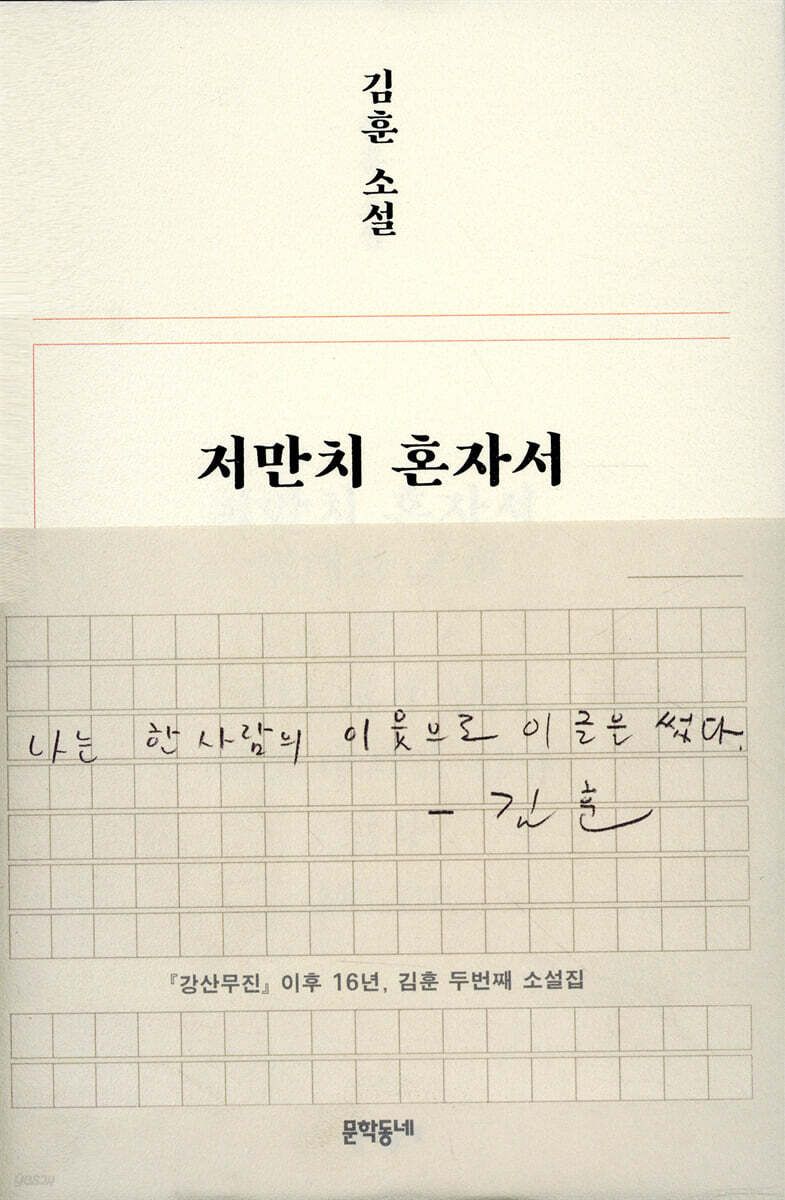
All alone over there
 |
Description
Book Introduction
“I wrote this as a neighbor to one person.” Writing wrapped in life, life wrapped in writing Sixteen years after "Gangsanmujin," Kim Hoon's second novel collection Kim Hoon's novel collection, "Alone Alone," has been published, and he has always written from the perspective of a human facing fate. This is the second collection of short stories, which contains seven short stories written after publishing the first collection of short stories, 『Gangsanmujin』, in 2006. In this way, Kim Hoon's short stories are precious. This is true even though he has continued to show sincere writing and self-renewal since he rose to the ranks of a master by publishing a series of irreplaceable masterpieces of Korean literature, such as 『Song of the Sword』, 『Song of Strings』, and 『Namhansanseong』. Compared to his long stories, his short stories mainly deal with everyday people and events. Does this mean that Kim Hoon takes special pains when writing stories about his close neighbors as novels? Kim Hoon's short story reveals, to a poignant degree, that everyday life is never a trivial event in the history of each individual human being. Kim Hoon's gaze, which used to look at the miserable human affairs with a sense of futility, seems to have become a little more sorrowful as 16 years have passed. Of course, even in "All Alone", human life flows indifferently, regardless of their pain or despair, and time merely destroys their bodies in exchange for teaching them the art of living. Humans are weak and can only watch this miserable process. But in this collection of short stories, Kim Hoon even writes about how such a weak human being surrenders himself to time that cannot be stopped. If you hold on, the difficult past will become a bearable memory, and the lonely process of gradually losing someone to confide in is life itself. Kim Hoon's characters, who accept the fact that humans simply go from the beginning to the end and begin to live again, exude a much more comfortable atmosphere. |
- You can preview some of the book's contents.
Preview
index
Cod and Whale… 007
Hand… 047
Dinner bet long-term… 089
Colonoscopy… 121
Youngja… 147
48GOP … 185
Alone over there… 213
Military horse… 249
Hand… 047
Dinner bet long-term… 089
Colonoscopy… 121
Youngja… 147
48GOP … 185
Alone over there… 213
Military horse… 249
Detailed image

Into the book
For hundreds of millions of years, the sun rose over the horizon every dawn, dimming and splitting the light and darkness, but no trace of time remained on the sea.
The time of the sea did not land.
The sea was always the first, and the waves of new life rippled into the approaching time.
In the morning, the whales' formation spreads the light
I moved towards the setting horizon.
The morning sun glided off the whales' heads as they breached the water, and dustings of light scattered from their tail fins as they plunged and sank.
--- p.9~10 From “Pollack and Whale”
Even in the shoes, I could smell Cheol-ho's feet and the dirt from the ground he walked on.
When I had to call a repairman because the sink drain was clogged, or the air conditioner or refrigerator was broken, or when I had a new washing machine delivered, I was afraid to let a strange man into my house where a woman lived alone, so I took out Cheol-ho's shoes and left them in the hallway to pretend there was a man in the house.
I was using the rapist's shoes as camouflage to protect myself.
--- p.58 From "Hand"
As he read the document bearing the court's seal, Lee Chun-gap felt an empty space, like a mudflat, where all the daily life of his life had vanished.
Lee Chun-gap grew up moving around various small towns and ports along the Gyeongnam coast.
Lee Chun-gap couldn't clearly remember what his father's occupation was, but it seemed like his father was born into this world to serve the punishment of being a rice cooker, and that he had been sentenced to life imprisonment since birth.
--- p.106 From "Evening Bet Janggi"
I could recognize my ex-wife, Wollong-dong, just by looking at her back through the crowd.
It was unclear what features made such identification possible, but my ex-wife, Wollong-dong, was definitely sitting there.
The sight of him sitting there as if the irreversible conflicts and discord of the past years were nothing was both familiar and unfamiliar.
Wolongdong sat among the mourners, as if bearing the weight of that irreversible time.
It was difficult to bear the feeling of being familiar with someone else's back, as if it were engraved in my mind.
--- p.142 From “Colonoscopy”
Lim Ha-sa's squad cleared weeds from the workshop and carried the dug-up dirt on stretchers.
Lim Ha-sa walked between the pits, carrying a stretcher, and examined the bone fragments.
The bones looked loose.
The spring sun shone through the small holes.
The bones seemed to be struggling with the sunlight they had not experienced in fifty years.
--- p.209 From “48GOP”
From spring to early winter, roses bloomed in the convent courtyard, and as they withered, they bloomed even more.
A flower does not bloom on the opposite side of death, so the withering of a flower is not death.
--- p.229 From "All Alone Over There"
Forgiveness does not mean denying the existence of sins already committed, but rather saving the soul from those sins.
It would be a grace that goes beyond words.
Go and forgive the sins of the incomprehensible nun.
I believe that God is on Father Jang's side.
The time of the sea did not land.
The sea was always the first, and the waves of new life rippled into the approaching time.
In the morning, the whales' formation spreads the light
I moved towards the setting horizon.
The morning sun glided off the whales' heads as they breached the water, and dustings of light scattered from their tail fins as they plunged and sank.
--- p.9~10 From “Pollack and Whale”
Even in the shoes, I could smell Cheol-ho's feet and the dirt from the ground he walked on.
When I had to call a repairman because the sink drain was clogged, or the air conditioner or refrigerator was broken, or when I had a new washing machine delivered, I was afraid to let a strange man into my house where a woman lived alone, so I took out Cheol-ho's shoes and left them in the hallway to pretend there was a man in the house.
I was using the rapist's shoes as camouflage to protect myself.
--- p.58 From "Hand"
As he read the document bearing the court's seal, Lee Chun-gap felt an empty space, like a mudflat, where all the daily life of his life had vanished.
Lee Chun-gap grew up moving around various small towns and ports along the Gyeongnam coast.
Lee Chun-gap couldn't clearly remember what his father's occupation was, but it seemed like his father was born into this world to serve the punishment of being a rice cooker, and that he had been sentenced to life imprisonment since birth.
--- p.106 From "Evening Bet Janggi"
I could recognize my ex-wife, Wollong-dong, just by looking at her back through the crowd.
It was unclear what features made such identification possible, but my ex-wife, Wollong-dong, was definitely sitting there.
The sight of him sitting there as if the irreversible conflicts and discord of the past years were nothing was both familiar and unfamiliar.
Wolongdong sat among the mourners, as if bearing the weight of that irreversible time.
It was difficult to bear the feeling of being familiar with someone else's back, as if it were engraved in my mind.
--- p.142 From “Colonoscopy”
Lim Ha-sa's squad cleared weeds from the workshop and carried the dug-up dirt on stretchers.
Lim Ha-sa walked between the pits, carrying a stretcher, and examined the bone fragments.
The bones looked loose.
The spring sun shone through the small holes.
The bones seemed to be struggling with the sunlight they had not experienced in fifty years.
--- p.209 From “48GOP”
From spring to early winter, roses bloomed in the convent courtyard, and as they withered, they bloomed even more.
A flower does not bloom on the opposite side of death, so the withering of a flower is not death.
--- p.229 From "All Alone Over There"
Forgiveness does not mean denying the existence of sins already committed, but rather saving the soul from those sins.
It would be a grace that goes beyond words.
Go and forgive the sins of the incomprehensible nun.
I believe that God is on Father Jang's side.
--- p.245 From "All Alone"
Publisher's Review
Kim Hoon's novel collection, "Alone Over There," has been published, and he has always written from the perspective of a human facing fate.
This is the second collection of short stories, which is a compilation of seven short stories written after publishing the first collection of short stories, 『Gangsanmujin』, in 2006.
In this way, Kim Hoon's short stories are precious.
This is true even though he has continued to show sincere writing and self-renewal since he rose to the ranks of a master by publishing a series of irreplaceable masterpieces of Korean literature, such as 『Song of the Sword』, 『Song of Strings』, and 『Namhansanseong』.
Compared to his long stories, his short stories mainly deal with everyday people and events. Does this mean that Kim Hoon takes special pains when writing stories about his close neighbors as novels?
Kim Hoon's short story reveals, to a poignant degree, that everyday life is never a trivial event in the history of each individual human being.
In publishing her latest work, “The Horse that Runs Beyond the Moon,” which actively utilizes elements of fantasy, the author stated, “I want to spend the rest of my life talking about love and hope, humanity and spirituality, the sorrows and joys of my neighbors, and the expressions of living things.”
"Alone Over There" is a collection of short stories that Kim Hoon sends out to the world with this mindset, as a silent and affectionate neighbor by the reader's side.
The author, after carefully observing the world and everyday life, unfolds the life stories of fragile beings with his characteristically strong prose.
Above all, these short stories, which originated from Kim Hoon's own experiences and research, show how the writer's daily life becomes the basis for his novels and how writing novels becomes his daily life, thereby evoking a sense of emotion about the act of writing literature itself.
As time goes by, things become bearable
Fragile emotions that are becoming increasingly difficult to express
On human existence becoming humble before the flow of time
Kim Hoon, a former journalist who competes for the accuracy of his writing based on facts, has captivated readers with his unique style of touching their hearts with simple, clear sentences that omit emotion since entering the realm of novels that deal with the joys and sorrows of human nature.
Kim Hoon's writing style, which paradoxically reveals the fate of humans who cannot escape the worldly squalor by setting the character's occupation in detail, using specialized terminology related to that occupation, or dryly describing the details of the work, remains a trademark of his.
His sentences, such as those in 『Gangsanmujin』, also coldly and directly portrayed the human existence that becomes nothing more than a finite body in the flow of birth, aging, illness, and death.
However, Kim Hoon's gaze, which had been looking at the miserable human affairs with a vain air, seems to have become a little more affectionate as 16 years have passed.
Of course, even in "All Alone", human life flows indifferently, regardless of their pain or despair, and time merely destroys their bodies in exchange for teaching them the art of living.
Humans are weak and can only watch this miserable process.
But in this collection of short stories, Kim Hoon even writes about how such a weak human being surrenders himself to time that cannot be stopped.
If you hold on, the difficult past will become a bearable memory, and the lonely process of gradually losing someone to confide in is life itself. Kim Hoon's characters, who accept the fact that humans simply go from the beginning to the end and begin to live again, exude a much more comfortable atmosphere.
The title piece, "Alone in the Deep," which most clearly shows this change in Kim Hoon's short stories, depicts the days of elderly nuns who live together in a hospice convent facing death and a young priest who wholeheartedly serves them to guide them to a comfortable death.
Even the clergy feel an instinctive fear of the unknown event of death, agonize over it, and ultimately accept it and find peace, leaving a sorrowful sense of relief.
The situation of having to watch one's body crumble with age is a scene that appears frequently in Kim Hoon's short stories.
"Evening Janggi Bet," conceived by the author while watching a game of Janggi in a park, symbolically reveals the sorrows of old age, where people endure loneliness by playing Janggi with unknown opponents, each with their own tragedies, such as the disintegration of their families and being pushed out of their jobs, through the universal symptom of aging, dry eye.
After retiring from my job and being promoted to an honorary executive position, I postpone worrying about the work I have to do and the tasks I have been asked to do until after my colonoscopy.
Among the things he can stop worrying about if his test results aren't good is a request for greetings from his ex-lover, Na Eun-hee.
Sometimes, we sustain our daily lives by ruminating on the emotions embedded in past memories, but at other times, the lonely aspects of life stand out as we have to sort out those emotions and move on.
"Youngja" is a work that makes us think about how the love story of the past between "I" and Na Eun-hee in "Colonoscopy" is changing in the modern youth generation.
This short story, written by the author while observing civil service exam candidates living in Noryangjin, features a young man who has grown old after realizing the harshness of life too early as the main character, and captures the world in which the more he tries to enter it, the more he ends up being pushed out of it, evoking empathy.
Even though literature cannot save life,
Writing that carefully embraces human tragedy
Kim Hoon has repeatedly said that literature is not something grandiose and that writing cannot fully bear the weight of life.
As such, Kim Hoon handles the pain and despair of the characters in his novels very carefully.
Rather than vividly depicting and revealing pain and despair, the narrative allows us to sense it behind the text, which is the joy of reading Kim Hoon's novels and also the author's consideration for his characters.
Especially in "The Cod and the Whale" and "48GOP," when depicting beings who are fleetingly sacrificed to institutionalized violence, the author substitutes a narrative by contrasting the long history of nature, which has continued since before Christ, with the comparatively brief and insignificant human civilization.
The state violence between the North and South that drives one character to ruin in "The Cod and the Whale" and the ideological conflict that exploits the prime years of youth in "48GOP" since the division of the country for decades while also leaving the remains of the fallen soldiers uncollected due to divisions remain as insignificant traces in the grand flow of nature, further emphasizing the tragedy of such sacrifices.
Kim Hoon's humble attitude when translating life into literature is clearly revealed in the 'Gunmal' included at the end of the collection of short stories.
'Gunmal' is an unusually long 'author's note' and an introduction to the work for Kim Hoon.
In this article, he reveals that he wrote the new short stories not from the position of a writer but from the position of a neighbor, and yet he could not overcome the language of life with the language of literature.
For Kim Hoon, literature has no value beyond that of real life.
But paradoxically, Kim Hoon's writing proves the value of literature by demonstrating achievements that can only be achieved through literature.
This is because the subtlety of thought and expression that Kim Hoon displays can only be fully revealed through writing, not through any other medium.
In an age when the power of writing is being questioned, the existence of author Kim Hoon, who always respects all the miserable lives from a human perspective and consistently writes outstanding novels, is all the more precious.
◆
After reading Firefighter Oh Young-hwan's article, I called him and urged him to describe in more detail and more sensually the feeling he had in his hands at that time, but he only repeated three words: earnest, powerful, and warm.
(…) When I read it again, I realized that my story had some stitches here and there.
Earnest, strong, warm… there is no way to overcome these three words.
Writing cannot fully capture life.
Nevertheless, the human hand remains a precious theme of mine.
I want to write about the hands that work, the hands that love, the hands that caress, the hands that knead, the hands that give, the hands that receive, the hands that call, the hands that send, the hands that pray, the hands that hold tools, the hands that hold instruments, the hands that hold weapons, the hands that are gentle, the hands that are swollen, and the traces and expressions of the hands that remain on the countless handles of this world.
_Kim Hoon, in 'Military Words'
This is the second collection of short stories, which is a compilation of seven short stories written after publishing the first collection of short stories, 『Gangsanmujin』, in 2006.
In this way, Kim Hoon's short stories are precious.
This is true even though he has continued to show sincere writing and self-renewal since he rose to the ranks of a master by publishing a series of irreplaceable masterpieces of Korean literature, such as 『Song of the Sword』, 『Song of Strings』, and 『Namhansanseong』.
Compared to his long stories, his short stories mainly deal with everyday people and events. Does this mean that Kim Hoon takes special pains when writing stories about his close neighbors as novels?
Kim Hoon's short story reveals, to a poignant degree, that everyday life is never a trivial event in the history of each individual human being.
In publishing her latest work, “The Horse that Runs Beyond the Moon,” which actively utilizes elements of fantasy, the author stated, “I want to spend the rest of my life talking about love and hope, humanity and spirituality, the sorrows and joys of my neighbors, and the expressions of living things.”
"Alone Over There" is a collection of short stories that Kim Hoon sends out to the world with this mindset, as a silent and affectionate neighbor by the reader's side.
The author, after carefully observing the world and everyday life, unfolds the life stories of fragile beings with his characteristically strong prose.
Above all, these short stories, which originated from Kim Hoon's own experiences and research, show how the writer's daily life becomes the basis for his novels and how writing novels becomes his daily life, thereby evoking a sense of emotion about the act of writing literature itself.
As time goes by, things become bearable
Fragile emotions that are becoming increasingly difficult to express
On human existence becoming humble before the flow of time
Kim Hoon, a former journalist who competes for the accuracy of his writing based on facts, has captivated readers with his unique style of touching their hearts with simple, clear sentences that omit emotion since entering the realm of novels that deal with the joys and sorrows of human nature.
Kim Hoon's writing style, which paradoxically reveals the fate of humans who cannot escape the worldly squalor by setting the character's occupation in detail, using specialized terminology related to that occupation, or dryly describing the details of the work, remains a trademark of his.
His sentences, such as those in 『Gangsanmujin』, also coldly and directly portrayed the human existence that becomes nothing more than a finite body in the flow of birth, aging, illness, and death.
However, Kim Hoon's gaze, which had been looking at the miserable human affairs with a vain air, seems to have become a little more affectionate as 16 years have passed.
Of course, even in "All Alone", human life flows indifferently, regardless of their pain or despair, and time merely destroys their bodies in exchange for teaching them the art of living.
Humans are weak and can only watch this miserable process.
But in this collection of short stories, Kim Hoon even writes about how such a weak human being surrenders himself to time that cannot be stopped.
If you hold on, the difficult past will become a bearable memory, and the lonely process of gradually losing someone to confide in is life itself. Kim Hoon's characters, who accept the fact that humans simply go from the beginning to the end and begin to live again, exude a much more comfortable atmosphere.
The title piece, "Alone in the Deep," which most clearly shows this change in Kim Hoon's short stories, depicts the days of elderly nuns who live together in a hospice convent facing death and a young priest who wholeheartedly serves them to guide them to a comfortable death.
Even the clergy feel an instinctive fear of the unknown event of death, agonize over it, and ultimately accept it and find peace, leaving a sorrowful sense of relief.
The situation of having to watch one's body crumble with age is a scene that appears frequently in Kim Hoon's short stories.
"Evening Janggi Bet," conceived by the author while watching a game of Janggi in a park, symbolically reveals the sorrows of old age, where people endure loneliness by playing Janggi with unknown opponents, each with their own tragedies, such as the disintegration of their families and being pushed out of their jobs, through the universal symptom of aging, dry eye.
After retiring from my job and being promoted to an honorary executive position, I postpone worrying about the work I have to do and the tasks I have been asked to do until after my colonoscopy.
Among the things he can stop worrying about if his test results aren't good is a request for greetings from his ex-lover, Na Eun-hee.
Sometimes, we sustain our daily lives by ruminating on the emotions embedded in past memories, but at other times, the lonely aspects of life stand out as we have to sort out those emotions and move on.
"Youngja" is a work that makes us think about how the love story of the past between "I" and Na Eun-hee in "Colonoscopy" is changing in the modern youth generation.
This short story, written by the author while observing civil service exam candidates living in Noryangjin, features a young man who has grown old after realizing the harshness of life too early as the main character, and captures the world in which the more he tries to enter it, the more he ends up being pushed out of it, evoking empathy.
Even though literature cannot save life,
Writing that carefully embraces human tragedy
Kim Hoon has repeatedly said that literature is not something grandiose and that writing cannot fully bear the weight of life.
As such, Kim Hoon handles the pain and despair of the characters in his novels very carefully.
Rather than vividly depicting and revealing pain and despair, the narrative allows us to sense it behind the text, which is the joy of reading Kim Hoon's novels and also the author's consideration for his characters.
Especially in "The Cod and the Whale" and "48GOP," when depicting beings who are fleetingly sacrificed to institutionalized violence, the author substitutes a narrative by contrasting the long history of nature, which has continued since before Christ, with the comparatively brief and insignificant human civilization.
The state violence between the North and South that drives one character to ruin in "The Cod and the Whale" and the ideological conflict that exploits the prime years of youth in "48GOP" since the division of the country for decades while also leaving the remains of the fallen soldiers uncollected due to divisions remain as insignificant traces in the grand flow of nature, further emphasizing the tragedy of such sacrifices.
Kim Hoon's humble attitude when translating life into literature is clearly revealed in the 'Gunmal' included at the end of the collection of short stories.
'Gunmal' is an unusually long 'author's note' and an introduction to the work for Kim Hoon.
In this article, he reveals that he wrote the new short stories not from the position of a writer but from the position of a neighbor, and yet he could not overcome the language of life with the language of literature.
For Kim Hoon, literature has no value beyond that of real life.
But paradoxically, Kim Hoon's writing proves the value of literature by demonstrating achievements that can only be achieved through literature.
This is because the subtlety of thought and expression that Kim Hoon displays can only be fully revealed through writing, not through any other medium.
In an age when the power of writing is being questioned, the existence of author Kim Hoon, who always respects all the miserable lives from a human perspective and consistently writes outstanding novels, is all the more precious.
◆
After reading Firefighter Oh Young-hwan's article, I called him and urged him to describe in more detail and more sensually the feeling he had in his hands at that time, but he only repeated three words: earnest, powerful, and warm.
(…) When I read it again, I realized that my story had some stitches here and there.
Earnest, strong, warm… there is no way to overcome these three words.
Writing cannot fully capture life.
Nevertheless, the human hand remains a precious theme of mine.
I want to write about the hands that work, the hands that love, the hands that caress, the hands that knead, the hands that give, the hands that receive, the hands that call, the hands that send, the hands that pray, the hands that hold tools, the hands that hold instruments, the hands that hold weapons, the hands that are gentle, the hands that are swollen, and the traces and expressions of the hands that remain on the countless handles of this world.
_Kim Hoon, in 'Military Words'
GOODS SPECIFICS
- Date of issue: June 2, 2022
- Format: Hardcover book binding method guide
- Page count, weight, size: 264 pages | 368g | 128*188*20mm
- ISBN13: 9788954686921
- ISBN10: 8954686923
You may also like
카테고리
korean


korean

![GQ KOREA Mark (Monthly): December [2025]](http://librairie.coreenne.fr/cdn/shop/files/8ef265dbbfbf186523ed75ba7319009d.jpg?v=1765340328&width=3840)


