

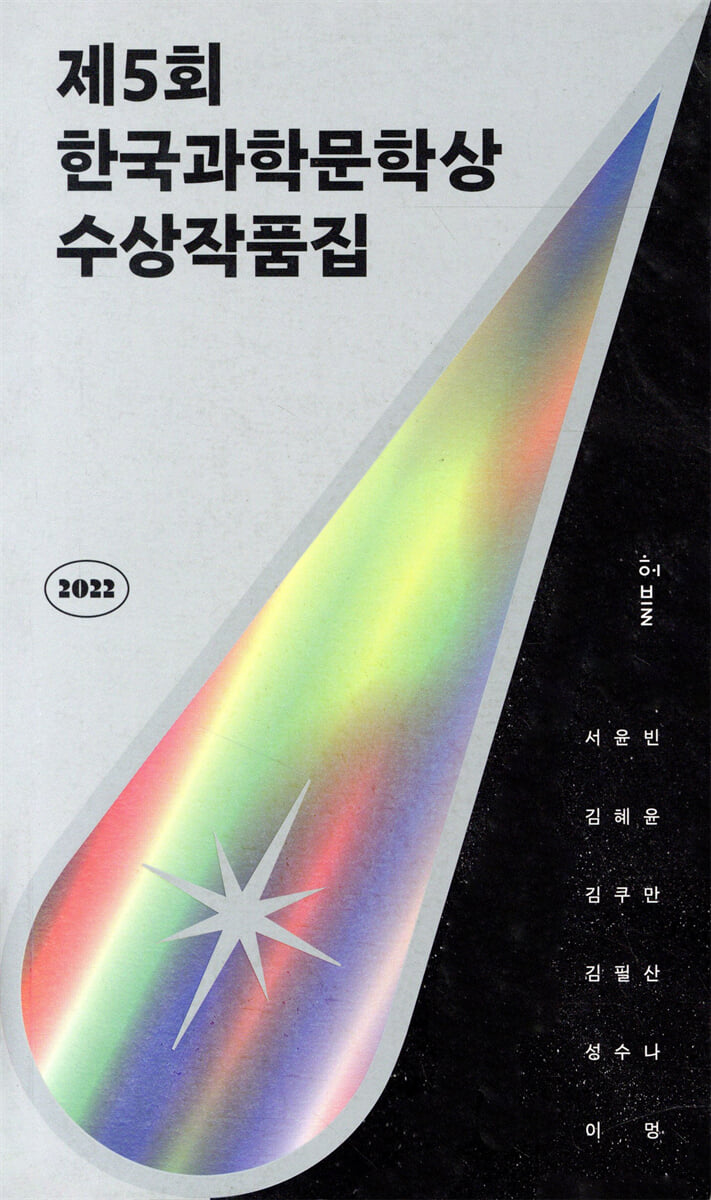
2022 5th Korea Science Literature Award Winners Collection
 |
Description
Book Introduction
- A word from MD
-
Welcome to six shining universes!The Korean Science Literature Award, which announced the birth of Kim Cho-yeop and Cheon Seon-ran, announces another beginning.
The awards have returned with a new look, from the judging panel to the design of the award-winning collection.
Let's take a step forward into the future of Korean science fiction through the shining world contained in six stories, including Seo Yoon-bin's award-winning "Luna."May 24, 2022. Novel/Poetry PD Park Hyung-wook
The Korean Science Literature Award, which announced the birth of “Kim Cho-yeop” and “Cheon Seon-ran,” has returned!
A shining universe of new writers emerging across our nights!
From 2019 to 2022, our last nights were dark and gloomy due to the pandemic.
As a result, the Korea Science Literature Award was also put on hold for a while, but fortunately, the organizer 'Hubble' and partner 'Studio Dragon' came together and resumed the event after two years.
Since the literary award announcement, the response from the science fiction fandom has been truly remarkable.
Thankfully, they showed that they had not forgotten the Korean Science Literature Award through the explosive number of applications.
The number of submissions, which averaged around 250 in previous years, has more than doubled to around 550.
Thanks to your support, Hubble has renewed the Korea Science Literature Award.
We have formed a new judging panel with novelists Kim Bo-young, Kim Seong-jung, and Kim Hee-sun, who are active at the forefront of literature, and critics Kang Ji-hee and In A-young, and we have prepared the works of new writers with new designs and special prices.
All of these renewals were carried out to accompany the author's birth in a slightly wider world.
A shining universe of new writers emerging across our nights!
From 2019 to 2022, our last nights were dark and gloomy due to the pandemic.
As a result, the Korea Science Literature Award was also put on hold for a while, but fortunately, the organizer 'Hubble' and partner 'Studio Dragon' came together and resumed the event after two years.
Since the literary award announcement, the response from the science fiction fandom has been truly remarkable.
Thankfully, they showed that they had not forgotten the Korean Science Literature Award through the explosive number of applications.
The number of submissions, which averaged around 250 in previous years, has more than doubled to around 550.
Thanks to your support, Hubble has renewed the Korea Science Literature Award.
We have formed a new judging panel with novelists Kim Bo-young, Kim Seong-jung, and Kim Hee-sun, who are active at the forefront of literature, and critics Kang Ji-hee and In A-young, and we have prepared the works of new writers with new designs and special prices.
All of these renewals were carried out to accompany the author's birth in a slightly wider world.
- You can preview some of the book's contents.
Preview
index
【Target】 Seo Yoon-bin, "Luna" ·9
Author's Note ·53
[Excellence Award] Kim Hye-yoon, "Interview with the Black Box" ·57
Author's Note ·111
Honorable Mention: Kim Kuman, "Once Upon a Time in Pangyo" ·115
Author's Note ·181
Honorable Mention: Kim Pil-san, "The Man Who Became a Book" ·163
Author's Note ·247
Honorable Mention: Seong Su-na, "God is a Child" ·251
Author's Note ·285
Honorable Mention: Lee Meng, "Slurp, S ...
Author's Note ·345
2022 5th Korea Science Literature Award Review ·349
Author's Note ·53
[Excellence Award] Kim Hye-yoon, "Interview with the Black Box" ·57
Author's Note ·111
Honorable Mention: Kim Kuman, "Once Upon a Time in Pangyo" ·115
Author's Note ·181
Honorable Mention: Kim Pil-san, "The Man Who Became a Book" ·163
Author's Note ·247
Honorable Mention: Seong Su-na, "God is a Child" ·251
Author's Note ·285
Honorable Mention: Lee Meng, "Slurp, S ...
Author's Note ·345
2022 5th Korea Science Literature Award Review ·349
Detailed image

Into the book
“It’s more important to come back than to go forward.”
--- From "Seo Yoon-bin, Luna"
Then the satellite flashed green.
Phosphyllite.
Looking up, I saw a green line of phosphine light stretching like a runway in the direction Io was heading.
--- From "Seo Yoon-bin, Luna"
We had to move to an alley where people like Roti lived to avoid detection, as we didn't want anyone to get caught for having illegal procedures.
The neighborhood was always bleak and quiet, as if holding its breath.
--- From "Kim Hye-yoon, Interview with Black Box"
We are ghosts.
Ellie said with a smile.
As time goes by, we get worn out, but no one sees us.
--- From "Kim Hye-yoon, Interview with Black Box"
Sonic came into the bathroom with a cigarette in his mouth.
It was a Red Apple cigarette.
I'm talking about those cigarettes that are so toxic that only macho men can smoke them without caring at all about the health checkups that tell them they might get some kind of disease.
--- From "Kim Kuman, Once Upon a Time in Pangyo"
Yeonwoo left Jiwoo in front of the toilet and came out alone.
Strangely enough, when Yeonwoo opened the door, someone wearing clothes similar to Yeonwoo entered the room next to her.
As luck would have it, there was a slanted mirror right in front of that stall, so Yeonwoo said it looked like she was going back into the bathroom.
--- From "Kim Kuman, Once Upon a Time in Pangyo"
Reader, ask me anything.
The book will answer.
--- From "Kim Pil-san, the Man Who Became a Book"
“Your Majesty, it will become a book.”
“A book, a book?”
“Yes, that’s right.
I knew from rumors that you were a passionate book collector.
He was called the intellectual of Constantinople.
Then, wouldn’t it not be a bad idea to try becoming a book yourself?”
--- From "Kim Pil-san, the Man Who Became a Book"
Other children are also crying, holding their necks.
I squat down in front of the brown-haired girl and move my lips.
Slowly so that the child can understand.
Neither I, nor you, nor anyone else, has a voice.
are you okay.
At my words, the child points to the dog.
The dog is still barking and wandering around the children.
--- From "Seongsu-na, God has children"
I can't go into the sea.
Because God did not give me the sea.
I'm the only one feeling hungry here.
--- From "Seongsu-na, God has children"
The adult aliens elegantly used their long fingers as forks to slurp down the pasta… no, the noodles… no, the blood vessels of the Earthlings…
--- From "Eomyeong, slurp slurp delicious"
Stir-fried Earthling Blood Vessels was once a favorite dish in Cape Rap.
The chewy texture of the blood vessels and the tangy seasoning combine to create a flavor that no one can resist.
It was the biggest hit of the century.
--- From "Seo Yoon-bin, Luna"
Then the satellite flashed green.
Phosphyllite.
Looking up, I saw a green line of phosphine light stretching like a runway in the direction Io was heading.
--- From "Seo Yoon-bin, Luna"
We had to move to an alley where people like Roti lived to avoid detection, as we didn't want anyone to get caught for having illegal procedures.
The neighborhood was always bleak and quiet, as if holding its breath.
--- From "Kim Hye-yoon, Interview with Black Box"
We are ghosts.
Ellie said with a smile.
As time goes by, we get worn out, but no one sees us.
--- From "Kim Hye-yoon, Interview with Black Box"
Sonic came into the bathroom with a cigarette in his mouth.
It was a Red Apple cigarette.
I'm talking about those cigarettes that are so toxic that only macho men can smoke them without caring at all about the health checkups that tell them they might get some kind of disease.
--- From "Kim Kuman, Once Upon a Time in Pangyo"
Yeonwoo left Jiwoo in front of the toilet and came out alone.
Strangely enough, when Yeonwoo opened the door, someone wearing clothes similar to Yeonwoo entered the room next to her.
As luck would have it, there was a slanted mirror right in front of that stall, so Yeonwoo said it looked like she was going back into the bathroom.
--- From "Kim Kuman, Once Upon a Time in Pangyo"
Reader, ask me anything.
The book will answer.
--- From "Kim Pil-san, the Man Who Became a Book"
“Your Majesty, it will become a book.”
“A book, a book?”
“Yes, that’s right.
I knew from rumors that you were a passionate book collector.
He was called the intellectual of Constantinople.
Then, wouldn’t it not be a bad idea to try becoming a book yourself?”
--- From "Kim Pil-san, the Man Who Became a Book"
Other children are also crying, holding their necks.
I squat down in front of the brown-haired girl and move my lips.
Slowly so that the child can understand.
Neither I, nor you, nor anyone else, has a voice.
are you okay.
At my words, the child points to the dog.
The dog is still barking and wandering around the children.
--- From "Seongsu-na, God has children"
I can't go into the sea.
Because God did not give me the sea.
I'm the only one feeling hungry here.
--- From "Seongsu-na, God has children"
The adult aliens elegantly used their long fingers as forks to slurp down the pasta… no, the noodles… no, the blood vessels of the Earthlings…
--- From "Eomyeong, slurp slurp delicious"
Stir-fried Earthling Blood Vessels was once a favorite dish in Cape Rap.
The chewy texture of the blood vessels and the tangy seasoning combine to create a flavor that no one can resist.
It was the biggest hit of the century.
--- From "Eomyeong, slurp slurp delicious"
Publisher's Review
A sudden renewal of the Korean Science Literature Award, which gave birth to “Kim Cho-yeop” and “Cheon Seon-ran”!?
A shining universe of new writers brightening up the dark nights of the pandemic!?
Stories that build a worldview inevitably begin with questions or answers about the universe, whether ancient mythology or modern science fiction.
Just as the Thousand Character Classic, which contains the worldview of ancient China, begins with the sentence, “The sky is black, the earth is heavy, and the universe is wide and rough,” science fiction also begins by asking questions about the black and vast universe beyond the blue sky.
But, of course, there are no answers in the universe, only empty darkness.
There is only one way to find the answer.
Filling in the blank spaces of the universe with your imagination to create your own new universe.
And now, here are six emerging writers who are creating their own universes with their brilliant imaginations.
These are the winners of the 5th Korea Science Literature Award in the short story and medium story category: Seo Yun-bin, Kim Hye-yoon, Kim Ku-man, Kim Pil-san, Seong Su-na, and Lee Meng.
From 2019 to 2022, our last nights were dark and gloomy due to the pandemic.
As a result, the Korea Science Literature Award was also put on hold for a while, but fortunately, the organizer Hubble and partner Studio Dragon met and resumed the event after two years.
Since the literary award announcement, the response from the science fiction fandom has been truly remarkable.
Thankfully, they showed that they had not forgotten the Korean Science Literature Award through the explosive number of applications.
The number of submissions, which averaged around 250 in previous years, has more than doubled to around 550.
Thanks to your support, Hubble has renewed the Korea Science Literature Award.
We have formed a new judging panel with novelists Kim Bo-young, Kim Seong-jung, and Kim Hee-sun, who are active at the forefront of literature, and critics Kang Ji-hee and In A-young, and we have prepared the works of new writers with new designs and special prices.
All of these renewals were carried out to accompany the author's birth in a slightly wider world.
Just as 21 new writers, including Kim Cho-yeop (2nd Grand Prize Winner of the Short Story and Medium-Length Literature Award) and Cheon Seon-ran (4th Grand Prize Winner of the Long Story and Medium-Length Literature Award), gathered the light of recovery from the darkness of despair and created a universe of solidarity, the winners of the 5th Short Story and Medium-Length Literature Award are also creating a universe of hope with the anxieties and fears we currently experience.
As our current anxieties stem from future events like pandemics, our imagination to transform that anxiety into hope also needs to be more forward-thinking.
We will now introduce six universes that will brighten up the night sky on our dark night last night.
★Target★ Seo Yoon-bin's "Luna"
Jeju Haenyeo, a matriarchal society in space, mine for minerals instead of seafood.
“Comparing ‘space swimming’ to ‘the substance of a haenyeo’,
Beauty that can only come from Korea - Kim Bo-young (novelist)
In the universe of the award-winning work "Luna," Jeju haenyeo (female divers) do 'diving' in space, not the sea.
They form a matriarchal community based in a space base called 'Sammuho', and while floating between satellites, they mine for minerals instead of seafood.
The protagonist of this unique science fiction story, which even judge Kim Bo-young exclaimed, “This is a new story I’ve never seen before,” is a female diver named Luna.
Luna, who was living peacefully with her grandmothers and other young divers of her age, feels a great vibration in her life that she has never felt before because of the space survivor 'Kelvin' whom she rescued.
Luna, who has been wondering who she is and where she came from, and Kelvin, who encourages Luna to go to Earth with her.
Luna, who wants to stay on Sammuho but also wants to go to Earth, cannot bring herself to choose either.
While floating through space with his close friend 'Io', he sees a vision, and strangely enough, it looks like a newborn baby.
And 'Io' disappears, entranced by the illusion.
As judge Kang Ji-hee said, "Luna" is confusing because of the parts that are left out of explanation, but at the same time, it is surprising because those missing parts point precisely to the character's desires.
This work, which simultaneously contains confusion and surprise, is incredibly fantastic and beautiful, like the image of a child floating through space.
★Excellence Award★ Kim Hye-yoon's "Interview with the Black Box"
Young people caring for a family member who lost their body and whose consciousness was transferred to an old machine.
“Through the being whose consciousness has been transferred into the old machine,
Contemporary questions about the near future and the disabled - Kim Seong-jung (novelist)
In the universe of the award-winning work "Interview with a Black Box," if someone loses their body in an accident, they can transfer their consciousness to a machine to prolong their life, but poor patients have no choice but to use old machines like black boxes or radios as their second bodies.
The protagonist of this realistic SF is a poor young man named 'Lana', so much so that judge Kim Seong-jung said, "It stands out for its realism in that class operates (even in mind uploading)."
He has a family to support, and his name is 'Roti'.
Lottie, Lana's foster parent, is involved in a serious accident that leaves her completely crushed.
The only way for such a Roti to survive is to transfer his consciousness to an old machine.
Lotti, who has become a cyborg with a black box in her body, forces Lana into relentless suffering with her significantly reduced empathy and communication skills.
When I see Lana and Lotti like this, I am naturally reminded of the families of dementia patients who are forced into endless caregiving labor.
From this seemingly eternal cycle of suffering, Lana eventually escapes.
Lana started a new life, but always lived with a sense of debt.
Building on the oral history classes he had taken, he began collecting the voices of those living inside the old machines.
As judge Kang Ji-hee said, “Interview with a Black Box” is beautiful because it “does not persuade with a moral tone” and “makes us imagine a new sensual world that can only open up when we break out of the framework of self-defined categories,” and “Interview with a Black Box” does not lose its objective perspective even at the moment when it makes heart-wrenching statements.
The writer's attitude is very trustworthy.
★Honorable Mention★ Kim Kuman's "Once Upon a Time in Pangyo"
A creative AI that recalls the joys and sorrows of Pangyo game developers through the game.
“A realistic depiction of the game development scene and
A novel with outstanding insight into creative AI - Kim Bo-young (novelist)
In the universe of the winning entry, “Once Upon a Time in Pangyo,” the creative AI progresses the game story while reflecting on the lives of those who developed it, and the game that the AI progresses is structured, to borrow the expression of judge Kim Seong-jung, “like putting two pairs of socks together and turning them inside out to make one sock, or unwrapping one sock to make two pairs of socks, the inside becomes the outside and the outside becomes the inside.”
The protagonists of this science fiction novel, which is so well-researched that judge Kim Bo-young said, “The depiction of the game development scene is outstanding, and the insight into creative AI is also outstanding,” are all the characters that appear in the work, but if I had to pick one, it would be ‘Ji-woo,’ a game developer from Pangyo.
Jiwoo, a young man who worked at a company that developed a storytelling AI and prepared a 100 billion won video game, ended up going bankrupt without completing anything. He ended up suffering in vain.
This work is a story about him getting entangled with 'Yeon-woo', who is a little younger than him but much more boldly quits the company, 'Sonic', a bartender with a blue-collar job, and 'Team Leader', a veteran old fart who is suddenly assigned a large-scale project worth 100 billion won without much success.
It's a story of a happy yet bittersweet time, now a distant memory, of going to work every day and developing a game.
As judge Ina Young said, “It was so fun and natural that it read smoothly, as if the author had just sat down and written it all in one sitting,” “Once Upon a Time in Pangyo” allows you to enjoy the flow and energy of the story itself without any burden, as if you were floating on water wearing an inner tube.
It is a skill that will make you stick out your tongue.
★Honorable Mention★ Kim Pil-san's "The Man Who Became a Book"
The man whose brain was sliced into pieces and placed inside a book, and the book hunter who stole him.
“The topics of ‘mind uploading’ and ‘immortality’
"Hard SF that pushes the Eastern Roman era to the limit" _ Kim Hee-sun (novelist)
The universe of the award-winning novel "The Man Who Became a Book" is set in the Eastern Roman era, where an alchemist named Al Rasir invented a technique to transfer consciousness onto paper by slicing the brain into very thin slices, passing electricity through them, measuring the current, and transferring it onto paper.
The main characters of this science fiction novel, which judge Kim Hee-sun praised as “a brilliant work that deals with the modern scientific topics of mind uploading and immortality against the backdrop of the past,” are a book hunter named Leo and Komnimos, a wealthy man and translator famous throughout Eastern Rome who was kidnapped by Al-Rasir and forced to become a book.
Leo, who values the value of ancient books, steals books that are at high risk of being damaged or creates manuscripts. As a professional 'book hunter', there was a book that caught Leo's radar: 『The Book of Death and Wisdom I』 by Al Rasir.
The last sentence of this book, which is 99 percent filled with seemingly meaningless Arabic numerals, reads:
Ask me anything.
'The book will answer.' Leo, after studying the book he had copied for a long time, calculates the numbers and asks the book.
'What is your name?' And the book answers.
"My name is Komnimos." Thus begins a long conversation between a man trapped in a book and a book hunter, using numbers as a medium.
As judge Kim Bo-young said, “It’s an idea that’s hard to find in modern Korea, at least, and as a SF fan, I was happy to discover a work that went this far,” “The Man Who Became a Book” novelly weaves together ancient alchemy and modern mind uploading, which at first glance seem to have nothing in common, and then pushes it forward as hard SF without mercy.
It's also fun, like 『A Thousand and One Nights』.
It's truly overwhelming.
★Honorable Mention★ Seongsu Na's "God Has Children"
A caretaker who looks after children alone in an afterlife where only animals have voices
“In the afterlife where children decide reincarnation,
“The ecstasy of experiencing the presence of inconsolable sorrow” – Kang Ji-hee (critic)
In the universe of the masterpiece "God Has Children," dead children go to an island called "Pian," an afterlife where they can choose whether to be reincarnated or disappear, and on Pian, one animal and one human are waiting.
Pian is a world of silence where only animals can speak, a world of solitude where countless children pass by but in the end only the manager remains.
As judge Kang Ji-hee said, “Humans who repeat strange behaviors or slip from desires with bizarre actions unsettle us, (…) and it becomes a good narrative when it shows a leap of will or an explosion in those seemingly meaningless actions, (…) and it is the most excellent in that respect,” the protagonist of this science fiction that drives us emotionally crazy is ‘I’, the manager of Pian who lives with a dog.
My situation, to borrow the words of judge Kim Seong-jung, is “like a game NPC.”
They are trapped in an endless loop of having to welcome and send off children who can be considered as a kind of 'game player'.
Moreover, every time he sends his children away, most of his memories are lost, so his attempts to contemplate his own existence and origins always fail.
In this helpless world, 'I' think about God's providence.
I doubt God.
And then you encounter a love that is so unfamiliar.
As judge Ina Young said, “This work is so complete that it can be read as poetic, with its natural flow of dialogue and narration,” “God’s Children” is extremely poetic and beautiful in that it establishes a world order that reflects specific emotions and sensibilities and then describes that world in a rhythmic style as if singing.
It is truly a comforting beauty.
★Honorable Mention★ Lee Meng's "Slurp, Slurp, Delicious"
A man and woman in a romantic relationship are captured by aliens during a clinical trial and are in danger of being turned into food.
“A soft and cute love story with aliens slaughtering humans.
“A sharp question to humanity that connects us.” _ Inayoung (critic)
In the universe of the masterpiece "Slurp, slurp, delicious", there exist aliens called "Rap-Gotians" who have a taste for the blood vessels of Earthlings. They capture Earthlings and "very actively" raise and slaughter them, enjoying their flesh.
However, this golden age was short-lived, as breeding and slaughtering were banned for various reasons, and the Rab-Got people began to purchase the blood vessels of Earthlings with money.
As judge Ina Young said, “This can be read as a question that sharply reveals the ecological conditions under which the human species survives on Earth today,” and the protagonist of this science fiction black comedy, which is full of mockery, twists, and humor about meat-eating, is ‘Yang-hee,’ a participant in a clinical trial planned by aliens.
Yanghee, who has a family history of cardiovascular disease, participates in a test for a drug related to arteriosclerosis and blood clot removal, and eats a lot of food prepared by aliens that is not good for the health of blood vessels but tastes really good, and even meets a pretty nice-looking guy from her hometown.
After happily completing the 2 nights and 3 days of testing, they were about to return home when the aliens suddenly revealed their identities and knocked the two out.
When I came to, I saw Yanghee sitting in front of the TV.
An announcement is made to watch quietly, and the aliens on the screen explain their situation.
As judge Kang Ji-hee said, “It is unique and special because it exposes the limitations of humans who often fall into deception while exploiting other species, while giving a cognitive shock and maintaining a cheerful tone throughout without resorting to a logic of tragic accusation.” As judge Kang Ji-hee said, “Slurp, slurp, delicious” is fundamentally very fun and cheerful, but it is impossible to look away when it exposes our shame.
It's a truly destructive immersion.
A shining universe of new writers brightening up the dark nights of the pandemic!?
Stories that build a worldview inevitably begin with questions or answers about the universe, whether ancient mythology or modern science fiction.
Just as the Thousand Character Classic, which contains the worldview of ancient China, begins with the sentence, “The sky is black, the earth is heavy, and the universe is wide and rough,” science fiction also begins by asking questions about the black and vast universe beyond the blue sky.
But, of course, there are no answers in the universe, only empty darkness.
There is only one way to find the answer.
Filling in the blank spaces of the universe with your imagination to create your own new universe.
And now, here are six emerging writers who are creating their own universes with their brilliant imaginations.
These are the winners of the 5th Korea Science Literature Award in the short story and medium story category: Seo Yun-bin, Kim Hye-yoon, Kim Ku-man, Kim Pil-san, Seong Su-na, and Lee Meng.
From 2019 to 2022, our last nights were dark and gloomy due to the pandemic.
As a result, the Korea Science Literature Award was also put on hold for a while, but fortunately, the organizer Hubble and partner Studio Dragon met and resumed the event after two years.
Since the literary award announcement, the response from the science fiction fandom has been truly remarkable.
Thankfully, they showed that they had not forgotten the Korean Science Literature Award through the explosive number of applications.
The number of submissions, which averaged around 250 in previous years, has more than doubled to around 550.
Thanks to your support, Hubble has renewed the Korea Science Literature Award.
We have formed a new judging panel with novelists Kim Bo-young, Kim Seong-jung, and Kim Hee-sun, who are active at the forefront of literature, and critics Kang Ji-hee and In A-young, and we have prepared the works of new writers with new designs and special prices.
All of these renewals were carried out to accompany the author's birth in a slightly wider world.
Just as 21 new writers, including Kim Cho-yeop (2nd Grand Prize Winner of the Short Story and Medium-Length Literature Award) and Cheon Seon-ran (4th Grand Prize Winner of the Long Story and Medium-Length Literature Award), gathered the light of recovery from the darkness of despair and created a universe of solidarity, the winners of the 5th Short Story and Medium-Length Literature Award are also creating a universe of hope with the anxieties and fears we currently experience.
As our current anxieties stem from future events like pandemics, our imagination to transform that anxiety into hope also needs to be more forward-thinking.
We will now introduce six universes that will brighten up the night sky on our dark night last night.
★Target★ Seo Yoon-bin's "Luna"
Jeju Haenyeo, a matriarchal society in space, mine for minerals instead of seafood.
“Comparing ‘space swimming’ to ‘the substance of a haenyeo’,
Beauty that can only come from Korea - Kim Bo-young (novelist)
In the universe of the award-winning work "Luna," Jeju haenyeo (female divers) do 'diving' in space, not the sea.
They form a matriarchal community based in a space base called 'Sammuho', and while floating between satellites, they mine for minerals instead of seafood.
The protagonist of this unique science fiction story, which even judge Kim Bo-young exclaimed, “This is a new story I’ve never seen before,” is a female diver named Luna.
Luna, who was living peacefully with her grandmothers and other young divers of her age, feels a great vibration in her life that she has never felt before because of the space survivor 'Kelvin' whom she rescued.
Luna, who has been wondering who she is and where she came from, and Kelvin, who encourages Luna to go to Earth with her.
Luna, who wants to stay on Sammuho but also wants to go to Earth, cannot bring herself to choose either.
While floating through space with his close friend 'Io', he sees a vision, and strangely enough, it looks like a newborn baby.
And 'Io' disappears, entranced by the illusion.
As judge Kang Ji-hee said, "Luna" is confusing because of the parts that are left out of explanation, but at the same time, it is surprising because those missing parts point precisely to the character's desires.
This work, which simultaneously contains confusion and surprise, is incredibly fantastic and beautiful, like the image of a child floating through space.
★Excellence Award★ Kim Hye-yoon's "Interview with the Black Box"
Young people caring for a family member who lost their body and whose consciousness was transferred to an old machine.
“Through the being whose consciousness has been transferred into the old machine,
Contemporary questions about the near future and the disabled - Kim Seong-jung (novelist)
In the universe of the award-winning work "Interview with a Black Box," if someone loses their body in an accident, they can transfer their consciousness to a machine to prolong their life, but poor patients have no choice but to use old machines like black boxes or radios as their second bodies.
The protagonist of this realistic SF is a poor young man named 'Lana', so much so that judge Kim Seong-jung said, "It stands out for its realism in that class operates (even in mind uploading)."
He has a family to support, and his name is 'Roti'.
Lottie, Lana's foster parent, is involved in a serious accident that leaves her completely crushed.
The only way for such a Roti to survive is to transfer his consciousness to an old machine.
Lotti, who has become a cyborg with a black box in her body, forces Lana into relentless suffering with her significantly reduced empathy and communication skills.
When I see Lana and Lotti like this, I am naturally reminded of the families of dementia patients who are forced into endless caregiving labor.
From this seemingly eternal cycle of suffering, Lana eventually escapes.
Lana started a new life, but always lived with a sense of debt.
Building on the oral history classes he had taken, he began collecting the voices of those living inside the old machines.
As judge Kang Ji-hee said, “Interview with a Black Box” is beautiful because it “does not persuade with a moral tone” and “makes us imagine a new sensual world that can only open up when we break out of the framework of self-defined categories,” and “Interview with a Black Box” does not lose its objective perspective even at the moment when it makes heart-wrenching statements.
The writer's attitude is very trustworthy.
★Honorable Mention★ Kim Kuman's "Once Upon a Time in Pangyo"
A creative AI that recalls the joys and sorrows of Pangyo game developers through the game.
“A realistic depiction of the game development scene and
A novel with outstanding insight into creative AI - Kim Bo-young (novelist)
In the universe of the winning entry, “Once Upon a Time in Pangyo,” the creative AI progresses the game story while reflecting on the lives of those who developed it, and the game that the AI progresses is structured, to borrow the expression of judge Kim Seong-jung, “like putting two pairs of socks together and turning them inside out to make one sock, or unwrapping one sock to make two pairs of socks, the inside becomes the outside and the outside becomes the inside.”
The protagonists of this science fiction novel, which is so well-researched that judge Kim Bo-young said, “The depiction of the game development scene is outstanding, and the insight into creative AI is also outstanding,” are all the characters that appear in the work, but if I had to pick one, it would be ‘Ji-woo,’ a game developer from Pangyo.
Jiwoo, a young man who worked at a company that developed a storytelling AI and prepared a 100 billion won video game, ended up going bankrupt without completing anything. He ended up suffering in vain.
This work is a story about him getting entangled with 'Yeon-woo', who is a little younger than him but much more boldly quits the company, 'Sonic', a bartender with a blue-collar job, and 'Team Leader', a veteran old fart who is suddenly assigned a large-scale project worth 100 billion won without much success.
It's a story of a happy yet bittersweet time, now a distant memory, of going to work every day and developing a game.
As judge Ina Young said, “It was so fun and natural that it read smoothly, as if the author had just sat down and written it all in one sitting,” “Once Upon a Time in Pangyo” allows you to enjoy the flow and energy of the story itself without any burden, as if you were floating on water wearing an inner tube.
It is a skill that will make you stick out your tongue.
★Honorable Mention★ Kim Pil-san's "The Man Who Became a Book"
The man whose brain was sliced into pieces and placed inside a book, and the book hunter who stole him.
“The topics of ‘mind uploading’ and ‘immortality’
"Hard SF that pushes the Eastern Roman era to the limit" _ Kim Hee-sun (novelist)
The universe of the award-winning novel "The Man Who Became a Book" is set in the Eastern Roman era, where an alchemist named Al Rasir invented a technique to transfer consciousness onto paper by slicing the brain into very thin slices, passing electricity through them, measuring the current, and transferring it onto paper.
The main characters of this science fiction novel, which judge Kim Hee-sun praised as “a brilliant work that deals with the modern scientific topics of mind uploading and immortality against the backdrop of the past,” are a book hunter named Leo and Komnimos, a wealthy man and translator famous throughout Eastern Rome who was kidnapped by Al-Rasir and forced to become a book.
Leo, who values the value of ancient books, steals books that are at high risk of being damaged or creates manuscripts. As a professional 'book hunter', there was a book that caught Leo's radar: 『The Book of Death and Wisdom I』 by Al Rasir.
The last sentence of this book, which is 99 percent filled with seemingly meaningless Arabic numerals, reads:
Ask me anything.
'The book will answer.' Leo, after studying the book he had copied for a long time, calculates the numbers and asks the book.
'What is your name?' And the book answers.
"My name is Komnimos." Thus begins a long conversation between a man trapped in a book and a book hunter, using numbers as a medium.
As judge Kim Bo-young said, “It’s an idea that’s hard to find in modern Korea, at least, and as a SF fan, I was happy to discover a work that went this far,” “The Man Who Became a Book” novelly weaves together ancient alchemy and modern mind uploading, which at first glance seem to have nothing in common, and then pushes it forward as hard SF without mercy.
It's also fun, like 『A Thousand and One Nights』.
It's truly overwhelming.
★Honorable Mention★ Seongsu Na's "God Has Children"
A caretaker who looks after children alone in an afterlife where only animals have voices
“In the afterlife where children decide reincarnation,
“The ecstasy of experiencing the presence of inconsolable sorrow” – Kang Ji-hee (critic)
In the universe of the masterpiece "God Has Children," dead children go to an island called "Pian," an afterlife where they can choose whether to be reincarnated or disappear, and on Pian, one animal and one human are waiting.
Pian is a world of silence where only animals can speak, a world of solitude where countless children pass by but in the end only the manager remains.
As judge Kang Ji-hee said, “Humans who repeat strange behaviors or slip from desires with bizarre actions unsettle us, (…) and it becomes a good narrative when it shows a leap of will or an explosion in those seemingly meaningless actions, (…) and it is the most excellent in that respect,” the protagonist of this science fiction that drives us emotionally crazy is ‘I’, the manager of Pian who lives with a dog.
My situation, to borrow the words of judge Kim Seong-jung, is “like a game NPC.”
They are trapped in an endless loop of having to welcome and send off children who can be considered as a kind of 'game player'.
Moreover, every time he sends his children away, most of his memories are lost, so his attempts to contemplate his own existence and origins always fail.
In this helpless world, 'I' think about God's providence.
I doubt God.
And then you encounter a love that is so unfamiliar.
As judge Ina Young said, “This work is so complete that it can be read as poetic, with its natural flow of dialogue and narration,” “God’s Children” is extremely poetic and beautiful in that it establishes a world order that reflects specific emotions and sensibilities and then describes that world in a rhythmic style as if singing.
It is truly a comforting beauty.
★Honorable Mention★ Lee Meng's "Slurp, Slurp, Delicious"
A man and woman in a romantic relationship are captured by aliens during a clinical trial and are in danger of being turned into food.
“A soft and cute love story with aliens slaughtering humans.
“A sharp question to humanity that connects us.” _ Inayoung (critic)
In the universe of the masterpiece "Slurp, slurp, delicious", there exist aliens called "Rap-Gotians" who have a taste for the blood vessels of Earthlings. They capture Earthlings and "very actively" raise and slaughter them, enjoying their flesh.
However, this golden age was short-lived, as breeding and slaughtering were banned for various reasons, and the Rab-Got people began to purchase the blood vessels of Earthlings with money.
As judge Ina Young said, “This can be read as a question that sharply reveals the ecological conditions under which the human species survives on Earth today,” and the protagonist of this science fiction black comedy, which is full of mockery, twists, and humor about meat-eating, is ‘Yang-hee,’ a participant in a clinical trial planned by aliens.
Yanghee, who has a family history of cardiovascular disease, participates in a test for a drug related to arteriosclerosis and blood clot removal, and eats a lot of food prepared by aliens that is not good for the health of blood vessels but tastes really good, and even meets a pretty nice-looking guy from her hometown.
After happily completing the 2 nights and 3 days of testing, they were about to return home when the aliens suddenly revealed their identities and knocked the two out.
When I came to, I saw Yanghee sitting in front of the TV.
An announcement is made to watch quietly, and the aliens on the screen explain their situation.
As judge Kang Ji-hee said, “It is unique and special because it exposes the limitations of humans who often fall into deception while exploiting other species, while giving a cognitive shock and maintaining a cheerful tone throughout without resorting to a logic of tragic accusation.” As judge Kang Ji-hee said, “Slurp, slurp, delicious” is fundamentally very fun and cheerful, but it is impossible to look away when it exposes our shame.
It's a truly destructive immersion.
GOODS SPECIFICS
- Date of issue: May 24, 2022
- Page count, weight, size: 400 pages | 454g | 125*210*18mm
- ISBN13: 9791190090643
- ISBN10: 1190090643
You may also like
카테고리
korean


korean

![GQ KOREA Mark (Monthly): December [2025]](http://librairie.coreenne.fr/cdn/shop/files/8ef265dbbfbf186523ed75ba7319009d.jpg?v=1765340328&width=3840)


