

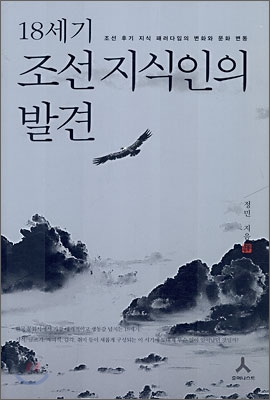
The discovery of 18th-century Joseon intellectuals
 |
Description
Book Introduction
《Discovery of 18th Century Joseon Intellectuals》 deals with the changes in the knowledge paradigm and cultural changes in the 18th century.
This work, which organizes the 18th century, a century in which knowledge, self, writing, senses, and tastes were newly formed, from an academic and cultural perspective, can be said to be a cultural history of the 18th century written by Professor Jeong Min, who is broadening the scope of his writing and thinking beyond literature to encompass cultural history in general.
This work, which organizes the 18th century, a century in which knowledge, self, writing, senses, and tastes were newly formed, from an academic and cultural perspective, can be said to be a cultural history of the 18th century written by Professor Jeong Min, who is broadening the scope of his writing and thinking beyond literature to encompass cultural history in general.
- You can preview some of the book's contents.
Preview
index
Introduction
The Mad Fools of the 18th Century
Part 1: Self-consciousness and worldview of 18th-century Joseon intellectuals
1.
Cultural Openness in the 18th Century and the Response of Joseon Intellectuals to Globalization
2.
The tendency of 18th-century Joseon intellectuals to criticize the "wall" and "chi"
3.
The transformation of self-consciousness and its direction among 18th-century Joseon intellectuals
4.
The perception of interpretation and its path among literati intellectuals in the 18th and 19th centuries
Part 2: Intellectual Trends of 18th-Century Joseon Intellectuals
1.
New trends in 18th-century Sansuyugi
2.
Gardening hobby of the literati intellectual class in the 18th and 19th centuries
3.
The complete hobbies and intellectual tendencies of 18th-century intellectuals
4.
18th century horticultural culture and Yubak
5.
The cultural and historical value of the tea written by Lee Deok-ri
Part 3: The Self-Consciousness and Inner Thoughts of 18th-Century Joseon Intellectuals
1.
Ian Jin's written materials and their meaning in
2.
The poetic world of 18th-century poetry and everyday life
3.
Lee Yong-hyu's Biography in the Context of 18th-Century Theory of Friendship
Americas
Search (person name)
Search (title and keywords)
The Mad Fools of the 18th Century
Part 1: Self-consciousness and worldview of 18th-century Joseon intellectuals
1.
Cultural Openness in the 18th Century and the Response of Joseon Intellectuals to Globalization
2.
The tendency of 18th-century Joseon intellectuals to criticize the "wall" and "chi"
3.
The transformation of self-consciousness and its direction among 18th-century Joseon intellectuals
4.
The perception of interpretation and its path among literati intellectuals in the 18th and 19th centuries
Part 2: Intellectual Trends of 18th-Century Joseon Intellectuals
1.
New trends in 18th-century Sansuyugi
2.
Gardening hobby of the literati intellectual class in the 18th and 19th centuries
3.
The complete hobbies and intellectual tendencies of 18th-century intellectuals
4.
18th century horticultural culture and Yubak
5.
The cultural and historical value of the tea written by Lee Deok-ri
Part 3: The Self-Consciousness and Inner Thoughts of 18th-Century Joseon Intellectuals
1.
Ian Jin's written materials and their meaning in
2.
The poetic world of 18th-century poetry and everyday life
3.
Lee Yong-hyu's Biography in the Context of 18th-Century Theory of Friendship
Americas
Search (person name)
Search (title and keywords)
Publisher's Review
The Power of Knowledge Transformed Joseon Society
The 18th century was an era of discovery of 'new knowledge'.
It was informatization that brought about change.
In a tightly closed Confucian society, Western scientific civilization, which arrived through China, stirred up the young intellectuals of Joseon.
The way we process information and the basis for judging its usefulness have changed.
Changes in the material foundation also played a role.
In short, you have the financial power to spend money on things you like.
This gave rise to the emergence of eccentric intellectuals never seen before.
Who are they? What drove them crazy? By examining them, we can understand the changes taking place in our society today.
In the 18th century, the praise for 'addictions' suddenly began to pour out.
It's a kind of maniac praise.
The word 'wall', meaning to be crazy about something, encapsulates one trend of intellectuals during this period.
Park Je-ga openly said, “A person without walls is a useless person.”
There is also a tendency to call oneself a 'fool', that is, a fool or an idiot.
What was considered abnormally crazy by conventional standards was perceived as a 'chi' by social convention.
The fact that there are many names or nicknames that include the character ‘치’, such as ‘설불(雪癡),’ ‘치재(癡齋),’ ‘마케팅(梅癡),’ ‘간서치(看書癡),’ and ‘석치(石癡),’ is a reflection of this.
They considered it an honor to be called crazy or stupid.
I thought that living without being cursed at and not being able to go crazy was worse than dying.
At this point, the energy of modernity bursts forth.
The pattern of knowledge has changed, and the perception of information has changed.
Life goals also had to change course.
His maniacal organizing instinct, his indiscriminate collecting instinct, and his love of even the smallest objects were met with enthusiastic support under the comradely solidarity.
The ideal of a gentlemanly life that realizes the way of the sage was gradually buried by the voices of the market.
The cultural gap between Seoul and the provinces is widening significantly day by day.
The impact was so great that King Jeongjo had no choice but to draw the sword of Munchebanjeong (literary reform).
To local intellectuals, this trend in Seoul's cultural scene was seen as nothing more than a bizarre sign of national ruin.
― From pages 13-14 of the text, “Mad Fools of the 18th Century”
The self-consciousness and worldview of Joseon intellectuals
― The nature and transformation of self-consciousness, friendship
From the mid-18th century onwards, urban culture began to develop, centered around the Seoul area, and with it, notable changes in lifestyle patterns.
Changes in the external environment surrounding an individual bring about a change in self-consciousness through conflict with the contradictions of the system.
What are the specific directions of the transformation of self-consciousness since the 18th century and what does it mean?
Meanwhile, the author has continued to explore the new intellectual trends and changing cultural environment of 18th-century intellectuals.
Changes in the cultural environment shape new values, and the axes of change that strongly dominated the consciousness of intellectuals during this period appear in three major directions.
First, the value orientation of pursuing the ‘Tao’ changes to pursuing the ‘truth.’
Second, the value orientation that was oriented towards the ‘old days’ has shifted towards the ‘present.’
The regressive view of history that believed that the ideal values to be pursued were in the past has now lost its power.
Third, interest in ‘there’ has changed to interest in ‘here’.
In other words, the thinking that was centered on China is transformed into thinking centered on Joseon.
These changes may seem minor on the surface, but their significance is significant.
While people's consciousness changed rapidly, the system not only did not change at all, but rather became more conservative.
The system could not afford to embrace the transformed consciousness, and intellectuals were frustrated by the oppression of the system that could not embrace change.
The change in self-consciousness detected among intellectuals during this period is the result of this conflict.
This expansion of self-consciousness is closely related to the 'Joseon style' and 'Joseon poetry' that were popular during this period.
To put it simply, the core of this argument is that we are not Chinese, we are Korean.
We are not people of the past, we are people of today.
But why do modern-day Koreans only imitate the ancient Chinese? Let's abandon this parroting and clowning, and instead create literature that exudes the distinct flavor of the Korean people.
Jeong Yak-yong publicly declared, “I am a Joseon person, so I will enjoy writing Joseon poetry (我是朝鮮人, 甘作朝鮮詩).”
Park Ji-won also said that if someone who reads my poetry cannot see the unique scent and customs of the Korean people in it, then such poetry is useless.
The pursuit of discarding the fake self and finding the true self led writers of this period to turn their eyes to the reality of the 'here and now.'
… … However, they were still a minority, and the violent oppression of the privileged class still exerted a strong influence.
This is why the issue of friendship is particularly emphasized in the discourse of intellectuals during this period.
― From pages 131-132 of the text, “Transformation of the Self-Consciousness of 18th Century Joseon Intellectuals and Its Direction”
Intellectual trends of 18th-century Joseon intellectuals
― Cornelian cherry blossoms, complete hobbies, and gardening
The 18th and 19th centuries were a period of remarkable change in Korean cultural history.
The intellectual community, divided by political strife, strengthened internal solidarity and cultural exchange, and the changes in the overall atmosphere, such as the import of Qing Dynasty artifacts and the spread of publishing culture against the backdrop of the vibrant urban culture of the time, brought about great changes in the lifestyle patterns, especially among the Gyeonghwa literati.
Cultural activities in the form of entertainment and consumption became active, and hobbies such as collecting antiques, calligraphy, and paintings and gardening, which were previously considered taboo and considered to be a luxury for the literati, were actively enjoyed.
The intellectual trends and various cultural phenomena that emerged among the literati class during this period, which pursued art in daily life, not only encouraged hobbies for books and antique paintings and calligraphy, but also amplified interest in horticulture, which involved decorating gardens and planting various exotic flowers and trees.
If you look at the garden records and gardening-related references included in various anthologies, you can see how widespread this atmosphere was during this period.
New intellectual trends within the 18th-century intellectual community are detected in various directions.
We have previously examined the emergence of a new type of intellectual group represented by 'wall' and 'chi'.
This paper, in connection with this article, will turn its direction and examine the objects they enjoyed and the unique intellectual tendencies confirmed through them.
Among the recently discovered materials is the “Balhapgyeong (??經)” which contains information on raising pigeons for entertainment.
Lee Seo-gu's "Green Parrot Sutra" (綠鸚鵡經), which is related to parrots, had only been passed down through Park Ji-won's preface, but some of the data has been confirmed this time.
The practice of raising pigeons and parrots and compiling records about them into a single booklet is particularly interesting not only because it shows traces of these two books but also of a peculiar intellectual climate that was popular at the time.
… … Based on these two newly confirmed sources, we will examine the new intellectual trends that were prevalent at the time and examine their significance.
The change in which an interest that would have been considered taboo in the past as “playing with things and losing one’s will” is now understood as a process of studying things and learning, reflects to some extent the changes in the material foundation and worldview of Joseon society in the 18th and 19th centuries.
― From pages 221-222 of the text, “The Perfect Hobbies and Intellectual Tendencies of 18th Century Joseon Intellectuals”
Discovering and introducing new materials
― 《Hwaamsurok》, 《Dongdagi》, 《Dongsa Yeodam》, etc.
This book also includes the discovery and introduction of new materials.
We confirm that the author of “Hwaamsurok (花庵髓錄),” a masterpiece in the history of Korean horticultural culture, is Yu Bak, and introduce its value as a source material.
In addition, the full text of 《Dongdagi (東茶記)》 (《Gida (記茶)》, of which only a portion of the content was known, was discovered, and for the first time, the content and authorship were revealed to be Lee Deok-ri (李德履).
Dongdagi is a valuable resource that should rewrite the history of tea culture.
Lastly, we are introducing for the first time the materials related to Ian Jin, which are included in the Japanese record “Dongsa Yeodam (東?餘談).”
We spoke with Lee Deok-ri, the author of "Dongdagi," about the contents of the book.
Now, I will conclude this article by briefly summarizing the historical value of this material in tea culture.
First, it is the first specialized book on tea culture in our country.
At that time, Joseon people did not know how to drink tea at all.
Although some aristocrats, such as Kim Gwang-su of Sanggodang, drank tea imported from China, ordinary people did not even know what the tea trees were used for, even though they saw them growing all over the place near their living spaces.
I only knew how to use it for medicinal purposes.
《Dongdagi》 systematically organized the various names of tea, how to drink it, and various effects.
Second, he advocated for national wealth creation through the national monopoly of tea and international trade.
He saw through the commercial value of tea, a luxury good, in the international trade market and argued that tea should be managed and monopolized at the national level and the profits should be used to strengthen national defense, and he even presented specific implementation methods and steps.
The method is very realistic and feasible.
Third, it contains vivid information that allows us to understand the events and surrounding circumstances surrounding the tea of the time.
For example, there is an interesting description of the situation at the time, including the story of a tea trading ship drifting in the South Sea in 1760 and the whole Joseon Dynasty drinking tea for 10 years, as well as the situation of intellectuals at the time bringing Chinese tea and drinking it.
In the section “Discussion on Trade with Jiangnan and Zhejiang Merchants” in Bak Je-ga’s “Bukhakui (Northern Learning Discussion),” it is written, “I once saw a ship carrying yellow tea drift and anchored in the South Sea.
There is a passage that says, “The whole country used that yellow tea for about 10 years, and it still remains today.”
It is exactly the same as the record in this book.
Through this, we can learn more vividly about the reality of tea culture and the surrounding circumstances in Joseon at that time.
Fourth, we presented how to make and drink tea in our own way.
By introducing the differences between rice cake tea and incense tea, the excellence of Korean tea, its medicinal properties, and various anecdotes related to tea, it is possible to grasp the objective reality.
― From pages 312-313 of the text, “The value of ‘Dongdagi’ written by Lee Deok-ri as a cultural historical resource”
The 18th century was an era of discovery of 'new knowledge'.
It was informatization that brought about change.
In a tightly closed Confucian society, Western scientific civilization, which arrived through China, stirred up the young intellectuals of Joseon.
The way we process information and the basis for judging its usefulness have changed.
Changes in the material foundation also played a role.
In short, you have the financial power to spend money on things you like.
This gave rise to the emergence of eccentric intellectuals never seen before.
Who are they? What drove them crazy? By examining them, we can understand the changes taking place in our society today.
In the 18th century, the praise for 'addictions' suddenly began to pour out.
It's a kind of maniac praise.
The word 'wall', meaning to be crazy about something, encapsulates one trend of intellectuals during this period.
Park Je-ga openly said, “A person without walls is a useless person.”
There is also a tendency to call oneself a 'fool', that is, a fool or an idiot.
What was considered abnormally crazy by conventional standards was perceived as a 'chi' by social convention.
The fact that there are many names or nicknames that include the character ‘치’, such as ‘설불(雪癡),’ ‘치재(癡齋),’ ‘마케팅(梅癡),’ ‘간서치(看書癡),’ and ‘석치(石癡),’ is a reflection of this.
They considered it an honor to be called crazy or stupid.
I thought that living without being cursed at and not being able to go crazy was worse than dying.
At this point, the energy of modernity bursts forth.
The pattern of knowledge has changed, and the perception of information has changed.
Life goals also had to change course.
His maniacal organizing instinct, his indiscriminate collecting instinct, and his love of even the smallest objects were met with enthusiastic support under the comradely solidarity.
The ideal of a gentlemanly life that realizes the way of the sage was gradually buried by the voices of the market.
The cultural gap between Seoul and the provinces is widening significantly day by day.
The impact was so great that King Jeongjo had no choice but to draw the sword of Munchebanjeong (literary reform).
To local intellectuals, this trend in Seoul's cultural scene was seen as nothing more than a bizarre sign of national ruin.
― From pages 13-14 of the text, “Mad Fools of the 18th Century”
The self-consciousness and worldview of Joseon intellectuals
― The nature and transformation of self-consciousness, friendship
From the mid-18th century onwards, urban culture began to develop, centered around the Seoul area, and with it, notable changes in lifestyle patterns.
Changes in the external environment surrounding an individual bring about a change in self-consciousness through conflict with the contradictions of the system.
What are the specific directions of the transformation of self-consciousness since the 18th century and what does it mean?
Meanwhile, the author has continued to explore the new intellectual trends and changing cultural environment of 18th-century intellectuals.
Changes in the cultural environment shape new values, and the axes of change that strongly dominated the consciousness of intellectuals during this period appear in three major directions.
First, the value orientation of pursuing the ‘Tao’ changes to pursuing the ‘truth.’
Second, the value orientation that was oriented towards the ‘old days’ has shifted towards the ‘present.’
The regressive view of history that believed that the ideal values to be pursued were in the past has now lost its power.
Third, interest in ‘there’ has changed to interest in ‘here’.
In other words, the thinking that was centered on China is transformed into thinking centered on Joseon.
These changes may seem minor on the surface, but their significance is significant.
While people's consciousness changed rapidly, the system not only did not change at all, but rather became more conservative.
The system could not afford to embrace the transformed consciousness, and intellectuals were frustrated by the oppression of the system that could not embrace change.
The change in self-consciousness detected among intellectuals during this period is the result of this conflict.
This expansion of self-consciousness is closely related to the 'Joseon style' and 'Joseon poetry' that were popular during this period.
To put it simply, the core of this argument is that we are not Chinese, we are Korean.
We are not people of the past, we are people of today.
But why do modern-day Koreans only imitate the ancient Chinese? Let's abandon this parroting and clowning, and instead create literature that exudes the distinct flavor of the Korean people.
Jeong Yak-yong publicly declared, “I am a Joseon person, so I will enjoy writing Joseon poetry (我是朝鮮人, 甘作朝鮮詩).”
Park Ji-won also said that if someone who reads my poetry cannot see the unique scent and customs of the Korean people in it, then such poetry is useless.
The pursuit of discarding the fake self and finding the true self led writers of this period to turn their eyes to the reality of the 'here and now.'
… … However, they were still a minority, and the violent oppression of the privileged class still exerted a strong influence.
This is why the issue of friendship is particularly emphasized in the discourse of intellectuals during this period.
― From pages 131-132 of the text, “Transformation of the Self-Consciousness of 18th Century Joseon Intellectuals and Its Direction”
Intellectual trends of 18th-century Joseon intellectuals
― Cornelian cherry blossoms, complete hobbies, and gardening
The 18th and 19th centuries were a period of remarkable change in Korean cultural history.
The intellectual community, divided by political strife, strengthened internal solidarity and cultural exchange, and the changes in the overall atmosphere, such as the import of Qing Dynasty artifacts and the spread of publishing culture against the backdrop of the vibrant urban culture of the time, brought about great changes in the lifestyle patterns, especially among the Gyeonghwa literati.
Cultural activities in the form of entertainment and consumption became active, and hobbies such as collecting antiques, calligraphy, and paintings and gardening, which were previously considered taboo and considered to be a luxury for the literati, were actively enjoyed.
The intellectual trends and various cultural phenomena that emerged among the literati class during this period, which pursued art in daily life, not only encouraged hobbies for books and antique paintings and calligraphy, but also amplified interest in horticulture, which involved decorating gardens and planting various exotic flowers and trees.
If you look at the garden records and gardening-related references included in various anthologies, you can see how widespread this atmosphere was during this period.
New intellectual trends within the 18th-century intellectual community are detected in various directions.
We have previously examined the emergence of a new type of intellectual group represented by 'wall' and 'chi'.
This paper, in connection with this article, will turn its direction and examine the objects they enjoyed and the unique intellectual tendencies confirmed through them.
Among the recently discovered materials is the “Balhapgyeong (??經)” which contains information on raising pigeons for entertainment.
Lee Seo-gu's "Green Parrot Sutra" (綠鸚鵡經), which is related to parrots, had only been passed down through Park Ji-won's preface, but some of the data has been confirmed this time.
The practice of raising pigeons and parrots and compiling records about them into a single booklet is particularly interesting not only because it shows traces of these two books but also of a peculiar intellectual climate that was popular at the time.
… … Based on these two newly confirmed sources, we will examine the new intellectual trends that were prevalent at the time and examine their significance.
The change in which an interest that would have been considered taboo in the past as “playing with things and losing one’s will” is now understood as a process of studying things and learning, reflects to some extent the changes in the material foundation and worldview of Joseon society in the 18th and 19th centuries.
― From pages 221-222 of the text, “The Perfect Hobbies and Intellectual Tendencies of 18th Century Joseon Intellectuals”
Discovering and introducing new materials
― 《Hwaamsurok》, 《Dongdagi》, 《Dongsa Yeodam》, etc.
This book also includes the discovery and introduction of new materials.
We confirm that the author of “Hwaamsurok (花庵髓錄),” a masterpiece in the history of Korean horticultural culture, is Yu Bak, and introduce its value as a source material.
In addition, the full text of 《Dongdagi (東茶記)》 (《Gida (記茶)》, of which only a portion of the content was known, was discovered, and for the first time, the content and authorship were revealed to be Lee Deok-ri (李德履).
Dongdagi is a valuable resource that should rewrite the history of tea culture.
Lastly, we are introducing for the first time the materials related to Ian Jin, which are included in the Japanese record “Dongsa Yeodam (東?餘談).”
We spoke with Lee Deok-ri, the author of "Dongdagi," about the contents of the book.
Now, I will conclude this article by briefly summarizing the historical value of this material in tea culture.
First, it is the first specialized book on tea culture in our country.
At that time, Joseon people did not know how to drink tea at all.
Although some aristocrats, such as Kim Gwang-su of Sanggodang, drank tea imported from China, ordinary people did not even know what the tea trees were used for, even though they saw them growing all over the place near their living spaces.
I only knew how to use it for medicinal purposes.
《Dongdagi》 systematically organized the various names of tea, how to drink it, and various effects.
Second, he advocated for national wealth creation through the national monopoly of tea and international trade.
He saw through the commercial value of tea, a luxury good, in the international trade market and argued that tea should be managed and monopolized at the national level and the profits should be used to strengthen national defense, and he even presented specific implementation methods and steps.
The method is very realistic and feasible.
Third, it contains vivid information that allows us to understand the events and surrounding circumstances surrounding the tea of the time.
For example, there is an interesting description of the situation at the time, including the story of a tea trading ship drifting in the South Sea in 1760 and the whole Joseon Dynasty drinking tea for 10 years, as well as the situation of intellectuals at the time bringing Chinese tea and drinking it.
In the section “Discussion on Trade with Jiangnan and Zhejiang Merchants” in Bak Je-ga’s “Bukhakui (Northern Learning Discussion),” it is written, “I once saw a ship carrying yellow tea drift and anchored in the South Sea.
There is a passage that says, “The whole country used that yellow tea for about 10 years, and it still remains today.”
It is exactly the same as the record in this book.
Through this, we can learn more vividly about the reality of tea culture and the surrounding circumstances in Joseon at that time.
Fourth, we presented how to make and drink tea in our own way.
By introducing the differences between rice cake tea and incense tea, the excellence of Korean tea, its medicinal properties, and various anecdotes related to tea, it is possible to grasp the objective reality.
― From pages 312-313 of the text, “The value of ‘Dongdagi’ written by Lee Deok-ri as a cultural historical resource”
GOODS SPECIFICS
- Date of issue: February 20, 2007
- Format: Hardcover book binding method guide
- Page count, weight, size: 445 pages | 651g | Checking size
- ISBN13: 9788958621720
- ISBN10: 8958621729
You may also like
카테고리
korean


korean

![GQ KOREA Mark (Monthly): December [2025]](http://librairie.coreenne.fr/cdn/shop/files/8ef265dbbfbf186523ed75ba7319009d.jpg?v=1765340328&width=3840)


