

Gyeongseonggidam
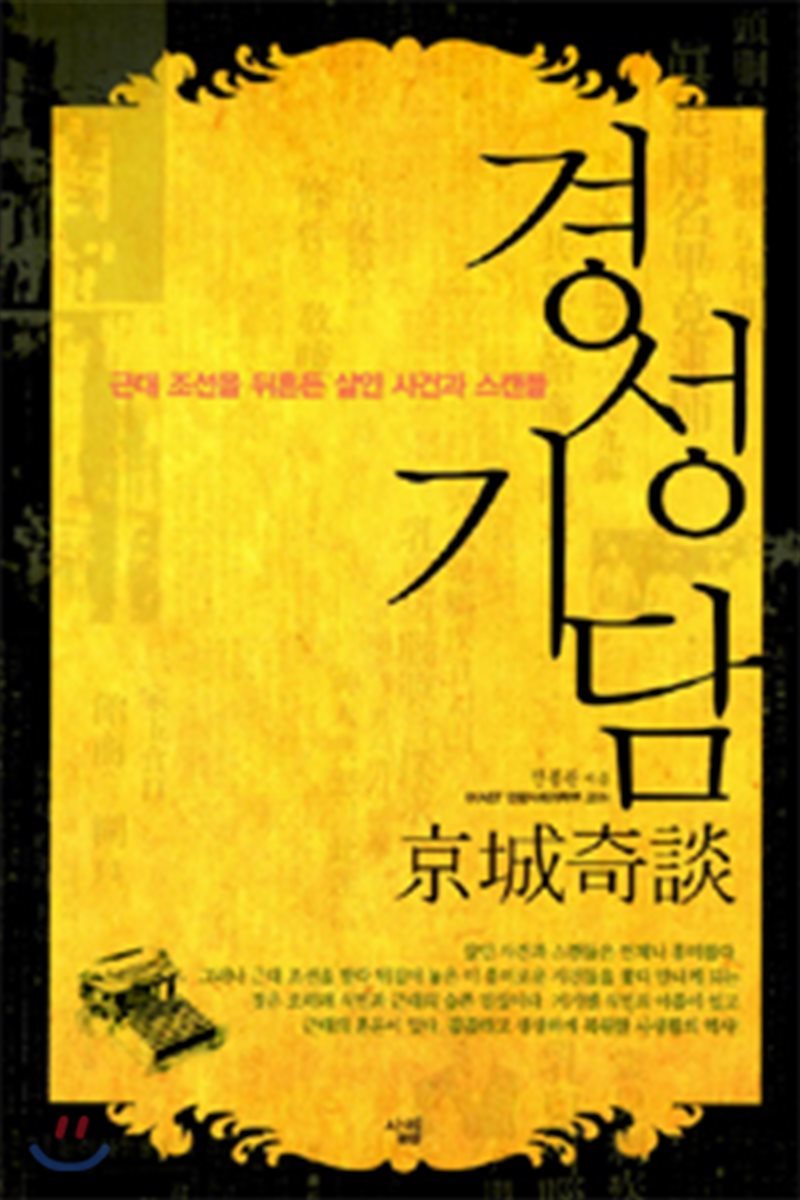 |
Description
Book Introduction
There will always be murders and scandals.
It couldn't be any different from the Japanese colonial period.
This book contains four murder cases and six scandals that were reported more than ten times in newspapers and magazines at the time.
These are all incidents that turned modern Joseon upside down.
But what is more interesting is not only the incident itself, but also its development and ending.
The Japanese police, who prided themselves on being the 'leading experts in scientific investigation,' conducted a haphazard investigation, and the Japanese mistress who killed her Korean maid was acquitted.
In addition, the revelations surrounding the 'violation of the chastity of a female disciple' incident always go beyond public expectations, and Joseon's first Swedish economist had to die while 'selling bean sprouts'.
Why did such a bizarre thing happen?
Professor Jeon Bong-gwan, who is drawing attention for his research on modern Korean cultural history, restores the essence of modern Joseon through meticulous research and rich imagination!
It couldn't be any different from the Japanese colonial period.
This book contains four murder cases and six scandals that were reported more than ten times in newspapers and magazines at the time.
These are all incidents that turned modern Joseon upside down.
But what is more interesting is not only the incident itself, but also its development and ending.
The Japanese police, who prided themselves on being the 'leading experts in scientific investigation,' conducted a haphazard investigation, and the Japanese mistress who killed her Korean maid was acquitted.
In addition, the revelations surrounding the 'violation of the chastity of a female disciple' incident always go beyond public expectations, and Joseon's first Swedish economist had to die while 'selling bean sprouts'.
Why did such a bizarre thing happen?
Professor Jeon Bong-gwan, who is drawing attention for his research on modern Korean cultural history, restores the essence of modern Joseon through meticulous research and rich imagination!
- You can preview some of the book's contents.
Preview
index
Part 1: A Mysterious Murder Case That Shook Modern Joseon
The Jukcheomjeong 'Decapitated Infant' Incident
A child's head lying on the streets of Gyeongseong in broad daylight, the 23 days of chaos
Andong Police Officer Kawakami Murder Case
Are the captured Korean youths responsible for the brutal murder of a Japanese police officer?
Busan Maria Massacre
A Korean maid who was abused and her Japanese mistress who smiled coldly
The Baek Baek Cult Murder Case
With 314 confirmed murders, the end of a cult that shocked the entire Joseon Dynasty.
Part 2: The Scandal That Shook Modern Joseon
The case of Principal Park Hee-do of Joongang Daycare Center's "violation of a female student's chastity"
Is it a brazen sexual assault or a malicious false accusation? A fiery game of truth.
The debt suffering of Marquis Yun Taek-yeong, the debt king
King Sunjong's father-in-law embezzled 3 million won and fled to Beijing.
The two-person baron's family fight
Conspiracy and secret struggle surrounding Baron Lee Jae-geuk's million-dollar inheritance
Ewha Womans University Professor Ahn Ki-young's "Love Escape"
The sordid private life of a great artist who abandoned his family "in the name of love."
The divorce case of Park In-deok, Joseon's "Nora"
Why did the 'new woman leader' abandon her husband and children?
The Sad Story of Choi Yeong-suk, Joseon's First Swedish Economist
An intellectual woman who chose her country over honor and love, abandoned by her homeland, died in poverty.
Epilogue
Drawing humanities with a human touch
The Jukcheomjeong 'Decapitated Infant' Incident
A child's head lying on the streets of Gyeongseong in broad daylight, the 23 days of chaos
Andong Police Officer Kawakami Murder Case
Are the captured Korean youths responsible for the brutal murder of a Japanese police officer?
Busan Maria Massacre
A Korean maid who was abused and her Japanese mistress who smiled coldly
The Baek Baek Cult Murder Case
With 314 confirmed murders, the end of a cult that shocked the entire Joseon Dynasty.
Part 2: The Scandal That Shook Modern Joseon
The case of Principal Park Hee-do of Joongang Daycare Center's "violation of a female student's chastity"
Is it a brazen sexual assault or a malicious false accusation? A fiery game of truth.
The debt suffering of Marquis Yun Taek-yeong, the debt king
King Sunjong's father-in-law embezzled 3 million won and fled to Beijing.
The two-person baron's family fight
Conspiracy and secret struggle surrounding Baron Lee Jae-geuk's million-dollar inheritance
Ewha Womans University Professor Ahn Ki-young's "Love Escape"
The sordid private life of a great artist who abandoned his family "in the name of love."
The divorce case of Park In-deok, Joseon's "Nora"
Why did the 'new woman leader' abandon her husband and children?
The Sad Story of Choi Yeong-suk, Joseon's First Swedish Economist
An intellectual woman who chose her country over honor and love, abandoned by her homeland, died in poverty.
Epilogue
Drawing humanities with a human touch
Into the book
Just because private life is a different matter from public life, it doesn't mean it's a trivial matter.
Few subjects are better at demonstrating the complexities of life than private life.
The fact that Ahn Ki-young, who was called Joseon's greatest tenor, abandoned his ailing wife and fled with his female disciple Kim Hyeon-sun does not diminish his musical greatness.
Just as Park In-deok's pioneering achievements as a feminist activist do not disappear because she collaborated with the Japanese, the evaluation of Park In-deok's public life does not change because she divorced a wealthy young man and married him.
What their scandalous private lives reveal is simply how complex human beings are, and how powerless ideology is in the face of desire.
It is not right to hide one's shameful private life in order to show off one's greatness.
Because private life is also an undeniable part of life that takes up more than a third of our lives.
Few subjects are better at demonstrating the complexities of life than private life.
The fact that Ahn Ki-young, who was called Joseon's greatest tenor, abandoned his ailing wife and fled with his female disciple Kim Hyeon-sun does not diminish his musical greatness.
Just as Park In-deok's pioneering achievements as a feminist activist do not disappear because she collaborated with the Japanese, the evaluation of Park In-deok's public life does not change because she divorced a wealthy young man and married him.
What their scandalous private lives reveal is simply how complex human beings are, and how powerless ideology is in the face of desire.
It is not right to hide one's shameful private life in order to show off one's greatness.
Because private life is also an undeniable part of life that takes up more than a third of our lives.
-- p345, Drawing on the humanities that smell like people
Publisher's Review
A cultural and historical perspective on murder cases and scandals in modern Joseon.
Murders and scandals happen in every era.
Even now, bizarre murders occur and major scandals break out in various places.
And broadcasts, newspapers, and magazines compete to report on this.
It is a miserable and embarrassing situation for the parties involved, but for third parties, it is as entertaining as watching a fire.
I wonder if there is another story that has such a big impact on the so-called 'word of mouth effect'.
But the murders and scandals that shook the times are easily forgotten.
Just look at the cases of Shin Chang-won and Yu Hyeong-cheol, who were famous for their bizarre murders.
Few people now remember this tragic event.
Those who like to talk might cite 'volatile gossip' or 'Koreans' hot-headedness' as the reasons.
However, it is not a simple matter to consider, as issues regarding ‘prison administration’ have been raised since the escaped prisoner Shin Chang-won case, and issues regarding the ‘death penalty system’ have been raised during the trial of serial killer Yoo Hyeong-cheol.
The social and cultural significance of the murder case and scandal is not small.
Yet, the murders and scandals have been thoroughly excluded from history books.
The same goes for the events that appear in this book.
These are all sensational events that were reported more than ten times in newspapers and magazines during the Japanese colonial period, but they were not recorded in history books more than a single line.
Of course, there are cases like Park Hee-do and Park In-deok who decorated history books with their pro-Japanese activities.
However, their ‘violation of the chastity of female disciples’ and ‘divorce incidents’ were not recorded at all.
At the time, what attracted the public's attention was not the 'pro-Japanese' aspect, but rather the 'scandal'.
For researchers, ‘sexual harassment’ by celebrities or ‘divorce of new women’ were bigger taboos than ‘pro-Japanese’ activities.
History is a 'selective record'.
It is inevitable that history cannot record everything.
The problem is that historical narratives up to now have been overly focused on the realm of reason, the public sphere, and special lives.
On the other side, the realm of desire, the realm of privacy, the realm of ordinary daily life, has been ignored or treated with negligence.
As the author of this book says, no great person has ever lived a rational and extraordinary life in the public sphere, but has lived an ordinary life in the private sphere, constantly yearning for more.
Therefore, for the author, who pursues the humanities with a genuine human touch, murder cases and scandals that are often dismissed as gossip are all history and valuable subjects of study.
The humanities should no longer draw on public life to explain human life and personal fulfillment.
Independence activists and great scientists are not the ultimate form of personal perfection, but rather examples of public life worthy of emulation.
If we are to confidently assert that the modern value of the humanities lies in restoring humanity damaged by materialism, the humanities must no longer conceal their private lives.” (p. 345, Drawing Humanities with a Human Touch)
Writing that crosses the line between fact and fiction
In his previous work, The Gold Rush (2005), the author received attention for faithfully restoring the gold rush that swept through Joseon in the 1930s through historical research.
This time it's a murder case and a scandal.
However, the author's series of works on modern cultural history are not only noteworthy because of the 'uniqueness of the material' or 'new perspective'.
For him, ‘writing that communicates with readers’ is another key axis that supports humanistic humanities.
If we fail to communicate with 'ordinary people' while telling 'the little-known stories of ordinary people', then it is already a dead humanities.
What he borrows for this is ‘literary imagination.’
It is about filling in the gaps that materials cannot fill with imagination, creating a living text that is closest to reality, yet can be interpreted differently.
This book's attempts to 'reconstruct events through the rearrangement of time', 'naturally incorporate quotations into the text', and 'preserve the style of old writing while modernizing the expressions' are all products of these efforts.
This is why the author's words in the epilogue, regarding the murder story, "You can either flip through the pages without thinking, as if you were watching a Hollywood action thriller, or you can read between the lines and feel the dark atmosphere of the colonial era" (p. 348), read with quite a certain confidence.
Murders with even more bizarre endings, and the pain of colonialism hidden within them.
There are four murder cases that shook colonial Korea.
These are the incidents where a Korean murdered a Korean (the Jukcheomjeong 'guillotined infant' incident), the incidents where a Korean murdered a Japanese (the Andong Kawakami police officer murder incident), the incidents where a Japanese murdered a Korean (the Busan Maria massacre incident), and the unprecedented serial murders committed in the name of religion (the Baekbaekgyo murder cult incident).
These are all bizarre incidents.
But what is more interesting is not only the incident itself, but also its development and ending.
There is a deep pain of colonial Korea in it.
May 16, 1933.
In the 23rd year of colonial rule, in the middle of Gyeongseong, a "safe city" that the Japanese Government-General boasted of maintaining world-class public safety, a torsoless child's head was discovered in broad daylight.
When an unexpected and heinous crime occurred, all police stations in Gyeongseong City were put on emergency alert and an on-site investigation began immediately.
As befitting a 'leading figure in scientific investigation,' the police took dozens of photos of evidence and performed an autopsy.
The scene was so badly damaged that only four clues were available, but the autopsy results were released within a day.
“Gender: Male.
Age: around 1 year old.
Slitting the throat of a living child.
The crime took place within 10 hours of discovery.” And the day after the incident, a dog was found to have discovered that the paper wrapped around the severed head was actually a rice bag.
Although they did obtain some additional important information, the police's 'scientific investigation' ended there.
The case made no progress and became increasingly entangled.
The police, who had become anxious, gave up on scientific investigation from this point on and began a 'haphazard investigation'.
First, people who were raising dogs in the area where the incident occurred were questioned as if they were being interrogated, and if any suspicious evidence was found, they were immediately locked up in a detention center.
As there were no significant results, they started digging in any suspicious place, even if it was not a child's grave.
When even this failed, the police, who had become increasingly venomous, arrested all the lower-class people in Gyeongseong City, including homeless people, lepers, and even widows, stepmothers, and stepmothers.
For a while, the stench of street vendors and lepers filled the police stations in the city.
After many twists and turns, the case was closed after 23 days, and the culprit was an unexpected person.
The infant guillotine incident clearly revealed the shame of Joseon in 1933.
Gyeongseong was not a ‘safe city’ as the Government-General boasted.
···The process of finding the lost child's body revealed how many bodies were secretly buried in the backwaters of Gyeongseong and how many lower-class people were crouching in the shadows of society.
And above all, it revealed how "scientific" the Japanese police were and how diligently they "digged" to solve the case. (Page 47, Jukcheomjeong "Guillotined Infant" Case)
On the night of July 31, 1931, the gruesome body of Maria Byeon Heung-rye, a Korean maid, was found in the Choryangjeong Railroad Bureau official residence in Busan.
The police, who concluded that the incident was most likely the work of an insider based on various circumstances, arrested the Japanese landlady, Mrs. Takahashi, a month after the incident.
However, Mrs. Takahashi was acquitted in the first trial due to insufficient evidence.
The prosecutors' subsequent appeals were also dismissed by the Daegu High Court.
The case, which had been mired in a labyrinth, began to find a clue to its solution after 50 days when Shuichiro Inoue was arrested and confessed to the crime.
Finally, on January 27, 1934, two years and five months after the incident, the Busan District Court (first trial) identified Mrs. Takahashi as the main culprit and her lover, Inoue, as an accomplice, and sentenced Inoue to life imprisonment.
However, even though Mrs. Takahashi was identified as the main culprit by the court, she was not arrested because the prosecutor, who upholds the principle of double jeopardy, did not indict her.
During the second trial, a strange scene was created where the prosecutor and the lawyer argued that Mrs. Takahashi was innocent, and the judge questioned Mrs. Takahashi, who had been summoned as a witness.
Finally, on August 6, the second trial court betrayed the expectations of all Koreans and acquitted Inoue due to insufficient evidence.
Was it unpleasant that a 'noble' Japanese woman was punished for a 'lowly' Korean maid?
Considering that among the hundreds of investigators and trial officials, only one was Korean, such suspicions are understandable.
Maria Byeon Heung-rye, a Joseon woman, died unjustly in a Japanese home, but no one was punished.
If it were these days, it would have been an incident that would have filled Gwanghwamun Square with candles, but nothing actually happened.
"It was yet another pain endured by the colonial people in the mid-1930s, a time of rampant absurdity." (Page 108, Busan Maria Massacre)
Celebrity scandals and the modern chaos hidden within them
There was a scandal that turned modern Joseon upside down.
Park Hee-do, Yoon Taek-young, Lee In-yong, Ahn Ki-young, Park In-deok, Choi Young-sook.
These are all unfamiliar names.
Although they were not recorded in history books for more than a single line, they were representative nationalist activists (Park Hee-do, Ahn Gi-yeong), nobles (Yoon Taek-yeong, Lee In-yong), and new women (Park In-deok, Choi Yeong-suk) of the time.
Let's not be quick to dismiss it as just a pesky peeping thing.
Behind this massive scandal lies the chaos surrounding modern chastity and love, a declining dynasty and a corrupt aristocracy, and the ideals and realities of the new woman.
It is revealed that Park Hee-do, the principal of Joongang Kindergarten (now Joongang University), a respected independence activist and educator, played a game of Hwatu with a female student and violated her chastity.
Why did he play the strange card game that required a kiss between Lee Gi-na and Jinah? And is it true that he violated his female disciple's chastity? A shocking war of revelations ensues between Park Hee-do, his female disciple Yoon Shin-sil, and her husband Noh Won-woo, and the situation becomes increasingly bizarre.
The bitter truth about the massive scandal that brought the Central Daycare School to the brink of closure!
The nickname of Yun Taek-yeong, the father-in-law of the last king of Joseon, Sunjong, is ‘Debt King.’
He only had 300 won in assets (currently worth 30 million won), but his debt exceeded 3 million won (currently worth 300 billion won).
The lawsuit continues, and eventually, Yoon Taek-young escapes to Beijing.
What ability did he possess to incur such enormous debt, and how did he repay it? A portrait of the corrupt Joseon royal family on the brink of collapse!
It took less than ten years to drain Baron Lee Jae-geuk's million-dollar inheritance.
The enemy is inside.
Incompetent son Lee In-yong, greedy daughter-in-law Jo Joong-in, and property management committee chairman Park Yeong-hyo engage in a fierce battle over inheritance.
The miserable end of the Joseon aristocrats who lived in luxury with the money earned from selling out the country!
An Ki-young, an independence activist and known as 'Joseon's greatest tenor', suddenly runs away from home and embarks on a romantic escapade to China and Japan with his female disciple, Kim Hyeon-sun.
He had promised to be a 'monogamous servant' to his wife, who had devoted herself to his success, but in front of 'love', it was just a sand castle.
The sordid private life of a great artist who abandoned his family 'in the name of love'!
Park In-deok (the first chairman of Induk University), the 'best talent and beauty at Ewha Hakdang', defies the expectations of those around her and divorces the married 'rich young man' Kim Woon-ho to get married.
After getting married, she left her husband and two daughters behind to study abroad in the United States. After a successful study abroad and a lecture tour to 23 countries, she returned home in style.
But instead of returning to her beloved family, she boldly asks her husband for a divorce.
What on earth could possibly be the story? A flawed choice by a representative modern woman of Joseon!
'Marx Girl' Choi Young-sook heads to Sweden alone to become a worker for her country and people.
With his strong conviction and hard work, he became the first Swedish economist in Joseon and returned home in glory.
But his country is only interested in his love affair with the Indian youth, Mr. Law, and not in his 'talent'.
She barely made a living by selling bean sprouts, but she eventually passed away at the age of 27.
A heartbreaking story of an intellectual woman who gave up honor and love to choose her country.
Murders and scandals happen in every era.
Even now, bizarre murders occur and major scandals break out in various places.
And broadcasts, newspapers, and magazines compete to report on this.
It is a miserable and embarrassing situation for the parties involved, but for third parties, it is as entertaining as watching a fire.
I wonder if there is another story that has such a big impact on the so-called 'word of mouth effect'.
But the murders and scandals that shook the times are easily forgotten.
Just look at the cases of Shin Chang-won and Yu Hyeong-cheol, who were famous for their bizarre murders.
Few people now remember this tragic event.
Those who like to talk might cite 'volatile gossip' or 'Koreans' hot-headedness' as the reasons.
However, it is not a simple matter to consider, as issues regarding ‘prison administration’ have been raised since the escaped prisoner Shin Chang-won case, and issues regarding the ‘death penalty system’ have been raised during the trial of serial killer Yoo Hyeong-cheol.
The social and cultural significance of the murder case and scandal is not small.
Yet, the murders and scandals have been thoroughly excluded from history books.
The same goes for the events that appear in this book.
These are all sensational events that were reported more than ten times in newspapers and magazines during the Japanese colonial period, but they were not recorded in history books more than a single line.
Of course, there are cases like Park Hee-do and Park In-deok who decorated history books with their pro-Japanese activities.
However, their ‘violation of the chastity of female disciples’ and ‘divorce incidents’ were not recorded at all.
At the time, what attracted the public's attention was not the 'pro-Japanese' aspect, but rather the 'scandal'.
For researchers, ‘sexual harassment’ by celebrities or ‘divorce of new women’ were bigger taboos than ‘pro-Japanese’ activities.
History is a 'selective record'.
It is inevitable that history cannot record everything.
The problem is that historical narratives up to now have been overly focused on the realm of reason, the public sphere, and special lives.
On the other side, the realm of desire, the realm of privacy, the realm of ordinary daily life, has been ignored or treated with negligence.
As the author of this book says, no great person has ever lived a rational and extraordinary life in the public sphere, but has lived an ordinary life in the private sphere, constantly yearning for more.
Therefore, for the author, who pursues the humanities with a genuine human touch, murder cases and scandals that are often dismissed as gossip are all history and valuable subjects of study.
The humanities should no longer draw on public life to explain human life and personal fulfillment.
Independence activists and great scientists are not the ultimate form of personal perfection, but rather examples of public life worthy of emulation.
If we are to confidently assert that the modern value of the humanities lies in restoring humanity damaged by materialism, the humanities must no longer conceal their private lives.” (p. 345, Drawing Humanities with a Human Touch)
Writing that crosses the line between fact and fiction
In his previous work, The Gold Rush (2005), the author received attention for faithfully restoring the gold rush that swept through Joseon in the 1930s through historical research.
This time it's a murder case and a scandal.
However, the author's series of works on modern cultural history are not only noteworthy because of the 'uniqueness of the material' or 'new perspective'.
For him, ‘writing that communicates with readers’ is another key axis that supports humanistic humanities.
If we fail to communicate with 'ordinary people' while telling 'the little-known stories of ordinary people', then it is already a dead humanities.
What he borrows for this is ‘literary imagination.’
It is about filling in the gaps that materials cannot fill with imagination, creating a living text that is closest to reality, yet can be interpreted differently.
This book's attempts to 'reconstruct events through the rearrangement of time', 'naturally incorporate quotations into the text', and 'preserve the style of old writing while modernizing the expressions' are all products of these efforts.
This is why the author's words in the epilogue, regarding the murder story, "You can either flip through the pages without thinking, as if you were watching a Hollywood action thriller, or you can read between the lines and feel the dark atmosphere of the colonial era" (p. 348), read with quite a certain confidence.
Murders with even more bizarre endings, and the pain of colonialism hidden within them.
There are four murder cases that shook colonial Korea.
These are the incidents where a Korean murdered a Korean (the Jukcheomjeong 'guillotined infant' incident), the incidents where a Korean murdered a Japanese (the Andong Kawakami police officer murder incident), the incidents where a Japanese murdered a Korean (the Busan Maria massacre incident), and the unprecedented serial murders committed in the name of religion (the Baekbaekgyo murder cult incident).
These are all bizarre incidents.
But what is more interesting is not only the incident itself, but also its development and ending.
There is a deep pain of colonial Korea in it.
May 16, 1933.
In the 23rd year of colonial rule, in the middle of Gyeongseong, a "safe city" that the Japanese Government-General boasted of maintaining world-class public safety, a torsoless child's head was discovered in broad daylight.
When an unexpected and heinous crime occurred, all police stations in Gyeongseong City were put on emergency alert and an on-site investigation began immediately.
As befitting a 'leading figure in scientific investigation,' the police took dozens of photos of evidence and performed an autopsy.
The scene was so badly damaged that only four clues were available, but the autopsy results were released within a day.
“Gender: Male.
Age: around 1 year old.
Slitting the throat of a living child.
The crime took place within 10 hours of discovery.” And the day after the incident, a dog was found to have discovered that the paper wrapped around the severed head was actually a rice bag.
Although they did obtain some additional important information, the police's 'scientific investigation' ended there.
The case made no progress and became increasingly entangled.
The police, who had become anxious, gave up on scientific investigation from this point on and began a 'haphazard investigation'.
First, people who were raising dogs in the area where the incident occurred were questioned as if they were being interrogated, and if any suspicious evidence was found, they were immediately locked up in a detention center.
As there were no significant results, they started digging in any suspicious place, even if it was not a child's grave.
When even this failed, the police, who had become increasingly venomous, arrested all the lower-class people in Gyeongseong City, including homeless people, lepers, and even widows, stepmothers, and stepmothers.
For a while, the stench of street vendors and lepers filled the police stations in the city.
After many twists and turns, the case was closed after 23 days, and the culprit was an unexpected person.
The infant guillotine incident clearly revealed the shame of Joseon in 1933.
Gyeongseong was not a ‘safe city’ as the Government-General boasted.
···The process of finding the lost child's body revealed how many bodies were secretly buried in the backwaters of Gyeongseong and how many lower-class people were crouching in the shadows of society.
And above all, it revealed how "scientific" the Japanese police were and how diligently they "digged" to solve the case. (Page 47, Jukcheomjeong "Guillotined Infant" Case)
On the night of July 31, 1931, the gruesome body of Maria Byeon Heung-rye, a Korean maid, was found in the Choryangjeong Railroad Bureau official residence in Busan.
The police, who concluded that the incident was most likely the work of an insider based on various circumstances, arrested the Japanese landlady, Mrs. Takahashi, a month after the incident.
However, Mrs. Takahashi was acquitted in the first trial due to insufficient evidence.
The prosecutors' subsequent appeals were also dismissed by the Daegu High Court.
The case, which had been mired in a labyrinth, began to find a clue to its solution after 50 days when Shuichiro Inoue was arrested and confessed to the crime.
Finally, on January 27, 1934, two years and five months after the incident, the Busan District Court (first trial) identified Mrs. Takahashi as the main culprit and her lover, Inoue, as an accomplice, and sentenced Inoue to life imprisonment.
However, even though Mrs. Takahashi was identified as the main culprit by the court, she was not arrested because the prosecutor, who upholds the principle of double jeopardy, did not indict her.
During the second trial, a strange scene was created where the prosecutor and the lawyer argued that Mrs. Takahashi was innocent, and the judge questioned Mrs. Takahashi, who had been summoned as a witness.
Finally, on August 6, the second trial court betrayed the expectations of all Koreans and acquitted Inoue due to insufficient evidence.
Was it unpleasant that a 'noble' Japanese woman was punished for a 'lowly' Korean maid?
Considering that among the hundreds of investigators and trial officials, only one was Korean, such suspicions are understandable.
Maria Byeon Heung-rye, a Joseon woman, died unjustly in a Japanese home, but no one was punished.
If it were these days, it would have been an incident that would have filled Gwanghwamun Square with candles, but nothing actually happened.
"It was yet another pain endured by the colonial people in the mid-1930s, a time of rampant absurdity." (Page 108, Busan Maria Massacre)
Celebrity scandals and the modern chaos hidden within them
There was a scandal that turned modern Joseon upside down.
Park Hee-do, Yoon Taek-young, Lee In-yong, Ahn Ki-young, Park In-deok, Choi Young-sook.
These are all unfamiliar names.
Although they were not recorded in history books for more than a single line, they were representative nationalist activists (Park Hee-do, Ahn Gi-yeong), nobles (Yoon Taek-yeong, Lee In-yong), and new women (Park In-deok, Choi Yeong-suk) of the time.
Let's not be quick to dismiss it as just a pesky peeping thing.
Behind this massive scandal lies the chaos surrounding modern chastity and love, a declining dynasty and a corrupt aristocracy, and the ideals and realities of the new woman.
It is revealed that Park Hee-do, the principal of Joongang Kindergarten (now Joongang University), a respected independence activist and educator, played a game of Hwatu with a female student and violated her chastity.
Why did he play the strange card game that required a kiss between Lee Gi-na and Jinah? And is it true that he violated his female disciple's chastity? A shocking war of revelations ensues between Park Hee-do, his female disciple Yoon Shin-sil, and her husband Noh Won-woo, and the situation becomes increasingly bizarre.
The bitter truth about the massive scandal that brought the Central Daycare School to the brink of closure!
The nickname of Yun Taek-yeong, the father-in-law of the last king of Joseon, Sunjong, is ‘Debt King.’
He only had 300 won in assets (currently worth 30 million won), but his debt exceeded 3 million won (currently worth 300 billion won).
The lawsuit continues, and eventually, Yoon Taek-young escapes to Beijing.
What ability did he possess to incur such enormous debt, and how did he repay it? A portrait of the corrupt Joseon royal family on the brink of collapse!
It took less than ten years to drain Baron Lee Jae-geuk's million-dollar inheritance.
The enemy is inside.
Incompetent son Lee In-yong, greedy daughter-in-law Jo Joong-in, and property management committee chairman Park Yeong-hyo engage in a fierce battle over inheritance.
The miserable end of the Joseon aristocrats who lived in luxury with the money earned from selling out the country!
An Ki-young, an independence activist and known as 'Joseon's greatest tenor', suddenly runs away from home and embarks on a romantic escapade to China and Japan with his female disciple, Kim Hyeon-sun.
He had promised to be a 'monogamous servant' to his wife, who had devoted herself to his success, but in front of 'love', it was just a sand castle.
The sordid private life of a great artist who abandoned his family 'in the name of love'!
Park In-deok (the first chairman of Induk University), the 'best talent and beauty at Ewha Hakdang', defies the expectations of those around her and divorces the married 'rich young man' Kim Woon-ho to get married.
After getting married, she left her husband and two daughters behind to study abroad in the United States. After a successful study abroad and a lecture tour to 23 countries, she returned home in style.
But instead of returning to her beloved family, she boldly asks her husband for a divorce.
What on earth could possibly be the story? A flawed choice by a representative modern woman of Joseon!
'Marx Girl' Choi Young-sook heads to Sweden alone to become a worker for her country and people.
With his strong conviction and hard work, he became the first Swedish economist in Joseon and returned home in glory.
But his country is only interested in his love affair with the Indian youth, Mr. Law, and not in his 'talent'.
She barely made a living by selling bean sprouts, but she eventually passed away at the age of 27.
A heartbreaking story of an intellectual woman who gave up honor and love to choose her country.
GOODS SPECIFICS
- Date of issue: July 22, 2006
- Page count, weight, size: 348 pages | 532g | 153*224*30mm
- ISBN13: 9788952205407
- ISBN10: 8952205405
You may also like
카테고리
korean


korean

![GQ KOREA Mark (Monthly): December [2025]](http://librairie.coreenne.fr/cdn/shop/files/8ef265dbbfbf186523ed75ba7319009d.jpg?v=1765340328&width=3840)


