

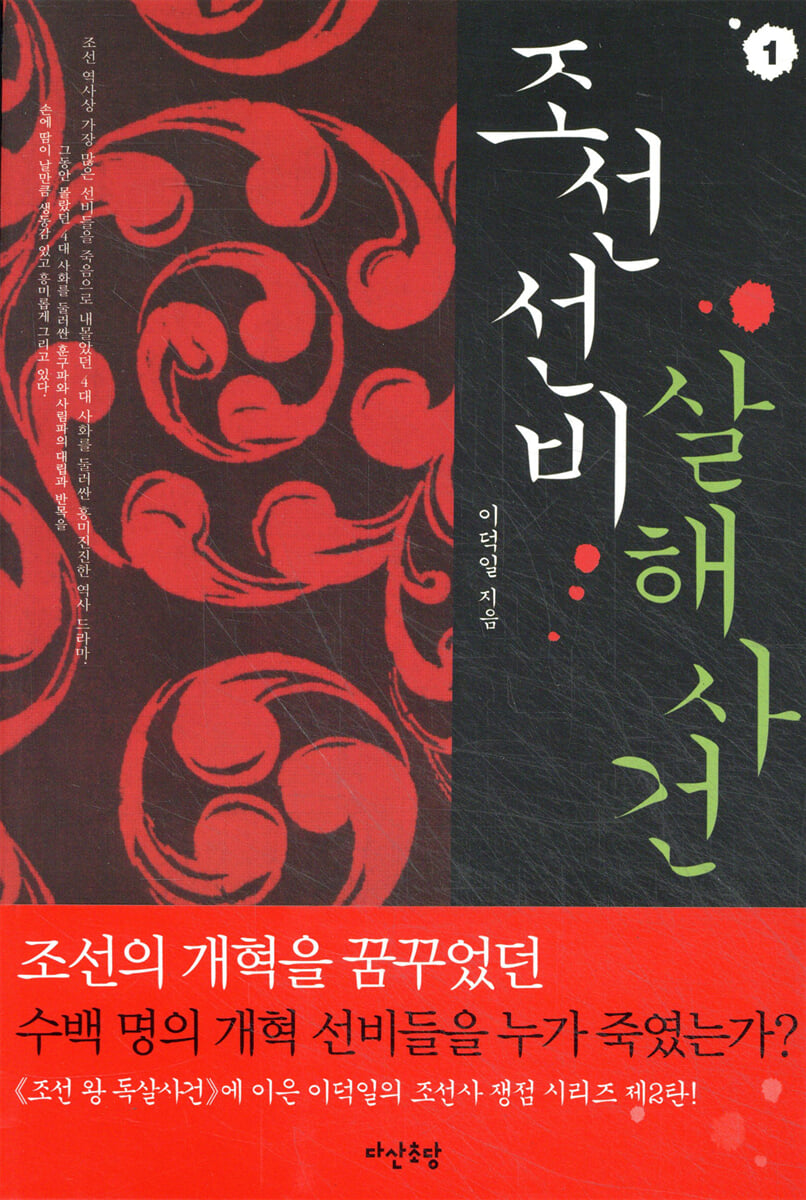
Joseon scholar murder case 1
 |
Description
Book Introduction
Following the ‘Joseon King Poisoning Incident’
The second installment of Lee Deok-il's Joseon History Guide series! "The Joseon Scholar Murder Case"
A thrilling historical drama surrounding the four major purges that drove the greatest number of scholars to death in Joseon history.
Through Lee Deok-il's unique and flavorful writing style that crosses between official and unofficial history, the conflict and animosity between the Hun-gu and Sa-rim factions surrounding the four major purges, which were previously unknown, are depicted vividly and interestingly enough to make your palms sweat.
Although it is a history of political strife marked by bloodshed, it tells the reader the background, causes, progress, and results of historical events as realistically as possible based on the remaining historical materials.
In particular, it presents the fierce challenges and frustrations of the new opposition Sarim faction, which longed for a change of government, and the history of the Joseon Dynasty purges, in which relatively progressive forces challenged the corrupt and privileged conservative class.
Furthermore, the origins of the purges are examined from the birth of the powerful families and new scholar-officials in the late Goryeo Dynasty, so if you read it with interest, you can naturally acquire historical knowledge from the late Goryeo Dynasty to the Joseon Dynasty.
Revised edition of .
The second installment of Lee Deok-il's Joseon History Guide series! "The Joseon Scholar Murder Case"
A thrilling historical drama surrounding the four major purges that drove the greatest number of scholars to death in Joseon history.
Through Lee Deok-il's unique and flavorful writing style that crosses between official and unofficial history, the conflict and animosity between the Hun-gu and Sa-rim factions surrounding the four major purges, which were previously unknown, are depicted vividly and interestingly enough to make your palms sweat.
Although it is a history of political strife marked by bloodshed, it tells the reader the background, causes, progress, and results of historical events as realistically as possible based on the remaining historical materials.
In particular, it presents the fierce challenges and frustrations of the new opposition Sarim faction, which longed for a change of government, and the history of the Joseon Dynasty purges, in which relatively progressive forces challenged the corrupt and privileged conservative class.
Furthermore, the origins of the purges are examined from the birth of the powerful families and new scholar-officials in the late Goryeo Dynasty, so if you read it with interest, you can naturally acquire historical knowledge from the late Goryeo Dynasty to the Joseon Dynasty.
Revised edition of .
index
Dreaming of the revival of the scholarly spirit
Volume 1 Main Characters
01 For a new world
Jeong Do-jeon and Yi Seong-gye: A Meeting That Changed History | The Assassination of King Gongmin and the Murder of the Ming Envoy | Revolutionary Ideas Sprouting from a Poor Village | Jeong Do-jeon's Gamble
02 The Fall of the Old Powers
The logic of the closed membership|Choi Young's end|Eliminating Jo Min-soo|Burn the resignation letter|
03 The Last Struggle to Save Goryeo
Eliminate Lee Seong-gye | From Comrade to Enemy
04 The founding of a new dynasty
Was Yi Seong-gye the Last King of Goryeo? | The End of the Three Kings of Gongyang | Goryeo's Last Loyal Servants
05 Dream of a Broken Empire
The Covenant of the Founding Contributors | Abolish Private Armies | Jeong Do-jeon's Crisis | Dreaming of Emperor of the Central Plains | The First Princes' Rebellion and Jeong Do-jeon's Death
06 The Princes' Street Battle in Broad Daylight
The Dividing Fate of the Founding Fathers|The Brothers' Differing Ambition|The Second Prince's Rebellion|Reforms Are Gone…
07 Days of Bloodless Purges
The Diverging Dreams of King Taejong and His Wife|Taejong's Abdication Controversy|The Tragedy of the Min Family|The Min Brothers Are Killed|Even the Two Remaining Brothers...|The Crown Prince's Irresistible Journey Beyond the Palace Wall|The Father-in-Law Is Killed, and the Mother-in-Law Is Turned into a Slave
08 Shadow of the Age of Peace
Even a Bad Law Is Still a Law? | Taejong's Greatest Achievement: King Sejong | Joseon's Renaissance
09 King Munjong, the wise king who died young, and King Danjong, the tragic boy king
A sickly older brother and a strong younger brother | The regency of the ministers | Han Myeong-hoe, a man of great fortune, meets Prince Suyang | Prince Suyang goes to Beijing | The unjustified coup and the list of murders | The price of blood
10 The Land of Meritorious Subjects Where Scholars Disappeared
A Candle in the Wind | A Plan to Restore the Former King | A Sad Song Wetting Yeongwol | Myths for Self-Justification | Endless Rebellions and Deaths
Volume 1 Main Characters
01 For a new world
Jeong Do-jeon and Yi Seong-gye: A Meeting That Changed History | The Assassination of King Gongmin and the Murder of the Ming Envoy | Revolutionary Ideas Sprouting from a Poor Village | Jeong Do-jeon's Gamble
02 The Fall of the Old Powers
The logic of the closed membership|Choi Young's end|Eliminating Jo Min-soo|Burn the resignation letter|
03 The Last Struggle to Save Goryeo
Eliminate Lee Seong-gye | From Comrade to Enemy
04 The founding of a new dynasty
Was Yi Seong-gye the Last King of Goryeo? | The End of the Three Kings of Gongyang | Goryeo's Last Loyal Servants
05 Dream of a Broken Empire
The Covenant of the Founding Contributors | Abolish Private Armies | Jeong Do-jeon's Crisis | Dreaming of Emperor of the Central Plains | The First Princes' Rebellion and Jeong Do-jeon's Death
06 The Princes' Street Battle in Broad Daylight
The Dividing Fate of the Founding Fathers|The Brothers' Differing Ambition|The Second Prince's Rebellion|Reforms Are Gone…
07 Days of Bloodless Purges
The Diverging Dreams of King Taejong and His Wife|Taejong's Abdication Controversy|The Tragedy of the Min Family|The Min Brothers Are Killed|Even the Two Remaining Brothers...|The Crown Prince's Irresistible Journey Beyond the Palace Wall|The Father-in-Law Is Killed, and the Mother-in-Law Is Turned into a Slave
08 Shadow of the Age of Peace
Even a Bad Law Is Still a Law? | Taejong's Greatest Achievement: King Sejong | Joseon's Renaissance
09 King Munjong, the wise king who died young, and King Danjong, the tragic boy king
A sickly older brother and a strong younger brother | The regency of the ministers | Han Myeong-hoe, a man of great fortune, meets Prince Suyang | Prince Suyang goes to Beijing | The unjustified coup and the list of murders | The price of blood
10 The Land of Meritorious Subjects Where Scholars Disappeared
A Candle in the Wind | A Plan to Restore the Former King | A Sad Song Wetting Yeongwol | Myths for Self-Justification | Endless Rebellions and Deaths
Into the book
“Stop it.
“How could I betray His Majesty the King and my comrades just to live alone?”
_Park Pang-nyeon's words to the persuasive King Sejo
“Nari did not steal the country.
I, Sammun, could not bear to see the military being deposed as a subject of another, so I tried to restore His Majesty the King to the throne.
Nari often compared herself to the Duke of Zhou during the week. Has the Duke of Zhou ever usurped the throne from her young nephew? I did this because there can be no two suns in heaven, and the people cannot have two kings.
“I am a subject of His Majesty the King, not yours.”
_The words left by Seong Sam-mun, who went to the National Assembly
The sound of the drums beating is urging people to take their lives/I turn my head to look and the sun has already set/They say there is not a single inn on the road to hell/Whose house will I sleep at tonight?
A poem recited by Seong Sam-mun as he headed to the execution ground
I ate the food and wore the clothes you gave me/How could I ever go against your heart for the rest of my life/I know that death is loyalty/The pine trees of Hyeonreung shimmer in my dreams.
_Seongseung's dying poem
When affairs are heavy like a cauldron, life is also great, / But when they are light like a goose's feathers, death is also a glory. / When I step out the door before dawn, / Even in my dreams, the pine trees of Hyeonreung are green.
_A poem left by Lee Gae before his death
“How could I betray His Majesty the King and my comrades just to live alone?”
_Park Pang-nyeon's words to the persuasive King Sejo
“Nari did not steal the country.
I, Sammun, could not bear to see the military being deposed as a subject of another, so I tried to restore His Majesty the King to the throne.
Nari often compared herself to the Duke of Zhou during the week. Has the Duke of Zhou ever usurped the throne from her young nephew? I did this because there can be no two suns in heaven, and the people cannot have two kings.
“I am a subject of His Majesty the King, not yours.”
_The words left by Seong Sam-mun, who went to the National Assembly
The sound of the drums beating is urging people to take their lives/I turn my head to look and the sun has already set/They say there is not a single inn on the road to hell/Whose house will I sleep at tonight?
A poem recited by Seong Sam-mun as he headed to the execution ground
I ate the food and wore the clothes you gave me/How could I ever go against your heart for the rest of my life/I know that death is loyalty/The pine trees of Hyeonreung shimmer in my dreams.
_Seongseung's dying poem
When affairs are heavy like a cauldron, life is also great, / But when they are light like a goose's feathers, death is also a glory. / When I step out the door before dawn, / Even in my dreams, the pine trees of Hyeonreung are green.
_A poem left by Lee Gae before his death
--- From the text
Publisher's Review
* Who killed hundreds of scholars who dreamed of reform, and why?
- The second installment of Lee Deok-il's series on controversial issues in Joseon history, following "The Poisoning Incident of the Joseon King"!
A revised edition of "Joseon History as Seen Through Sahwa" by historian Lee Deok-il, who has emerged as a leader in the history book market with his easy-to-understand and realistic writing style.
Through the four major purges that drove the largest number of scholars to death in Joseon history, the conflict and animosity between the conservatives (Hungu faction) and the reformists (Sarim faction) are depicted in a thrilling and thrilling way.
Based on a wealth of historical materials that cross over official and unofficial history, it reconstructs the background, causes, and results of the bloody Muo, Gapja, Gimiyo, and Eulsa Purges, and explores the roots of the conflict and animosity between the Hun-gu and Sarim factions, thereby helping readers gain a deeper understanding of the history of the late Goryeo and early Joseon periods.
Furthermore, it will foster a correct perspective on our times through the struggles of the corrupt, privileged conservative class to maintain its power and the challenges of the new reformist forces who dream of creating new power.
- An irreversible clash between conservatives and reformers!
At the end of the Goryeo Dynasty and the beginning of the Joseon Dynasty, when one era was ending and a new era was beginning, intellectuals were given two paths.
Should they uphold their loyalty to the collapsing Goryeo Dynasty, or risk the stigma of traitors and spearhead the founding of a new dynasty? Torn at a crossroads, forced to turn against one another, the intellectuals of the late Goryeo Dynasty were forced to take different paths even after the new Joseon Dynasty emerged.
It is no exaggeration to say that the early Joseon period was marked by confrontations between the two factions, the Hun-gu faction and the Sarim faction.
The Hun-gu faction, which at times wielded even more power than the crown! A young Sarim faction's reckless challenge to them! The story is more thrilling than any drama or film, and the rich photo documentation adds a vivid sense of realism.
- The sun in the sky will recognize my single heart!
The scholars of the Sarim faction, who did not know how to bend or bend.
That is why they had no choice but to shed so much blood in their confrontation with the Hun-gu faction.
In particular, the death of Jo Gwang-jo, the greatest reformer of the Joseon Dynasty, saddens many readers.
Jo Gwang-jo, who wielded the sword of reform without hesitation and enjoyed the trust of the people, said, “I loved the king like a father and cared for the country like my own home.
He left behind a poem titled “The sun looks down on the lower world and brightly illuminates loyalty,” and was killed after being framed by the opposition party.
What was it that he pursued, unhesitatingly risking his life to speak his mind? And what kind of world did he so desperately desire? And how would history have changed had his reforms succeeded? Jo Gwang-jo's death continues to spark readers' imaginations.
- A small tribute to all the true scholars of this land!
Besides Jo Gwang-jo, there are countless scholars who died miserably.
Perhaps that was the fate that the scholars of this land, who lived in an era of persecution, had to accept.
At that time, the intellectuals of this land, represented by the scholars, had to personally walk the path of asceticism and politically walk the path of torture.
They had to walk the path of solitary caution even when alone, and they had to walk the path of a seeker who fought against the corrupt reality with his whole body.
For true scholars, personal and social life were not two separate things, but one.
The fact that Joseon, a country with a weak culture, was able to endure for 500 years was possible because of these scholars.
This book is a small tribute to all the true scholars of this land who died while walking this very path.
- The second installment of Lee Deok-il's series on controversial issues in Joseon history, following "The Poisoning Incident of the Joseon King"!
A revised edition of "Joseon History as Seen Through Sahwa" by historian Lee Deok-il, who has emerged as a leader in the history book market with his easy-to-understand and realistic writing style.
Through the four major purges that drove the largest number of scholars to death in Joseon history, the conflict and animosity between the conservatives (Hungu faction) and the reformists (Sarim faction) are depicted in a thrilling and thrilling way.
Based on a wealth of historical materials that cross over official and unofficial history, it reconstructs the background, causes, and results of the bloody Muo, Gapja, Gimiyo, and Eulsa Purges, and explores the roots of the conflict and animosity between the Hun-gu and Sarim factions, thereby helping readers gain a deeper understanding of the history of the late Goryeo and early Joseon periods.
Furthermore, it will foster a correct perspective on our times through the struggles of the corrupt, privileged conservative class to maintain its power and the challenges of the new reformist forces who dream of creating new power.
- An irreversible clash between conservatives and reformers!
At the end of the Goryeo Dynasty and the beginning of the Joseon Dynasty, when one era was ending and a new era was beginning, intellectuals were given two paths.
Should they uphold their loyalty to the collapsing Goryeo Dynasty, or risk the stigma of traitors and spearhead the founding of a new dynasty? Torn at a crossroads, forced to turn against one another, the intellectuals of the late Goryeo Dynasty were forced to take different paths even after the new Joseon Dynasty emerged.
It is no exaggeration to say that the early Joseon period was marked by confrontations between the two factions, the Hun-gu faction and the Sarim faction.
The Hun-gu faction, which at times wielded even more power than the crown! A young Sarim faction's reckless challenge to them! The story is more thrilling than any drama or film, and the rich photo documentation adds a vivid sense of realism.
- The sun in the sky will recognize my single heart!
The scholars of the Sarim faction, who did not know how to bend or bend.
That is why they had no choice but to shed so much blood in their confrontation with the Hun-gu faction.
In particular, the death of Jo Gwang-jo, the greatest reformer of the Joseon Dynasty, saddens many readers.
Jo Gwang-jo, who wielded the sword of reform without hesitation and enjoyed the trust of the people, said, “I loved the king like a father and cared for the country like my own home.
He left behind a poem titled “The sun looks down on the lower world and brightly illuminates loyalty,” and was killed after being framed by the opposition party.
What was it that he pursued, unhesitatingly risking his life to speak his mind? And what kind of world did he so desperately desire? And how would history have changed had his reforms succeeded? Jo Gwang-jo's death continues to spark readers' imaginations.
- A small tribute to all the true scholars of this land!
Besides Jo Gwang-jo, there are countless scholars who died miserably.
Perhaps that was the fate that the scholars of this land, who lived in an era of persecution, had to accept.
At that time, the intellectuals of this land, represented by the scholars, had to personally walk the path of asceticism and politically walk the path of torture.
They had to walk the path of solitary caution even when alone, and they had to walk the path of a seeker who fought against the corrupt reality with his whole body.
For true scholars, personal and social life were not two separate things, but one.
The fact that Joseon, a country with a weak culture, was able to endure for 500 years was possible because of these scholars.
This book is a small tribute to all the true scholars of this land who died while walking this very path.
GOODS SPECIFICS
- Date of issue: June 26, 2006
- Page count, weight, size: 370 pages | 676g | 153*224*30mm
- ISBN13: 9788991147676
- ISBN10: 8991147674
You may also like
카테고리
korean


korean

![GQ KOREA Mark (Monthly): December [2025]](http://librairie.coreenne.fr/cdn/shop/files/8ef265dbbfbf186523ed75ba7319009d.jpg?v=1765340328&width=3840)


