

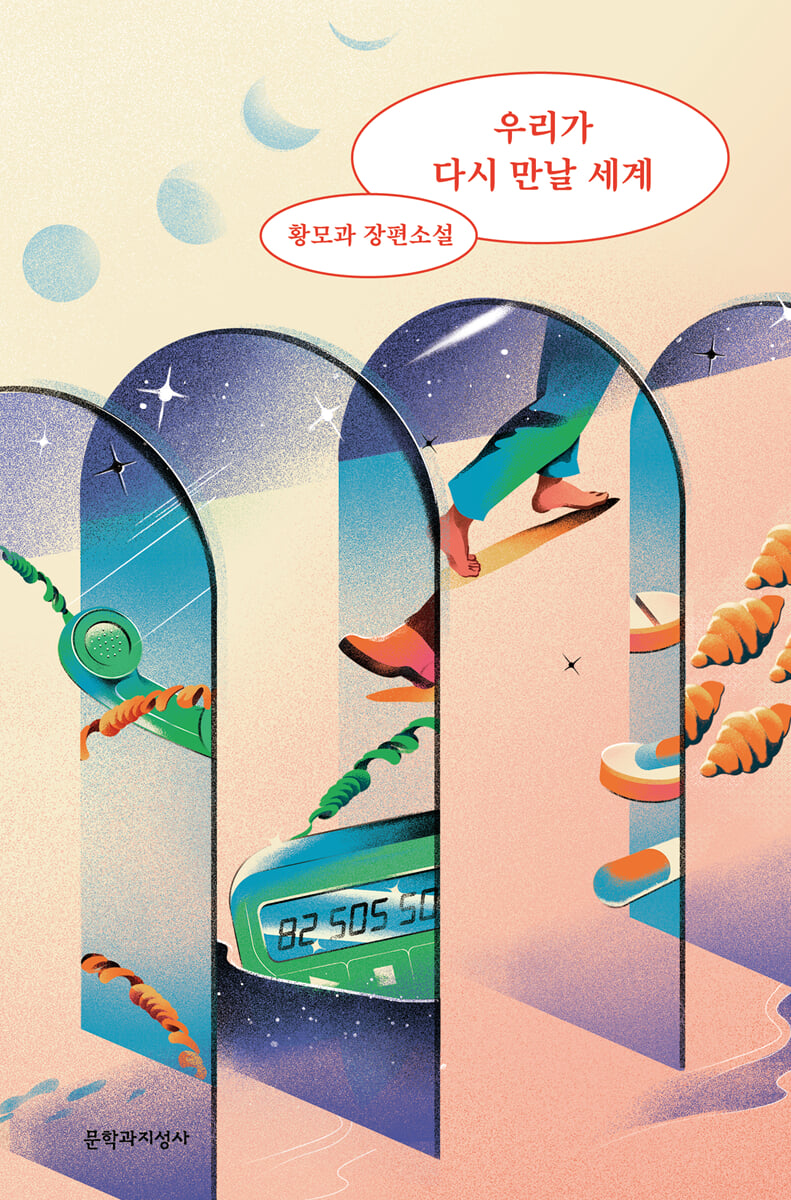
The world we meet again
 |
Description
Book Introduction
- A word from MD
-
It will not be forgotten.
Until we forget"The World We Meet Again" is a touching portrayal of the small voices that cry out, "They were here," to a world that has carelessly forgotten people, in a world where precious beings have disappeared, and the strength they unleash and the steps they take as they gather one by one.
This is the moment when the story of author Hwang Mo-gwa, who calls out the names of the forgotten, shines again.
February 11, 2022. Novel/Poetry PD Park Hyung-wook
This novel is based on a historical event in 1990 when selective abortion of female pregnancies was carried out due to the popular belief that “women born in the year of the white horse are strong.”
The story begins when the virtual world where all women born in 1990 were born suddenly goes into chaos one day.
This is the story of the protagonist Chae Jin-ri's struggle to return to her previous world while traveling between parallel worlds as the women around her disappear one by one and even her memories of them are erased.
"The World We Meet Again" is directed at you, born in 1990, in your thirties, who survived but still struggle to survive amidst the stark wage gap, job insecurity, misogyny, and all sorts of sexual crimes. Yet, you are ordinary and courageous.
To you, the thoughtful ones who have been burdened by the sense of guilt and responsibility for surviving in place of your sisters, and to you who have suffered and agonized under the pressure of “having to have a son,” I extend my heartfelt condolences.
I hope that this novel can offer a little courage and comfort to everyone living in this society who has experienced all this oppression, whether a few years late or early.
The story begins when the virtual world where all women born in 1990 were born suddenly goes into chaos one day.
This is the story of the protagonist Chae Jin-ri's struggle to return to her previous world while traveling between parallel worlds as the women around her disappear one by one and even her memories of them are erased.
"The World We Meet Again" is directed at you, born in 1990, in your thirties, who survived but still struggle to survive amidst the stark wage gap, job insecurity, misogyny, and all sorts of sexual crimes. Yet, you are ordinary and courageous.
To you, the thoughtful ones who have been burdened by the sense of guilt and responsibility for surviving in place of your sisters, and to you who have suffered and agonized under the pressure of “having to have a son,” I extend my heartfelt condolences.
I hope that this novel can offer a little courage and comfort to everyone living in this society who has experienced all this oppression, whether a few years late or early.
- You can preview some of the book's contents.
Preview
index
Part 1: Chae Jin-ri, born in 1990
1990, a special year for my mother and me
new memories
Changes for the worse
Two worlds
second chance
mass disappearance
Do it
Erased existence
A body that will disappear
invasion
Part 2: The World We Reunited
Daughter's name 123505 505 505 505… …
The name we are
Every moment
EastX
Something that has disappeared but does not disappear
anti-girl ideology
Something I've never done before
The scenery I missed
two people
Epilogue
Author's Note
Recommendation
1990, a special year for my mother and me
new memories
Changes for the worse
Two worlds
second chance
mass disappearance
Do it
Erased existence
A body that will disappear
invasion
Part 2: The World We Reunited
Daughter's name 123505 505 505 505… …
The name we are
Every moment
EastX
Something that has disappeared but does not disappear
anti-girl ideology
Something I've never done before
The scenery I missed
two people
Epilogue
Author's Note
Recommendation
Detailed image
Publisher's Review
“Let no one be forgotten now.
“Until we finish”
The Year of the White Horse in 1990, which recorded the worst sex ratio in history
An adventure across parallel universes and the past and future.
The world of lost women, finally remembered and restored
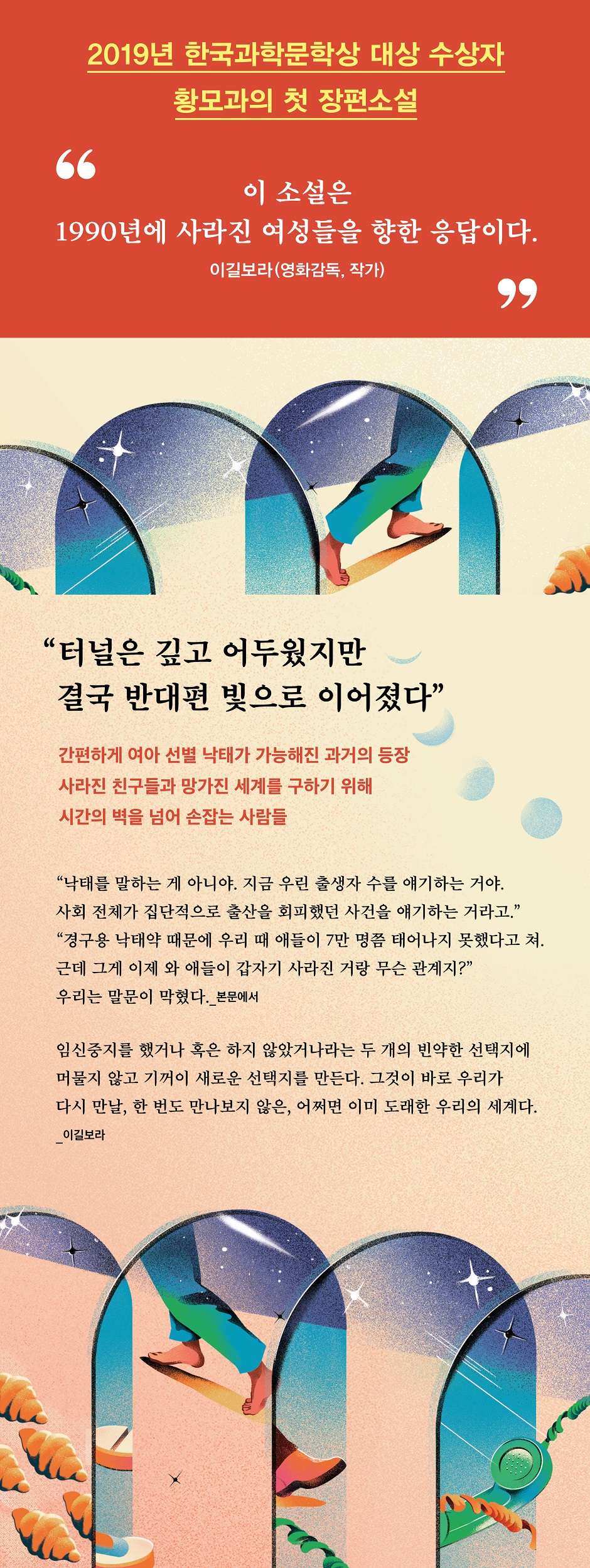
Hwang Mo-gwa's first science fiction novel, "The World We Will Meet Again" (Munhak-kwa-Jiseongsa, 2022), which won the grand prize in the short story category at the 2019 Korea Science Literature Award for "Moment Arcade," has been published.
Hwang Mo-gwa's first short story collection, "Faces of the Night," received critical acclaim, saying, "It's a novel that seeks to save us with the story of 'what if'" (Dahye Lee, reporter for Cine21).
The short story "Augmented Bean Pod" was produced as the MBC cinematic drama "SF8" and garnered great expectations from science fiction readers as a promising new writer.
This novel is based on a historical event in 1990 when selective abortion of female pregnancies was carried out due to the popular belief that “women born in the year of the white horse are strong.”
The story begins when the virtual world where all women born in 1990 were born suddenly goes into chaos one day.
This is the story of the protagonist Chae Jin-ri's struggle to return to her previous world while traveling between parallel worlds as the women around her disappear one by one and even her memories of them are erased.
But the reason this novel doesn't read as just a refreshing heroic tale is probably because it ultimately focuses more on reflecting on the world of disappeared women, the world that cannot be returned to, the world that is not remembered, and the world right here and now, and urging reflection.
After experiencing a feminist reboot and the subsequent powerful backlash, women have once again been erased from the 2022 presidential election agenda.
The novel asks questions.
How can the position of women, who have become invisible yesterday and today, be restored?
I hope that readers who open this book will find a variety of inspiration as they follow the courageous steps of Truth and his friends as they race through parallel worlds and the past and future.
“This was a world where no one knew who had disappeared.”
March 2007, the beginning of my second year of high school, everything was mixed up.
Jinri, who was running late on the first day of school and was in a hurry, felt a vibration strong enough to make her knees buckle on her way to school.
A sudden change that began without any warning.
In the new classroom, there were friends who were familiar faces but had become completely different people.
The homeroom teacher's survey reveals that some children remember the co-ed school as an all-boys school, and Jinri is even more shocked to learn that one of them is her boyfriend, Hoonwoo.
Hoonwoo, who was once deep and affectionate, has already changed 180 degrees in both his personality and his gaze.
The truth had no choice but to ask:
“Who are you?” (p.
35).
But kids, isn't it strange? If you suddenly shout that you didn't know, that you forgot, is that the end of it? If you deny us, what will become of your time? Is it okay? If you simply deny us, will the places you've been living be replaced without a hitch? Will everything be filled in, without missing a single thing? Is that even possible? I wanted to ask Hoonwoo, the kids, the teacher, everyone.
(pp.
38~39)
As I was trying to return home after going through this whirlwind of confusion, my dad told me to come to a new house and gave me an unfamiliar address.
Chae Pil-lim, the father who was once a scientist who dreamed of winning the Nobel Prize but later became a baker and ran 'Jinri Bakery', has now become the CEO of a pharmaceutical company.
In the midst of this upheaval, Jinri also harbors hopes that her mother, Choi Yi-young, who died giving birth to Jinri in the past, will be able to return.
But things gradually got worse, my friends started disappearing one by one, and strangely, even my memories of them started to fade.
Jinri, who tries hard to keep her memories by writing her friends' names on her palm every day.
Who can fix this broken world and how?
"In a place where neither victory nor defeat means anything, we have become each other's enemies."
The problem isn't abortion, it's patriarchy.
“I don’t think abortion itself should be an issue.
“The harm is greater because abortion is illegal.”
Jinhee summarized the argument in my words.
“It is estimated that there are hundreds of thousands of abortions annually.
Even though it is not properly counted.
I'm not talking about abortion.
Now we are talking about the number of births.
“I’m talking about an incident where the entire society collectively avoided giving birth to a certain gender.”
[… … ]
“Let’s say that about 70,000 children in our time were not born because of the abortion pill.
But what does that have to do with the kids suddenly disappearing now?”
We were speechless.
(pp.
175~76)
In the 1990s and 2000s, when asking questions about family members in a home environment survey at school, this kind of thing often followed.
“My mother just wanted to have a third child, but it just so happened that she had a younger brother.” Despite the slogan of having only two children and raising them well, regardless of whether they were boys or girls, people insisted on having sons, and to the point that selective abortion of female fetuses became popular, especially among the middle class.
The preference for sons was ultimately synonymous with the dislike of girls, and the gender imbalance reached its peak in 1990, with 116.5 males per 100 females.
There was a time when there were three or four boys in each classroom, and even this situation was described as “there are no women to bear children,” and women were viewed only as tools for reproduction.
Hwang Mo-gwa's "The World We Meet Again" is not a novel that deals with abortion.
It is a story about restoring the deep-rooted patriarchy of Korean society and the women who disappeared as a result.
It brings back an event that everyone knows but is remembered only as a superstitious happening of the past, and leaves us with questions by bringing it into two parallel worlds.
About how much has changed here and now, and how this world can change.
This book is definitely for you.
Born in 1990, in your thirties, you survived, but still struggle to survive amidst the glaring wage gap, job insecurity, misogyny, and all sorts of sexual crimes. But you are ordinary and courageous.
To you, the thoughtful ones who have been burdened by the sense of guilt and responsibility for surviving in place of your sisters, and to you, who have suffered and agonized under the pressure of “having to have a son,” I extend my heartfelt condolences.
I hope that this novel can offer a little courage and comfort to everyone living in this society who has experienced all this oppression, whether a few years late or early.
GOODS SPECIFICS
- Publication date: February 3, 2022
- Page count, weight, size: 259 pages | 274g | 124*188*16mm
- ISBN13: 9788932039497
- ISBN10: 8932039496
You may also like
카테고리
korean


korean

![GQ KOREA Mark (Monthly): December [2025]](http://librairie.coreenne.fr/cdn/shop/files/8ef265dbbfbf186523ed75ba7319009d.jpg?v=1765340328&width=3840)


