

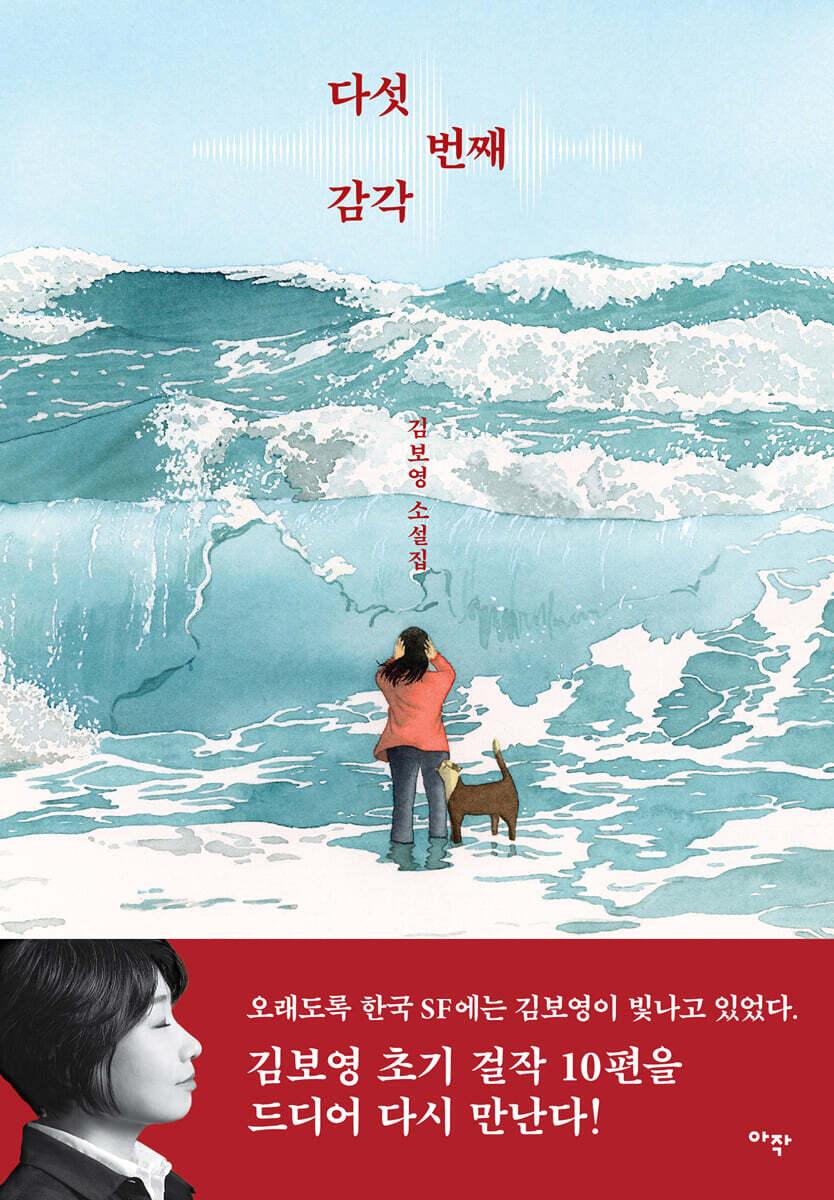
Fifth sense
 |
Description
Book Introduction
Kim Bo-young has long been a shining star in Korean science fiction.
The first Korean science fiction writer to be nominated for the National Book Award
We finally get to see 10 of Kim Bo-young's early masterpieces again!
When Kim Bo-young's short story collections 『A Story of Going Far』 and 『Evolution Myth』 first came out in 2010, novelist Park Min-gyu wrote the following:
“It is the queen’s coronation.
I have no doubt that Kim Bo-young's works will one day become the 'origin of species' of Korean science fiction." Ten years later, Kim Bo-young became the first Korean science fiction writer to publish an English collection of short stories from HarperCollins, the largest publisher in the United States, and achieved the feat of being nominated for the National Book Award for another English collection of short stories.
Many science fiction experts unanimously predicted that 『A Long Way to Go』 and 『Evolution Myth』 would “go down in history as legends in Korean science fiction,” and while these predictions proved to be true, the two books are unfortunately out of print and cannot be found in bookstores.
Fortunately, several of the included works, including "People Going to the Future," have been republished and are now available to readers. However, it would be unfortunate for all of us if readers still have difficulty easily encountering the works that can be called the "origin of Korean science fiction" in a practical sense.
Kim Bo-young's short story collection, "The Fifth Sense," which is being republished after 12 years, includes the "People Going to the Future" series, which was published separately from "Stories of Going Far" and "Evolution Myth," the "Origin of Species" series, which is being prepared as a full-length novel with a sequel, "Evolution Myth," which will be published as a graphic novel, and all of her works except "Between 0 and 1" from "How Similar Are We?"
From her debut work, "The Experience of Tactile Sense," which won the first Science and Technology Creative Writing Award, to "Stars Shine in the Sky of Earth," which will be remembered as one of the most beautiful works in Korean science fiction history, let's revisit the early masterpieces of Kim Bo-young, who has long been a shining star in Korean science fiction.
The first Korean science fiction writer to be nominated for the National Book Award
We finally get to see 10 of Kim Bo-young's early masterpieces again!
When Kim Bo-young's short story collections 『A Story of Going Far』 and 『Evolution Myth』 first came out in 2010, novelist Park Min-gyu wrote the following:
“It is the queen’s coronation.
I have no doubt that Kim Bo-young's works will one day become the 'origin of species' of Korean science fiction." Ten years later, Kim Bo-young became the first Korean science fiction writer to publish an English collection of short stories from HarperCollins, the largest publisher in the United States, and achieved the feat of being nominated for the National Book Award for another English collection of short stories.
Many science fiction experts unanimously predicted that 『A Long Way to Go』 and 『Evolution Myth』 would “go down in history as legends in Korean science fiction,” and while these predictions proved to be true, the two books are unfortunately out of print and cannot be found in bookstores.
Fortunately, several of the included works, including "People Going to the Future," have been republished and are now available to readers. However, it would be unfortunate for all of us if readers still have difficulty easily encountering the works that can be called the "origin of Korean science fiction" in a practical sense.
Kim Bo-young's short story collection, "The Fifth Sense," which is being republished after 12 years, includes the "People Going to the Future" series, which was published separately from "Stories of Going Far" and "Evolution Myth," the "Origin of Species" series, which is being prepared as a full-length novel with a sequel, "Evolution Myth," which will be published as a graphic novel, and all of her works except "Between 0 and 1" from "How Similar Are We?"
From her debut work, "The Experience of Tactile Sense," which won the first Science and Technology Creative Writing Award, to "Stars Shine in the Sky of Earth," which will be remembered as one of the most beautiful works in Korean science fiction history, let's revisit the early masterpieces of Kim Bo-young, who has long been a shining star in Korean science fiction.
- You can preview some of the book's contents.
Preview
index
01_Stars are shining in the Earth's sky_7
02_Under the Ground_25
03_Tactile Experience_63
04_The Fifth Sense_117
05_Excellent Genes_207
06_The Last Wolf_233
07_Scripter_265
08_Mirror_327
09_Old Man and Boy_371
10_Dream Within a Dream_389
Description of included works_421
Author's Note_424
02_Under the Ground_25
03_Tactile Experience_63
04_The Fifth Sense_117
05_Excellent Genes_207
06_The Last Wolf_233
07_Scripter_265
08_Mirror_327
09_Old Man and Boy_371
10_Dream Within a Dream_389
Description of included works_421
Author's Note_424
Publisher's Review
What makes a great twist is the beauty of process and logic.
When the English-language anthology of Korean science fiction stories, The Readymade Bodhisattva, came out, a surprising number of English-speaking critics and readers were surprised to find that these stories were Korean stories about Korean people speaking Korean.
For us, the surprise is rather surprising.
Even when reading a translation, the narrow-mindedness that prevents one from imagining the future of that country, its culture, and its language.
But it's surprisingly common for non-English science fiction writers to be unable to read their own future.
This was especially true in the latter half of the 20th century, when space development was monopolized by the two superpowers.
Back then, it seemed likely that aliens would land on the White House lawn, and it was hard to find a reason why they wouldn't.
We were not the main characters, and to be the main characters we had to stay on the periphery of the great powers.
Just like Han Nak-won's "Venus Exploration Team," which had to board Soviet and American spaceships to go into space.
Conversely, one could argue that the reason stories set in Korea became more natural was because the technological monopoly of the 20th century began to break down.
The future we imagine has become diverse, and it is natural that we are the main characters in it.
There is no longer any reason to feel embarrassed or shy about using your Korean name.
But Kim Bo-young's world is a little different from this trend.
Because of this, readers who are not familiar with the author's rules often have a hard time adjusting.
Let's look at the following sentence from "Under the Ground".
“My wife brought the stew and sat down quietly at the table.
My wife sat in her chair and waited for me to hang up.” With the names Min-seok and Yun-hyeong mentioned before, we naturally assume that the protagonist is part of patriarchal early 21st-century Korean culture.
But wasn't an underground labyrinth discovered about a hundred years ago, something that doesn't exist in our history? The author then goes into more detail about the world and its history that form the backdrop of this story.
“I also know that the world is round.
(…) People in ancient times had to travel around the world to discover that fact.
They also learned that on the other side of the world, people live upside down.”
Now readers will know that this story, which features people who continue to descend underground through an underground labyrinth, is not set in Korea, or rather, not on Earth, where we live, but in Robert A.
Heinlein's The Jordan Children and Brian W.
We learn that it is a science fiction adventure story in the tradition of Oldies' "Nonstop."
However, even while reading, the image of a Korean woman serving freshly boiled stew on a table in what appears to be a typical Korean apartment is blatantly revealed, hindering a full reading of the genre setting.
Beyond this, a sense of liberation awaits.
We don't need to worry about continuity between our world and the fictional world.
You no longer have to place the center of your world somewhere else.
We are, of course, the protagonists of our own world.
I often wonder how much international readers of Kim Bo-young's works will understand this sense of liberation when they read her works through translation.
They may not notice that this obviousness is not at all obvious.
Rather, one might think that this is an effect that deliberately starts in an unfamiliar world and alienates the readers.
*
The setting of this everyday world is important.
Because many of the short stories in this book take a form that overturns what we take for granted as normalcy.
A representative work that demonstrates this is “The Fifth Sense.”
This story begins in a space that pretends to be an everyday space in modern Korea, even more so than “Under the Ground.”
It is a story about a younger sibling who investigates the mystery surrounding her older sister's death in a car accident.
If we had seen it through a visual medium like a movie, we would have immediately realized that this world is completely different from the one we live in.
But in the case of novels, it takes a little longer to confirm this.
Unlike audiovisual information, language is much more effective at concealing the information you want to convey to the reader.
This world is a place where almost everyone is deaf and cannot hear.
Until now, people have been communicating using sign language, and the title's "Fifth Sense" is hearing.
And to the protagonist, who has begun to hear, music and sound come with an almost cosmic horror-like sense of fear and awe.
The world that was turned upside down, pretending nothing happened, is turned upside down again with a grand fanfare.
There might have been a way to explain from the beginning how a world came to be where what we consider abnormal has become normal, as H.G. Wells did in Blindness.
However, Wells' story, which revolves around a man from a foreign land who is the only one with sight, lacks the novelty and shock of Kim Bo-young's story.
It is so important where you start.
〈Stars Shine in the Sky of Earth〉 is also a story of reversal.
This short story starts off somewhat like a ploy.
It doesn't take long to realize that the symptom that people in the novel call special narcolepsy is 'sleep', and that in this world, only a small number of people sleep.
This alone makes enough of a story, so we can stop here.
But the story gradually expands the boundaries of this upside-down world.
And the rate of expansion accelerates at an incredible rate until the end of the story.
A story that begins with one person's symptoms ends with the entire galaxy expanding.
Nancy Kress has traveled through small parts of this world ("Beggars in Spain") and Isaac Asimov has traveled through large parts ("Knightfall").
But connecting them into one curve is a completely different matter.
A whole new stage of wonder opens.
“Good Genes” and “Scripter” use this reversal as a twist.
In the case of “Good Genes,” you can guess what the twist is just by looking at the title.
At least in this genre neighborhood, no one in their right mind writes a title sentence as it is.
Despite the title's obvious subject matter, the fact that many readers failed to notice the twist in the story suggests that there are a significant number of people who need to be educated on this kind of twist.
I would like to keep my mouth shut about the 〈Scripter〉.
Because I don't want to spoil the enjoyment of readers who accidentally come here without reading the work.
Isn't the very fact that there's a twist a spoiler? For some, it might be.
But what makes a great twist is the beauty of process and logic.
The twist in "Scripter" is not a sudden surprise, but rather a moment closer to the completion of the world's structure.
The reason the ending is beautiful is because it completely convinces the readers as they turn the pages and go on a journey of discovery.
*
Kim Bo-young offers a genre-bending perspective on the human experience.
Kim Bo-young's book will be placed on the shelf next to Ray Bradbury, Ursula Le Guin, and Haruki Murakami.
- Publisher's Weekly
In all her novels, Kim Bo-young's visual imagination is astonishing, her characters are compellingly desperate within their limitations, and even the familiar ideas are provocative, as classic science fiction and fantasy intended.
- 〈Locus Magazine〉
It's amazing and fascinating.
I want to read the original Korean text.
- Goodreads
Author's Note
Even if you only write one in your lifetime, it's better to write more than nothing.
This book is my record from 2002 to 2009.
There are some writings that are different from the present, but I think that is why they are meaningful.
Unlike "How Similar Are They," this one has undergone some revision, focusing mainly on correcting errors and contradictions and conveying sentences clearly.
〈Mirror Love〉, 〈Under the Ground〉, 〈The Last Wolf〉, and 〈Dream in a Dream〉 were judged to have many internal contradictions, so several parts were revised.
(……) As I have said occasionally, I had no other hobbies besides writing novels until I was twenty, and after I was twenty, it was as if I suddenly stopped writing and couldn’t write a single line.
I wasted time there, unable to get out, so I decided to complete a novel, whether it took 10 years or my entire life, with the thought that 'writing just one novel is better than nothing.'
My first novels took such an ignorant amount of time to write.
I was so convinced that I was writing something unpublishable that I wanted to write novels that would satisfy only myself, and those novels came out in the form of science fiction.
(……) I still dedicate this book to my friends Gu Ji-eun and Han So-young, who were my first readers.
Gu Ji-eun was my reader during my teenage years, and whenever we met, she encouraged me to write novels when I was wandering around with the conviction that I could never become a writer.
Sometimes he would come over to play and sit in my room, urging me to write quickly.
My writing journey began anew with the determination to gift at least one novel to that friend who had been waiting for me.
Even before my debut, Ms. Han So-young was the first to read my first draft and shared her sincere appreciation.
Through that appreciation, I was able to refine and revise the novel.
Even though many years have passed, I am still grateful to you both.
You two have shown me that one reader can make one writer.
Kim Bo-young, February 2020
When the English-language anthology of Korean science fiction stories, The Readymade Bodhisattva, came out, a surprising number of English-speaking critics and readers were surprised to find that these stories were Korean stories about Korean people speaking Korean.
For us, the surprise is rather surprising.
Even when reading a translation, the narrow-mindedness that prevents one from imagining the future of that country, its culture, and its language.
But it's surprisingly common for non-English science fiction writers to be unable to read their own future.
This was especially true in the latter half of the 20th century, when space development was monopolized by the two superpowers.
Back then, it seemed likely that aliens would land on the White House lawn, and it was hard to find a reason why they wouldn't.
We were not the main characters, and to be the main characters we had to stay on the periphery of the great powers.
Just like Han Nak-won's "Venus Exploration Team," which had to board Soviet and American spaceships to go into space.
Conversely, one could argue that the reason stories set in Korea became more natural was because the technological monopoly of the 20th century began to break down.
The future we imagine has become diverse, and it is natural that we are the main characters in it.
There is no longer any reason to feel embarrassed or shy about using your Korean name.
But Kim Bo-young's world is a little different from this trend.
Because of this, readers who are not familiar with the author's rules often have a hard time adjusting.
Let's look at the following sentence from "Under the Ground".
“My wife brought the stew and sat down quietly at the table.
My wife sat in her chair and waited for me to hang up.” With the names Min-seok and Yun-hyeong mentioned before, we naturally assume that the protagonist is part of patriarchal early 21st-century Korean culture.
But wasn't an underground labyrinth discovered about a hundred years ago, something that doesn't exist in our history? The author then goes into more detail about the world and its history that form the backdrop of this story.
“I also know that the world is round.
(…) People in ancient times had to travel around the world to discover that fact.
They also learned that on the other side of the world, people live upside down.”
Now readers will know that this story, which features people who continue to descend underground through an underground labyrinth, is not set in Korea, or rather, not on Earth, where we live, but in Robert A.
Heinlein's The Jordan Children and Brian W.
We learn that it is a science fiction adventure story in the tradition of Oldies' "Nonstop."
However, even while reading, the image of a Korean woman serving freshly boiled stew on a table in what appears to be a typical Korean apartment is blatantly revealed, hindering a full reading of the genre setting.
Beyond this, a sense of liberation awaits.
We don't need to worry about continuity between our world and the fictional world.
You no longer have to place the center of your world somewhere else.
We are, of course, the protagonists of our own world.
I often wonder how much international readers of Kim Bo-young's works will understand this sense of liberation when they read her works through translation.
They may not notice that this obviousness is not at all obvious.
Rather, one might think that this is an effect that deliberately starts in an unfamiliar world and alienates the readers.
*
The setting of this everyday world is important.
Because many of the short stories in this book take a form that overturns what we take for granted as normalcy.
A representative work that demonstrates this is “The Fifth Sense.”
This story begins in a space that pretends to be an everyday space in modern Korea, even more so than “Under the Ground.”
It is a story about a younger sibling who investigates the mystery surrounding her older sister's death in a car accident.
If we had seen it through a visual medium like a movie, we would have immediately realized that this world is completely different from the one we live in.
But in the case of novels, it takes a little longer to confirm this.
Unlike audiovisual information, language is much more effective at concealing the information you want to convey to the reader.
This world is a place where almost everyone is deaf and cannot hear.
Until now, people have been communicating using sign language, and the title's "Fifth Sense" is hearing.
And to the protagonist, who has begun to hear, music and sound come with an almost cosmic horror-like sense of fear and awe.
The world that was turned upside down, pretending nothing happened, is turned upside down again with a grand fanfare.
There might have been a way to explain from the beginning how a world came to be where what we consider abnormal has become normal, as H.G. Wells did in Blindness.
However, Wells' story, which revolves around a man from a foreign land who is the only one with sight, lacks the novelty and shock of Kim Bo-young's story.
It is so important where you start.
〈Stars Shine in the Sky of Earth〉 is also a story of reversal.
This short story starts off somewhat like a ploy.
It doesn't take long to realize that the symptom that people in the novel call special narcolepsy is 'sleep', and that in this world, only a small number of people sleep.
This alone makes enough of a story, so we can stop here.
But the story gradually expands the boundaries of this upside-down world.
And the rate of expansion accelerates at an incredible rate until the end of the story.
A story that begins with one person's symptoms ends with the entire galaxy expanding.
Nancy Kress has traveled through small parts of this world ("Beggars in Spain") and Isaac Asimov has traveled through large parts ("Knightfall").
But connecting them into one curve is a completely different matter.
A whole new stage of wonder opens.
“Good Genes” and “Scripter” use this reversal as a twist.
In the case of “Good Genes,” you can guess what the twist is just by looking at the title.
At least in this genre neighborhood, no one in their right mind writes a title sentence as it is.
Despite the title's obvious subject matter, the fact that many readers failed to notice the twist in the story suggests that there are a significant number of people who need to be educated on this kind of twist.
I would like to keep my mouth shut about the 〈Scripter〉.
Because I don't want to spoil the enjoyment of readers who accidentally come here without reading the work.
Isn't the very fact that there's a twist a spoiler? For some, it might be.
But what makes a great twist is the beauty of process and logic.
The twist in "Scripter" is not a sudden surprise, but rather a moment closer to the completion of the world's structure.
The reason the ending is beautiful is because it completely convinces the readers as they turn the pages and go on a journey of discovery.
*
Kim Bo-young offers a genre-bending perspective on the human experience.
Kim Bo-young's book will be placed on the shelf next to Ray Bradbury, Ursula Le Guin, and Haruki Murakami.
- Publisher's Weekly
In all her novels, Kim Bo-young's visual imagination is astonishing, her characters are compellingly desperate within their limitations, and even the familiar ideas are provocative, as classic science fiction and fantasy intended.
- 〈Locus Magazine〉
It's amazing and fascinating.
I want to read the original Korean text.
- Goodreads
Author's Note
Even if you only write one in your lifetime, it's better to write more than nothing.
This book is my record from 2002 to 2009.
There are some writings that are different from the present, but I think that is why they are meaningful.
Unlike "How Similar Are They," this one has undergone some revision, focusing mainly on correcting errors and contradictions and conveying sentences clearly.
〈Mirror Love〉, 〈Under the Ground〉, 〈The Last Wolf〉, and 〈Dream in a Dream〉 were judged to have many internal contradictions, so several parts were revised.
(……) As I have said occasionally, I had no other hobbies besides writing novels until I was twenty, and after I was twenty, it was as if I suddenly stopped writing and couldn’t write a single line.
I wasted time there, unable to get out, so I decided to complete a novel, whether it took 10 years or my entire life, with the thought that 'writing just one novel is better than nothing.'
My first novels took such an ignorant amount of time to write.
I was so convinced that I was writing something unpublishable that I wanted to write novels that would satisfy only myself, and those novels came out in the form of science fiction.
(……) I still dedicate this book to my friends Gu Ji-eun and Han So-young, who were my first readers.
Gu Ji-eun was my reader during my teenage years, and whenever we met, she encouraged me to write novels when I was wandering around with the conviction that I could never become a writer.
Sometimes he would come over to play and sit in my room, urging me to write quickly.
My writing journey began anew with the determination to gift at least one novel to that friend who had been waiting for me.
Even before my debut, Ms. Han So-young was the first to read my first draft and shared her sincere appreciation.
Through that appreciation, I was able to refine and revise the novel.
Even though many years have passed, I am still grateful to you both.
You two have shown me that one reader can make one writer.
Kim Bo-young, February 2020
GOODS SPECIFICS
- Date of issue: February 10, 2022
- Page count, weight, size: 440 pages | 480g | 137*197*26mm
- ISBN13: 9791166686603
- ISBN10: 1166686604
You may also like
카테고리
korean


korean

![GQ KOREA Mark (Monthly): December [2025]](http://librairie.coreenne.fr/cdn/shop/files/8ef265dbbfbf186523ed75ba7319009d.jpg?v=1765340328&width=3840)


