

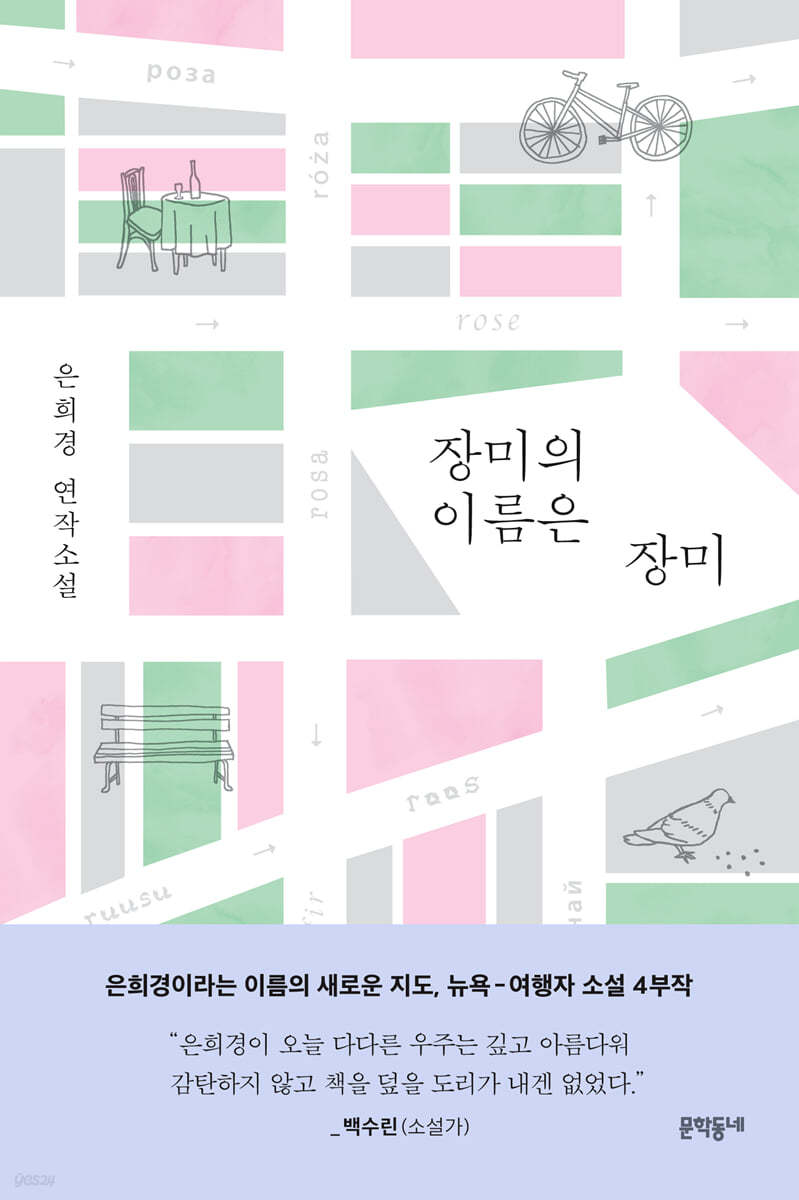
The name of the rose is rose
 |
Description
Book Introduction
- A word from MD
-
Eun Hee-kyung's New York-Traveler Novel Four-Part SeriesA series of four novels, including “The Name of the Rose is Rose,” which won the Oh Young-su Literary Award.
The characters in each work leave for New York, and when they leave their familiar space, the people standing next to them are strangers or strangers they once felt close to.
A new and welcome story that suddenly comes to me as I look at unfamiliar faces.January 18, 2022. Novel/Poetry PD Park Hyung-wook
The feeling of myself becoming clearer unexpectedly in the place I left to forget myself
Everything the most exceptional time in my life left me with
A New Map by Eun Hee-kyung, a New York-Traveler Novel Four-Part Series
Eun Hee-kyung, an icon of constant self-innovation, has published her seventh novel collection, “The Name of the Rose is Rose.”
Eun Hee-kyung, who has been read consistently for a long time and loved by everyone regardless of generation as a “writer of our time,” is publishing this short story collection six years after “Chinese Roulette.” It includes a total of four serial novels, including “The Name of the Rose is Rose,” which won the 29th Oh Young-su Literary Award, and was praised for “embodying the fundamental problem surrounding human relationships, ‘how should we understand others,’ with the author’s unique and refreshing style.”
Eun Hee-kyung, who has brought the unfamiliarity and joy of reading novels with sharp insight and intelligent, sophisticated prose, has completed another world in this collection by loosely connecting the characters in each work and using New York as the common setting.
A foreign country is a place where people are freed from their existing circumstances, but at the same time, prejudice against individuals is reinforced because they are evaluated based on factors beyond their control, such as nationality and race.
How will the way I see myself and others change through the eyes of a traveler?
"The Name of the Rose is Rose" is a sophisticated experiment in the style of Eun Hee-kyung, observing the reactions that follow by intersecting the three points of "foreigner-traveler-other," and is also a beautiful introduction to human studies that focuses the lens back on oneself through unfamiliar places and other people.
Everything the most exceptional time in my life left me with
A New Map by Eun Hee-kyung, a New York-Traveler Novel Four-Part Series
Eun Hee-kyung, an icon of constant self-innovation, has published her seventh novel collection, “The Name of the Rose is Rose.”
Eun Hee-kyung, who has been read consistently for a long time and loved by everyone regardless of generation as a “writer of our time,” is publishing this short story collection six years after “Chinese Roulette.” It includes a total of four serial novels, including “The Name of the Rose is Rose,” which won the 29th Oh Young-su Literary Award, and was praised for “embodying the fundamental problem surrounding human relationships, ‘how should we understand others,’ with the author’s unique and refreshing style.”
Eun Hee-kyung, who has brought the unfamiliarity and joy of reading novels with sharp insight and intelligent, sophisticated prose, has completed another world in this collection by loosely connecting the characters in each work and using New York as the common setting.
A foreign country is a place where people are freed from their existing circumstances, but at the same time, prejudice against individuals is reinforced because they are evaluated based on factors beyond their control, such as nationality and race.
How will the way I see myself and others change through the eyes of a traveler?
"The Name of the Rose is Rose" is a sophisticated experiment in the style of Eun Hee-kyung, observing the reactions that follow by intersecting the three points of "foreigner-traveler-other," and is also a beautiful introduction to human studies that focuses the lens back on oneself through unfamiliar places and other people.
- You can preview some of the book's contents.
Preview
index
Why and where are we for some time _007
The Name of the Rose is Rose _077
Palace without sheep and clock _137
Miss Yoo Jeong-do too _195
Author's Note _251
The Name of the Rose is Rose _077
Palace without sheep and clock _137
Miss Yoo Jeong-do too _195
Author's Note _251
Into the book
She has been wary of both irresponsible optimism and the pessimism that comes from self-pity.
I have been adapting to given conditions, thinking of myself as a realist.
But now, it was time to show that he wasn't always like that.
To yourself more than anyone else.
--- p.18 From “Why and Where We Are for How Long”
It was naive and narrow-minded to transfer your negative emotions onto someone close to you because it felt more comfortable when you had to deal with them.
--- p.38 From “Why and Where We Are for How Long”
If a relationship that starts off as close but then suddenly becomes incomprehensible is like a building built with a few wooden pillars called goodwill, then the relationship with a friend you spent your childhood with is like a cement house that has hardened over time with stones, sand, water, and a few impurities added to it.
--- p.41 From “Why and Where We Are for How Long”
Seung-ah, who didn't have much to show off, often used her writing skills to promote herself whenever she wrote her self-introduction.
The strengths she touted were mainly her sincerity and adaptability.
But emphasizing that there is something is often just an attempt to hide the fact that there is nothing else you want.
--- p.45 From “Why and Where We Are for How Long”
In fact, Sujin may have wanted to run away not only from the world around her, but also from herself.
An age when you're too scared to turn back and find a different path even after realizing you've come to the wrong place; a contract job that you somehow manage to stick with even though it never gets better; and relationships that suddenly made you realize these things, but ended up broken, shattered, and eventually disappeared.
Sujin believed that by leaving here, she would be able to escape, even if only for a moment, the age and life history that defined her.
--- p.90 From “The Name of the Rose is Rose”
Why did I leave?
The idea that when you no longer want to hate someone, rather than spending time alone and listlessly, you should try new things that are regularly and visibly progressing.
Why on earth did I think about such serious things?
Isn't that also a form of self-righteous seriousness that creates a framework within the categories I know and then judges meaning to fit that framework?
The weight of innocence that made me fall into hatred, turn away from forgiveness, and even lead to breakups, and the countless daily wounds and frustrations that arise from our differences, the complex thoughts that are not optimistic and the long arguments to convince them, am I still trapped in that frame?
Did I really leave?
--- p.117 From “The Name of the Rose is Rose”
Hyun-ju was dragged along by the given inertia, unable to trust her own judgment.
Despite my doubts, I continued to walk along the path before me, and eventually I came so far that I had no choice but to wholeheartedly believe that it was the right path.
--- p.150 From “The Palace Without Sheep and Clocks”
Tourists receive superficial hospitality while standing outside an open door.
But tourists are also divided into classes, and when that prejudice comes into play, it doesn't even apply to foreigners.
Just like in Greenwich Village, the door is closed right before your eyes.
--- p.173 From “The Palace Without Sheep and Clocks”
It was true that while it was clear that my mother was drawing a line, she was lenient towards those who had already entered it.
But that generosity may have stemmed from low expectations of others.
--- p.208 From “Miss Yoo Jeong Do”
Some dedications are taken for granted and are excluded from the calculation.
It was also strange how the moral interpretation of an individual's desires changed depending on the time and situation.
And I knew better than anyone that not everyone with strong narcissism is positive about their life.
--- p.210 From “Miss Yoo Jeong Do”
My mother reacted negatively to the words, "You don't look like a grandmother," just as much as to the words, "You look like a grandmother."
“If I treat her kindly, she says it’s because she’s a grandmother, but if I treat her coldly, she says it’s because she’s a grandmother, and in the end, the thought that my grandmother is kind doesn’t change.
But it has nothing to do with my cold personality or being a grandmother.
Then who would have thought wrong?
“Is it them or me?” “What’s so complicated and fussy about it?” My brother often got irritated whenever my mother said something unusual for a mother.
“Well, you’re still a grandmother,” my mother replied immediately.
“I am a grandmother, but I am not the grandmother that those people know.
“That’s why I’m telling you not to pretend to know.” My mother was right.
It was natural that my mother's narrative was different from anyone else's.
I have been adapting to given conditions, thinking of myself as a realist.
But now, it was time to show that he wasn't always like that.
To yourself more than anyone else.
--- p.18 From “Why and Where We Are for How Long”
It was naive and narrow-minded to transfer your negative emotions onto someone close to you because it felt more comfortable when you had to deal with them.
--- p.38 From “Why and Where We Are for How Long”
If a relationship that starts off as close but then suddenly becomes incomprehensible is like a building built with a few wooden pillars called goodwill, then the relationship with a friend you spent your childhood with is like a cement house that has hardened over time with stones, sand, water, and a few impurities added to it.
--- p.41 From “Why and Where We Are for How Long”
Seung-ah, who didn't have much to show off, often used her writing skills to promote herself whenever she wrote her self-introduction.
The strengths she touted were mainly her sincerity and adaptability.
But emphasizing that there is something is often just an attempt to hide the fact that there is nothing else you want.
--- p.45 From “Why and Where We Are for How Long”
In fact, Sujin may have wanted to run away not only from the world around her, but also from herself.
An age when you're too scared to turn back and find a different path even after realizing you've come to the wrong place; a contract job that you somehow manage to stick with even though it never gets better; and relationships that suddenly made you realize these things, but ended up broken, shattered, and eventually disappeared.
Sujin believed that by leaving here, she would be able to escape, even if only for a moment, the age and life history that defined her.
--- p.90 From “The Name of the Rose is Rose”
Why did I leave?
The idea that when you no longer want to hate someone, rather than spending time alone and listlessly, you should try new things that are regularly and visibly progressing.
Why on earth did I think about such serious things?
Isn't that also a form of self-righteous seriousness that creates a framework within the categories I know and then judges meaning to fit that framework?
The weight of innocence that made me fall into hatred, turn away from forgiveness, and even lead to breakups, and the countless daily wounds and frustrations that arise from our differences, the complex thoughts that are not optimistic and the long arguments to convince them, am I still trapped in that frame?
Did I really leave?
--- p.117 From “The Name of the Rose is Rose”
Hyun-ju was dragged along by the given inertia, unable to trust her own judgment.
Despite my doubts, I continued to walk along the path before me, and eventually I came so far that I had no choice but to wholeheartedly believe that it was the right path.
--- p.150 From “The Palace Without Sheep and Clocks”
Tourists receive superficial hospitality while standing outside an open door.
But tourists are also divided into classes, and when that prejudice comes into play, it doesn't even apply to foreigners.
Just like in Greenwich Village, the door is closed right before your eyes.
--- p.173 From “The Palace Without Sheep and Clocks”
It was true that while it was clear that my mother was drawing a line, she was lenient towards those who had already entered it.
But that generosity may have stemmed from low expectations of others.
--- p.208 From “Miss Yoo Jeong Do”
Some dedications are taken for granted and are excluded from the calculation.
It was also strange how the moral interpretation of an individual's desires changed depending on the time and situation.
And I knew better than anyone that not everyone with strong narcissism is positive about their life.
--- p.210 From “Miss Yoo Jeong Do”
My mother reacted negatively to the words, "You don't look like a grandmother," just as much as to the words, "You look like a grandmother."
“If I treat her kindly, she says it’s because she’s a grandmother, but if I treat her coldly, she says it’s because she’s a grandmother, and in the end, the thought that my grandmother is kind doesn’t change.
But it has nothing to do with my cold personality or being a grandmother.
Then who would have thought wrong?
“Is it them or me?” “What’s so complicated and fussy about it?” My brother often got irritated whenever my mother said something unusual for a mother.
“Well, you’re still a grandmother,” my mother replied immediately.
“I am a grandmother, but I am not the grandmother that those people know.
“That’s why I’m telling you not to pretend to know.” My mother was right.
It was natural that my mother's narrative was different from anyone else's.
--- p.229 From “Miss Yoo Jeong Do”
Publisher's Review
“The universe that Eunhee Kyung arrived at today is deep and beautiful.
“There was no way I could put the book down without being amazed.” _Baek Su-rin (novelist)
A New Map by Eun Hee-kyung, a New York-Traveler Novel Four-Part Series
Eun Hee-kyung, an icon of constant self-innovation, has published her seventh novel collection, “The Name of the Rose is Rose,” by Munhakdongne.
Eun Hee-kyung, who has been read consistently for a long time and loved by everyone regardless of generation as a “writer of our time,” is publishing this short story collection six years after “Chinese Roulette” (Changbi, 2016). It includes a total of four short stories including “The Name of the Rose is Rose,” which won the 29th Oh Young-su Literary Award and was praised for “embodying the fundamental problem surrounding human relationships, ‘how should we understand others,’ with the author’s signature, refreshing style.”
Eun Hee-kyung, who has brought the unfamiliarity and joy of reading novels with sharp insight and intelligent, sophisticated prose, has completed another world in this collection by loosely connecting the characters in each work and using New York as the common setting.
A foreign country is a place where people are freed from their existing circumstances, but at the same time, prejudice against individuals is reinforced because they are evaluated based on factors beyond their control, such as nationality and race.
How will the way I see myself and others change through the eyes of a traveler?
"The Name of the Rose is Rose" is a sophisticated experiment in the style of Eun Hee-kyung, observing the reactions that follow by intersecting the three points of "foreigner-traveler-other," and is also a beautiful introduction to human studies that focuses the lens back on oneself through unfamiliar places and other people.
“Someone’s distorted history starts out rosy.”
The feeling of myself becoming clearer unexpectedly in the place I left to forget myself
Everything the most exceptional time in my life left me with
What would happen if two friends who have been in a relationship for quite some time and think they know each other well were forced to live together in an unfamiliar foreign country?
"Why We Were Where For How Long" tensely portrays the days the two characters spend together from each character's perspective, tensely portraying the circumstances they are unaware of and the resulting misunderstandings.
Seung-ah leaves Korea with plans to stay for about ten days at her friend Min-young's house in New York.
Min-young impulsively leaves to live a different life from the one he had lived in until now, adapting to the given conditions, but when he arrives at his house, it looks old and worn out, contrary to his expectations.
Moreover, there are no towering buildings around, and the people's attire is far from that of New Yorkers.
In this situation, Seung-ah tries hard to clean the house and make detox juice for Min-yeong, but Min-yeong, far from being grateful, does not hide his displeasure.
Looking at that sight, Seung-ah thinks.
“What on earth could be the problem?
(…) How can he be so self-centered?” (pp. 67-68)
The main characters of "The Name of the Rose" are 'I', a 46-year-old divorced woman who left for New York alone, and 'Mamadou', a Senegalese college student she met at a language school.
Mamadou hardly speaks during class and doesn't get along well with anyone, but 'Na' often pairs up with Mamadou and gradually becomes closer to him.
Although we are different in gender, nationality, and age, I feel a strange sense of liberation when I talk to Mamadou because, unlike in Korea, I can speak clearly and intuitively in English.
With only a few weeks left in the language program, 'I' decide to go out for a meal with Mamadou for the first time.
But maybe it was because I was uncomfortable with the hot sunlight.
Mamadou's appearance, no different from usual, made me feel uneasy and naive that day, and my first outing with him started to go wrong.
However, both works do not stop at confirming their differences that were triggered by misunderstanding.
"Why We Were Where For How Long" depicts Seung-ah and Min-young sitting side by side, looking out at the East River, with a faint warmth as their conflict escalates, while "The Name of the Rose is Rose" meticulously retraces the time with Mamadou and inserts a scene of their future together, read in a soft voice during their last class.
That part, which is one of the most beautiful scenes in "The Name of the Rose", creates a small ripple in the mind of "I" who thought it was useless to imagine the future while not rushing to mend the moment when "I" and Mamadou were hurt by each other.
"The Palace Without Sheep and Clocks" and "Miss Yoo Jeong Do Not Do It" each feature characters who write, sharply revealing sensitivity to others and language.
Hyun-ju, who entered the playwriting department of an art college late in life and is working on a script for "The Palace Without Sheep and Clocks," is visiting the United States for the fourth time this year.
One of the reasons I was able to come to the US so regularly was because of the influence of 'Roan', whom I met three years ago when I first visited the US and went on a picnic with my cousin.
Rowan, who came here to study abroad when he was in middle school, spoke affectionately to Hyunju at the picnic that day and acted without hesitation.
However, as time passes, Rowan, who is dissatisfied with Hyun-joo not learning English in earnest, does not show consideration for her even when she is with her friends.
However, Hyun-ju does not miss the meeting with Rowan's friends.
I haven't decided yet who the main character will be, but I've decided to write about Rowan's friends.
But now that her relationship with Rowan is not the same as before, and her attitude toward strangers has become sharper due to COVID-19, Hyun-ju's heart is extremely sensitive and hardened as she heads out to meet up with her friends.
The 'I' in "Miss Yoo Jeong Do Ha Ji" is a novelist in her fifties who goes to New York as part of a literary event.
Accompanied by my mother, who is in her eighties and was not particularly proud of the fact that she was a writer and did not interfere with her children's work.
I feel anxious at the thought of having to spend five days with my mother, but once I arrive in New York, my mother behaves skillfully.
Moreover, the mother even makes plans to tour New York with Amy, a Korean high school student she met at a reading session.
Why on earth did my mother want to come here?
In the midst of all this, I stumble upon a very old airmail parcel in my mother's carrier.
The postcard, addressed to my mother's name, 'Choi Yu-jeong', was sent by a young man who had set foot on American soil about sixty years ago.
With the following content:
“Last weekend, I went to a place called Coney Island.
It really felt like it wasn't of this world.
I can't possibly capture that scenery in a letter.
“I always had a dream that one day I would walk along that beach with my loved one.” (p. 232)
The reason my mother wanted to come here so badly was probably because of that letter.
Sixty years ago, the young man's wish to visit Coney Island with him never came true, but perhaps his mother is trying to make that wish come true now.
My mother, who had always seemed cold and independent, began to seem like a different person to me at that moment.
And this is also a rare moment in Eun Hee-kyung's novels, which have maintained strict self-censorship and objectivity, where she lets out the characters' emotions and makes us feel touched.
This will also be a new look for Eun Hee-kyung, different from the existing Eun Hee-kyung we know.
For Eun Hee-kyung, who is more wary than anyone of being trapped in an "inertial framework of interpretation" and who meticulously observes the complexities of the world surrounding us with keen observation, perhaps "New York" is the place that best suits her novels.
Eun Hee-kyung's character is not afraid of going to an unfamiliar place, but has the flexibility to reflect on herself through others and heads to new places.
Still strict and sharp, yet harboring unexpected feelings toward others, “a faint sadness and friendship” (p. 185).
★
As a long-time reader, I knew that there aren't many novelists who can as coolly and sharply see through the secrets and misunderstandings that make up the world, and the resulting loneliness and contradictions of life between people, as Eun Hee-kyung.
But reading four novels set in New York City, I was struck again.
I never thought I would be moved by the lingering emotions after reading her novels, which are still flawless and precise.
How does Eun Hee-kyung manage to constantly renew herself like this? Her name is Eun Hee-kyung.
A writer who cannot be confined by any adjectives.
The universe that Eun-hee Kyung, who constantly expands her world, has reached today is so deep and beautiful that I couldn't put the book down without being amazed.
_Baek Su-rin ((novelist)
★
I'm compiling the novels I've written over the past two years into a book.
This is my fifteenth book.
But why am I suddenly feeling so clumsy? It's something I've been doing consistently, and it hasn't even been that long since I published a book. Why am I writing this with a stern face, wiping the sweat from my palms on my pants?
Suddenly, I feel like I know the answer.
These novels are a form of reflection that confesses my prejudices and impatience, so I seem to be nervous about whether I will be forgiven or not.
Although I tried hard to pretend it wasn't me, my self-righteous seriousness is evident in all four novels.
But as I once wrote, I hoped that the characters in my novels, even when they were discouraged and anxious, would not neglect themselves and would strive to empathize with others.
I hoped to find solidarity in loneliness.
So, I hope that I was sincere when I wrote this reflection, and that it will be safely conveyed to the judges of life and books, so that I can be pardoned and become freer as a writer.
_From the author's note
“There was no way I could put the book down without being amazed.” _Baek Su-rin (novelist)
A New Map by Eun Hee-kyung, a New York-Traveler Novel Four-Part Series
Eun Hee-kyung, an icon of constant self-innovation, has published her seventh novel collection, “The Name of the Rose is Rose,” by Munhakdongne.
Eun Hee-kyung, who has been read consistently for a long time and loved by everyone regardless of generation as a “writer of our time,” is publishing this short story collection six years after “Chinese Roulette” (Changbi, 2016). It includes a total of four short stories including “The Name of the Rose is Rose,” which won the 29th Oh Young-su Literary Award and was praised for “embodying the fundamental problem surrounding human relationships, ‘how should we understand others,’ with the author’s signature, refreshing style.”
Eun Hee-kyung, who has brought the unfamiliarity and joy of reading novels with sharp insight and intelligent, sophisticated prose, has completed another world in this collection by loosely connecting the characters in each work and using New York as the common setting.
A foreign country is a place where people are freed from their existing circumstances, but at the same time, prejudice against individuals is reinforced because they are evaluated based on factors beyond their control, such as nationality and race.
How will the way I see myself and others change through the eyes of a traveler?
"The Name of the Rose is Rose" is a sophisticated experiment in the style of Eun Hee-kyung, observing the reactions that follow by intersecting the three points of "foreigner-traveler-other," and is also a beautiful introduction to human studies that focuses the lens back on oneself through unfamiliar places and other people.
“Someone’s distorted history starts out rosy.”
The feeling of myself becoming clearer unexpectedly in the place I left to forget myself
Everything the most exceptional time in my life left me with
What would happen if two friends who have been in a relationship for quite some time and think they know each other well were forced to live together in an unfamiliar foreign country?
"Why We Were Where For How Long" tensely portrays the days the two characters spend together from each character's perspective, tensely portraying the circumstances they are unaware of and the resulting misunderstandings.
Seung-ah leaves Korea with plans to stay for about ten days at her friend Min-young's house in New York.
Min-young impulsively leaves to live a different life from the one he had lived in until now, adapting to the given conditions, but when he arrives at his house, it looks old and worn out, contrary to his expectations.
Moreover, there are no towering buildings around, and the people's attire is far from that of New Yorkers.
In this situation, Seung-ah tries hard to clean the house and make detox juice for Min-yeong, but Min-yeong, far from being grateful, does not hide his displeasure.
Looking at that sight, Seung-ah thinks.
“What on earth could be the problem?
(…) How can he be so self-centered?” (pp. 67-68)
The main characters of "The Name of the Rose" are 'I', a 46-year-old divorced woman who left for New York alone, and 'Mamadou', a Senegalese college student she met at a language school.
Mamadou hardly speaks during class and doesn't get along well with anyone, but 'Na' often pairs up with Mamadou and gradually becomes closer to him.
Although we are different in gender, nationality, and age, I feel a strange sense of liberation when I talk to Mamadou because, unlike in Korea, I can speak clearly and intuitively in English.
With only a few weeks left in the language program, 'I' decide to go out for a meal with Mamadou for the first time.
But maybe it was because I was uncomfortable with the hot sunlight.
Mamadou's appearance, no different from usual, made me feel uneasy and naive that day, and my first outing with him started to go wrong.
However, both works do not stop at confirming their differences that were triggered by misunderstanding.
"Why We Were Where For How Long" depicts Seung-ah and Min-young sitting side by side, looking out at the East River, with a faint warmth as their conflict escalates, while "The Name of the Rose is Rose" meticulously retraces the time with Mamadou and inserts a scene of their future together, read in a soft voice during their last class.
That part, which is one of the most beautiful scenes in "The Name of the Rose", creates a small ripple in the mind of "I" who thought it was useless to imagine the future while not rushing to mend the moment when "I" and Mamadou were hurt by each other.
"The Palace Without Sheep and Clocks" and "Miss Yoo Jeong Do Not Do It" each feature characters who write, sharply revealing sensitivity to others and language.
Hyun-ju, who entered the playwriting department of an art college late in life and is working on a script for "The Palace Without Sheep and Clocks," is visiting the United States for the fourth time this year.
One of the reasons I was able to come to the US so regularly was because of the influence of 'Roan', whom I met three years ago when I first visited the US and went on a picnic with my cousin.
Rowan, who came here to study abroad when he was in middle school, spoke affectionately to Hyunju at the picnic that day and acted without hesitation.
However, as time passes, Rowan, who is dissatisfied with Hyun-joo not learning English in earnest, does not show consideration for her even when she is with her friends.
However, Hyun-ju does not miss the meeting with Rowan's friends.
I haven't decided yet who the main character will be, but I've decided to write about Rowan's friends.
But now that her relationship with Rowan is not the same as before, and her attitude toward strangers has become sharper due to COVID-19, Hyun-ju's heart is extremely sensitive and hardened as she heads out to meet up with her friends.
The 'I' in "Miss Yoo Jeong Do Ha Ji" is a novelist in her fifties who goes to New York as part of a literary event.
Accompanied by my mother, who is in her eighties and was not particularly proud of the fact that she was a writer and did not interfere with her children's work.
I feel anxious at the thought of having to spend five days with my mother, but once I arrive in New York, my mother behaves skillfully.
Moreover, the mother even makes plans to tour New York with Amy, a Korean high school student she met at a reading session.
Why on earth did my mother want to come here?
In the midst of all this, I stumble upon a very old airmail parcel in my mother's carrier.
The postcard, addressed to my mother's name, 'Choi Yu-jeong', was sent by a young man who had set foot on American soil about sixty years ago.
With the following content:
“Last weekend, I went to a place called Coney Island.
It really felt like it wasn't of this world.
I can't possibly capture that scenery in a letter.
“I always had a dream that one day I would walk along that beach with my loved one.” (p. 232)
The reason my mother wanted to come here so badly was probably because of that letter.
Sixty years ago, the young man's wish to visit Coney Island with him never came true, but perhaps his mother is trying to make that wish come true now.
My mother, who had always seemed cold and independent, began to seem like a different person to me at that moment.
And this is also a rare moment in Eun Hee-kyung's novels, which have maintained strict self-censorship and objectivity, where she lets out the characters' emotions and makes us feel touched.
This will also be a new look for Eun Hee-kyung, different from the existing Eun Hee-kyung we know.
For Eun Hee-kyung, who is more wary than anyone of being trapped in an "inertial framework of interpretation" and who meticulously observes the complexities of the world surrounding us with keen observation, perhaps "New York" is the place that best suits her novels.
Eun Hee-kyung's character is not afraid of going to an unfamiliar place, but has the flexibility to reflect on herself through others and heads to new places.
Still strict and sharp, yet harboring unexpected feelings toward others, “a faint sadness and friendship” (p. 185).
★
As a long-time reader, I knew that there aren't many novelists who can as coolly and sharply see through the secrets and misunderstandings that make up the world, and the resulting loneliness and contradictions of life between people, as Eun Hee-kyung.
But reading four novels set in New York City, I was struck again.
I never thought I would be moved by the lingering emotions after reading her novels, which are still flawless and precise.
How does Eun Hee-kyung manage to constantly renew herself like this? Her name is Eun Hee-kyung.
A writer who cannot be confined by any adjectives.
The universe that Eun-hee Kyung, who constantly expands her world, has reached today is so deep and beautiful that I couldn't put the book down without being amazed.
_Baek Su-rin ((novelist)
★
I'm compiling the novels I've written over the past two years into a book.
This is my fifteenth book.
But why am I suddenly feeling so clumsy? It's something I've been doing consistently, and it hasn't even been that long since I published a book. Why am I writing this with a stern face, wiping the sweat from my palms on my pants?
Suddenly, I feel like I know the answer.
These novels are a form of reflection that confesses my prejudices and impatience, so I seem to be nervous about whether I will be forgiven or not.
Although I tried hard to pretend it wasn't me, my self-righteous seriousness is evident in all four novels.
But as I once wrote, I hoped that the characters in my novels, even when they were discouraged and anxious, would not neglect themselves and would strive to empathize with others.
I hoped to find solidarity in loneliness.
So, I hope that I was sincere when I wrote this reflection, and that it will be safely conveyed to the judges of life and books, so that I can be pardoned and become freer as a writer.
_From the author's note
GOODS SPECIFICS
- Date of issue: January 18, 2022
- Format: Hardcover book binding method guide
- Page count, weight, size: 256 pages | 356g | 133*195*20mm
- ISBN13: 9788954684736
- ISBN10: 8954684734
You may also like
카테고리
korean


korean

![GQ KOREA Mark (Monthly): December [2025]](http://librairie.coreenne.fr/cdn/shop/files/8ef265dbbfbf186523ed75ba7319009d.jpg?v=1765340328&width=3840)


