

Mremosa
 |
Description
Book Introduction
- A word from MD
-
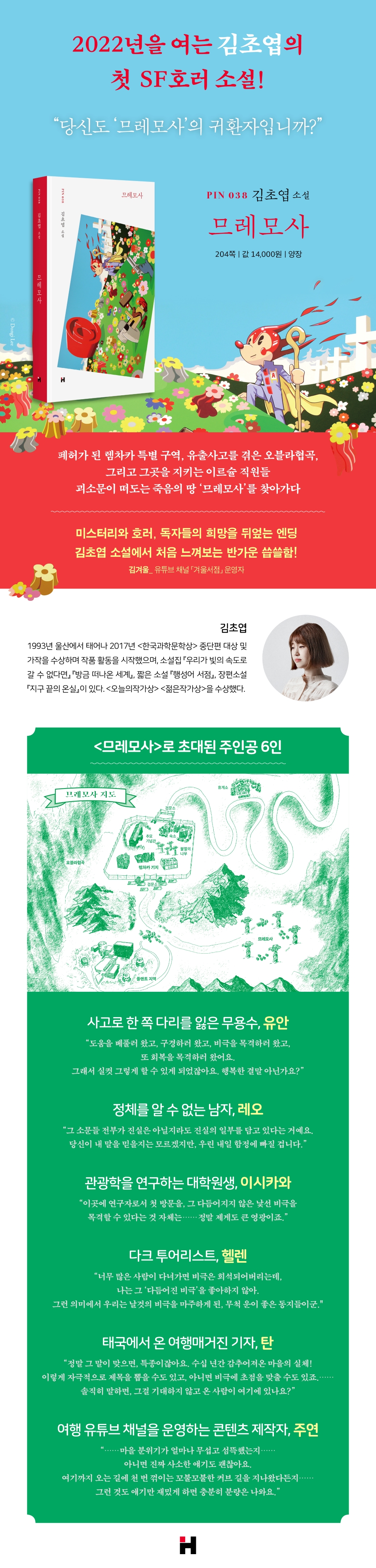
Kim Cho-yeop's first sci-fi horror filmThe returnees' village, 'Mremosa', built on the land of the dead, are invited there and begin a special journey, each with their own purpose.
The scenery is suspicious, the story is questionable, and the characters betray expectations.
We read the new possibilities of Kim Cho-yeop's novel, which came on a very appropriate day and has a different color from his previous novels.
December 31, 2021. Novel/Poetry PD Park Hyung-wook
Kim Cho-yeop's first sci-fi horror novel, opening 2022.
A village of returnees built on the dead land, the last dystopia on Earth.
“Are you also a returnee from Mremosa?”
The thirty-eighth novel in the special feature "Modern Literature Pin Series" of the monthly magazine [Modern Literature], which selects the most modern and cutting-edge writers of contemporary Korean literature and includes new poetry and novels, Kim Cho-yeop's "Mremosa" has been published.
Kim Cho-yeop, who made a splendid debut by winning both the grand prize and honorable mention in the short story category of the 2017 Korea Science Literature Award, has opened a new horizon for Korean literature beyond science fiction with his solid composition, delicate sentences, and expanded worldview. This new work is a revised version of the novel published in the March 2021 issue of [Modern Literature].
This novel portrays the stories of travelers who became the first tourists in Mremosa, a restricted area due to a chemical spill, and the unexpected truths projected onto the seemingly peaceful but upside-down fantasy city of Mremosa.
A village of returnees built on the dead land, the last dystopia on Earth.
“Are you also a returnee from Mremosa?”
The thirty-eighth novel in the special feature "Modern Literature Pin Series" of the monthly magazine [Modern Literature], which selects the most modern and cutting-edge writers of contemporary Korean literature and includes new poetry and novels, Kim Cho-yeop's "Mremosa" has been published.
Kim Cho-yeop, who made a splendid debut by winning both the grand prize and honorable mention in the short story category of the 2017 Korea Science Literature Award, has opened a new horizon for Korean literature beyond science fiction with his solid composition, delicate sentences, and expanded worldview. This new work is a revised version of the novel published in the March 2021 issue of [Modern Literature].
This novel portrays the stories of travelers who became the first tourists in Mremosa, a restricted area due to a chemical spill, and the unexpected truths projected onto the seemingly peaceful but upside-down fantasy city of Mremosa.
- You can preview some of the book's contents.
Preview
index
Mremosa 9
Work Commentary 185
Author's Note 200
Work Commentary 185
Author's Note 200
Detailed image
Into the book
* Toxic chemicals that began to spread at an uncontrollable rate.
The substances carried the wind, formed clouds, and caused rain, devastating the Lemchatka Special Area and nearby cities, crops, and water sources.
It was only after people started dying from unknown illnesses after drinking tap water that authorities decided they needed to evacuate people.
(……) In an instant, hundreds of thousands of people were forced to leave their homes, and Lemchaca and the surrounding mountains became a complete no-go zone, a land of death, a place where no human could set foot.
--- p.51
* While Yu-an was hesitating about what to say, Joo-yeon continued speaking in a refreshing voice.
“I think I know the truth.
Sister, you've come to meet the returnees of Mremosa? People who live bravely even in the land of death, who pursue life with hope...
So what if I really turned into a zombie?
Still, living is what matters.
Surely we have something to learn from the returnees.
On the other hand, my sister might be an inspiration to those people.
Oh, I'm already so nervous about doing an interview like that with my sister, aren't I?
--- pp.70~71
* “Are you saying that only travelers like you can discover the truth about Mremosa? Not the residents?”
Yuan asked in a mocking tone.
“I don’t think it’s necessary to express it that way, but I think it’s in a similar context.
"Does that offend you? You seem to have been uncomfortable with how others treated Mremosa from the beginning."
--- pp.79~80
“We came to help, we came to see, we came to witness tragedy, and we came to witness recovery.
So now you can do that to your heart's content, isn't that a happy ending?
The substances carried the wind, formed clouds, and caused rain, devastating the Lemchatka Special Area and nearby cities, crops, and water sources.
It was only after people started dying from unknown illnesses after drinking tap water that authorities decided they needed to evacuate people.
(……) In an instant, hundreds of thousands of people were forced to leave their homes, and Lemchaca and the surrounding mountains became a complete no-go zone, a land of death, a place where no human could set foot.
--- p.51
* While Yu-an was hesitating about what to say, Joo-yeon continued speaking in a refreshing voice.
“I think I know the truth.
Sister, you've come to meet the returnees of Mremosa? People who live bravely even in the land of death, who pursue life with hope...
So what if I really turned into a zombie?
Still, living is what matters.
Surely we have something to learn from the returnees.
On the other hand, my sister might be an inspiration to those people.
Oh, I'm already so nervous about doing an interview like that with my sister, aren't I?
--- pp.70~71
* “Are you saying that only travelers like you can discover the truth about Mremosa? Not the residents?”
Yuan asked in a mocking tone.
“I don’t think it’s necessary to express it that way, but I think it’s in a similar context.
"Does that offend you? You seem to have been uncomfortable with how others treated Mremosa from the beginning."
--- pp.79~80
“We came to help, we came to see, we came to witness tragedy, and we came to witness recovery.
So now you can do that to your heart's content, isn't that a happy ending?
--- p.179
Publisher's Review
Monthly Pin Novel, published by the monthly magazine 『Modern Literature』 on the 25th of every month.
〈Modern Literature Pin Series Novel Selection〉!
With the most modern and cutting-edge writers of contemporary Korean literature
The thirty-eighth book in the "Modern Literature Pin Series" novel collection has been published!
Kim Cho-yeop's first sci-fi horror novel, opening 2022.
A village of returnees built on the dead land, the last dystopia on Earth.
“Are you also a returnee from Mremosa?”
Since her debut, Kim Cho-yeop has published the short story collections “If We Can’t Travel at the Speed of Light” and “The World We Just Left,” the novels “The Girl in the Cylinder” and “Greenhouse at the End of the Earth,” and the short story “Planetary Bookstore,” establishing herself as a leading writer who has opened new horizons for Korean literature beyond science fiction literature.
In particular, Kim Cho-yeop's unique and irreplaceable novel world is gradually expanding by unfolding the social perspective on the disabled, the marginalized and excluded, the negative perception of failed lives, and the stigma of normal and abnormal into a fantastical and cosmic world.
In 『Greenhouse at the End of the Earth』, he brought a story from another time and space into the problematic reality, such as the crisis of isolation while uncovering the mystery of a ruined city where vines are rapidly multiplying, and led readers to a wondrous moment. In this new work 『Mremosa』, he once again thrills readers through the hidden truth of Mremosa, a land of death that has not been revealed to the outside world, and an ending that overturns expectations, through the protagonist Yu-an who suffers from hallucinations.
Mremossa, a city in Irshu, is completely cut off from the outside world due to a large-scale spill of toxic chemicals.
Yuan and five other visitors, invited to a place known as the land of ghosts and zombies, cannot hide their excitement at being the first to visit the place. However, on the first night of their trip, Yuan is confused when he hears a surprising story from Leo, who is staying in the next room.
Visitors who are increasingly drawn to Mremosa, which welcomes returnees first, forget their own travel purpose and fall into their trap. Yuan struggles with the pain to overcome everything, but Mremosa, a place where 'once you enter, you cannot leave', does not let him go easily.
This novel impressively highlights a dystopian world with diverse scenes of realistic human history, in which the protagonist, who has found salvation in a life of stagnation without action, confronts the truth of the "hidden village."
In fact, this dystopia was also a utopia for some, and “Mremosa” says, “The cold universe does not allow utopia.
It is a world that I will forever miss because it does not exist.
However, I now believe that what a novel can do is to confront that contradiction and try to imagine a path to another world,” is a novel that paradoxically puts into practice Kim Cho-yeop’s words.
The world that Yu-an will forever long for is a world without phantom limb pain or the pain of prosthetic limbs, a world without obsession with normalcy or easy objectification.
-Kim Gyul-wool (operator of the YouTube channel "Gyulwool Bookstore" and host of "Radio Book Club, This is Kim Gyul-wool")
Author's Note
With the pandemic making travel impossible, I'm looking into all sorts of travel documentaries and video content.
What I miss when I watch those videos is not the airport ride or the hotel lobby, but the moments of riding in a rattling tour van and heading somewhere.
The first meeting at the morning gathering place, sharing a ride with strangers, awkward glances, uncomfortable seats, carriers shaking on the van, winding dirt roads, the stuffy air inside the car, the rapidly changing foreign landscapes outside the square windows.
At that moment, 『Mremosa』 began with the determination to write a novel that begins with that strange tension.
(……) I like stories that arise from a failure of understanding, and this was an attempt to push the consequences of that failure into catastrophe.
While writing, there were moments when I realized, 'Ah, I used to like writing stories like this.'
A serious question for humanity
Why do we want to repeat the disaster so often?
The scene depicted by the occurrence and progression of the 'disaster' that occurred in Mremosa is not so unfamiliar.
The situation in Mremosa is not a dystopian future that has yet to come, as science fiction clichés.
Rather, the feeling evoked by the disaster of Mremosa is 'a familiar fear unheim unheimlich lich'.
(……) The narrative of ‘Mremosa’ can also be read as a question of ‘how to live’ along with the trauma after a disaster or with an ongoing disaster.
However, the narrative of this novel is far from the apocalyptic narrative of salvation that reflects the so-called 'history of human civilization' that has overcome the catastrophes of natural disasters, epidemics, and other disasters.
(……) In the narrative of ‘Mremosa’, there is only the past when the event occurred and the present.
The power of difference that arises from the repetition of these two tenses drives the narrative of 『Mremosa』.
So the question that this narrative poses is why the past of disaster does not disappear but is repeated, creating a 'zone of difficulty'.
no.
Rather, we should ask this:
Why do we try to repeat disasters so often?
-Kim Eun-ju, from “Work Commentary”
The thirty-eighth volume of the monthly "Pin Novel" published by the monthly magazine "Modern Literature"!
The "Modern Literature Pin Series" is a project that selects the most modern and cutting-edge writers of contemporary Korean literature, presents them in the monthly magazine "Modern Literature," and then publishes them in book form.
The single volumes presented here are individual works, but are also curated by six authors as a 'series'.
Modern literature hopes that the seriousness of this series will be ironically combined with the delicate lightness of the word 'pin'.
The <Modern Literature Pin Series> novel selection is also a monthly pin published by the monthly magazine 『Modern Literature』.
The follow-up issues, scheduled to be published on the 25th of each month, are designed to allow readers to see new works by Korea's top authors on a set date.
This is a kind of 'salary book' concept that is being introduced for the first time in Korean publishing history.
001 to 006 are composed of works by writers born between 1971 and 1973 and debuted between the late 1990s and 2000s, who are currently the backbone of Korean novels. 007 to 012 are composed of works by writers born between the late 1970s and early 1980s and debuted in the mid-to-late 2000s, who are currently the most active writers in Korean novels.
013 to 018 are comprised of works by authors born between the mid-to-late 1950s and the 1960s, who played a pivotal role in leading the development of contemporary Korean literature, and by authors who debuted between the 1980s and the mid-1990s. 019 to 024 are comprised of works by ambitious young authors who are writing a new history of Korean literature.
The Finn novels, which had been published by generation, were grouped and published under the category of genre novels in 025-030, and 031-036 were composed of works by writers born in the mid-to-late 1970s, when literature was at its peak.
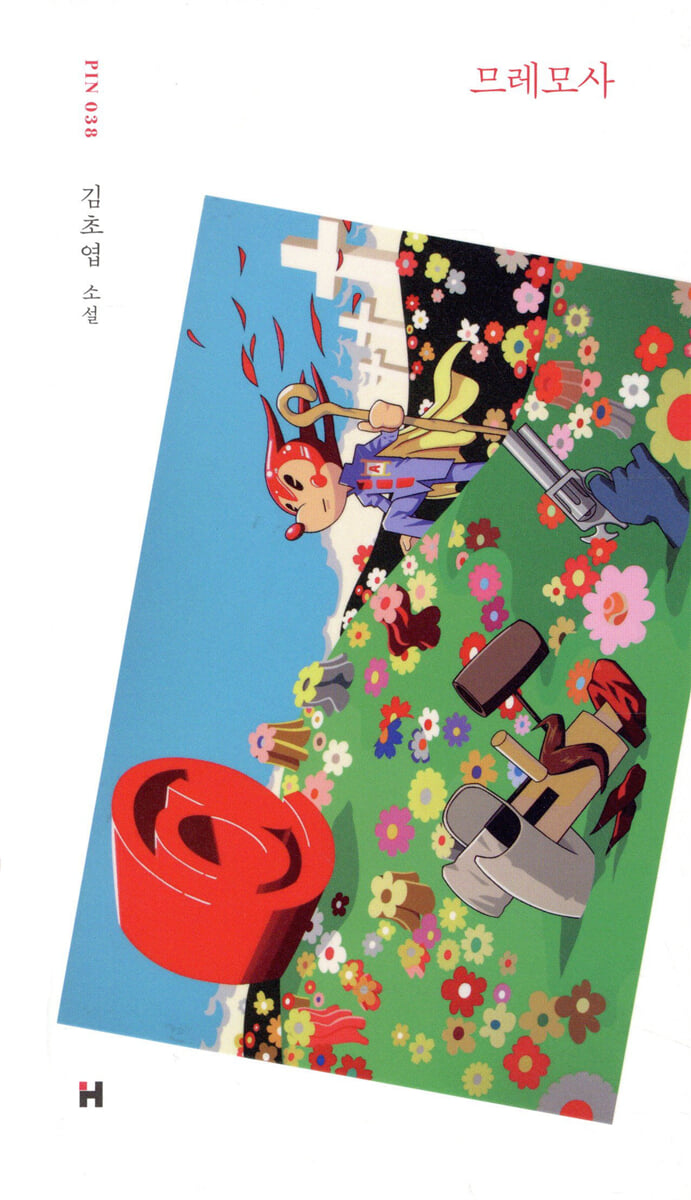
Modern Literature × Artist Lee Dong-gi
The "Modern Literature Pin Series" has become an original novel collection, an art anthology, reconstructed as a special work of art with a cover work imbued with the artist's soul.
The reason each novel possesses its own unique fragrance and profound artistic fascination is probably because of the spiritual harmony created by the meeting of the two worlds of novels and art.
Moving machine
He is an artist who introduced cartoon images into Korean modern art in earnest, and is known for a series of modern art works featuring the character 'Atomouse', which he created in 1993.
His works, which anticipated the 'neo-pop' trend in global art in the 2000s, deal with various elements of modern society. Through various visual and cultural elements ranging from comics, advertisements, and the Internet to classical paintings and abstract art, they suggest the complex relationships between heterogeneous realms such as reality and fiction, heaviness and lightness, material and spirit, and East and West.
He has held over 30 solo exhibitions at venues including the Michael Schultz Gallery in Berlin, the Willemkers Boom Gallery in Amsterdam, and the Ilmin Museum of Art in Seoul, and participated in exhibitions such as the 2011 Venice Biennale side exhibition 'Future Pass' and the 2005 Fukuoka Asian Art Museum 'Animate'.
〈Modern Literature Pin Series Novel Selection〉!
With the most modern and cutting-edge writers of contemporary Korean literature
The thirty-eighth book in the "Modern Literature Pin Series" novel collection has been published!
Kim Cho-yeop's first sci-fi horror novel, opening 2022.
A village of returnees built on the dead land, the last dystopia on Earth.
“Are you also a returnee from Mremosa?”
Since her debut, Kim Cho-yeop has published the short story collections “If We Can’t Travel at the Speed of Light” and “The World We Just Left,” the novels “The Girl in the Cylinder” and “Greenhouse at the End of the Earth,” and the short story “Planetary Bookstore,” establishing herself as a leading writer who has opened new horizons for Korean literature beyond science fiction literature.
In particular, Kim Cho-yeop's unique and irreplaceable novel world is gradually expanding by unfolding the social perspective on the disabled, the marginalized and excluded, the negative perception of failed lives, and the stigma of normal and abnormal into a fantastical and cosmic world.
In 『Greenhouse at the End of the Earth』, he brought a story from another time and space into the problematic reality, such as the crisis of isolation while uncovering the mystery of a ruined city where vines are rapidly multiplying, and led readers to a wondrous moment. In this new work 『Mremosa』, he once again thrills readers through the hidden truth of Mremosa, a land of death that has not been revealed to the outside world, and an ending that overturns expectations, through the protagonist Yu-an who suffers from hallucinations.
Mremossa, a city in Irshu, is completely cut off from the outside world due to a large-scale spill of toxic chemicals.
Yuan and five other visitors, invited to a place known as the land of ghosts and zombies, cannot hide their excitement at being the first to visit the place. However, on the first night of their trip, Yuan is confused when he hears a surprising story from Leo, who is staying in the next room.
Visitors who are increasingly drawn to Mremosa, which welcomes returnees first, forget their own travel purpose and fall into their trap. Yuan struggles with the pain to overcome everything, but Mremosa, a place where 'once you enter, you cannot leave', does not let him go easily.
This novel impressively highlights a dystopian world with diverse scenes of realistic human history, in which the protagonist, who has found salvation in a life of stagnation without action, confronts the truth of the "hidden village."
In fact, this dystopia was also a utopia for some, and “Mremosa” says, “The cold universe does not allow utopia.
It is a world that I will forever miss because it does not exist.
However, I now believe that what a novel can do is to confront that contradiction and try to imagine a path to another world,” is a novel that paradoxically puts into practice Kim Cho-yeop’s words.
The world that Yu-an will forever long for is a world without phantom limb pain or the pain of prosthetic limbs, a world without obsession with normalcy or easy objectification.
-Kim Gyul-wool (operator of the YouTube channel "Gyulwool Bookstore" and host of "Radio Book Club, This is Kim Gyul-wool")
Author's Note
With the pandemic making travel impossible, I'm looking into all sorts of travel documentaries and video content.
What I miss when I watch those videos is not the airport ride or the hotel lobby, but the moments of riding in a rattling tour van and heading somewhere.
The first meeting at the morning gathering place, sharing a ride with strangers, awkward glances, uncomfortable seats, carriers shaking on the van, winding dirt roads, the stuffy air inside the car, the rapidly changing foreign landscapes outside the square windows.
At that moment, 『Mremosa』 began with the determination to write a novel that begins with that strange tension.
(……) I like stories that arise from a failure of understanding, and this was an attempt to push the consequences of that failure into catastrophe.
While writing, there were moments when I realized, 'Ah, I used to like writing stories like this.'
A serious question for humanity
Why do we want to repeat the disaster so often?
The scene depicted by the occurrence and progression of the 'disaster' that occurred in Mremosa is not so unfamiliar.
The situation in Mremosa is not a dystopian future that has yet to come, as science fiction clichés.
Rather, the feeling evoked by the disaster of Mremosa is 'a familiar fear unheim unheimlich lich'.
(……) The narrative of ‘Mremosa’ can also be read as a question of ‘how to live’ along with the trauma after a disaster or with an ongoing disaster.
However, the narrative of this novel is far from the apocalyptic narrative of salvation that reflects the so-called 'history of human civilization' that has overcome the catastrophes of natural disasters, epidemics, and other disasters.
(……) In the narrative of ‘Mremosa’, there is only the past when the event occurred and the present.
The power of difference that arises from the repetition of these two tenses drives the narrative of 『Mremosa』.
So the question that this narrative poses is why the past of disaster does not disappear but is repeated, creating a 'zone of difficulty'.
no.
Rather, we should ask this:
Why do we try to repeat disasters so often?
-Kim Eun-ju, from “Work Commentary”
The thirty-eighth volume of the monthly "Pin Novel" published by the monthly magazine "Modern Literature"!
The "Modern Literature Pin Series" is a project that selects the most modern and cutting-edge writers of contemporary Korean literature, presents them in the monthly magazine "Modern Literature," and then publishes them in book form.
The single volumes presented here are individual works, but are also curated by six authors as a 'series'.
Modern literature hopes that the seriousness of this series will be ironically combined with the delicate lightness of the word 'pin'.
The <Modern Literature Pin Series> novel selection is also a monthly pin published by the monthly magazine 『Modern Literature』.
The follow-up issues, scheduled to be published on the 25th of each month, are designed to allow readers to see new works by Korea's top authors on a set date.
This is a kind of 'salary book' concept that is being introduced for the first time in Korean publishing history.
001 to 006 are composed of works by writers born between 1971 and 1973 and debuted between the late 1990s and 2000s, who are currently the backbone of Korean novels. 007 to 012 are composed of works by writers born between the late 1970s and early 1980s and debuted in the mid-to-late 2000s, who are currently the most active writers in Korean novels.
013 to 018 are comprised of works by authors born between the mid-to-late 1950s and the 1960s, who played a pivotal role in leading the development of contemporary Korean literature, and by authors who debuted between the 1980s and the mid-1990s. 019 to 024 are comprised of works by ambitious young authors who are writing a new history of Korean literature.
The Finn novels, which had been published by generation, were grouped and published under the category of genre novels in 025-030, and 031-036 were composed of works by writers born in the mid-to-late 1970s, when literature was at its peak.
Modern Literature × Artist Lee Dong-gi
The "Modern Literature Pin Series" has become an original novel collection, an art anthology, reconstructed as a special work of art with a cover work imbued with the artist's soul.
The reason each novel possesses its own unique fragrance and profound artistic fascination is probably because of the spiritual harmony created by the meeting of the two worlds of novels and art.
Moving machine
He is an artist who introduced cartoon images into Korean modern art in earnest, and is known for a series of modern art works featuring the character 'Atomouse', which he created in 1993.
His works, which anticipated the 'neo-pop' trend in global art in the 2000s, deal with various elements of modern society. Through various visual and cultural elements ranging from comics, advertisements, and the Internet to classical paintings and abstract art, they suggest the complex relationships between heterogeneous realms such as reality and fiction, heaviness and lightness, material and spirit, and East and West.
He has held over 30 solo exhibitions at venues including the Michael Schultz Gallery in Berlin, the Willemkers Boom Gallery in Amsterdam, and the Ilmin Museum of Art in Seoul, and participated in exhibitions such as the 2011 Venice Biennale side exhibition 'Future Pass' and the 2005 Fukuoka Asian Art Museum 'Animate'.
GOODS SPECIFICS
- Publication date: December 25, 2021
- Format: Hardcover book binding method guide
- Page count, weight, size: 204 pages | 392g | 111*190*28mm
- ISBN13: 9791167900821
- ISBN10: 1167900820
You may also like
카테고리
korean


korean

![GQ KOREA Mark (Monthly): December [2025]](http://librairie.coreenne.fr/cdn/shop/files/8ef265dbbfbf186523ed75ba7319009d.jpg?v=1765340328&width=3840)


