

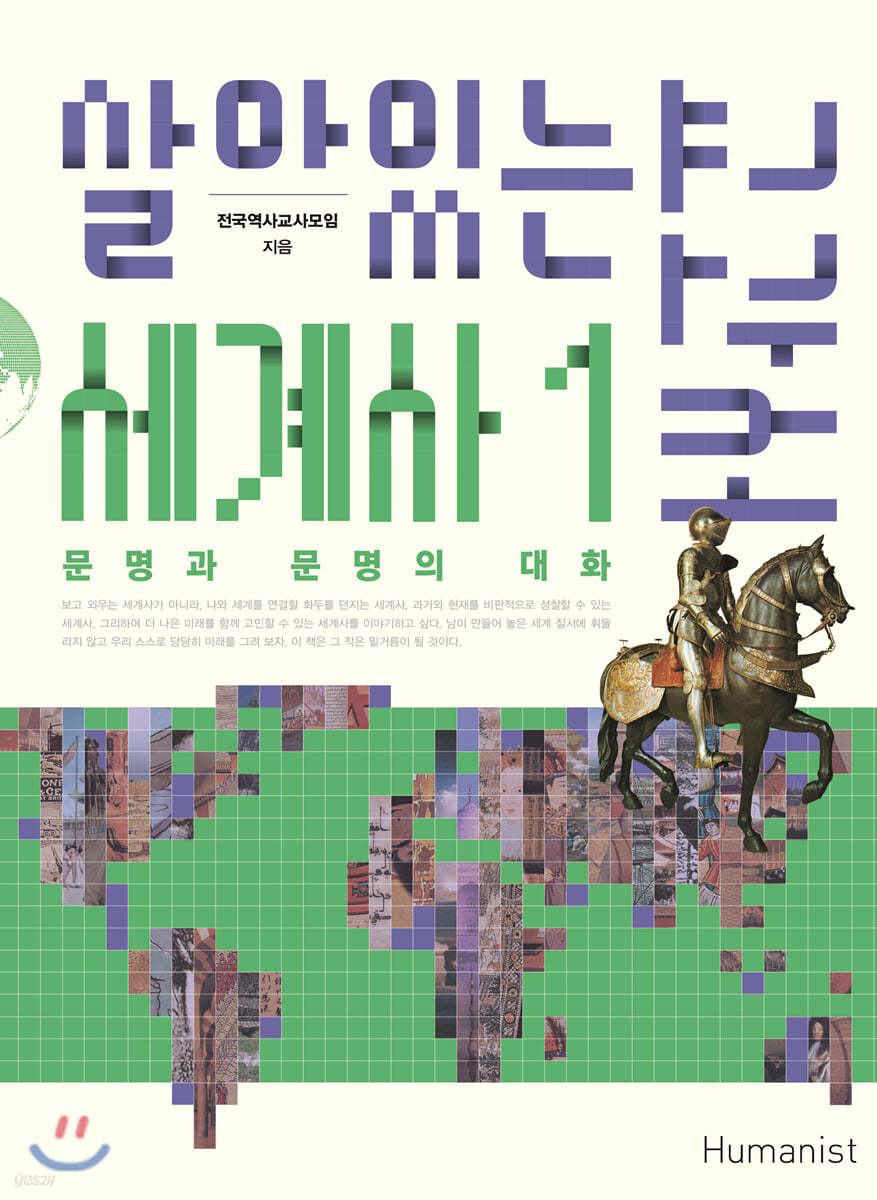
Living World History Textbook 1
 |
Description
Book Introduction
Living World History Textbook 1
Let's throw away old, boring textbooks and embrace living history! Following the March 2002 publication of "Living Korean History Textbooks 1 and 2," which touted itself as an "alternative textbook," "Living World History Textbooks 1 and 2," which will transform our perspectives on the world beyond our own, has been published.
Development period: 3 years and 6 months, 175 developers, development cost: 300 million won, production cost: 300 million won.
As the above figures suggest, the World History Project was, in a word, a revolution in the concept of 21st century Korean textbooks.
Breaking away from the textbook format, the book is written in a way that allows for a quick read, and features meticulously detailed illustrations and photographs, making it an innovative and novel text that offers a fresh perspective with each page.
More important than the 'perspective' and method of describing and developing world history is the question of 'who will write it?'
The 2,000 or so history teachers of the National History Teachers Association, who had already written 『Living Korean History Textbooks 1 and 2』, and the 10 history teachers who are the authors of this book, worked to ensure that our youth, who will live in the 21st century, can perceive the world through our eyes and with our stories, breaking away from the Western-centric perspective of 'Europe as the lead, China as the supporting role.'
In addition, we maintained a perspective that enables people to pursue peace, democracy, and a humane life, and we made it possible to read world history and Korean history within the larger context.
Education, after all, provides a framework that allows one to view the world and the future through one's own eyes.
However, textbooks filled with existing fossilized knowledge have failed to provide this.
『Living World History Textbook 1,2』will serve as a guide to looking into today's world and suggesting the world we will live in in the future.
Development period: 3 years and 6 months, 175 developers, development cost: 300 million won, production cost: 300 million won.
As the above figures suggest, the World History Project was, in a word, a revolution in the concept of 21st century Korean textbooks.
Breaking away from the textbook format, the book is written in a way that allows for a quick read, and features meticulously detailed illustrations and photographs, making it an innovative and novel text that offers a fresh perspective with each page.
More important than the 'perspective' and method of describing and developing world history is the question of 'who will write it?'
The 2,000 or so history teachers of the National History Teachers Association, who had already written 『Living Korean History Textbooks 1 and 2』, and the 10 history teachers who are the authors of this book, worked to ensure that our youth, who will live in the 21st century, can perceive the world through our eyes and with our stories, breaking away from the Western-centric perspective of 'Europe as the lead, China as the supporting role.'
In addition, we maintained a perspective that enables people to pursue peace, democracy, and a humane life, and we made it possible to read world history and Korean history within the larger context.
Education, after all, provides a framework that allows one to view the world and the future through one's own eyes.
However, textbooks filled with existing fossilized knowledge have failed to provide this.
『Living World History Textbook 1,2』will serve as a guide to looking into today's world and suggesting the world we will live in in the future.
- You can preview some of the book's contents.
Preview
index
preface
1.
A world where we live together
2.
To establish a country and create a civilization
3.
Vast empire, great faith
4.
The Islamic world, embracing deserts and grasslands
5.
Europe carrying the cross
6.
India, the River of the Soul, Southeast Asia Open to the Sea
7.
East Asia, winding from Chang'an to Nara
8.
The Mongol Empire Crosses Eurasia
9.
The expanding Islamic world
10.
Europe crossing the Atlantic
11.
Ming and Qing Empires and East Asia
12.
A World Becoming One, a Meeting of Civilizations
1.
A world where we live together
2.
To establish a country and create a civilization
3.
Vast empire, great faith
4.
The Islamic world, embracing deserts and grasslands
5.
Europe carrying the cross
6.
India, the River of the Soul, Southeast Asia Open to the Sea
7.
East Asia, winding from Chang'an to Nara
8.
The Mongol Empire Crosses Eurasia
9.
The expanding Islamic world
10.
Europe crossing the Atlantic
11.
Ming and Qing Empires and East Asia
12.
A World Becoming One, a Meeting of Civilizations
Detailed image
Publisher's Review
Living World History Textbook
Korean history teachers rewrote world history.
It rejected the superiority of the West or the universality of Western modernity and focused on experiencing various forms of life while taking cultural diversity into consideration.
The theme that runs through the entire story is the recognition of world history that pursues peace, democracy, and a humane life.
By focusing on the status of minorities, the book depicts a world history that pursues coexistence and solidarity, and by reflectively examining the social changes brought about by science and technology, it allows us to contemplate alternative ways of living to individualism, competition, and success-oriented thinking.
Above all, I attempted to explain the 'road not taken'.
For example, we actively sought to discover and introduce people and arguments calling for peace amidst the turmoil of war, and even if they were not realized, we sought to find a path we should take.
Rather than knowing the history that 'has become that way', we aim for a healthy history and peace by also thinking about the history that 'should have become that way'.
"Seeing Asian history through Korean eyes, reading world history beyond the Eurocentric lens" - A perspective on world history
Why is Europe a continent? Europe is simply a huge peninsula on the western side of the Eurasian continent, connected to Asia.
But why could it be a continent?
Western history begins with Greek and Roman civilization. But what does Greek and Roman civilization have to do with the history of Britain or Germany? Have you ever wondered this?
Did Europe usher in the modern era because it was originally strong or advanced? Or did it become strong through invasion?
We have been instilled with a Western-centric view of history from a young age through history textbooks, history education, and history education books.
Current world history textbooks contain a Western-centric view of history.
It is a world history with 'European history as the lead' and 'Chinese history as the supporting'.
We will look closely at how Europe has developed, and Asia will only be explored by looking at China.
It is based on the division of world history into three periods: ancient, medieval, and modern.
From this perspective, other regions appear to be developing more slowly than Europe.
The Western powers that currently dominate the world are perceiving it as they always have been.
《Living World History Textbook》 rejects the superiority of the West or the universality of Western modernity, and focuses on encountering various forms of life while taking cultural diversity into consideration.
Instead of focusing too heavily on Europe, we sought to increase understanding of world civilizations and various regions.
By adding geographical divisions to the concept of historical civilizations, the world was divided into seven regions, with the four major civilizations of Europe, West Asia, South Asia, and East Asia as the center, and Central Asia, Southeast Asia, and Africa as the sub-regions, thereby significantly broadening the world's perspective.
The theme that runs through the entire book is “a world history that aims for peace, democracy, and a humane life.”
By focusing on the status of minorities, we aim to create a world history that promotes coexistence and solidarity, and by reflectively examining the social changes brought about by science and technology, we aim to create a history that allows us to contemplate alternative ways of living to individualism, competition, and success-oriented thinking.
Above all, I attempted to explain the 'road not taken'.
For example, we actively sought to discover and introduce people and arguments calling for peace amidst the turmoil of war, and even if they were not realized, we sought to find a path we should take.
Rather than knowing the history that 'has become that way', we aim for a healthy history and peace by also thinking about the history that 'should have become that way'.
Eleven Korean history teachers rewrote world history for Korean youth over three years - National History Teachers Association
Three full years have passed.
We have made every effort to realize the world history we see with our own eyes.
I believe that this is an effort to create a peaceful and healthy society in the future by interacting with people around the world with a warm perspective on their diverse cultures.
Thus, we dream that our youth will become global citizens with a strong sense of purpose and a generous mindset in the 21st century.
Now, we take the first step toward world history for Koreans.
-From the publisher's note
More important than the 'viewpoint' that constitutes world history is the question of 'who will write it.'
This is in line with the question, 'For whom will you write?'
Over 2,000 history teachers from the National History Teachers Association and the 11 authors of this book rewrote world history over three years and six months for the youth of 21st century Korea and the world.
The National History Teachers Association believed that history classes should go beyond lectures and memorization and become vivid stories and moving experiences, and that textbooks should go beyond textbooks that are just a summary of introductory texts and list dead knowledge, and that textbooks should be created that see the world through the eyes of children and contain the future they will open.
By pouring in the passion, dedication, and ability of the past 10 years, we published “A Living Korean History Textbook” in March 2002, which has reached over 300,000 readers to date, clearly imprinting the concept of a “living alternative textbook” in a single book. This led to a forced march into world history, and after 3 years and 6 months of effort, we finally published “A Living World History Textbook.”
What makes "Living World History Textbook" particularly special is that, in a world where there are only regional histories covering Europe and China, and where there are few history books covering the histories of various countries around the world or world history in general, this is a masterpiece that allows us to read Asian history through the eyes of Koreans and view world history beyond the Eurocentric perspective.
It is the fruit of a desire to go beyond outdated textbooks and history education, and a sense of responsibility that textbooks must be written by teachers.
World History: A Guide to Peace, Democracy, and a Humane World
It consists of two volumes: one volume on pre-modern history and one volume on modern and contemporary history.
The two volumes were combined to form a single textbook, but each volume could also function as an independent book.
The overarching theme is “World History Awareness for 21st Century Korean Youth - World History Awareness for Peace, Democracy, and a Humane World,” and each volume is divided into two core concepts to ensure a clear theme.
ㆍVolume 1 - Dialogue between Civilizations
The keywords of Volume 1 are ‘civilization’ and ‘relationships.’
It covers pre-modern world history, starting from the formation of the civilized world.
By approaching human experience from a historical perspective, we understand the characteristics of various civilizations that were formed through adaptation to or confrontation with nature, or through cooperation or struggle with other human groups.
Based on this, we learned to understand and tolerate others and explore alternative values of the 21st century.
By abolishing the Eurocentric three-division system of ancient, medieval, and modern times and taking “the establishment of civilization and individual nations and dynasties – the formation and exchange of the regional world – the establishment and integration of world history” as the main theme, it was possible to understand the history of nations and regions “in their relationships” without losing sight of the overall flow of world history and paying attention to the relationships between nations and regions.
Volume 2 - Creating a Hopeful Future in the 21st Century
Volume 2 covers modern and contemporary history.
Capitalism, the nation-state, and the world system formed through the double revolution were considered the characteristics of modernity, and the homogeneity between modern and contemporary times was emphasized rather than the differences in terms of the order formed around this time being enforced to the present day.
Rather than considering ‘realized Western modernity’ as something universal, they focused on objectifying and relativizing it.
In particular, it gave significant weight to the national movements and anti-colonial lines in the Asian and African regions that had previously received little attention.
In particular, it vividly portrays the concerns and practices of the people who lived in that era, befitting the phrase ‘creating the future.’
ㆍRelates the flow of world history to Korean history.
《Living World History Textbook》 focuses on the connection between world history and Korean history, and actively addresses the world perception of contemporary Koreans and the key issues in world perception needed by 21st-century Korean youth.
In terms of content, the focus was on East Asia among various regions of Asia, with special emphasis on the history of relations between Korea, China, and Japan.
In Volume 1, Korean history is considered a part of East Asian history, and a point of intersection with the world is established, and a path is set for East Asia to meet the European world through South Asia and West Asia.
Volume 2 examines the process of full-scale integration of world history, examines the path to our own independent modernization, and is designed to foster reflective thinking that serves as the foundation for peaceful development toward a future society.
Through this, we have considered ways to correctly understand our history, which has been distorted by our past colonial experiences, and to enable us to actively participate in the flow of world history.
Focusing on people and events, ultimately discovering who they are and who I am - Unit Structure
Each volume is divided into 12 units.
Chapters 1 and 12 of each volume serve as entry and exit points, introducing the book's main perspectives and cases.
The beginning of Volume 1 addressed the question of how to view the world from a subjective perspective, and the conclusion of Volume 2 presented the path forward for a world history of peace and coexistence.
Through this, we have guided people to cultivate a healthy worldview with historical insight that transcends the boundaries between world history and Korean history.
Volume 1 unfolds the story in the following order: “Establishment of civilization → Characteristics of civilizations, comparison between civilizations → Formation of world history and development of regional worlds,” while Volume 2 unfolds the story in the following order: “Formation of Western modernity → Nation-state movement in Asia → Imperialist war and practice for peace → Construction of nation-states in Asia and the Cold War order → Decolonization movement and unrest in the Cold War order → Globalization and the post-Cold War world.”
Just by looking at the title of each chapter, the content is clear at a glance, and the subject matter is clearly defined to the extent that you can guess what kind of story is being told.
The development of world history is explained in chronological order, focusing on political and economic changes, but the content is structured and described so that people and events stand out rather than issues of systems or structures.
Volume 1, which pursues a 'dialogue between civilizations,' places a high emphasis on cultural history, while also not forgetting to consider the history of people's lives.
This is because I decided that experiencing various forms of life is the way to know 'who they are and who I am.'
In the case of the second volume, which seeks a 'critical reflection on modernity', attention is paid to the status of minorities, and it becomes a world history that aims for coexistence and solidarity.
The importance of the history of science and technology and the history of intellect was increased because we wanted to create a history that reflectively examines the social changes brought about by science and technology and contemplates alternative ways of living to individualism, competition, and success-oriented thinking.
The Flower of Publishing: Opening a New Chapter in Textbook Editing - Editorial Design
Introduction: Suggesting the spirit and narrative of the times.
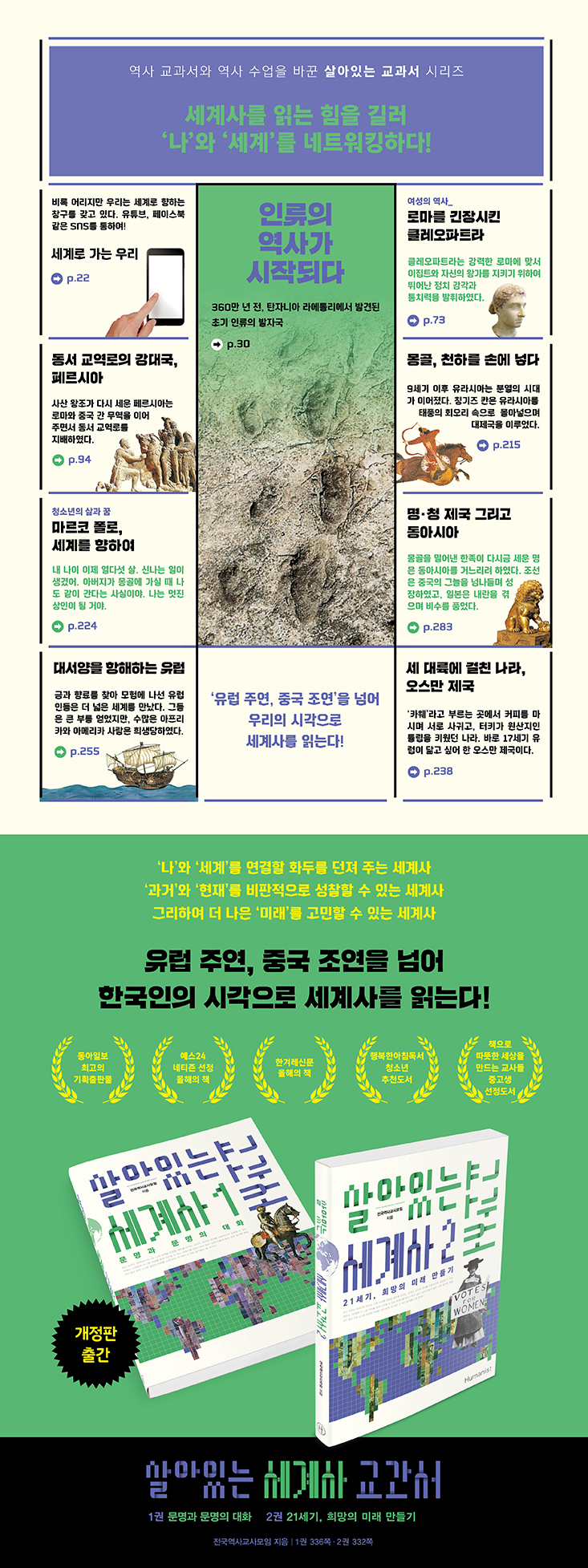
The text is naturally connected to the main text through photography, typography, and photomontage.
Title: The theme is clearly revealed.
Icon: A condensation of time, space, people and events.
Body: A comprehensive text that can be read in one sitting.
Rather than explaining things, the reader is allowed to enter a specific time and space through clues provided, and then meet the protagonist. Then, through the protagonist's movements, the reader is allowed to experience the events and changes of the times for themselves.
The title and body of the text are combined to make it easy to read at a glance.
Map Illustration: Securing the time and space of world history and expressing the ‘path of history.’
Illustration: Reproduce the main background of the period in a painting style.
Photo-montage: A comprehensive reading of history, not a list of narratives and facts.
The key is to read, not just look at the pictures.
Discovering historical materials and stories closely related to the lives of young people - Special Composition
ㆍYouth's life and dreams
We captured the footsteps of young people so that we could see that the power to lead history and change the world comes from young people.
Volume 1 describes the life and education of youth from the perspective of ‘youth’s life and education’.
It showed the lives of youth in history through their efforts to become respectable members of society through coming-of-age ceremonies and their studies at school.
Volume 2 describes the social problems faced throughout history and the efforts of young people to overcome them.
The image of being devoted to national movements such as the March 1st Movement and the May 4th Movement, the image of opposing evil practices such as apartheid and dreaming of a just society, the image of opposing war and praying for peace, etc.
ㆍWomen's History
There can be no history without women, as half the world is made up of women.
Through the stories of hidden and excluded women, we were able to see that women were also subjects of history.
In Volume 1, the lives of women, their sacrifices, and their suffering were candidly revealed from the perspective of “women’s ideals and reality,” while in Volume 2, the subjective appearance of women who led history was more actively addressed from the perspective of “efforts and practices for gender equality.”
Cultural Heritage Tour
The screen was designed to allow one to immerse oneself in the world of cultural heritage while taking a leisurely stroll, as the word "outing" suggests.
Rather than simply listing splendid cultural assets, it also presents content that deepens the text's critical awareness and its significance in the contemporary era, thereby allowing for recognition of its high value as a cultural asset.
We have taken care to ensure that you can appreciate the essence of each culture and experience its fragrance.
ㆍMeet the times
This page specifically introduces people who have worked for peace, democracy, and a humane life.
The selection was centered around people who lived alternative lives that represented the era or replaced the spirit of the times.
Life and thoughts are presented in an interesting way by presenting chronology, anecdotes, essays containing opinions, and appropriate scenes.
It rejected the superiority of the West or the universality of Western modernity and focused on experiencing various forms of life while taking cultural diversity into consideration.
The theme that runs through the entire story is the recognition of world history that pursues peace, democracy, and a humane life.
By focusing on the status of minorities, the book depicts a world history that pursues coexistence and solidarity, and by reflectively examining the social changes brought about by science and technology, it allows us to contemplate alternative ways of living to individualism, competition, and success-oriented thinking.
Above all, I attempted to explain the 'road not taken'.
For example, we actively sought to discover and introduce people and arguments calling for peace amidst the turmoil of war, and even if they were not realized, we sought to find a path we should take.
Rather than knowing the history that 'has become that way', we aim for a healthy history and peace by also thinking about the history that 'should have become that way'.
"Seeing Asian history through Korean eyes, reading world history beyond the Eurocentric lens" - A perspective on world history
Why is Europe a continent? Europe is simply a huge peninsula on the western side of the Eurasian continent, connected to Asia.
But why could it be a continent?
Western history begins with Greek and Roman civilization. But what does Greek and Roman civilization have to do with the history of Britain or Germany? Have you ever wondered this?
Did Europe usher in the modern era because it was originally strong or advanced? Or did it become strong through invasion?
We have been instilled with a Western-centric view of history from a young age through history textbooks, history education, and history education books.
Current world history textbooks contain a Western-centric view of history.
It is a world history with 'European history as the lead' and 'Chinese history as the supporting'.
We will look closely at how Europe has developed, and Asia will only be explored by looking at China.
It is based on the division of world history into three periods: ancient, medieval, and modern.
From this perspective, other regions appear to be developing more slowly than Europe.
The Western powers that currently dominate the world are perceiving it as they always have been.
《Living World History Textbook》 rejects the superiority of the West or the universality of Western modernity, and focuses on encountering various forms of life while taking cultural diversity into consideration.
Instead of focusing too heavily on Europe, we sought to increase understanding of world civilizations and various regions.
By adding geographical divisions to the concept of historical civilizations, the world was divided into seven regions, with the four major civilizations of Europe, West Asia, South Asia, and East Asia as the center, and Central Asia, Southeast Asia, and Africa as the sub-regions, thereby significantly broadening the world's perspective.
The theme that runs through the entire book is “a world history that aims for peace, democracy, and a humane life.”
By focusing on the status of minorities, we aim to create a world history that promotes coexistence and solidarity, and by reflectively examining the social changes brought about by science and technology, we aim to create a history that allows us to contemplate alternative ways of living to individualism, competition, and success-oriented thinking.
Above all, I attempted to explain the 'road not taken'.
For example, we actively sought to discover and introduce people and arguments calling for peace amidst the turmoil of war, and even if they were not realized, we sought to find a path we should take.
Rather than knowing the history that 'has become that way', we aim for a healthy history and peace by also thinking about the history that 'should have become that way'.
Eleven Korean history teachers rewrote world history for Korean youth over three years - National History Teachers Association
Three full years have passed.
We have made every effort to realize the world history we see with our own eyes.
I believe that this is an effort to create a peaceful and healthy society in the future by interacting with people around the world with a warm perspective on their diverse cultures.
Thus, we dream that our youth will become global citizens with a strong sense of purpose and a generous mindset in the 21st century.
Now, we take the first step toward world history for Koreans.
-From the publisher's note
More important than the 'viewpoint' that constitutes world history is the question of 'who will write it.'
This is in line with the question, 'For whom will you write?'
Over 2,000 history teachers from the National History Teachers Association and the 11 authors of this book rewrote world history over three years and six months for the youth of 21st century Korea and the world.
The National History Teachers Association believed that history classes should go beyond lectures and memorization and become vivid stories and moving experiences, and that textbooks should go beyond textbooks that are just a summary of introductory texts and list dead knowledge, and that textbooks should be created that see the world through the eyes of children and contain the future they will open.
By pouring in the passion, dedication, and ability of the past 10 years, we published “A Living Korean History Textbook” in March 2002, which has reached over 300,000 readers to date, clearly imprinting the concept of a “living alternative textbook” in a single book. This led to a forced march into world history, and after 3 years and 6 months of effort, we finally published “A Living World History Textbook.”
What makes "Living World History Textbook" particularly special is that, in a world where there are only regional histories covering Europe and China, and where there are few history books covering the histories of various countries around the world or world history in general, this is a masterpiece that allows us to read Asian history through the eyes of Koreans and view world history beyond the Eurocentric perspective.
It is the fruit of a desire to go beyond outdated textbooks and history education, and a sense of responsibility that textbooks must be written by teachers.
World History: A Guide to Peace, Democracy, and a Humane World
It consists of two volumes: one volume on pre-modern history and one volume on modern and contemporary history.
The two volumes were combined to form a single textbook, but each volume could also function as an independent book.
The overarching theme is “World History Awareness for 21st Century Korean Youth - World History Awareness for Peace, Democracy, and a Humane World,” and each volume is divided into two core concepts to ensure a clear theme.
ㆍVolume 1 - Dialogue between Civilizations
The keywords of Volume 1 are ‘civilization’ and ‘relationships.’
It covers pre-modern world history, starting from the formation of the civilized world.
By approaching human experience from a historical perspective, we understand the characteristics of various civilizations that were formed through adaptation to or confrontation with nature, or through cooperation or struggle with other human groups.
Based on this, we learned to understand and tolerate others and explore alternative values of the 21st century.
By abolishing the Eurocentric three-division system of ancient, medieval, and modern times and taking “the establishment of civilization and individual nations and dynasties – the formation and exchange of the regional world – the establishment and integration of world history” as the main theme, it was possible to understand the history of nations and regions “in their relationships” without losing sight of the overall flow of world history and paying attention to the relationships between nations and regions.
Volume 2 - Creating a Hopeful Future in the 21st Century
Volume 2 covers modern and contemporary history.
Capitalism, the nation-state, and the world system formed through the double revolution were considered the characteristics of modernity, and the homogeneity between modern and contemporary times was emphasized rather than the differences in terms of the order formed around this time being enforced to the present day.
Rather than considering ‘realized Western modernity’ as something universal, they focused on objectifying and relativizing it.
In particular, it gave significant weight to the national movements and anti-colonial lines in the Asian and African regions that had previously received little attention.
In particular, it vividly portrays the concerns and practices of the people who lived in that era, befitting the phrase ‘creating the future.’
ㆍRelates the flow of world history to Korean history.
《Living World History Textbook》 focuses on the connection between world history and Korean history, and actively addresses the world perception of contemporary Koreans and the key issues in world perception needed by 21st-century Korean youth.
In terms of content, the focus was on East Asia among various regions of Asia, with special emphasis on the history of relations between Korea, China, and Japan.
In Volume 1, Korean history is considered a part of East Asian history, and a point of intersection with the world is established, and a path is set for East Asia to meet the European world through South Asia and West Asia.
Volume 2 examines the process of full-scale integration of world history, examines the path to our own independent modernization, and is designed to foster reflective thinking that serves as the foundation for peaceful development toward a future society.
Through this, we have considered ways to correctly understand our history, which has been distorted by our past colonial experiences, and to enable us to actively participate in the flow of world history.
Focusing on people and events, ultimately discovering who they are and who I am - Unit Structure
Each volume is divided into 12 units.
Chapters 1 and 12 of each volume serve as entry and exit points, introducing the book's main perspectives and cases.
The beginning of Volume 1 addressed the question of how to view the world from a subjective perspective, and the conclusion of Volume 2 presented the path forward for a world history of peace and coexistence.
Through this, we have guided people to cultivate a healthy worldview with historical insight that transcends the boundaries between world history and Korean history.
Volume 1 unfolds the story in the following order: “Establishment of civilization → Characteristics of civilizations, comparison between civilizations → Formation of world history and development of regional worlds,” while Volume 2 unfolds the story in the following order: “Formation of Western modernity → Nation-state movement in Asia → Imperialist war and practice for peace → Construction of nation-states in Asia and the Cold War order → Decolonization movement and unrest in the Cold War order → Globalization and the post-Cold War world.”
Just by looking at the title of each chapter, the content is clear at a glance, and the subject matter is clearly defined to the extent that you can guess what kind of story is being told.
The development of world history is explained in chronological order, focusing on political and economic changes, but the content is structured and described so that people and events stand out rather than issues of systems or structures.
Volume 1, which pursues a 'dialogue between civilizations,' places a high emphasis on cultural history, while also not forgetting to consider the history of people's lives.
This is because I decided that experiencing various forms of life is the way to know 'who they are and who I am.'
In the case of the second volume, which seeks a 'critical reflection on modernity', attention is paid to the status of minorities, and it becomes a world history that aims for coexistence and solidarity.
The importance of the history of science and technology and the history of intellect was increased because we wanted to create a history that reflectively examines the social changes brought about by science and technology and contemplates alternative ways of living to individualism, competition, and success-oriented thinking.
The Flower of Publishing: Opening a New Chapter in Textbook Editing - Editorial Design
Introduction: Suggesting the spirit and narrative of the times.
The text is naturally connected to the main text through photography, typography, and photomontage.
Title: The theme is clearly revealed.
Icon: A condensation of time, space, people and events.
Body: A comprehensive text that can be read in one sitting.
Rather than explaining things, the reader is allowed to enter a specific time and space through clues provided, and then meet the protagonist. Then, through the protagonist's movements, the reader is allowed to experience the events and changes of the times for themselves.
The title and body of the text are combined to make it easy to read at a glance.
Map Illustration: Securing the time and space of world history and expressing the ‘path of history.’
Illustration: Reproduce the main background of the period in a painting style.
Photo-montage: A comprehensive reading of history, not a list of narratives and facts.
The key is to read, not just look at the pictures.
Discovering historical materials and stories closely related to the lives of young people - Special Composition
ㆍYouth's life and dreams
We captured the footsteps of young people so that we could see that the power to lead history and change the world comes from young people.
Volume 1 describes the life and education of youth from the perspective of ‘youth’s life and education’.
It showed the lives of youth in history through their efforts to become respectable members of society through coming-of-age ceremonies and their studies at school.
Volume 2 describes the social problems faced throughout history and the efforts of young people to overcome them.
The image of being devoted to national movements such as the March 1st Movement and the May 4th Movement, the image of opposing evil practices such as apartheid and dreaming of a just society, the image of opposing war and praying for peace, etc.
ㆍWomen's History
There can be no history without women, as half the world is made up of women.
Through the stories of hidden and excluded women, we were able to see that women were also subjects of history.
In Volume 1, the lives of women, their sacrifices, and their suffering were candidly revealed from the perspective of “women’s ideals and reality,” while in Volume 2, the subjective appearance of women who led history was more actively addressed from the perspective of “efforts and practices for gender equality.”
Cultural Heritage Tour
The screen was designed to allow one to immerse oneself in the world of cultural heritage while taking a leisurely stroll, as the word "outing" suggests.
Rather than simply listing splendid cultural assets, it also presents content that deepens the text's critical awareness and its significance in the contemporary era, thereby allowing for recognition of its high value as a cultural asset.
We have taken care to ensure that you can appreciate the essence of each culture and experience its fragrance.
ㆍMeet the times
This page specifically introduces people who have worked for peace, democracy, and a humane life.
The selection was centered around people who lived alternative lives that represented the era or replaced the spirit of the times.
Life and thoughts are presented in an interesting way by presenting chronology, anecdotes, essays containing opinions, and appropriate scenes.
GOODS SPECIFICS
- Publication date: November 11, 2019
- Page count, weight, size: 340 pages | 780g | 186*257*30mm
- ISBN13: 9788958620709
- ISBN10: 8958620706
You may also like
카테고리
korean


korean

![GQ KOREA Mark (Monthly): December [2025]](http://librairie.coreenne.fr/cdn/shop/files/8ef265dbbfbf186523ed75ba7319009d.jpg?v=1765340328&width=3840)


