

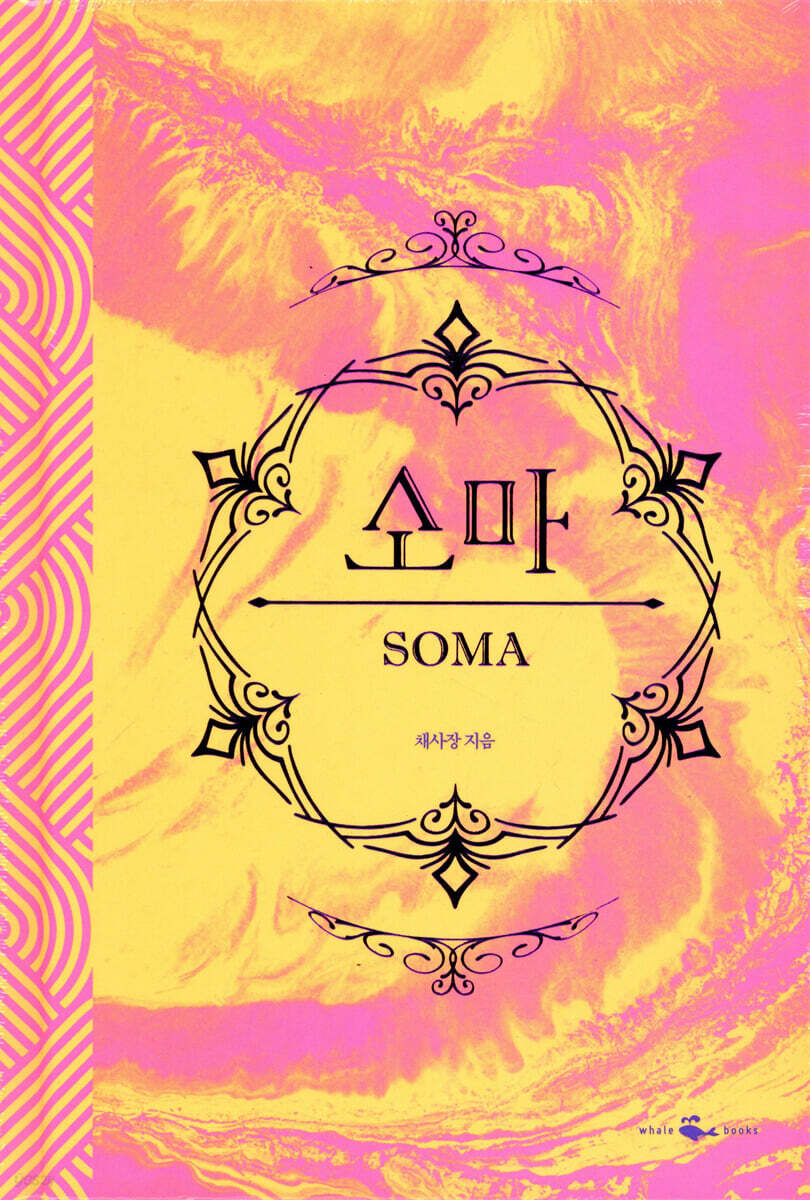
Soma
 |
Description
Book Introduction
The best-selling book in the Korean humanities With excellent storytelling, he unfolded hard knowledge like a thousand and one nights. Author Cha Sa-jang's first full-length novel A unique and wondrous narrative that has arrived in Korean society! The appearance of Chairman Chae was truly a sensation. The first book by an unknown author sounded a refreshing alarm in the heavy and rigid field of humanities, shattered all conventional wisdom and shattered records. This writer, who was considered a knowledge-selling president, actually had deep and profound thoughts lurking inside him. Author Cha Sa-jang has long been interested in human nature, inner self, and consciousness. The books I have published so far are the result of my efforts to convey this difficult and indifferent topic in various ways. Now, the author is trying to convey the topic he has pursued throughout his life through the form of a novel. This is vividly expressed in this book through the character of Soma. In today's Korean society, which craves new content, this novel is surprisingly timely. The novel "Soma" begins from the perspective of a boy watching his father. The father shoots an arrow toward the village and tells the boy Soma to find the arrow. Soma, who sets out in search of arrows without knowing English, is faced with a mysterious encounter, death, oblivion, and revival. A man's breathtaking journey begins in a spatial setting imbued with the major ideas of human history. During this journey, Soma has everything in the world and then loses everything, one by one. What, after all, will remain for Soma in the end? Within this question, author Cha Sa-jang conceals a surprising truth about life. |
- You can preview some of the book's contents.
Preview
index
Part 1
Part 2
Part 3
Part 4
Part 5
Part 6
Author's Note
Part 2
Part 3
Part 4
Part 5
Part 6
Author's Note
Detailed image
.jpg)
Into the book
“A well-polished arrow does not change direction along its trajectory.
A true traveler never changes his course during his journey.
Soma is a well-polished arrow and a straight traveler.
There will come a time when you will lose your way somewhere along the journey of life.
But you will find your way back to your original path.
“There is no need for the time of worry or regret to be too long.”
A true traveler never changes his course during his journey.
Soma is a well-polished arrow and a straight traveler.
There will come a time when you will lose your way somewhere along the journey of life.
But you will find your way back to your original path.
“There is no need for the time of worry or regret to be too long.”
--- p.20
Publisher's Review
“What I always wanted to know was humanity.
Where do all the countries of the world come from, what do they do, and where do they go?
By writing humanities, I got to know humans,
“Following Soma’s life, I came to love humans.” _Writer Cha Sa-jang
Breaking down the rigid walls of humanities with simple and clear explanations and humorous developments
Writer Cha Sa-jang broke the conventions of essays with sentences of deep thought and new compositions.
This time, he's back with his own novel!
Author Cha Sa-jang's humanities books read like one long story.
To convey complex knowledge, we create a structure, inject conflict, and then present the main characters.
As the story progressed, knowledge of history, economics, politics, society, ethics, philosophy, science, art, religion, etc. were naturally remembered as a single narrative.
In this book, "Soma," the author's accumulated inner strength is displayed with surprising skill.
That is why the structure of author Cha Sa-jang's novel "Soma" is similar to that of his previous works.
Under the structure of a long human life journey that runs through the entire novel, the characters meet, conflict, resolve, and conflict again, unfolding in a breathtakingly antithetical and synthetic manner, and beneath that lies a deep humanistic thought.
Readers who are drawn into the story will be moved by the surprising question they receive at the end of the novel.
“Do you want to live again?” _From the text
Overwhelming storytelling, immersive experience
Philosophical thinking intricately laid out beneath the surface of a grand narrative
A father sending his son away, a woman whipping herself, a group of people living with wrong beliefs and justice, a man wasting his life on an obsession that started from a misunderstanding, forces that hasten death with greed, a man who becomes a monster in revenge for life, an old man who commands the world but is neglected, etc…
The people that Soma the boy meets throughout his life until he becomes an old man are truly diverse.
The story that their desires weave into a grand warp and weft is based on all the joys and sorrows of humanity.
So it shakes the hearts of readers.
These characters the author introduces may seem unique at first glance, but they are historical characters who think and act appropriately within the framework of their time.
The moment these two clash with each other due to their own motives such as misunderstanding, jealousy, and obsession while being dependent on the times, the protagonist's Soma's life becomes infinitely turbulent.
Even if his home is devastated, even if he loses his memories, even if he loses loved ones, even if he is imprisoned, chased, and abandoned, Soma will always get back on his feet.
What causes soma?
What is it that makes Soma hesitate like that?
The protagonist Soma, who was more successful than anyone else but knew less about himself than anyone else, painfully reminds us of the lives we each had abandoned.
As we eliminate everything one by one,
What will be left for me in life?
An intellectual epic with captivating characters and an overwhelming scale.
From boy to hero, the truth of life refracted through a man's time
The novel "Soma" begins from the perspective of a boy watching his father.
The father shoots an arrow toward the village and tells the boy Soma to find the arrow.
Soma, who sets out in search of arrows without knowing English, is faced with a mysterious encounter, death, oblivion, and revival.
A man's breathtaking journey begins in a spatial setting imbued with the major ideas of human history.
During this journey, Soma has everything in the world and then loses everything, one by one.
What is it that Soma holds onto until the very end? Within this question, author Cha Sa-jang conceals a surprising truth about life.
This book follows the breathtaking journey of a man's life from boyhood to old age.
And at the end, it unfolds the truth of life that we come to know and asks us questions.
When everything is erased, can that truly be me? This question, sorely lacking in a modern society that desires only what's visible and tangible, is poignantly raised.
What is the real me?
This question will be deeply etched in your heart as you close the book.
And the hero Soma will probably shine in your life for a very long time.
A fantastic and grand epic of characters caught up in history and religion.
The flow of time symbolizing ancient, medieval, and modern times
In the unfolding of a space where Eastern and Western civilizations converge,
A human being unfolds the sorrowful yet beautiful journey of life.
Sometimes pity, sometimes deny, sometimes cry
You will come to a deep sorrow and the truth of life.
In an age full of trivialities, the revival of the classic tragedy we've lost.
Love and hate, revenge and obsession, forgiveness and return, etc.
Tragic stories that evoke the most explosive emotions in humans
It pushes the reader to the end of the book.
While reading, you are helplessly dragged along,
In the end, you will painfully cheer for the protagonist's ordinary yet noble life.
Desperate and fundamental questions about life
What does it mean to live? What are we obsessed with?
Are humans truly capable of forgiveness? What is love?
When everything is lost, what will be left in the end? Is that really me?
Through Soma, we encounter questions that must be asked, especially in chaotic times like these.
You will feel the joy of thought brought about by a powerful narrative.
Here are some excerpts from the commentary book:
Q.
You wrote your first novel.
Although I wrote a short story in "We Will Meet Someday", it was still quite good.
A ceremonial procession.
I opened it with anticipation, and the first sentence of "Soma" was very impressive.
It would not be an exaggeration to say that the first part of Part 1 unfolds with the power of this sentence.
However, the latter part of Part 1 unfolds in a way that makes it difficult to guess what will happen next.
As the book progresses, the narrative becomes more overwhelming, whereas Part 1 seems to be more image-driven.
Perhaps because of this, the pre-monitoring team was divided in their opinions, with some saying that the first part was good because it was like the writer Cha Sa-jang's, and others saying that it was difficult to get into.
I wonder what the intention behind writing Part 1 was.
A.
Part 1 feels concise and abstract for two reasons.
First, because Part 1 is a description of the child's inner experiences.
Wasn't that our childhood? It was always images, not narratives.
Second, Part 1 encompasses the theme of the entire novel.
Part 1 is one big door.
Once you open this door and step inside, a human life unfolds breathtakingly.
It will be interesting.
Just as preparation is needed before taking the first step on a journey, Part 1 contains a lot of implications as a preliminary stage for the full-fledged narrative.
Part 6, the end of the journey, therefore has a similar format to Part 1.
Because I have to return home after my trip.
I have always been more interested in a person's life from birth to death than in a single dramatic event.
This novel also deals with the long journey of life, from its beginning and growth to its end.
Q.
In Part 2, the setting changes.
Samuel, whose name is given here, appears to be a quiet and sad child.
It seems that the newly appearing Hannah and I are connected by the intersection of sadness.
Hannah may seem like a difficult character to understand in this day and age, but it seems that she is accepted through her connection with Soma.
It seems to be a device that explains both the times and emotions at the same time by throwing characters into extreme backgrounds.
What kind of background did you want to unfold?
A.
If Part 1 depicts the mysterious polytheistic world of ancient times, Part 2 and onward shows the ascetic monotheistic world of the Middle Ages.
In parts 4 and 5, a transitional period toward a modern worldview is shown.
Set in a medieval setting, Hannah, like other characters, thinks and desires within the limitations of the times in which she lives.
People think that their 'thoughts' are their own, but in reality they are not.
The way of thinking and life of an individual human being is always subject to the historical and ideological background.
My spirit is the spirit of the times, and my thoughts are always the thoughts of the group.
By throwing Soma into each era experienced by humanity, I tried to portray in an extremely realistic way how he naturally relates to the people within that era and how he changes within the spirit and ideas of that era.
I thought that through this, I could show the multi-layered life that a human being can experience.
Q.
The part where Attila appears in the introduction to Part 4 was as exciting as a movie.
Compared to the time difference between each part in the previous section, the 4th part took a relatively longer time.
The monstrous figure of Attila seems to give us an idea of what the protagonist's life was like during those years.
Perhaps that's why, when it was revealed who Attila was, I felt a strange sense of joy, but also pity for the protagonist.
Soma's darkening seems to epitomize his difficult life.
What is the meaning of this gap?
A.
The time difference between parts 3 and 4 is approximately 20 years.
During this period, Soma spends his time on the battlefield, filled with revenge and obsession.
The twists and turns of Soma's life are probably similar to those experienced by all individuals who have reached middle age.
The image of ourselves that we have become accustomed to after being thrown into society, struggling, and falling.
Perhaps it is our own projection that makes us feel both joy and pity when Attila's identity is revealed.
☞ The appendix commentary book consists of a total of 15 questions and answers, character introductions, etc., and can be received when purchasing the book.
Where do all the countries of the world come from, what do they do, and where do they go?
By writing humanities, I got to know humans,
“Following Soma’s life, I came to love humans.” _Writer Cha Sa-jang
Breaking down the rigid walls of humanities with simple and clear explanations and humorous developments
Writer Cha Sa-jang broke the conventions of essays with sentences of deep thought and new compositions.
This time, he's back with his own novel!
Author Cha Sa-jang's humanities books read like one long story.
To convey complex knowledge, we create a structure, inject conflict, and then present the main characters.
As the story progressed, knowledge of history, economics, politics, society, ethics, philosophy, science, art, religion, etc. were naturally remembered as a single narrative.
In this book, "Soma," the author's accumulated inner strength is displayed with surprising skill.
That is why the structure of author Cha Sa-jang's novel "Soma" is similar to that of his previous works.
Under the structure of a long human life journey that runs through the entire novel, the characters meet, conflict, resolve, and conflict again, unfolding in a breathtakingly antithetical and synthetic manner, and beneath that lies a deep humanistic thought.
Readers who are drawn into the story will be moved by the surprising question they receive at the end of the novel.
“Do you want to live again?” _From the text
Overwhelming storytelling, immersive experience
Philosophical thinking intricately laid out beneath the surface of a grand narrative
A father sending his son away, a woman whipping herself, a group of people living with wrong beliefs and justice, a man wasting his life on an obsession that started from a misunderstanding, forces that hasten death with greed, a man who becomes a monster in revenge for life, an old man who commands the world but is neglected, etc…
The people that Soma the boy meets throughout his life until he becomes an old man are truly diverse.
The story that their desires weave into a grand warp and weft is based on all the joys and sorrows of humanity.
So it shakes the hearts of readers.
These characters the author introduces may seem unique at first glance, but they are historical characters who think and act appropriately within the framework of their time.
The moment these two clash with each other due to their own motives such as misunderstanding, jealousy, and obsession while being dependent on the times, the protagonist's Soma's life becomes infinitely turbulent.
Even if his home is devastated, even if he loses his memories, even if he loses loved ones, even if he is imprisoned, chased, and abandoned, Soma will always get back on his feet.
What causes soma?
What is it that makes Soma hesitate like that?
The protagonist Soma, who was more successful than anyone else but knew less about himself than anyone else, painfully reminds us of the lives we each had abandoned.
As we eliminate everything one by one,
What will be left for me in life?
An intellectual epic with captivating characters and an overwhelming scale.
From boy to hero, the truth of life refracted through a man's time
The novel "Soma" begins from the perspective of a boy watching his father.
The father shoots an arrow toward the village and tells the boy Soma to find the arrow.
Soma, who sets out in search of arrows without knowing English, is faced with a mysterious encounter, death, oblivion, and revival.
A man's breathtaking journey begins in a spatial setting imbued with the major ideas of human history.
During this journey, Soma has everything in the world and then loses everything, one by one.
What is it that Soma holds onto until the very end? Within this question, author Cha Sa-jang conceals a surprising truth about life.
This book follows the breathtaking journey of a man's life from boyhood to old age.
And at the end, it unfolds the truth of life that we come to know and asks us questions.
When everything is erased, can that truly be me? This question, sorely lacking in a modern society that desires only what's visible and tangible, is poignantly raised.
What is the real me?
This question will be deeply etched in your heart as you close the book.
And the hero Soma will probably shine in your life for a very long time.
A fantastic and grand epic of characters caught up in history and religion.
The flow of time symbolizing ancient, medieval, and modern times
In the unfolding of a space where Eastern and Western civilizations converge,
A human being unfolds the sorrowful yet beautiful journey of life.
Sometimes pity, sometimes deny, sometimes cry
You will come to a deep sorrow and the truth of life.
In an age full of trivialities, the revival of the classic tragedy we've lost.
Love and hate, revenge and obsession, forgiveness and return, etc.
Tragic stories that evoke the most explosive emotions in humans
It pushes the reader to the end of the book.
While reading, you are helplessly dragged along,
In the end, you will painfully cheer for the protagonist's ordinary yet noble life.
Desperate and fundamental questions about life
What does it mean to live? What are we obsessed with?
Are humans truly capable of forgiveness? What is love?
When everything is lost, what will be left in the end? Is that really me?
Through Soma, we encounter questions that must be asked, especially in chaotic times like these.
You will feel the joy of thought brought about by a powerful narrative.
Here are some excerpts from the commentary book:
Q.
You wrote your first novel.
Although I wrote a short story in "We Will Meet Someday", it was still quite good.
A ceremonial procession.
I opened it with anticipation, and the first sentence of "Soma" was very impressive.
It would not be an exaggeration to say that the first part of Part 1 unfolds with the power of this sentence.
However, the latter part of Part 1 unfolds in a way that makes it difficult to guess what will happen next.
As the book progresses, the narrative becomes more overwhelming, whereas Part 1 seems to be more image-driven.
Perhaps because of this, the pre-monitoring team was divided in their opinions, with some saying that the first part was good because it was like the writer Cha Sa-jang's, and others saying that it was difficult to get into.
I wonder what the intention behind writing Part 1 was.
A.
Part 1 feels concise and abstract for two reasons.
First, because Part 1 is a description of the child's inner experiences.
Wasn't that our childhood? It was always images, not narratives.
Second, Part 1 encompasses the theme of the entire novel.
Part 1 is one big door.
Once you open this door and step inside, a human life unfolds breathtakingly.
It will be interesting.
Just as preparation is needed before taking the first step on a journey, Part 1 contains a lot of implications as a preliminary stage for the full-fledged narrative.
Part 6, the end of the journey, therefore has a similar format to Part 1.
Because I have to return home after my trip.
I have always been more interested in a person's life from birth to death than in a single dramatic event.
This novel also deals with the long journey of life, from its beginning and growth to its end.
Q.
In Part 2, the setting changes.
Samuel, whose name is given here, appears to be a quiet and sad child.
It seems that the newly appearing Hannah and I are connected by the intersection of sadness.
Hannah may seem like a difficult character to understand in this day and age, but it seems that she is accepted through her connection with Soma.
It seems to be a device that explains both the times and emotions at the same time by throwing characters into extreme backgrounds.
What kind of background did you want to unfold?
A.
If Part 1 depicts the mysterious polytheistic world of ancient times, Part 2 and onward shows the ascetic monotheistic world of the Middle Ages.
In parts 4 and 5, a transitional period toward a modern worldview is shown.
Set in a medieval setting, Hannah, like other characters, thinks and desires within the limitations of the times in which she lives.
People think that their 'thoughts' are their own, but in reality they are not.
The way of thinking and life of an individual human being is always subject to the historical and ideological background.
My spirit is the spirit of the times, and my thoughts are always the thoughts of the group.
By throwing Soma into each era experienced by humanity, I tried to portray in an extremely realistic way how he naturally relates to the people within that era and how he changes within the spirit and ideas of that era.
I thought that through this, I could show the multi-layered life that a human being can experience.
Q.
The part where Attila appears in the introduction to Part 4 was as exciting as a movie.
Compared to the time difference between each part in the previous section, the 4th part took a relatively longer time.
The monstrous figure of Attila seems to give us an idea of what the protagonist's life was like during those years.
Perhaps that's why, when it was revealed who Attila was, I felt a strange sense of joy, but also pity for the protagonist.
Soma's darkening seems to epitomize his difficult life.
What is the meaning of this gap?
A.
The time difference between parts 3 and 4 is approximately 20 years.
During this period, Soma spends his time on the battlefield, filled with revenge and obsession.
The twists and turns of Soma's life are probably similar to those experienced by all individuals who have reached middle age.
The image of ourselves that we have become accustomed to after being thrown into society, struggling, and falling.
Perhaps it is our own projection that makes us feel both joy and pity when Attila's identity is revealed.
☞ The appendix commentary book consists of a total of 15 questions and answers, character introductions, etc., and can be received when purchasing the book.
GOODS SPECIFICS
- Publication date: December 24, 2021
- Format: Hardcover book binding method guide
- Page count, weight, size: 384 pages | 430g | 130*193*24mm
- ISBN13: 9791192097060
- ISBN10: 1192097068
You may also like
카테고리
korean


korean

![GQ KOREA Mark (Monthly): December [2025]](http://librairie.coreenne.fr/cdn/shop/files/8ef265dbbfbf186523ed75ba7319009d.jpg?v=1765340328&width=3840)


