

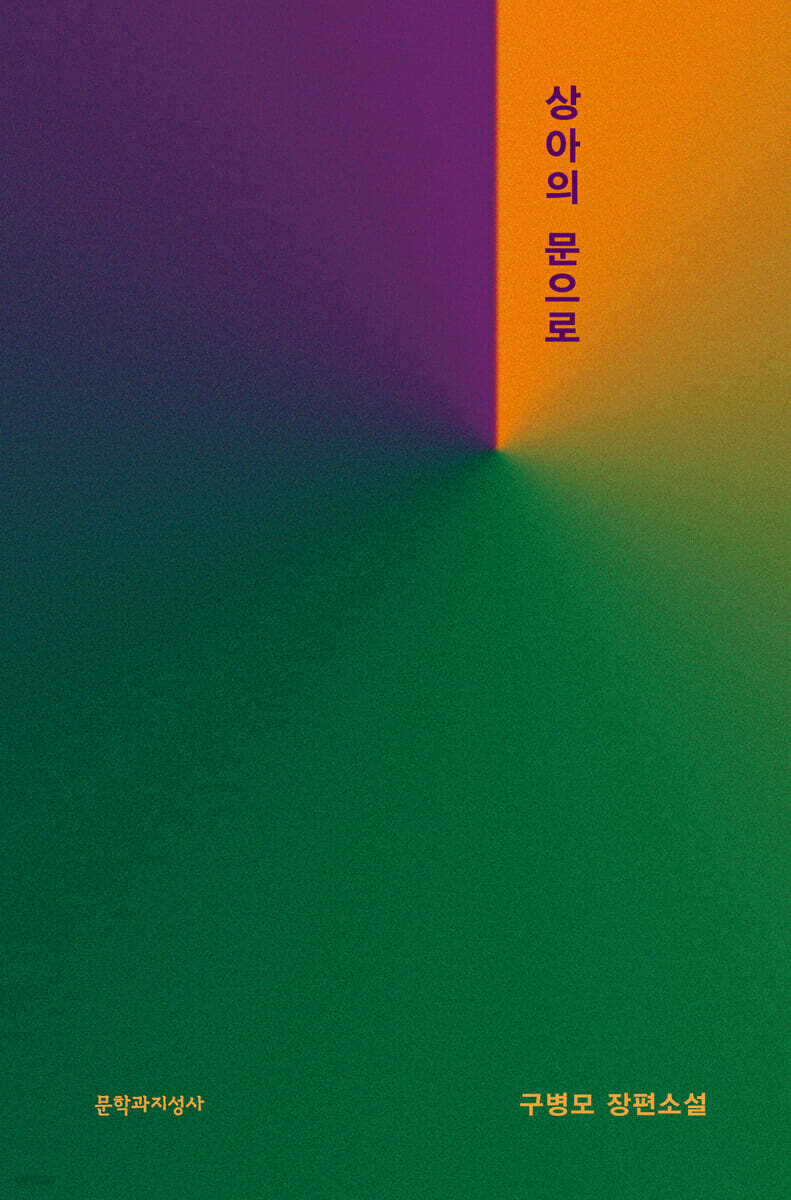
Through the ivory gate
 |
Description
Book Introduction
- A word from MD
-
Sentences that erase boundaries and draw the worldA novel by Gu Byeong-mo.
Sentences that erase the distinction between dreams and reality, you and me, and the meanings and thoughts that suddenly appear and disappear between them, uniquely portray this world where boundaries cannot be drawn and our every moment.
All that exists is this sentence you are reading now, and without any interpretation or prediction, you are caught up in it and just take a step forward.
November 30, 2021. Novel/Poetry PD Park Hyung-wook
“There is no going back now.
So, just continue with your daily routine.”
Gu Byeong-mo's sentences run wild, erasing the distinction between dreams and reality, you and me!
Author Koo Byung-mo, who immediately secured a wide fan base from teenagers to adults with the publication of his first book in 2009, has published a new full-length novel, "Through the Ivory Gate."
He has been steadily releasing new works since his debut, and ahead of the end of 2021, he has compiled the novels he serialized in the quarterly 『Literature and Society』 (Fall 2020 - Summer 2021).
The title of this book is borrowed from the ideas of 'ivory gates' and 'horn gates' that appear in Homer's 'Odyssey' and Virgil's 'Aeneid'.
These epics say that dreams that flow through the ivory gate are false, and that only true things can pass through the horn gate.
Of the two doors, we will head towards the 'Ivory Gate'.
When you pass through this door, you will begin to doubt the sensations that appear behind it, everything you see, and even your own existence.
Between sentences that have lost their clear logic and solid grounds for reliance, there is only the current state of affairs that is flickering.
Therefore, 『Through the Ivory Gate』 can only move forward when it secures the will to read each and every sentence and welcomes new sentences that appear at each moment.
If you open the first chapter of this book, rather than trying to hastily find the ending by traversing the sentences, you will enjoy reading more by concentrating on the events before you, which light up briefly and then fade away as you read each sentence.
So, just continue with your daily routine.”
Gu Byeong-mo's sentences run wild, erasing the distinction between dreams and reality, you and me!
Author Koo Byung-mo, who immediately secured a wide fan base from teenagers to adults with the publication of his first book in 2009, has published a new full-length novel, "Through the Ivory Gate."
He has been steadily releasing new works since his debut, and ahead of the end of 2021, he has compiled the novels he serialized in the quarterly 『Literature and Society』 (Fall 2020 - Summer 2021).
The title of this book is borrowed from the ideas of 'ivory gates' and 'horn gates' that appear in Homer's 'Odyssey' and Virgil's 'Aeneid'.
These epics say that dreams that flow through the ivory gate are false, and that only true things can pass through the horn gate.
Of the two doors, we will head towards the 'Ivory Gate'.
When you pass through this door, you will begin to doubt the sensations that appear behind it, everything you see, and even your own existence.
Between sentences that have lost their clear logic and solid grounds for reliance, there is only the current state of affairs that is flickering.
Therefore, 『Through the Ivory Gate』 can only move forward when it secures the will to read each and every sentence and welcomes new sentences that appear at each moment.
If you open the first chapter of this book, rather than trying to hastily find the ending by traversing the sentences, you will enjoy reading more by concentrating on the events before you, which light up briefly and then fade away as you read each sentence.
- You can preview some of the book's contents.
Preview
index
Through the ivory gate
America.
References
Recommendation
America.
References
Recommendation
Into the book
I lean my head against the bus window and open my phone, bringing up the search bar.
By inputting symptoms of hallucinations, hallucination phenomena, seeing hallucinations, hearing hallucinations, feeling like my body is floating, visual hallucinations, tactile hallucinations, olfactory hallucinations, taste hallucinations, etc., various results are referenced, and false memories, false memories, Munchausen syndrome, and daydreams are also reviewed, and in the process, documents consisting of explanations of schizophrenia, clear guidance on the treatment process, and indirect yet earnest recommendations are poured out.
Sometimes, explanations are given in relation to products of artistic obsession and madness, such as literature, film, and art. However, the films and famous paintings that appear on the screen somehow seem to be works that Jinyeo is seeing for the first time, or rather, works that do not exist in this world.
The moment she realizes this, Jinyeo either forgets her search terms or is unable to decipher the web pages where her search results appear.
--- p.17
There is no going back now.
It is impossible until a social atmosphere is formed in which everyone lives a minimal life, returning to the days when everyone baked bread from the rye they harvested themselves and wove cloth on a loom by the fading light of a kerosene lamp.
Such an atmosphere will not naturally form or take hold simply through a sense of crisis. It will require the active consent of the constituents to deliver a strong message from the leaders, calling for a return to the past, willingness to become poor and humble, even through acts tantamount to a violent revolution.
Therefore, if we are not to go back, we must boldly change our standards for a healthy and creative life, starting now. We must regard this series of phenomena as a kind of constant paradoxical sleep, and accept and become accustomed to all the illogical events that appear before our eyes as part of our daily lives.
--- p.29
As an ordinary human being who has secured life and death in one sentence, Jinyeo is placed in a state of neither living nor dead disappearance, and her mind becomes clearer. This time, without any errors or misunderstandings, she gets off at station H on the green line and turns around, knowing clearly where she should go.
To live life in a state of death, awake and dreaming, or asleep and not dreaming, or neither and yet embodying all of them simultaneously.
--- p.56
In an environment where workers choose to go to work with their sick bodies rather than worry about what the capitalists think even when a highly fatal infectious disease is spreading, taking time off for a dream only affects their performance evaluation. On the other hand, there are cases where people who are judged to have mild dream symptoms and are capable of daily life intentionally take paid leave by attaching it to a holiday. In either case, the side effects are not small. In this situation, will an employee who fails to report problem behavior or anxiety factors in a timely manner and fails to manage himself/herself be able to successfully renew his/her contract next time?
--- p.77
Jinyeo had no intention of blocking anyone's path, nor did she want to hold anyone back, and it seems like it was wrong to honestly face what was before her eyes at every moment, but what's the use of looking at it alone without looking back? Isn't a one-sided gaze without encounter, coordination, or exchange self-satisfaction? Have you ever met the eyes of one who has so many eyes?
--- p.140
At first, the members seem to pay special attention to the symptomatic person and provide convenience, but this is limited to consideration in everyday areas where they do not consider the pie to be shared with them. In rare cases, they draw the line by saying that although they feel sorry for the symptomatic person who fails to take an important evaluation exam, they should not be given a chance to retake the exam.
By inputting symptoms of hallucinations, hallucination phenomena, seeing hallucinations, hearing hallucinations, feeling like my body is floating, visual hallucinations, tactile hallucinations, olfactory hallucinations, taste hallucinations, etc., various results are referenced, and false memories, false memories, Munchausen syndrome, and daydreams are also reviewed, and in the process, documents consisting of explanations of schizophrenia, clear guidance on the treatment process, and indirect yet earnest recommendations are poured out.
Sometimes, explanations are given in relation to products of artistic obsession and madness, such as literature, film, and art. However, the films and famous paintings that appear on the screen somehow seem to be works that Jinyeo is seeing for the first time, or rather, works that do not exist in this world.
The moment she realizes this, Jinyeo either forgets her search terms or is unable to decipher the web pages where her search results appear.
--- p.17
There is no going back now.
It is impossible until a social atmosphere is formed in which everyone lives a minimal life, returning to the days when everyone baked bread from the rye they harvested themselves and wove cloth on a loom by the fading light of a kerosene lamp.
Such an atmosphere will not naturally form or take hold simply through a sense of crisis. It will require the active consent of the constituents to deliver a strong message from the leaders, calling for a return to the past, willingness to become poor and humble, even through acts tantamount to a violent revolution.
Therefore, if we are not to go back, we must boldly change our standards for a healthy and creative life, starting now. We must regard this series of phenomena as a kind of constant paradoxical sleep, and accept and become accustomed to all the illogical events that appear before our eyes as part of our daily lives.
--- p.29
As an ordinary human being who has secured life and death in one sentence, Jinyeo is placed in a state of neither living nor dead disappearance, and her mind becomes clearer. This time, without any errors or misunderstandings, she gets off at station H on the green line and turns around, knowing clearly where she should go.
To live life in a state of death, awake and dreaming, or asleep and not dreaming, or neither and yet embodying all of them simultaneously.
--- p.56
In an environment where workers choose to go to work with their sick bodies rather than worry about what the capitalists think even when a highly fatal infectious disease is spreading, taking time off for a dream only affects their performance evaluation. On the other hand, there are cases where people who are judged to have mild dream symptoms and are capable of daily life intentionally take paid leave by attaching it to a holiday. In either case, the side effects are not small. In this situation, will an employee who fails to report problem behavior or anxiety factors in a timely manner and fails to manage himself/herself be able to successfully renew his/her contract next time?
--- p.77
Jinyeo had no intention of blocking anyone's path, nor did she want to hold anyone back, and it seems like it was wrong to honestly face what was before her eyes at every moment, but what's the use of looking at it alone without looking back? Isn't a one-sided gaze without encounter, coordination, or exchange self-satisfaction? Have you ever met the eyes of one who has so many eyes?
--- p.140
At first, the members seem to pay special attention to the symptomatic person and provide convenience, but this is limited to consideration in everyday areas where they do not consider the pie to be shared with them. In rare cases, they draw the line by saying that although they feel sorry for the symptomatic person who fails to take an important evaluation exam, they should not be given a chance to retake the exam.
--- p.149
Publisher's Review
I have never seen a novel so obsessively about reality and unreality, here and there, this and that, and ultimately, the point where you and I become indistinguishable.
Lee Jang-wook (novelist)
This is not a 'story'.
A writing that cannot be summarized, a writing that destroys the message, a writing that is out of place, a writing that happened just the day before yesterday, in the blink of an eye, maybe a writing about a year.
Jo Jae-ryong (literary critic)
A city where there is no need to distinguish between dreams and reality
The beginning of the dream symptom that prices reality
From the onset of this symptom, every moment becomes a tool for analysis of the previous moment and anticipation of the next moment, and the act will never end.
In the mirror she looked into, only the red towel hanging on the towel rack behind her was reflected like a signal of a crosswalk that would never cross, and Jinyeo's own image was nowhere to be found. Now that she was used to that kind of appearance... Jinyeo turned on the faucet, filled her hands with water that she couldn't tell if they were there, and threw the water towards the spot where her face would usually be, washing it, and this action and the feeling of the cold water touching her face let her know that Jinyeo was there.
(p.
10)
When I wake up in the morning and wash my face, I can usually feel the cold water because there is a person called 'I', but in 'Through the Ivory Gate', it starts by denying this obvious fact.
In the mirror, 'Jinyeo' cannot find her own reflection.
Habitually splashing water on the area where your face should be.
Only the cold sensation felt where a face is supposed to be makes me sense that 'I' am there.
In this novel, situations that seem unrealistic are called “symptoms.”
This 'symptom', which began among city dwellers who live in a city where the lights never go out 24 hours a day, creates a state of neither sleeping nor waking up, where dreams "strike the weak point of reality with their ignorance" (p.
199) is being driven to the point of being done.
“Rather than saying that it has become a space where dreams and reality cannot be distinguished, it is more like a space where there is no need to distinguish between the two” (p.
29) In the city as a space, it is impossible to discover hidden meanings one by one or to create a consistent logic.
Our best defense in a world that is not fixed is to accept that these events “may have been part of the universe before we were born” (p.
32) It is only a matter of doubting the fact that their appearances are fixed.
So, what we continue to read is not a journey toward a fixed goal or destination, but rather a situation before our eyes of the 'true nature' that is not even reflected in a mirror and whose substance is unclear, sentences that erase the boundaries of all things like liquid and are faithful to the moment.
In a world where daily life and order have been destroyed
A sentence that creates discontinuous, disconnected moments
Sometimes, the repetition that seems unappealing is surprisingly the only truth.
Meaning may be a stopping point for cognition, but it is not its destination.
There may be moments when meaning seems to stand out, but when we realize that it is an illusion, the ultimate purpose of perception is not meaning.
What all this is saying, what are we talking about, what are we missing while we're obsessing over and talking about what we don't know, I think that's important.
(p.
191)
“An undefined future” and an “unfixed past” (p.
33) In the meantime, countless possibilities are bound to open up, and while embracing these possibilities, ‘Jinyeo’ lives in an unpredictable present.
I don't know where I'm going to work, but I go to work like I always do, and I get on the train like I always do, but I don't know where I'm going.
It's clear that yesterday you were a school teacher, but today you're a student, so it wouldn't be surprising.
What happened in the past does not guarantee what will happen today.
Creating a story is only possible in a world that can create a consistent order, but it is difficult to think that it is possible for the character 'Jinyeo', whose daily life and order have been destroyed.
Because of this, we may ultimately fail to grasp the true nature of the character called 'Jinyeo'.
The act of reading, of observing the actions of the true nature and imagining its reality in one's mind, is dismantled by the next sentence and rendered powerless by the sentence that follows.
The novel continues to dwell on fragmented moments of events, erasing any possibility of being told with certainty.
All we can do is silently follow the sentences of Koo Byung-mo, who persistently pushes us to the point where we cannot distinguish between yesterday and today, between 'you' and 'me', and make us question what we have believed.
When we finish reading this book, what will we discover in it?
Perhaps the idea of discovering something within a book is common sense that only applies in the orderly world outside of this book.
Pursuing the 'true self' that is not reflected in the mirror is nothing less than an act that breaks common sense in seeking meaning.
Let me rewrite the sentence I quoted earlier.
“This is not a ‘story.’
“These are sentences that cannot be summarized, that is, sentences that destroy the message” (literary critic Jae-ryong Jo).
Only by turning the pages, navigating the endless maze where the sentence you are reading now brings forth the next sentence, will you be able to experience the new reading experience that author Gu Byeong-mo has opened up.
Lee Jang-wook (novelist)
This is not a 'story'.
A writing that cannot be summarized, a writing that destroys the message, a writing that is out of place, a writing that happened just the day before yesterday, in the blink of an eye, maybe a writing about a year.
Jo Jae-ryong (literary critic)
A city where there is no need to distinguish between dreams and reality
The beginning of the dream symptom that prices reality
From the onset of this symptom, every moment becomes a tool for analysis of the previous moment and anticipation of the next moment, and the act will never end.
In the mirror she looked into, only the red towel hanging on the towel rack behind her was reflected like a signal of a crosswalk that would never cross, and Jinyeo's own image was nowhere to be found. Now that she was used to that kind of appearance... Jinyeo turned on the faucet, filled her hands with water that she couldn't tell if they were there, and threw the water towards the spot where her face would usually be, washing it, and this action and the feeling of the cold water touching her face let her know that Jinyeo was there.
(p.
10)
When I wake up in the morning and wash my face, I can usually feel the cold water because there is a person called 'I', but in 'Through the Ivory Gate', it starts by denying this obvious fact.
In the mirror, 'Jinyeo' cannot find her own reflection.
Habitually splashing water on the area where your face should be.
Only the cold sensation felt where a face is supposed to be makes me sense that 'I' am there.
In this novel, situations that seem unrealistic are called “symptoms.”
This 'symptom', which began among city dwellers who live in a city where the lights never go out 24 hours a day, creates a state of neither sleeping nor waking up, where dreams "strike the weak point of reality with their ignorance" (p.
199) is being driven to the point of being done.
“Rather than saying that it has become a space where dreams and reality cannot be distinguished, it is more like a space where there is no need to distinguish between the two” (p.
29) In the city as a space, it is impossible to discover hidden meanings one by one or to create a consistent logic.
Our best defense in a world that is not fixed is to accept that these events “may have been part of the universe before we were born” (p.
32) It is only a matter of doubting the fact that their appearances are fixed.
So, what we continue to read is not a journey toward a fixed goal or destination, but rather a situation before our eyes of the 'true nature' that is not even reflected in a mirror and whose substance is unclear, sentences that erase the boundaries of all things like liquid and are faithful to the moment.
In a world where daily life and order have been destroyed
A sentence that creates discontinuous, disconnected moments
Sometimes, the repetition that seems unappealing is surprisingly the only truth.
Meaning may be a stopping point for cognition, but it is not its destination.
There may be moments when meaning seems to stand out, but when we realize that it is an illusion, the ultimate purpose of perception is not meaning.
What all this is saying, what are we talking about, what are we missing while we're obsessing over and talking about what we don't know, I think that's important.
(p.
191)
“An undefined future” and an “unfixed past” (p.
33) In the meantime, countless possibilities are bound to open up, and while embracing these possibilities, ‘Jinyeo’ lives in an unpredictable present.
I don't know where I'm going to work, but I go to work like I always do, and I get on the train like I always do, but I don't know where I'm going.
It's clear that yesterday you were a school teacher, but today you're a student, so it wouldn't be surprising.
What happened in the past does not guarantee what will happen today.
Creating a story is only possible in a world that can create a consistent order, but it is difficult to think that it is possible for the character 'Jinyeo', whose daily life and order have been destroyed.
Because of this, we may ultimately fail to grasp the true nature of the character called 'Jinyeo'.
The act of reading, of observing the actions of the true nature and imagining its reality in one's mind, is dismantled by the next sentence and rendered powerless by the sentence that follows.
The novel continues to dwell on fragmented moments of events, erasing any possibility of being told with certainty.
All we can do is silently follow the sentences of Koo Byung-mo, who persistently pushes us to the point where we cannot distinguish between yesterday and today, between 'you' and 'me', and make us question what we have believed.
When we finish reading this book, what will we discover in it?
Perhaps the idea of discovering something within a book is common sense that only applies in the orderly world outside of this book.
Pursuing the 'true self' that is not reflected in the mirror is nothing less than an act that breaks common sense in seeking meaning.
Let me rewrite the sentence I quoted earlier.
“This is not a ‘story.’
“These are sentences that cannot be summarized, that is, sentences that destroy the message” (literary critic Jae-ryong Jo).
Only by turning the pages, navigating the endless maze where the sentence you are reading now brings forth the next sentence, will you be able to experience the new reading experience that author Gu Byeong-mo has opened up.
GOODS SPECIFICS
- Publication date: November 20, 2021
- Pages, weight, size: 223 pages | 234g | 120*188*12mm
- ISBN13: 9788932039251
- ISBN10: 8932039259
You may also like
카테고리
korean


korean

![GQ KOREA Mark (Monthly): December [2025]](http://librairie.coreenne.fr/cdn/shop/files/8ef265dbbfbf186523ed75ba7319009d.jpg?v=1765340328&width=3840)


