

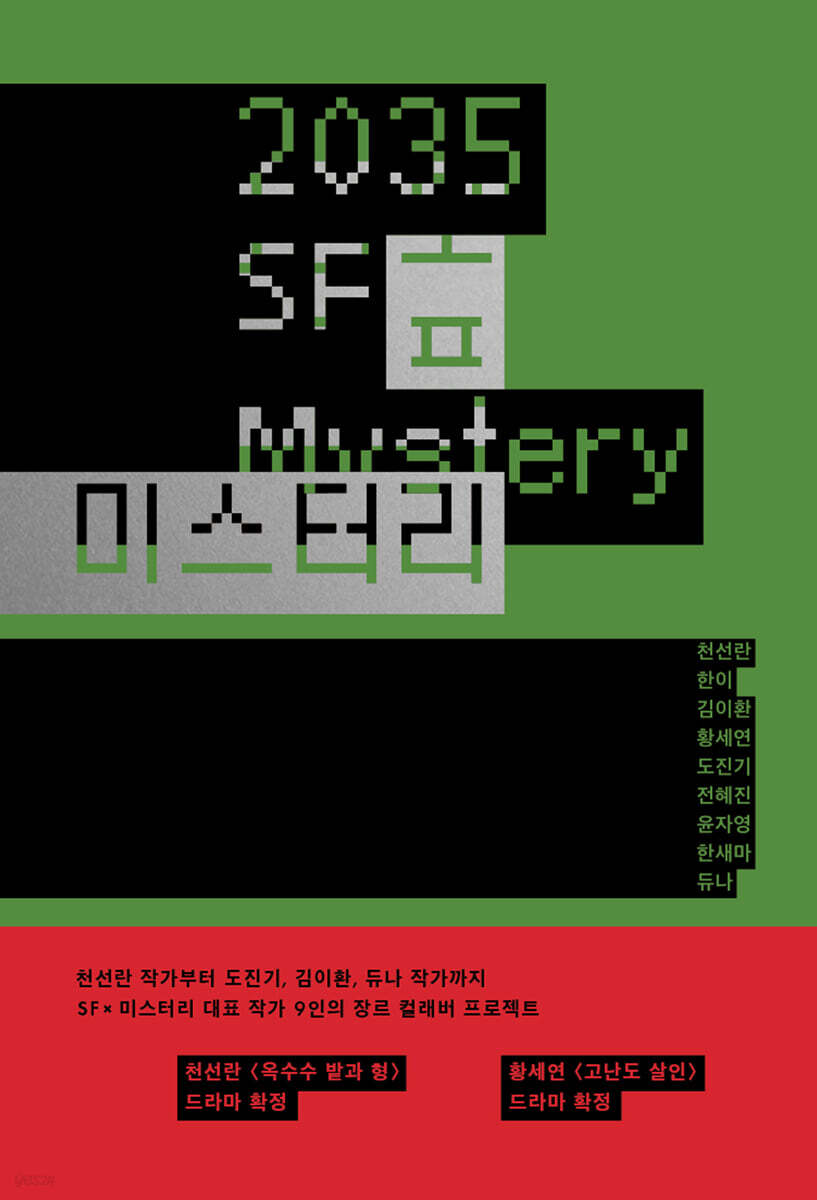
2035 SF Mystery
 |
Description
Book Introduction
- A word from MD
- [The world that awaits us after the end of Corona] A genre landscape of 2035, as seen by a SF X mystery writer with sharp imagination.
A collection of captivating stories that explore contemporary issues like cloning, the metaverse, and gene editing.
If you're curious about the world that awaits us after the end of COVID-19, I urge you to open this book without hesitation.
- Novel MD Kim So-jeong
The world after COVID-19
Exploring the near future of 2035 through genre-specific imagination
Science fiction, a genre that ponders the future of humanity at the forefront of its time, and mystery, which explores the abyss of humanity, have come together.
The ongoing pandemic sweeping the globe and the blades of wrath unleashed by the Earth upon humanity clearly demonstrate that the dystopian world prophesied by the prophets of the times has already arrived.
Set in the near future of 2035, it explores science fiction issues such as cloning, the metaverse, and gene editing through a sharp mystery plot.
Exploring the near future of 2035 through genre-specific imagination
Science fiction, a genre that ponders the future of humanity at the forefront of its time, and mystery, which explores the abyss of humanity, have come together.
The ongoing pandemic sweeping the globe and the blades of wrath unleashed by the Earth upon humanity clearly demonstrate that the dystopian world prophesied by the prophets of the times has already arrived.
Set in the near future of 2035, it explores science fiction issues such as cloning, the metaverse, and gene editing through a sharp mystery plot.
- You can preview some of the book's contents.
Preview
index
Cheon Seon-ran, "Cornfield and Brother"
Han Lee, Children of Eden
Kim I-hwan, "A Cat's Heart"
Hwang Se-yeon, "High-Difficulty Murder"
Dojinki, Control X
Jeon Hye-jin, "Death Without Fault"
Yoon Ja-young, "A Choice for the Starving"
Hansaemar, "Protected from Threats"
Dune, "I might die a few days late."
Han Lee, Children of Eden
Kim I-hwan, "A Cat's Heart"
Hwang Se-yeon, "High-Difficulty Murder"
Dojinki, Control X
Jeon Hye-jin, "Death Without Fault"
Yoon Ja-young, "A Choice for the Starving"
Hansaemar, "Protected from Threats"
Dune, "I might die a few days late."
Detailed image

Into the book
“All the corn in our house has the same genes.
We're no different than growing a single corn plant... but it won't be the same.
Because my memories are different.
The memories of the corn at one end and the corn at the other end are different.
So you can't say it's the same corn.
“What really matters is memory.”
--- Cheon Seon-ran, from “Cornfield and Brother”
There are no detectives depicted in hard-boiled novels of old.
There are just self-employed people who do odd jobs that are cheaper than machines can handle.
--- Han, from "Children of Eden"
It's about trusting the government.
He said that the Korean government might send a car or a helicopter.
But that was something the manager said because he didn't know much about Korea.
Korean people have to find their own way to survive.
--- Kim I-hwan, from “The Cat’s Heart”
As I got used to the metaverse, meeting my friends in real life became a hassle.
In short, meeting in real life was less fun than meeting in the metaverse.
--- Hwang Se-yeon, from "Difficult Murder"
“Humans have been searching for who they are until now.
But the question we should be more curious about is, “What exactly is ‘I’?”
--- Dojinki, from "Control X"
“These days, wherever you go, there are refugees everywhere.
“When I see guys like that, I feel like I’m just going to sit still and let some random guy empty my pockets.”
--- Jeon Hye-jin, from "Death Without Wrongness"
“I know how to save them.
“There is a way to save all the starving people in the world.”
--- Yoon Ja-young, from "Choices for the Starving"
For eternal life? Is it greed? Selfishness? Wanting to give your ailing son a few more years of life?
I looked at the face of the guy who was talking about eternal life on hologram SNS.
If I could, I would have slapped him in the face.
--- Han Saema, from "Protected from Threats"
“This is not a Christie mystery novel.
People are all just a little bit vague.
There may be other motives hidden that we will never know.”
We're no different than growing a single corn plant... but it won't be the same.
Because my memories are different.
The memories of the corn at one end and the corn at the other end are different.
So you can't say it's the same corn.
“What really matters is memory.”
--- Cheon Seon-ran, from “Cornfield and Brother”
There are no detectives depicted in hard-boiled novels of old.
There are just self-employed people who do odd jobs that are cheaper than machines can handle.
--- Han, from "Children of Eden"
It's about trusting the government.
He said that the Korean government might send a car or a helicopter.
But that was something the manager said because he didn't know much about Korea.
Korean people have to find their own way to survive.
--- Kim I-hwan, from “The Cat’s Heart”
As I got used to the metaverse, meeting my friends in real life became a hassle.
In short, meeting in real life was less fun than meeting in the metaverse.
--- Hwang Se-yeon, from "Difficult Murder"
“Humans have been searching for who they are until now.
But the question we should be more curious about is, “What exactly is ‘I’?”
--- Dojinki, from "Control X"
“These days, wherever you go, there are refugees everywhere.
“When I see guys like that, I feel like I’m just going to sit still and let some random guy empty my pockets.”
--- Jeon Hye-jin, from "Death Without Wrongness"
“I know how to save them.
“There is a way to save all the starving people in the world.”
--- Yoon Ja-young, from "Choices for the Starving"
For eternal life? Is it greed? Selfishness? Wanting to give your ailing son a few more years of life?
I looked at the face of the guy who was talking about eternal life on hologram SNS.
If I could, I would have slapped him in the face.
--- Han Saema, from "Protected from Threats"
“This is not a Christie mystery novel.
People are all just a little bit vague.
There may be other motives hidden that we will never know.”
--- From Dune, "I might die a few days late"
Publisher's Review
The world after the end of COVID-19
Exploring the near future of 2035 through genre-specific imagination
★ Drama adaptation contract ★
Cheon Seon-ran, "Cornfield and Brother"
Hwang Se-yeon's "High-Difficulty Murder"
Science fiction, a genre that ponders the future of humanity at the forefront of its time, and mystery, which explores the abyss of humanity, have come together.
The ongoing pandemic sweeping the globe and the blades of wrath unleashed by the Earth upon humanity clearly demonstrate that the dystopian world prophesied by the prophets of the times has already arrived.
Even after the massive pandemic tsunami has passed, the global crises we must face are approaching one after another, under different names.
With the climate crisis, food shortages, refugee crises, extreme individualism, and excessive anxiety about the future, the complacent attitude that nothing will happen is making things worse.
《2035 SF Mystery》 began with the intention of exploring the near future after the aftermath of COVID-19 through the outstanding genre imagination of writers representing each field.
Through "2035 SF Mystery," readers can experience a clash of passionate desires and a cool genre imagination set in the near future of South Korea, not in a virtual space of the distant future that is difficult to imagine.
To share a specific time period, 2035, each work uses geopolitical aspects, common science and technology, hate crimes, and worsening environmental issues as the basic background.
In it, nine writers representing the Korean science fiction and mystery genres freely created detailed social scenes, and showed at the forefront what could happen when variables such as clones, refugee acceptance, genome editing, teleportation, and Megalopolis interfere with our world.
Nine works that maximize the strengths of mystery and science fiction were first introduced as an exclusive release on 'Milli's Library' in 2021, and amidst the enthusiastic response from readers, Cheon Seon-ran's 'Corn Field and Brother' and Hwang Se-yeon's 'A High-Difficulty Murder' have signed drama contracts and are awaiting production.
● From author Cheon Seon-ran to Do Jin-gi, Kim I-hwan, and Duna
A genre collaboration project by nine leading SF and mystery writers.
For the project "2035 SF Mystery," which sharply depicts a future that has already arrived with imagination that transcends genres, nine writers representing the Korean SF and mystery genres dissected SF issues with sharp mystery plots.
A total of nine writers participated in the genre collaboration project, including Duna, the first generation of Korean original SF writers; Yun Ja-young, Do Jin-gi, and Hwang Se-yeon, winners of the Korean Mystery Literature Award; Cheon Seon-ran, the most promising writer in the SF genre; Han Yi, winner of the 15th Golden Pen Award in 2021 and editor-in-chief of Quarterly Mystery; Kim I-hwan, who crosses between fantasy and science fiction; Jeon Hye-jin, who is active in feminist SF; and Han Sae-ma, a formidable newcomer in mystery literature.
One of the core elements of science fiction is "extrapolation," or how the world changes when certain elements are inserted. Science fiction is a genre that uses scientific facts and thought experiments to envision the future, while mystery vividly portrays the absurdity and conflict of our time through dramatic crimes.
《2035 SF Mystery》 is an interesting case study that shows what kind of synergy can be created when mystery is 'extrapolated' into SF, and mystery is 'extrapolated' into SF.
Set in the year 2035, this mystery feast delves into the essence of humanity through a fleeting twist, offering a genre thrill unlike anything you've ever experienced before.
The world around 2035
Since its emergence, COVID-19 has continuously mutated and has caused over 150 million deaths worldwide.
The damage was particularly severe in India, Africa, and Europe, and more than 300,000 people died in South Korea.
Even now, we have not fully recovered from the aftermath of the pandemic, and there is a pervasive anxiety about the potential outbreak of a new infectious disease.
Environmental problems such as fine dust, yellow dust, and global warming are becoming more serious day by day.
After 2030, mandatory carbon emission reduction policies will be implemented, and these mandatory measures will lead to energy shortages, making electricity extremely expensive.
Slumification is rapidly progressing in areas other than some wealthy neighborhoods in Seoul.
Services that store electricity and trade it between individuals are active.
The problem of energy poverty, where people cannot enjoy the benefits of electricity due to lack of money, is serious.
Swarms of locusts are sweeping through Uganda, Somalia, Kenya, and China, threatening crops and threatening the entire world.
In 2030, a swarm of locusts swept across North Korea, causing unprecedented food shortages and threatening the collapse of the regime.
China is moving to absorb and unify North Korea, and South Korea is in a sharp conflict with those who support unifying North Korea and those who argue that doing so will lead to serious economic problems.
? Under UN conventions, some countries are forced to accept a certain percentage of refugees, and Korea is one of them.
Since then, crimes against refugees, crimes by refugees, and hate crimes have been on the rise.
The rapidly increasing number of North Korean defectors is also becoming a social problem.
? Detectives are legalized and codified.
Violent crimes are on the rise, and police forces alone cannot adequately address them.
Legalized detectives investigate a variety of cases, such as missing persons or kidnappings, and assist the police when requested.
? Guns are not legal in South Korea, but hundreds of thousands of illegal firearms are traded on the black market.
The proliferation of sophisticated 3D printers has created a market for individuals to personally create and sell firearms.
Many criminal organizations are armed with illegal weapons, so police officers are basically issued with live ammunition while on duty.
Gun-related incidents are increasing exponentially.
Drone delivery and self-driving cars are commercialized.
The wealthy are using gene-editing technology to create genetically superior children.
Although it is illegal in Korea, it is illegally practiced in countries with relatively lax laws, such as China, India, and Japan.
Exploring the near future of 2035 through genre-specific imagination
★ Drama adaptation contract ★
Cheon Seon-ran, "Cornfield and Brother"
Hwang Se-yeon's "High-Difficulty Murder"
Science fiction, a genre that ponders the future of humanity at the forefront of its time, and mystery, which explores the abyss of humanity, have come together.
The ongoing pandemic sweeping the globe and the blades of wrath unleashed by the Earth upon humanity clearly demonstrate that the dystopian world prophesied by the prophets of the times has already arrived.
Even after the massive pandemic tsunami has passed, the global crises we must face are approaching one after another, under different names.
With the climate crisis, food shortages, refugee crises, extreme individualism, and excessive anxiety about the future, the complacent attitude that nothing will happen is making things worse.
《2035 SF Mystery》 began with the intention of exploring the near future after the aftermath of COVID-19 through the outstanding genre imagination of writers representing each field.
Through "2035 SF Mystery," readers can experience a clash of passionate desires and a cool genre imagination set in the near future of South Korea, not in a virtual space of the distant future that is difficult to imagine.
To share a specific time period, 2035, each work uses geopolitical aspects, common science and technology, hate crimes, and worsening environmental issues as the basic background.
In it, nine writers representing the Korean science fiction and mystery genres freely created detailed social scenes, and showed at the forefront what could happen when variables such as clones, refugee acceptance, genome editing, teleportation, and Megalopolis interfere with our world.
Nine works that maximize the strengths of mystery and science fiction were first introduced as an exclusive release on 'Milli's Library' in 2021, and amidst the enthusiastic response from readers, Cheon Seon-ran's 'Corn Field and Brother' and Hwang Se-yeon's 'A High-Difficulty Murder' have signed drama contracts and are awaiting production.
● From author Cheon Seon-ran to Do Jin-gi, Kim I-hwan, and Duna
A genre collaboration project by nine leading SF and mystery writers.
For the project "2035 SF Mystery," which sharply depicts a future that has already arrived with imagination that transcends genres, nine writers representing the Korean SF and mystery genres dissected SF issues with sharp mystery plots.
A total of nine writers participated in the genre collaboration project, including Duna, the first generation of Korean original SF writers; Yun Ja-young, Do Jin-gi, and Hwang Se-yeon, winners of the Korean Mystery Literature Award; Cheon Seon-ran, the most promising writer in the SF genre; Han Yi, winner of the 15th Golden Pen Award in 2021 and editor-in-chief of Quarterly Mystery; Kim I-hwan, who crosses between fantasy and science fiction; Jeon Hye-jin, who is active in feminist SF; and Han Sae-ma, a formidable newcomer in mystery literature.
One of the core elements of science fiction is "extrapolation," or how the world changes when certain elements are inserted. Science fiction is a genre that uses scientific facts and thought experiments to envision the future, while mystery vividly portrays the absurdity and conflict of our time through dramatic crimes.
《2035 SF Mystery》 is an interesting case study that shows what kind of synergy can be created when mystery is 'extrapolated' into SF, and mystery is 'extrapolated' into SF.
Set in the year 2035, this mystery feast delves into the essence of humanity through a fleeting twist, offering a genre thrill unlike anything you've ever experienced before.
The world around 2035
Since its emergence, COVID-19 has continuously mutated and has caused over 150 million deaths worldwide.
The damage was particularly severe in India, Africa, and Europe, and more than 300,000 people died in South Korea.
Even now, we have not fully recovered from the aftermath of the pandemic, and there is a pervasive anxiety about the potential outbreak of a new infectious disease.
Environmental problems such as fine dust, yellow dust, and global warming are becoming more serious day by day.
After 2030, mandatory carbon emission reduction policies will be implemented, and these mandatory measures will lead to energy shortages, making electricity extremely expensive.
Slumification is rapidly progressing in areas other than some wealthy neighborhoods in Seoul.
Services that store electricity and trade it between individuals are active.
The problem of energy poverty, where people cannot enjoy the benefits of electricity due to lack of money, is serious.
Swarms of locusts are sweeping through Uganda, Somalia, Kenya, and China, threatening crops and threatening the entire world.
In 2030, a swarm of locusts swept across North Korea, causing unprecedented food shortages and threatening the collapse of the regime.
China is moving to absorb and unify North Korea, and South Korea is in a sharp conflict with those who support unifying North Korea and those who argue that doing so will lead to serious economic problems.
? Under UN conventions, some countries are forced to accept a certain percentage of refugees, and Korea is one of them.
Since then, crimes against refugees, crimes by refugees, and hate crimes have been on the rise.
The rapidly increasing number of North Korean defectors is also becoming a social problem.
? Detectives are legalized and codified.
Violent crimes are on the rise, and police forces alone cannot adequately address them.
Legalized detectives investigate a variety of cases, such as missing persons or kidnappings, and assist the police when requested.
? Guns are not legal in South Korea, but hundreds of thousands of illegal firearms are traded on the black market.
The proliferation of sophisticated 3D printers has created a market for individuals to personally create and sell firearms.
Many criminal organizations are armed with illegal weapons, so police officers are basically issued with live ammunition while on duty.
Gun-related incidents are increasing exponentially.
Drone delivery and self-driving cars are commercialized.
The wealthy are using gene-editing technology to create genetically superior children.
Although it is illegal in Korea, it is illegally practiced in countries with relatively lax laws, such as China, India, and Japan.
GOODS SPECIFICS
- Date of issue: January 14, 2022
- Page count, weight, size: 308 pages | 322g | 128*188*18mm
- ISBN13: 9791191029406
- ISBN10: 1191029409
You may also like
카테고리
korean


korean

![GQ KOREA Mark (Monthly): December [2025]](http://librairie.coreenne.fr/cdn/shop/files/8ef265dbbfbf186523ed75ba7319009d.jpg?v=1765340328&width=3840)


