

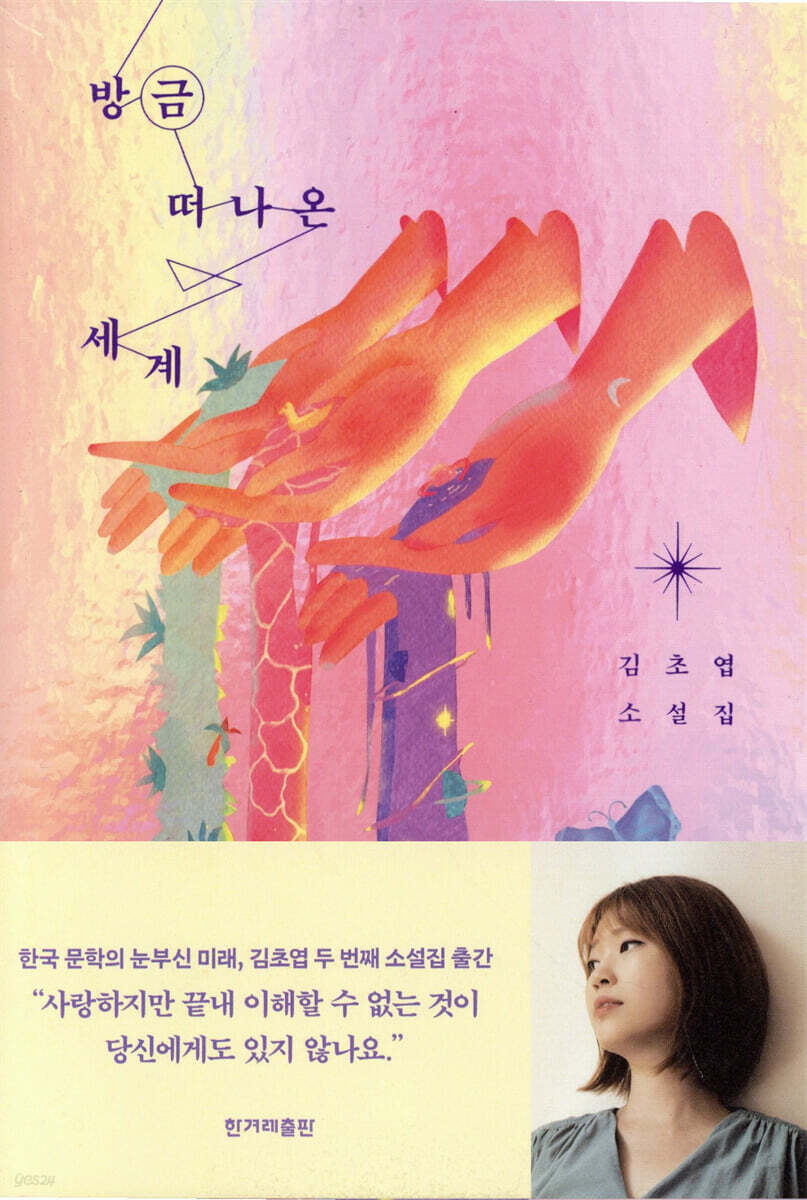
The world I just left
 |
Description
Book Introduction
- A word from MD
-
Kim Cho-yeop's expanding worldKim Cho-yeop's second collection of short stories.
The seven novels in the book feature people who have become "minorities" because they are different, and those who, instead of settling, dream of change and break away.
Through stories centered around them, we break down the boundaries of our thinking, expand the realms of our imagination and understanding, and once again, we come one step closer to each other's universe.
October 22, 2021. Novel/Poetry PD Park Hyung-wook
Riding on particles of love, wandering through an unfamiliar world
Stories from the wondrous and beautiful beyond the universe
If We Can't Travel at the Speed of Light, Kim Cho-yeop's Second Short Story Collection
"The World I Just Left" is a novel by Kim Cho-yeop, who emerged as a future star in Korean literature after winning the grand prize and honorable mention in the short story category of the 2nd Korea Science Literature Award with "Lost in the Office" and "If We Can't Travel at the Speed of Light."
This is also the second collection of short stories published in two years after the first collection, “If We Can’t Travel at the Speed of Light,” which sold 200,000 copies.
It contains seven wondrous and beautiful novels written with the desire to love and understand 'myself' and 'the world', including 'Cognitive Space', winner of the 11th Young Writer's Award, and 'Old Agreement', selected as the 2021 Problem Novel of the Year.
In this collection of short stories, the author, with her delicate prose, unwavering narrative, and deep reflections on others, captures the stories of the unfamiliar world beyond, within Kim Cho-yeop's own world, as a meticulous observer.
In the first collection of short stories, social issues that were only depicted indirectly are brought one step closer.
In this collection of short stories, the author, with her delicate prose, unwavering narrative, and deep reflections on others, captures the stories of the unfamiliar world beyond, within Kim Cho-yeop's own world, as a meticulous observer.
In the first collection of short stories, social issues that were only depicted indirectly are brought one step closer.
The characters Kim Cho-yeop portrays all live based on love and understanding, but rather than enduring and stopping because of love and understanding, they dream of some kind of social overthrow instead of settling for reality.
To become the real me, I run away from my younger brother ("The Cabin Equation"), to become the real me, I inform my lover ("Laura"), and to become the real me, I cause terrorism on normal people ("Marie's Dance").
The metaphor of disability as a marginalized and excluded entity is also revealed through the characters in the novel.
Stories from the wondrous and beautiful beyond the universe
If We Can't Travel at the Speed of Light, Kim Cho-yeop's Second Short Story Collection
"The World I Just Left" is a novel by Kim Cho-yeop, who emerged as a future star in Korean literature after winning the grand prize and honorable mention in the short story category of the 2nd Korea Science Literature Award with "Lost in the Office" and "If We Can't Travel at the Speed of Light."
This is also the second collection of short stories published in two years after the first collection, “If We Can’t Travel at the Speed of Light,” which sold 200,000 copies.
It contains seven wondrous and beautiful novels written with the desire to love and understand 'myself' and 'the world', including 'Cognitive Space', winner of the 11th Young Writer's Award, and 'Old Agreement', selected as the 2021 Problem Novel of the Year.
In this collection of short stories, the author, with her delicate prose, unwavering narrative, and deep reflections on others, captures the stories of the unfamiliar world beyond, within Kim Cho-yeop's own world, as a meticulous observer.
In the first collection of short stories, social issues that were only depicted indirectly are brought one step closer.
In this collection of short stories, the author, with her delicate prose, unwavering narrative, and deep reflections on others, captures the stories of the unfamiliar world beyond, within Kim Cho-yeop's own world, as a meticulous observer.
In the first collection of short stories, social issues that were only depicted indirectly are brought one step closer.
The characters Kim Cho-yeop portrays all live based on love and understanding, but rather than enduring and stopping because of love and understanding, they dream of some kind of social overthrow instead of settling for reality.
To become the real me, I run away from my younger brother ("The Cabin Equation"), to become the real me, I inform my lover ("Laura"), and to become the real me, I cause terrorism on normal people ("Marie's Dance").
The metaphor of disability as a marginalized and excluded entity is also revealed through the characters in the novel.
- You can preview some of the book's contents.
Preview
index
The Last Lion
Marie's Dance
Laura
Hidden Shadow
Old convention
cognitive space
Cabin equation
Author's Note
Marie's Dance
Laura
Hidden Shadow
Old convention
cognitive space
Cabin equation
Author's Note
Into the book
Even now, when I close my eyes, I sometimes see Cell.
He laughs out loud as he protects the collapsing city.
Fragments fall onto the cell.
And strangely enough, in that scenery, it's not me, but Liony.
Lionie holds Cell's hand as he lies dying.
Both are facing destruction, but they are not unhappy.
--- p.54, from "The Last Lioness"
Marie will still dance like a wooden doll.
The movements will only trace calculated trajectories in the air and disappear.
Beauty will remain beneath the surface.
What is shown will no longer matter to anyone.
--- p.100, from "Marie's Dance"
Laura said.
Love and understanding are not the same.
Jin couldn't agree with that statement and began a long interview.
It saddened Jean that some part of Laura remained completely unknown, and that Laura had no intention of explaining it to Jean.
As Jin traveled the world, he met people who were similar to Laura, but not exactly the same.
They were wary of Jin, sometimes welcomed him, sometimes rejected him, but Jin discovered a different part of his true self in each of them.
So, for a moment, Jin thought she almost understood Laura, almost reached into Laura's complex inner self.
--- p.105, from "Laura"
The only person who understood Laura, Jin wanted to be that person.
--- p.125, from "Laura"
The fact is that the time we have been given to live is nothing more than a brief borrowing of this planet's time.
--- p.226, from “Old Agreements”
I turned my head and looked at the lattice structure I had come from.
At midnight, the scribe blinked the lights in the cognitive space three times.
When the lights went out completely, I was facing the lattice structure in darkness for the first time.
It was our cognitive space.
It was a shared memory.
It was once all we had.
And it was also the world I had just left.
He laughs out loud as he protects the collapsing city.
Fragments fall onto the cell.
And strangely enough, in that scenery, it's not me, but Liony.
Lionie holds Cell's hand as he lies dying.
Both are facing destruction, but they are not unhappy.
--- p.54, from "The Last Lioness"
Marie will still dance like a wooden doll.
The movements will only trace calculated trajectories in the air and disappear.
Beauty will remain beneath the surface.
What is shown will no longer matter to anyone.
--- p.100, from "Marie's Dance"
Laura said.
Love and understanding are not the same.
Jin couldn't agree with that statement and began a long interview.
It saddened Jean that some part of Laura remained completely unknown, and that Laura had no intention of explaining it to Jean.
As Jin traveled the world, he met people who were similar to Laura, but not exactly the same.
They were wary of Jin, sometimes welcomed him, sometimes rejected him, but Jin discovered a different part of his true self in each of them.
So, for a moment, Jin thought she almost understood Laura, almost reached into Laura's complex inner self.
--- p.105, from "Laura"
The only person who understood Laura, Jin wanted to be that person.
--- p.125, from "Laura"
The fact is that the time we have been given to live is nothing more than a brief borrowing of this planet's time.
--- p.226, from “Old Agreements”
I turned my head and looked at the lattice structure I had come from.
At midnight, the scribe blinked the lights in the cognitive space three times.
When the lights went out completely, I was facing the lattice structure in darkness for the first time.
It was our cognitive space.
It was a shared memory.
It was once all we had.
And it was also the world I had just left.
--- p.272 From “Cognitive Space”
Publisher's Review
“I love you, but isn’t there something about you that I can never understand?”
If We Can't Travel at the Speed of Light, Kim Cho-yeop's second novel collection
-
The 11th Young Writer Award winner, “Cognitive Space”
Includes seven novels, including the 2021 Problem Novel of the Year, "The Old Agreement."
“The things that make me love this place don’t make me hate it any less.
It just exists simultaneously.
“Like everything else.” _From the text
If Kim Cho-yeop was the first writer introduced when talking about science fiction, now Kim Cho-yeop has become the first writer to be summoned when talking about Korean literature.
As critic Kang Ji-hee said (from the 11th Young Writer's Award review), "When reading Kim Cho-yeop's novels, you get the feeling that this world expands by an inch or so", Kim Cho-yeop's novels, like other science fiction, deal with stories set in a different time and space than the here and now, but they also lead us to different truths, different emotions, and moments of distant wonder that we encounter for the first time.
《The World I Just Left》 is a novel by Kim Cho-yeop, who emerged as a future star in Korean literature after winning the grand prize and honorable mention award for short stories at the 2nd Korea Science Literature Award for 《Lost in the Office》 and 《If We Cannot Travel at the Speed of Light》.
This is also the second collection of short stories published in two years after the first collection, “If We Can’t Travel at the Speed of Light,” which sold 200,000 copies.
It contains seven wondrous and beautiful novels written with the desire to love and understand 'myself' and 'the world', including 'Cognitive Space', winner of the 11th Young Writer's Award, and 'Old Agreement', selected as the 2021 Problem Novel of the Year.
In this collection of short stories, the author, with her delicate prose, unwavering narrative, and deep reflections on others, captures the stories of the unfamiliar world beyond, within Kim Cho-yeop's own world, as a meticulous observer.
In the first collection of short stories, social issues that were only depicted indirectly are brought one step closer.
The characters Kim Cho-yeop portrays all live based on love and understanding, but rather than enduring and stopping because of love and understanding, they dream of some kind of social overthrow instead of settling for reality.
To become the real me, I run away from my younger brother (The Cabin Equation), to become the real me, I inform my lover (Laura), and to become the real me, I cause terrorism on normal people (Marie's Dance).
The metaphor of disability as a marginalized and excluded entity is also revealed through the characters in the novel.
The 'I' in 'The Last Lion' is a defective clone, and the 'Marie' in 'Marie's Dance' is 'Mog' who has suffered from visual dyspraxia since birth.
In "Laura," Laura chooses to become a transhuman by receiving a third arm transplant to escape the dissonance between her mind and body, and in "The Cabin Equation," her sister ends up living in a very slow time zone different from others due to an unexpected accident.
Noah in "The Old Agreement" is destined to die of a mental illness at the age of only thirty, and Eve in "Cognitive Space" is too small and weak to enter "Cognitive Space."
Danhee from "The Shadow of Breath" is a being whose vocal organs have degenerated.
However, the world that Kim Cho-yeop draws with them as the main characters is by no means cold.
The marginalized and excluded characters of "The World I Just Left" confront the contradictions of society and, without ceasing to question society, leave the present world and move on to a greater world.
It shows the power of love, the power of understanding, and the power of comfort, not love, understanding, and comfort.
Without forgetting the world you just left, you embark on a journey to an infinite world.
In her recommendation for “The World I Just Left,” author Gyul-wool Kim of YouTube’s “Winter Bookstore” says, “I think I will often recall certain scenes from this collection of short stories as I live.”
“I’m glad he’s writing in this day and age.”
Riding on particles of love, wandering through an unfamiliar world
Stories from the wondrous and beautiful beyond the universe
“There are two kinds of destruction in the universe.
“A worthwhile destruction and a worthless destruction.” _〈The Last Lioness〉
A story about the friendship between 'I', who was given a solo mission to explore planet 3420ED, and 'Cell', the leader of the machines.
Through his encounter with Cell, 'I' realizes that the innate defect he had may not have been a defect after all.
-
I, a member of the 'Romon', a brave and daring race that goes to destroyed planets to recover and organize the remaining resources and information, head to planet 3420ED, which has been deemed unworthy of exploration, at the request of the planetary system.
However, during the exploration, he is captured by the machines that control 3420ED.
The leader of the machines, 'Cell', keeps calling me 'Lionie' and repeating the strange phrase, "Lionie, you're finally back"...
“How relative is light?” _〈Marie’s Dance〉
The story of Marie, who was a Mog from birth, and the strange and secret dance class of 'I', who is teaching for the first time to a Mog student.
To 'Na', who says that Mog, who suffers from visual dyspraxia, cannot even appreciate the dance, let alone dance, 'Marie' tells Mog that he can dance too.
“Until now, it was our Mogs who tried to fit into this world.
“Not you.” By looking into the reasons for the words and actions of ‘Marie’, a being who is objectified and objectified, we are led to think about whether we should simply view Marie’s resistance as terrorism and what the standards of beauty really are.
-
Marie, who suffers from dysarthria, can only perceive the movements of others through an assistive device called Fluid.
At the request of a friend, I teach Marie to dance. I start the dance class with half curiosity and half worry about whether Marie, a natural born Mog, will be able to learn to dance.
Two months after the lesson, Marie announces to me that she will be performing in front of an audience.
'I' experience 'Fluid' at 'Marie's' recommendation and learn the real reason why 'Marie' wanted to learn dancing...
“Love and understanding are not the same.
Jin couldn't agree with that and started a long interview." _〈Laura〉
The story of 'Laura', who wants a third arm transplant, and 'Jin', who goes on a long reporting trip to understand 'Laura'.
Through the story of 'Laura' and 'Jean', we realize that 'love' and 'understanding' are not the same.
Loving someone makes us happy, but being ourselves is a lifelong adventure.
But still, life requires both love and understanding.
-
One day, Laura, whose proprioception, which detects the position and movement of her body, has been disrupted, informs Jin that she wants to receive a third arm transplant to cure the mismap in her brain and the mismatch in her body.
Jin, who was confused by the decision made by her beloved lover, goes on a long reporting trip to understand Laura, and meets the 'Chairman of the Transhuman Federation' and the 'Excess Limb Researcher'...
“No, I don’t belong here.” _〈Hidden Shadow〉
An imperfect but beautiful story of communication, love, and separation between 'Dan-hee', a shadow person who has lost her vocal organs and communicates through breathing, and 'Joan', a proto-human who wakes up under the ice with a broken spaceship.
Through the imperfect conversation between 'Danhee' and 'Joan' that takes place in the midst of delay, it makes us think about things that can never be captured or expressed in words.
-
One day, hundreds of cabins under the ice are discovered by an expedition team that went to investigate the polar regions.
Only one cabin remained undamaged, and only a girl named Joan awoke from a long, near-death sleep.
Researchers lock 'Joan' in an isolation room in the genetic vault to hide the existence of the original human.
On her first day at work at the research institute, 'Danhee' meets 'Joan', who was in isolation, and attempts to have her first conversation through a meaning interpreter.
So, the conversation between the two began with the glass wall between them, but there was a barrier called double interpretation between them.
Dan-hee, a shadow person with a degenerated vocal organ, and Jo-an, a proto-human who cannot learn the particle language of the shadow people, continue to communicate despite numerous obstacles.
And one day, 'Danhee' creates a meaning synthesis machine to help 'Joan', but 'Joan' participates in a spaceship restoration project to go outside the planet without 'Danhee's knowledge...
“The time we have been given to live is nothing more than a brief borrowing of this planet’s time.” _〈Old Agreement〉
A story in the form of a letter sent by 'Noah', a priest from the planet 'Belata', to 'Lee Jeong', an Earthling who has left to explore 'Belata'.
Only after Lee Jeong leaves does 'Noah' confess about the 'old agreement' that existed between 'Ob' and the 'Bellatains'.
The novel presents an alternative life form that Earthlings, filled with scientific supremacy, can never perceive or understand, through the taboo and shunned strange creatures called 'Orbs'.
Unlike humans, the appearance of 'Orbs', who live for an extremely long time, makes us think again about the meaning of 'coexistence'.
-
Noah, a priest of 'Belata', welcomes 'Lee Jeong', an explorer from Earth, and introduces various places in Belata.
In particular, he warns that no one should touch or eat the creatures called 'Orbs' when visiting the Orb Fields.
Meanwhile, after continuous investigation, Lee Jeong discovers the secret of why the average lifespan of the Belata people does not exceed twenty-five years.
That's right, the substance called rutinil emitted by 'Orb' was having a fatal effect on the health of the Belata people.
'Lee Jeong' goes to Noah and tells him that he must eat 'Orb' to extend his life, but Noah says that he can never break the taboo...
“I have to go.
“Not for Eve, but for us.” _〈Cognitive Space〉
A story about the friendship and conflict between 'I', the manager of 'cognitive space', and 'Eve', who was born small and weak and was unable to enter 'cognitive space'.
Through the death of 'Eve', 'I' finally decide to leave the 'cognitive space' where all of humanity's knowledge is believed to be contained.
It was a search for 'our origins' that Eve spoke of, and it was also a search for 'Eve' to remember.
Through 'Eve', we are made to look back on 'cognitive space', that is, the trivial but precious memories that the present world, which is considered perfect and normal, cannot contain.
About the things we have forgotten, and perhaps are being forgotten by us even now.
-
'Cognitive space' refers to a cubic system, a shared knowledge area, or a grid structure that helps knowledge to be permanently stored beyond the limits of the organic brain.
'Cognitive space' contains the sophisticated laws of nature, the amazing structure of the world, all the beauty of the world, and myths passed down from generation to generation.
Only through 'cognitive space' is knowledge transmitted and left behind.
But, shared knowledge is also what makes us forget the differences we had as children, the different memories we have from each other, and prevents us from going outside the planet.
Eve, who was born small and weak and unable to enter the 'cognitive space', constantly believes that the origin of humanity lies outside the planet, and is killed by wild beasts while exploring outside the cognitive space.
Half a year later, 'I', who came to Eve's house, discovered a small, portable cognitive space called 'Sphere' in Eve's room...
“Our universe contains countless pocket universes.” _〈Cavin Equation〉
The story of sisters, Hyunhwa and Hyunji, who live in different times due to a sudden accident.
The two get on the Ferris wheel together.
As Hyun-ji goes to ride the Ferris wheel, she feels a sense of alienation from her sister and her own time, which can never be the same again.
But the moment they discover a 'pocket universe' inside the cabin at the top, they finally understand that their time is parallel.
The story of sisters who live in the same space but at different times, riding a Ferris wheel together and witnessing a 'pocket universe' suggests that love and understanding may be the keys to expanding the concept of space and time in which we live.
-
Hyunhwa, a promising physicist studying 'local time bubbles', loses her ability to perceive time after an unexpected accident and begins to live more slowly than other people.
During treatment, 'Thank you.'
love you.
'Hyeonhwa', who disappeared leaving behind only the message 'I couldn't bear it any longer', sends a letter to 'her younger sister Hyunji' several years later, asking her to investigate an old Ferris wheel in Ulsan...
Wishing you happiness as you travel countless worlds
“I write to understand something, but I almost always seem to fail,” said author Kim Cho-yeop, who published her novel “Laura” in the webzine “Biyu” in 2019.
For those who read to understand something, and who almost always fail, this collection of short stories will surely be of great comfort.
It is important to know that there are worlds that we can never reach, no matter how much we run through our lives.
This collection of short stories contains a tender yet lonely declaration that there is our universe and that there is also their universe.
There is also the beauty of remaining two worlds, with love and understanding, rather than becoming one world.
As we read "The World We Just Left," we think of our friends, family, and lovers whom we love but cannot understand, and by the end of the novel, we gain the courage to leave their world and travel to countless other worlds.
Wishing them and those of us who have left behind countless good fortune.
If We Can't Travel at the Speed of Light, Kim Cho-yeop's second novel collection
-
The 11th Young Writer Award winner, “Cognitive Space”
Includes seven novels, including the 2021 Problem Novel of the Year, "The Old Agreement."
“The things that make me love this place don’t make me hate it any less.
It just exists simultaneously.
“Like everything else.” _From the text
If Kim Cho-yeop was the first writer introduced when talking about science fiction, now Kim Cho-yeop has become the first writer to be summoned when talking about Korean literature.
As critic Kang Ji-hee said (from the 11th Young Writer's Award review), "When reading Kim Cho-yeop's novels, you get the feeling that this world expands by an inch or so", Kim Cho-yeop's novels, like other science fiction, deal with stories set in a different time and space than the here and now, but they also lead us to different truths, different emotions, and moments of distant wonder that we encounter for the first time.
《The World I Just Left》 is a novel by Kim Cho-yeop, who emerged as a future star in Korean literature after winning the grand prize and honorable mention award for short stories at the 2nd Korea Science Literature Award for 《Lost in the Office》 and 《If We Cannot Travel at the Speed of Light》.
This is also the second collection of short stories published in two years after the first collection, “If We Can’t Travel at the Speed of Light,” which sold 200,000 copies.
It contains seven wondrous and beautiful novels written with the desire to love and understand 'myself' and 'the world', including 'Cognitive Space', winner of the 11th Young Writer's Award, and 'Old Agreement', selected as the 2021 Problem Novel of the Year.
In this collection of short stories, the author, with her delicate prose, unwavering narrative, and deep reflections on others, captures the stories of the unfamiliar world beyond, within Kim Cho-yeop's own world, as a meticulous observer.
In the first collection of short stories, social issues that were only depicted indirectly are brought one step closer.
The characters Kim Cho-yeop portrays all live based on love and understanding, but rather than enduring and stopping because of love and understanding, they dream of some kind of social overthrow instead of settling for reality.
To become the real me, I run away from my younger brother (The Cabin Equation), to become the real me, I inform my lover (Laura), and to become the real me, I cause terrorism on normal people (Marie's Dance).
The metaphor of disability as a marginalized and excluded entity is also revealed through the characters in the novel.
The 'I' in 'The Last Lion' is a defective clone, and the 'Marie' in 'Marie's Dance' is 'Mog' who has suffered from visual dyspraxia since birth.
In "Laura," Laura chooses to become a transhuman by receiving a third arm transplant to escape the dissonance between her mind and body, and in "The Cabin Equation," her sister ends up living in a very slow time zone different from others due to an unexpected accident.
Noah in "The Old Agreement" is destined to die of a mental illness at the age of only thirty, and Eve in "Cognitive Space" is too small and weak to enter "Cognitive Space."
Danhee from "The Shadow of Breath" is a being whose vocal organs have degenerated.
However, the world that Kim Cho-yeop draws with them as the main characters is by no means cold.
The marginalized and excluded characters of "The World I Just Left" confront the contradictions of society and, without ceasing to question society, leave the present world and move on to a greater world.
It shows the power of love, the power of understanding, and the power of comfort, not love, understanding, and comfort.
Without forgetting the world you just left, you embark on a journey to an infinite world.
In her recommendation for “The World I Just Left,” author Gyul-wool Kim of YouTube’s “Winter Bookstore” says, “I think I will often recall certain scenes from this collection of short stories as I live.”
“I’m glad he’s writing in this day and age.”
Riding on particles of love, wandering through an unfamiliar world
Stories from the wondrous and beautiful beyond the universe
“There are two kinds of destruction in the universe.
“A worthwhile destruction and a worthless destruction.” _〈The Last Lioness〉
A story about the friendship between 'I', who was given a solo mission to explore planet 3420ED, and 'Cell', the leader of the machines.
Through his encounter with Cell, 'I' realizes that the innate defect he had may not have been a defect after all.
-
I, a member of the 'Romon', a brave and daring race that goes to destroyed planets to recover and organize the remaining resources and information, head to planet 3420ED, which has been deemed unworthy of exploration, at the request of the planetary system.
However, during the exploration, he is captured by the machines that control 3420ED.
The leader of the machines, 'Cell', keeps calling me 'Lionie' and repeating the strange phrase, "Lionie, you're finally back"...
“How relative is light?” _〈Marie’s Dance〉
The story of Marie, who was a Mog from birth, and the strange and secret dance class of 'I', who is teaching for the first time to a Mog student.
To 'Na', who says that Mog, who suffers from visual dyspraxia, cannot even appreciate the dance, let alone dance, 'Marie' tells Mog that he can dance too.
“Until now, it was our Mogs who tried to fit into this world.
“Not you.” By looking into the reasons for the words and actions of ‘Marie’, a being who is objectified and objectified, we are led to think about whether we should simply view Marie’s resistance as terrorism and what the standards of beauty really are.
-
Marie, who suffers from dysarthria, can only perceive the movements of others through an assistive device called Fluid.
At the request of a friend, I teach Marie to dance. I start the dance class with half curiosity and half worry about whether Marie, a natural born Mog, will be able to learn to dance.
Two months after the lesson, Marie announces to me that she will be performing in front of an audience.
'I' experience 'Fluid' at 'Marie's' recommendation and learn the real reason why 'Marie' wanted to learn dancing...
“Love and understanding are not the same.
Jin couldn't agree with that and started a long interview." _〈Laura〉
The story of 'Laura', who wants a third arm transplant, and 'Jin', who goes on a long reporting trip to understand 'Laura'.
Through the story of 'Laura' and 'Jean', we realize that 'love' and 'understanding' are not the same.
Loving someone makes us happy, but being ourselves is a lifelong adventure.
But still, life requires both love and understanding.
-
One day, Laura, whose proprioception, which detects the position and movement of her body, has been disrupted, informs Jin that she wants to receive a third arm transplant to cure the mismap in her brain and the mismatch in her body.
Jin, who was confused by the decision made by her beloved lover, goes on a long reporting trip to understand Laura, and meets the 'Chairman of the Transhuman Federation' and the 'Excess Limb Researcher'...
“No, I don’t belong here.” _〈Hidden Shadow〉
An imperfect but beautiful story of communication, love, and separation between 'Dan-hee', a shadow person who has lost her vocal organs and communicates through breathing, and 'Joan', a proto-human who wakes up under the ice with a broken spaceship.
Through the imperfect conversation between 'Danhee' and 'Joan' that takes place in the midst of delay, it makes us think about things that can never be captured or expressed in words.
-
One day, hundreds of cabins under the ice are discovered by an expedition team that went to investigate the polar regions.
Only one cabin remained undamaged, and only a girl named Joan awoke from a long, near-death sleep.
Researchers lock 'Joan' in an isolation room in the genetic vault to hide the existence of the original human.
On her first day at work at the research institute, 'Danhee' meets 'Joan', who was in isolation, and attempts to have her first conversation through a meaning interpreter.
So, the conversation between the two began with the glass wall between them, but there was a barrier called double interpretation between them.
Dan-hee, a shadow person with a degenerated vocal organ, and Jo-an, a proto-human who cannot learn the particle language of the shadow people, continue to communicate despite numerous obstacles.
And one day, 'Danhee' creates a meaning synthesis machine to help 'Joan', but 'Joan' participates in a spaceship restoration project to go outside the planet without 'Danhee's knowledge...
“The time we have been given to live is nothing more than a brief borrowing of this planet’s time.” _〈Old Agreement〉
A story in the form of a letter sent by 'Noah', a priest from the planet 'Belata', to 'Lee Jeong', an Earthling who has left to explore 'Belata'.
Only after Lee Jeong leaves does 'Noah' confess about the 'old agreement' that existed between 'Ob' and the 'Bellatains'.
The novel presents an alternative life form that Earthlings, filled with scientific supremacy, can never perceive or understand, through the taboo and shunned strange creatures called 'Orbs'.
Unlike humans, the appearance of 'Orbs', who live for an extremely long time, makes us think again about the meaning of 'coexistence'.
-
Noah, a priest of 'Belata', welcomes 'Lee Jeong', an explorer from Earth, and introduces various places in Belata.
In particular, he warns that no one should touch or eat the creatures called 'Orbs' when visiting the Orb Fields.
Meanwhile, after continuous investigation, Lee Jeong discovers the secret of why the average lifespan of the Belata people does not exceed twenty-five years.
That's right, the substance called rutinil emitted by 'Orb' was having a fatal effect on the health of the Belata people.
'Lee Jeong' goes to Noah and tells him that he must eat 'Orb' to extend his life, but Noah says that he can never break the taboo...
“I have to go.
“Not for Eve, but for us.” _〈Cognitive Space〉
A story about the friendship and conflict between 'I', the manager of 'cognitive space', and 'Eve', who was born small and weak and was unable to enter 'cognitive space'.
Through the death of 'Eve', 'I' finally decide to leave the 'cognitive space' where all of humanity's knowledge is believed to be contained.
It was a search for 'our origins' that Eve spoke of, and it was also a search for 'Eve' to remember.
Through 'Eve', we are made to look back on 'cognitive space', that is, the trivial but precious memories that the present world, which is considered perfect and normal, cannot contain.
About the things we have forgotten, and perhaps are being forgotten by us even now.
-
'Cognitive space' refers to a cubic system, a shared knowledge area, or a grid structure that helps knowledge to be permanently stored beyond the limits of the organic brain.
'Cognitive space' contains the sophisticated laws of nature, the amazing structure of the world, all the beauty of the world, and myths passed down from generation to generation.
Only through 'cognitive space' is knowledge transmitted and left behind.
But, shared knowledge is also what makes us forget the differences we had as children, the different memories we have from each other, and prevents us from going outside the planet.
Eve, who was born small and weak and unable to enter the 'cognitive space', constantly believes that the origin of humanity lies outside the planet, and is killed by wild beasts while exploring outside the cognitive space.
Half a year later, 'I', who came to Eve's house, discovered a small, portable cognitive space called 'Sphere' in Eve's room...
“Our universe contains countless pocket universes.” _〈Cavin Equation〉
The story of sisters, Hyunhwa and Hyunji, who live in different times due to a sudden accident.
The two get on the Ferris wheel together.
As Hyun-ji goes to ride the Ferris wheel, she feels a sense of alienation from her sister and her own time, which can never be the same again.
But the moment they discover a 'pocket universe' inside the cabin at the top, they finally understand that their time is parallel.
The story of sisters who live in the same space but at different times, riding a Ferris wheel together and witnessing a 'pocket universe' suggests that love and understanding may be the keys to expanding the concept of space and time in which we live.
-
Hyunhwa, a promising physicist studying 'local time bubbles', loses her ability to perceive time after an unexpected accident and begins to live more slowly than other people.
During treatment, 'Thank you.'
love you.
'Hyeonhwa', who disappeared leaving behind only the message 'I couldn't bear it any longer', sends a letter to 'her younger sister Hyunji' several years later, asking her to investigate an old Ferris wheel in Ulsan...
Wishing you happiness as you travel countless worlds
“I write to understand something, but I almost always seem to fail,” said author Kim Cho-yeop, who published her novel “Laura” in the webzine “Biyu” in 2019.
For those who read to understand something, and who almost always fail, this collection of short stories will surely be of great comfort.
It is important to know that there are worlds that we can never reach, no matter how much we run through our lives.
This collection of short stories contains a tender yet lonely declaration that there is our universe and that there is also their universe.
There is also the beauty of remaining two worlds, with love and understanding, rather than becoming one world.
As we read "The World We Just Left," we think of our friends, family, and lovers whom we love but cannot understand, and by the end of the novel, we gain the courage to leave their world and travel to countless other worlds.
Wishing them and those of us who have left behind countless good fortune.
GOODS SPECIFICS
- Publication date: October 20, 2021
- Page count, weight, size: 324 pages | 408g | 134*195*20mm
- ISBN13: 9791160406504
- ISBN10: 1160406502
You may also like
카테고리
korean


korean

![GQ KOREA Mark (Monthly): December [2025]](http://librairie.coreenne.fr/cdn/shop/files/8ef265dbbfbf186523ed75ba7319009d.jpg?v=1765340328&width=3840)


