

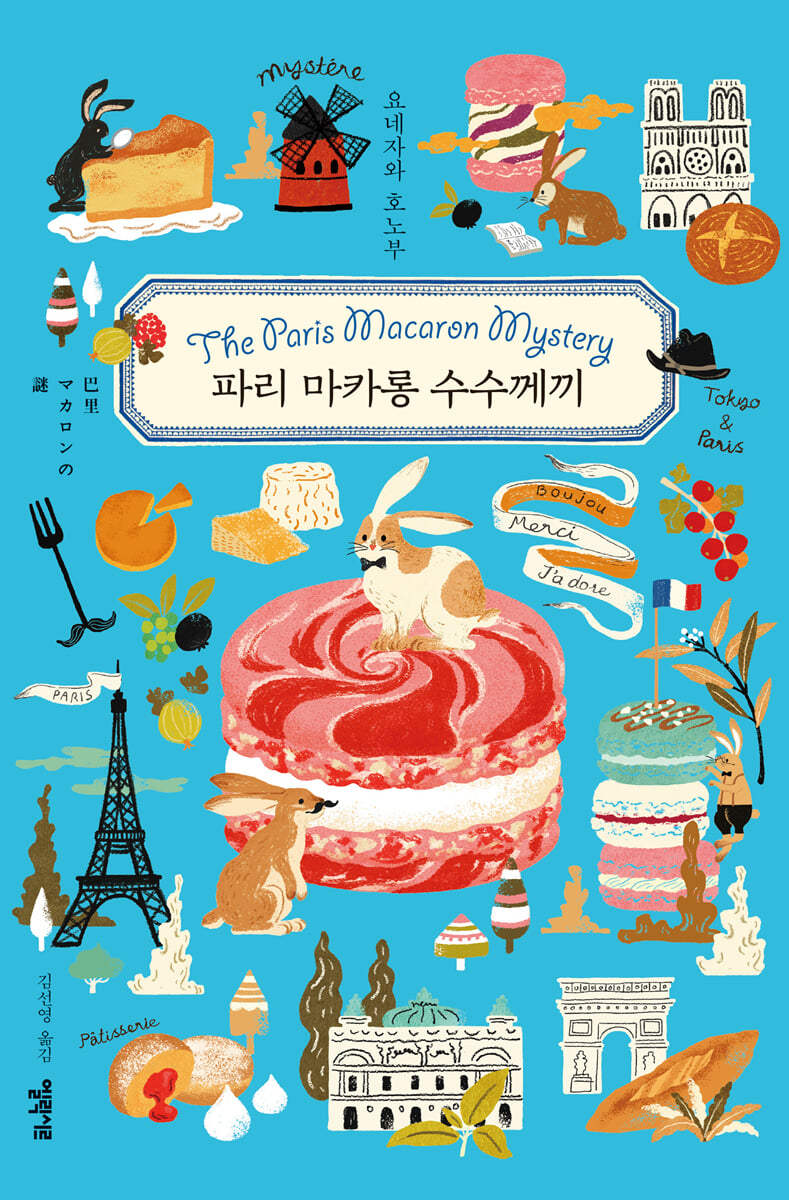
Paris Macaron Riddle
 |
Description
Book Introduction
- A word from MD
- What is the mysterious fourth macaron?A spin-off of Honobu Yonezawa's school youth mystery series "Petit Bourgeois."
Osanai and Kobato, who aspire to be ordinary citizens for the peace of everyday life, are depicted in this book, which depicts the mysteries and puzzle-solving they discover in various places in their daily lives, such as at school, a dessert shop, and a traditional tea house, from the fall to the winter of their first year of high school.
October 19, 2021. Novel/Poetry PD Park Hyung-wook
“More than anything else to me,
“Macaroons are exciting!”
The 'Petit Bourgeois' series, a spin-off published after 4 years!
Kobato is led by Osanai to a newly opened dessert shop.
Osanai's new fall limited edition macarons are available as a set menu with three in one.
But there are four macarons on Osanai's plate.
What is the identity of the fourth macaron, whose English is unknown? Will Osanai and Kobato, who aspire to be ordinary citizens for the peace of everyday life, be able to preserve their ordinary lives?
The "Petit Bourgeois" series, a school youth mystery series that is considered one of Honobu Yonezawa's representative series, along with the "Classical Club" series, which deals with everyday events set in a school.
The spin-off work, "The Paris Macaron Mystery," was published in Korea after four years.
This work, which depicts the fall and winter of the first year of the two main characters, falls between "The Spring Limited Strawberry Tart Incident," which depicts the spring of the first year, and "The Summer Limited Tropical Parfait Incident," which depicts the summer of the second year.
When I open the book and think about the main characters who have already grown to a certain extent through previous volumes, I am somehow immersed in old memories by seeing their innocent appearances that are different from my memories.
There are also many welcome elements scattered throughout, such as references to traditional Japanese tea houses and dessert shops that readers will be familiar with through the "Summer Limited Tropical Parfait Incident" and the "Autumn Limited Kuri Kinton Incident."
“Macaroons are exciting!”
The 'Petit Bourgeois' series, a spin-off published after 4 years!
Kobato is led by Osanai to a newly opened dessert shop.
Osanai's new fall limited edition macarons are available as a set menu with three in one.
But there are four macarons on Osanai's plate.
What is the identity of the fourth macaron, whose English is unknown? Will Osanai and Kobato, who aspire to be ordinary citizens for the peace of everyday life, be able to preserve their ordinary lives?
The "Petit Bourgeois" series, a school youth mystery series that is considered one of Honobu Yonezawa's representative series, along with the "Classical Club" series, which deals with everyday events set in a school.
The spin-off work, "The Paris Macaron Mystery," was published in Korea after four years.
This work, which depicts the fall and winter of the first year of the two main characters, falls between "The Spring Limited Strawberry Tart Incident," which depicts the spring of the first year, and "The Summer Limited Tropical Parfait Incident," which depicts the summer of the second year.
When I open the book and think about the main characters who have already grown to a certain extent through previous volumes, I am somehow immersed in old memories by seeing their innocent appearances that are different from my memories.
There are also many welcome elements scattered throughout, such as references to traditional Japanese tea houses and dessert shops that readers will be familiar with through the "Summer Limited Tropical Parfait Incident" and the "Autumn Limited Kuri Kinton Incident."
- You can preview some of the book's contents.
Preview
index
Paris Macaron Riddle
New York Cheesecake Riddle
Berlin Fried Bun Riddle
Florentine Cream Puff Riddle
New York Cheesecake Riddle
Berlin Fried Bun Riddle
Florentine Cream Puff Riddle
Into the book
“A German bakery recently opened near my school.
Since they were also selling these fried breads, I applied for an interview with them to cover the December issue under the theme of the end of the year around the world, and they readily accepted.
So instead of just listening to the story, I decided to actually play the game and write an article about it, one that got me hooked on mustard bread.
“I prepared fried bread for each person and put it on this plate.” That’s why there was a plate on the desk. “And we all ate it at the same time.” Just imagining Gengo eating fried bread with jam at a signal made it a little funny.
Of course, Gengo, despite his appearance, is a man who is obsessed with making delicious cocoa, so he probably enjoys sweet desserts as well. “Was it delicious?” When I asked that, Gengo frowned for some reason. “That’s the problem.” “Was it not delicious?” “No, it was delicious.” “Then there’s no problem.” “I said there was a problem.
Listen carefully, everything was delicious.”
--- p.170~171, "The Berlin Fried Bread Mystery"
“Listen carefully, Corgi.
“Do you really want to know who your enemy was?” As soon as the words left his mouth, a clear answer came back. “Yes.” I can tell.
Osanai wants Corgi to give up.
I hope that we can become ordinary citizens who can accept the absurdity of the situation and accept that such things happen.
That's why Osanai kept saying, "If you try to find out hidden circumstances, you usually have to pay a price.
You might end up thinking that you didn't really want to know what you were doing.
"Even so? No matter what happens?" Kogi didn't hesitate. "No matter what!" he cried. "I can't forgive you!" "... ... That's right." Osanai's expression was unreadable as he lowered his head.
Was he sad? No, perhaps he was laughing? Osanai sank deep into the white sofa and said, "Okay.
“I will help you.”
Since they were also selling these fried breads, I applied for an interview with them to cover the December issue under the theme of the end of the year around the world, and they readily accepted.
So instead of just listening to the story, I decided to actually play the game and write an article about it, one that got me hooked on mustard bread.
“I prepared fried bread for each person and put it on this plate.” That’s why there was a plate on the desk. “And we all ate it at the same time.” Just imagining Gengo eating fried bread with jam at a signal made it a little funny.
Of course, Gengo, despite his appearance, is a man who is obsessed with making delicious cocoa, so he probably enjoys sweet desserts as well. “Was it delicious?” When I asked that, Gengo frowned for some reason. “That’s the problem.” “Was it not delicious?” “No, it was delicious.” “Then there’s no problem.” “I said there was a problem.
Listen carefully, everything was delicious.”
--- p.170~171, "The Berlin Fried Bread Mystery"
“Listen carefully, Corgi.
“Do you really want to know who your enemy was?” As soon as the words left his mouth, a clear answer came back. “Yes.” I can tell.
Osanai wants Corgi to give up.
I hope that we can become ordinary citizens who can accept the absurdity of the situation and accept that such things happen.
That's why Osanai kept saying, "If you try to find out hidden circumstances, you usually have to pay a price.
You might end up thinking that you didn't really want to know what you were doing.
"Even so? No matter what happens?" Kogi didn't hesitate. "No matter what!" he cried. "I can't forgive you!" "... ... That's right." Osanai's expression was unreadable as he lowered his head.
Was he sad? No, perhaps he was laughing? Osanai sank deep into the white sofa and said, "Okay.
“I will help you.”
--- p.275~276, "The Florentine Cream Puff Riddle"
Publisher's Review
The 'Petit Bourgeois' series, a spin-off published after 4 years!
The mystery of ordinary 'petty citizens' and ordinary daily life
Kobato and Osanai decide to become ordinary "petty citizens" in order to avoid repeating the failures they experienced in middle school due to their personalities.
Neither simple friends nor lovers, this is the only relationship where two people are allowed to use each other as excuses to escape from public attention when they are in an awkward situation.
The more they dream of such an ordinary life, the more they encounter the mysteries of everyday life that, as if by a twist of fate, they are forced to appear before people.
Everyday mysteries are established as 'everyday mysteries' when the observer discovers a riddle in an everyday event.
It's not that cases come to detectives, it's that detectives uncover cases.
The 'Petit Bourgeois' series is a full-fledged mystery or everyday mystery that focuses on 'solving everyday mysteries', and Kobato plays the role of the detective who solves these mysteries.
However, since the trauma that led Kobato to pursue petit bourgeoisdom stems from the act of 'solving riddles', the attitude of pursuing petit bourgeoisdom, the nature of being drawn to riddles, and the characteristics of the genre are portrayed in a contradictory manner.
A new book in the "Petit Bourgeois" series, four years in the making
After 『Spring Limited Strawberry Tart Incident』, 『Summer Limited Tropical Parfait Incident』, and 『Autumn Limited Copper Kinton Incident』, it seems natural that a title that starts with 'Winter Limited~' should follow, but the title of this new book in the 'Little Citizen' series is 'Paris Macaron Mystery'.
As you can roughly guess from the title, this work is not the main story, but a spin-off. It features the same main characters as the main story and the story progresses in a similar way, but the time period is different.
This work, which depicts the fall and winter of the first year of the two main characters, falls between "The Spring Limited Strawberry Tart Incident," which depicts the spring of the first year, and "The Summer Limited Tropical Parfait Incident," which depicts the summer of the second year.
When I open the book and think of the protagonists who have already grown to a certain extent through the previous books (but are still far from being true petit bourgeois), I am somehow immersed in old memories by their innocent appearance, different from my memories.
There are also some welcome elements scattered throughout, such as references to traditional Japanese tea houses and dessert shops that readers are familiar with through the "Summer Limited Tropical Parfait Incident" and the "Autumn Limited Kuri Kinton Incident" (something they haven't yet experienced in "The Paris Macaron Mystery").
A simple but complete puzzle
『The Paris Macaron Mystery』 is somewhat similar to 『The Spring Limited Strawberry Tart Incident』 in that it feels somewhat small and fresh.
Another reason could be that, unlike the long-form novels 『Summer Limited Tropical Parfait Incident』 and 『Autumn Limited Copper Kinton Incident』, it is in the form of a short story collection like 『Spring Limited Strawberry Tart Incident』.
However, while 『The Spring Limited Strawberry Tart Incident』 deals with small stories that happen around us, 『The Paris Macaron Mystery』 is different in that it focuses on the story related to the pastry corgi and cosmos.
The first short story and the title work, "The Paris Macaron Mystery," is set in the pastry shop where the character, a corgi, and a person become connected to the two main characters in this incident, and later appear in "The New York Cheesecake Mystery" and "The Florentine Cream Puff Mystery," forming the axis of the entire work.
Kobato and Osanai, who came all the way to a neighboring city to eat a limited edition macaron set of three macarons, encounter an unbelievable situation.
There are four macarons in front of you when there should clearly be three.
In order to understand or solve this strange phenomenon, and to act as a citizen, we embark on a 'reasoning' that is not desirable for a citizen.
("The Paris Macaron Mystery") The sudden kidnapping of Osanai at the Cosmos festival, where they became friends through the "Macaron Incident."
Kobato and Cosmos, who were tracing the circumstances of the incident and Osanai's whereabouts, arrive at an unexpected truth.
(The New York Cheesecake Mystery) The school newspaper decided to cover Berlin fried bread for this issue.
We all ate Berliner fritters prepared according to the number of people, and the person who stumbled upon the one fritter with mustard instead of jam decided to write an article.
But no one got a blank.
Kobato decides to solve this case at the request of newspaper club member Dojima Kengo.
(The Berlin Fried Bread Mystery) Cosmos was placed on probation for being present at a drinking scene.
However, Cosmos completely denies these allegations.
Kobato and Osanai step forward to clear Cosmos's name, who is complaining of injustice.
(The Florentine Cream Puff Mystery) Each of the four short stories presents a different kind of mystery, dealing with events that are both ordinary and extraordinary.
Whether it's trying to figure out the source of another mysterious macaron, tracking down the CD hidden by Osanai in order to find the kidnapped Osanai, investigating why there weren't any blanks when there should have been, or tracking down why a student who wasn't even in the drinking place was put on probation, it has a good mix of mysteries that fall under the categories of Whodunit, Howdunit, and Widunit, and it neatly handles the process of reasoning, the recovery of foreshadowing, and even the truth, providing satisfaction to readers who have been waiting for a "petty bourgeois" mystery.
Although the overall mystical perfection of the work is excellent, its plainness is also a characteristic of this work.
The first spin-off in the series
『The Paris Macaron Mystery』 is not much different from the main story, even though it is a spin-off, except that the time period goes backwards.
Given the series' characteristic of events growing in scale as time passes, it's only natural that "The Mystery of the Paris Macaron," which travels back in time, feels somewhat bland.
Considering the title of the main story, which continues with a seasonal theme, it may be the author's intention not to end this series with just "Winter Limited~".
This is a fun prediction for fans of the series.
The mystery of ordinary 'petty citizens' and ordinary daily life
Kobato and Osanai decide to become ordinary "petty citizens" in order to avoid repeating the failures they experienced in middle school due to their personalities.
Neither simple friends nor lovers, this is the only relationship where two people are allowed to use each other as excuses to escape from public attention when they are in an awkward situation.
The more they dream of such an ordinary life, the more they encounter the mysteries of everyday life that, as if by a twist of fate, they are forced to appear before people.
Everyday mysteries are established as 'everyday mysteries' when the observer discovers a riddle in an everyday event.
It's not that cases come to detectives, it's that detectives uncover cases.
The 'Petit Bourgeois' series is a full-fledged mystery or everyday mystery that focuses on 'solving everyday mysteries', and Kobato plays the role of the detective who solves these mysteries.
However, since the trauma that led Kobato to pursue petit bourgeoisdom stems from the act of 'solving riddles', the attitude of pursuing petit bourgeoisdom, the nature of being drawn to riddles, and the characteristics of the genre are portrayed in a contradictory manner.
A new book in the "Petit Bourgeois" series, four years in the making
After 『Spring Limited Strawberry Tart Incident』, 『Summer Limited Tropical Parfait Incident』, and 『Autumn Limited Copper Kinton Incident』, it seems natural that a title that starts with 'Winter Limited~' should follow, but the title of this new book in the 'Little Citizen' series is 'Paris Macaron Mystery'.
As you can roughly guess from the title, this work is not the main story, but a spin-off. It features the same main characters as the main story and the story progresses in a similar way, but the time period is different.
This work, which depicts the fall and winter of the first year of the two main characters, falls between "The Spring Limited Strawberry Tart Incident," which depicts the spring of the first year, and "The Summer Limited Tropical Parfait Incident," which depicts the summer of the second year.
When I open the book and think of the protagonists who have already grown to a certain extent through the previous books (but are still far from being true petit bourgeois), I am somehow immersed in old memories by their innocent appearance, different from my memories.
There are also some welcome elements scattered throughout, such as references to traditional Japanese tea houses and dessert shops that readers are familiar with through the "Summer Limited Tropical Parfait Incident" and the "Autumn Limited Kuri Kinton Incident" (something they haven't yet experienced in "The Paris Macaron Mystery").
A simple but complete puzzle
『The Paris Macaron Mystery』 is somewhat similar to 『The Spring Limited Strawberry Tart Incident』 in that it feels somewhat small and fresh.
Another reason could be that, unlike the long-form novels 『Summer Limited Tropical Parfait Incident』 and 『Autumn Limited Copper Kinton Incident』, it is in the form of a short story collection like 『Spring Limited Strawberry Tart Incident』.
However, while 『The Spring Limited Strawberry Tart Incident』 deals with small stories that happen around us, 『The Paris Macaron Mystery』 is different in that it focuses on the story related to the pastry corgi and cosmos.
The first short story and the title work, "The Paris Macaron Mystery," is set in the pastry shop where the character, a corgi, and a person become connected to the two main characters in this incident, and later appear in "The New York Cheesecake Mystery" and "The Florentine Cream Puff Mystery," forming the axis of the entire work.
Kobato and Osanai, who came all the way to a neighboring city to eat a limited edition macaron set of three macarons, encounter an unbelievable situation.
There are four macarons in front of you when there should clearly be three.
In order to understand or solve this strange phenomenon, and to act as a citizen, we embark on a 'reasoning' that is not desirable for a citizen.
("The Paris Macaron Mystery") The sudden kidnapping of Osanai at the Cosmos festival, where they became friends through the "Macaron Incident."
Kobato and Cosmos, who were tracing the circumstances of the incident and Osanai's whereabouts, arrive at an unexpected truth.
(The New York Cheesecake Mystery) The school newspaper decided to cover Berlin fried bread for this issue.
We all ate Berliner fritters prepared according to the number of people, and the person who stumbled upon the one fritter with mustard instead of jam decided to write an article.
But no one got a blank.
Kobato decides to solve this case at the request of newspaper club member Dojima Kengo.
(The Berlin Fried Bread Mystery) Cosmos was placed on probation for being present at a drinking scene.
However, Cosmos completely denies these allegations.
Kobato and Osanai step forward to clear Cosmos's name, who is complaining of injustice.
(The Florentine Cream Puff Mystery) Each of the four short stories presents a different kind of mystery, dealing with events that are both ordinary and extraordinary.
Whether it's trying to figure out the source of another mysterious macaron, tracking down the CD hidden by Osanai in order to find the kidnapped Osanai, investigating why there weren't any blanks when there should have been, or tracking down why a student who wasn't even in the drinking place was put on probation, it has a good mix of mysteries that fall under the categories of Whodunit, Howdunit, and Widunit, and it neatly handles the process of reasoning, the recovery of foreshadowing, and even the truth, providing satisfaction to readers who have been waiting for a "petty bourgeois" mystery.
Although the overall mystical perfection of the work is excellent, its plainness is also a characteristic of this work.
The first spin-off in the series
『The Paris Macaron Mystery』 is not much different from the main story, even though it is a spin-off, except that the time period goes backwards.
Given the series' characteristic of events growing in scale as time passes, it's only natural that "The Mystery of the Paris Macaron," which travels back in time, feels somewhat bland.
Considering the title of the main story, which continues with a seasonal theme, it may be the author's intention not to end this series with just "Winter Limited~".
This is a fun prediction for fans of the series.
GOODS SPECIFICS
- Publication date: October 6, 2021
- Format: Hardcover book binding method guide
- Page count, weight, size: 328 pages | 418g | 132*195*20mm
- ISBN13: 9788954682367
- ISBN10: 8954682367
You may also like
카테고리
korean


korean

![GQ KOREA Mark (Monthly): December [2025]](http://librairie.coreenne.fr/cdn/shop/files/8ef265dbbfbf186523ed75ba7319009d.jpg?v=1765340328&width=3840)


