

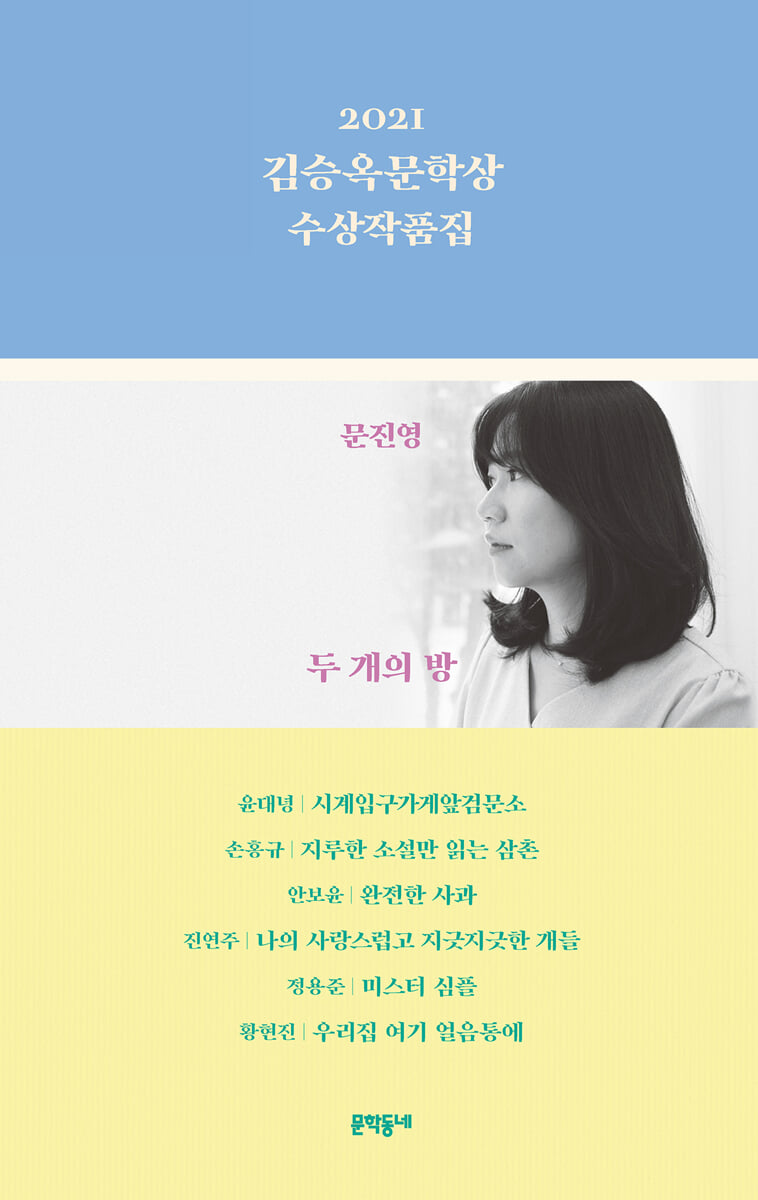
2021 Kim Seung-ok Literary Award Winners Collection
 |
Description
Book Introduction
- A word from MD
-
Short stories depicting today's Korean societyThe Kim Seung-ok Literary Award is given to short stories published in one year by authors who have been in the literary world for over 10 years.
This year's collection includes a total of seven works, including "Two Rooms" by Jinyoung Moon, the winner of the grand prize.
A variety of lives are vividly depicted in novels that illuminate various aspects of Korean society.
October 12, 2021. Novel/Poetry PD Park Hyung-wook
“This result was a refreshing shock to the judges as well.”
What the blind review found
The unfamiliar yet prepared name of Moon Jin-young
The Kim Seung-ok Literary Award selects the seven best short stories published in the past year by authors who have been in the literary world for over ten years and presents them to readers.
This year, 184 works by 100 authors published in 28 literary magazines, including major literary magazines, webzines, and independent literary magazines, were reviewed from July 2020 to June 2021.
Blind judging, which erases the author's information, has always been a guarantee of the literary quality of the Kim Seung-ok Literary Award, but this year's results were particularly notable.
Authors Moon Jin-young, who was selected as the grand prize winner, as well as Yoon Dae-nyeong, Son Hong-gyu, Ahn Bo-yoon, Jin Yeon-ju, Jeong Yong-jun, and Hwang Hyeon-jin, have made new appearances in the 2021 Kim Seung-ok Literary Award.
Moreover, this 2021 collection of award-winning works is noteworthy for its portrayal of not only Korean literature but also Korean society as a whole, spanning generations.
As can be seen from the judges' comments, which testify to the enthusiastic atmosphere of the judges, the stories of diverse lives and human figures are vividly included.
This is the result of trying to affirm without erasing any voices, as all of this is our life, while showing a colorful cross-section divided by generation and identity.
As a prism illuminating the 2020s, the Kim Seung-ok Literary Award will allow readers to closely examine Korean society and its people across a spectrum.
What the blind review found
The unfamiliar yet prepared name of Moon Jin-young
The Kim Seung-ok Literary Award selects the seven best short stories published in the past year by authors who have been in the literary world for over ten years and presents them to readers.
This year, 184 works by 100 authors published in 28 literary magazines, including major literary magazines, webzines, and independent literary magazines, were reviewed from July 2020 to June 2021.
Blind judging, which erases the author's information, has always been a guarantee of the literary quality of the Kim Seung-ok Literary Award, but this year's results were particularly notable.
Authors Moon Jin-young, who was selected as the grand prize winner, as well as Yoon Dae-nyeong, Son Hong-gyu, Ahn Bo-yoon, Jin Yeon-ju, Jeong Yong-jun, and Hwang Hyeon-jin, have made new appearances in the 2021 Kim Seung-ok Literary Award.
Moreover, this 2021 collection of award-winning works is noteworthy for its portrayal of not only Korean literature but also Korean society as a whole, spanning generations.
As can be seen from the judges' comments, which testify to the enthusiastic atmosphere of the judges, the stories of diverse lives and human figures are vividly included.
This is the result of trying to affirm without erasing any voices, as all of this is our life, while showing a colorful cross-section divided by generation and identity.
As a prism illuminating the 2020s, the Kim Seung-ok Literary Award will allow readers to closely examine Korean society and its people across a spectrum.
- You can preview some of the book's contents.
Preview
index
Target
Moon Jin-young's Two Rooms
Author's Note | Layers of the Heart
Review | A Dreamy Path Leading to the Primordial Center of the Room (Kim Hwa-young)
Checkpoint in front of the Yun Dae-nyeong watch store entrance
Author's Note | The Point Where Someone's Story Begins Again
Review | Time and Place (Kwon Hee-chul)
Son Hong-gyu, the uncle who only reads boring novels
Author's Note | To You Who Cries of Joy
Review | The Strategy and Reversal Power of Boring Novels (Jeon Kyung-rin)
Ahn Bo-yoon's complete apology
Author's Note | What Sincerity
Review | A 'complete apology' is impossible, but we (Seo Young-in) are connected as 'surviving' human beings.
Jin Yeon-ju My beloved and annoying dogs
Author's Note | Ssitgimgut
Review | On the Road: On Expected Loss and Yet, Unexpected Life (Cha Mi-ryeong)
Jeong Yong-jun, Mr. Simple
Author's Note | Simple Sadness
Review | I Will Applaud That Sorrow for a Long Time (Kim Geum-hee)
Hwang Hyun-jin, here in our house, in the ice bucket
Author's Note | Benjamin died, but Olive survived.
Review | The Emergence of Patterns, the Triumph of Wit (Hwang Jong-yeon)
2021 Kim Seung-ok Literary Award
-Purpose of the Kim Seung-ok Literary Award
-Review process and review comments
Moon Jin-young's Two Rooms
Author's Note | Layers of the Heart
Review | A Dreamy Path Leading to the Primordial Center of the Room (Kim Hwa-young)
Checkpoint in front of the Yun Dae-nyeong watch store entrance
Author's Note | The Point Where Someone's Story Begins Again
Review | Time and Place (Kwon Hee-chul)
Son Hong-gyu, the uncle who only reads boring novels
Author's Note | To You Who Cries of Joy
Review | The Strategy and Reversal Power of Boring Novels (Jeon Kyung-rin)
Ahn Bo-yoon's complete apology
Author's Note | What Sincerity
Review | A 'complete apology' is impossible, but we (Seo Young-in) are connected as 'surviving' human beings.
Jin Yeon-ju My beloved and annoying dogs
Author's Note | Ssitgimgut
Review | On the Road: On Expected Loss and Yet, Unexpected Life (Cha Mi-ryeong)
Jeong Yong-jun, Mr. Simple
Author's Note | Simple Sadness
Review | I Will Applaud That Sorrow for a Long Time (Kim Geum-hee)
Hwang Hyun-jin, here in our house, in the ice bucket
Author's Note | Benjamin died, but Olive survived.
Review | The Emergence of Patterns, the Triumph of Wit (Hwang Jong-yeon)
2021 Kim Seung-ok Literary Award
-Purpose of the Kim Seung-ok Literary Award
-Review process and review comments
Publisher's Review
The Kim Seung-ok Literary Award selects the seven best short stories published in the past year by authors who have been in the literary world for over ten years and presents them to readers.
This is a showcase of the best short stories written by writers who have remained at the heart of Korean literature for a long time and who have stood out each year.
This year, 184 works by 100 authors published in 28 literary magazines, including major literary magazines, webzines, and independent literary magazines, were reviewed from July 2020 to June 2021.
This represents an increase of approximately 25% over the 147 works from last year, and was able to reap the enthusiastic response to readers' growing interest in Korean literature.
Blind judging, which erases the author's information, has always been a guarantee of the literary quality of the Kim Seung-ok Literary Award, but this year's results were particularly notable.
Authors Moon Jin-young, who was selected as the grand prize winner for his novels that “do not simply remain as unique tastes or styles of life, but reach the level of ethics of how to live” (Kwon Hee-chul), as well as Yoon Dae-nyeong, Son Hong-gyu, Ahn Bo-yoon, Jin Yeon-ju, Jeong Yong-jun, and Hwang Hyeon-jin, have made new appearances in the 2021 Kim Seung-ok Literary Award.
Furthermore, this collection of award-winning works is noteworthy for depicting not only Korean literature but also Korean society as a whole across generations.
As can be seen from the judges' comments, which testify to the enthusiastic atmosphere of the judges, the stories of diverse lives and human figures are vividly included.
This is the result of trying to affirm without erasing any voices, as all of this is our life, while showing a colorful cross-section divided by generation and identity.
As a prism illuminating the 2020s, the Kim Seung-ok Literary Award will allow readers to closely examine Korean society and its people across a spectrum.
★
It cannot be said that all seven judges unanimously supported the seven works selected this time.
But to put it the other way around, each judge found something in each of the different works that they could not possibly withdraw their support for, despite the various flaws and criticism that followed.
We think that something is more precious and special than something that can be agreed upon by most people with little to criticize, something that connects strongly with some people and makes them unable to give it up, even if it contains some anachronisms, excesses, or sloppiness.
The fact that this year's winners, including Moon Jin-young, who received the grand prize, were clearly different from the recent winners of literary awards, (...) this result was a refreshing shock to the judges as well.
I hope that readers, like the judges, will engage in lively discussion about the award-winning entries, and that each will discover its own unique and precious points that resonate deeply with them.
_In 'Review Process and Review Comments'
★
A sensibility that senses us living in the present of the 2020s
A gaze that lifts up faintly fading beings
The award-winning novel, "Two Rooms" by Moon Jin-young, is a novel in which "the process of visualizing the theme of space's memory and existence has a deep resonance" (Kim Hwa-young). It is a physical and mental journey of two characters who remember the space they had to helplessly let go of.
The “space of dreams, protection, rest, and true encounter and unity” that we have lived in the past but left only in our memories has been “destroyed and disappeared by time and external forces.”
However, for those who never forget and remember “things that are useless but somehow precious” (from the text), space and people are not forgotten and live and breathe for a long time.
The two people who know this truth laugh and say “haha” and “okay” and walk away again.
This novel, which looks back on the past and gains positivity about the future, is a novel that allows us in the 2020s to look back on our space and “persuade without forcing” (Kwon Hee-chul) the space we should create and the way we should live.
Yoon Dae-nyeong's "Checkpoint in Front of the Watch Entrance Store" depicts a life like a "funeral," where one must live with the scars left after loss has scratched and passed.
In the face of the futility of life, there is a surprising reversal in the novel where “desiring and pursuing” futility itself (Kwon Hee-chul) actually makes life “vividly alive.”
Son Hong-gyu's "The Uncle Who Only Reads Boring Novels" follows the story of an uncle who used to tell cheerful jokes, but who, after losing a loved one, becomes someone who only reads boring novels.
As the 'I' who remembers my uncle overlaps with my uncle, the story soon becomes life as I embrace sadness as life.
An Bo-yoon's "A Complete Apology" highlights the ethical dilemma of the pain that must be endured as the family of a murderer, and the mixed feelings of anger and guilt over lost experiences.
This is a sharp novel that targets the realm of humanity that the dichotomy of victim and perpetrator fails to address, through the process of such an 'I' stepping forward to stop school violence.
Jin Yeon-ju's "My Beloved and Tired Dogs" describes in meticulous detail the repetitive daily life of someone preparing to part ways with someone close to them.
Going for a walk with your beloved and sometimes tiresome companion dog is a courageous attempt to overcome a great loss rather than remain stuck in the same place in frustration.
Jeong Yong-jun's "Mr. Simple" is a novel about two people who have experienced loss and comfort each other's efforts to get through each day.
Understanding loss is no different from understanding others, and it shows that only through understanding others can we truly face ourselves.
Hwang Hyun-jin's "In the Ice Bucket at Our House" confronts the uncertainty and fear of modern people who find it difficult to even plan for their livelihood.
It has become an excellent example of a novel of the times by dealing with the finiteness of love, an emotion swayed by economic conditions, and the extremely human nature of having to live together despite it all.
★
Moon Jin-young, "Two Rooms" How many things have we witnessed destroyed and vanished by time and external forces before reaching this space of rest and harmony? (...) Now we can understand why this novel, which underlying the hopeless battle of memory against the destructive power of time that causes "complete disappearance," is so often filled with optimistic laughter.
Kim Hwa-young (French literature scholar and literary critic)
Well, I have a strange obsession.
In the end, if I forget myself, won't what has already disappeared disappear completely?
Isn't that strange? he said.
But just because everyone has forgotten doesn't mean it never happened, right? I said.
Then the smile disappeared from his face.
No, I don't think so.
I believe that if no one remembers, it's as good as if it never happened. (Munjang Webzine, October 2020)
Yoon Dae-nyeong, "Checkpoint in Front of the Watch Store Entrance" Those things that have disappeared and become unnecessary now are almost everything that has made up our lives, and our future is nothing but things that will disappear.
So, desiring and pursuing such things is not much different from living vividly.
Or maybe that's what makes life alive.
Kwon Hee-cheol (literary critic)
When I surrender to the quiet flow of time and watch the things flowing around me, sometimes I feel like life sparkles and shines.
Like the light of a lighthouse flickering lonely in a distant harbor at night.
I think that it is because such light exists that we are alive.
In the world we live in, it still rains, flowers bloom, and snow falls, there is this side and that side, and there is still day and night.
And somewhere in there are you and me.
Yes, you.
You and I, separated by a hazy border where wind, rain, and snow rage. (Literature and Thought, April 2021)
Son Hong-gyu, "The Uncle Who Only Reads Boring Novels" Before I knew it, time had seeped into me, and my heart was touched, and I became attached to him.
It means that even before and after reading the novel, it felt like it was with me for a long time, and that I was comforted and consoled by it.
Above all, the keyword "boredom" attracted attention because the sense of isolation and stagnation that has encroached upon our lives today are fierce challenges.
Jeon Gyeong-rin (novelist)
If you read this sentence, Heesuk will come back.
If you read this paragraph... ...you will come back before you finish reading this page.
My uncle, who read every single word, every single sentence, with rapt attention, never to forget, must have ultimately fallen into the delusion that each letter was etched with the person he loved. (Korean Literature, Second Half of 2020)
An Bo-yoon, "A Complete Apology" This novel so painstakingly expresses the obvious concepts of ethics and solidarity among living humans.
It may be impossible, but we still cannot help but think and think again about 'perfect' survival and self-esteem with our complex minds without giving up.
"A Perfect Apology" is a serious, ongoing demonstration of what a novel can and should do.
It's been a long time since I read a novel like that.
Seo Young-in (literary critic)
But the most unfair thing was this.
Why can't I hate my brother to the fullest?
Why is it that guilt always follows the curse like a habit?
I envy people who have no hesitation in telling their older brother to rip them to pieces.
I too want to be just a black person like them, spewing only righteous evil words.
I don't want to feel any responsibility for swearing at a murderer.
Since that night, I think about my brother often.
But if you think about it, it's not about you, but about the things you damaged.
It's a thought about things that have disappeared, things that no sincerity can reach. (Korean Literature, Second Half of 2020)
Jin Yeon-ju, "My Beloved and Tired Dogs" So this novel is a story about dogs and their companions who are destined for irreversible loss, and a story about death as a fundamental loss.
The process of a loved one gradually becoming a predetermined loss is difficult to bear.
The novel, which painfully stares at this, does not lose courage, and discovers that even within the planned process, unexpected changes are embedded.
Cha Mi-ryeong (literary critic)
I'm getting more and more angry.
I think it started when I lost my mother.
I was so angry the whole time because loss came so easily and so absurdly.
Even then, I couldn't help but accept the sudden, uncontrollable events that had happened.
I had no choice but to accept it.
Everything was so easy that I was angry for days on end.
The words "I love you" came too late.
It was so late that all I could do was tell him not to come back. (Munjang Webzine, April 2021)
Jeong Yong-jun, "Mr. Simple" We always become beginners in the face of sadness.
So, rather than being the agent of sorrow, one becomes the irreplaceable, unique sorrow itself.
Being remembered by others as a sadness of one's own choosing, not as a platform user.
"Mr. Simple" is a novel for those who are willing to become the masters of their own wounds.
We will remember this novel as a “surprisingly beautiful” response to the encouragement that must be repeated and sent off to someone who has chosen to silently walk the sorrow that no one else has walked.
_Kim Geum-hee (novelist)
His words, “I would rather have died,” pierced me like an awl.
Doesn't he know?
What it's like to be with someone who's dead and remains an eternal secret.
How paralyzing life is the feeling of the end of the mind, which cannot be resolved and is raised to the level of a question at every moment.
Questions and doubts that stand upright like a snake's head and look at me.
Doesn't he know that being attached to it or not being attached to it both feel like sins?
I took a long breath.
I waited for the hot and cold flames that clawed at my heart to disappear. (Modern Literature, January 2021)
Hwang Hyun-jin, "In the Ice Bucket Here at My House" The world of "In the Ice Bucket Here at My House" is economically poor, but rich in terms of meaning.
This is because one thing or situation functions as a metaphorical symbol for a different thing or situation.
The ability to nimbly and intuitively discover similar relationships between fragmented, disparate, and heterogeneous things is commonly called wit.
Hwang Hyun-jin's sharp wit makes the horrors of poverty a worthwhile read.
Hwang Jong-yeon (literary critic)
The thought that I might become an object of fear to Jaeho, the feeling that I might break up with him for even the smallest reason, the possibility that if I continued living like this, I would soon become poor.
The terrifying future that combined all of these things did not let Yujeong go.
If last winter hadn't been so cold, I wouldn't have chosen someone who was trying to overcome the hardships of the past, and I wouldn't have let my love leak out like that. (Modern Literature, March 2021)
This is a showcase of the best short stories written by writers who have remained at the heart of Korean literature for a long time and who have stood out each year.
This year, 184 works by 100 authors published in 28 literary magazines, including major literary magazines, webzines, and independent literary magazines, were reviewed from July 2020 to June 2021.
This represents an increase of approximately 25% over the 147 works from last year, and was able to reap the enthusiastic response to readers' growing interest in Korean literature.
Blind judging, which erases the author's information, has always been a guarantee of the literary quality of the Kim Seung-ok Literary Award, but this year's results were particularly notable.
Authors Moon Jin-young, who was selected as the grand prize winner for his novels that “do not simply remain as unique tastes or styles of life, but reach the level of ethics of how to live” (Kwon Hee-chul), as well as Yoon Dae-nyeong, Son Hong-gyu, Ahn Bo-yoon, Jin Yeon-ju, Jeong Yong-jun, and Hwang Hyeon-jin, have made new appearances in the 2021 Kim Seung-ok Literary Award.
Furthermore, this collection of award-winning works is noteworthy for depicting not only Korean literature but also Korean society as a whole across generations.
As can be seen from the judges' comments, which testify to the enthusiastic atmosphere of the judges, the stories of diverse lives and human figures are vividly included.
This is the result of trying to affirm without erasing any voices, as all of this is our life, while showing a colorful cross-section divided by generation and identity.
As a prism illuminating the 2020s, the Kim Seung-ok Literary Award will allow readers to closely examine Korean society and its people across a spectrum.
★
It cannot be said that all seven judges unanimously supported the seven works selected this time.
But to put it the other way around, each judge found something in each of the different works that they could not possibly withdraw their support for, despite the various flaws and criticism that followed.
We think that something is more precious and special than something that can be agreed upon by most people with little to criticize, something that connects strongly with some people and makes them unable to give it up, even if it contains some anachronisms, excesses, or sloppiness.
The fact that this year's winners, including Moon Jin-young, who received the grand prize, were clearly different from the recent winners of literary awards, (...) this result was a refreshing shock to the judges as well.
I hope that readers, like the judges, will engage in lively discussion about the award-winning entries, and that each will discover its own unique and precious points that resonate deeply with them.
_In 'Review Process and Review Comments'
★
A sensibility that senses us living in the present of the 2020s
A gaze that lifts up faintly fading beings
The award-winning novel, "Two Rooms" by Moon Jin-young, is a novel in which "the process of visualizing the theme of space's memory and existence has a deep resonance" (Kim Hwa-young). It is a physical and mental journey of two characters who remember the space they had to helplessly let go of.
The “space of dreams, protection, rest, and true encounter and unity” that we have lived in the past but left only in our memories has been “destroyed and disappeared by time and external forces.”
However, for those who never forget and remember “things that are useless but somehow precious” (from the text), space and people are not forgotten and live and breathe for a long time.
The two people who know this truth laugh and say “haha” and “okay” and walk away again.
This novel, which looks back on the past and gains positivity about the future, is a novel that allows us in the 2020s to look back on our space and “persuade without forcing” (Kwon Hee-chul) the space we should create and the way we should live.
Yoon Dae-nyeong's "Checkpoint in Front of the Watch Entrance Store" depicts a life like a "funeral," where one must live with the scars left after loss has scratched and passed.
In the face of the futility of life, there is a surprising reversal in the novel where “desiring and pursuing” futility itself (Kwon Hee-chul) actually makes life “vividly alive.”
Son Hong-gyu's "The Uncle Who Only Reads Boring Novels" follows the story of an uncle who used to tell cheerful jokes, but who, after losing a loved one, becomes someone who only reads boring novels.
As the 'I' who remembers my uncle overlaps with my uncle, the story soon becomes life as I embrace sadness as life.
An Bo-yoon's "A Complete Apology" highlights the ethical dilemma of the pain that must be endured as the family of a murderer, and the mixed feelings of anger and guilt over lost experiences.
This is a sharp novel that targets the realm of humanity that the dichotomy of victim and perpetrator fails to address, through the process of such an 'I' stepping forward to stop school violence.
Jin Yeon-ju's "My Beloved and Tired Dogs" describes in meticulous detail the repetitive daily life of someone preparing to part ways with someone close to them.
Going for a walk with your beloved and sometimes tiresome companion dog is a courageous attempt to overcome a great loss rather than remain stuck in the same place in frustration.
Jeong Yong-jun's "Mr. Simple" is a novel about two people who have experienced loss and comfort each other's efforts to get through each day.
Understanding loss is no different from understanding others, and it shows that only through understanding others can we truly face ourselves.
Hwang Hyun-jin's "In the Ice Bucket at Our House" confronts the uncertainty and fear of modern people who find it difficult to even plan for their livelihood.
It has become an excellent example of a novel of the times by dealing with the finiteness of love, an emotion swayed by economic conditions, and the extremely human nature of having to live together despite it all.
★
Moon Jin-young, "Two Rooms" How many things have we witnessed destroyed and vanished by time and external forces before reaching this space of rest and harmony? (...) Now we can understand why this novel, which underlying the hopeless battle of memory against the destructive power of time that causes "complete disappearance," is so often filled with optimistic laughter.
Kim Hwa-young (French literature scholar and literary critic)
Well, I have a strange obsession.
In the end, if I forget myself, won't what has already disappeared disappear completely?
Isn't that strange? he said.
But just because everyone has forgotten doesn't mean it never happened, right? I said.
Then the smile disappeared from his face.
No, I don't think so.
I believe that if no one remembers, it's as good as if it never happened. (Munjang Webzine, October 2020)
Yoon Dae-nyeong, "Checkpoint in Front of the Watch Store Entrance" Those things that have disappeared and become unnecessary now are almost everything that has made up our lives, and our future is nothing but things that will disappear.
So, desiring and pursuing such things is not much different from living vividly.
Or maybe that's what makes life alive.
Kwon Hee-cheol (literary critic)
When I surrender to the quiet flow of time and watch the things flowing around me, sometimes I feel like life sparkles and shines.
Like the light of a lighthouse flickering lonely in a distant harbor at night.
I think that it is because such light exists that we are alive.
In the world we live in, it still rains, flowers bloom, and snow falls, there is this side and that side, and there is still day and night.
And somewhere in there are you and me.
Yes, you.
You and I, separated by a hazy border where wind, rain, and snow rage. (Literature and Thought, April 2021)
Son Hong-gyu, "The Uncle Who Only Reads Boring Novels" Before I knew it, time had seeped into me, and my heart was touched, and I became attached to him.
It means that even before and after reading the novel, it felt like it was with me for a long time, and that I was comforted and consoled by it.
Above all, the keyword "boredom" attracted attention because the sense of isolation and stagnation that has encroached upon our lives today are fierce challenges.
Jeon Gyeong-rin (novelist)
If you read this sentence, Heesuk will come back.
If you read this paragraph... ...you will come back before you finish reading this page.
My uncle, who read every single word, every single sentence, with rapt attention, never to forget, must have ultimately fallen into the delusion that each letter was etched with the person he loved. (Korean Literature, Second Half of 2020)
An Bo-yoon, "A Complete Apology" This novel so painstakingly expresses the obvious concepts of ethics and solidarity among living humans.
It may be impossible, but we still cannot help but think and think again about 'perfect' survival and self-esteem with our complex minds without giving up.
"A Perfect Apology" is a serious, ongoing demonstration of what a novel can and should do.
It's been a long time since I read a novel like that.
Seo Young-in (literary critic)
But the most unfair thing was this.
Why can't I hate my brother to the fullest?
Why is it that guilt always follows the curse like a habit?
I envy people who have no hesitation in telling their older brother to rip them to pieces.
I too want to be just a black person like them, spewing only righteous evil words.
I don't want to feel any responsibility for swearing at a murderer.
Since that night, I think about my brother often.
But if you think about it, it's not about you, but about the things you damaged.
It's a thought about things that have disappeared, things that no sincerity can reach. (Korean Literature, Second Half of 2020)
Jin Yeon-ju, "My Beloved and Tired Dogs" So this novel is a story about dogs and their companions who are destined for irreversible loss, and a story about death as a fundamental loss.
The process of a loved one gradually becoming a predetermined loss is difficult to bear.
The novel, which painfully stares at this, does not lose courage, and discovers that even within the planned process, unexpected changes are embedded.
Cha Mi-ryeong (literary critic)
I'm getting more and more angry.
I think it started when I lost my mother.
I was so angry the whole time because loss came so easily and so absurdly.
Even then, I couldn't help but accept the sudden, uncontrollable events that had happened.
I had no choice but to accept it.
Everything was so easy that I was angry for days on end.
The words "I love you" came too late.
It was so late that all I could do was tell him not to come back. (Munjang Webzine, April 2021)
Jeong Yong-jun, "Mr. Simple" We always become beginners in the face of sadness.
So, rather than being the agent of sorrow, one becomes the irreplaceable, unique sorrow itself.
Being remembered by others as a sadness of one's own choosing, not as a platform user.
"Mr. Simple" is a novel for those who are willing to become the masters of their own wounds.
We will remember this novel as a “surprisingly beautiful” response to the encouragement that must be repeated and sent off to someone who has chosen to silently walk the sorrow that no one else has walked.
_Kim Geum-hee (novelist)
His words, “I would rather have died,” pierced me like an awl.
Doesn't he know?
What it's like to be with someone who's dead and remains an eternal secret.
How paralyzing life is the feeling of the end of the mind, which cannot be resolved and is raised to the level of a question at every moment.
Questions and doubts that stand upright like a snake's head and look at me.
Doesn't he know that being attached to it or not being attached to it both feel like sins?
I took a long breath.
I waited for the hot and cold flames that clawed at my heart to disappear. (Modern Literature, January 2021)
Hwang Hyun-jin, "In the Ice Bucket Here at My House" The world of "In the Ice Bucket Here at My House" is economically poor, but rich in terms of meaning.
This is because one thing or situation functions as a metaphorical symbol for a different thing or situation.
The ability to nimbly and intuitively discover similar relationships between fragmented, disparate, and heterogeneous things is commonly called wit.
Hwang Hyun-jin's sharp wit makes the horrors of poverty a worthwhile read.
Hwang Jong-yeon (literary critic)
The thought that I might become an object of fear to Jaeho, the feeling that I might break up with him for even the smallest reason, the possibility that if I continued living like this, I would soon become poor.
The terrifying future that combined all of these things did not let Yujeong go.
If last winter hadn't been so cold, I wouldn't have chosen someone who was trying to overcome the hardships of the past, and I wouldn't have let my love leak out like that. (Modern Literature, March 2021)
GOODS SPECIFICS
- Publication date: October 5, 2021
- Page count, weight, size: 300 pages | 366g | 130*205*17mm
- ISBN13: 9788954682527
- ISBN10: 8954682529
You may also like
카테고리
korean


korean

![GQ KOREA Mark (Monthly): December [2025]](http://librairie.coreenne.fr/cdn/shop/files/8ef265dbbfbf186523ed75ba7319009d.jpg?v=1765340328&width=3840)


