

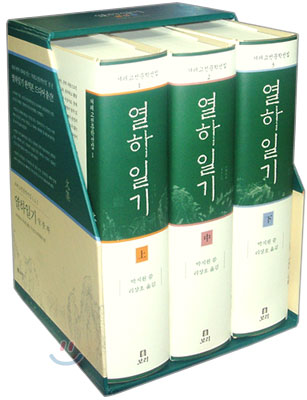
Yeolha Diary Set
 |
Description
Book Introduction
The year 2005 marks the 200th anniversary of Yeonam's death.
In North Korea, a complete translation of "Yeolha Diary" was published to coincide with the 150th anniversary of Yeonam's birth, and in South Korea, a complete translation was published ahead of the 200th anniversary of Yeonam's death.
In “Yeolha Diary,” Yeonam freely explores philosophy and thought, science and music, politics and culture, practicality and logic.
If you read this book, you will understand why people say that the Middle Ages of Joseon began with this one book.
Yeonam, who happened to join a group of envoys celebrating the longevity of the Qing Emperor Qianlong, enjoys all kinds of pleasures on his own, regardless of the tight schedule.
Yeonam, who secretly envied Park Je-ga, the author of "Bukhakui," decided to have deep conversations with good friends in China, and thanks to his open attitude that did not discriminate between Koreans and people of all nationalities, he was able to have conversations with many people.
'Yeolha' was a place used as a summer resort by the Qing emperors, and it was during the reign of Yeonam that a Joseon envoy first went to Jeolha.
This place, which corresponds to today's Chengde (承德) in northern Hebei Province, west of the Rehe River, is about 230 kilometers from Beijing.
On the long journey of about 2,300 li from the Yalu River to Beijing, and about 700 li from Beijing to Rehe, a distance of 3,000 li by land, Yeonam felt intense jealousy upon seeing the advanced civilization of the Qing Dynasty, which he had looked down on as a barbarian.
The book contains a wide range of complaints about the rifts in 18th century Joseon society, the hypocrisy of the yangban scholars, and the feudal society that ignored Silhak and was obsessed with old literature, and Yeonam's earnest desire for a new society is revealed throughout.
The Yeolha Diary contains issues covering all areas of social life, including philosophy, politics, economics, astronomy, geography, customs, systems, history, historic sites, and culture.
The formats range from orthodox thesis to casual essays, novels, and poetry.
Yeonam, who depicts the nature and culture of a great country with free brushstrokes, is both disappointed and surprised.
The humor and satire hidden throughout the book were things that no one who had visited Beijing before Yeonam had been able to capture.
The story about Banseon Lama is unique in Yeonam's records, and the stories included in Hwanggyomundap were top secrets that Joseon officials at the time, who looked down on the Qing, would never have heard. In Mangyangnok, which discusses extensive knowledge of music, or Gokjeongpildam, which presents surprising views on celestial bodies, we can encounter Yeonam's advanced thoughts classified as the 'Lee Yong-hu Saeng School.'
Another charm of this book is that you will burst into laughter at Yeonam's unexpected antics while reading a stiff story.
In North Korea, a complete translation of "Yeolha Diary" was published to coincide with the 150th anniversary of Yeonam's birth, and in South Korea, a complete translation was published ahead of the 200th anniversary of Yeonam's death.
In “Yeolha Diary,” Yeonam freely explores philosophy and thought, science and music, politics and culture, practicality and logic.
If you read this book, you will understand why people say that the Middle Ages of Joseon began with this one book.
Yeonam, who happened to join a group of envoys celebrating the longevity of the Qing Emperor Qianlong, enjoys all kinds of pleasures on his own, regardless of the tight schedule.
Yeonam, who secretly envied Park Je-ga, the author of "Bukhakui," decided to have deep conversations with good friends in China, and thanks to his open attitude that did not discriminate between Koreans and people of all nationalities, he was able to have conversations with many people.
'Yeolha' was a place used as a summer resort by the Qing emperors, and it was during the reign of Yeonam that a Joseon envoy first went to Jeolha.
This place, which corresponds to today's Chengde (承德) in northern Hebei Province, west of the Rehe River, is about 230 kilometers from Beijing.
On the long journey of about 2,300 li from the Yalu River to Beijing, and about 700 li from Beijing to Rehe, a distance of 3,000 li by land, Yeonam felt intense jealousy upon seeing the advanced civilization of the Qing Dynasty, which he had looked down on as a barbarian.
The book contains a wide range of complaints about the rifts in 18th century Joseon society, the hypocrisy of the yangban scholars, and the feudal society that ignored Silhak and was obsessed with old literature, and Yeonam's earnest desire for a new society is revealed throughout.
The Yeolha Diary contains issues covering all areas of social life, including philosophy, politics, economics, astronomy, geography, customs, systems, history, historic sites, and culture.
The formats range from orthodox thesis to casual essays, novels, and poetry.
Yeonam, who depicts the nature and culture of a great country with free brushstrokes, is both disappointed and surprised.
The humor and satire hidden throughout the book were things that no one who had visited Beijing before Yeonam had been able to capture.
The story about Banseon Lama is unique in Yeonam's records, and the stories included in Hwanggyomundap were top secrets that Joseon officials at the time, who looked down on the Qing, would never have heard. In Mangyangnok, which discusses extensive knowledge of music, or Gokjeongpildam, which presents surprising views on celestial bodies, we can encounter Yeonam's advanced thoughts classified as the 'Lee Yong-hu Saeng School.'
Another charm of this book is that you will burst into laughter at Yeonam's unexpected antics while reading a stiff story.
Publisher's Review
Why was the "Yeolha Diary" banned?
As soon as he returned to Korea from Jeolla Province, Yeonam began writing his “Jeolla Diary” while traveling between the house of his brother-in-law Lee Jae-seong, who lived in Seoul, and Yeonamgol, Hwanghae Province.
It is estimated that it was written from the fall of 1780 to 1783, but scholars were busy copying and reading it even before the book was completed.
While most previous travel records had ordinary and conventional titles such as travel records, travel miscellaneous records, travel records, and travel diaries, Yeonam gave them the unfamiliar title of “Yeolha Diary” to emphasize “Yeolha.”
It is known that he continued to revise or rewrite the text even after it was completed, and because it was a banned book for a long time, even the contents added by later generations to Yeonam's records have been passed down.
In Bori's "Yeolha Diary," there are often additions such as "Mr. Jungjon says (brother-in-law Lee Jae-seong)" and "Mr. Yeonam says."
Even before the "Yeolha Diary," there were many travelogues written by people who had visited Beijing.
Among the numerous travelogues, the reason why Yeonam's is special is because of the 'rich knowledge, progressive thoughts, and novel and realistic expression techniques (Kim Myeong-ho)' it contains.
After reading the “Yeolha Diary,” King Jeongjo said that the fact that the writing style of intellectuals at the time had become impure was all Park Ji-won’s fault.
Then he ordered that a pure text be written immediately.
The writing style of scholars at the time was extremely monotonous, and more importance was placed on how well the writer knew ancient texts and how well he or she could quote and incorporate them into his or her writing at the right time, rather than on the writer's appreciation or originality.
As short sentences were introduced and light writing became widespread, King Jeongjo took special care to correct the writing styles of those who did not write neatly, saying that the writings of scholars were being corrupted.
Yeonam and his disciples, Lee Deok-mu and Lee Seo-ga, received particular attention.
King Jeongjo ordered Nam Gong-cheol to write a letter of reflection for Park Ji-won, but Park Ji-won refused to write it and kept avoiding it until 1797, when he finally presented the 'Seo Ibang Ik-sa', and the incident was finally settled.
Even if it wasn't Jeongjo, it was common in some circles of the yangban society to hear criticisms of the "Yeolha Diary" as "a joke that made fun of the world" or "a useless piece of writing that used a bad era name."
However, despite such criticism, “Yeolha Diary” was the greatest bestseller of its time, and every literate person tried to read it.
What are the characteristics of the “Yeolha Diary”?
1) Various types of banquets
Before the "Yeolha Diary," there were two types of travel records.
It was a diary format that wrote the journey in chronological order and a system that divided people, places of interest, and events into items by topic.
Yeonam is taking both of these approaches.
While taking advantage of the existing travelogue, it added a unique format, organizing the journey in chronological order and setting aside important details that were difficult to include in a diary as independent records or narratives.
One of the prominent forms in the “Yeolha Diary” is written communication.
He recorded his conversations with the Qing scholars he met in Jehol in ‘Hwanggyomundap’, ‘Mangyangrok’, and ‘Gokjeongpildam’, and his conversations with the merchants of Seonggyeong in ‘Sokjaepildam’ and ‘Sangrupildam’.
The stories people shared were recorded vividly and meticulously.
Next is the small group format.
The 'Geumryosocho' included in the lower volume is a summary of the contents on medicine from Wang Sa-jeong's 'Hyangjo Pilgi' by Yeonam, who was always lamenting the backward level of medicine in Joseon, and added his own experiences to it.
Next is the story format.
'Beom's Scolding' in the upper volume and 'Heosaengjeon' in the lower volume satirize reality by using the form of a novel.
Next is light cursive.
Writings like 'Straying from Gobukgu in the Night' are examples of this, and works like 'Crossing the River Nine Times in One Night' and 'The Elephant Story' still leave me amazed at their excellent descriptive power even when I read them now.
The entire essay is written in a light essay format, written in a haphazard manner.
On the other hand, writings like 'The Law of Making a Cart' are like reading a thesis, written in a formal style with meticulous attention to detail.
Finally, the poetic form.
The lower volume, 'Piseorok', contains fragments of criticism and commentary on poetry, as well as anecdotes about the poet.
2) Depiction of living people
“The people of Huihui have fierce faces, big noses, blue eyes, and strong hair and beards.” “The Mongol king trembles and shakes his head in a way that is insignificant, like a tree about to fall.” “Paro Huihuido is a Mongol, his courtesy name is Bujae, and his pen name is Hwajeong.
He was 47 years old, the grandson of Emperor Kangxi, was 8 feet tall, had a long, drooping beard, and had a thin, sallow face.” ? Gyeongsunmi’s courtesy name was Angru, and she was Mongolian.
“He was seven feet tall, had fair skin, long, slitted eyes, dark eyebrows, and fingers that resembled green onions, so he could be called a handsome man.”
Yeonam meticulously observed and wrote about not only the characters described in 'Sokjaepildam' and 'Hwanggyomundap', but also the nameless old man he met on the street and the seven-year-old child.
3) A wide variety of materials
It covers issues across all areas of social life, including philosophy, politics, economics, astronomy, geography, customs, systems, history, ancient sites, and culture.
The passages praising manure, the passages examining carts in detail, and the passages comparing the Qing Dynasty's 'kang' with our ondol are surprisingly detailed, as these were areas in which Yeonam, as a Silhak scholar, paid particular attention.
There is also a scientific explanation of the fact that the Earth is round and that it is the Earth, not the sky, that rotates, which shows what Yeonam was interested in and studying at the time.
From his 'Mangyangnok', which discusses music, to his 'Geumryosocho', which contains various prescriptions, to his interest in various paintings and utensils in 'Golden Story' and 'Yeolsanghwabo', Yeonam moves freely in various directions in his books.
What is special about Bori Publishing's "Yeolha Diary"?
1) The South continues the North's achievements.
The translation results of North Korea's long-standing efforts to revive classical literature were accepted by South Korea and published so that South Koreans could easily read them.
This massive translation was completed in the 1950s and went through several revisions.
This "Yeolha Diary," which the South has published based on the achievements of the North, will serve as a touchstone for contributing to the unification of our divided people.
The currently extant versions of the "Yeolha Diary" differ slightly in their structure depending on who edited them; there are nine manuscript versions and two new type-printed versions.
There are Chungnam National University version, Seoul National University version, Godoseo version, Gyujanggak version, Gwangmunhoe version, Park Yeong-cheol version, Chonnam National University version, and Taiwan version.
Lee Sang-ho's translation was based on two sources: the 1911 publication of only the Yeolha Diary by Joseon Gwangmunhoe, and the 1900 and 1916 collections of Yeonamjip by scholar Kim Taek-yeong, published by his descendants as the Yeonamjeonjip.
In Bori, the first volume was based on the 《Park Ji-won's Works 2》 published in the North in 1995, and the middle and lower volumes were based on previously published books.
2) This is the only complete translation available in South Korean bookstores!
The complete translation of the Yeolha Diary by Professor Lee Ga-won published by the National Culture Promotion Committee was first published in 1967 and then reprinted in 1987, but it is now difficult to find. The complete translation by Professor Lee Ga-won published by Daeyang Books has also become difficult for readers to find since it was first published in 1973.
The complete translation translated by Yoon Jae-young and published by Park Young-sa in 1983 is also old and unavailable.
The one published by Sol Publishing contains only a few of the best parts of the Yeolha Diary, and the one published by Greenbee by Gomi Suk is not a translation but a commentary, so it cannot be compared to Bori's.
Books edited by other publishers for teenagers are also not generating much of a response.
Bori's book is the only one that has been edited and produced by a proper publisher so that readers can easily read it.
3) We are using our language well.
The taste of our writing and language before the pollution of language began is still alive, and Park Ji-won's cheerfulness and cheerfulness are vividly expressed.
Even though it is a Chinese character sentence, it has been translated into colloquial language that is not difficult to read.
Korean words that remain in the North, such as jjigeokji, jachegi, mokkoji, and mulyeok, are also visible here and there, and native words such as janjureuda, deungdulhada, and naltangpae are also alive throughout the book.
4) To help readers understand, the travel itinerary and chronology have been reorganized.
At the end of the book, a newly organized chronology of Park Ji-won and a travel itinerary from the Yeolha Diary have been added, and in the first volume, a detailed commentary on the work by the North Korean scholar Kim Ha-myeong has been added, and in the second volume, a note by the translator Lee Sang-ho has been added.
The Yeolha Diary is a common asset of the South and the North.
As the political divide grew, the academic world also split into the South and the North, and for decades they lived without being able to pool their research results.
We have included two excellent pieces of information that allow you to see how the North views the world of Yeonam Park Ji-won's works.
The writings of Lee Sang-ho, who called Park Ji-won a "giant of the Middle Ages," and Kim Ha-myeong, who has a keen eye for discerning the sharp criticism of the yangban class and the special writing style in Park Ji-won's works, will serve as good guides for those who read "Yeolha Diary."
The 'Park Ji-won Chronology' compiled and added by the Bori Editorial Department was created with the help of Professor Kim Myeong-ho, who has studied the Yeolha Diary for a long time. It helps to understand the world of Yeonam's works at a glance by listing the political situation and the period of Yeonam's creation together.
The 'Travel Itinerary', compiled separately with a map, allows a brief overview of Yeonam's activities before reading the extensive 'Yeolha Diary'.
As soon as he returned to Korea from Jeolla Province, Yeonam began writing his “Jeolla Diary” while traveling between the house of his brother-in-law Lee Jae-seong, who lived in Seoul, and Yeonamgol, Hwanghae Province.
It is estimated that it was written from the fall of 1780 to 1783, but scholars were busy copying and reading it even before the book was completed.
While most previous travel records had ordinary and conventional titles such as travel records, travel miscellaneous records, travel records, and travel diaries, Yeonam gave them the unfamiliar title of “Yeolha Diary” to emphasize “Yeolha.”
It is known that he continued to revise or rewrite the text even after it was completed, and because it was a banned book for a long time, even the contents added by later generations to Yeonam's records have been passed down.
In Bori's "Yeolha Diary," there are often additions such as "Mr. Jungjon says (brother-in-law Lee Jae-seong)" and "Mr. Yeonam says."
Even before the "Yeolha Diary," there were many travelogues written by people who had visited Beijing.
Among the numerous travelogues, the reason why Yeonam's is special is because of the 'rich knowledge, progressive thoughts, and novel and realistic expression techniques (Kim Myeong-ho)' it contains.
After reading the “Yeolha Diary,” King Jeongjo said that the fact that the writing style of intellectuals at the time had become impure was all Park Ji-won’s fault.
Then he ordered that a pure text be written immediately.
The writing style of scholars at the time was extremely monotonous, and more importance was placed on how well the writer knew ancient texts and how well he or she could quote and incorporate them into his or her writing at the right time, rather than on the writer's appreciation or originality.
As short sentences were introduced and light writing became widespread, King Jeongjo took special care to correct the writing styles of those who did not write neatly, saying that the writings of scholars were being corrupted.
Yeonam and his disciples, Lee Deok-mu and Lee Seo-ga, received particular attention.
King Jeongjo ordered Nam Gong-cheol to write a letter of reflection for Park Ji-won, but Park Ji-won refused to write it and kept avoiding it until 1797, when he finally presented the 'Seo Ibang Ik-sa', and the incident was finally settled.
Even if it wasn't Jeongjo, it was common in some circles of the yangban society to hear criticisms of the "Yeolha Diary" as "a joke that made fun of the world" or "a useless piece of writing that used a bad era name."
However, despite such criticism, “Yeolha Diary” was the greatest bestseller of its time, and every literate person tried to read it.
What are the characteristics of the “Yeolha Diary”?
1) Various types of banquets
Before the "Yeolha Diary," there were two types of travel records.
It was a diary format that wrote the journey in chronological order and a system that divided people, places of interest, and events into items by topic.
Yeonam is taking both of these approaches.
While taking advantage of the existing travelogue, it added a unique format, organizing the journey in chronological order and setting aside important details that were difficult to include in a diary as independent records or narratives.
One of the prominent forms in the “Yeolha Diary” is written communication.
He recorded his conversations with the Qing scholars he met in Jehol in ‘Hwanggyomundap’, ‘Mangyangrok’, and ‘Gokjeongpildam’, and his conversations with the merchants of Seonggyeong in ‘Sokjaepildam’ and ‘Sangrupildam’.
The stories people shared were recorded vividly and meticulously.
Next is the small group format.
The 'Geumryosocho' included in the lower volume is a summary of the contents on medicine from Wang Sa-jeong's 'Hyangjo Pilgi' by Yeonam, who was always lamenting the backward level of medicine in Joseon, and added his own experiences to it.
Next is the story format.
'Beom's Scolding' in the upper volume and 'Heosaengjeon' in the lower volume satirize reality by using the form of a novel.
Next is light cursive.
Writings like 'Straying from Gobukgu in the Night' are examples of this, and works like 'Crossing the River Nine Times in One Night' and 'The Elephant Story' still leave me amazed at their excellent descriptive power even when I read them now.
The entire essay is written in a light essay format, written in a haphazard manner.
On the other hand, writings like 'The Law of Making a Cart' are like reading a thesis, written in a formal style with meticulous attention to detail.
Finally, the poetic form.
The lower volume, 'Piseorok', contains fragments of criticism and commentary on poetry, as well as anecdotes about the poet.
2) Depiction of living people
“The people of Huihui have fierce faces, big noses, blue eyes, and strong hair and beards.” “The Mongol king trembles and shakes his head in a way that is insignificant, like a tree about to fall.” “Paro Huihuido is a Mongol, his courtesy name is Bujae, and his pen name is Hwajeong.
He was 47 years old, the grandson of Emperor Kangxi, was 8 feet tall, had a long, drooping beard, and had a thin, sallow face.” ? Gyeongsunmi’s courtesy name was Angru, and she was Mongolian.
“He was seven feet tall, had fair skin, long, slitted eyes, dark eyebrows, and fingers that resembled green onions, so he could be called a handsome man.”
Yeonam meticulously observed and wrote about not only the characters described in 'Sokjaepildam' and 'Hwanggyomundap', but also the nameless old man he met on the street and the seven-year-old child.
3) A wide variety of materials
It covers issues across all areas of social life, including philosophy, politics, economics, astronomy, geography, customs, systems, history, ancient sites, and culture.
The passages praising manure, the passages examining carts in detail, and the passages comparing the Qing Dynasty's 'kang' with our ondol are surprisingly detailed, as these were areas in which Yeonam, as a Silhak scholar, paid particular attention.
There is also a scientific explanation of the fact that the Earth is round and that it is the Earth, not the sky, that rotates, which shows what Yeonam was interested in and studying at the time.
From his 'Mangyangnok', which discusses music, to his 'Geumryosocho', which contains various prescriptions, to his interest in various paintings and utensils in 'Golden Story' and 'Yeolsanghwabo', Yeonam moves freely in various directions in his books.
What is special about Bori Publishing's "Yeolha Diary"?
1) The South continues the North's achievements.
The translation results of North Korea's long-standing efforts to revive classical literature were accepted by South Korea and published so that South Koreans could easily read them.
This massive translation was completed in the 1950s and went through several revisions.
This "Yeolha Diary," which the South has published based on the achievements of the North, will serve as a touchstone for contributing to the unification of our divided people.
The currently extant versions of the "Yeolha Diary" differ slightly in their structure depending on who edited them; there are nine manuscript versions and two new type-printed versions.
There are Chungnam National University version, Seoul National University version, Godoseo version, Gyujanggak version, Gwangmunhoe version, Park Yeong-cheol version, Chonnam National University version, and Taiwan version.
Lee Sang-ho's translation was based on two sources: the 1911 publication of only the Yeolha Diary by Joseon Gwangmunhoe, and the 1900 and 1916 collections of Yeonamjip by scholar Kim Taek-yeong, published by his descendants as the Yeonamjeonjip.
In Bori, the first volume was based on the 《Park Ji-won's Works 2》 published in the North in 1995, and the middle and lower volumes were based on previously published books.
2) This is the only complete translation available in South Korean bookstores!
The complete translation of the Yeolha Diary by Professor Lee Ga-won published by the National Culture Promotion Committee was first published in 1967 and then reprinted in 1987, but it is now difficult to find. The complete translation by Professor Lee Ga-won published by Daeyang Books has also become difficult for readers to find since it was first published in 1973.
The complete translation translated by Yoon Jae-young and published by Park Young-sa in 1983 is also old and unavailable.
The one published by Sol Publishing contains only a few of the best parts of the Yeolha Diary, and the one published by Greenbee by Gomi Suk is not a translation but a commentary, so it cannot be compared to Bori's.
Books edited by other publishers for teenagers are also not generating much of a response.
Bori's book is the only one that has been edited and produced by a proper publisher so that readers can easily read it.
3) We are using our language well.
The taste of our writing and language before the pollution of language began is still alive, and Park Ji-won's cheerfulness and cheerfulness are vividly expressed.
Even though it is a Chinese character sentence, it has been translated into colloquial language that is not difficult to read.
Korean words that remain in the North, such as jjigeokji, jachegi, mokkoji, and mulyeok, are also visible here and there, and native words such as janjureuda, deungdulhada, and naltangpae are also alive throughout the book.
4) To help readers understand, the travel itinerary and chronology have been reorganized.
At the end of the book, a newly organized chronology of Park Ji-won and a travel itinerary from the Yeolha Diary have been added, and in the first volume, a detailed commentary on the work by the North Korean scholar Kim Ha-myeong has been added, and in the second volume, a note by the translator Lee Sang-ho has been added.
The Yeolha Diary is a common asset of the South and the North.
As the political divide grew, the academic world also split into the South and the North, and for decades they lived without being able to pool their research results.
We have included two excellent pieces of information that allow you to see how the North views the world of Yeonam Park Ji-won's works.
The writings of Lee Sang-ho, who called Park Ji-won a "giant of the Middle Ages," and Kim Ha-myeong, who has a keen eye for discerning the sharp criticism of the yangban class and the special writing style in Park Ji-won's works, will serve as good guides for those who read "Yeolha Diary."
The 'Park Ji-won Chronology' compiled and added by the Bori Editorial Department was created with the help of Professor Kim Myeong-ho, who has studied the Yeolha Diary for a long time. It helps to understand the world of Yeonam's works at a glance by listing the political situation and the period of Yeonam's creation together.
The 'Travel Itinerary', compiled separately with a map, allows a brief overview of Yeonam's activities before reading the extensive 'Yeolha Diary'.
GOODS SPECIFICS
- Date of issue: November 15, 2004
- Page count, weight, size: 1,960 pages | 153*224*80mm
- ISBN13: 9788984281868
- ISBN10: 8984281867
You may also like
카테고리
korean


korean

![ELLE 엘르 스페셜 에디션 A형 : 12월 [2025]](http://librairie.coreenne.fr/cdn/shop/files/b8e27a3de6c9538896439686c6b0e8fb.jpg?v=1766436872&width=3840)


