

Bullpen time
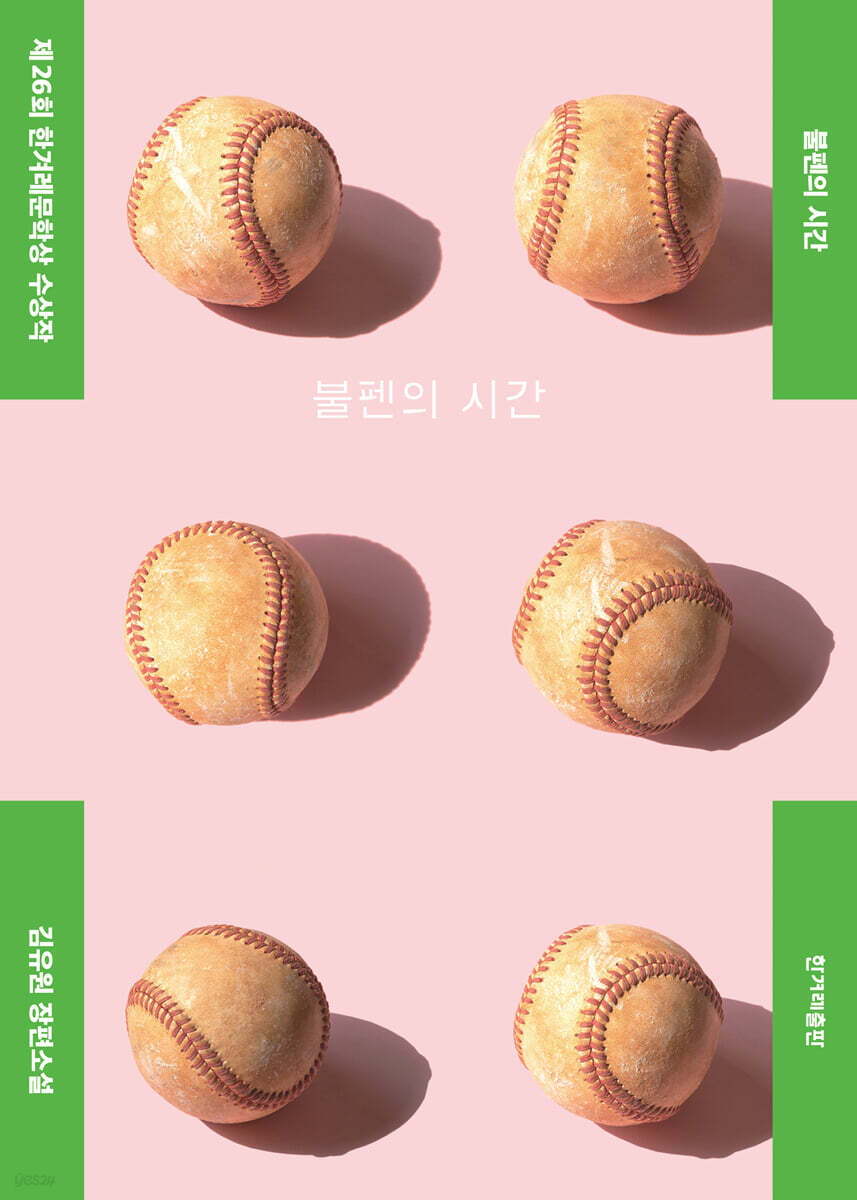 |
Description
Book Introduction
- A word from MD
-
Winner of the 26th Hankyoreh Literary AwardA story of those who choose to be losers in a world that doesn't admit failure.
Their promising lives take an unexpected turn, but even off the field, life goes on.
The novel shows that what ultimately runs through our individual histories is not the time on the mound as a starter, but the time in the bullpen.
July 20, 2021. Novel/Poetry PD Park Hyung-wook
Winners of the 26th Hankyoreh Literary Award in 2021
In a world ruled by winners and losers, win rates and defense rates,
The story of three people who chose not to win
A problematic novel that expands the scope of the sports narrative of baseball!
The Hankyoreh Literary Award, which was established in 1996 and has been loved by readers for a long time, including Park Min-gyu's "The Last Fan Club of Sammi Superstars," Shim Yun-gyeong's "My Beautiful Garden," Jang Kang-myeong's "Bleach," Kang Hwa-gil's "Another Person," Park Seo-ryeon's "The Gym Girl Kang Ju-ryong," and Seo Su-jin's "Korean Teacher," is publishing its 26th award-winning work, "Bullpen Time."
Kim Yu-won, the winner, who received a review from novelist Jeon Seong-tae, who said that his work had refreshing “vivid characters and bold narratives,” is a documentary director who directed [Youthful Dog] (co-director), [The Day That Son Became President], and [How to Become a Chair].
"Bullpen Time" is an omnibus novel that contains the growth and struggles of three people, each entangled in the sport of baseball in different ways, as they crumble within the system of endless competition.
『Bullpen Time』, which won the literary award after beating out 206 other strong contenders, received strong support during the literary award evaluation process for its outstanding “balance in weaving the theme of baseball into each character’s story” and for its “power that sets it apart from existing novels, as it does not end with the self-growth familiar from sports narratives, but powerfully expands into a social perspective.”
Novelist Jeong Yong-jun, a member of the judging panel, emphasized that the novel is “a story about people who were once MVPs but are now living in the bullpen,” but by breaking away from the typical narrative of a “come-from-behind grand slam,” it has become “a story that goes beyond a dramatic ending and is essential for us living in the present.”
Furthermore, literary critic Oh Hye-jin, in her recommendation, singled out “Bullpen Time” as a problematic work because it constantly reminds us of “a society that justifies endless competition and monopolization by the few in the name of victory, achievement, and scoops, (…) what can an individual do in this ‘ruins’ where screams of ‘Is this a country?’ erupt.”
The tightly woven narrative, vivid characters, and delicate, dynamic writing style, reminiscent of the author's background as a documentary director, are reminiscent of a film.
In a world ruled by winners and losers, win rates and defense rates,
The story of three people who chose not to win
A problematic novel that expands the scope of the sports narrative of baseball!
The Hankyoreh Literary Award, which was established in 1996 and has been loved by readers for a long time, including Park Min-gyu's "The Last Fan Club of Sammi Superstars," Shim Yun-gyeong's "My Beautiful Garden," Jang Kang-myeong's "Bleach," Kang Hwa-gil's "Another Person," Park Seo-ryeon's "The Gym Girl Kang Ju-ryong," and Seo Su-jin's "Korean Teacher," is publishing its 26th award-winning work, "Bullpen Time."
Kim Yu-won, the winner, who received a review from novelist Jeon Seong-tae, who said that his work had refreshing “vivid characters and bold narratives,” is a documentary director who directed [Youthful Dog] (co-director), [The Day That Son Became President], and [How to Become a Chair].
"Bullpen Time" is an omnibus novel that contains the growth and struggles of three people, each entangled in the sport of baseball in different ways, as they crumble within the system of endless competition.
『Bullpen Time』, which won the literary award after beating out 206 other strong contenders, received strong support during the literary award evaluation process for its outstanding “balance in weaving the theme of baseball into each character’s story” and for its “power that sets it apart from existing novels, as it does not end with the self-growth familiar from sports narratives, but powerfully expands into a social perspective.”
Novelist Jeong Yong-jun, a member of the judging panel, emphasized that the novel is “a story about people who were once MVPs but are now living in the bullpen,” but by breaking away from the typical narrative of a “come-from-behind grand slam,” it has become “a story that goes beyond a dramatic ending and is essential for us living in the present.”
Furthermore, literary critic Oh Hye-jin, in her recommendation, singled out “Bullpen Time” as a problematic work because it constantly reminds us of “a society that justifies endless competition and monopolization by the few in the name of victory, achievement, and scoops, (…) what can an individual do in this ‘ruins’ where screams of ‘Is this a country?’ erupt.”
The tightly woven narrative, vivid characters, and delicate, dynamic writing style, reminiscent of the author's background as a documentary director, are reminiscent of a film.
- You can preview some of the book's contents.
Preview
index
Part 1
Junsam
Hyukoh
Kihyun
player
desert
survivalism
A ball thrown on purpose
Bullpen Time 1
Bullpen Time 2
Bullpen Time 3
Part 2
summer vacation
0B0S
Jinru
Woof woof
Playball
Small and hard
Epilogue | In the Outfield
Author's Note
Recommendation
Junsam
Hyukoh
Kihyun
player
desert
survivalism
A ball thrown on purpose
Bullpen Time 1
Bullpen Time 2
Bullpen Time 3
Part 2
summer vacation
0B0S
Jinru
Woof woof
Playball
Small and hard
Epilogue | In the Outfield
Author's Note
Recommendation
Into the book
“Who does this manager want to live like?” Manager Park asked Jun-sam.
I had to name just one thing that anyone would envy, but the only word that came to mind was pebble.
Pebbles, pebbles, pebbles.
--- p.7
Typhoon's Kwon Hyuk-oh was a relief pitcher in winning games, pitching one, or at most two, innings very well.
He was able to throw a variety of pitches, including fastballs, sliders, curveballs, and forkballs, and had good control.
It was the best of the best as a surefire way to secure victory.
But it was a different story when he pitched in a close game with the score tied at 1 or 2 points or in the 9th inning when the game needed to be wrapped up.
He issued too many walks due to his poor control, worse than that of an amateur pitcher.
Kwon Hyuk-oh was synonymous with a mentally weak player, a pitcher who could secure a win but not create one, and a pitcher with clear strengths and limitations.
--- p.30
An exclusive interview with Kim Seung-il was reported under Ki-Hyeon's name, and the baseball world was turned upside down.
A large-scale investigation was conducted.
The Korea Baseball Association and its 10 clubs declared that they would use this opportunity to root out match-fixing.
(…) But that was it.
The five pitchers Kim Seung-il mentioned in the press conference were briefly the subject of public discussion while being questioned by the police, but were all cleared of charges due to insufficient evidence.
(…) For the second scoop, Kihyun checked the match results of the five players that Seungil Kim had pointed out every night.
I kept an eye on Kwon Hyuk-oh.
--- pp.69~71
If someone were to ask Junsam to choose between unpredictable joy and planned humiliation, Junsam would choose planned humiliation.
Even if you shed tears, it's better to be predictable.
It's nice to have a life where you know where to go when your vacation is over.
I wonder why Hyuk-oh is satisfied with giving up a walk.
I want to know.
But I'm scared.
I'm afraid that the reason will make my life miserable.
--- p.173
Before the interview, I thought Kwon Hyuk-oh's walk was a way to overcome trauma.
As I was recording, I realized that wasn't all.
Kwon Hyuk-oh's walk was not just an anomaly, but a direct challenge to baseball and sports.
It was a question that threw his life into the question.
"Reporter, is winning important? How important? Is it more important than anything else? These are the questions that have dogged me for years.
“Jinho League was my answer to that question.”
--- pp.189~190
A batter who gets hit by a pitch is guaranteed to advance, but an office worker who gets slapped in the ear by his boss is guaranteed nothing.
If you protest, you could lose the next at-bat.
Kihyun decided to think simply.
Life is baseball, we got hit, so let's advance, let's think about it after we get to first base.
--- p.196
I learned that you have to seize an opportunity when it comes.
So I lived desperately, trying not to miss any opportunity.
But I decided to miss this opportunity.
There's no need to take chances to be mean, and there are opportunities that can be missed, as someone who deliberately throws walks tells us.
--- p.208
Hyuk-oh spoke not to the reporter but to the camera filming him.
"no.
It's not match fixing.
“The baseball I’ve played so far wasn’t about fixing the game, it was about trying to forget about the game.”
--- p.225
“Ah ...
It was both a cry against a world in shambles and an escape from long-suffering sadness.
Kihyun turned his steps towards home.
It felt like I was witnessing the ruins with my ears.
If I continued like this, I felt like I would be buried in ashes and suffocate.
What was desperately needed was something that didn't collapse, something that didn't break.
Small but strong, perhaps small and yet strong.
Only then did Kihyun fully realize the meaning of what Saerom had said last night.
Kihyun arrived home, went into his room, and grabbed the baseball in the drawer with both hands.
I had to name just one thing that anyone would envy, but the only word that came to mind was pebble.
Pebbles, pebbles, pebbles.
--- p.7
Typhoon's Kwon Hyuk-oh was a relief pitcher in winning games, pitching one, or at most two, innings very well.
He was able to throw a variety of pitches, including fastballs, sliders, curveballs, and forkballs, and had good control.
It was the best of the best as a surefire way to secure victory.
But it was a different story when he pitched in a close game with the score tied at 1 or 2 points or in the 9th inning when the game needed to be wrapped up.
He issued too many walks due to his poor control, worse than that of an amateur pitcher.
Kwon Hyuk-oh was synonymous with a mentally weak player, a pitcher who could secure a win but not create one, and a pitcher with clear strengths and limitations.
--- p.30
An exclusive interview with Kim Seung-il was reported under Ki-Hyeon's name, and the baseball world was turned upside down.
A large-scale investigation was conducted.
The Korea Baseball Association and its 10 clubs declared that they would use this opportunity to root out match-fixing.
(…) But that was it.
The five pitchers Kim Seung-il mentioned in the press conference were briefly the subject of public discussion while being questioned by the police, but were all cleared of charges due to insufficient evidence.
(…) For the second scoop, Kihyun checked the match results of the five players that Seungil Kim had pointed out every night.
I kept an eye on Kwon Hyuk-oh.
--- pp.69~71
If someone were to ask Junsam to choose between unpredictable joy and planned humiliation, Junsam would choose planned humiliation.
Even if you shed tears, it's better to be predictable.
It's nice to have a life where you know where to go when your vacation is over.
I wonder why Hyuk-oh is satisfied with giving up a walk.
I want to know.
But I'm scared.
I'm afraid that the reason will make my life miserable.
--- p.173
Before the interview, I thought Kwon Hyuk-oh's walk was a way to overcome trauma.
As I was recording, I realized that wasn't all.
Kwon Hyuk-oh's walk was not just an anomaly, but a direct challenge to baseball and sports.
It was a question that threw his life into the question.
"Reporter, is winning important? How important? Is it more important than anything else? These are the questions that have dogged me for years.
“Jinho League was my answer to that question.”
--- pp.189~190
A batter who gets hit by a pitch is guaranteed to advance, but an office worker who gets slapped in the ear by his boss is guaranteed nothing.
If you protest, you could lose the next at-bat.
Kihyun decided to think simply.
Life is baseball, we got hit, so let's advance, let's think about it after we get to first base.
--- p.196
I learned that you have to seize an opportunity when it comes.
So I lived desperately, trying not to miss any opportunity.
But I decided to miss this opportunity.
There's no need to take chances to be mean, and there are opportunities that can be missed, as someone who deliberately throws walks tells us.
--- p.208
Hyuk-oh spoke not to the reporter but to the camera filming him.
"no.
It's not match fixing.
“The baseball I’ve played so far wasn’t about fixing the game, it was about trying to forget about the game.”
--- p.225
“Ah ...
It was both a cry against a world in shambles and an escape from long-suffering sadness.
Kihyun turned his steps towards home.
It felt like I was witnessing the ruins with my ears.
If I continued like this, I felt like I would be buried in ashes and suffocate.
What was desperately needed was something that didn't collapse, something that didn't break.
Small but strong, perhaps small and yet strong.
Only then did Kihyun fully realize the meaning of what Saerom had said last night.
Kihyun arrived home, went into his room, and grabbed the baseball in the drawer with both hands.
--- pp.235~236
Publisher's Review
A 'small but strong' ball thrown at an absurd world
"The story of those who were once MVPs but now live in the bullpen."
_From the review comments
"Is winning important? How important? Is it more important than anything else?"
We are all living in bullpen times!
The bullpen is a space in a baseball stadium where pitchers practice, but it is also used metaphorically as a space for workers, following its etymology of a place where bulls wait before a bullfight.
Professional baseball player, securities firm employee, sports newspaper reporter.
The reason why stories in novels that seem disparate at first glance can come together is because all the characters are people who encounter the absurdity of the organizational world they are in, are broken, and end up in the bullpen.
one.
Hyuk-oh's story
Hyuk-oh is a promising baseball player who entered the professional league with the highest salary among high school graduates.
A player with a variety of pitches, perfect pitching form, and a considerate personality.
However, after joining the team, he suffers trauma from an unexpected accident and ends up living as a middle reliever without being able to secure a starting spot.
In this situation, a sports reporter raises suspicions of match-fixing against Hyuk-Oh, who issues too many walks despite his perfect pitching form.
Typhoon's Kwon Hyuk-oh was a relief pitcher in winning games, pitching one, or at most two, innings very well.
But it was a different story when he pitched in a close game with the score tied at 1 or 2 points or in the 9th inning when the game needed to be wrapped up.
He issued too many walks due to his poor control, worse than that of an amateur pitcher.
Kwon Hyuk-oh was synonymous with a mentally weak player, a pitcher who could secure a win but not create one, and a pitcher with clear strengths and limitations.
_From the text
two.
Junsam's story
Junsam is Hyukoh's middle school baseball team classmate.
Jun-sam, who admired Hyuk-oh's beautiful pitching, quits baseball when he enters high school and gets a job at a securities firm.
Jun-sam, one of the few openly hired employees, either turns a blind eye to the company's unfair practices against contract female employees or gradually settles into a stable work life while enjoying the conveniences of the company's union.
Then one day, Jun-sam gets caught up in the company's restructuring issue that arose from a conflict between multiple unions, and is assigned the task of creating a peer evaluation report to be used in selecting retirees.
Because he lacked the confidence to live exceptionally and to live independently, Junsam fit himself into the mold presented by society.
I never refused any instructions from my teacher, professor, or boss.
If you live like this, you will become a manager, a section chief, and a department head.
It was a plain life.
Junsam wanted to enjoy the stability that comes with the obvious for as long as possible.
The problem was the stench.
I expected that I would smell something bad as I went through social life, but I didn't know that I would smell this bad.
To enjoy the security that a salary provides, you also have to endure the stench and insults that come bundled with it.
But Junsam was determined to endure it all.
_From the text
three.
Kihyun's story
Kihyun was a baseball player in elementary school, but gave up his dream of becoming a baseball player because there was no girls' baseball team and became a sports reporter.
Ki-hyun, who has been developing an ambition to become the first female editor-in-chief of a sports newspaper by breaking a scoop since she was a rookie, ends up uncovering match-fixing in the baseball world to get her second scoop.
Ki-Hyeon, who obtained a recording of match-fixing by professional players through a broker, gets closer to the secret of Hyuk-Oh, who has an unusually high number of walks, but ends up getting caught up in the internal corruption of the newspaper company he works for.
The company had high expectations for the new reporter who had already hit the jackpot.
Kihyun was given tasks that a newbie wouldn't be able to handle.
There were many times.
The seniors' opinion of Kihyun was that they had no idea what he wanted, and the juniors' opinion was that it was unlucky for him to act like he was doing something.
Kihyun envisioned a future where he would become their boss, and every night he checked the match results of the five players Kim Seung-il had pointed out for the second scoop.
I kept an eye on Kwon Hyuk-oh.
_From the text
four.
Jin-ho's story
Jin-ho was an excellent hitter who had played baseball with Hyuk-oh since they were young.
To Jin-ho, who considered Hyuk-oh a 'rival', Hyuk-oh was a thorn in his side.
The son of my mother's friend, a baseball player that my mother, a former athlete, cannot help but admire, a being that I could never catch up to since birth.
However, as he advances to high school, Jin-ho realizes that his hitting skills are no longer enough to compete with Hyuk-oh's. He unravels his tangled feelings by gossiping about Hyuk-oh, and falls into an uncontrollable inferiority complex.
In the end, in the finals of the high school national sports festival for his professional debut, Jin-ho is shut out by Hyuk-oh and dies unexpectedly the next day.
The number of strikeouts Hyuk-oh suffered was so great that he couldn't even count them all with his toes.
It was a one-sided match.
The more his mother praised Hyuk-oh, and the more pressure Jin-ho felt not to disappoint her, the more twisted his feelings became toward Hyuk-oh, and this twisted feeling led to him gossiping about Hyuk-oh.
The more Jin-ho gossiped about Hyuk-oh, the more isolated he felt, but he couldn't stand it without gossiping.
Everyone knew that Jin-ho's record was getting worse.
But no one noticed that Jin-ho's vision was narrowing down to only Hyuk-oh.
_From the text
The bullpen in the novel is not depicted as a device for leaping to success or a time of delay for the climax, as is usually the case in sports narratives.
The author says that if there is something we need in a society of endless competition that forces us to be certain winners and be selected in life, it is “time to focus on the feeling of fully passing on what has been passed down to us to the next.”
The examples of Hyuk-oh, Jun-sam, and Ki-hyun, who “created cracks in the system by rejecting guaranteed success and accepting voluntary failure,” show us that we are not necessarily the only ones who can step up to the mound as a starter in life.
“The game is over, but life isn’t.”
The story of people who create their own league and advance.
"Bullpen Time" is the story of three people who, despite failing in competition, fight for their own lives.
Looking at that scene, I feel a little envious, because the world outside of competition depicted in the novel makes me reflect on our current reality.
Hyuk-oh, who intentionally throws walks, Jun-sam, who suffers from anxiety disorder and faces the risk of restructuring, and Ki-hyeon, who only pursues scoops despite suffering from all kinds of rumors, are all clearly defeated in a social system that values performance and grades.
Their failures resonate with our reality, where rankings are invariably given out, and our daily lives, where success and failure are 'strictly' distinguished like the strike zone, and they discourage us.
But the novel doesn't end there.
As novelist Jeong Yong-jun said, “Whether heading to the mound, coming down from the mound, or failing to stand on the mound and returning to the bench, life is like an endless story that continues without an ending.” Hyuk-oh, who is satisfied even after throwing a walk, Jun-sam, who regains his inner beauty despite suffering from anxiety disorder, and Ki-hyun, who pursues the real truth, not a scoop, outside of the company, continue to live their lives in their own ways, managing the failures given to them.
As we read the novel, we feel their 'righteous beauty', portrayed as 'a league of its own', taking root in our hearts as well.
In a reality where screams can be heard everywhere in daily life, such as countless regrets, self-reproach, and failures, such as "Why am I only this good?", suicide due to pessimistic grades, death due to overwork, burnout due to anxiety, and a sense of crisis due to disaster, how warm and cozy is the space provided by "Bullpen Time"?
How valuable is the time spent trying to forget about the competition within it?
In today's world, when unwavering strength is more crucial than ever, I hope that "Bullpen Time" will provide even greater comfort to readers whose lives will never end even after the novel ends.
"This novel began when a friend asked me how I would live if I could live the way I wanted to live, and I answered that I would like to live as a relief pitcher who only throws one inning.
It was a time when I took a break from making documentaries that I had been doing for a long time.
It was a time when I couldn't find anywhere to look, inside or outside.
To create something to do tomorrow, I started writing a story about a baseball player, which seemed to be the furthest thing from my reality. As I wrote, I realized that the story contained fragments of reality that I had seen through the camera over the past 10 years, shadows of moments that were too raw to swallow.
Despair and joy at the same time!
Thanks to the three people who moved forward without collapsing, I learned that there is a place to look within myself and within everyone.
I would like to express my gratitude to Junsam, Hyukoh, and Kihyun who waited for me for a long time despite my clumsiness in following along.
Saerom's workplace was inspired by 'Youth Solidarity Bank Todak'.
The idea of establishing a multiple union was inspired by the 'Act with Media in Chungbuk' activity and interviews with union members met there.
Besides that, I received direct and indirect help from the stories of many people who stood in front of my camera.
Thank you.
I'm glad I got to write it."
― From the author's words
"The story of those who were once MVPs but now live in the bullpen."
_From the review comments
"Is winning important? How important? Is it more important than anything else?"
We are all living in bullpen times!
The bullpen is a space in a baseball stadium where pitchers practice, but it is also used metaphorically as a space for workers, following its etymology of a place where bulls wait before a bullfight.
Professional baseball player, securities firm employee, sports newspaper reporter.
The reason why stories in novels that seem disparate at first glance can come together is because all the characters are people who encounter the absurdity of the organizational world they are in, are broken, and end up in the bullpen.
one.
Hyuk-oh's story
Hyuk-oh is a promising baseball player who entered the professional league with the highest salary among high school graduates.
A player with a variety of pitches, perfect pitching form, and a considerate personality.
However, after joining the team, he suffers trauma from an unexpected accident and ends up living as a middle reliever without being able to secure a starting spot.
In this situation, a sports reporter raises suspicions of match-fixing against Hyuk-Oh, who issues too many walks despite his perfect pitching form.
Typhoon's Kwon Hyuk-oh was a relief pitcher in winning games, pitching one, or at most two, innings very well.
But it was a different story when he pitched in a close game with the score tied at 1 or 2 points or in the 9th inning when the game needed to be wrapped up.
He issued too many walks due to his poor control, worse than that of an amateur pitcher.
Kwon Hyuk-oh was synonymous with a mentally weak player, a pitcher who could secure a win but not create one, and a pitcher with clear strengths and limitations.
_From the text
two.
Junsam's story
Junsam is Hyukoh's middle school baseball team classmate.
Jun-sam, who admired Hyuk-oh's beautiful pitching, quits baseball when he enters high school and gets a job at a securities firm.
Jun-sam, one of the few openly hired employees, either turns a blind eye to the company's unfair practices against contract female employees or gradually settles into a stable work life while enjoying the conveniences of the company's union.
Then one day, Jun-sam gets caught up in the company's restructuring issue that arose from a conflict between multiple unions, and is assigned the task of creating a peer evaluation report to be used in selecting retirees.
Because he lacked the confidence to live exceptionally and to live independently, Junsam fit himself into the mold presented by society.
I never refused any instructions from my teacher, professor, or boss.
If you live like this, you will become a manager, a section chief, and a department head.
It was a plain life.
Junsam wanted to enjoy the stability that comes with the obvious for as long as possible.
The problem was the stench.
I expected that I would smell something bad as I went through social life, but I didn't know that I would smell this bad.
To enjoy the security that a salary provides, you also have to endure the stench and insults that come bundled with it.
But Junsam was determined to endure it all.
_From the text
three.
Kihyun's story
Kihyun was a baseball player in elementary school, but gave up his dream of becoming a baseball player because there was no girls' baseball team and became a sports reporter.
Ki-hyun, who has been developing an ambition to become the first female editor-in-chief of a sports newspaper by breaking a scoop since she was a rookie, ends up uncovering match-fixing in the baseball world to get her second scoop.
Ki-Hyeon, who obtained a recording of match-fixing by professional players through a broker, gets closer to the secret of Hyuk-Oh, who has an unusually high number of walks, but ends up getting caught up in the internal corruption of the newspaper company he works for.
The company had high expectations for the new reporter who had already hit the jackpot.
Kihyun was given tasks that a newbie wouldn't be able to handle.
There were many times.
The seniors' opinion of Kihyun was that they had no idea what he wanted, and the juniors' opinion was that it was unlucky for him to act like he was doing something.
Kihyun envisioned a future where he would become their boss, and every night he checked the match results of the five players Kim Seung-il had pointed out for the second scoop.
I kept an eye on Kwon Hyuk-oh.
_From the text
four.
Jin-ho's story
Jin-ho was an excellent hitter who had played baseball with Hyuk-oh since they were young.
To Jin-ho, who considered Hyuk-oh a 'rival', Hyuk-oh was a thorn in his side.
The son of my mother's friend, a baseball player that my mother, a former athlete, cannot help but admire, a being that I could never catch up to since birth.
However, as he advances to high school, Jin-ho realizes that his hitting skills are no longer enough to compete with Hyuk-oh's. He unravels his tangled feelings by gossiping about Hyuk-oh, and falls into an uncontrollable inferiority complex.
In the end, in the finals of the high school national sports festival for his professional debut, Jin-ho is shut out by Hyuk-oh and dies unexpectedly the next day.
The number of strikeouts Hyuk-oh suffered was so great that he couldn't even count them all with his toes.
It was a one-sided match.
The more his mother praised Hyuk-oh, and the more pressure Jin-ho felt not to disappoint her, the more twisted his feelings became toward Hyuk-oh, and this twisted feeling led to him gossiping about Hyuk-oh.
The more Jin-ho gossiped about Hyuk-oh, the more isolated he felt, but he couldn't stand it without gossiping.
Everyone knew that Jin-ho's record was getting worse.
But no one noticed that Jin-ho's vision was narrowing down to only Hyuk-oh.
_From the text
The bullpen in the novel is not depicted as a device for leaping to success or a time of delay for the climax, as is usually the case in sports narratives.
The author says that if there is something we need in a society of endless competition that forces us to be certain winners and be selected in life, it is “time to focus on the feeling of fully passing on what has been passed down to us to the next.”
The examples of Hyuk-oh, Jun-sam, and Ki-hyun, who “created cracks in the system by rejecting guaranteed success and accepting voluntary failure,” show us that we are not necessarily the only ones who can step up to the mound as a starter in life.
“The game is over, but life isn’t.”
The story of people who create their own league and advance.
"Bullpen Time" is the story of three people who, despite failing in competition, fight for their own lives.
Looking at that scene, I feel a little envious, because the world outside of competition depicted in the novel makes me reflect on our current reality.
Hyuk-oh, who intentionally throws walks, Jun-sam, who suffers from anxiety disorder and faces the risk of restructuring, and Ki-hyeon, who only pursues scoops despite suffering from all kinds of rumors, are all clearly defeated in a social system that values performance and grades.
Their failures resonate with our reality, where rankings are invariably given out, and our daily lives, where success and failure are 'strictly' distinguished like the strike zone, and they discourage us.
But the novel doesn't end there.
As novelist Jeong Yong-jun said, “Whether heading to the mound, coming down from the mound, or failing to stand on the mound and returning to the bench, life is like an endless story that continues without an ending.” Hyuk-oh, who is satisfied even after throwing a walk, Jun-sam, who regains his inner beauty despite suffering from anxiety disorder, and Ki-hyun, who pursues the real truth, not a scoop, outside of the company, continue to live their lives in their own ways, managing the failures given to them.
As we read the novel, we feel their 'righteous beauty', portrayed as 'a league of its own', taking root in our hearts as well.
In a reality where screams can be heard everywhere in daily life, such as countless regrets, self-reproach, and failures, such as "Why am I only this good?", suicide due to pessimistic grades, death due to overwork, burnout due to anxiety, and a sense of crisis due to disaster, how warm and cozy is the space provided by "Bullpen Time"?
How valuable is the time spent trying to forget about the competition within it?
In today's world, when unwavering strength is more crucial than ever, I hope that "Bullpen Time" will provide even greater comfort to readers whose lives will never end even after the novel ends.
"This novel began when a friend asked me how I would live if I could live the way I wanted to live, and I answered that I would like to live as a relief pitcher who only throws one inning.
It was a time when I took a break from making documentaries that I had been doing for a long time.
It was a time when I couldn't find anywhere to look, inside or outside.
To create something to do tomorrow, I started writing a story about a baseball player, which seemed to be the furthest thing from my reality. As I wrote, I realized that the story contained fragments of reality that I had seen through the camera over the past 10 years, shadows of moments that were too raw to swallow.
Despair and joy at the same time!
Thanks to the three people who moved forward without collapsing, I learned that there is a place to look within myself and within everyone.
I would like to express my gratitude to Junsam, Hyukoh, and Kihyun who waited for me for a long time despite my clumsiness in following along.
Saerom's workplace was inspired by 'Youth Solidarity Bank Todak'.
The idea of establishing a multiple union was inspired by the 'Act with Media in Chungbuk' activity and interviews with union members met there.
Besides that, I received direct and indirect help from the stories of many people who stood in front of my camera.
Thank you.
I'm glad I got to write it."
― From the author's words
GOODS SPECIFICS
- Publication date: July 15, 2021
- Pages, weight, size: 264 pages | 368g | 150*210*13mm
- ISBN13: 9791160406207
- ISBN10: 1160406200
You may also like
카테고리
korean


korean

![GQ KOREA Mark (Monthly): December [2025]](http://librairie.coreenne.fr/cdn/shop/files/8ef265dbbfbf186523ed75ba7319009d.jpg?v=1765340328&width=3840)


