

A Walk Through Modern Korean History: 1980s Part 1
 |
 |
 |
 |
 |
 |
Description
Book Introduction
In order to look back on the 1980s that we have lived through, we are grafting the 80s onto two codes: the 'Gwangju Massacre' and the 'Seoul Olympics'.
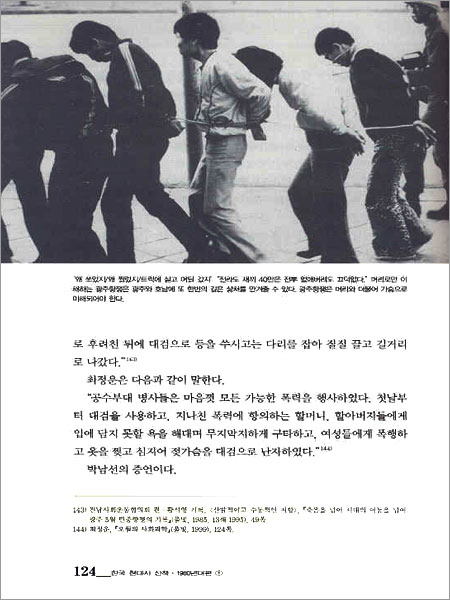
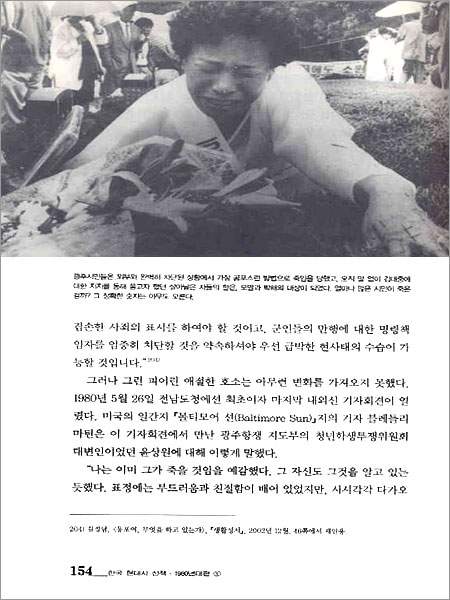
The Gwangju Democratization Movement was a protest that took place from May 18 to 27, 1980, by citizens of South Jeolla Province and Gwangju, demanding the abolition of martial law, the resignation of Chun Doo-hwan, and the release of Kim Dae-jung. The massive casualties that occurred during the protests are called the Gwangju Massacre.
However, the Gwangju Democratization Movement is evaluated as a turning point that brought about a change in Korean social movements from the intellectual-centered movement of the 1970s to a people's movement.
Even after that, the wind of democratization continued to blow without cooling down and continued to reach its peak.
And as time passed, we hosted the Seoul Olympics.
After the successful hosting of the Seoul Olympics, the economy experienced remarkable growth.
However, the author says that under the nationalistic control imposed by the 1988 Olympics, citizens gradually became less interested in politics.
It is a story that feels a bit unfamiliar, even though it is a history we walked through only 10-20 years ago.
Although it contains a very different era from the present, let us remember that the past is a continuous process that continues to the present, so it is something that can never be forgotten and must not be forgotten.
The Gwangju Democratization Movement was a protest that took place from May 18 to 27, 1980, by citizens of South Jeolla Province and Gwangju, demanding the abolition of martial law, the resignation of Chun Doo-hwan, and the release of Kim Dae-jung. The massive casualties that occurred during the protests are called the Gwangju Massacre.
However, the Gwangju Democratization Movement is evaluated as a turning point that brought about a change in Korean social movements from the intellectual-centered movement of the 1970s to a people's movement.
Even after that, the wind of democratization continued to blow without cooling down and continued to reach its peak.
And as time passed, we hosted the Seoul Olympics.
After the successful hosting of the Seoul Olympics, the economy experienced remarkable growth.
However, the author says that under the nationalistic control imposed by the 1988 Olympics, citizens gradually became less interested in politics.
It is a story that feels a bit unfamiliar, even though it is a history we walked through only 10-20 years ago.
Although it contains a very different era from the present, let us remember that the past is a continuous process that continues to the present, so it is something that can never be forgotten and must not be forgotten.
- You can preview some of the book's contents.
Preview
index
Preface - The Gwangju Massacre and the Seoul Olympics
1.
Chapter 1: Why Did Gwangju Shed Blood? / 1980
Duke K
A dream of two different people in 'Spring in Seoul'
The fight between Lee Byung-chul and Chung Ju-young
Sabuk Labor Struggle
Free Press Movement
Seoul Station Retreat
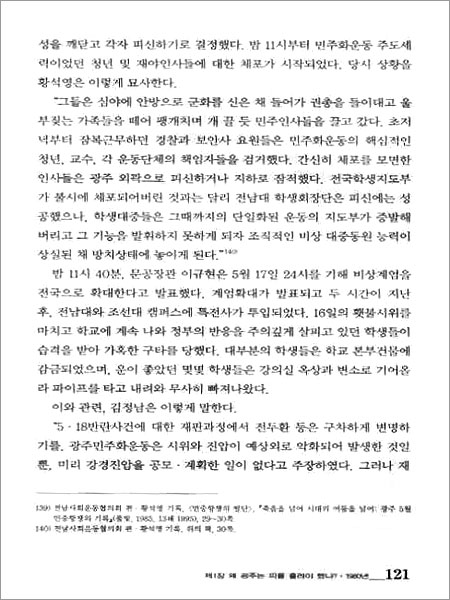
May 17 martial law expansion
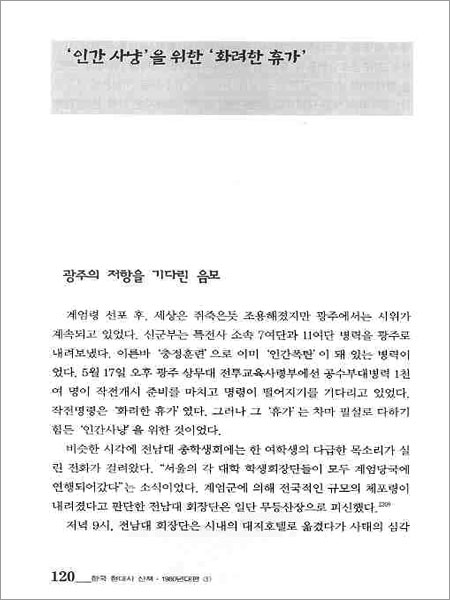
A 'gorgeous vacation' for 'human hunting'
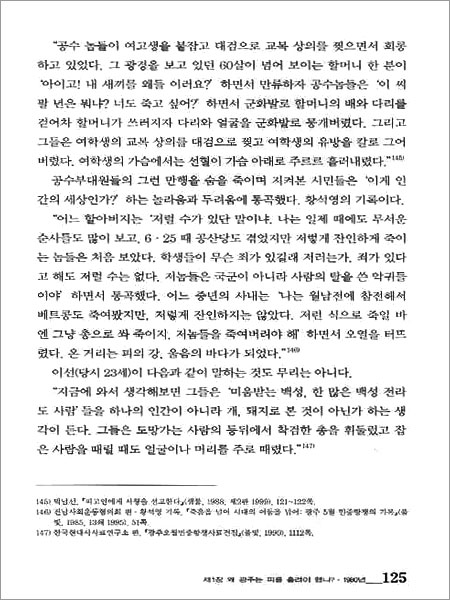
The pain and cries of 'Liberated Gwangju'
Media Distortion Beyond the "Absence of an Audience"
The Hidden Truth of May 18th
The birth of the National Security Emergency Committee
Kim Dae-jung conspiracy case
Dismissal of journalists and closure of media outlets
Ban on private tutoring and graduation quota system
Are Koreans a bunch of rats?
Samcheong Education Corps
October 27th Persecution
media consolidation
Color TV broadcasting
Enactment of the Basic Press Act
The Chosun Ilbo's era of peace
< Read more >
The debate on ignorance
Park Gwan-hyeon, President of the Chonnam National University Student Council
Testimony of a Gwangju citizen
Kim Jae-gyu's execution
Yoon Hyung-joo's 'Star Story'
Park No-hae's 'Samcheong Education Corps'
Famine and rice imports
The 'Yun-Cheon-Ji-Gang' incident
1.
Chapter 1: Why Did Gwangju Shed Blood? / 1980
Duke K
A dream of two different people in 'Spring in Seoul'
The fight between Lee Byung-chul and Chung Ju-young
Sabuk Labor Struggle
Free Press Movement
Seoul Station Retreat
May 17 martial law expansion
A 'gorgeous vacation' for 'human hunting'
The pain and cries of 'Liberated Gwangju'
Media Distortion Beyond the "Absence of an Audience"
The Hidden Truth of May 18th
The birth of the National Security Emergency Committee
Kim Dae-jung conspiracy case
Dismissal of journalists and closure of media outlets
Ban on private tutoring and graduation quota system
Are Koreans a bunch of rats?
Samcheong Education Corps
October 27th Persecution
media consolidation
Color TV broadcasting
Enactment of the Basic Press Act
The Chosun Ilbo's era of peace
< Read more >
The debate on ignorance
Park Gwan-hyeon, President of the Chonnam National University Student Council
Testimony of a Gwangju citizen
Kim Jae-gyu's execution
Yoon Hyung-joo's 'Star Story'
Park No-hae's 'Samcheong Education Corps'
Famine and rice imports
The 'Yun-Cheon-Ji-Gang' incident
Into the book
The nation's parroting has even permeated the textbooks of young students.
The textbook is 5.
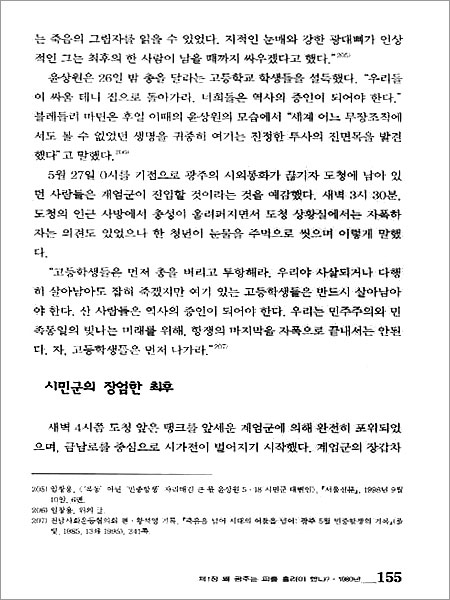
How was May 18 described? The 1982 high school history textbook didn't even cover May 18, simply stating, "Afterwards, a period of continued chaos ensued. Amidst this chaos, the government formed the National Security Emergency Committee to avert the threat of invasion by North Korean communist forces and restore domestic order. This led to bold reforms across all sectors." This only highlighted the legitimacy and reformist nature of the establishment of the Fifth Republic.
The National Institute of Korean History, an official government agency, published 『Modern Korean History』(1982) and Byun Tae-seop's 『Korean History Communication Theory』(1986), which was commonly used as a 'national history textbook for civil service examinations', described that the 'Gwangju Incident' occurred due to social unrest and the radicalization of university student protests after October 26, and that the government 'responded to the situation' through martial law and established the National Security Council to promote 'large-scale political, social, and cultural reforms'.
Here, the May 18th incident was defined as an 'incident' that had exacerbated political and social instability and thus had to be 'resolved', while the Fifth Republic was portrayed as a 'new leadership' that resolved the situation and carried out major reforms.
The textbook is 5.
How was May 18 described? The 1982 high school history textbook didn't even cover May 18, simply stating, "Afterwards, a period of continued chaos ensued. Amidst this chaos, the government formed the National Security Emergency Committee to avert the threat of invasion by North Korean communist forces and restore domestic order. This led to bold reforms across all sectors." This only highlighted the legitimacy and reformist nature of the establishment of the Fifth Republic.
The National Institute of Korean History, an official government agency, published 『Modern Korean History』(1982) and Byun Tae-seop's 『Korean History Communication Theory』(1986), which was commonly used as a 'national history textbook for civil service examinations', described that the 'Gwangju Incident' occurred due to social unrest and the radicalization of university student protests after October 26, and that the government 'responded to the situation' through martial law and established the National Security Council to promote 'large-scale political, social, and cultural reforms'.
Here, the May 18th incident was defined as an 'incident' that had exacerbated political and social instability and thus had to be 'resolved', while the Fifth Republic was portrayed as a 'new leadership' that resolved the situation and carried out major reforms.
---p.
182
182
Publisher's Review
What kind of book is 『A Walk Through Modern Korean History』?
‘Modern history’ is the starting point and the finishing point of history.
And it is a 'living, moving creature'.
Because I have to live in a world where I have to make constant choices.
However, modern history has often been treated as a cold meal in our society as well as in the historical community.
This was because of the vast amount of data, the sensitivity of the viewpoint, the burden of evaluating contemporary figures and events, and the injustice of the power group that prevented proper reading of modern history.
It goes without saying that the remnants of history that should be liquidated continue to roam our society.
The "A Walk Through Modern Korean History" series will be the first step toward filling the gaps in modern history that have been neglected or distorted.
And it is a 'living, moving creature'.
Because I have to live in a world where I have to make constant choices.
However, modern history has often been treated as a cold meal in our society as well as in the historical community.
This was because of the vast amount of data, the sensitivity of the viewpoint, the burden of evaluating contemporary figures and events, and the injustice of the power group that prevented proper reading of modern history.
It goes without saying that the remnants of history that should be liquidated continue to roam our society.
The "A Walk Through Modern Korean History" series will be the first step toward filling the gaps in modern history that have been neglected or distorted.
GOODS SPECIFICS
- Date of issue: May 12, 2003
- Page count, weight, size: 295 pages | 448g | 153*224*20mm
- ISBN13: 9788988410738
- ISBN10: 8988410734
You may also like
카테고리
korean


korean

![GQ KOREA Mark (Monthly): December [2025]](http://librairie.coreenne.fr/cdn/shop/files/8ef265dbbfbf186523ed75ba7319009d.jpg?v=1765340328&width=3840)


