

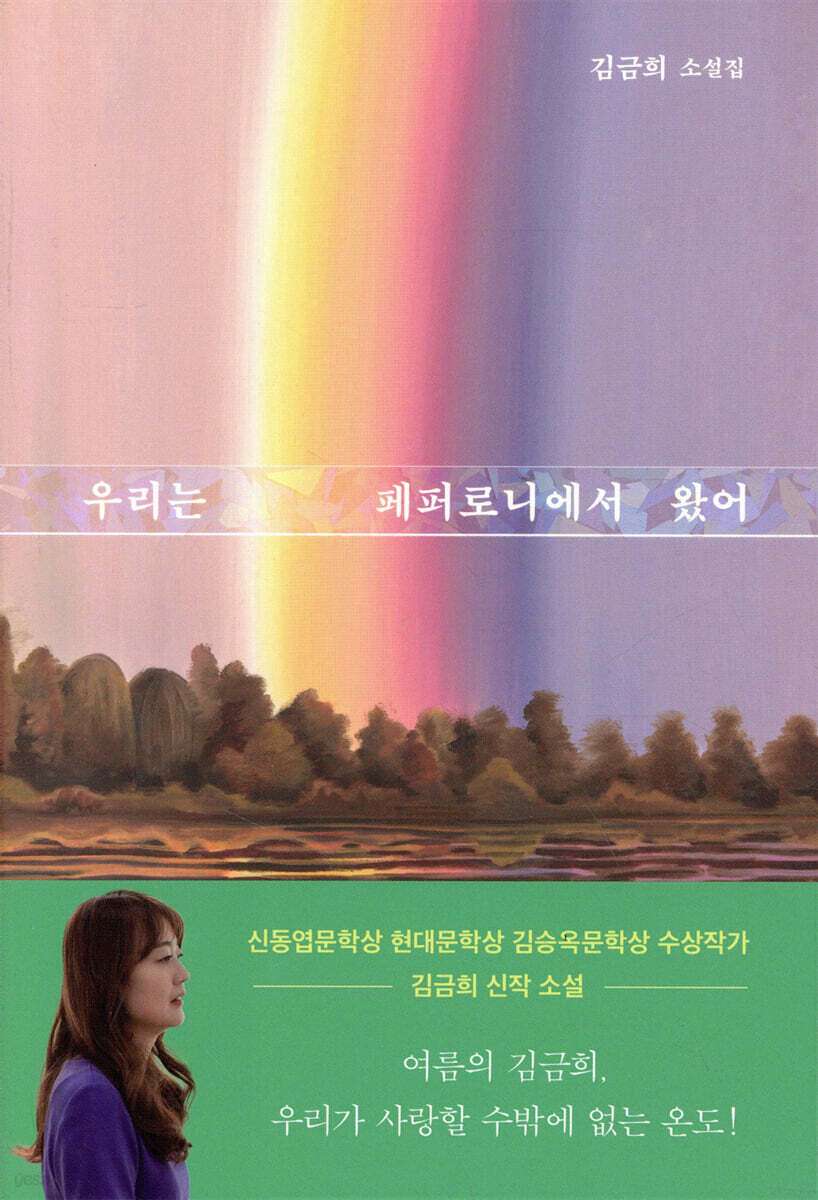
We come from pepperoni
 |
Description
Book Introduction
- A word from MD
-
Kim Geum-hee's novels that ask about your well-beingA book compiling seven works by novelist Kim Geum-hee published between 2019 and 2021.
The novel unflinchingly portrays the failures and losses we face throughout our lives, as well as the small and large moments of growth we ultimately achieve within them.
A story like greetings to those walking alongside us todayMay 11, 2021. Novel/Poetry PD Park Hyung-wook
A new novel by Kim Geum-hee, winner of the Shin Dong-yup Literary Award, the Contemporary Literature Award, and the Kim Seung-ok Literary Award
Now, a literary achievement that only Kim Geum-hee's novels can achieve.
Author Kim Geum-hee, who depicts our distorted minds with bright sentences, has published her fourth short story collection, “We Came from Pepperoni.”
This collection of short stories, published from 2019 to 2021, features seven solid masterpieces that have received various literary awards over the past three years.
The title work, “We Came from Pepperoni,” was praised as “a beautiful novel in itself” (Judge’s Comment, Kim Hwa-young) that “testifies to and confirms the passion, love, frustration, and growth through that frustration of a generation” and won the Grand Prize of the 2020 Kim Seung-ok Literary Award. The included work, “The Last Lee Gi-seong,” won the Excellence Award of the 2019 Kim Seung-ok Literary Award and the Excellence Award of the 2020 Lee Hyo-seok Literary Award, and “The Birth of a Bizarre” was nominated for the 2019 Kim Yu-jeong Literary Award.
When he won the 2017 Contemporary Literature Award, he received the following comment: “I now feel that he is moving from being a good writer to a trustworthy writer” (Judge’s comment, Yoon Seong-hee). It is rare to find a writer who demonstrates his writing skills without any flaws.
This collection of short stories, which meticulously and delicately shows where 'we' originated and where we flowed to, the time we spent together, and the growth that followed, reaffirms to readers that there are novels that only Kim Geum-hee can write, and that the literary achievements that only Kim Geum-hee's novels can achieve are truly remarkable.
Now, a literary achievement that only Kim Geum-hee's novels can achieve.
Author Kim Geum-hee, who depicts our distorted minds with bright sentences, has published her fourth short story collection, “We Came from Pepperoni.”
This collection of short stories, published from 2019 to 2021, features seven solid masterpieces that have received various literary awards over the past three years.
The title work, “We Came from Pepperoni,” was praised as “a beautiful novel in itself” (Judge’s Comment, Kim Hwa-young) that “testifies to and confirms the passion, love, frustration, and growth through that frustration of a generation” and won the Grand Prize of the 2020 Kim Seung-ok Literary Award. The included work, “The Last Lee Gi-seong,” won the Excellence Award of the 2019 Kim Seung-ok Literary Award and the Excellence Award of the 2020 Lee Hyo-seok Literary Award, and “The Birth of a Bizarre” was nominated for the 2019 Kim Yu-jeong Literary Award.
When he won the 2017 Contemporary Literature Award, he received the following comment: “I now feel that he is moving from being a good writer to a trustworthy writer” (Judge’s comment, Yoon Seong-hee). It is rare to find a writer who demonstrates his writing skills without any flaws.
This collection of short stories, which meticulously and delicately shows where 'we' originated and where we flowed to, the time we spent together, and the growth that followed, reaffirms to readers that there are novels that only Kim Geum-hee can write, and that the literary achievements that only Kim Geum-hee's novels can achieve are truly remarkable.
- You can preview some of the book's contents.
Preview
index
The summer we could have had
At Christmas
The last selfishness
We come from pepperoni
The Birth of a Monstrosity
Depth and slope
Choa
Commentary | Hwang Jeong-ah
Author's Note
Announcement page of included works
At Christmas
The last selfishness
We come from pepperoni
The Birth of a Monstrosity
Depth and slope
Choa
Commentary | Hwang Jeong-ah
Author's Note
Announcement page of included works
Detailed image
Into the book
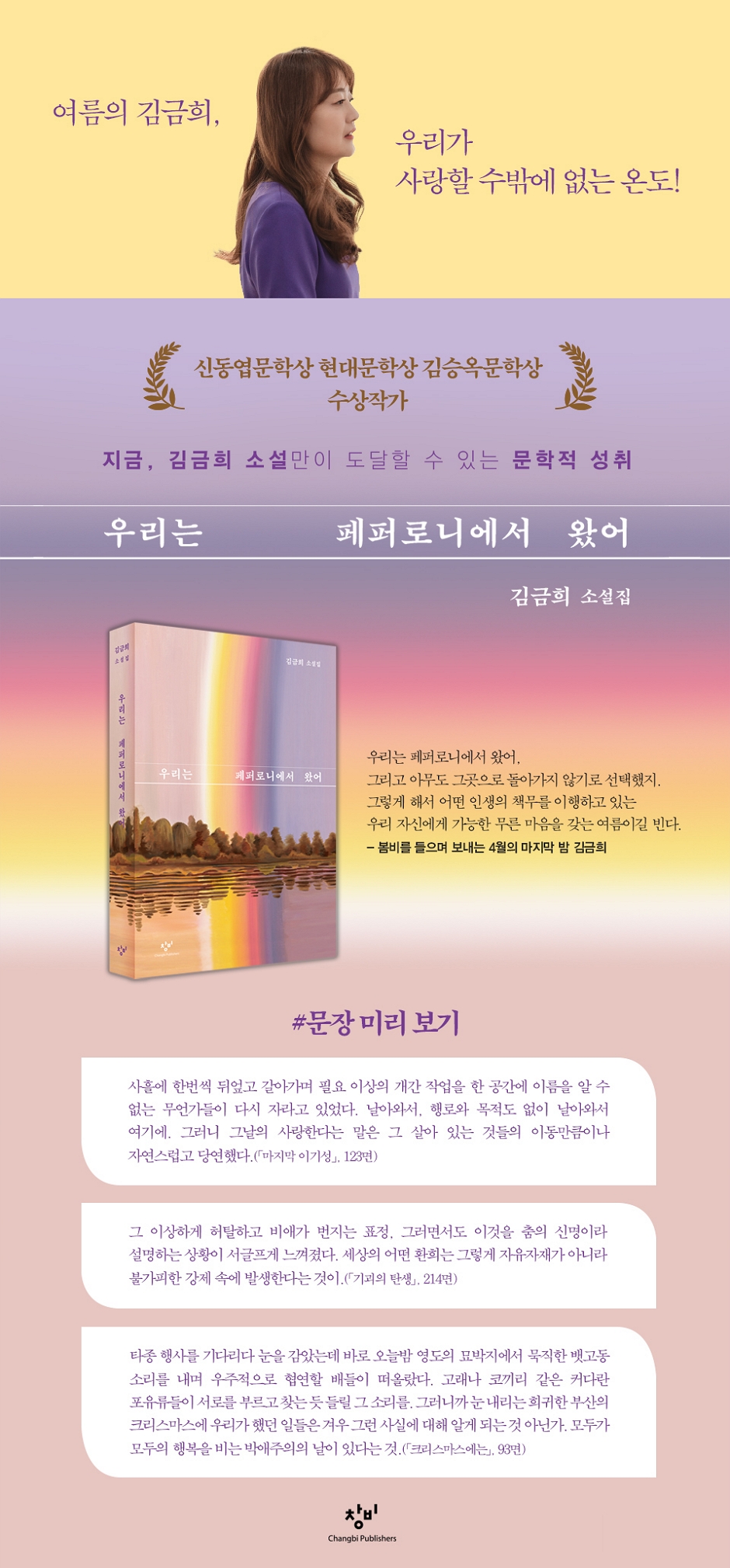
I kept thinking about Wonmi Udon, which I had been thinking about while saying goodbye, goodbye, and taking care of myself, and I felt tears welling up in my eyes.
What opportunities did I have?
So, was that a summer that I could have made flow differently?
Every time guilt came over me, I strongly denied it, but the moment I wrote down those words at my child's request, I knew that my child was right.
The fact that "hello" is something you can and should ask someone over and over again, even if it's to someone who's no longer sitting across from you, is what keeps Ilsan's summer alive.
--- p.48, "The Summer We Were Possible"
As I closed my eyes waiting for the bell-ringing ceremony, I pictured the ships that would be honking their horns and performing a cosmic concert at Yeongdo's anchorage that very night.
The sound that large mammals like whales and elephants make when they call out to each other.
So, what we did on that rare snowy Christmas in Busan was just barely enough to make us aware of that fact.
There is a day of philanthropy where everyone prays for everyone's happiness.
--- p.93, "At Christmas"
In a space where the land had been overturned and replaced every three days, and where unnecessary reclamation work had been done, something nameless was growing again.
Flying here, flying here without a destination or purpose.
So, the words “I love you” that day were as natural and obvious as the movement of living things.
--- p.123, "The Last Selfishness"
I've said it many times that it's a hit, but in reality, there's never been a time when it was really good.
I went through that time feeling like crying because I didn't know where I came from and where I was going.
Being able to talk about frustration as frustration and no longer deny it was growth for us.
--- p.172, "We Came from Pepperoni"
That strangely empty and sorrowful expression, yet the way it was explained as the spirit of dance, felt sad.
Some joys in the world do not arise freely, but rather under inevitable compulsion.
--- p.214, "The Birth of the Monstrous"
When I heard that there were many deaths on the island because the sea was so strong that waves piled on top of waves, it didn't sound like something that applied to me, but as I walked through the underpass and saw the waves made of people constantly coming towards me and then passing through me without a second thought and disappearing behind me, I felt as if something within me was being precariously erased.
I felt like I was being constantly cut down.
Because so many people come to me and just pass me by without even recognizing me, and nothing happens to me.
--- pp.251~252, "Depth and Slope"
“Since you’re my older sister, you should ask her how she’s doing and see what she’s doing.
No one should be left alone.
“You have to meddle and keep bothering them.”
Then, my mom sent me a few pictures she took on the first trip.
Among them were Choa and I, standing side by side in the dark Chupungnyeong rest area.
The faces of the two people looking at their phones shone in the light, and so the two figures were clearly visible even in the darkness.
But it was still a distant dream that I couldn't know what kind of change would occur in our relationship with Choa.
What opportunities did I have?
So, was that a summer that I could have made flow differently?
Every time guilt came over me, I strongly denied it, but the moment I wrote down those words at my child's request, I knew that my child was right.
The fact that "hello" is something you can and should ask someone over and over again, even if it's to someone who's no longer sitting across from you, is what keeps Ilsan's summer alive.
--- p.48, "The Summer We Were Possible"
As I closed my eyes waiting for the bell-ringing ceremony, I pictured the ships that would be honking their horns and performing a cosmic concert at Yeongdo's anchorage that very night.
The sound that large mammals like whales and elephants make when they call out to each other.
So, what we did on that rare snowy Christmas in Busan was just barely enough to make us aware of that fact.
There is a day of philanthropy where everyone prays for everyone's happiness.
--- p.93, "At Christmas"
In a space where the land had been overturned and replaced every three days, and where unnecessary reclamation work had been done, something nameless was growing again.
Flying here, flying here without a destination or purpose.
So, the words “I love you” that day were as natural and obvious as the movement of living things.
--- p.123, "The Last Selfishness"
I've said it many times that it's a hit, but in reality, there's never been a time when it was really good.
I went through that time feeling like crying because I didn't know where I came from and where I was going.
Being able to talk about frustration as frustration and no longer deny it was growth for us.
--- p.172, "We Came from Pepperoni"
That strangely empty and sorrowful expression, yet the way it was explained as the spirit of dance, felt sad.
Some joys in the world do not arise freely, but rather under inevitable compulsion.
--- p.214, "The Birth of the Monstrous"
When I heard that there were many deaths on the island because the sea was so strong that waves piled on top of waves, it didn't sound like something that applied to me, but as I walked through the underpass and saw the waves made of people constantly coming towards me and then passing through me without a second thought and disappearing behind me, I felt as if something within me was being precariously erased.
I felt like I was being constantly cut down.
Because so many people come to me and just pass me by without even recognizing me, and nothing happens to me.
--- pp.251~252, "Depth and Slope"
“Since you’re my older sister, you should ask her how she’s doing and see what she’s doing.
No one should be left alone.
“You have to meddle and keep bothering them.”
Then, my mom sent me a few pictures she took on the first trip.
Among them were Choa and I, standing side by side in the dark Chupungnyeong rest area.
The faces of the two people looking at their phones shone in the light, and so the two figures were clearly visible even in the darkness.
But it was still a distant dream that I couldn't know what kind of change would occur in our relationship with Choa.
--- p.305, "Choah"
Publisher's Review
Bright sentences that soothe the delicate knots of the heart
The trustworthy world of Kim Geum-hee
The title piece, "We Came from Pepperoni," depicts the process in which 'I' and 'Gio-seong' become close and then drift apart during the three months they work part-time organizing genealogy at the old professor's house.
In that relationship, there is the old professor's granddaughter, 'Kang-seon', who blatantly ignores the world's order and hierarchy represented by the old professor's family tree and genealogy, and cleverly damages the relationship between 'I' and 'Gi-o-seong'.
I, who quickly withdrew from the relationship without doing anything, only later wondered whether that withdrawal was “a poor resignation that there was nothing to gain even if I did that.”
The meaning of 'growth' discovered later can be read as a definition of a generation called those in their 20s.
I went through that time feeling like crying because I didn't know where I came from and where I was going.
Being able to talk about frustration as frustration and no longer deny it was a growth for us. (p. 172)
The memoirs of a generation that spent their 20s in the early to mid-2000s are like the seal of Kim Geum-hee's novels.
"The Summer We Were Possible," which opens this collection of short stories, vividly depicts the defeated summer spent by "I," a third-year college entrance exam taker who repeatedly failed to get into college, and "The Undertaker," who entered medical school but failed to adapt.
What makes this novel particularly shine is the present of 'me' reminiscing about that time.
I feel a deep sense of shame at myself for simplifying the poverty and helplessness felt by the younger generation today, and I think, “Isn’t it impossible to look back on that time with today’s perspective?”
In this present moment, where each person is preoccupied with “preserving Ilsan’s summer” without romanticizing the era that has passed, Kim Geum-hee’s novels are always written anew.
"The Last Lee Ki-seong" is a novel about the love and solidarity between the international student Lee Ki-seong and the Korean resident in Japan, Yukiko. It depicts the struggles that these two, who stood in the same place from different perspectives, once shared.
This struggle ultimately ends in failure, but Lee Ki-seong discovers the “final truth” that “the anxious youth threw into the present while imagining the future.”
"The Birth of a Monstrous" is a work that shows our complex hearts, which want to comfort and simultaneously criticize the "bizarre" choices made in love, through a very attractive character.
'I', who couldn't understand the 'teacher' who had an affair with a student and ended up getting a divorce, becomes close to 'Lee Ae', a coworker who returned to Korea from New York after getting divorced, and opens up to her about her feelings.
Through these two characters, the author delicately portrays the pain the speaker feels at the moment when he is about to face the bizarre truth of life.
The characters who grow by witnessing the truth stand out particularly in this collection of novels.
My second cousin, Choa, caused a stir in the family by being the only one in the family to enter a prestigious university, but now she does nothing but invest in stocks.
'Na', who has reunited with 'Cho-ah', who thought she could "justly" protest against unreasonable things, protests in her own way against what she thought was unfair, and brings about "fair treatment for herself" as "a change brought about by the restoration of those times."
"At Christmas," which depicts a trip to Busan to interview an ex-lover who is famous on social media as the "Gourmet Alpha Go," warmly and refreshingly shows the process of reconciling with one's past through a day of tumultuous reporting.
"Depth and Slope," which movingly depicts the process by which writers who moved into the Jeju Island residence "Gongga" successfully repair a broken car, is also a work that delivers a positive message to readers about discovering the meaning of life.
As I was working on binding it into a book and rereading it, I realized that there were many parts about reuniting with someone I had broken up with.
Loss has been a problem that has haunted me since I first began writing, but meeting again could be read as healing a wound or restoring a relationship, but it seemed closer to the confirmation of a loss.
It's like walking slowly, pulling back the curtain and glaring fiercely at a stage, but even there, some bright and soft memories pour out, and I suddenly drop my hand at the energy they hold.
I'm glad I was able to write all of that into a novel without any problems.
From the author's note
Kim Geum-hee depicts the loss of the past, but does not beautify or romanticize it.
By connecting the past to the present, we discover the meaningful truth that lies before us now.
We cannot help but believe in this novel, which shows a character who has been unable to overcome past wounds somehow overcoming them, learning the “final truth” and changing, and in this author who creates new and beautiful scenes with his characteristically sharp perspective.
Meanwhile, the author, who is at the forefront of providing readers with new reading experiences, such as releasing new works in audiobook format on portal sites, is currently continuing to communicate with readers about books through his personal SNS.
The author's readership has also expanded beyond the 2030 generation to include those in their 40s, and is receiving strong support from readers.
"I only now realize that I wrote all the short stories in my fourth collection when I was in my forties.
Everyone consoles themselves by saying that biological age doesn't really matter, but when I actually reached my forties, that wasn't the case at all.
There were many changes, and it was mostly a feeling closer to fall than spring or summer.
So, now that I'm standing here, it's probably the end of August, or if you're being generous, it's mid-July, right when the rainy season is ending. Whatever it is, I feel like I'm ready to talk about spring and summer, at least.
As I was working on binding it into a book and rereading it, I realized that there were many parts about reuniting with someone I had broken up with.
Loss has been a problem that has haunted me since I first began writing, but meeting again could be read as healing a wound or restoring a relationship, but it seemed closer to the confirmation of a loss.
It's like walking slowly, pulling back the curtain and glaring fiercely at a stage, but even there, some bright and soft memories pour out, and I suddenly drop my hand at the energy they hold.
I'm glad I was able to write all of that into a novel without any problems.
And so, we overcome another hurdle.
Twelve years ago, my writing began entirely out of a yearning of my own, and it was thanks to my readers that I was able to reach this point.
Thanks to those who read, I was able to write more or less.
I'm just now beginning to think that struggling to find that exquisite balance is actually the basis of novel writing.
It is a practical response to what I intend to write for.
The title, 'We Came from Pepperoni', really came to me the day I came out of lunch at a pizza place.
As I walked out of that restaurant in Mangwon, I tried other things instead of pepperoni.
I also thought about the sentence, “We came from Jongam-dong, even though we have no special connection to Jongam-dong.”
In addition, there are many other words that someone can use to describe themselves.
Then, just as I initially thought, it settled back down to pepperoni, which is a bit odd and weird, and now I want to put another one after that sentence.
We came from Pepperoni, and none of us chose to go back there.
So, I hope this summer will be one where we can be as gentle as possible toward ourselves as we fulfill our responsibilities in life."
The last night of April spent listening to the spring rain
Kim Geum-hee
The trustworthy world of Kim Geum-hee
The title piece, "We Came from Pepperoni," depicts the process in which 'I' and 'Gio-seong' become close and then drift apart during the three months they work part-time organizing genealogy at the old professor's house.
In that relationship, there is the old professor's granddaughter, 'Kang-seon', who blatantly ignores the world's order and hierarchy represented by the old professor's family tree and genealogy, and cleverly damages the relationship between 'I' and 'Gi-o-seong'.
I, who quickly withdrew from the relationship without doing anything, only later wondered whether that withdrawal was “a poor resignation that there was nothing to gain even if I did that.”
The meaning of 'growth' discovered later can be read as a definition of a generation called those in their 20s.
I went through that time feeling like crying because I didn't know where I came from and where I was going.
Being able to talk about frustration as frustration and no longer deny it was a growth for us. (p. 172)
The memoirs of a generation that spent their 20s in the early to mid-2000s are like the seal of Kim Geum-hee's novels.
"The Summer We Were Possible," which opens this collection of short stories, vividly depicts the defeated summer spent by "I," a third-year college entrance exam taker who repeatedly failed to get into college, and "The Undertaker," who entered medical school but failed to adapt.
What makes this novel particularly shine is the present of 'me' reminiscing about that time.
I feel a deep sense of shame at myself for simplifying the poverty and helplessness felt by the younger generation today, and I think, “Isn’t it impossible to look back on that time with today’s perspective?”
In this present moment, where each person is preoccupied with “preserving Ilsan’s summer” without romanticizing the era that has passed, Kim Geum-hee’s novels are always written anew.
"The Last Lee Ki-seong" is a novel about the love and solidarity between the international student Lee Ki-seong and the Korean resident in Japan, Yukiko. It depicts the struggles that these two, who stood in the same place from different perspectives, once shared.
This struggle ultimately ends in failure, but Lee Ki-seong discovers the “final truth” that “the anxious youth threw into the present while imagining the future.”
"The Birth of a Monstrous" is a work that shows our complex hearts, which want to comfort and simultaneously criticize the "bizarre" choices made in love, through a very attractive character.
'I', who couldn't understand the 'teacher' who had an affair with a student and ended up getting a divorce, becomes close to 'Lee Ae', a coworker who returned to Korea from New York after getting divorced, and opens up to her about her feelings.
Through these two characters, the author delicately portrays the pain the speaker feels at the moment when he is about to face the bizarre truth of life.
The characters who grow by witnessing the truth stand out particularly in this collection of novels.
My second cousin, Choa, caused a stir in the family by being the only one in the family to enter a prestigious university, but now she does nothing but invest in stocks.
'Na', who has reunited with 'Cho-ah', who thought she could "justly" protest against unreasonable things, protests in her own way against what she thought was unfair, and brings about "fair treatment for herself" as "a change brought about by the restoration of those times."
"At Christmas," which depicts a trip to Busan to interview an ex-lover who is famous on social media as the "Gourmet Alpha Go," warmly and refreshingly shows the process of reconciling with one's past through a day of tumultuous reporting.
"Depth and Slope," which movingly depicts the process by which writers who moved into the Jeju Island residence "Gongga" successfully repair a broken car, is also a work that delivers a positive message to readers about discovering the meaning of life.
As I was working on binding it into a book and rereading it, I realized that there were many parts about reuniting with someone I had broken up with.
Loss has been a problem that has haunted me since I first began writing, but meeting again could be read as healing a wound or restoring a relationship, but it seemed closer to the confirmation of a loss.
It's like walking slowly, pulling back the curtain and glaring fiercely at a stage, but even there, some bright and soft memories pour out, and I suddenly drop my hand at the energy they hold.
I'm glad I was able to write all of that into a novel without any problems.
From the author's note
Kim Geum-hee depicts the loss of the past, but does not beautify or romanticize it.
By connecting the past to the present, we discover the meaningful truth that lies before us now.
We cannot help but believe in this novel, which shows a character who has been unable to overcome past wounds somehow overcoming them, learning the “final truth” and changing, and in this author who creates new and beautiful scenes with his characteristically sharp perspective.
Meanwhile, the author, who is at the forefront of providing readers with new reading experiences, such as releasing new works in audiobook format on portal sites, is currently continuing to communicate with readers about books through his personal SNS.
The author's readership has also expanded beyond the 2030 generation to include those in their 40s, and is receiving strong support from readers.
"I only now realize that I wrote all the short stories in my fourth collection when I was in my forties.
Everyone consoles themselves by saying that biological age doesn't really matter, but when I actually reached my forties, that wasn't the case at all.
There were many changes, and it was mostly a feeling closer to fall than spring or summer.
So, now that I'm standing here, it's probably the end of August, or if you're being generous, it's mid-July, right when the rainy season is ending. Whatever it is, I feel like I'm ready to talk about spring and summer, at least.
As I was working on binding it into a book and rereading it, I realized that there were many parts about reuniting with someone I had broken up with.
Loss has been a problem that has haunted me since I first began writing, but meeting again could be read as healing a wound or restoring a relationship, but it seemed closer to the confirmation of a loss.
It's like walking slowly, pulling back the curtain and glaring fiercely at a stage, but even there, some bright and soft memories pour out, and I suddenly drop my hand at the energy they hold.
I'm glad I was able to write all of that into a novel without any problems.
And so, we overcome another hurdle.
Twelve years ago, my writing began entirely out of a yearning of my own, and it was thanks to my readers that I was able to reach this point.
Thanks to those who read, I was able to write more or less.
I'm just now beginning to think that struggling to find that exquisite balance is actually the basis of novel writing.
It is a practical response to what I intend to write for.
The title, 'We Came from Pepperoni', really came to me the day I came out of lunch at a pizza place.
As I walked out of that restaurant in Mangwon, I tried other things instead of pepperoni.
I also thought about the sentence, “We came from Jongam-dong, even though we have no special connection to Jongam-dong.”
In addition, there are many other words that someone can use to describe themselves.
Then, just as I initially thought, it settled back down to pepperoni, which is a bit odd and weird, and now I want to put another one after that sentence.
We came from Pepperoni, and none of us chose to go back there.
So, I hope this summer will be one where we can be as gentle as possible toward ourselves as we fulfill our responsibilities in life."
The last night of April spent listening to the spring rain
Kim Geum-hee
GOODS SPECIFICS
- Date of issue: May 10, 2021
- Page count, weight, size: 324 pages | 356g | 128*188*20mm
- ISBN13: 9788936438418
- ISBN10: 8936438417
You may also like
카테고리
korean


korean

![GQ KOREA Mark (Monthly): December [2025]](http://librairie.coreenne.fr/cdn/shop/files/8ef265dbbfbf186523ed75ba7319009d.jpg?v=1765340328&width=3840)


