

Poem of Needles and Leather
 |
Description
Book Introduction
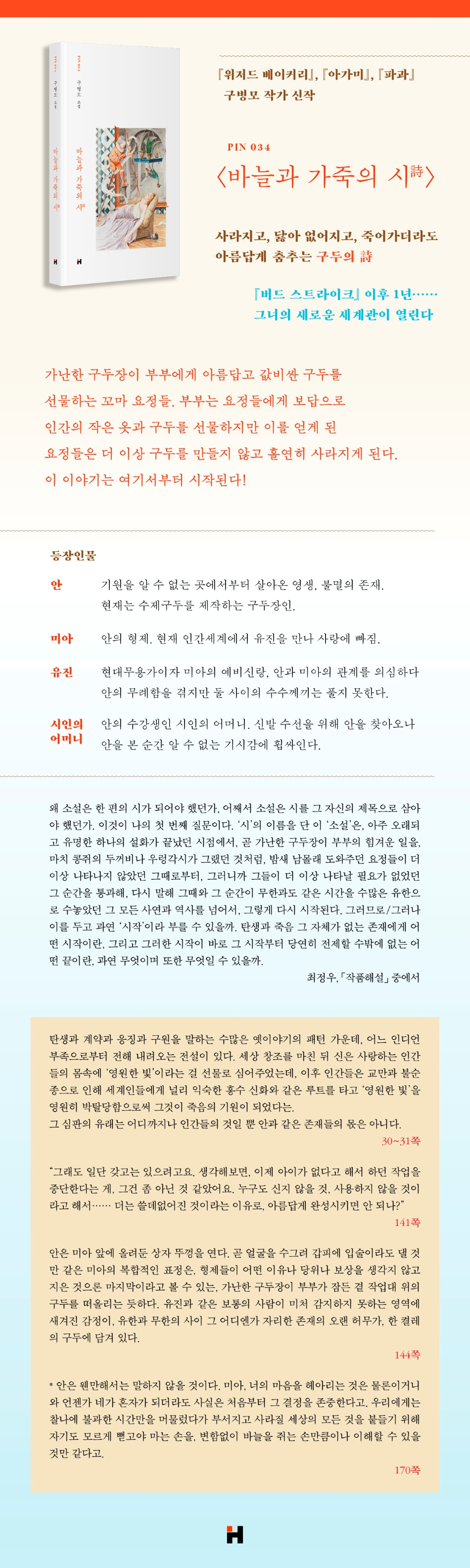
With the most modern and cutting-edge writers of contemporary Korean literature [Modern Literature Pin Series] The 34th novel in the series has been published! The thirty-fourth novel in the special feature series [Modern Literature Pin Series] of the monthly [Modern Literature], which selects the most modern and cutting-edge writers of contemporary Korean literature and includes new poetry and novels, has been published: Koo Byeong-mo's "Poetry of Needles and Leather." The author, who debuted in 2009 with 『Wizard Bakery』 and has broadened the horizons of Korean literature by captivating readers with stable sentences, solid structure, and imagination that transcends genre distinctions, has released this new work as a revised version of a novel published in the July 2020 issue of 『Modern Literature』. This novel, which originated from the fairy tale "The Shoemaker Fairy," is a poetic account of infinite life and eternal life through the eyes of a humanized fairy who can change her appearance and live an ageless life. |
- You can preview some of the book's contents.
Preview
index
Poem of Needles and Leather 009
Work Commentary 172
Author's Note 190
Work Commentary 172
Author's Note 190
Detailed image
Into the book
* Among the many ancient stories that tell of birth, contracts, punishment, and salvation, there is a legend handed down from a certain Indian tribe.
After completing the creation of the world, God implanted something called 'eternal light' as a gift into the bodies of his beloved humans. However, due to their arrogance and disobedience, humans were forever deprived of the 'eternal light', following the same route as the flood myth widely known to people around the world, and this became the origin of death.
The origin of that judgment is entirely human, not the share of beings like An.
--- pp.30~31
* “But I still want to keep it for now.
Come to think of it, it didn't seem right to stop what I was doing just because I didn't have a child.
“Just because no one will believe it, because no one will use it… … because it has become useless, can’t we just make it beautiful?”
--- p.141
* Open the lid of the box placed in front of Mia.
Mia's complex expression, as if she were about to lower her face and press her lips to the upper leather, seems to bring to mind the shoes on the workbench next to the poor shoemaker couple sleeping, which the brothers made without any thought of reason, duty, or compensation, and which could be considered the last.
The emotions engraved in a realm that ordinary people like Eugene cannot perceive, the long-standing emptiness of existence that resides somewhere between the finite and the infinite, are contained in a pair of shoes.
--- p.144
* I won't say anything unless absolutely necessary.
Mia, of course I understand your feelings, and even if you end up alone someday, I will respect your decision from the beginning.
I think we can understand the hand that unconsciously reaches out to hold onto everything in the world that will only last a fleeting moment before crumbling and disappearing, just as we can understand the hand that invariably holds a needle.
--- p.170
* Wherever Eugene's gestures linger, wherever his toes touch, small beings appear, jumping up like water droplets.
Is it really invisible to other people's eyes?
One, two, three… … .
It's been so long since I last saw it that I can't be certain, but something beyond human understanding is clearly moving around the stage, its body swaying to the music and its movements softly.
At first, these beings were perceived only as light, without any skepticism, distrust, or antipathy, but as the movement of waves gradually became clearer, they could be felt as sounds and smells, and at times they were like a moving picture, then a blazing torch, then a melting snowflake, freely changing their properties, and the next moment they were music with rhythm and beat, and finally they seemed like a poem written in a language that was forever impossible to read.
After completing the creation of the world, God implanted something called 'eternal light' as a gift into the bodies of his beloved humans. However, due to their arrogance and disobedience, humans were forever deprived of the 'eternal light', following the same route as the flood myth widely known to people around the world, and this became the origin of death.
The origin of that judgment is entirely human, not the share of beings like An.
--- pp.30~31
* “But I still want to keep it for now.
Come to think of it, it didn't seem right to stop what I was doing just because I didn't have a child.
“Just because no one will believe it, because no one will use it… … because it has become useless, can’t we just make it beautiful?”
--- p.141
* Open the lid of the box placed in front of Mia.
Mia's complex expression, as if she were about to lower her face and press her lips to the upper leather, seems to bring to mind the shoes on the workbench next to the poor shoemaker couple sleeping, which the brothers made without any thought of reason, duty, or compensation, and which could be considered the last.
The emotions engraved in a realm that ordinary people like Eugene cannot perceive, the long-standing emptiness of existence that resides somewhere between the finite and the infinite, are contained in a pair of shoes.
--- p.144
* I won't say anything unless absolutely necessary.
Mia, of course I understand your feelings, and even if you end up alone someday, I will respect your decision from the beginning.
I think we can understand the hand that unconsciously reaches out to hold onto everything in the world that will only last a fleeting moment before crumbling and disappearing, just as we can understand the hand that invariably holds a needle.
--- p.170
* Wherever Eugene's gestures linger, wherever his toes touch, small beings appear, jumping up like water droplets.
Is it really invisible to other people's eyes?
One, two, three… … .
It's been so long since I last saw it that I can't be certain, but something beyond human understanding is clearly moving around the stage, its body swaying to the music and its movements softly.
At first, these beings were perceived only as light, without any skepticism, distrust, or antipathy, but as the movement of waves gradually became clearer, they could be felt as sounds and smells, and at times they were like a moving picture, then a blazing torch, then a melting snowflake, freely changing their properties, and the next moment they were music with rhythm and beat, and finally they seemed like a poem written in a language that was forever impossible to read.
--- pp.169-170
Publisher's Review
Even if it disappears, wears out, and dies
The Poem of Beautifully Dancing Shoes
『Poetry of Needles and Leather』 is the latest work by Gu Byeong-mo, who is evaluated to have broken down the boundaries of novels and established his own style by publishing the short story collections 『I Hope It's Not Just Me』 and 『A Single Sentence』, and the full-length novels 『Your Neighbor's Table』, 『Breakthrough』, 『Gills』, and 『A Spoonful of Time』 after making his literary debut in 2009 with 『Wizard Bakery』.
This work by the author, who questions the conventional wisdom of common sense and presents a new perspective by twisting it to a new level, is a novel that uses the life of a 'human' that wears out like a shoe as material to unfold the eternal life of 'existence' like a poem.
The fairies who lived together making shoes have scattered over time and are now living in human form.
In front of An, who is still living an eternal life as a shoemaker in the human world, his sibling Mia, who has been with him the longest, appears.
Mia asks him to make shoes for her companion, Eugene, as she is getting married soon.
When the time comes, unlike herself who still lives the life of a spirit, changing appearances and residences, Mia falls in love with Eugene, a finite being, and An falls into thought, but when Mia says, “I know I will disappear, I know I will wear out and die, so it has to be now,” he feels an inexplicable jealousy and emptiness.
There was a woman inside him who had shared her feelings a long time ago.
However, An, who had to turn away painfully after realizing that she was unable to lead a normal life.
One day, after many years had passed, An met her as a white-haired woman and finally began to realize a little about the direction his life should take.
“There is nothing more meaningless than forming a relationship with a human being who disappears helplessly in a time that cannot be occupied or used.
“Even so, I wonder if the goal of my remaining days will be to think about what I can do for Mia, who chose that meaninglessness.” (p. 109)
Instead of wishing for the impossible return to the imaginary world filled with 'us' with his brothers, he decides to take a step closer to the disappearing beings.
If we call the moment when we voluntarily accept another person love, then this story ultimately becomes a story about the inherent asymmetry between ordinary human life and love, which presupposes extinction.
The story of the growth of the 'old spirit, now human' can be said to be the process of 'humanization'.
We too live in the symbolic realm, with clothes and names.
Psychoanalysis has always warned about how grotesque the reality captured through the cracks of the symbolic order can be.
However, the places that An and Mia passed through, and that are still rarely seen, are quite different from the reality shown in Gu Byeong-mo's previous works.
Of course, even without borrowing the words of An, humans are generally impatient and barbaric.
At the same time, it also causes something to shine for a fleeting moment.
If the poetic traces that remain in this fleeting moment of disappearance are fortunately human, the novel says, then we do not need to deny that our lives are all about “the human passion to draw our movements in the air until the wick burns out, like a body already lit, even though it will disappear without a trace.”
-Iso (literary critic)
*
Last
Shoe last is also called shoe last or shoe type.
**
Gosori is also called cobbler pliers or lasting pincers. It is not a regular straight pliers, but a tool with a shape like a bird's beak that makes it easy to hold and bend leather. I have not been able to figure out the etymology of why it is called gosori in Korea, but based on the pronunciation, I can only guess that it may have been modified from Japanese.
Perhaps it is a coincidence, but 'sori' means the shape or state of a curved extension like a sword.
***
These days, it is said that eco-friendly leather is produced using cactus, mushroom mycelium, pineapple leaves, and grape pomace.
****
If even a single piece of beauty has been conveyed through this novel, it is thanks to Choi Jeong-woo's commentary and the hard work of the editorial staff."
Spring 2021
- From the author's words
A novel about connection and flesh
The infinity and permanence of literature
Why did a novel have to become a poem, why did a novel have to take a poem as its own title?
This is my first question.
This 'novel', which bears the name of 'poem', begins again at the point where a very old and famous tale ended, when the fairies who had secretly helped the poor shoemaker couple through their difficult work all night, like Kongjwi's toad or the snail, had no longer appeared; that is, past that moment when they no longer needed to appear, in other words, beyond all the stories and histories that had woven the infinite time into countless finite pieces.
Therefore/But can this really be called a ‘beginning’?
What is the beginning of a being that has neither birth nor death, and what end is it that such a beginning must naturally presuppose? What is it, and what can it be?
- Choi Jeong-woo, from “Work Commentary”
The thirty-fourth volume of the monthly "Pin Novel" published by the monthly magazine "Modern Literature"!
The "Modern Literature Pin Series" is a project that selects the most modern and cutting-edge writers of contemporary Korean literature, presents them in the monthly magazine "Modern Literature," and then publishes them in book form.
The single volumes presented here are individual works, but are also curated by six authors as a 'series'.
Modern literature hopes that the seriousness of this series will be ironically combined with the delicate lightness of the word 'pin'.
The <Modern Literature Pin Series> novel selection is also a monthly pin published by the monthly magazine 『Modern Literature』.
The follow-up issues, scheduled to be published on the 25th of each month, are designed to allow readers to see new works by Korea's top authors on a set date.
This is a kind of 'salary book' concept that is being introduced for the first time in Korean publishing history.
001 to 006 are composed of works by writers born between 1971 and 1973 and debuted between the late 1990s and 2000s, who are currently the backbone of Korean novels. 007 to 012 are composed of works by writers born between the late 1970s and early 1980s and debuted in the mid-to-late 2000s, who are currently the most active writers in Korean novels.
013 to 018 are composed of works by writers born between the mid-to-late 1950s and the 1960s, who played a pivotal role in leading the development of contemporary Korean literature, and writers who debuted between the 1980s and the mid-1990s. 019 to 024 are composed of works by young, energetic writers born in the 1980s who are writing a new history of Korean literature.
The Finn novels, which were published by generation, were grouped and published under the category of genre novels in 025-030, and 031-036 will be composed of works by writers born in the mid-to-late 1970s, when literature was at its peak.
Modern Literature × Artist Park Min-jun
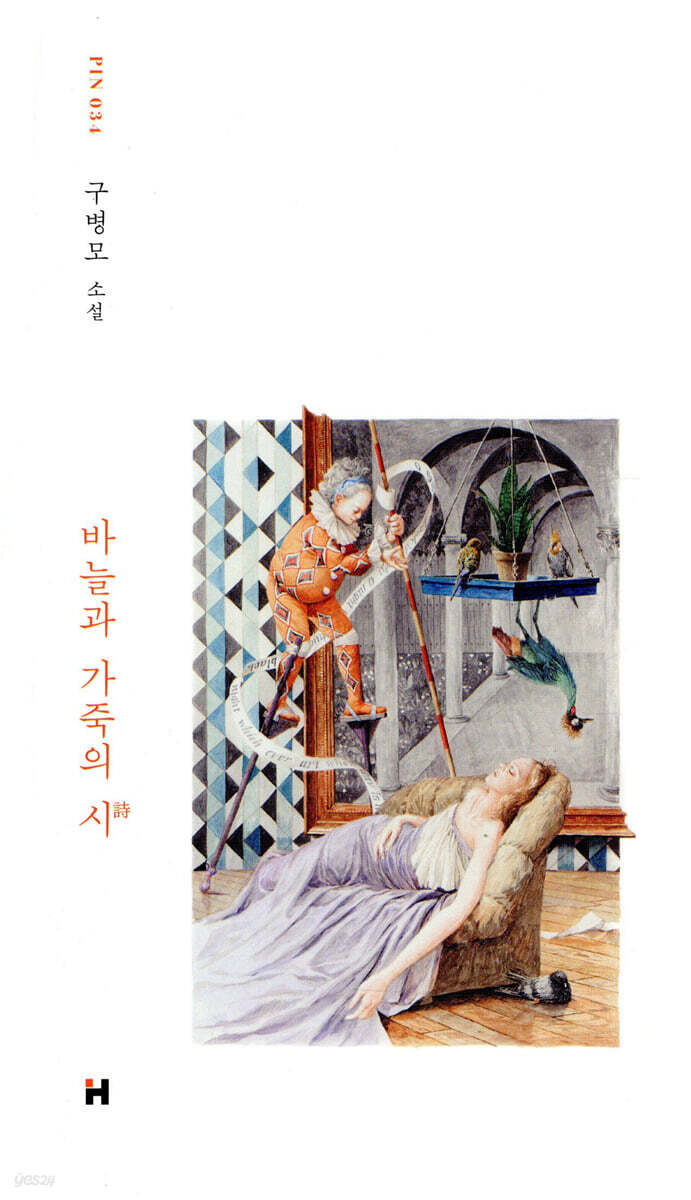
The "Modern Literature Pin Series" has become an original novel collection, an art anthology, reconstructed as a special work of art with a cover work imbued with the artist's soul.
The reason each novel possesses its own unique fragrance and profound artistic fascination is probably because of the spiritual harmony created by the meeting of the two worlds of novels and art.
The Poem of Beautifully Dancing Shoes
『Poetry of Needles and Leather』 is the latest work by Gu Byeong-mo, who is evaluated to have broken down the boundaries of novels and established his own style by publishing the short story collections 『I Hope It's Not Just Me』 and 『A Single Sentence』, and the full-length novels 『Your Neighbor's Table』, 『Breakthrough』, 『Gills』, and 『A Spoonful of Time』 after making his literary debut in 2009 with 『Wizard Bakery』.
This work by the author, who questions the conventional wisdom of common sense and presents a new perspective by twisting it to a new level, is a novel that uses the life of a 'human' that wears out like a shoe as material to unfold the eternal life of 'existence' like a poem.
The fairies who lived together making shoes have scattered over time and are now living in human form.
In front of An, who is still living an eternal life as a shoemaker in the human world, his sibling Mia, who has been with him the longest, appears.
Mia asks him to make shoes for her companion, Eugene, as she is getting married soon.
When the time comes, unlike herself who still lives the life of a spirit, changing appearances and residences, Mia falls in love with Eugene, a finite being, and An falls into thought, but when Mia says, “I know I will disappear, I know I will wear out and die, so it has to be now,” he feels an inexplicable jealousy and emptiness.
There was a woman inside him who had shared her feelings a long time ago.
However, An, who had to turn away painfully after realizing that she was unable to lead a normal life.
One day, after many years had passed, An met her as a white-haired woman and finally began to realize a little about the direction his life should take.
“There is nothing more meaningless than forming a relationship with a human being who disappears helplessly in a time that cannot be occupied or used.
“Even so, I wonder if the goal of my remaining days will be to think about what I can do for Mia, who chose that meaninglessness.” (p. 109)
Instead of wishing for the impossible return to the imaginary world filled with 'us' with his brothers, he decides to take a step closer to the disappearing beings.
If we call the moment when we voluntarily accept another person love, then this story ultimately becomes a story about the inherent asymmetry between ordinary human life and love, which presupposes extinction.
The story of the growth of the 'old spirit, now human' can be said to be the process of 'humanization'.
We too live in the symbolic realm, with clothes and names.
Psychoanalysis has always warned about how grotesque the reality captured through the cracks of the symbolic order can be.
However, the places that An and Mia passed through, and that are still rarely seen, are quite different from the reality shown in Gu Byeong-mo's previous works.
Of course, even without borrowing the words of An, humans are generally impatient and barbaric.
At the same time, it also causes something to shine for a fleeting moment.
If the poetic traces that remain in this fleeting moment of disappearance are fortunately human, the novel says, then we do not need to deny that our lives are all about “the human passion to draw our movements in the air until the wick burns out, like a body already lit, even though it will disappear without a trace.”
-Iso (literary critic)
*
Last
Shoe last is also called shoe last or shoe type.
**
Gosori is also called cobbler pliers or lasting pincers. It is not a regular straight pliers, but a tool with a shape like a bird's beak that makes it easy to hold and bend leather. I have not been able to figure out the etymology of why it is called gosori in Korea, but based on the pronunciation, I can only guess that it may have been modified from Japanese.
Perhaps it is a coincidence, but 'sori' means the shape or state of a curved extension like a sword.
***
These days, it is said that eco-friendly leather is produced using cactus, mushroom mycelium, pineapple leaves, and grape pomace.
****
If even a single piece of beauty has been conveyed through this novel, it is thanks to Choi Jeong-woo's commentary and the hard work of the editorial staff."
Spring 2021
- From the author's words
A novel about connection and flesh
The infinity and permanence of literature
Why did a novel have to become a poem, why did a novel have to take a poem as its own title?
This is my first question.
This 'novel', which bears the name of 'poem', begins again at the point where a very old and famous tale ended, when the fairies who had secretly helped the poor shoemaker couple through their difficult work all night, like Kongjwi's toad or the snail, had no longer appeared; that is, past that moment when they no longer needed to appear, in other words, beyond all the stories and histories that had woven the infinite time into countless finite pieces.
Therefore/But can this really be called a ‘beginning’?
What is the beginning of a being that has neither birth nor death, and what end is it that such a beginning must naturally presuppose? What is it, and what can it be?
- Choi Jeong-woo, from “Work Commentary”
The thirty-fourth volume of the monthly "Pin Novel" published by the monthly magazine "Modern Literature"!
The "Modern Literature Pin Series" is a project that selects the most modern and cutting-edge writers of contemporary Korean literature, presents them in the monthly magazine "Modern Literature," and then publishes them in book form.
The single volumes presented here are individual works, but are also curated by six authors as a 'series'.
Modern literature hopes that the seriousness of this series will be ironically combined with the delicate lightness of the word 'pin'.
The <Modern Literature Pin Series> novel selection is also a monthly pin published by the monthly magazine 『Modern Literature』.
The follow-up issues, scheduled to be published on the 25th of each month, are designed to allow readers to see new works by Korea's top authors on a set date.
This is a kind of 'salary book' concept that is being introduced for the first time in Korean publishing history.
001 to 006 are composed of works by writers born between 1971 and 1973 and debuted between the late 1990s and 2000s, who are currently the backbone of Korean novels. 007 to 012 are composed of works by writers born between the late 1970s and early 1980s and debuted in the mid-to-late 2000s, who are currently the most active writers in Korean novels.
013 to 018 are composed of works by writers born between the mid-to-late 1950s and the 1960s, who played a pivotal role in leading the development of contemporary Korean literature, and writers who debuted between the 1980s and the mid-1990s. 019 to 024 are composed of works by young, energetic writers born in the 1980s who are writing a new history of Korean literature.
The Finn novels, which were published by generation, were grouped and published under the category of genre novels in 025-030, and 031-036 will be composed of works by writers born in the mid-to-late 1970s, when literature was at its peak.
Modern Literature × Artist Park Min-jun
The "Modern Literature Pin Series" has become an original novel collection, an art anthology, reconstructed as a special work of art with a cover work imbued with the artist's soul.
The reason each novel possesses its own unique fragrance and profound artistic fascination is probably because of the spiritual harmony created by the meeting of the two worlds of novels and art.
GOODS SPECIFICS
- Publication date: April 25, 2021
- Format: Hardcover book binding method guide
- Page count, weight, size: 192 pages | 268g | 111*190*20mm
- ISBN13: 9791190885713
- ISBN10: 1190885719
You may also like
카테고리
korean


korean

![GQ KOREA Mark (Monthly): December [2025]](http://librairie.coreenne.fr/cdn/shop/files/8ef265dbbfbf186523ed75ba7319009d.jpg?v=1765340328&width=3840)


