

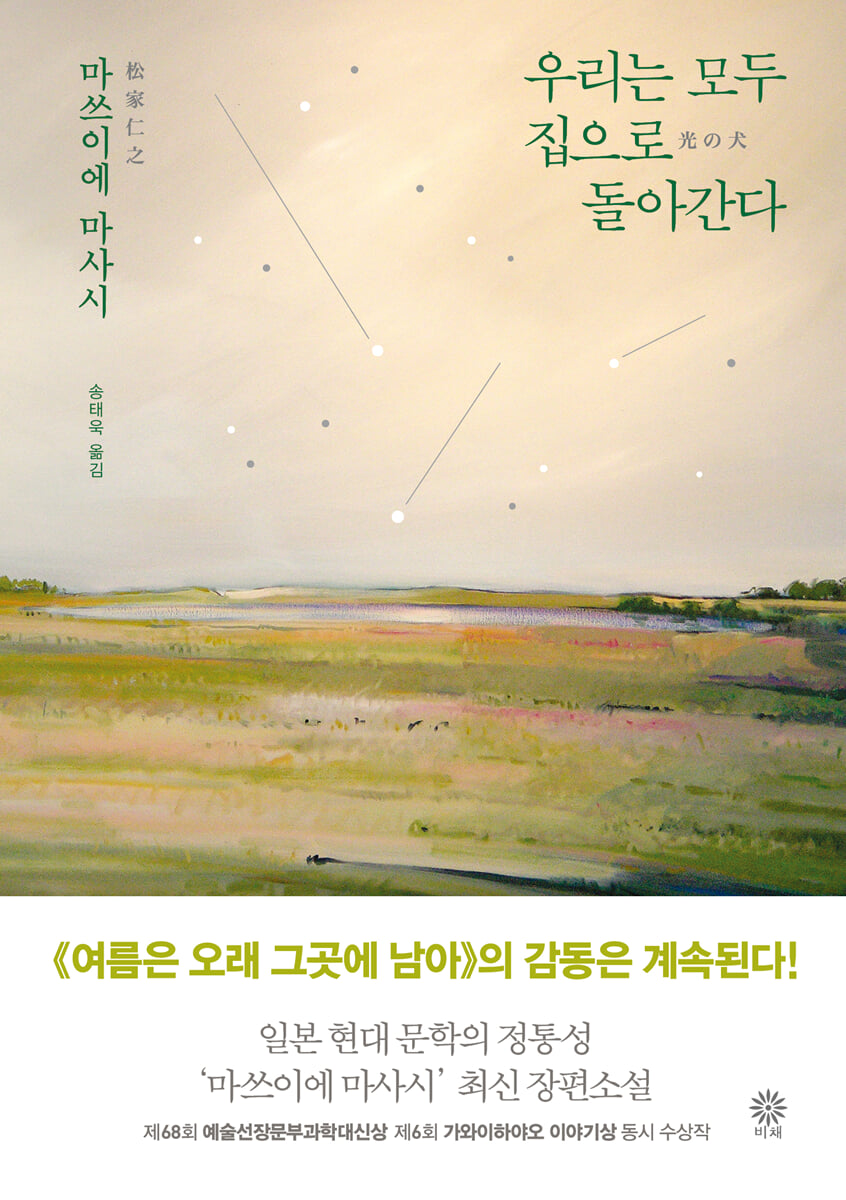
We all go home
 |
Description
Book Introduction
- A word from MD
-
The quiet, sparkling life of ordinary people『Summer remains there for a long time』 A long novel by Masashi Matsuie.
The author, who made a strong impression with her beautiful debut work, which stands out for its detailed descriptions, continues that sensibility in this book, calmly depicting the history of a family spanning nearly a hundred years.
A story where moments from the lives of ordinary people quietly shine here and there.April 9, 2021. Novel/Poetry PD Park Hyung-wook
The emotion of "Summer Stays There for a Long Time" continues!
A calm narrative like a wide, leisurely flowing river
The latest novel by Masashi Matsuie, the orthodoxy of modern Japanese literature.
Masashi Matsuie, a writer widely loved by both Japanese and Korean readers for his deep sensibility, delicate vocabulary, and solemn narratives, presents his new full-length novel, We All Return Home, following “Summer Remains There for a Long Time” and “I Don’t Know Whether It’s Elegant or Not.”
"We All Go Home" is a novel that tells the story of the three generations of the Soejima family, who live in the fictional small town of Edaru in Hokkaido, the four Hokkaido dogs that guard them, and the people around them.
Through the brief history of the Soejima family spanning approximately one hundred years, from the birth of grandmother 'Yone' (1901) to the retirement and return home of grandson 'Hajime', the author calmly portrays the drama of ordinary people who lived in the 20th century.
Each of us is born and raised in our own place, encounters the world, grows old, becomes ill, and dies… Masashi Matsui, with his uniquely deep and delicate observation, reminds us that we are all the protagonists of our own lives.
『We All Go Home』 was immediately met with rave reviews from critics and readers, starting with fellow writer Mitsuyo Kakuta's praise, "It doesn't romanticize life in the slightest, it's so objective, yet how can it be so beautiful!" and won both the 68th Minister of Education, Culture, Sports, Science and Technology Award for the Arts and the 6th Kawai Hayao Story Award.
A calm narrative like a wide, leisurely flowing river
The latest novel by Masashi Matsuie, the orthodoxy of modern Japanese literature.
Masashi Matsuie, a writer widely loved by both Japanese and Korean readers for his deep sensibility, delicate vocabulary, and solemn narratives, presents his new full-length novel, We All Return Home, following “Summer Remains There for a Long Time” and “I Don’t Know Whether It’s Elegant or Not.”
"We All Go Home" is a novel that tells the story of the three generations of the Soejima family, who live in the fictional small town of Edaru in Hokkaido, the four Hokkaido dogs that guard them, and the people around them.
Through the brief history of the Soejima family spanning approximately one hundred years, from the birth of grandmother 'Yone' (1901) to the retirement and return home of grandson 'Hajime', the author calmly portrays the drama of ordinary people who lived in the 20th century.
Each of us is born and raised in our own place, encounters the world, grows old, becomes ill, and dies… Masashi Matsui, with his uniquely deep and delicate observation, reminds us that we are all the protagonists of our own lives.
『We All Go Home』 was immediately met with rave reviews from critics and readers, starting with fellow writer Mitsuyo Kakuta's praise, "It doesn't romanticize life in the slightest, it's so objective, yet how can it be so beautiful!" and won both the 68th Minister of Education, Culture, Sports, Science and Technology Award for the Arts and the 6th Kawai Hayao Story Award.
- You can preview some of the book's contents.
Preview
Into the book
Shinjiro was working as an electrician for Edaru Mint.
Toyoko, who worked as an administrative officer, was recognized for her abacus skills and transferred to the accounting department a year later.
The two people who worked on the same second floor of the same building met there.
About forty years have passed since then.
When the eldest son, Hajime, who was about to get married, returned to his fiancée, Kumiko, and Edaru's family home, Toyoko, who was feeling strangely happy by herself at the dinner table, suddenly talked about her 'love marriage' and said, "Back then, there was no such thing as entertainment... love was the only entertainment."
Hajime and Kumiko couldn't react right away, and Shinjiro gave a short laugh as if trying to avoid the situation.
For a while after that, Hajime used his mother's words as a joke.
“Anyway, I am a product of entertainment.”
--- p.37
“You are completely wrong.”
Yone flinched and shrank back onto the tatami mat.
“Do you see what’s wrong?”
Was the water temperature not right?
Was the cup a little wet?
I can't remember anything more than that.
The teacher neither got angry nor laughed.
It was a face like someone picking up the shards of a broken bowl.
“Speed.”
The teacher said that and then closed his mouth.
Unable to nod, Yone just stared at the teacher.
“The thing that is most inappropriate for childbirth is speed.
Of course, it's not just childbirth that's like that.
Probably the sound of your footsteps opening and closing the door and the sound of the sliding door.
Have you ever thought about what sound is?
Yone tilted his head faintly in silence.
“Sound is speed.
It would be nice if speed could be sound.
The sound of a sliding door closing quickly is fast.
The sound of closing slowly is slow.”
The teacher stood in front of the sliding door and opened and closed it with his right hand.
A straight line of sound cuts through the air.
This time, open it slowly and close it slowly.
A sound that subsides quickly, like crawling on a tatami mat.
“Whether you rush or not, the time it takes is only this much.
But don't rush to open and close it.
“It’s just an assertion that you’re in a hurry.”
--- p.84
“At night, in this room where the 100-inch reflecting telescope is located, you can sometimes see the red glow of pipe tobacco.
Some people even smelled the sweet smell of pipe tobacco, not just the red light.
There's not a single pipe smoker on the observatory staff right now.
“Hubble, who passed away suddenly from a stroke, was a genius in observation, so perhaps he had some regrets?”
“Was that a summer night?”
“Why do you ask summer?
“In Japan, ghosts appear on summer nights.”
“That’s interesting.
“Hubble appears at any time, whether spring, summer, fall or winter.”
“Have you ever met him?”
The researcher paused for a beat and said, "Yes."
“Hubble seems to be only interested in astronomical observations, so people like us don’t seem to be in its sights.
He never spoke to anyone.
So now no one is scared, and in fact, it's not even scary.”
Toyoko, who worked as an administrative officer, was recognized for her abacus skills and transferred to the accounting department a year later.
The two people who worked on the same second floor of the same building met there.
About forty years have passed since then.
When the eldest son, Hajime, who was about to get married, returned to his fiancée, Kumiko, and Edaru's family home, Toyoko, who was feeling strangely happy by herself at the dinner table, suddenly talked about her 'love marriage' and said, "Back then, there was no such thing as entertainment... love was the only entertainment."
Hajime and Kumiko couldn't react right away, and Shinjiro gave a short laugh as if trying to avoid the situation.
For a while after that, Hajime used his mother's words as a joke.
“Anyway, I am a product of entertainment.”
--- p.37
“You are completely wrong.”
Yone flinched and shrank back onto the tatami mat.
“Do you see what’s wrong?”
Was the water temperature not right?
Was the cup a little wet?
I can't remember anything more than that.
The teacher neither got angry nor laughed.
It was a face like someone picking up the shards of a broken bowl.
“Speed.”
The teacher said that and then closed his mouth.
Unable to nod, Yone just stared at the teacher.
“The thing that is most inappropriate for childbirth is speed.
Of course, it's not just childbirth that's like that.
Probably the sound of your footsteps opening and closing the door and the sound of the sliding door.
Have you ever thought about what sound is?
Yone tilted his head faintly in silence.
“Sound is speed.
It would be nice if speed could be sound.
The sound of a sliding door closing quickly is fast.
The sound of closing slowly is slow.”
The teacher stood in front of the sliding door and opened and closed it with his right hand.
A straight line of sound cuts through the air.
This time, open it slowly and close it slowly.
A sound that subsides quickly, like crawling on a tatami mat.
“Whether you rush or not, the time it takes is only this much.
But don't rush to open and close it.
“It’s just an assertion that you’re in a hurry.”
--- p.84
“At night, in this room where the 100-inch reflecting telescope is located, you can sometimes see the red glow of pipe tobacco.
Some people even smelled the sweet smell of pipe tobacco, not just the red light.
There's not a single pipe smoker on the observatory staff right now.
“Hubble, who passed away suddenly from a stroke, was a genius in observation, so perhaps he had some regrets?”
“Was that a summer night?”
“Why do you ask summer?
“In Japan, ghosts appear on summer nights.”
“That’s interesting.
“Hubble appears at any time, whether spring, summer, fall or winter.”
“Have you ever met him?”
The researcher paused for a beat and said, "Yes."
“Hubble seems to be only interested in astronomical observations, so people like us don’t seem to be in its sights.
He never spoke to anyone.
So now no one is scared, and in fact, it's not even scary.”
--- pp.329-330
Publisher's Review
There are things that are beautiful when seen from a distance, like stars or a city at night.
Portraits of ordinary people, splendid even without embellishment!
★68th Arts Award Winner: Minister of Education, Culture, Sports, Science and Technology Award★
★6th Kawai Hayao Story Award Winner★
“The sadness, joy and pain I have experienced in my life so far
It is a full-length novel completed within a story.
The novel is set in Japan's favorite land.
“I chose the eastern part of Hokkaido.”
_Masashi Matsui┃A Word from the Author to Korean Readers
Born in Oiwake, Shinshu (Nagano), Yone went to Tokyo to become a midwife, met her husband Shinzo, and settled in Edaru, Hokkaido.
Shinjo was an executive at Edaru Mint Co., Ltd., and his eldest son Shinjiro later worked as an electrician at the factory.
Shinjiro has one older sister and two younger sisters, all single and living right next door.
Ayumi and Hajime are born to Shinjiro and his wife Toyoko.
The children grow up with Hokkaido dogs such as Iyo, Es, and Jiro, and leave their hometown to go to college.
Ayumi starts working at the observatory in Mitaka, and Hajime returns home one day in his fifties after working as a university professor in Tokyo.
His father, Shinjiro, is an elderly man with health concerns, and his aunts are showing signs of dementia.
There, the only thing Hajime has to take care of is the old dog Haru…
The Beatles' music flows through the story of the Soejima family spanning three generations, and World War II and the Showa era (1926-1989) pass by.
Aside from the tragic death of Takeshi Ishikawa and the early death of Ayumi, no significant events occurred between these three generations of the family and their surroundings.
Just like everyone else, we are born, grow up, get sick, and die.
Yet, the reader is drawn to the story, and the landscape of life, viewed from a distance, is as beautiful as a distant star or a city at night.
As Professor Ogasawara says in the novel, “Every substance emits light of a wavelength that is individually determined by its own characteristics,” this is probably because each character shines with their own unique charm in their own place.
Grandmother Yone, who lived a brave life as a midwife rather than relying on her husband; Shinzo, who started a mint factory that was on the decline due to the war; Hajime, who stays by his aging parents and aunts; Ayumi, who struggles in her sickbed; Tsugada, a passionate young man who enjoys heated debates; Kumiko, who documents the life of the natural monument, the grouse; Ichii, who named her son after a dear childhood friend; and even S, a Hokkaido dog who did not back down an inch in front of a big bear…
Anyone who opens a book will feel as if they have met precious friends they will remember for a long time.
Many writers focus on and enjoy writing about the explosive energy of their teens and twenties, and the dreams that come and go in their thirties and forties, but few are so fixated on the beauty of life's final moments that it's almost an obsession.
We cannot help but applaud the literary challenge of author Masashi Matsui, who confronts even the wrinkles of life head-on.
Adding praise to the author Ryo Asai.
“In an age where only short, easy-to-enjoy entertainment is popular, this is a book you want to read leisurely, as if enjoying a luxury.”
“It is a novel that makes you want to sit and enjoy the aftertaste for a while in silence after closing the book.
“I find myself wandering endlessly in the silence of the story.”
_Yomiuri Shimbun
“The many moments of life in the novel will seep into the reader’s memory like particles of light.
“It is a light that contains the power to endure loneliness.”
Nikkei Economic Daily
“If you meet the Soejima family
“You will suddenly look back on your life and be overcome with beautiful longing.”
_Asahi Shimbun
“Quiet, deep and rich.”
Saburo Kawamoto (literary critic)
“In this era where only entertainment that can be enjoyed in a short period of time without any burden is popular,
“It’s a book you want to read leisurely, as if enjoying a luxury.”
_Ryo Asai (author)
“It is fiercely objective, without romanticizing life in the slightest,
“Why is it so beautiful!”
_Mitsuyo Kakuta (author)
"After I finished translating, I had no thoughts.
I was staring blankly at the river when I suddenly turned my head and the street that came into view felt unrealistically close.
I could only sit there blankly, my eyes slightly blurred and unfocused.
It's been a long time since I've read a good novel, and I didn't even feel like I was reading one.
I felt lonely because I missed something I couldn't identify.
Growing old means losing something.
No, it's about getting used to the fact that you're losing.
If you don't want to show your emotions, you have to be less watery and more blunt, but if you don't do that, you get angry more often.
Maybe it's because time is always the first, and it can't be helped.
(…)
Without specifically blaming or praising any one person, many lives flow smoothly over a period of over a hundred years.
Violence, terrible suffering, disease, and death are just gentle waves when seen from a distance.
Each person is simply born, grows, gets sick, and dies in their own place.
Yet, it is as beautiful as a distant landscape.
No, it may not be that the scenery is beautiful, but that the heart of the person looking at the scenery becomes beautiful.
Yone's teacher said, "A midwife's job is to simply be with the person giving birth and wait for the right time.
“Other people’s interference, meddling, and saying things like ‘Come on, come on,’ are the biggest enemies of Ansan,” he says.
It seems to be saying that the distance between family members should be the same as the distance between a midwife and a mother.
After some time has passed since reading, when the plot becomes vague, the names of the characters become vague, and only the atmosphere remains in your memory, there are works that suddenly come to mind like a hazy past.
For me, it was Natsume Soseki's "The Gate."
Even now, the languid daily life of that beginning comes to me from time to time as a video.
To me, “We All Go Home” is also that kind of work.
A work that matures over time.
"It's a really good novel."
- From the translator's note
Portraits of ordinary people, splendid even without embellishment!
★68th Arts Award Winner: Minister of Education, Culture, Sports, Science and Technology Award★
★6th Kawai Hayao Story Award Winner★
“The sadness, joy and pain I have experienced in my life so far
It is a full-length novel completed within a story.
The novel is set in Japan's favorite land.
“I chose the eastern part of Hokkaido.”
_Masashi Matsui┃A Word from the Author to Korean Readers
Born in Oiwake, Shinshu (Nagano), Yone went to Tokyo to become a midwife, met her husband Shinzo, and settled in Edaru, Hokkaido.
Shinjo was an executive at Edaru Mint Co., Ltd., and his eldest son Shinjiro later worked as an electrician at the factory.
Shinjiro has one older sister and two younger sisters, all single and living right next door.
Ayumi and Hajime are born to Shinjiro and his wife Toyoko.
The children grow up with Hokkaido dogs such as Iyo, Es, and Jiro, and leave their hometown to go to college.
Ayumi starts working at the observatory in Mitaka, and Hajime returns home one day in his fifties after working as a university professor in Tokyo.
His father, Shinjiro, is an elderly man with health concerns, and his aunts are showing signs of dementia.
There, the only thing Hajime has to take care of is the old dog Haru…
The Beatles' music flows through the story of the Soejima family spanning three generations, and World War II and the Showa era (1926-1989) pass by.
Aside from the tragic death of Takeshi Ishikawa and the early death of Ayumi, no significant events occurred between these three generations of the family and their surroundings.
Just like everyone else, we are born, grow up, get sick, and die.
Yet, the reader is drawn to the story, and the landscape of life, viewed from a distance, is as beautiful as a distant star or a city at night.
As Professor Ogasawara says in the novel, “Every substance emits light of a wavelength that is individually determined by its own characteristics,” this is probably because each character shines with their own unique charm in their own place.
Grandmother Yone, who lived a brave life as a midwife rather than relying on her husband; Shinzo, who started a mint factory that was on the decline due to the war; Hajime, who stays by his aging parents and aunts; Ayumi, who struggles in her sickbed; Tsugada, a passionate young man who enjoys heated debates; Kumiko, who documents the life of the natural monument, the grouse; Ichii, who named her son after a dear childhood friend; and even S, a Hokkaido dog who did not back down an inch in front of a big bear…
Anyone who opens a book will feel as if they have met precious friends they will remember for a long time.
Many writers focus on and enjoy writing about the explosive energy of their teens and twenties, and the dreams that come and go in their thirties and forties, but few are so fixated on the beauty of life's final moments that it's almost an obsession.
We cannot help but applaud the literary challenge of author Masashi Matsui, who confronts even the wrinkles of life head-on.
Adding praise to the author Ryo Asai.
“In an age where only short, easy-to-enjoy entertainment is popular, this is a book you want to read leisurely, as if enjoying a luxury.”
“It is a novel that makes you want to sit and enjoy the aftertaste for a while in silence after closing the book.
“I find myself wandering endlessly in the silence of the story.”
_Yomiuri Shimbun
“The many moments of life in the novel will seep into the reader’s memory like particles of light.
“It is a light that contains the power to endure loneliness.”
Nikkei Economic Daily
“If you meet the Soejima family
“You will suddenly look back on your life and be overcome with beautiful longing.”
_Asahi Shimbun
“Quiet, deep and rich.”
Saburo Kawamoto (literary critic)
“In this era where only entertainment that can be enjoyed in a short period of time without any burden is popular,
“It’s a book you want to read leisurely, as if enjoying a luxury.”
_Ryo Asai (author)
“It is fiercely objective, without romanticizing life in the slightest,
“Why is it so beautiful!”
_Mitsuyo Kakuta (author)
"After I finished translating, I had no thoughts.
I was staring blankly at the river when I suddenly turned my head and the street that came into view felt unrealistically close.
I could only sit there blankly, my eyes slightly blurred and unfocused.
It's been a long time since I've read a good novel, and I didn't even feel like I was reading one.
I felt lonely because I missed something I couldn't identify.
Growing old means losing something.
No, it's about getting used to the fact that you're losing.
If you don't want to show your emotions, you have to be less watery and more blunt, but if you don't do that, you get angry more often.
Maybe it's because time is always the first, and it can't be helped.
(…)
Without specifically blaming or praising any one person, many lives flow smoothly over a period of over a hundred years.
Violence, terrible suffering, disease, and death are just gentle waves when seen from a distance.
Each person is simply born, grows, gets sick, and dies in their own place.
Yet, it is as beautiful as a distant landscape.
No, it may not be that the scenery is beautiful, but that the heart of the person looking at the scenery becomes beautiful.
Yone's teacher said, "A midwife's job is to simply be with the person giving birth and wait for the right time.
“Other people’s interference, meddling, and saying things like ‘Come on, come on,’ are the biggest enemies of Ansan,” he says.
It seems to be saying that the distance between family members should be the same as the distance between a midwife and a mother.
After some time has passed since reading, when the plot becomes vague, the names of the characters become vague, and only the atmosphere remains in your memory, there are works that suddenly come to mind like a hazy past.
For me, it was Natsume Soseki's "The Gate."
Even now, the languid daily life of that beginning comes to me from time to time as a video.
To me, “We All Go Home” is also that kind of work.
A work that matures over time.
"It's a really good novel."
- From the translator's note
GOODS SPECIFICS
- Publication date: April 2, 2021
- Format: Hardcover book binding method guide
- Page count, weight, size: 504 pages | 634g | 140*198*36mm
- ISBN13: 9788934990062
- ISBN10: 8934990066
You may also like
카테고리
korean


korean

![GQ KOREA Mark (Monthly): December [2025]](http://librairie.coreenne.fr/cdn/shop/files/8ef265dbbfbf186523ed75ba7319009d.jpg?v=1765340328&width=3840)


