

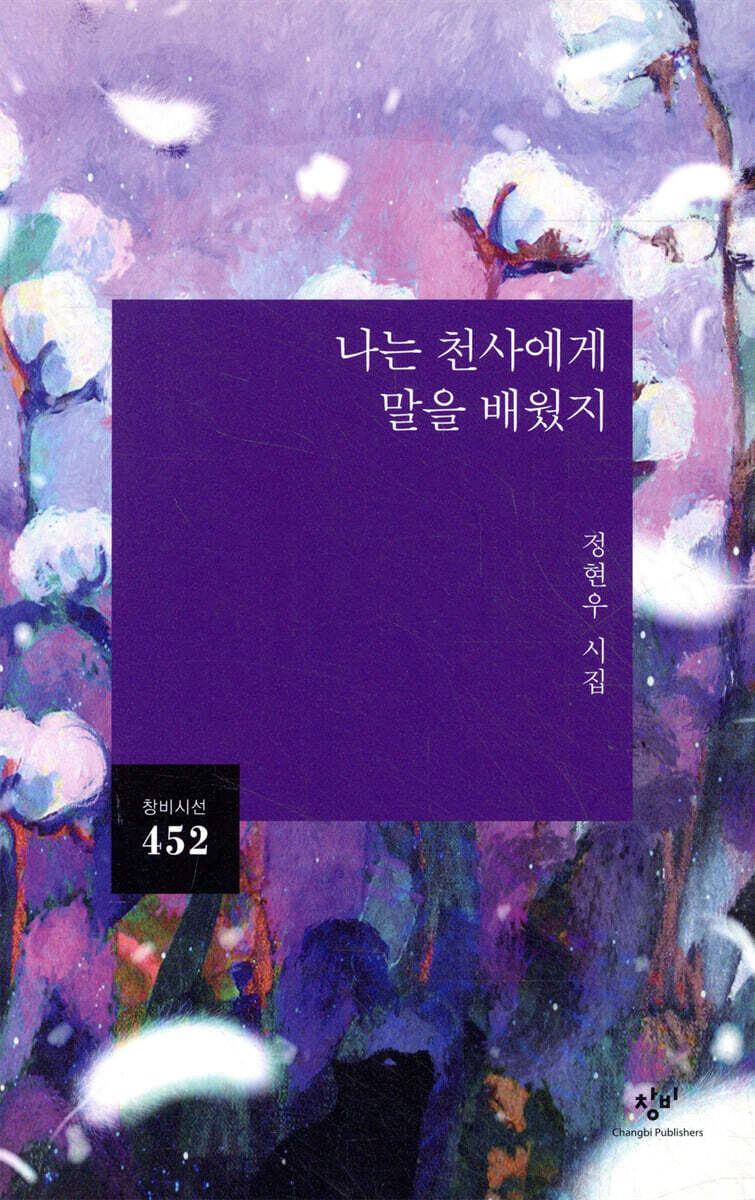
I learned to speak from an angel
 |
Description
Book Introduction
“I flow.
Should it flow with things lying down?”
Jeong Hyeon-woo's first poetry collection, which sings of unspeakable sorrow.
The birth of an unfamiliar voice confessing the surplus of life and death.
The first poetry collection to open the door to the 2021 Changbi Poetry Collection was published with poet Jeong Hyeon-woo's "I Learned to Speak from an Angel."
This is the first poetry collection of a poet who began his career by winning the Chosun Ilbo New Year's Literary Contest in 2015.
The poet, who debuted as a singer before his debut, released the album "Beautiful and Useless" last year under the unique name "Poet's Instrument Shop" and is currently active in both literature and music as a musician.
He received the 4th Dongju Literary Award (Yun Dong-ju Poetry Literature Award) in 2019, drawing attention as a young poet who will lead the future of poetry.
In his first poetry collection, published six years after his debut, the poet unfolds a captivating world of poetry characterized by vivid, novel images and sophisticated, emotional language.
The poems, which feature a profound reflection on life and death and a deep poetic thought that constantly questions the identity of one's own existence, and lively and individualistic sentences, evoke a sorrowful and poignant feeling within the deep resonance of lyrical sentiment that embraces all the sorrows of the world.
68 poems, including the Dongju Literary Award-winning poem “Just as sadness is not sadness when it is discovered,” were compiled and published in four parts.
Should it flow with things lying down?”
Jeong Hyeon-woo's first poetry collection, which sings of unspeakable sorrow.
The birth of an unfamiliar voice confessing the surplus of life and death.
The first poetry collection to open the door to the 2021 Changbi Poetry Collection was published with poet Jeong Hyeon-woo's "I Learned to Speak from an Angel."
This is the first poetry collection of a poet who began his career by winning the Chosun Ilbo New Year's Literary Contest in 2015.
The poet, who debuted as a singer before his debut, released the album "Beautiful and Useless" last year under the unique name "Poet's Instrument Shop" and is currently active in both literature and music as a musician.
He received the 4th Dongju Literary Award (Yun Dong-ju Poetry Literature Award) in 2019, drawing attention as a young poet who will lead the future of poetry.
In his first poetry collection, published six years after his debut, the poet unfolds a captivating world of poetry characterized by vivid, novel images and sophisticated, emotional language.
The poems, which feature a profound reflection on life and death and a deep poetic thought that constantly questions the identity of one's own existence, and lively and individualistic sentences, evoke a sorrowful and poignant feeling within the deep resonance of lyrical sentiment that embraces all the sorrows of the world.
68 poems, including the Dongju Literary Award-winning poem “Just as sadness is not sadness when it is discovered,” were compiled and published in four parts.
- You can preview some of the book's contents.
Preview
index
Part 1: Can't we all cry at once?
baptism
bruise
Sora's Diary
The Room to Become a Woman
ears and horns
trap
blank
music box
glass dice
Just as sadness is not sadness if you let it be
Island that blinks an eye(?)
Will it be the first time I sneeze under a poplar tree?
Dream bookmark
Colorful
Winter Jenga
Dreams and Hearth
Part 2 Resting my chin between time and shade
Snail Farm 1
Fortune-telling
sunset
evolution
Baptism 1
peach blossom
Snail Farm 2
Blue Order
Weekend masterpiece
Goblin Needle
When God comes to kill us
The Secret of Angles
Myo Myo
The Sounds of Silence
Roseville
Ortolan
Function of the navel
How do I call someone whose face I can't remember?
Part 3: The Boy and the Water Splash
mermaid
If you swallow a spoon while swallowing a grain of rice,
Kang Shin-moo
forgiveness
For those without anus
Can't people breathe underwater like fish?
genesis
Drawer layout
Salt Moon
Baptism 2
Book of Glass
Palm
The Forest Where Mermaids Cry
Snowball
Munjo (文鳥)
The back side of love
ink and wash painting
Oh, that word
Part 4: Summer Carols
Picked flowers
Winter ears
Ghosts of the Tundra 1
Ghosts of the Tundra 2
ask
giant
The Vanishing Night
Oversleeping
Ophiuchus
The Land of Clothes
The end
freezing point
I want to live in a place where cotton blossoms
boy's attitude
Summer Carol
Fukushima
Commentary | Kim Eon
Poet's words
baptism
bruise
Sora's Diary
The Room to Become a Woman
ears and horns
trap
blank
music box
glass dice
Just as sadness is not sadness if you let it be
Island that blinks an eye(?)
Will it be the first time I sneeze under a poplar tree?
Dream bookmark
Colorful
Winter Jenga
Dreams and Hearth
Part 2 Resting my chin between time and shade
Snail Farm 1
Fortune-telling
sunset
evolution
Baptism 1
peach blossom
Snail Farm 2
Blue Order
Weekend masterpiece
Goblin Needle
When God comes to kill us
The Secret of Angles
Myo Myo
The Sounds of Silence
Roseville
Ortolan
Function of the navel
How do I call someone whose face I can't remember?
Part 3: The Boy and the Water Splash
mermaid
If you swallow a spoon while swallowing a grain of rice,
Kang Shin-moo
forgiveness
For those without anus
Can't people breathe underwater like fish?
genesis
Drawer layout
Salt Moon
Baptism 2
Book of Glass
Palm
The Forest Where Mermaids Cry
Snowball
Munjo (文鳥)
The back side of love
ink and wash painting
Oh, that word
Part 4: Summer Carols
Picked flowers
Winter ears
Ghosts of the Tundra 1
Ghosts of the Tundra 2
ask
giant
The Vanishing Night
Oversleeping
Ophiuchus
The Land of Clothes
The end
freezing point
I want to live in a place where cotton blossoms
boy's attitude
Summer Carol
Fukushima
Commentary | Kim Eon
Poet's words
Into the book
Humans
The deformed sea breeze,
Even if you knock down the ice tree forest
Tears that can't stop
The idea that pearls are embedded in the ribs
I feel like taking it out
When I was born
Half of the world
It was full of crippled people who had lost their eyesight due to the plague.
---From "Baptism"
I walked through the snowy forest.
Birds flocked over the fallen angel.
I carry an angel on my back
He brought him home and washed him like an angel.
On the wings, small ears were shining.
I stole an ear.
I put my ears to the moonlight
I learned to speak from an angel.
Two ears,
Two feathers.
When did human ears forget the words of angels?
---From "Ears and Horns"
The eyes were made to cry,
Humans have the softest sadness
(…)
It's also possible to have dead people
Luck for me,
Having sadness is also a part of being human.
Number of cases,
Angels think, you can cry as much as you want, that's okay
How much sorrow must be broken
Will a person become human?
---From "Glass Dice"
Just as I cannot remember all of my dreams from last night, just as what can be forgiven cannot be reborn, is the unforgivable the god who hears my other side? Just as when a mistake is discovered, it becomes a mistake, and when sadness is discovered, it is not sadness, I flow towards the unforgivable.
In the black water, in the black trees, with black faces, who can endure sorrow longer, on the night when cars rush into the sunset, do I flow?
Should things that lie down flow?
---From "Just as sadness is not sadness when it is discovered"
Between human hearts and minds
Please give us heavy snow
Let me know the path that cannot be entered.
With a piece of sadness
A broken person
The snow that walks alone
Let me say it's love.
The unstoppable light between the eyes
Do you call it a gaze?
If we close each other's eyes
I can't take only sadness with me
---From "Winter Jenga"
We eat rice without spoons.
Even without hands, I
You can shake the edge leaves
You can steal the dinner that was clattering on the table
A winter night when all the confessions come flooding back
Sitting across from each other without doing anything
When you eat cold soup,
Bring back the dead you
If you put your face on the spoon side by side
I have a sore throat.
As I look out at my hungry heart
While holding the spoon with your right hand
I lowered my head and gasped for breath.
Handing over the corpses
Oh, I'm hot
The faces of sadness on the left and right
I knew it was different.
Just the grains of rice flying by the window
I wanted to chew it up and spit it out.
---From "If you swallow a spoon while passing over a grain of rice"
A broken mirror becomes a tree, and on a night when sleep is crumbling, a light comes to me, and on the way back from this world to the next, I whistle.
The birds are joining me as I draw night and sleep.
Aren't you afraid of the unexplained? The living room lights up as you return, and outside the window, every time a soul emerges, the dusk washes over my forehead.
Those who cannot be reborn wander through the constellations and fall into the stars by hanging themselves.
I strain my ears all night to endure the rustling of the snow, but all I hear is crumbling. On the night road, where leaves rub against the snowflakes, I stand with both hands over my ears and feel around to see how many leaves remain.
The soul that has no choice but to return spends the winter with its leaves fallen.
Three days passed by as the tree, covered with rustling snow crystals, licked its lips and asked, “What is your sleep?” and “Can I dream again?”
The deformed sea breeze,
Even if you knock down the ice tree forest
Tears that can't stop
The idea that pearls are embedded in the ribs
I feel like taking it out
When I was born
Half of the world
It was full of crippled people who had lost their eyesight due to the plague.
---From "Baptism"
I walked through the snowy forest.
Birds flocked over the fallen angel.
I carry an angel on my back
He brought him home and washed him like an angel.
On the wings, small ears were shining.
I stole an ear.
I put my ears to the moonlight
I learned to speak from an angel.
Two ears,
Two feathers.
When did human ears forget the words of angels?
---From "Ears and Horns"
The eyes were made to cry,
Humans have the softest sadness
(…)
It's also possible to have dead people
Luck for me,
Having sadness is also a part of being human.
Number of cases,
Angels think, you can cry as much as you want, that's okay
How much sorrow must be broken
Will a person become human?
---From "Glass Dice"
Just as I cannot remember all of my dreams from last night, just as what can be forgiven cannot be reborn, is the unforgivable the god who hears my other side? Just as when a mistake is discovered, it becomes a mistake, and when sadness is discovered, it is not sadness, I flow towards the unforgivable.
In the black water, in the black trees, with black faces, who can endure sorrow longer, on the night when cars rush into the sunset, do I flow?
Should things that lie down flow?
---From "Just as sadness is not sadness when it is discovered"
Between human hearts and minds
Please give us heavy snow
Let me know the path that cannot be entered.
With a piece of sadness
A broken person
The snow that walks alone
Let me say it's love.
The unstoppable light between the eyes
Do you call it a gaze?
If we close each other's eyes
I can't take only sadness with me
---From "Winter Jenga"
We eat rice without spoons.
Even without hands, I
You can shake the edge leaves
You can steal the dinner that was clattering on the table
A winter night when all the confessions come flooding back
Sitting across from each other without doing anything
When you eat cold soup,
Bring back the dead you
If you put your face on the spoon side by side
I have a sore throat.
As I look out at my hungry heart
While holding the spoon with your right hand
I lowered my head and gasped for breath.
Handing over the corpses
Oh, I'm hot
The faces of sadness on the left and right
I knew it was different.
Just the grains of rice flying by the window
I wanted to chew it up and spit it out.
---From "If you swallow a spoon while passing over a grain of rice"
A broken mirror becomes a tree, and on a night when sleep is crumbling, a light comes to me, and on the way back from this world to the next, I whistle.
The birds are joining me as I draw night and sleep.
Aren't you afraid of the unexplained? The living room lights up as you return, and outside the window, every time a soul emerges, the dusk washes over my forehead.
Those who cannot be reborn wander through the constellations and fall into the stars by hanging themselves.
I strain my ears all night to endure the rustling of the snow, but all I hear is crumbling. On the night road, where leaves rub against the snowflakes, I stand with both hands over my ears and feel around to see how many leaves remain.
The soul that has no choice but to return spends the winter with its leaves fallen.
Three days passed by as the tree, covered with rustling snow crystals, licked its lips and asked, “What is your sleep?” and “Can I dream again?”
---From "The Vanishing Night"
Publisher's Review
If you are caught doing something wrong, it becomes a mistake,
Just as sadness is not sadness if you let it be
Jeong Hyeon-woo's poetry is filled with 'sadness'.
The true nature of the “unerasable sadness” (“Oh, the Word”) is not clearly revealed, but as seen in the expression “Just as a mistake becomes a mistake when it is discovered, and sadness is no longer sadness when it is discovered” (“Just as sadness is no longer sadness when it is discovered”), we can only feel the existence of sadness that disappears or is denied the moment it is revealed.
The poet who says, “When I was born/Half the world/was filled with cripples blinded by plague” (“Baptism”), even “mourns scenes he has never seen” (“Baptism”).
Likewise, if “having sadness” is “the number of cases for becoming human” (“Glass Dice”), the poet who asks “Can’t all sadness be cried out at once” (“Dream and Hearth”) endures the pain and sadness of life by engraving “unspeakable sadness” in his heart as “sadness that can only be spoken” (Kim Eon, commentary).
Thus, even in the shady landscape of life, which is “just a puddle and a shadow filled with each person’s sorrow” (“Just as sorrow is no longer sorrow when it is discovered”), the warmth of “love and joy” (“Winter Jenga”) that “licks sorrow with a burnt tongue” seeps in.
But “How much sorrow must be broken/For a person to become human” (“Glass Dice”).
The poet, in the midst of an inner sadness that cannot be explained in conventional language, “recalls things that were born wrongly” (“Freezing Point”) and explores a dark, labyrinthine world in search of his origins.
The poet's anguish about his own identity never ends in the midst of questions like, "Two people sleep together/Why can't we have two sexes?" (Baptism 1) and "When a person dies, is he a woman or a man?" (The Room That Becomes a Woman).
The poet seeks to break free from the shackles of existing systems and language and embrace the “color of wanting to live” (“Colorful”) as “me” among the “colors that humans can have.”
It is the poet's immediate reality and the most urgent existential problem.
The poet breaks down the boundary of “time that divides men and women” (“Human-faced Fish”) with “black scissors that cut the light” and sometimes “becomes a thoughtful woman” (“For Things Without Anuses”).
Jeong Hyeon-woo's first poetry collection, "I Learned to Speak from an Angel," is a lament that comforts the wounds of young souls living in a chaotic era "filled with bruises" ("Bruises"), and a confession about the essence and identity of human existence.
The poet concludes his confession with a “sinless prayer” (“Forgiveness”) to “a god I do not believe in” in this collection of poems.
But we will not turn back or stop here.
Reality is as bleak as “the night when the wrongs outweigh the right ones” (“The Room to Become a Woman”), and life, a continuation of suffering, is like “a future without light” (“Baptism”), but because “what is dangerous is beautiful” (“For Things Without Anuses”), the poet will “look into my trapped insides for a long time” (“The Trap”) and sing of sorrow with the voice of a holy angel toward the lowest place in the world.
“We will become one with the circuits of the void, drifting sadly, tangled, without a name, and we will live by burning each other.” (Lee Byeong-ryul, Recommendation)
A Brief Interview with Poet Jeong Hyeon-woo (Questions: Editor)
―I’d like to hear your thoughts on publishing your first poetry collection.
I am happy that I was able to bring into the poem all the people and beings that I could not touch, and I am touched that I will be able to meet them again.
―I understand that you are active in both literature and music.
I'm curious about what your daily routine is like when you write poetry.
I'm in charge of vocals in a team called 'Poet's Instrument Shop'. When I can't write poetry, I live by making music, and when I can't write music, I live by making poetry.
These days, I think the poet's identity is so strong that he has lost his ability to compose.
I'm thinking about leaving the composing to another member of my team. (Laughs)
―What was the most important part or feature you considered while compiling your first poetry collection?
I wanted to speak on behalf of those who are not called out and who are marginalized.
Above all, I had a strong desire to take the side of poverty, and it seems that the emotions and fantasies I felt while going through my impoverished childhood were born into poetry.
―If there is a piece in this collection that you feel particularly attached to, please introduce it and explain why.
The first poem is called "Baptism" and the last poem is called "Fukushima."
Society today is emotionally and physically bare.
I think that the strongest weapon for humans is tears.
Because we are human, not stones or trees, we can feel countless emotions.
I hope you can grieve with all your might when times are tough.
Beyond religious meaning, I hope that this situation will be washed away quickly and that we will overcome it.
More than anything, I hope that a world will come where people feel deeply moved.
-I'm curious about your future plans.
I want to be someone who writes poetry for a long time.
I think I'll work hard on the album that's currently on hold.
Poet's words
Don't die, don't fall, there's nothing
You can't even taste the watermelon you eat in the middle of summer.
We have to choose what kind of mind we have until the moment of death.
It's also sad to have sad eyes at night
It is also a beautiful thing to believe that there is a heaven.
You don't, why do humans cry? Can I lean on your sadness?
I blew my breath on the window of the bus.
I drew your eyes, they keep getting erased, but that kind of sadness is cruel
(…)
When did time begin? Where does space end?
Things that make you kneel between darkness and light
Brilliant sorrow, dark joys… …
If everything I hear and say were to rot away
Just, a sad leaf, dazzling
I'm okay with being blown away by the wind
Just, this kind of trivial feeling, so
This is my last letter
I won't ask you anymore
Neither praying for your sorrow nor comforting you
I haven't become a human yet
So you became human?
Will it snow where you are?
I'm crazy curious
No, you need any questions or anything
Okay, I tried to hold on, with joy like your eyes
Just as sadness is not sadness if you let it be
Jeong Hyeon-woo's poetry is filled with 'sadness'.
The true nature of the “unerasable sadness” (“Oh, the Word”) is not clearly revealed, but as seen in the expression “Just as a mistake becomes a mistake when it is discovered, and sadness is no longer sadness when it is discovered” (“Just as sadness is no longer sadness when it is discovered”), we can only feel the existence of sadness that disappears or is denied the moment it is revealed.
The poet who says, “When I was born/Half the world/was filled with cripples blinded by plague” (“Baptism”), even “mourns scenes he has never seen” (“Baptism”).
Likewise, if “having sadness” is “the number of cases for becoming human” (“Glass Dice”), the poet who asks “Can’t all sadness be cried out at once” (“Dream and Hearth”) endures the pain and sadness of life by engraving “unspeakable sadness” in his heart as “sadness that can only be spoken” (Kim Eon, commentary).
Thus, even in the shady landscape of life, which is “just a puddle and a shadow filled with each person’s sorrow” (“Just as sorrow is no longer sorrow when it is discovered”), the warmth of “love and joy” (“Winter Jenga”) that “licks sorrow with a burnt tongue” seeps in.
But “How much sorrow must be broken/For a person to become human” (“Glass Dice”).
The poet, in the midst of an inner sadness that cannot be explained in conventional language, “recalls things that were born wrongly” (“Freezing Point”) and explores a dark, labyrinthine world in search of his origins.
The poet's anguish about his own identity never ends in the midst of questions like, "Two people sleep together/Why can't we have two sexes?" (Baptism 1) and "When a person dies, is he a woman or a man?" (The Room That Becomes a Woman).
The poet seeks to break free from the shackles of existing systems and language and embrace the “color of wanting to live” (“Colorful”) as “me” among the “colors that humans can have.”
It is the poet's immediate reality and the most urgent existential problem.
The poet breaks down the boundary of “time that divides men and women” (“Human-faced Fish”) with “black scissors that cut the light” and sometimes “becomes a thoughtful woman” (“For Things Without Anuses”).
Jeong Hyeon-woo's first poetry collection, "I Learned to Speak from an Angel," is a lament that comforts the wounds of young souls living in a chaotic era "filled with bruises" ("Bruises"), and a confession about the essence and identity of human existence.
The poet concludes his confession with a “sinless prayer” (“Forgiveness”) to “a god I do not believe in” in this collection of poems.
But we will not turn back or stop here.
Reality is as bleak as “the night when the wrongs outweigh the right ones” (“The Room to Become a Woman”), and life, a continuation of suffering, is like “a future without light” (“Baptism”), but because “what is dangerous is beautiful” (“For Things Without Anuses”), the poet will “look into my trapped insides for a long time” (“The Trap”) and sing of sorrow with the voice of a holy angel toward the lowest place in the world.
“We will become one with the circuits of the void, drifting sadly, tangled, without a name, and we will live by burning each other.” (Lee Byeong-ryul, Recommendation)
A Brief Interview with Poet Jeong Hyeon-woo (Questions: Editor)
―I’d like to hear your thoughts on publishing your first poetry collection.
I am happy that I was able to bring into the poem all the people and beings that I could not touch, and I am touched that I will be able to meet them again.
―I understand that you are active in both literature and music.
I'm curious about what your daily routine is like when you write poetry.
I'm in charge of vocals in a team called 'Poet's Instrument Shop'. When I can't write poetry, I live by making music, and when I can't write music, I live by making poetry.
These days, I think the poet's identity is so strong that he has lost his ability to compose.
I'm thinking about leaving the composing to another member of my team. (Laughs)
―What was the most important part or feature you considered while compiling your first poetry collection?
I wanted to speak on behalf of those who are not called out and who are marginalized.
Above all, I had a strong desire to take the side of poverty, and it seems that the emotions and fantasies I felt while going through my impoverished childhood were born into poetry.
―If there is a piece in this collection that you feel particularly attached to, please introduce it and explain why.
The first poem is called "Baptism" and the last poem is called "Fukushima."
Society today is emotionally and physically bare.
I think that the strongest weapon for humans is tears.
Because we are human, not stones or trees, we can feel countless emotions.
I hope you can grieve with all your might when times are tough.
Beyond religious meaning, I hope that this situation will be washed away quickly and that we will overcome it.
More than anything, I hope that a world will come where people feel deeply moved.
-I'm curious about your future plans.
I want to be someone who writes poetry for a long time.
I think I'll work hard on the album that's currently on hold.
Poet's words
Don't die, don't fall, there's nothing
You can't even taste the watermelon you eat in the middle of summer.
We have to choose what kind of mind we have until the moment of death.
It's also sad to have sad eyes at night
It is also a beautiful thing to believe that there is a heaven.
You don't, why do humans cry? Can I lean on your sadness?
I blew my breath on the window of the bus.
I drew your eyes, they keep getting erased, but that kind of sadness is cruel
(…)
When did time begin? Where does space end?
Things that make you kneel between darkness and light
Brilliant sorrow, dark joys… …
If everything I hear and say were to rot away
Just, a sad leaf, dazzling
I'm okay with being blown away by the wind
Just, this kind of trivial feeling, so
This is my last letter
I won't ask you anymore
Neither praying for your sorrow nor comforting you
I haven't become a human yet
So you became human?
Will it snow where you are?
I'm crazy curious
No, you need any questions or anything
Okay, I tried to hold on, with joy like your eyes
GOODS SPECIFICS
- Date of issue: January 15, 2021
- Page count, weight, size: 156 pages | 198g | 128*188*9mm
- ISBN13: 9788936424527
- ISBN10: 8936424521
You may also like
카테고리
korean


korean

![GQ KOREA Mark (Monthly): December [2025]](http://librairie.coreenne.fr/cdn/shop/files/8ef265dbbfbf186523ed75ba7319009d.jpg?v=1765340328&width=3840)


