

A smooth world and its enemies
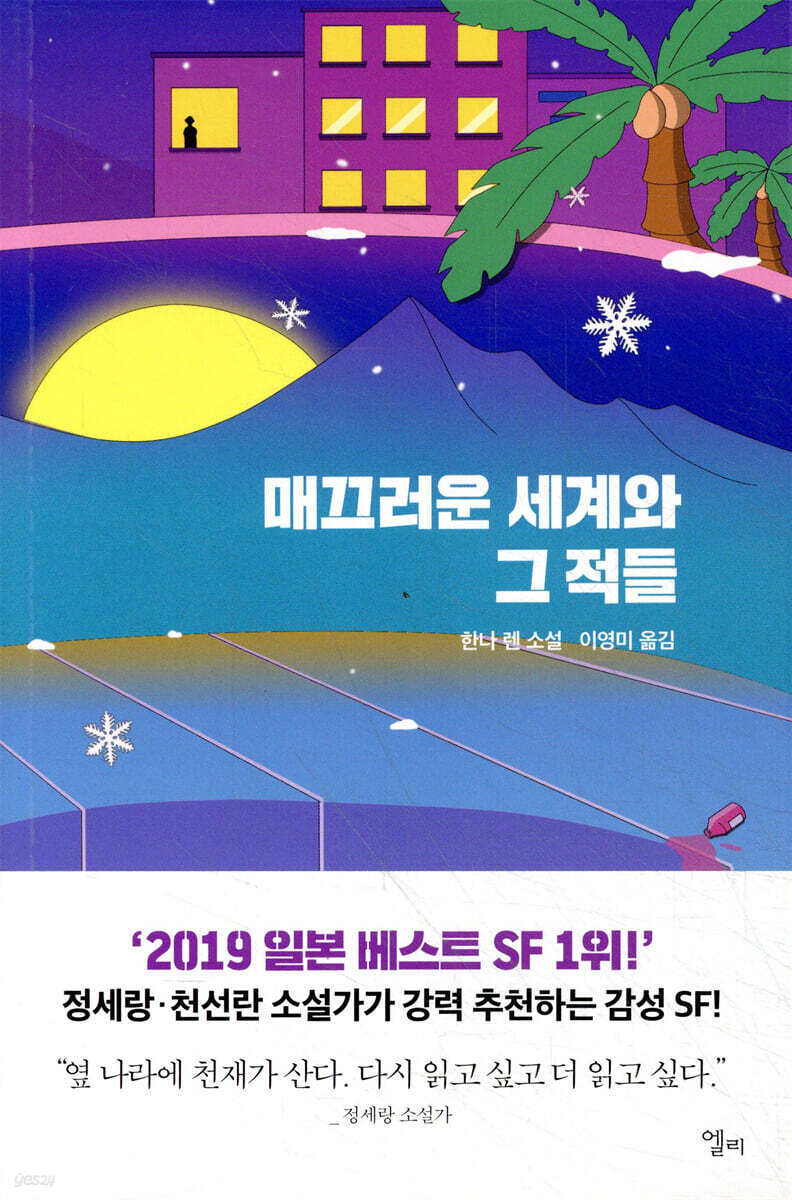 |
Description
Book Introduction
- A word from MD
-
The emergence of a new science fiction that will captivate youA novel that stands out for its ability to elicit universal sympathy through its unique setting, engaging characters, and immersive story.
A fresh and exciting sci-fi story brimming with elements that will thrill readers: a brilliant imagination based on a solid background, the solidarity of ordinary people, and pure and bold courage and growth.
December 8, 2020. Novel/Poetry PD Park Hyung-wook
The most talked-about Japanese SF work, ranked #1 in the '2019 Best SF' (selected by 'I Want to Read SF!').
A sentimental sci-fi story filled with charming characters and lyrical tales of love and friendship.
The most talked-about Japanese SF work of 2019, with a reprint decision made before its official release and a record of five reprints in just two weeks.
The unique settings of science fiction, such as parallel worlds, personality transplants, singularity, alternate history, and the slowdown of the Shinkansen, are tightly woven with attractive characters, presenting masterpieces with a consistently high level of completion.
A total of six stories are included, including a title piece reminiscent of Karl Popper's "The Open Society and Its Enemies," and novelists Jeong Se-rang and Cheon Seon-ran wrote recommendations.
A sentimental sci-fi story filled with charming characters and lyrical tales of love and friendship.
The most talked-about Japanese SF work of 2019, with a reprint decision made before its official release and a record of five reprints in just two weeks.
The unique settings of science fiction, such as parallel worlds, personality transplants, singularity, alternate history, and the slowdown of the Shinkansen, are tightly woven with attractive characters, presenting masterpieces with a consistently high level of completion.
A total of six stories are included, including a title piece reminiscent of Karl Popper's "The Open Society and Its Enemies," and novelists Jeong Se-rang and Cheon Seon-ran wrote recommendations.
- You can preview some of the book's contents.
Preview
index
Smooth World and Its Enemies 7
Zero Solidarity's Critical Point 63
Pistol 95 given to Miaha
Holy Iron Maiden 193
Singularity Soviet 233
Faster than light, slower than 301
Acknowledgments 430
Translator's Note 434
Zero Solidarity's Critical Point 63
Pistol 95 given to Miaha
Holy Iron Maiden 193
Singularity Soviet 233
Faster than light, slower than 301
Acknowledgments 430
Translator's Note 434
Detailed image
.jpg)
Into the book
“We live our lives moving through ourselves, living in all possibilities.”
--- p.24
“All humans in this smooth world live in an absolute utopia.
If you are not loved, you can go to a reality where you are loved.
If you want eternal life, you just have to move into the reality of achieving it.
To them, we, who must live with only one possibility, are low-dimensional creatures, incomprehensible beings, and objects of fear.
Above all, they are the enemies of this world.”
--- p.43
“I plan to run and live my life on my own from now on.
“Because I am the only one who doesn’t turn a blind eye to me.”
--- p.52
“Humanity has conquered love.
“I hope you will watch the world and humanity change from a special seat.”
--- p.113
“But I want to live as I am, the me who loves you.”
--- p.146
“The human mind is fragile, like a sandcastle that is swallowed up by waves of new ‘I’s’ one after another, so there is no absolute ‘I’.”
--- p.149
“Tomorrow’s me may be different from today’s me.
But I want to live tomorrow as well, using the fact that I still like you as proof and support for myself.”
--- p.151
“Please suffer as a living human being, with a brain that cannot be implanted.
“Please continue to suffer without finding answers, holding on to illusions and vain obsessions in your heart, such as justice, ethics, love, and the soul, which will disappear in an instant if you implant them.”
--- p.165~166
You know how this story ends.
Because you are the ending of this story.
--- p.192
It's okay, don't worry about anything, Vika.
The god of machines will protect you.
--- p.277
My sister kept fighting.
To create an artificial intelligence that can kill itself.
For the day of defeat that will finally arrive.
--- p.279
However, just as after a long dream, only one scene remains in my memory right before I wake up, only one truth remains.
--- p.297
“Man must fight and try to master the conditions in which he finds himself.
Even if it leads to a worse path of destruction, that too is the fate of humanity.”
--- p.303
There is no such thing in his eyes.
What he sees in his eyes is the light of days that have already disappeared.
--- p.342
“Someone must be waiting outside for that moment to greet us.
We have not forgotten you. We have protected everything like this. If we do not convey this message, the sorrow of those inside will grow beyond measure, and a great disaster will occur.
But if you don't forget and wait, it might bring a miracle instead of a disaster."
--- p.358
“I will save Amano.
You'll just play with dolls forever in the 2700 years of your own future.
“I reject that kind of future.”
--- p.392
Just from vague anxiety, just from the fear of being caught up in an unstoppable disaster, the world slowly changed.
--- p.398
As time passed, you, none of you, forgot the wandering travelers.
--- p.24
“All humans in this smooth world live in an absolute utopia.
If you are not loved, you can go to a reality where you are loved.
If you want eternal life, you just have to move into the reality of achieving it.
To them, we, who must live with only one possibility, are low-dimensional creatures, incomprehensible beings, and objects of fear.
Above all, they are the enemies of this world.”
--- p.43
“I plan to run and live my life on my own from now on.
“Because I am the only one who doesn’t turn a blind eye to me.”
--- p.52
“Humanity has conquered love.
“I hope you will watch the world and humanity change from a special seat.”
--- p.113
“But I want to live as I am, the me who loves you.”
--- p.146
“The human mind is fragile, like a sandcastle that is swallowed up by waves of new ‘I’s’ one after another, so there is no absolute ‘I’.”
--- p.149
“Tomorrow’s me may be different from today’s me.
But I want to live tomorrow as well, using the fact that I still like you as proof and support for myself.”
--- p.151
“Please suffer as a living human being, with a brain that cannot be implanted.
“Please continue to suffer without finding answers, holding on to illusions and vain obsessions in your heart, such as justice, ethics, love, and the soul, which will disappear in an instant if you implant them.”
--- p.165~166
You know how this story ends.
Because you are the ending of this story.
--- p.192
It's okay, don't worry about anything, Vika.
The god of machines will protect you.
--- p.277
My sister kept fighting.
To create an artificial intelligence that can kill itself.
For the day of defeat that will finally arrive.
--- p.279
However, just as after a long dream, only one scene remains in my memory right before I wake up, only one truth remains.
--- p.297
“Man must fight and try to master the conditions in which he finds himself.
Even if it leads to a worse path of destruction, that too is the fate of humanity.”
--- p.303
There is no such thing in his eyes.
What he sees in his eyes is the light of days that have already disappeared.
--- p.342
“Someone must be waiting outside for that moment to greet us.
We have not forgotten you. We have protected everything like this. If we do not convey this message, the sorrow of those inside will grow beyond measure, and a great disaster will occur.
But if you don't forget and wait, it might bring a miracle instead of a disaster."
--- p.358
“I will save Amano.
You'll just play with dolls forever in the 2700 years of your own future.
“I reject that kind of future.”
--- p.392
Just from vague anxiety, just from the fear of being caught up in an unstoppable disaster, the world slowly changed.
--- p.398
As time passed, you, none of you, forgot the wandering travelers.
--- p.428
Publisher's Review
Ranked #1 in '2019 Best SF' (selected by 'I Want to Read SF!')
The most talked about Japanese SF work.
Reprinting decided before the official release! Fifth printing in just two weeks!
The most popular science fiction writer in Japan right now!
“I can’t believe that it was written by one writer.
“These six works, woven together with exceptional writing and imagination, are amazing masterpieces based on miraculous talent and thorough preparation born from an endless yearning for science fiction.” ―Lee Young-mi (translator)
“Hannah Wren is a writer that everyone knows.
Since his debut, his work has been limited to short and medium-length stories, primarily published through doujinshi. However, his work has consistently been included in the "Annual Selection of Japanese SF Masterpieces," demonstrating his high regard for his writing. Overflowing with homage to science fiction, his writings nevertheless transcend genre boundaries, achieving a universal appeal that resonates with many.
I hope the latest work, "Faster Than Light, Slower Than Light," will be made into a theatrical animation." ―[Asahi Shimbun]
A special solidarity between ordinary girls!
Another me, another us
Science fiction that depicts a world of all possibilities
The title piece, "The Smooth World and Its Enemies," begins with the strange sentence, "I woke up to the sweltering heat, opened the curtains, and looked out the window at the snowy landscape." It is a work that depicts the friendship and solidarity of ordinary but special girls, set in a world where one can choose and move between the realities they like in the "infinite reality."
In a world where heavy snow falls on hot summer mornings, in a world where you can cover yourself with a blanket and play a game when a sermon seems about to begin, in a world where you can seamlessly move between infinite parallel worlds, conflicts in human relationships would be reduced to near zero, and there would be no need to hurt anyone or be hurt by anyone.
It is truly a peaceful and 'smooth world'.
High school girl Hazuki decides to become the enemy of the world she was living in, for the sake of her friend Makoto, who becomes the 'enemy' of this world due to an unexpected accident.
The 'smooth world' is a gentle world where no one can be hurt, but at the same time, it is a cruel world that can drive those who do not belong to that world into absolute loneliness. Therefore, Hazuki's hand extended to Makoto signifies voluntary solidarity with that lonely world.
One girl reaches out to another girl, even as she instinctively knows that she will have to live with the fear that the person she is talking to will be replaced by someone from another world, that they will abandon her and go to a world where another version of herself exists.
With the warmth of their clasped hands, may they live steadfastly in this world where they are stuck with no other options.
A science fiction coming-of-age novel themed around time!
Only those who have the courage to confront ‘this world’ and the imagination to dream of ‘another world’
You have a real opportunity to change the world!
'Time' is one of the most important subjects of science fiction.
Hannah Ren's latest work, "Faster Than Light, Slower Than Light," depicts a time-delayed Shinkansen train, or in other words, a slowed-down train, and explores two questions surrounding it.
The first question is 'why' Hayaki did not board the slow-speed Shinkansen.
The second question is 'how' to rescue the people trapped on the slowed-down Shinkansen.
In the process of resolving the first question, elements of a coming-of-age novel stand out, and in the process of resolving the second question, elements of science fiction stand out.
The story depicts the state of mind of the protagonist Hayaki, who did not go on a school trip and was unable to board the Shinkansen, and the state of society after the disaster. It repeatedly mentions competition in reporting, public interest and climate change, and social changes, which will likely remind many readers of the actual disaster that occurred in our country.
The subject who solves problems and reforms the world is neither a simple realist like Nagihara nor a simple romantic like his uncle.
Only Hayaki, the person who succeeds in fusing two conflicting attitudes—the courage to confront “this world” and the imagination to dream of “another world”—has a true opportunity to change the world.
Therefore, this work can also be interpreted as Hayaki's existential adventure of returning to 'this world' after an imaginary escape from longing for 'another world'.
Understanding that his uncle was not simply a materialist but was trying his best to solve the problem within his worldview, and encountering Nagihara's genuine, realistic attitude, Hayaki, who was at the root of the incident, clearly recognizes what he must do and transforms into a "man of action."
The characters in Hannah Ren's works sometimes seem to be tempted to jump into the possibility of another self, another world, but ultimately, they resolutely decide to accept who they are and this world.
This conclusion does not deny the significance of science fiction imagination, which presents infinite possibilities to humanity.
Rather, by confronting the possibility of another self and another world through science fiction imagination, they realize the preciousness of themselves and this world, and gain the strength to love it.
A SF that depicts the [SF literary history of three women]!
Fuji has the qualifications to become a time traveler, which he so desperately desired.
Will we ever meet Domi and Otora again?
The second short story, "The Critical Point of the Zero Era," is a critical novel that organizes the origins of "Japanese SF literature."
As the fictional history of Japanese science fiction is written, the ancestors are set as women.
In 1879, Jules Verne's Around the World in Eighty Days was translated and published in Japan by H.
It was in 1913 that H.G. Wells's The Time Machine and The Invisible Man were introduced.
Meanwhile, inspired by overseas science fiction, Shunro Oshikawa began publishing adventure novels such as “Battleship Underwater” (1900).
In other words, it can be said that the SF literary world was formed in Japan in the 1900s, with novels classified as SF being created and even specialized magazines being produced.
So, it would be safe to say that this 20th century 'Zero Generation' is the first generation of Japanese science fiction.
However, there are too many difficulties in re-examining the history of science fiction literature and clarifying the influence of authors and their works.
How interesting it would be if such non-fiction existed.
The work that satisfies that intellectual curiosity by borrowing the power of imagination is “The Critical Point of Zero Years.”
However, the central figures of this work are not Oshikawa Shunro, but his classmates at a girls' school named Tomie, Fuji, and Otora.
In 1902, Nakazaike Tomie submitted the story "The Suibashi Double Suicide Incident" to the magazine "Yogaku Doubou," marking the beginning of Japanese science fiction. The setting is that Tomie, Fuji, and Otora exchanged stimulation through novel creation and criticism, leading to the sprouting of the Japanese science fiction literary world.
However, with the exception of Western novels that are said to have been influenced (e.g., Irving's "Rip Van Winkle," Mark Twain's "A Connecticut Yankee in King Arthur's Court," Nathaniel Hawthorne's "The House of the Seven Gables," and Dumas's "The Count of Monte Cristo"), not only the characters, but also the titles, plots, and even the footnotes are all fictional.
This world, armed with extremely realistic writing, is a complete fiction.
This perfect 'virtual literary history' does not stop at being a fictional 'literary history'.
Leaving behind the book "The Secret of the Fujiwara Family" which tells the story of time travelers, Tomie and Otora disappear from the Suibashi Bridge.
The true ending of this story, which ends with no body found, is not in the main text, but in the final note.
Fuji, who was left alone and wrote over 70 science fiction pieces in his lifetime, says, “I had to bring the world forward to meet the two friends/SF writers who disappeared again,” and there is a clue to interpreting the entire work.
By depicting the history of fictional science fiction literature in a concise and analytical style and hinting at certain events that actually occurred within that literary history, the entire work becomes science fiction.
Will Fuji be able to attain the qualifications of a time traveler he so desperately longed for, and meet Domi and Otora again?
The most talked about Japanese SF work.
Reprinting decided before the official release! Fifth printing in just two weeks!
The most popular science fiction writer in Japan right now!
“I can’t believe that it was written by one writer.
“These six works, woven together with exceptional writing and imagination, are amazing masterpieces based on miraculous talent and thorough preparation born from an endless yearning for science fiction.” ―Lee Young-mi (translator)
“Hannah Wren is a writer that everyone knows.
Since his debut, his work has been limited to short and medium-length stories, primarily published through doujinshi. However, his work has consistently been included in the "Annual Selection of Japanese SF Masterpieces," demonstrating his high regard for his writing. Overflowing with homage to science fiction, his writings nevertheless transcend genre boundaries, achieving a universal appeal that resonates with many.
I hope the latest work, "Faster Than Light, Slower Than Light," will be made into a theatrical animation." ―[Asahi Shimbun]
A special solidarity between ordinary girls!
Another me, another us
Science fiction that depicts a world of all possibilities
The title piece, "The Smooth World and Its Enemies," begins with the strange sentence, "I woke up to the sweltering heat, opened the curtains, and looked out the window at the snowy landscape." It is a work that depicts the friendship and solidarity of ordinary but special girls, set in a world where one can choose and move between the realities they like in the "infinite reality."
In a world where heavy snow falls on hot summer mornings, in a world where you can cover yourself with a blanket and play a game when a sermon seems about to begin, in a world where you can seamlessly move between infinite parallel worlds, conflicts in human relationships would be reduced to near zero, and there would be no need to hurt anyone or be hurt by anyone.
It is truly a peaceful and 'smooth world'.
High school girl Hazuki decides to become the enemy of the world she was living in, for the sake of her friend Makoto, who becomes the 'enemy' of this world due to an unexpected accident.
The 'smooth world' is a gentle world where no one can be hurt, but at the same time, it is a cruel world that can drive those who do not belong to that world into absolute loneliness. Therefore, Hazuki's hand extended to Makoto signifies voluntary solidarity with that lonely world.
One girl reaches out to another girl, even as she instinctively knows that she will have to live with the fear that the person she is talking to will be replaced by someone from another world, that they will abandon her and go to a world where another version of herself exists.
With the warmth of their clasped hands, may they live steadfastly in this world where they are stuck with no other options.
A science fiction coming-of-age novel themed around time!
Only those who have the courage to confront ‘this world’ and the imagination to dream of ‘another world’
You have a real opportunity to change the world!
'Time' is one of the most important subjects of science fiction.
Hannah Ren's latest work, "Faster Than Light, Slower Than Light," depicts a time-delayed Shinkansen train, or in other words, a slowed-down train, and explores two questions surrounding it.
The first question is 'why' Hayaki did not board the slow-speed Shinkansen.
The second question is 'how' to rescue the people trapped on the slowed-down Shinkansen.
In the process of resolving the first question, elements of a coming-of-age novel stand out, and in the process of resolving the second question, elements of science fiction stand out.
The story depicts the state of mind of the protagonist Hayaki, who did not go on a school trip and was unable to board the Shinkansen, and the state of society after the disaster. It repeatedly mentions competition in reporting, public interest and climate change, and social changes, which will likely remind many readers of the actual disaster that occurred in our country.
The subject who solves problems and reforms the world is neither a simple realist like Nagihara nor a simple romantic like his uncle.
Only Hayaki, the person who succeeds in fusing two conflicting attitudes—the courage to confront “this world” and the imagination to dream of “another world”—has a true opportunity to change the world.
Therefore, this work can also be interpreted as Hayaki's existential adventure of returning to 'this world' after an imaginary escape from longing for 'another world'.
Understanding that his uncle was not simply a materialist but was trying his best to solve the problem within his worldview, and encountering Nagihara's genuine, realistic attitude, Hayaki, who was at the root of the incident, clearly recognizes what he must do and transforms into a "man of action."
The characters in Hannah Ren's works sometimes seem to be tempted to jump into the possibility of another self, another world, but ultimately, they resolutely decide to accept who they are and this world.
This conclusion does not deny the significance of science fiction imagination, which presents infinite possibilities to humanity.
Rather, by confronting the possibility of another self and another world through science fiction imagination, they realize the preciousness of themselves and this world, and gain the strength to love it.
A SF that depicts the [SF literary history of three women]!
Fuji has the qualifications to become a time traveler, which he so desperately desired.
Will we ever meet Domi and Otora again?
The second short story, "The Critical Point of the Zero Era," is a critical novel that organizes the origins of "Japanese SF literature."
As the fictional history of Japanese science fiction is written, the ancestors are set as women.
In 1879, Jules Verne's Around the World in Eighty Days was translated and published in Japan by H.
It was in 1913 that H.G. Wells's The Time Machine and The Invisible Man were introduced.
Meanwhile, inspired by overseas science fiction, Shunro Oshikawa began publishing adventure novels such as “Battleship Underwater” (1900).
In other words, it can be said that the SF literary world was formed in Japan in the 1900s, with novels classified as SF being created and even specialized magazines being produced.
So, it would be safe to say that this 20th century 'Zero Generation' is the first generation of Japanese science fiction.
However, there are too many difficulties in re-examining the history of science fiction literature and clarifying the influence of authors and their works.
How interesting it would be if such non-fiction existed.
The work that satisfies that intellectual curiosity by borrowing the power of imagination is “The Critical Point of Zero Years.”
However, the central figures of this work are not Oshikawa Shunro, but his classmates at a girls' school named Tomie, Fuji, and Otora.
In 1902, Nakazaike Tomie submitted the story "The Suibashi Double Suicide Incident" to the magazine "Yogaku Doubou," marking the beginning of Japanese science fiction. The setting is that Tomie, Fuji, and Otora exchanged stimulation through novel creation and criticism, leading to the sprouting of the Japanese science fiction literary world.
However, with the exception of Western novels that are said to have been influenced (e.g., Irving's "Rip Van Winkle," Mark Twain's "A Connecticut Yankee in King Arthur's Court," Nathaniel Hawthorne's "The House of the Seven Gables," and Dumas's "The Count of Monte Cristo"), not only the characters, but also the titles, plots, and even the footnotes are all fictional.
This world, armed with extremely realistic writing, is a complete fiction.
This perfect 'virtual literary history' does not stop at being a fictional 'literary history'.
Leaving behind the book "The Secret of the Fujiwara Family" which tells the story of time travelers, Tomie and Otora disappear from the Suibashi Bridge.
The true ending of this story, which ends with no body found, is not in the main text, but in the final note.
Fuji, who was left alone and wrote over 70 science fiction pieces in his lifetime, says, “I had to bring the world forward to meet the two friends/SF writers who disappeared again,” and there is a clue to interpreting the entire work.
By depicting the history of fictional science fiction literature in a concise and analytical style and hinting at certain events that actually occurred within that literary history, the entire work becomes science fiction.
Will Fuji be able to attain the qualifications of a time traveler he so desperately longed for, and meet Domi and Otora again?
GOODS SPECIFICS
- Publication date: November 27, 2020
- Page count, weight, size: 440 pages | 500g | 133*200*30mm
- ISBN13: 9791191247008
- ISBN10: 1191247007
You may also like
카테고리
korean


korean

![GQ KOREA Mark (Monthly): December [2025]](http://librairie.coreenne.fr/cdn/shop/files/8ef265dbbfbf186523ed75ba7319009d.jpg?v=1765340328&width=3840)


