

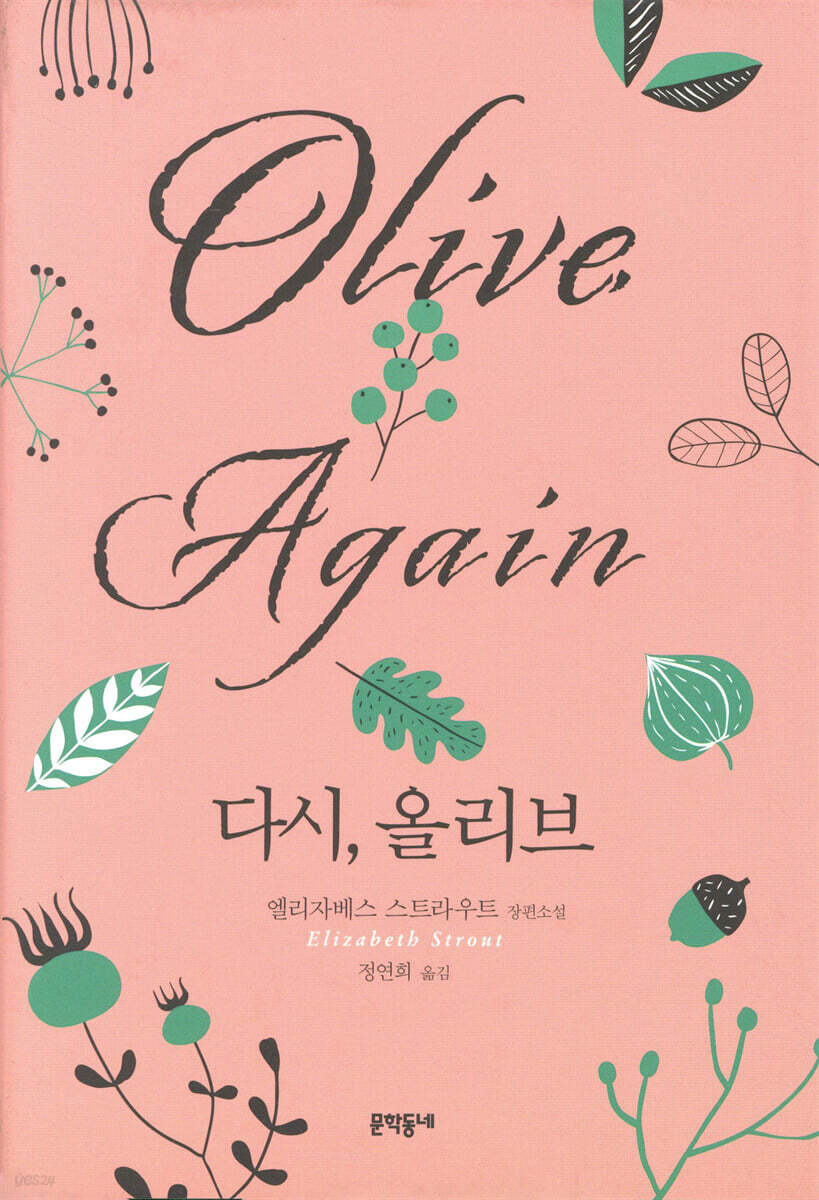
Again, olive
 |
Description
Book Introduction
- A word from MD
-
Olive Kitteridge is backA sequel to the Pulitzer Prize-winning novel Olive Kitteridge.
The protagonist, who returns with his quirky and charming 'olive-like' appearance, and the lives of those around him unfold beautifully.
The book shows that even in old age, life remains unfamiliar and difficult, but the world we live in together shines brightly again.
November 20, 2020. Novel/Poetry PD Park Hyung-wook
Time, Vogue, The Washington Post, Chicago Tribune, The Guardian, Kirkus Reviews, Publisher's Weekly, Vanity Fair, Entertainment Weekly, Esquire, Evening Standard, NPR, New York Public Library Book of the Year (2019)
Olive Kitteridge is back.
The eccentric yet charming woman who left a lasting impression on readers around the world through her 2008 novel, Olive Kitteridge, which won the Pulitzer Prize the following year, has returned to us after 11 years.
A little older, a little more shaken by loneliness, but still looking terribly 'olive-like'.
The sequel to Olive Kitteridge, Olive Again, like its predecessor, is a moving work that depicts the diverse landscapes of life in Crosby, a small town in Maine, USA, with keen insight and poignant beauty.
And of course, at the center of it all is Olive Kitteridge, the protagonist who tells her life story with surprising honesty.
Consisting of 13 chapters, the novel covers the last decade of Olive's life, from her mid-seventies to her mid-eighties.
Olive's role varies from chapter to chapter, and she sometimes appears only briefly, but she exerts a powerful presence throughout the work, tightly tying the series of stories together.
Olive's return was something even the author, Elizabeth Strout, herself, had not anticipated.
One day, while the writer was sitting in a cafe, a vivid image of an older Olive driving a car into the dock suddenly appeared before his eyes.
At that moment, Strout realized.
“Oh my, Olive is back.” Once Olive had decided to return, there was only one thing the writer could do.
It is right to listen to her voice and faithfully record her story.
That's how Olive's second story began, blunt, blunt, and direct, but ultimately one we can't help but empathize with and love.
“Every morning when I opened the door, I felt the beauty of the world.
Olive was surprised by that fact.
When my first husband died, nothing caught my eye.
Now I'm thinking like this.
And yet, the world exists here.
A world that screams beautiful things at her every day.
And I was grateful for that.” _Main text, pp. 335-336
The old age that Strout portrays in 'Olive Again' is by no means leisurely, leisurely, or full of wisdom and insight.
An aged body is as strange and confusing as a young man just entering puberty.
The loneliness and fear that often strikes the empty space left by the departure of loved ones seeps unfiltered into the old and worn-out heart.
But the death that hangs behind us makes the landscape of life unfold before our eyes clearer and more brilliant.
The quiet sunlight and newly emerging flower buds that promise the next season come to us with a different meaning than before.
Above all, the more we realize our own loneliness and ignorance, the better we understand others and their loneliness and pain.
At the heart of that understanding lies the somewhat bittersweet consolation that in this painful life we share essentially the same confusion and pain.
But the novel tells us that the deep-rooted bond forged through life's inevitable tragedies does not lead us to self-pity or resignation, but rather, it helps us grow and move forward together until the very end.
Olive Kitteridge is back.
The eccentric yet charming woman who left a lasting impression on readers around the world through her 2008 novel, Olive Kitteridge, which won the Pulitzer Prize the following year, has returned to us after 11 years.
A little older, a little more shaken by loneliness, but still looking terribly 'olive-like'.
The sequel to Olive Kitteridge, Olive Again, like its predecessor, is a moving work that depicts the diverse landscapes of life in Crosby, a small town in Maine, USA, with keen insight and poignant beauty.
And of course, at the center of it all is Olive Kitteridge, the protagonist who tells her life story with surprising honesty.
Consisting of 13 chapters, the novel covers the last decade of Olive's life, from her mid-seventies to her mid-eighties.
Olive's role varies from chapter to chapter, and she sometimes appears only briefly, but she exerts a powerful presence throughout the work, tightly tying the series of stories together.
Olive's return was something even the author, Elizabeth Strout, herself, had not anticipated.
One day, while the writer was sitting in a cafe, a vivid image of an older Olive driving a car into the dock suddenly appeared before his eyes.
At that moment, Strout realized.
“Oh my, Olive is back.” Once Olive had decided to return, there was only one thing the writer could do.
It is right to listen to her voice and faithfully record her story.
That's how Olive's second story began, blunt, blunt, and direct, but ultimately one we can't help but empathize with and love.
“Every morning when I opened the door, I felt the beauty of the world.
Olive was surprised by that fact.
When my first husband died, nothing caught my eye.
Now I'm thinking like this.
And yet, the world exists here.
A world that screams beautiful things at her every day.
And I was grateful for that.” _Main text, pp. 335-336
The old age that Strout portrays in 'Olive Again' is by no means leisurely, leisurely, or full of wisdom and insight.
An aged body is as strange and confusing as a young man just entering puberty.
The loneliness and fear that often strikes the empty space left by the departure of loved ones seeps unfiltered into the old and worn-out heart.
But the death that hangs behind us makes the landscape of life unfold before our eyes clearer and more brilliant.
The quiet sunlight and newly emerging flower buds that promise the next season come to us with a different meaning than before.
Above all, the more we realize our own loneliness and ignorance, the better we understand others and their loneliness and pain.
At the heart of that understanding lies the somewhat bittersweet consolation that in this painful life we share essentially the same confusion and pain.
But the novel tells us that the deep-rooted bond forged through life's inevitable tragedies does not lead us to self-pity or resignation, but rather, it helps us grow and move forward together until the very end.
- You can preview some of the book's contents.
Preview
index
Crackdown _009
Childbirth _039
Cleaning _071
Motherless Child _111
Help _151
Sunlight _191
Walk _225
Foot Care _237
Exiles _272
Poet _312
The Last Day of the Civil War _346
Heart _380
Friend _422
Acknowledgments _ 461
Translator's Note: Being with You in the Sunshine_ 463
Childbirth _039
Cleaning _071
Motherless Child _111
Help _151
Sunlight _191
Walk _225
Foot Care _237
Exiles _272
Poet _312
The Last Day of the Civil War _346
Heart _380
Friend _422
Acknowledgments _ 461
Translator's Note: Being with You in the Sunshine_ 463
Into the book
It seemed like everyone was talking to someone.
The sight was impressive.
How easily people take it for granted that they are together, that they talk to each other! No one seemed to even glance at him.
It's something I've known for a long time, but it feels different now.
He is just a pot-bellied old man, not worth looking at at all.
That fact almost set him free.
--- p.10
He realized that he was a seventy-four-year-old man who looked back on his past life, marveled at how it had unfolded, and felt overwhelming regret for all the mistakes he had made.
And then I thought.
How can a human being live an honest life?
--- p.16
It's always been like that.
That's all.
People seemed either unaware of how they felt about something or unwilling to talk about how they really felt.
--- p.17
Sometimes Kaylee actually felt pain crashing into her chest like small waves.
And I thought this.
When people say it's a wound in the heart, they really mean it.
--- p.87
“People live with a lot of things,” Bernie said.
“That’s true.
“I’m always amazed when I see what people embrace and live by.”
--- p.188
At the end of each day, the world opened up a little more, and more sunlight filtered through the barren trees.
And I promised.
That sunlight promised.
What a wonderful thing that would be.
Lying in bed, Cindy could still see.
The last golden light of the day opens the world.
--- p.200
“Who in the world doesn’t have at least one or two bad memories they have to carry with them for the rest of their lives?”
--- p.206
“You know, Cindy.
If you're really facing death, and you're going to die, the truth is... ...we're all just a few steps behind.
Twenty minutes later, that's the truth."
--- p.207
Jack was so scared that he sat down in his chair and downed his whiskey in one gulp.
The scary thing is how much of our lives we live without knowing who we are or what we do.
It sent a shiver through him, and he couldn't quite find the words—for himself—to express exactly what he felt.
He felt that he was unaware of the way he had been living.
That meant there was a huge blind spot right in front of my eyes.
It meant that he had no idea, really no idea, how other people viewed him.
And that also meant that he didn't know how to see himself.
--- p.266∼267
What was disconcerting was the feeling that their entire lives had been wasted.
But in fact, they laughed a lot and had many sweet moments, so it wasn't their whole life.
--- p.269
He was struck by the realization that the inherent loneliness of humanity should never be taken lightly, and that any choice made to protect oneself from the gaping darkness deserves respect.
--- p.310
“I don’t know if I can explain it well.
But as you live, you come to think that you are an important person.
That doesn't mean it's good or bad.
But somehow, you start to think that you are important.
“Then at some point you realize,” Olive shrugged in the direction of the woman who had brought the coffee earlier, “that you are nobody anymore.
Become invisible to the big butt employee.
But that gives you freedom.”
--- p.325
“Oh my God, Olive, you are such a difficult woman.
A very picky woman.
Damn, but I still love you.
So if it's okay, Olive, I'd like you to be a little less Olive when you're with me.
Even if that means being a little more olive when you're with other people.
“Because I love you, and we don’t have much time.”
--- p.336
“One day, the teacher stopped working on a math problem on the board and turned to us all and said to the whole class, ‘You all know who you are.
Just look at yourself and listen to yourself and you will know exactly who you are.
Don't forget that,' he said.
And I never forgot.
Those words have given me courage ever since.
Because the teacher was right.
“I knew who I was.”
--- p.368
Olive thought about it.
A person can love someone he barely knows.
How unchanging can that love be, how deep can that love be.
Even if that love—as in her own case—was temporary.
--- p.419~420
What did it mean that Betty harbored a love for Jerry Schuyler in her heart? Olive realized she had to take that fact seriously.
All love, including the brief love she had for her doctor, must be taken seriously.
Betty held this love close to her heart for a long time.
That love was so necessary.
--- p.421
“Well, that’s life.
“There is nothing we can do about life.”
The sight was impressive.
How easily people take it for granted that they are together, that they talk to each other! No one seemed to even glance at him.
It's something I've known for a long time, but it feels different now.
He is just a pot-bellied old man, not worth looking at at all.
That fact almost set him free.
--- p.10
He realized that he was a seventy-four-year-old man who looked back on his past life, marveled at how it had unfolded, and felt overwhelming regret for all the mistakes he had made.
And then I thought.
How can a human being live an honest life?
--- p.16
It's always been like that.
That's all.
People seemed either unaware of how they felt about something or unwilling to talk about how they really felt.
--- p.17
Sometimes Kaylee actually felt pain crashing into her chest like small waves.
And I thought this.
When people say it's a wound in the heart, they really mean it.
--- p.87
“People live with a lot of things,” Bernie said.
“That’s true.
“I’m always amazed when I see what people embrace and live by.”
--- p.188
At the end of each day, the world opened up a little more, and more sunlight filtered through the barren trees.
And I promised.
That sunlight promised.
What a wonderful thing that would be.
Lying in bed, Cindy could still see.
The last golden light of the day opens the world.
--- p.200
“Who in the world doesn’t have at least one or two bad memories they have to carry with them for the rest of their lives?”
--- p.206
“You know, Cindy.
If you're really facing death, and you're going to die, the truth is... ...we're all just a few steps behind.
Twenty minutes later, that's the truth."
--- p.207
Jack was so scared that he sat down in his chair and downed his whiskey in one gulp.
The scary thing is how much of our lives we live without knowing who we are or what we do.
It sent a shiver through him, and he couldn't quite find the words—for himself—to express exactly what he felt.
He felt that he was unaware of the way he had been living.
That meant there was a huge blind spot right in front of my eyes.
It meant that he had no idea, really no idea, how other people viewed him.
And that also meant that he didn't know how to see himself.
--- p.266∼267
What was disconcerting was the feeling that their entire lives had been wasted.
But in fact, they laughed a lot and had many sweet moments, so it wasn't their whole life.
--- p.269
He was struck by the realization that the inherent loneliness of humanity should never be taken lightly, and that any choice made to protect oneself from the gaping darkness deserves respect.
--- p.310
“I don’t know if I can explain it well.
But as you live, you come to think that you are an important person.
That doesn't mean it's good or bad.
But somehow, you start to think that you are important.
“Then at some point you realize,” Olive shrugged in the direction of the woman who had brought the coffee earlier, “that you are nobody anymore.
Become invisible to the big butt employee.
But that gives you freedom.”
--- p.325
“Oh my God, Olive, you are such a difficult woman.
A very picky woman.
Damn, but I still love you.
So if it's okay, Olive, I'd like you to be a little less Olive when you're with me.
Even if that means being a little more olive when you're with other people.
“Because I love you, and we don’t have much time.”
--- p.336
“One day, the teacher stopped working on a math problem on the board and turned to us all and said to the whole class, ‘You all know who you are.
Just look at yourself and listen to yourself and you will know exactly who you are.
Don't forget that,' he said.
And I never forgot.
Those words have given me courage ever since.
Because the teacher was right.
“I knew who I was.”
--- p.368
Olive thought about it.
A person can love someone he barely knows.
How unchanging can that love be, how deep can that love be.
Even if that love—as in her own case—was temporary.
--- p.419~420
What did it mean that Betty harbored a love for Jerry Schuyler in her heart? Olive realized she had to take that fact seriously.
All love, including the brief love she had for her doctor, must be taken seriously.
Betty held this love close to her heart for a long time.
That love was so necessary.
--- p.421
“Well, that’s life.
“There is nothing we can do about life.”
--- p.455
Publisher's Review
What a wonderful thing that is.
That love can still dwell in a broken body and a broken heart.
Even at dawn, when I alone hear the sound of death approaching,
The world is still dazzlingly beautiful.
Crosby, a coastal town in Maine, is still home to a diverse population with a variety of challenges.
“I’m always amazed at what people cling to,” says an older lawyer in the novel.
Among them is a girl confused by her longing for her deceased father and her burgeoning sexual desires; a man grieving over his brothers, who have long ago chosen separate lives and now have an unbridgeable gulf between them; a father torn by a daughter who has chosen a lifestyle he can never accept; and a woman struggling with a fatal illness, caught between life and death.
Their lives are painful at different points and for different reasons.
Olive Kitteridge, a retired math teacher whose stubbornness and overly honest attitude have earned her both hatred and love from her neighbors throughout her life, is no exception.
After the death of her first husband, Henry, Olive, now well into her old age, still lives in the same place, looking out at the same scenery.
The seasons always circle back to their original places, but Olive increasingly realizes that her time is slowly drawing to a close.
But who said that old age was peaceful?
Olive's life is constantly being torn apart by waves, big and small, shaking her mercilessly.
Olive meets someone new, gets married a second time, goes to a baby shower and accidentally delivers a baby in the backseat of a car, barely manages to reconcile with her estranged son after surviving a near-death experience, and makes new friends in a senior citizen's home at the age of eighty.
And in the process, she realizes that despite living as 'Olive', as herself, for decades, she is still surprisingly ignorant of herself.
“Loneliness.
Oh, loneliness! That tormented Olive.
She thought as she walked around the house, "I didn't even know I had such feelings in my life."
(…) It was as if she had been living with four big wheels underneath her all her life, and had not even realized it, and now all four were about to shake free.
“She didn’t know who she was or what was going to happen to her.” _Page 414
Old age, as seen through Olive's life, is a series of surprises and, often, painful realizations.
And it is the countless other people who always surround her life who give her that realization.
Olive becomes aware of the void left by her first husband and her own deep loneliness when she marries Jack Kennison, a man with different outlooks on life and political beliefs.
As she watched her daughter-in-law, who looked so much like her, scolding her son, she realized that she had completely failed as a mother.
A chance encounter with a former student who has become a poet laureate exposes the fundamental deficiencies and vanity that have haunted her throughout her life.
But what's remarkable about Olive is that, despite her physical decline and mental trauma, she continues to grow from that realization.
Even at an age where she can't even control her own body properly, Olive still loves, hates, misunderstands, understands, and moves forward.
Now she feels “a little, a little bit better as a human being.”
Perhaps it means that there is finally room in her heart for others to enter.
Like many of Strout's other works, "Olive Again" focuses on the chance and fateful encounters with others who appear in our lives at exquisite moments and shake everything up, who hold us steady with a word or a gesture when we feel like we're about to crumble.
Moreover, readers who have enjoyed Strout's previous works will also experience pleasant and surprising encounters with characters living in other worlds created by the author.
In addition to the characters from "Olive Kitteridge," you can also meet the three siblings who were the main characters of "The Burgess Brothers" (2013), and characters from Strout's first full-length novel, "Amy and Isabel," published a full 21 years ago.
In particular, watching how Olive and Isabelle meet and what kind of relationship they form is one of the great and moving gifts this book presents.
Illuminated by the flickering flame of life,
The last moments of a desperate and brilliant life
Olive, who started living in a senior citizen's welfare apartment at the age of over eighty, begins to record her life and write about it.
And after reflecting on her life and recalling countless memories, she came to this conclusion:
“I have no clue as to who I was.
Truly, I know nothing.” The aging this book speaks of does not mean maturity or maturity.
It is more like an act of staggering toward the unknown world of death, and letting go of the countless things one has held onto throughout one's life.
The consolation that 『Olive Again』 offers to all of us standing on that path is not that 'life is ultimately happy,' but that while life is inherently painful, if we look closely within it, we will find that there are certainly moments that shine brightly.
Like Olive, who, on that evening when the shocking truth that death was truly imminent slowly seeped in, looked out the darkening window and muttered that her life was “not unhappy.”
It is a deeply moving and heartwarming experience to see Olive finally reconcile with the turmoil of life and let go of the burden she has carried her entire life, but as a reader, it is incredibly heartbreaking and disheartening to have to let her go.
But perhaps Olive, oblivious to our regrets and sorrows, will take her last steps, as always, with a careless wave of her hand over her head.
That love can still dwell in a broken body and a broken heart.
Even at dawn, when I alone hear the sound of death approaching,
The world is still dazzlingly beautiful.
Crosby, a coastal town in Maine, is still home to a diverse population with a variety of challenges.
“I’m always amazed at what people cling to,” says an older lawyer in the novel.
Among them is a girl confused by her longing for her deceased father and her burgeoning sexual desires; a man grieving over his brothers, who have long ago chosen separate lives and now have an unbridgeable gulf between them; a father torn by a daughter who has chosen a lifestyle he can never accept; and a woman struggling with a fatal illness, caught between life and death.
Their lives are painful at different points and for different reasons.
Olive Kitteridge, a retired math teacher whose stubbornness and overly honest attitude have earned her both hatred and love from her neighbors throughout her life, is no exception.
After the death of her first husband, Henry, Olive, now well into her old age, still lives in the same place, looking out at the same scenery.
The seasons always circle back to their original places, but Olive increasingly realizes that her time is slowly drawing to a close.
But who said that old age was peaceful?
Olive's life is constantly being torn apart by waves, big and small, shaking her mercilessly.
Olive meets someone new, gets married a second time, goes to a baby shower and accidentally delivers a baby in the backseat of a car, barely manages to reconcile with her estranged son after surviving a near-death experience, and makes new friends in a senior citizen's home at the age of eighty.
And in the process, she realizes that despite living as 'Olive', as herself, for decades, she is still surprisingly ignorant of herself.
“Loneliness.
Oh, loneliness! That tormented Olive.
She thought as she walked around the house, "I didn't even know I had such feelings in my life."
(…) It was as if she had been living with four big wheels underneath her all her life, and had not even realized it, and now all four were about to shake free.
“She didn’t know who she was or what was going to happen to her.” _Page 414
Old age, as seen through Olive's life, is a series of surprises and, often, painful realizations.
And it is the countless other people who always surround her life who give her that realization.
Olive becomes aware of the void left by her first husband and her own deep loneliness when she marries Jack Kennison, a man with different outlooks on life and political beliefs.
As she watched her daughter-in-law, who looked so much like her, scolding her son, she realized that she had completely failed as a mother.
A chance encounter with a former student who has become a poet laureate exposes the fundamental deficiencies and vanity that have haunted her throughout her life.
But what's remarkable about Olive is that, despite her physical decline and mental trauma, she continues to grow from that realization.
Even at an age where she can't even control her own body properly, Olive still loves, hates, misunderstands, understands, and moves forward.
Now she feels “a little, a little bit better as a human being.”
Perhaps it means that there is finally room in her heart for others to enter.
Like many of Strout's other works, "Olive Again" focuses on the chance and fateful encounters with others who appear in our lives at exquisite moments and shake everything up, who hold us steady with a word or a gesture when we feel like we're about to crumble.
Moreover, readers who have enjoyed Strout's previous works will also experience pleasant and surprising encounters with characters living in other worlds created by the author.
In addition to the characters from "Olive Kitteridge," you can also meet the three siblings who were the main characters of "The Burgess Brothers" (2013), and characters from Strout's first full-length novel, "Amy and Isabel," published a full 21 years ago.
In particular, watching how Olive and Isabelle meet and what kind of relationship they form is one of the great and moving gifts this book presents.
Illuminated by the flickering flame of life,
The last moments of a desperate and brilliant life
Olive, who started living in a senior citizen's welfare apartment at the age of over eighty, begins to record her life and write about it.
And after reflecting on her life and recalling countless memories, she came to this conclusion:
“I have no clue as to who I was.
Truly, I know nothing.” The aging this book speaks of does not mean maturity or maturity.
It is more like an act of staggering toward the unknown world of death, and letting go of the countless things one has held onto throughout one's life.
The consolation that 『Olive Again』 offers to all of us standing on that path is not that 'life is ultimately happy,' but that while life is inherently painful, if we look closely within it, we will find that there are certainly moments that shine brightly.
Like Olive, who, on that evening when the shocking truth that death was truly imminent slowly seeped in, looked out the darkening window and muttered that her life was “not unhappy.”
It is a deeply moving and heartwarming experience to see Olive finally reconcile with the turmoil of life and let go of the burden she has carried her entire life, but as a reader, it is incredibly heartbreaking and disheartening to have to let her go.
But perhaps Olive, oblivious to our regrets and sorrows, will take her last steps, as always, with a careless wave of her hand over her head.
GOODS SPECIFICS
- Publication date: November 16, 2020
- Format: Hardcover book binding method guide
- Page count, weight, size: 476 pages | 568g | 128*188*30mm
- ISBN13: 9788954675444
- ISBN10: 8954675441
You may also like
카테고리
korean


korean

![GQ KOREA Mark (Monthly): December [2025]](http://librairie.coreenne.fr/cdn/shop/files/8ef265dbbfbf186523ed75ba7319009d.jpg?v=1765340328&width=3840)


