

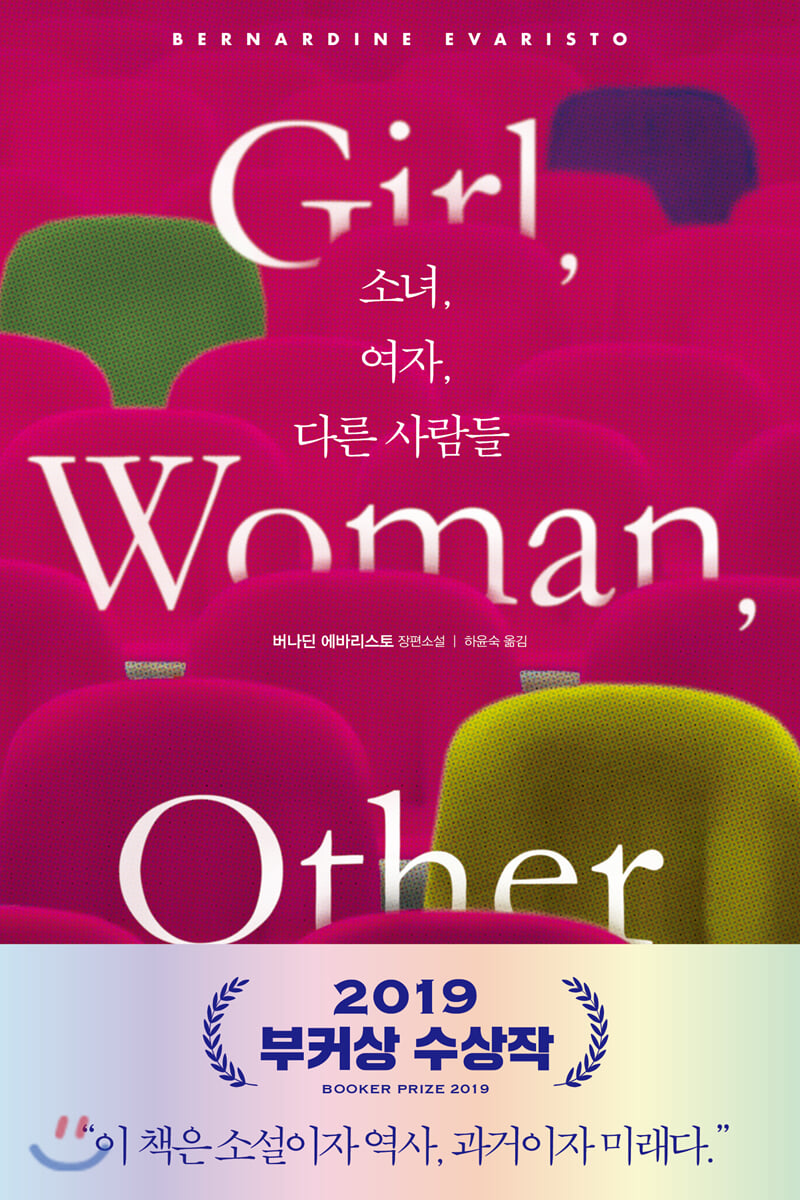
girls, women, other people
 |
Description
Book Introduction
- A word from MD
-
Reading the Times Through Twelve LivesWinner of the 2019 Booker Prize.
The book tells the story of Black British women who have been connected as family, friends and colleagues for over 150 years.
Life outside the 'mainstream' is filled with oppression, violence, and tragedy, but the hope they never give up creates a new future.
A book that provides an intense experience of reading the times through twelve lives.November 10, 2020. Novel/Poetry PD Park Hyung-wook
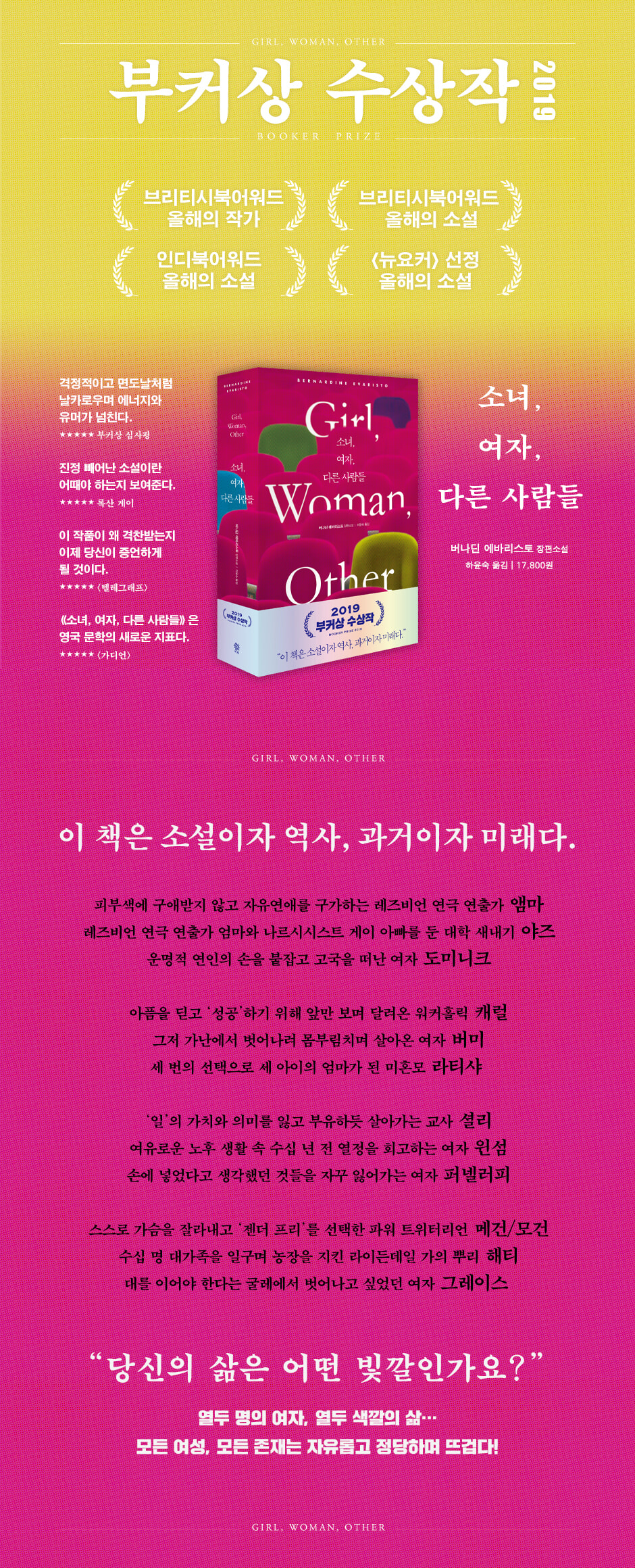
“This book is a novel and a history, a past and a future.”
Winner of the 2019 Booker Prize!
The 2019 Booker Prize winner caused a sensation in the literary world by sweeping major literary awards in the UK, including the British Book Award.
The Korean edition of "Girls, Women and Others," which was simultaneously selected as the "Book of the Year" by leading media outlets around the world, was on the Sunday Times bestseller list for 29 consecutive weeks, and was published in 32 countries around the world, and was recommended by prominent figures from Roxane Gay to Barack Obama, has been published.
In addition to the author's personal honor as the first black woman to win the Booker Prize, and as a joint winner with Margaret Atwood, the work's unique female narrative has garnered much attention.
Each chapter contains the lives of twelve women who have been connected as mothers and daughters, friends, or colleagues across a period of time and space spanning over one hundred and fifty years.
Regardless of what 'color' that life has, the author's perspective on life, looking at the entire human existence, is both cold and warm.
Above all, the magical storytelling, which repeatedly examines personal tragedy while remaining hopeful and blends emotion and humor in a fantastical ratio, is more than enough to provide a profound catharsis.
Winner of the 2019 Booker Prize!
The 2019 Booker Prize winner caused a sensation in the literary world by sweeping major literary awards in the UK, including the British Book Award.
The Korean edition of "Girls, Women and Others," which was simultaneously selected as the "Book of the Year" by leading media outlets around the world, was on the Sunday Times bestseller list for 29 consecutive weeks, and was published in 32 countries around the world, and was recommended by prominent figures from Roxane Gay to Barack Obama, has been published.
In addition to the author's personal honor as the first black woman to win the Booker Prize, and as a joint winner with Margaret Atwood, the work's unique female narrative has garnered much attention.
Each chapter contains the lives of twelve women who have been connected as mothers and daughters, friends, or colleagues across a period of time and space spanning over one hundred and fifty years.
Regardless of what 'color' that life has, the author's perspective on life, looking at the entire human existence, is both cold and warm.
Above all, the magical storytelling, which repeatedly examines personal tragedy while remaining hopeful and blends emotion and humor in a fantastical ratio, is more than enough to provide a profound catharsis.
- You can preview some of the book's contents.
Preview
index
Chapter 1: Emma / Yaz / Dominic
Chapter 2: Carol / Vermi / Latisha
Chapter 3: Shirley / Winsome / Penelope
Chapter 4: Megan/Morgan/Hattie/Grace
Chapter 5: The After Party
Epilogue
Acknowledgements
Translator's Note
Chapter 2: Carol / Vermi / Latisha
Chapter 3: Shirley / Winsome / Penelope
Chapter 4: Megan/Morgan/Hattie/Grace
Chapter 5: The After Party
Epilogue
Acknowledgements
Translator's Note
Detailed image
Into the book
Compared to the half a million people who died in the Somali civil war, I was born here and I'm going to succeed in this country. There's no room for me, so I'll have to work hard. I know it'll be tough when I go out into the job market, but you know that, Yaz? I'm not a victim. Don't ever treat me like one. My mother didn't raise me like one.
--- p.91
Born as the eldest daughter in a family of ten, she finally realized that she had been left to care for her younger siblings while not receiving proper care from her mother.
As soon as she was born, her mother became pregnant again, and the new babies took up her attention.
I realized that I was drawn to Enzinga because I subconsciously expected her care.
Then my mother's care degenerated into suffocating oppression, and it turned out that my mother was my father. I told Emma this, but she disagreed, saying it was just bad luck rather than unresolved childhood issues.
--- p.158
Carol arrives at the bank's headquarters overlooking the river. From her first day on the job, it's clear she'll be dressing up like a female lawyer, politician, or detective from an American television drama.
Women who work in a near-miraculous manner, wearing tight skirts and squeezing their feet tightly into dizzyingly high heels throughout their shifts.
The arousing area that is best revealed when upper-class strippers squeeze their feet into the high heels, crushing their muscles and twisting their bones.
If it takes physical damage to demonstrate her education, talent, intelligence, competence, and leadership potential, then fine, then so be it.
--- p.200~201
Vermi leans back on a green armchair in the garden of the house where he lives with Kopi.
The sunlight directly delivers vitamin D to her skin (…)
Vermi leans back in his chair and drinks the lemonade he brought made from fresh lemons.
I think it would be nice if her mother could live and enjoy a new life.
Look at me now, mama, look at me
--- p.91
Born as the eldest daughter in a family of ten, she finally realized that she had been left to care for her younger siblings while not receiving proper care from her mother.
As soon as she was born, her mother became pregnant again, and the new babies took up her attention.
I realized that I was drawn to Enzinga because I subconsciously expected her care.
Then my mother's care degenerated into suffocating oppression, and it turned out that my mother was my father. I told Emma this, but she disagreed, saying it was just bad luck rather than unresolved childhood issues.
--- p.158
Carol arrives at the bank's headquarters overlooking the river. From her first day on the job, it's clear she'll be dressing up like a female lawyer, politician, or detective from an American television drama.
Women who work in a near-miraculous manner, wearing tight skirts and squeezing their feet tightly into dizzyingly high heels throughout their shifts.
The arousing area that is best revealed when upper-class strippers squeeze their feet into the high heels, crushing their muscles and twisting their bones.
If it takes physical damage to demonstrate her education, talent, intelligence, competence, and leadership potential, then fine, then so be it.
--- p.200~201
Vermi leans back on a green armchair in the garden of the house where he lives with Kopi.
The sunlight directly delivers vitamin D to her skin (…)
Vermi leans back in his chair and drinks the lemonade he brought made from fresh lemons.
I think it would be nice if her mother could live and enjoy a new life.
Look at me now, mama, look at me
--- p.262~263
Publisher's Review
· Winner of the 2019 Booker Prize! ·
· British Book Award 'Novel of the Year' · British Book Award 'Author of the Year' · Indie Book Award 'Novel of the Year'
· [Sunday Times] Bestseller for 29 consecutive weeks · Published in 32 countries worldwide · Nominated for the Women's Literature Award
· [The New Yorker] · [Vogue (USA)] · [The Guardian] · [Evening Standard] · [Kirkus Review] · [Irish Times] 'Book of the Year'
· [The Washington Post] '10 Best Books of 2019' · [The Financial Times] '10 Best Novels of 2019'
· [Entertainment Weekly] Selected as one of the '10 Best Books of 2019' · Apple Books' 'Book of the Year'
The Booker Prize, along with the Nobel Prize in Literature and the Prix Goncourt, is considered one of the world's top three literary awards and boasts global fame and influence.
While the announcement itself becomes a hot topic every year, the 2019 awards ceremony attracted particularly heated interest.
Because two names were announced as the winners of the prestigious prize, one of them was Margaret Atwood, and the co-winner next to her, Bernardine Evaristo, was the first black woman to win the Booker Prize.
Bernardine Evaristo was already a writer of high standing in the British literary world, having been elected a Fellow of the Royal Society of Literature in 2004, a Fellow of the Royal Society of Arts in 2006, and a Member of the Order of the British Empire in 2009.
Even before 『Girl, Woman, Other People』, she was recognized as a writer with a unique voice through her groundbreaking form and unique thematic consciousness, and she was also prominent in the fields of drama and criticism, and was revered as the 'writer of British writers'.
In addition to the Booker Prize, "Girl, Woman, Other People" swept major literary awards such as the British Book Award and the Indie Book Award, shaking up the literary world.
[Sunday Times] After 29 consecutive weeks on the bestseller list, it became one of the best-selling novels in the UK in 2019 and was exported to 32 countries around the world.
Furthermore, it was selected as the 'Book of the Year' by world-renowned figures such as Roxane Gay and Barack Obama, and major media outlets including [The Guardian], [The New Yorker], [Kirkus Review], and [Time] simultaneously selected it as the 'Book of the Year', creating a truly global sensation.
“What color is your life?”
All beings are free, just and warm!
"Girls, Women, Others" centers around the lesbian theater director 'Emma' and tells the story of black British women who have been connected by blood or friendship over a period of one hundred and fifty years since the late 1800s.
The author vividly shows the trajectory of their lives from their teens to their nineties, as if they had twelve voices, in different environments and backgrounds.
Some people appear socially successful but hide deep wounds, others are outsiders struggling against the mainstream, some women struggle to achieve their goals, and others maintain their will to live even in the face of hardship.
In all reality, most lives are marked by sorrow rather than joy, and with British society still dominated by Anglo-Saxon men, black women, repeatedly marginalized by race and gender, are inevitably marginalized.
This is also true in the field of culture and arts, with Bernardine Evaristo saying in an interview that she was “dissatisfied with the lack of black British women in literature.
So, he revealed, “I reduced the existence to twelve people.”
In "Girls, Women, Others," the lives of twelve women, frustrated or oppressed by the establishment—white, British, male—and crushed and twisted by all kinds of violence, appear one after another.
Anyone who opens a novel is bound to compare their lives with their own.
As one reader commented in his review, "I had to put the book down and take a break several times while reading," the book is filled with painful stories, but Evaristo never gives up hope for the future even as he repeatedly examines personal tragedies.
Twelve women rise above their setbacks, seek joy greater than pain, and discover the value and meaning of life.
This is why it would not be an exaggeration to call "Girls, Women, Others" a hymn to all life, transcending gender and race, affirming existence as existence itself.
Especially, the surprise and emotion at the end when the twelve stories converge is a privilege and catharsis only for readers who have witnessed the lives of these women.
The resonance of Girls, Women, and Others is so universal and powerful that it is difficult to dismiss it simply as a work written for black people or women, or to limit it to a provocative "feminist novel."
The reason for the rave reviews, such as “This is the story of our times” and “The common experiences of our lives come alive and breathe”, is likely the same.
“This book is a novel and a history, a past and a future.”
A novel without periods: the birth of a groundbreaking stylist.
When you open 『Girls, Women, Others』, your eyes are drawn to its unique format.
Strangely, there is only one period at the end of the last sentence of each chapter, and the sentences flow together with numerous commas and line breaks.
It can be viewed as a novel composed of a few sentences, depending on the reader's breathing, it can be recited as a prose poem with an irregular rhythm, or it can be read with empathy like a play or script.
Evaristo called this unconventional style “fusion fiction,” and he recalled that the freedom from sentence beginnings and endings allowed him to “easily get into the minds of each character and move between past and present.”
In his previous seven works, he presented a verse novel, an epistolary novel, and a fusion novel of poetry and prose, and as a writer who breaks away from the typical, he said, “I always try to experiment to a certain degree.
He added that he did not want to confine creativity within traditional formats, explaining the reason for breaking the format.
Translator Ha Yoon-sook translated the book delicately, preserving the original text's format as much as possible to respect and reproduce the author's intentions.
A novel without periods demands a certain level of activity from the reader.
Because you have to actively understand the speaker and maintain a keen sense of narrative.
But there's no need to worry that it might be tricky or have high barriers.
Everyone will experience the translator's review, which states, "Just open the book, turn a few pages, and you'll find yourself immersed in the characters and story like water, without even realizing you've entered an experimental style and format."
Twelve Characters from "Girls, Women, and Others"
Emma: A lesbian who advocates free love regardless of the other person's skin color.
She is known as a theater director who creates stories about black women instead of the 'mainstream' works that are guaranteed to be successful.
His new work, [The Warriors of Dahomey], which is the result of his perseverance and hard work, is about to premiere and is receiving rave reviews from critics.
Yaz: I grew up in a unique(?) environment with a lesbian theater director as my mother, a narcissistic gay professor as my father, and over ten godfathers and godmothers.
The friends I met in the dormitory after entering college were also not 'ordinary', such as a Muslim who uses self-defense and a daughter who is like a princess of rejection.
Dominique: Emma's longtime friend.
He follows 'Eunjinga', whom he met by chance or fate at the subway station, and leaves for America despite the dissuasion of those around him.
I thought I would begin a new and fulfilling life as a 'womanist' in a lesbian community created in a foreign land...
Carol: After experiencing a traumatic event during her school years, she realizes that the only way out of the slums is to go to a prestigious university and become "successful."
He abandons everything and becomes a workaholic, eventually rising to the position of vice president of a bank. However, he experiences conflict because his mother, his only blood relative, wants him to maintain his Nigerian pride.
Vermi: She left her homeland as a child and suffered many hardships. She came to England with her husband, but she could only do odd jobs.
After her husband dies from overwork, she starts a cleaning business with great difficulty and runs it on a decent scale.
Then one day, he starts to feel more than just friendship with Sister Omope, a co-worker and church friend…
Latisha: Manager of a supermarket.
The older sister he relied on completely turned out to be his half-sister, and his father abandoned the family after falling in love with another woman.
Although she's already a mother of three children after three bad encounters with three men, she still holds out hope for the future, even going to night school to earn a degree.
Shirley: I once had a burning desire to be a great teacher, but now I've lost all motivation.
Fortunately, she maintains a good relationship with her husband, Lennox.
Now, Shirley's only joy and solace in life is spending summer vacations with her husband on the island where her mother, Winsome, lives.
Winsome: She and her husband Clovis are enjoying a comfortable, if not abundant, old age.
Although he suffered from racial discrimination in his youth, he was able to integrate into the community through the power of time.
This year, my daughter's family came to visit for the holidays, and seeing them brought back memories of when I had feelings for my son-in-law...
Penelope: She grew up without much love, with cold adoptive parents who suddenly told her that they were adopted.
She started a family with her first love, Giles, but they divorced after experiencing conflicts with the patriarchal attitude.
Her second husband, Philip, was not much different.
Moreover, my children leave for foreign countries to find their own way of life.
Megan/Morgan: They struggled with their parents, who instilled in them the idea that girls should be "ladylike" and "pretty."
Her only support at home is her great-grandmother, Hattie, who understands everything.
Through a friend she met online, she opens her eyes to a new world and chooses to become 'gender-free'.
Hattie: The roots of the Lydendale family, which has grown to include dozens of great-grandchildren.
I don't like my children who come to visit only on Christmas and complain.
The biggest pain and secret in his ninety-year life is his first child, Barbara, whom his father forcibly gave up for adoption, saying he could not allow his reckless daughter to become an unwed mother.
Grace: She grew up in an orphanage and became a maid for a wealthy family, but suddenly became a 'madam' after marrying a wealthy man she met by chance.
The repeated miscarriages deepen the wounds, but the husband does not care and only thinks about continuing the family line.
Maybe that's why I don't feel any affection for my daughter who was born healthy...
· British Book Award 'Novel of the Year' · British Book Award 'Author of the Year' · Indie Book Award 'Novel of the Year'
· [Sunday Times] Bestseller for 29 consecutive weeks · Published in 32 countries worldwide · Nominated for the Women's Literature Award
· [The New Yorker] · [Vogue (USA)] · [The Guardian] · [Evening Standard] · [Kirkus Review] · [Irish Times] 'Book of the Year'
· [The Washington Post] '10 Best Books of 2019' · [The Financial Times] '10 Best Novels of 2019'
· [Entertainment Weekly] Selected as one of the '10 Best Books of 2019' · Apple Books' 'Book of the Year'
The Booker Prize, along with the Nobel Prize in Literature and the Prix Goncourt, is considered one of the world's top three literary awards and boasts global fame and influence.
While the announcement itself becomes a hot topic every year, the 2019 awards ceremony attracted particularly heated interest.
Because two names were announced as the winners of the prestigious prize, one of them was Margaret Atwood, and the co-winner next to her, Bernardine Evaristo, was the first black woman to win the Booker Prize.
Bernardine Evaristo was already a writer of high standing in the British literary world, having been elected a Fellow of the Royal Society of Literature in 2004, a Fellow of the Royal Society of Arts in 2006, and a Member of the Order of the British Empire in 2009.
Even before 『Girl, Woman, Other People』, she was recognized as a writer with a unique voice through her groundbreaking form and unique thematic consciousness, and she was also prominent in the fields of drama and criticism, and was revered as the 'writer of British writers'.
In addition to the Booker Prize, "Girl, Woman, Other People" swept major literary awards such as the British Book Award and the Indie Book Award, shaking up the literary world.
[Sunday Times] After 29 consecutive weeks on the bestseller list, it became one of the best-selling novels in the UK in 2019 and was exported to 32 countries around the world.
Furthermore, it was selected as the 'Book of the Year' by world-renowned figures such as Roxane Gay and Barack Obama, and major media outlets including [The Guardian], [The New Yorker], [Kirkus Review], and [Time] simultaneously selected it as the 'Book of the Year', creating a truly global sensation.
“What color is your life?”
All beings are free, just and warm!
"Girls, Women, Others" centers around the lesbian theater director 'Emma' and tells the story of black British women who have been connected by blood or friendship over a period of one hundred and fifty years since the late 1800s.
The author vividly shows the trajectory of their lives from their teens to their nineties, as if they had twelve voices, in different environments and backgrounds.
Some people appear socially successful but hide deep wounds, others are outsiders struggling against the mainstream, some women struggle to achieve their goals, and others maintain their will to live even in the face of hardship.
In all reality, most lives are marked by sorrow rather than joy, and with British society still dominated by Anglo-Saxon men, black women, repeatedly marginalized by race and gender, are inevitably marginalized.
This is also true in the field of culture and arts, with Bernardine Evaristo saying in an interview that she was “dissatisfied with the lack of black British women in literature.
So, he revealed, “I reduced the existence to twelve people.”
In "Girls, Women, Others," the lives of twelve women, frustrated or oppressed by the establishment—white, British, male—and crushed and twisted by all kinds of violence, appear one after another.
Anyone who opens a novel is bound to compare their lives with their own.
As one reader commented in his review, "I had to put the book down and take a break several times while reading," the book is filled with painful stories, but Evaristo never gives up hope for the future even as he repeatedly examines personal tragedies.
Twelve women rise above their setbacks, seek joy greater than pain, and discover the value and meaning of life.
This is why it would not be an exaggeration to call "Girls, Women, Others" a hymn to all life, transcending gender and race, affirming existence as existence itself.
Especially, the surprise and emotion at the end when the twelve stories converge is a privilege and catharsis only for readers who have witnessed the lives of these women.
The resonance of Girls, Women, and Others is so universal and powerful that it is difficult to dismiss it simply as a work written for black people or women, or to limit it to a provocative "feminist novel."
The reason for the rave reviews, such as “This is the story of our times” and “The common experiences of our lives come alive and breathe”, is likely the same.
“This book is a novel and a history, a past and a future.”
A novel without periods: the birth of a groundbreaking stylist.
When you open 『Girls, Women, Others』, your eyes are drawn to its unique format.
Strangely, there is only one period at the end of the last sentence of each chapter, and the sentences flow together with numerous commas and line breaks.
It can be viewed as a novel composed of a few sentences, depending on the reader's breathing, it can be recited as a prose poem with an irregular rhythm, or it can be read with empathy like a play or script.
Evaristo called this unconventional style “fusion fiction,” and he recalled that the freedom from sentence beginnings and endings allowed him to “easily get into the minds of each character and move between past and present.”
In his previous seven works, he presented a verse novel, an epistolary novel, and a fusion novel of poetry and prose, and as a writer who breaks away from the typical, he said, “I always try to experiment to a certain degree.
He added that he did not want to confine creativity within traditional formats, explaining the reason for breaking the format.
Translator Ha Yoon-sook translated the book delicately, preserving the original text's format as much as possible to respect and reproduce the author's intentions.
A novel without periods demands a certain level of activity from the reader.
Because you have to actively understand the speaker and maintain a keen sense of narrative.
But there's no need to worry that it might be tricky or have high barriers.
Everyone will experience the translator's review, which states, "Just open the book, turn a few pages, and you'll find yourself immersed in the characters and story like water, without even realizing you've entered an experimental style and format."
Twelve Characters from "Girls, Women, and Others"
Emma: A lesbian who advocates free love regardless of the other person's skin color.
She is known as a theater director who creates stories about black women instead of the 'mainstream' works that are guaranteed to be successful.
His new work, [The Warriors of Dahomey], which is the result of his perseverance and hard work, is about to premiere and is receiving rave reviews from critics.
Yaz: I grew up in a unique(?) environment with a lesbian theater director as my mother, a narcissistic gay professor as my father, and over ten godfathers and godmothers.
The friends I met in the dormitory after entering college were also not 'ordinary', such as a Muslim who uses self-defense and a daughter who is like a princess of rejection.
Dominique: Emma's longtime friend.
He follows 'Eunjinga', whom he met by chance or fate at the subway station, and leaves for America despite the dissuasion of those around him.
I thought I would begin a new and fulfilling life as a 'womanist' in a lesbian community created in a foreign land...
Carol: After experiencing a traumatic event during her school years, she realizes that the only way out of the slums is to go to a prestigious university and become "successful."
He abandons everything and becomes a workaholic, eventually rising to the position of vice president of a bank. However, he experiences conflict because his mother, his only blood relative, wants him to maintain his Nigerian pride.
Vermi: She left her homeland as a child and suffered many hardships. She came to England with her husband, but she could only do odd jobs.
After her husband dies from overwork, she starts a cleaning business with great difficulty and runs it on a decent scale.
Then one day, he starts to feel more than just friendship with Sister Omope, a co-worker and church friend…
Latisha: Manager of a supermarket.
The older sister he relied on completely turned out to be his half-sister, and his father abandoned the family after falling in love with another woman.
Although she's already a mother of three children after three bad encounters with three men, she still holds out hope for the future, even going to night school to earn a degree.
Shirley: I once had a burning desire to be a great teacher, but now I've lost all motivation.
Fortunately, she maintains a good relationship with her husband, Lennox.
Now, Shirley's only joy and solace in life is spending summer vacations with her husband on the island where her mother, Winsome, lives.
Winsome: She and her husband Clovis are enjoying a comfortable, if not abundant, old age.
Although he suffered from racial discrimination in his youth, he was able to integrate into the community through the power of time.
This year, my daughter's family came to visit for the holidays, and seeing them brought back memories of when I had feelings for my son-in-law...
Penelope: She grew up without much love, with cold adoptive parents who suddenly told her that they were adopted.
She started a family with her first love, Giles, but they divorced after experiencing conflicts with the patriarchal attitude.
Her second husband, Philip, was not much different.
Moreover, my children leave for foreign countries to find their own way of life.
Megan/Morgan: They struggled with their parents, who instilled in them the idea that girls should be "ladylike" and "pretty."
Her only support at home is her great-grandmother, Hattie, who understands everything.
Through a friend she met online, she opens her eyes to a new world and chooses to become 'gender-free'.
Hattie: The roots of the Lydendale family, which has grown to include dozens of great-grandchildren.
I don't like my children who come to visit only on Christmas and complain.
The biggest pain and secret in his ninety-year life is his first child, Barbara, whom his father forcibly gave up for adoption, saying he could not allow his reckless daughter to become an unwed mother.
Grace: She grew up in an orphanage and became a maid for a wealthy family, but suddenly became a 'madam' after marrying a wealthy man she met by chance.
The repeated miscarriages deepen the wounds, but the husband does not care and only thinks about continuing the family line.
Maybe that's why I don't feel any affection for my daughter who was born healthy...
GOODS SPECIFICS
- Publication date: October 26, 2020
- Page count, weight, size: 636 pages | 760g | 140*210*35mm
- ISBN13: 9788934990994
- ISBN10: 8934990996
You may also like
카테고리
korean


korean

![GQ KOREA Mark (Monthly): December [2025]](http://librairie.coreenne.fr/cdn/shop/files/8ef265dbbfbf186523ed75ba7319009d.jpg?v=1765340328&width=3840)


