

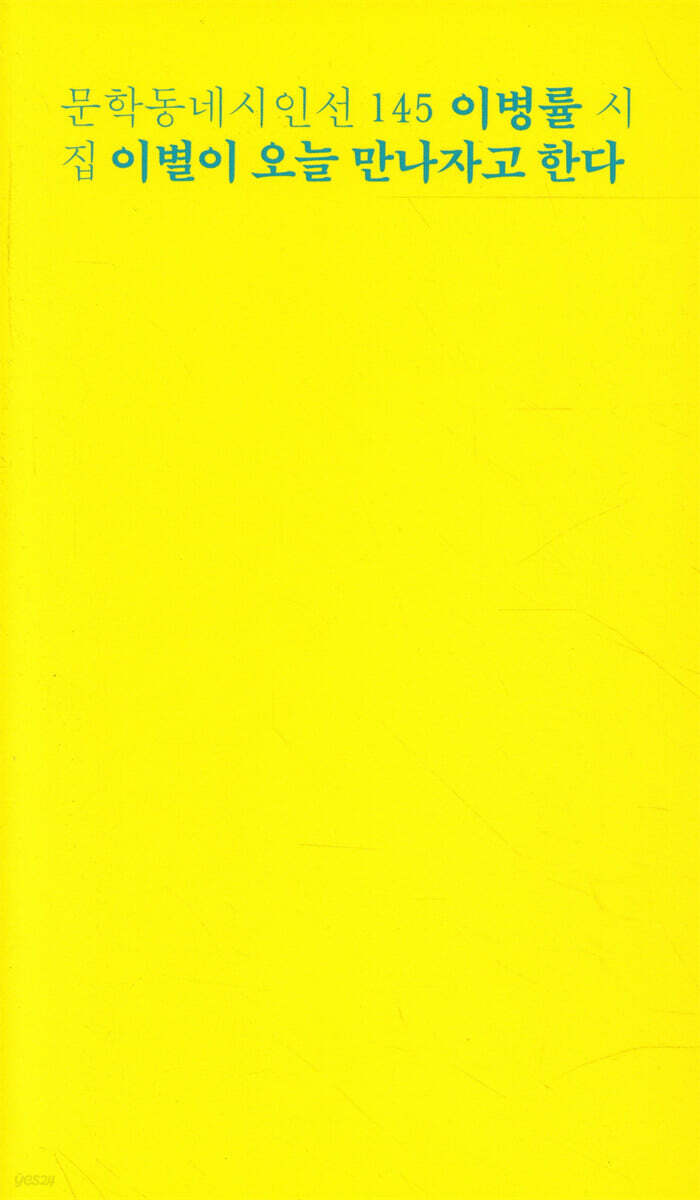
Farewell says let's meet today
 |
Description
Book Introduction
- A word from MD
-
If sadness had a nameLee Byeong-ryul's new poetry collection after three years.
The diverse stories of our lives, difficult to articulate, and the emotions that fill them, finally find names and faces in the world of poetry he has built, through new language.
A world of beautiful sorrow and warm comfort, a journey to that place, I willingly embark on at the poet's invitation.
September 4, 2020. Novel/Poetry PD Park Hyung-wook
A poet who gives language to our sorrow
Lee Byeong-ryul's new poetry collection, his first in three years
As the 145th poetry collection in the Munhakdongne Poet Series, we are publishing poet Lee Byeong-ryul's new poetry collection, "Parting Says Let's Meet Today," which is his first in three years.
"Parting Says Let's Meet Today" is a warm, comforting greeting quietly delivered to us by poet Lee Byeong-ryul, who knows my emotions better than I do and knows how to find beauty in sadness.
Lee Byeong-ryul's new poetry collection, his first in three years
As the 145th poetry collection in the Munhakdongne Poet Series, we are publishing poet Lee Byeong-ryul's new poetry collection, "Parting Says Let's Meet Today," which is his first in three years.
"Parting Says Let's Meet Today" is a warm, comforting greeting quietly delivered to us by poet Lee Byeong-ryul, who knows my emotions better than I do and knows how to find beauty in sadness.
- You can preview some of the book's contents.
Preview
index
Poet's words
Part 1: Giving myself a good role
Tears come / The corner of sadness / When it disappears / Overlapping / Without anyone knowing / The wind passing by / Face / I pass the North Pole route once a day / A sense of direction / What one person leaves behind is the aurora / Each other / Love / Someone else is writing my life for me / The button is loose / The village you come to / There is a saying that someone who resembles you lives somewhere
Part 2: You need to get one wooden box
Moderate speed, slow pace / Breath / Human gold / End / Frame / It would be better for three people to live together / Transit point Bangkok / Rooftop room / Letters / Seven days / Flower rain / On a lonely day, only the wind blows / At the beach / One person / If I were to be born again / Shanghai restaurant / Dazzling
Part 3 You will be nothing to me
The man who waters the plants in the empty house/ My brother/ A bird/ Going to my funeral/ Autumn day/ Travel/ A very quiet beat that brings tears to my eyes/ Unravel/ The sword of poetry/ The hill of freedom/ Sentence/ Home/ Worries about a certain age/ Questions/ To the longing
Part 4: Paper that brings good things
When you go to the moon, don't take your life with you / lover / something cut by a hairdresser / Jeju sea octopus / well-written calligraphy / good work / still life / if we don't have secrets, they say we'll fall / shirt pocket / suffering from the scenery / Busan Station / the end of the world / thread / then
Preface | Farewell Journey | Seo Hyo-in (poet)
Part 1: Giving myself a good role
Tears come / The corner of sadness / When it disappears / Overlapping / Without anyone knowing / The wind passing by / Face / I pass the North Pole route once a day / A sense of direction / What one person leaves behind is the aurora / Each other / Love / Someone else is writing my life for me / The button is loose / The village you come to / There is a saying that someone who resembles you lives somewhere
Part 2: You need to get one wooden box
Moderate speed, slow pace / Breath / Human gold / End / Frame / It would be better for three people to live together / Transit point Bangkok / Rooftop room / Letters / Seven days / Flower rain / On a lonely day, only the wind blows / At the beach / One person / If I were to be born again / Shanghai restaurant / Dazzling
Part 3 You will be nothing to me
The man who waters the plants in the empty house/ My brother/ A bird/ Going to my funeral/ Autumn day/ Travel/ A very quiet beat that brings tears to my eyes/ Unravel/ The sword of poetry/ The hill of freedom/ Sentence/ Home/ Worries about a certain age/ Questions/ To the longing
Part 4: Paper that brings good things
When you go to the moon, don't take your life with you / lover / something cut by a hairdresser / Jeju sea octopus / well-written calligraphy / good work / still life / if we don't have secrets, they say we'll fall / shirt pocket / suffering from the scenery / Busan Station / the end of the world / thread / then
Preface | Farewell Journey | Seo Hyo-in (poet)
Into the book
I crossed the Military Demarcation Line just with the thought of wanting to live in the South.
A girl who went south kept walking straight.
As I walked through a field densely covered with landmines,
How is it that you didn't step on a single landmine?
This thing that makes my chest feel so tight
Can you say you're not sad?
To a young man who has lived for twenty years with color blindness
When I put on the corrective glasses, he shrugged his shoulders a few times.
Tears dripped down my glasses
Everything I see is so overwhelming
What can I say about this desperate sadness?
In a sentence of twenty lines
My few past lives were not enough
In this life, I will deal with sadness to my heart's content.
I became a poet because I wanted to summarize it in one line.
I can't stop the rush, let alone the opponent
The sadness that I experience every time
How can I summarize it with what skill?
Sadness wants to meet you today
--- From "A Corner Called Sadness"
Tomorrow will never come
Today, you don't have to gossip about things that are scary.
The sack is still placed in a round, narrow seat.
People are now turning their backs on the sack
I will love you for a long time
God will follow them
The introduction sequence is over, but
The person who started the self-introduction first starts the self-introduction again.
The night is filled with people continuing to introduce themselves.
--- From "The Coming Village"
People become more like their own secrets.
Without even a single seed, we will fall
I have no way to explain myself
--- From "If there are no secrets, we will fall"
Your father passes by your face from left to right
My mother is also genetically sedentary, but if you look closely at her face,
Like everyone else, I'm an orphan by face alone.
The scenery you have seen and the things you have experienced shine down from top to bottom on your face.
The lines of childhood pass calmly under the eyes.
The expressions flow differently every time like waves along the diagonal lines.
A girl who went south kept walking straight.
As I walked through a field densely covered with landmines,
How is it that you didn't step on a single landmine?
This thing that makes my chest feel so tight
Can you say you're not sad?
To a young man who has lived for twenty years with color blindness
When I put on the corrective glasses, he shrugged his shoulders a few times.
Tears dripped down my glasses
Everything I see is so overwhelming
What can I say about this desperate sadness?
In a sentence of twenty lines
My few past lives were not enough
In this life, I will deal with sadness to my heart's content.
I became a poet because I wanted to summarize it in one line.
I can't stop the rush, let alone the opponent
The sadness that I experience every time
How can I summarize it with what skill?
Sadness wants to meet you today
--- From "A Corner Called Sadness"
Tomorrow will never come
Today, you don't have to gossip about things that are scary.
The sack is still placed in a round, narrow seat.
People are now turning their backs on the sack
I will love you for a long time
God will follow them
The introduction sequence is over, but
The person who started the self-introduction first starts the self-introduction again.
The night is filled with people continuing to introduce themselves.
--- From "The Coming Village"
People become more like their own secrets.
Without even a single seed, we will fall
I have no way to explain myself
--- From "If there are no secrets, we will fall"
Your father passes by your face from left to right
My mother is also genetically sedentary, but if you look closely at her face,
Like everyone else, I'm an orphan by face alone.
The scenery you have seen and the things you have experienced shine down from top to bottom on your face.
The lines of childhood pass calmly under the eyes.
The expressions flow differently every time like waves along the diagonal lines.
--- From "Face"
Publisher's Review
“Everything I see is too overwhelming.
What can I say about this desperate sorrow?
A poet who gives language to our sorrow
Lee Byeong-ryul's new poetry collection, his first in three years
The 145th poetry collection of the Munhakdongne Poetry Collection is Poet Lee Byeong-ryul's "Parting Says Let's Meet Today."
This is a new poetry collection by poet Lee Byeong-ryul, who came to us with the poetry collection “You Want to Go Somewhere” and surprised us with “The Wind’s Private Life,” “Brilliance,” “The Snowman Inn,” and “The Sea is Fine,” and who soothed our hearts with the prose collections “Attraction,” “The Wind Blows, I Like You,” “The Person Next to Me,” and “Alone to Alone,” and was loved by countless readers.
If his prose conveyed to us the feelings he encountered in a world beyond the everyday, his poetry portrays the specific aspects of the lives we live and walk on.
He knows how to sense the texture of everyday life and the world of life, and he expresses what he witnesses and touches in precise poetic language.
Readers familiar with Lee Byeong-ryul's prose might find it useful to pay attention to the process by which the language of prose is rearranged within the world of poetry in this collection of poems.
As can be guessed from the title, ‘Parting Says Let’s Meet Today,’ it is composed of poetic lines that visualize the emotion of sadness.
But the poems dealing with separation and sadness are never dark or heavy.
The poet shows us the wide spectrum of sadness.
This may be because, as poet Seo Hyo-in, who wrote the preface, said, he is a person who knows well that “sadness can be beautiful.”
Being able to discover the other side of an emotion also means that he has looked into that emotion for a long time.
That very thing, observing things and people thoughtfully and observing them for a long time, and thus sensing their emotions, is what poet Lee Byeong-ryul does best.
And that work wouldn't be all that different from writing good poetry.
Which hairdresser are you?
I'm going to wash my grandmother's hair after cutting it.
My hunched back won't let me lie back down
The story goes that he paused for a moment, went behind the curtain, and cried a lot.
(……)
There is also a middle-aged man who gets his hair cut by that hairdresser.
I always bring a dog with me.
If you cover a man's eyes with a small towel when washing his hair, the dog will cry like that.
Cover your face
The dog has been like that since it saw the man crying alone.
―From “Cut by a Hairdresser”
The people the poet watches are not only those close to him.
He is someone I have “never seen before” (“At the Beach”) and someone “who has nothing to do with me” (“The Lover”).
It is also a fleeting relationship, like a hairdresser cutting your own hair.
When he feels sad when he “tryes to see you but can’t see you” (“A Very Quiet Beat with Tears”), the object he wants to see is himself.
As he says, “In order to meet me/ I decide to come in a completely different way” (from “There is a saying that only one person who resembles me lives somewhere”), he sometimes meets ‘me’ in unfamiliar places.
There are no people writing anywhere
When working, use nails on iron plates
I also write on the moisture on the window
That one line sustains the day
―From “Letters”
What he does to meet you, or 'me', as a stranger 'someone' is 'writing'.
Alternatively, one could say that the only thing he can do is 'write'.
Especially for us who cannot go anywhere to meet unfamiliar things, his poems that speak of the pain of not being able to leave are even more appropriate and poignant.
When we want to leave, we write about imagining unfamiliar places, or about ourselves having such a longing.
In “Letters,” the poet says:
“Don’t write something down and then say you don’t want anything.”
It is also an expression of the recognition that the most basic act of practicing love is ‘writing,’ as in writing “Don’t go, / Can’t I not go” (from “Shanghai Restaurant”) with flour.
The emotions evoked by a chance encounter with unfamiliar things may not be different from the passionate outbreak of love.
However, while Lee Byeong-ryul pledges his passionate and intense love, he is conscious of the love that has previously disappeared.
The last line of “Seven Days,” which says that after “loving completely to pieces” for “seven days,” “I will crumble and disappear, leaving only bones,” is significant in that it says, “Even if I start over,/ It doesn’t mean I can have that person again.”
For the poet, the pain of separation is not only a point that allows him to mature, but love itself creates a deeper meaning when the pain of separation is a prerequisite.
That is why it becomes important to be able to love again, knowing the pain of the coming separation.
We are not born to do anything.
Pick your favorite spot
Stop by that place for a while
So, let's bring a good person to that place.
Don't try so hard in this life
But in the next life
In case you want to come back again
Press firmly to engrave the spot and return
―From “Travel”
The poet does not speak of vague optimism to us who cannot leave and who long for love as we write.
Love may not come in this life.
‘Writing’ inevitably brings about frustration in the writer.
Well then, let's prepare for the next life.
Of course, it is not synonymous with resignation.
Preparation based on the premise of the inverse relationship of 'just' is an attitude of thoroughly preparing for the future that you will inevitably encounter.
His attitude is that he wants to write despite knowing that it will be frustrating.
The will to continue writing without summarizing the sadness is manifested in the attitude of not rejecting the sadness that asks to meet today.
Delicate hearts are kept from becoming dull through the sharpened ‘sword of poetry.’
The last sentence of “The Farewell Says Let’s Meet Today” is “Then, I will come see you in December” (“Then”), which is related to the belief that came from his will.
Even if the process of shaking fills this entire life, the poet believes that there is someone for each of us to find.
It doesn't stop at believing.
He maintains an attitude of willingly crossing the 'glass window' ("Question") and the 'cliff' ("What the Hairdresser Cut") between 'me' and you to find you.
It is no coincidence that his poetry collection has come to us at this very time.
In a time when there is more sorrow than joy, more parting than meeting, and more safety in distancing ourselves from one another, it is clear that what we need is the voice of someone who knows how to find beauty even in such a world.
The space where the 'I's' that appear in Lee Byeong-ryul's poetry gather would be similar to the village where we in "The Village We Come to" gather and introduce ourselves.
We practice meeting each other through poetry, and we really meet.
“Press firmly with your bare hands and carve clearly” (“A Person”) Each person introduces themselves to each other while holding their own secrets contained in long letters.
As we get to know and love each other, the sadness will surely subside, if only for a moment.
In the face of the omnipresent sadness of separation, we can see in this collection of poems one definite action that a book can take.
[Poet's Note]
The house is empty, so stay for a few days.
The sea is to the left
Sadness is behind the house
If you want to stay longer, please do so.
I am just the next person to stay in that house for a while.
You live in that house
September 2020
Lee Byeong-ryul
What can I say about this desperate sorrow?
A poet who gives language to our sorrow
Lee Byeong-ryul's new poetry collection, his first in three years
The 145th poetry collection of the Munhakdongne Poetry Collection is Poet Lee Byeong-ryul's "Parting Says Let's Meet Today."
This is a new poetry collection by poet Lee Byeong-ryul, who came to us with the poetry collection “You Want to Go Somewhere” and surprised us with “The Wind’s Private Life,” “Brilliance,” “The Snowman Inn,” and “The Sea is Fine,” and who soothed our hearts with the prose collections “Attraction,” “The Wind Blows, I Like You,” “The Person Next to Me,” and “Alone to Alone,” and was loved by countless readers.
If his prose conveyed to us the feelings he encountered in a world beyond the everyday, his poetry portrays the specific aspects of the lives we live and walk on.
He knows how to sense the texture of everyday life and the world of life, and he expresses what he witnesses and touches in precise poetic language.
Readers familiar with Lee Byeong-ryul's prose might find it useful to pay attention to the process by which the language of prose is rearranged within the world of poetry in this collection of poems.
As can be guessed from the title, ‘Parting Says Let’s Meet Today,’ it is composed of poetic lines that visualize the emotion of sadness.
But the poems dealing with separation and sadness are never dark or heavy.
The poet shows us the wide spectrum of sadness.
This may be because, as poet Seo Hyo-in, who wrote the preface, said, he is a person who knows well that “sadness can be beautiful.”
Being able to discover the other side of an emotion also means that he has looked into that emotion for a long time.
That very thing, observing things and people thoughtfully and observing them for a long time, and thus sensing their emotions, is what poet Lee Byeong-ryul does best.
And that work wouldn't be all that different from writing good poetry.
Which hairdresser are you?
I'm going to wash my grandmother's hair after cutting it.
My hunched back won't let me lie back down
The story goes that he paused for a moment, went behind the curtain, and cried a lot.
(……)
There is also a middle-aged man who gets his hair cut by that hairdresser.
I always bring a dog with me.
If you cover a man's eyes with a small towel when washing his hair, the dog will cry like that.
Cover your face
The dog has been like that since it saw the man crying alone.
―From “Cut by a Hairdresser”
The people the poet watches are not only those close to him.
He is someone I have “never seen before” (“At the Beach”) and someone “who has nothing to do with me” (“The Lover”).
It is also a fleeting relationship, like a hairdresser cutting your own hair.
When he feels sad when he “tryes to see you but can’t see you” (“A Very Quiet Beat with Tears”), the object he wants to see is himself.
As he says, “In order to meet me/ I decide to come in a completely different way” (from “There is a saying that only one person who resembles me lives somewhere”), he sometimes meets ‘me’ in unfamiliar places.
There are no people writing anywhere
When working, use nails on iron plates
I also write on the moisture on the window
That one line sustains the day
―From “Letters”
What he does to meet you, or 'me', as a stranger 'someone' is 'writing'.
Alternatively, one could say that the only thing he can do is 'write'.
Especially for us who cannot go anywhere to meet unfamiliar things, his poems that speak of the pain of not being able to leave are even more appropriate and poignant.
When we want to leave, we write about imagining unfamiliar places, or about ourselves having such a longing.
In “Letters,” the poet says:
“Don’t write something down and then say you don’t want anything.”
It is also an expression of the recognition that the most basic act of practicing love is ‘writing,’ as in writing “Don’t go, / Can’t I not go” (from “Shanghai Restaurant”) with flour.
The emotions evoked by a chance encounter with unfamiliar things may not be different from the passionate outbreak of love.
However, while Lee Byeong-ryul pledges his passionate and intense love, he is conscious of the love that has previously disappeared.
The last line of “Seven Days,” which says that after “loving completely to pieces” for “seven days,” “I will crumble and disappear, leaving only bones,” is significant in that it says, “Even if I start over,/ It doesn’t mean I can have that person again.”
For the poet, the pain of separation is not only a point that allows him to mature, but love itself creates a deeper meaning when the pain of separation is a prerequisite.
That is why it becomes important to be able to love again, knowing the pain of the coming separation.
We are not born to do anything.
Pick your favorite spot
Stop by that place for a while
So, let's bring a good person to that place.
Don't try so hard in this life
But in the next life
In case you want to come back again
Press firmly to engrave the spot and return
―From “Travel”
The poet does not speak of vague optimism to us who cannot leave and who long for love as we write.
Love may not come in this life.
‘Writing’ inevitably brings about frustration in the writer.
Well then, let's prepare for the next life.
Of course, it is not synonymous with resignation.
Preparation based on the premise of the inverse relationship of 'just' is an attitude of thoroughly preparing for the future that you will inevitably encounter.
His attitude is that he wants to write despite knowing that it will be frustrating.
The will to continue writing without summarizing the sadness is manifested in the attitude of not rejecting the sadness that asks to meet today.
Delicate hearts are kept from becoming dull through the sharpened ‘sword of poetry.’
The last sentence of “The Farewell Says Let’s Meet Today” is “Then, I will come see you in December” (“Then”), which is related to the belief that came from his will.
Even if the process of shaking fills this entire life, the poet believes that there is someone for each of us to find.
It doesn't stop at believing.
He maintains an attitude of willingly crossing the 'glass window' ("Question") and the 'cliff' ("What the Hairdresser Cut") between 'me' and you to find you.
It is no coincidence that his poetry collection has come to us at this very time.
In a time when there is more sorrow than joy, more parting than meeting, and more safety in distancing ourselves from one another, it is clear that what we need is the voice of someone who knows how to find beauty even in such a world.
The space where the 'I's' that appear in Lee Byeong-ryul's poetry gather would be similar to the village where we in "The Village We Come to" gather and introduce ourselves.
We practice meeting each other through poetry, and we really meet.
“Press firmly with your bare hands and carve clearly” (“A Person”) Each person introduces themselves to each other while holding their own secrets contained in long letters.
As we get to know and love each other, the sadness will surely subside, if only for a moment.
In the face of the omnipresent sadness of separation, we can see in this collection of poems one definite action that a book can take.
[Poet's Note]
The house is empty, so stay for a few days.
The sea is to the left
Sadness is behind the house
If you want to stay longer, please do so.
I am just the next person to stay in that house for a while.
You live in that house
September 2020
Lee Byeong-ryul
GOODS SPECIFICS
- Date of issue: September 1, 2020
- Page count, weight, size: 144 pages | 200g | 130*224*8mm
- ISBN13: 9788954674201
- ISBN10: 8954674208
You may also like
카테고리
korean


korean

![GQ KOREA Mark (Monthly): December [2025]](http://librairie.coreenne.fr/cdn/shop/files/8ef265dbbfbf186523ed75ba7319009d.jpg?v=1765340328&width=3840)


