

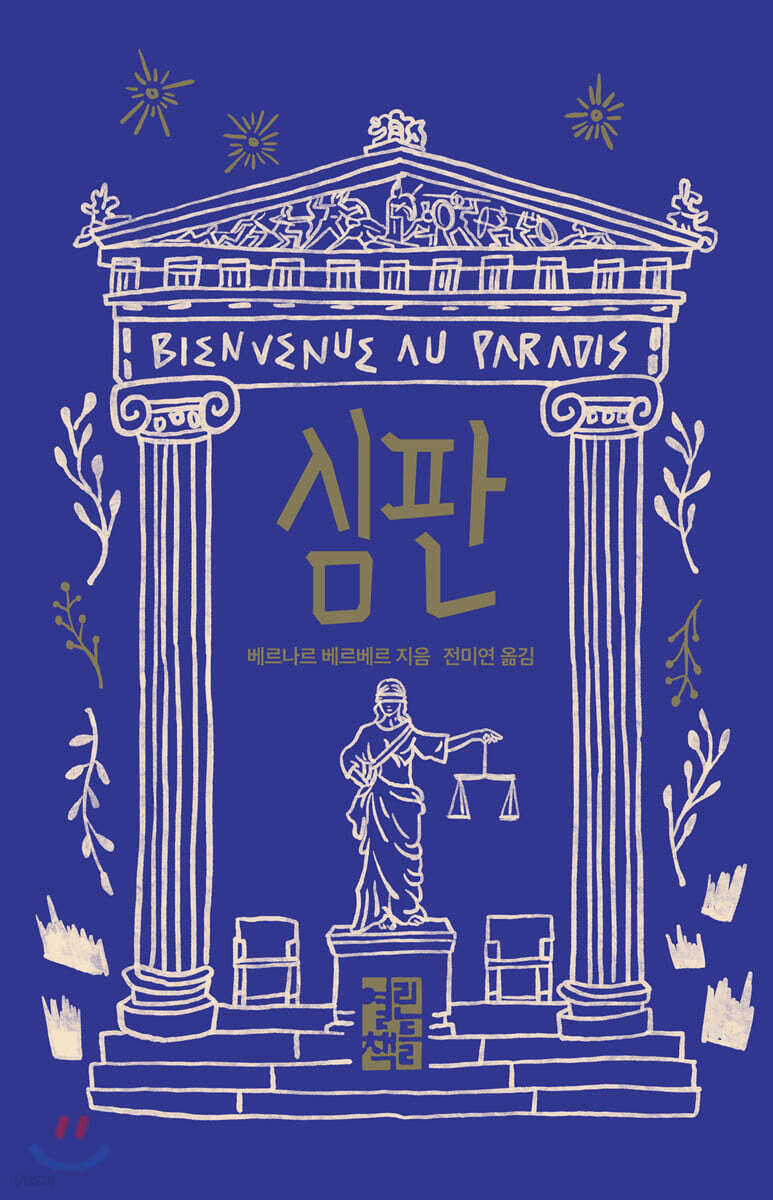
judgment
 |
Description
Book Introduction
A special judgment that begins after death Bernard Werber, a bestselling author beloved by Korean readers, has published his new work, The Trial, translated by Jeon Mi-yeon, a French literature specialist, through Open Books. "The Trial" is a play that Berber attempted again after "The Human," and it humorously depicts a debate between a judge, prosecutor, lawyer, and defendant in a heavenly courtroom. This work, which shines with Berber's unique imagination and humor, is a play, but reads like a novel. The original title was "Welcome to Heaven" and it was published in France in 2015, selling over 40,000 copies. In France, it was staged three times in 2017, 2018, and 2019. "The Judgment" consists of three acts. In Act 1, the protagonist, who died during surgery, arrives in heaven without realizing that he is dead and meets a lawyer, a prosecutor, and a judge in succession. Act 2 is about looking back on the protagonist's past life, and Act 3 is about deciding on his next life. The protagonist is Anatole Pichon, who just recently passed away. Ironically, he became a defendant as soon as he died, having served as a judge while alive. A heavy smoker, he developed lung cancer and underwent surgery in the middle of the holiday season when staff were short, but he ultimately failed to survive. He may now remain in heaven according to judgment, or he may have to be born again. Anatol insists that he has lived as a good student, a good citizen, a good husband and father, and a good worker, and Caroline, Anatol's guardian angel and defender, also tries to highlight his good qualities in some way. But prosecutor Bertrand uncovers an unexpected crime. Will Anatole be able to avoid the death penalty, or rather the “life sentence” of being reborn? |
- You can preview some of the book's contents.
Preview
index
Act 1: Arrival in Heaven
Act 2: Balance Sheet of Past Lives
Act 3: Preparation for the Next Life
Translator's Note
Act 2: Balance Sheet of Past Lives
Act 3: Preparation for the Next Life
Translator's Note
Into the book
Gabriel: Anyway, the rules are clear.
The defendant must come with the knowledge.
Anatole, what on earth are you talking about?
You know, Bertrand , Monsieur Pichon, at the end of a fulfilling life there always comes a fateful moment.
You have to know when to leave the stage.
Anatole, what the hell are you talking about? Where is Professor Azemiang?
Caroline (to Gabriel and Bertrand) Leave it to me.
(To Anatol) So, the problem with that “last hope surgery”… … well, that’s… … how should I explain it… … let me put it this way… … .
Accept that hope can be fickle sometimes.
Bertrand , listen to me, Monsieur Pichon, you are… …dead.
A moment of silence.
Caroline looks embarrassed.
Gabriel, who was surprised by Bertrand's quick actions, was also embarrassed by his blunt words.
Anatole (suddenly laughing out loud) No, you want me to believe that, I… …!
--- pp.71~72
Anatole, what do you know?
Caroline knows everything.
Anatole, are you trying to make me lose interest in life?
Caroline, I'm trying to get you to want to continue your adventure.
Remember that your soul is young.
It's like a child.
We must not confine that soul in such a cramped shell, but let it grow, mature, and evolve.
Anatole, who the hell are you? What is your identity, the one you're talking to me about? Maybe you don't even exist.
I'm still in a half-asleep state after the surgery.
She extends her hand to him.
He hesitates, then takes her hand and touches it.
Caroline, I am your guardian angel.
Anatole Aha… … I see, this is a mental ward.
--- p.87
Anatole's body, no longer responding to shock, is shown on the screen.
After the nurses checked the pulse, they exchanged signals indicating that they were in a state where they could no longer help, and then began to unplug the device.
Two more nurses came and wrapped Anatol's body in a black sheet and zipped it up.
A body wrapped in a blanket is placed on a wheeled bed.
Anatole, what are you doing?
Gabriel: It's nothing.
The camera follows the body on a wheeled bed.
His body, which was lowered to the hospital basement, is moved to the crematorium.
Anatole No, it's nothing special.
It's my body!
A man wearing an apron appears.
What on earth is Anatole doing to me?
Caroline: My body is just an object now, Mr. Pichon, so stop worrying about it.
--- pp.93~94
Gabriel , listen up, I'll explain the situation.
Your soul will be reincarnated as a fetus that will be born in a few seconds.
So, you have to choose one of the wombs that is ready to give birth to a boy.
You are lucky.
There's almost one on each continent now.
Let's see... ... There are some very precious cases.
The son of a Maharajah who will be born in Geneva, the son of the dictator of the Democratic Republic of the Congo, and perhaps even the son of a Cuban dignitary in Miami, if that's possible, though he may no longer be alive.
What about Anatole France?
Gabriel (checking the list) France… … Wait, I’ll look for it… … One, two, three… … six!
Anatole I don't think I can live without delicious cheese.
I want to be reincarnated in France.
Why wouldn't Bertrand be that curious?
Gabriel (taking notes) Okay.
Mr. Pichon, what kind of parenting style would you like?
Anatol: I guess parents can choose too?
Caroline Of course.
We all chose our parents before we were born.
That's why I can't really blame them.
Gabriel (raising his glasses to check the list) What I can offer you regarding your parents is… … .
The defendant must come with the knowledge.
Anatole, what on earth are you talking about?
You know, Bertrand , Monsieur Pichon, at the end of a fulfilling life there always comes a fateful moment.
You have to know when to leave the stage.
Anatole, what the hell are you talking about? Where is Professor Azemiang?
Caroline (to Gabriel and Bertrand) Leave it to me.
(To Anatol) So, the problem with that “last hope surgery”… … well, that’s… … how should I explain it… … let me put it this way… … .
Accept that hope can be fickle sometimes.
Bertrand , listen to me, Monsieur Pichon, you are… …dead.
A moment of silence.
Caroline looks embarrassed.
Gabriel, who was surprised by Bertrand's quick actions, was also embarrassed by his blunt words.
Anatole (suddenly laughing out loud) No, you want me to believe that, I… …!
--- pp.71~72
Anatole, what do you know?
Caroline knows everything.
Anatole, are you trying to make me lose interest in life?
Caroline, I'm trying to get you to want to continue your adventure.
Remember that your soul is young.
It's like a child.
We must not confine that soul in such a cramped shell, but let it grow, mature, and evolve.
Anatole, who the hell are you? What is your identity, the one you're talking to me about? Maybe you don't even exist.
I'm still in a half-asleep state after the surgery.
She extends her hand to him.
He hesitates, then takes her hand and touches it.
Caroline, I am your guardian angel.
Anatole Aha… … I see, this is a mental ward.
--- p.87
Anatole's body, no longer responding to shock, is shown on the screen.
After the nurses checked the pulse, they exchanged signals indicating that they were in a state where they could no longer help, and then began to unplug the device.
Two more nurses came and wrapped Anatol's body in a black sheet and zipped it up.
A body wrapped in a blanket is placed on a wheeled bed.
Anatole, what are you doing?
Gabriel: It's nothing.
The camera follows the body on a wheeled bed.
His body, which was lowered to the hospital basement, is moved to the crematorium.
Anatole No, it's nothing special.
It's my body!
A man wearing an apron appears.
What on earth is Anatole doing to me?
Caroline: My body is just an object now, Mr. Pichon, so stop worrying about it.
--- pp.93~94
Gabriel , listen up, I'll explain the situation.
Your soul will be reincarnated as a fetus that will be born in a few seconds.
So, you have to choose one of the wombs that is ready to give birth to a boy.
You are lucky.
There's almost one on each continent now.
Let's see... ... There are some very precious cases.
The son of a Maharajah who will be born in Geneva, the son of the dictator of the Democratic Republic of the Congo, and perhaps even the son of a Cuban dignitary in Miami, if that's possible, though he may no longer be alive.
What about Anatole France?
Gabriel (checking the list) France… … Wait, I’ll look for it… … One, two, three… … six!
Anatole I don't think I can live without delicious cheese.
I want to be reincarnated in France.
Why wouldn't Bertrand be that curious?
Gabriel (taking notes) Okay.
Mr. Pichon, what kind of parenting style would you like?
Anatol: I guess parents can choose too?
Caroline Of course.
We all chose our parents before we were born.
That's why I can't really blame them.
Gabriel (raising his glasses to check the list) What I can offer you regarding your parents is… … .
--- pp.176~177
Publisher's Review
A special judgment that begins after death
Bernard Werber, a bestselling author beloved by Korean readers, has published his new work, The Trial, translated by Jeon Mi-yeon, a French literature specialist, through Open Books.
"The Trial" is a play that Berber attempted again after "The Human," and it humorously depicts a debate between a judge, prosecutor, lawyer, and defendant in a heavenly courtroom.
This work, which shines with Berber's unique imagination and humor, is a play, but reads like a novel.
The original title was "Bienvenue au paradis" and it was published in France in 2015, selling over 40,000 copies.
In France, it was staged three times in 2017, 2018, and 2019.
The sin of not recognizing your destiny, the sin of wasting your talents… Do you admit your sins?
"The Judgment" consists of three acts.
In Act 1, the protagonist, who died during surgery, arrives in heaven without realizing that he is dead and meets a lawyer, a prosecutor, and a judge in succession.
Act 2 is about looking back on the protagonist's past life, and Act 3 is about deciding on his next life.
The protagonist is Anatole Pichon, who just recently passed away.
Ironically, he became a defendant as soon as he died, having served as a judge while alive.
A heavy smoker, he developed lung cancer and underwent surgery in the middle of the holiday season when staff were short, but he ultimately failed to survive.
He may now remain in heaven according to judgment, or he may have to be born again.
Anatol insists that he has lived as a good student, a good citizen, a good husband and father, and a good worker, and Caroline, Anatol's guardian angel and defender, also tries to highlight his good qualities in some way.
But prosecutor Bertrand uncovers an unexpected crime.
Will Anatole be able to avoid the death penalty, or rather the “life sentence” of being reborn?
A play that shines with imagination and humor
Despite the weighty subject of "judging the dead," international press reviews of "Judgment" unanimously focused on the work's humor.
Humor has always been a key element in Berber's work, but it stands out even more in The Trial, which has a considerably more compact length and structure than his usual novels.
Berber is good at typical wordplay and jokes, but his strength is the laughter that comes from his unique twists.
He actively uses his typing gaze to twist things.
Sometimes we look at humans, and ourselves, through the eyes of insects and animals, and sometimes through the eyes of wandering spirits or angels.
This work also sets the scene in a heavenly court where a different value system and moral code operate than on Earth, and naturally touches on social issues and prejudices.
The story of Anatole Pichon, who was a judge in his lifetime but ironically ended up being judged.
It's a really enjoyable piece.
- Feminin
A play full of light and witty humor.
- BlancVlan
Fun twisted humor, colorful story.
- L'Express Suisse
Bernard Werber, a bestselling author beloved by Korean readers, has published his new work, The Trial, translated by Jeon Mi-yeon, a French literature specialist, through Open Books.
"The Trial" is a play that Berber attempted again after "The Human," and it humorously depicts a debate between a judge, prosecutor, lawyer, and defendant in a heavenly courtroom.
This work, which shines with Berber's unique imagination and humor, is a play, but reads like a novel.
The original title was "Bienvenue au paradis" and it was published in France in 2015, selling over 40,000 copies.
In France, it was staged three times in 2017, 2018, and 2019.
The sin of not recognizing your destiny, the sin of wasting your talents… Do you admit your sins?
"The Judgment" consists of three acts.
In Act 1, the protagonist, who died during surgery, arrives in heaven without realizing that he is dead and meets a lawyer, a prosecutor, and a judge in succession.
Act 2 is about looking back on the protagonist's past life, and Act 3 is about deciding on his next life.
The protagonist is Anatole Pichon, who just recently passed away.
Ironically, he became a defendant as soon as he died, having served as a judge while alive.
A heavy smoker, he developed lung cancer and underwent surgery in the middle of the holiday season when staff were short, but he ultimately failed to survive.
He may now remain in heaven according to judgment, or he may have to be born again.
Anatol insists that he has lived as a good student, a good citizen, a good husband and father, and a good worker, and Caroline, Anatol's guardian angel and defender, also tries to highlight his good qualities in some way.
But prosecutor Bertrand uncovers an unexpected crime.
Will Anatole be able to avoid the death penalty, or rather the “life sentence” of being reborn?
A play that shines with imagination and humor
Despite the weighty subject of "judging the dead," international press reviews of "Judgment" unanimously focused on the work's humor.
Humor has always been a key element in Berber's work, but it stands out even more in The Trial, which has a considerably more compact length and structure than his usual novels.
Berber is good at typical wordplay and jokes, but his strength is the laughter that comes from his unique twists.
He actively uses his typing gaze to twist things.
Sometimes we look at humans, and ourselves, through the eyes of insects and animals, and sometimes through the eyes of wandering spirits or angels.
This work also sets the scene in a heavenly court where a different value system and moral code operate than on Earth, and naturally touches on social issues and prejudices.
The story of Anatole Pichon, who was a judge in his lifetime but ironically ended up being judged.
It's a really enjoyable piece.
- Feminin
A play full of light and witty humor.
- BlancVlan
Fun twisted humor, colorful story.
- L'Express Suisse
[Translator's Note]
Watching the tumultuous "Judgment" of the heavenly court, where a different value system and moral code operate than those on Earth, one can read a play in one sitting.
The day is coming when 『The Trial』, which was loved by French audiences, will be performed on stage in Korea as well.
[Translator's Note]
Watching the tumultuous "Judgment" of the heavenly court, where a different value system and moral code operate than those on Earth, one can read a play in one sitting.
The day is coming when 『The Trial』, which was loved by French audiences, will be performed on stage in Korea as well.
Watching the tumultuous "Judgment" of the heavenly court, where a different value system and moral code operate than those on Earth, one can read a play in one sitting.
The day is coming when 『The Trial』, which was loved by French audiences, will be performed on stage in Korea as well.
[Translator's Note]
Watching the tumultuous "Judgment" of the heavenly court, where a different value system and moral code operate than those on Earth, one can read a play in one sitting.
The day is coming when 『The Trial』, which was loved by French audiences, will be performed on stage in Korea as well.
GOODS SPECIFICS
- Date of issue: August 30, 2020
- Format: Hardcover book binding method guide
- Page count, weight, size: 224 pages | 328g | 128*194*20mm
- ISBN13: 9788932920405
- ISBN10: 8932920400
You may also like
카테고리
korean


korean

![GQ KOREA Mark (Monthly): December [2025]](http://librairie.coreenne.fr/cdn/shop/files/8ef265dbbfbf186523ed75ba7319009d.jpg?v=1765340328&width=3840)


