

Korean Teacher
 |
Description
Book Introduction
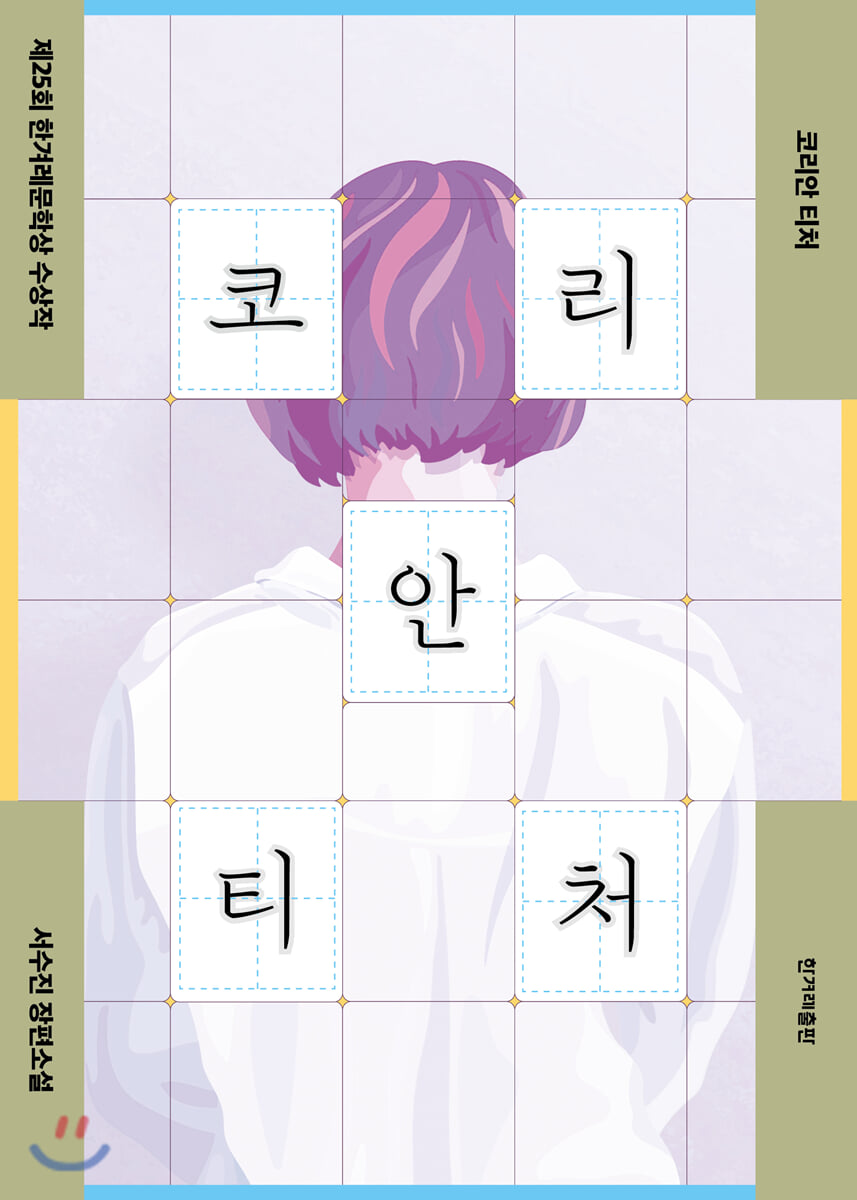
The story of four female part-time instructors at a Korean language school. The Hankyoreh Literary Award, which has been loved by readers for a long time and strives to repay that trust every year, has published its twenty-fifth award-winning work, “Korean Teacher.” The Hankyoreh Literary Award, which has produced many leading Korean novelists such as Shim Yun-gyeong's "My Beautiful Garden," Yoon Go-eun's "Zero Gravity Syndrome," Choi Jin-young's "The Name of the Girl Who Passed By You," Jeong Ah-eun's "Modern Heart," Kang Hwa-gil's "Another Person," and Park Seo-ryeon's "The Airship Girl Kang Ju-ryong," although it did not produce a winner, followed the 24th Hankyoreh Literary Award, which appointed an all-female jury for the first time, and for the 25th Hankyoreh Literary Award, it appointed an all-female jury in an effort to select works that read the flow of the times. The winning work, selected with the strong support of eight judges, is Seo Su-jin's novel, "Korean Teacher," which tells the story of four female part-time instructors at a Korean language school. This book is the story of four Korean language teachers, Seon-i, Mi-ju, Ga-eun, and Han-hee, who work at a Korean language school. The novel, which is composed of five parts, has one protagonist who becomes the narrator and leads the story for each semester. Novelist Kang Young-sook, who was in charge of the judging, commented that the novel raises the question, “Aren’t we still preventing many women, including highly educated women, from trying to become something in our society?” Critic Oh Hye-jin, in her recommendation, noted that the novel vividly portrays “the ‘site’ of a ‘Korean language school’ that indiscriminately draws in foreign students without sufficient human and material resources and systematic programs,” and that it is “a story about a bottomless world that squeezes every last grain of time, labor, emotion, and energy out of non-regular part-time instructors under the pretext of serving their ‘customers’ without ever promising a ‘future,’ a world that makes even such a world seem to some as the last ‘possibility’ that must never be missed.” |
- You can preview some of the book's contents.
Preview
index
Spring Semester 7
Summer Semester 69
Fall Semester 131
Winter Semester 193
Winter Short 261
Author's Note 273
Recommendation 276
Summer Semester 69
Fall Semester 131
Winter Semester 193
Winter Short 261
Author's Note 273
Recommendation 276
Into the book
The post had 37 comments.
Most of the comments were in Vietnamese, but there were three in English.
(…) There were sarcastic comments asking if this girl was really pretty, and opposite comments saying that she was too pretty to be a teacher.
The last comment should be translated as 'Fuck, that's annoying.'
Seon-i clicked on the hashtag 'Korean Hot Girl' and searched for posts with the same hashtag.
Pictures of women wearing only underwear and exposing their breasts poured in.
I felt like I couldn't breathe.
That's ridiculous.
Seon-i thought of the words she wanted to teach Gwan: 'unfair' and 'insulting'.
Mr. Gwan, this is unfair.
This is really insulting.
Don't call me that.
And America's voice rang in my head.
'I don't think we can just let this go.'
--- p.52
After putting up the poster, Miju met the eyes of her seniors and classmates who were still surrounding her, one by one, and clearly stated that she had no intention of taking down her poster until a public apology poster was put up next to it.
I will fight for what I believe is right.
Don't give up.
He said that he learned those things while working in a pungmul band.
No one pointed out that the period in which Miju had been active was too short to have learned any beliefs from the pungmulpae.
--- p.91
Hanhee worked too hard.
I was the earliest to arrive at work and the latest to leave.
It seemed like he was trying to compensate for the handicap of being from another university by working long hours.
Miju didn't care whether Hanhee came from outside or was selected from within.
I didn't care even more how hard Hanhee worked.
Hanhee was in charge, and Miju was the instructor.
All we had to do was do what we had to do in our respective positions.
--- p.104
“I hope other instructors will listen carefully as well.
Education is also a service.
Remember, students pay money, and you get a guaranteed job with that money.
The student is A and you are B.
“Without students, you can’t work here.”
Miju barely swallowed all the words welling up inside her.
You are wrong.
We are Jeong.
The student is A, you are B, the responsible instructors sitting right next to you with proud expressions are B, and the ordinary instructors like me are Jeong.
So you don't feel guilty when you threaten to cut us out with a lecture, and the instructors here just say stupid things when threatened to please you.
Me too.
--- pp.120~121
“I was lying in bed that night and suddenly I heard a beeping sound.
Why, when you watch dramas, there's a sound coming from the machine when someone dies in the hospital.
And then everything stopped.
I just lay there for a few days.
I couldn't even go to the interview that was called.
The hospital said it was depression.
“I wasn’t depressed.”
--- pp.157~158
“I guess being cut from school was really stressful.
I understand.
I think so too.”
“No, what I mean is, I don’t know why it was cut off.
When I was chosen, the reason was clear.
The need for more instructors arose due to the influx of Vietnamese students.
But when it was cut, I didn't know why.
I worked really hard.
The students really liked it too.
Why was my course evaluation so bad? How could I get a 7? I tried my best.
“What more could I have done?”
--- pp.158~159
Now Hanhee needed the future tense.
A complete future was needed.
We needed a future that existed as a complete fact, not dependent on will or guesswork.
--- p.221
“If we can’t pay their wages, they will have immediate difficulty making a living.”
The director said that Hanhee and Jacob were stealing their salaries.
In the cold hallway, Han-hee and Jacob had to hear about how hard the director's life was, and about those whose lives were even harder than the three of them combined.
The janitor was behind on his rent, and the school bus driver had to cancel all of his children's schooling.
Hanhee and Jacob were better than that.
That was the truth.
But it was a truth that was placed in a very wrong way.
Hanhee and Jacob had been the ones who were wrong from the beginning to the end, but now the director was even taking the victim's place.
--- pp.242~243
“The contract with H University is ending.
You said it would be difficult to renew the contract.”
"then."
Hanhee paused for a moment and took a breath.
“If the contract isn’t renewed, I’m going to sue.
So I will be reinstated and hired as a full-time employee.”
“Don’t you remember the lawyer saying it would be hard to win?”
“No, I didn’t say it would be hard to win.
I told you it would take a long time.
So I have to stay in Korea.
long time."
Most of the comments were in Vietnamese, but there were three in English.
(…) There were sarcastic comments asking if this girl was really pretty, and opposite comments saying that she was too pretty to be a teacher.
The last comment should be translated as 'Fuck, that's annoying.'
Seon-i clicked on the hashtag 'Korean Hot Girl' and searched for posts with the same hashtag.
Pictures of women wearing only underwear and exposing their breasts poured in.
I felt like I couldn't breathe.
That's ridiculous.
Seon-i thought of the words she wanted to teach Gwan: 'unfair' and 'insulting'.
Mr. Gwan, this is unfair.
This is really insulting.
Don't call me that.
And America's voice rang in my head.
'I don't think we can just let this go.'
--- p.52
After putting up the poster, Miju met the eyes of her seniors and classmates who were still surrounding her, one by one, and clearly stated that she had no intention of taking down her poster until a public apology poster was put up next to it.
I will fight for what I believe is right.
Don't give up.
He said that he learned those things while working in a pungmul band.
No one pointed out that the period in which Miju had been active was too short to have learned any beliefs from the pungmulpae.
--- p.91
Hanhee worked too hard.
I was the earliest to arrive at work and the latest to leave.
It seemed like he was trying to compensate for the handicap of being from another university by working long hours.
Miju didn't care whether Hanhee came from outside or was selected from within.
I didn't care even more how hard Hanhee worked.
Hanhee was in charge, and Miju was the instructor.
All we had to do was do what we had to do in our respective positions.
--- p.104
“I hope other instructors will listen carefully as well.
Education is also a service.
Remember, students pay money, and you get a guaranteed job with that money.
The student is A and you are B.
“Without students, you can’t work here.”
Miju barely swallowed all the words welling up inside her.
You are wrong.
We are Jeong.
The student is A, you are B, the responsible instructors sitting right next to you with proud expressions are B, and the ordinary instructors like me are Jeong.
So you don't feel guilty when you threaten to cut us out with a lecture, and the instructors here just say stupid things when threatened to please you.
Me too.
--- pp.120~121
“I was lying in bed that night and suddenly I heard a beeping sound.
Why, when you watch dramas, there's a sound coming from the machine when someone dies in the hospital.
And then everything stopped.
I just lay there for a few days.
I couldn't even go to the interview that was called.
The hospital said it was depression.
“I wasn’t depressed.”
--- pp.157~158
“I guess being cut from school was really stressful.
I understand.
I think so too.”
“No, what I mean is, I don’t know why it was cut off.
When I was chosen, the reason was clear.
The need for more instructors arose due to the influx of Vietnamese students.
But when it was cut, I didn't know why.
I worked really hard.
The students really liked it too.
Why was my course evaluation so bad? How could I get a 7? I tried my best.
“What more could I have done?”
--- pp.158~159
Now Hanhee needed the future tense.
A complete future was needed.
We needed a future that existed as a complete fact, not dependent on will or guesswork.
--- p.221
“If we can’t pay their wages, they will have immediate difficulty making a living.”
The director said that Hanhee and Jacob were stealing their salaries.
In the cold hallway, Han-hee and Jacob had to hear about how hard the director's life was, and about those whose lives were even harder than the three of them combined.
The janitor was behind on his rent, and the school bus driver had to cancel all of his children's schooling.
Hanhee and Jacob were better than that.
That was the truth.
But it was a truth that was placed in a very wrong way.
Hanhee and Jacob had been the ones who were wrong from the beginning to the end, but now the director was even taking the victim's place.
--- pp.242~243
“The contract with H University is ending.
You said it would be difficult to renew the contract.”
"then."
Hanhee paused for a moment and took a breath.
“If the contract isn’t renewed, I’m going to sue.
So I will be reinstated and hired as a full-time employee.”
“Don’t you remember the lawyer saying it would be hard to win?”
“No, I didn’t say it would be hard to win.
I told you it would take a long time.
So I have to stay in Korea.
long time."
--- p.257
Publisher's Review
Kang Young-sook, Kim Yu-jin, Seo Young-in, Shin Saet-byeol, Oh Hye-jin, Jang Eun-jung, Choi Jin-young, Pyeon Hye-young
New female narratives selected by an all-female jury
*
The story of four female part-time instructors at a Korean language school.
The Hankyoreh Literary Award, which has been loved by readers for a long time and strives to repay that trust every year, has published its twenty-fifth award-winning work, “Korean Teacher.”
The Hankyoreh Literary Award, which has produced many leading Korean novelists such as Shim Yun-gyeong's "My Beautiful Garden," Yoon Go-eun's "Zero Gravity Syndrome," Choi Jin-young's "The Name of the Girl Who Passed By You," Jeong Ah-eun's "Modern Heart," Kang Hwa-gil's "Another Person," and Park Seo-ryeon's "The Airship Girl Kang Ju-ryong," although it did not produce a winner, followed the 24th Hankyoreh Literary Award, which appointed an all-female jury for the first time, and for the 25th Hankyoreh Literary Award, it appointed an all-female jury in an effort to select works that read the flow of the times.
The winning work, selected with the strong support of eight judges, is Seo Su-jin's novel, "Korean Teacher," which tells the story of four female part-time instructors at a Korean language school.
Novelist Kang Young-sook, who was in charge of the judging, commented that the novel raises the question, “Aren’t we still preventing many women, including highly educated women, from trying to become something in our society?” Critic Oh Hye-jin, in her recommendation, noted that the novel vividly portrays “the ‘site’ of a ‘Korean language school’ that indiscriminately draws in foreign students without sufficient human and material resources and systematic programs,” and that it is “a story about a bottomless world that squeezes every last grain of time, labor, emotion, and energy out of non-regular part-time instructors under the pretext of serving their ‘customers’ without ever promising a ‘future,’ a world that makes even such a world seem to some as the last ‘possibility’ that must never be missed.”
The author, who currently resides in Australia, announced that he would not attend the awards ceremony due to COVID-19.
Seo Su-jin is the first Hankyoreh Literary Award winner to be unable to attend the awards ceremony due to a disaster.
For the 25th Hankyoreh Literary Award, everything from the announcement of the award winners to the newspaper interviews and book promotions is being conducted online.
“We need the future tense.
“A perfect future”
"Korean Teacher" is the story of four Korean language teachers, Seon-i, Mi-ju, Ga-eun, and Han-hee, who work at a Korean language school.
The novel, which is composed of five parts, has one protagonist who becomes the narrator and leads the story for each semester.
Part 1, Spring Semester is the story of 'Seon-i'.
Seon-i, who was preparing for the 7th level civil service exam after completing her master's degree, changed her direction to take the national exam to become a Korean language instructor and passed with a near perfect score.
Seon-i, who had been failing every time she applied to a university, finally gets accepted to the H University Language Institute and is assigned to teach a special Vietnamese class.
However, after a while, she is surprised to see her picture posted on the Instagram of her classmate, Gwan, with the hashtag #KoreanHotGirl, and goes to see the instructor in charge, Han Hee.
Seon-i took a deep breath and went straight into class.
I had to teach my students adjectives.
We had to teach 'good' and 'bad', 'a lot' and 'a little', 'happy' and 'sad'.
Someday, we will be able to teach what is 'just' and what is 'unjust', what is 'moving' and what is 'insulting'.
Seon-i hoped that when students learned such words, they would feel that "just" was more useful for life in Korea than "unfair," and that "impressive" was more useful than "insulting."
_From the text
Part 2, Summer Semester, is about 'America'.
Miju is a veteran instructor with 8 years of experience at H University Language Institute.
He is so unconventional that he wears jeans and sneakers to class, but he never shows consideration for his students, so he never gets good grades on his lecture evaluations.
Miju, who is assigned to teach a second-grade class this semester, meets Nika, a Belarusian national who has failed a grade three times.
Despite her determination to send him to the third level, a small misunderstanding ruins their relationship, and Miju ends up being sued by Nika.
For a moment, the back of my neck felt cold.
It seemed like Nika was still staring at him.
Miju felt a burning hatred towards Nika for a moment.
Nika couldn't figure out why on earth she hated herself.
Miju recalled being amazed by Nika's fluent Korean, checking her handwriting for any errors, and making sure she had her homework done first.
I wanted to go back to all those moments and abandon Nika, laugh at her bad notes, and throw her homework.
Just like Nika did.
Miju clenched her fist.
I gripped my hand so tightly that my fingernails dug into my palms.
It was as if the goodwill and anticipation he had briefly harbored toward Nika were being completely crushed within his fist.
_From the text
Part 3, Fall Semester is the story of 'Ga-eun'.
Ga-eun is a new second-year instructor at H University's language school.
Although he is one of only two students from a local university at H University Language Institute, he is very popular, always getting first place in class evaluations and even receiving public confessions from students.
One day, Ga-eun receives a text message saying, 'I saw your video.'
What secret did Ga-eun, who seemed so perfect, have?
Ga-eun looked around the classroom.
Some instructors smiled when their eyes met.
Why are you laughing? Because you saw the video? Several instructors avoided Ga-eun's eyes.
Why are you avoiding eye contact? Because you already know? I heard whispering.
Are you talking about me? _From the text
Part 4, Winter Semester, is the story of 'Hanhee'.
Hanhee joined H University Language Institute as a responsible instructor two years ago, and her contract is about to be renewed after the winter semester.
I worked hard, even hearing people say, “Why do you work so hard when you have a husband?”
If I extend my contract this time, I will become a permanent contract worker.
Everything went smoothly.
Until I found out I was pregnant.
And the story continues again with Seon-i's story and the stories of all the Korean language school instructors.
Hanhee wanted to repay him, but she didn't.
I just thought I needed to work harder.
There are people who work without even eating lunch, and saying things like they don't have time or it's hard are all just excuses.
But Hanhee really didn't have time and it was really hard.
At E University, I took classes while completing my doctoral course.
After class, I went to class while eating kimbap on the bus.
People who asked why he worked so hard asked Hanhee what he was going to do with his PhD when he started his PhD program.
Even back then, Hanhee made ridiculous excuses like self-realization, but she knew that she needed a doctorate to survive here.
Even at H University's language school, there were no Korean language instructors in their 50s.
I had to become a professor with a PhD and experience as a responsible lecturer.
Either that or you're out.
_From the text
Stories of highly educated, irregular women working
"Korean Teacher" is the story of four highly educated, non-regular women.
But, it is also a story about irregular workers, and ultimately, a story about working women.
The four characters in the novel show the various emotions we feel as we work.
The earnestness of 'Seon-i', who decides to attend for a long time while listening to the director's speech and thinking 'If I have to be picky, I have to be picky', the righteousness of 'Mi-ju', who always stands up to the conventions of the Korean language school despite the gazes of her colleagues asking 'Do you really have to go that far?', the naivety of 'Ga-eun', who accepts the words 'you are kind' as a compliment and attributes everything to 'luck' but therefore thinks that other people's misfortunes are also due to 'bad luck', and the fierceness of 'Han-hee', who doubts the future tense of the Korean language and is used to both being bullied and bullying others - all of these exist within us who work in the workplace.
As we read "Korean Teacher" while examining "How Are We Living Now," we witness four characters who have worked too hard in their respective positions each encountering their own crises, and we are faced with the question, "How should we live?"
That is why critic Seo Young-in's words, "Let us remember that where there is no dignity in work, there is no dignity in humanity," strike us with even greater pain.
Now, more than ever, the discussion on the dignity of working people is maturing, and the changes that "Korean Teacher," the winner of the 25th Hankyoreh Literary Award, will bring to Korean novels and Korean society are even more anticipated.
New female narratives selected by an all-female jury
*
The story of four female part-time instructors at a Korean language school.
The Hankyoreh Literary Award, which has been loved by readers for a long time and strives to repay that trust every year, has published its twenty-fifth award-winning work, “Korean Teacher.”
The Hankyoreh Literary Award, which has produced many leading Korean novelists such as Shim Yun-gyeong's "My Beautiful Garden," Yoon Go-eun's "Zero Gravity Syndrome," Choi Jin-young's "The Name of the Girl Who Passed By You," Jeong Ah-eun's "Modern Heart," Kang Hwa-gil's "Another Person," and Park Seo-ryeon's "The Airship Girl Kang Ju-ryong," although it did not produce a winner, followed the 24th Hankyoreh Literary Award, which appointed an all-female jury for the first time, and for the 25th Hankyoreh Literary Award, it appointed an all-female jury in an effort to select works that read the flow of the times.
The winning work, selected with the strong support of eight judges, is Seo Su-jin's novel, "Korean Teacher," which tells the story of four female part-time instructors at a Korean language school.
Novelist Kang Young-sook, who was in charge of the judging, commented that the novel raises the question, “Aren’t we still preventing many women, including highly educated women, from trying to become something in our society?” Critic Oh Hye-jin, in her recommendation, noted that the novel vividly portrays “the ‘site’ of a ‘Korean language school’ that indiscriminately draws in foreign students without sufficient human and material resources and systematic programs,” and that it is “a story about a bottomless world that squeezes every last grain of time, labor, emotion, and energy out of non-regular part-time instructors under the pretext of serving their ‘customers’ without ever promising a ‘future,’ a world that makes even such a world seem to some as the last ‘possibility’ that must never be missed.”
The author, who currently resides in Australia, announced that he would not attend the awards ceremony due to COVID-19.
Seo Su-jin is the first Hankyoreh Literary Award winner to be unable to attend the awards ceremony due to a disaster.
For the 25th Hankyoreh Literary Award, everything from the announcement of the award winners to the newspaper interviews and book promotions is being conducted online.
“We need the future tense.
“A perfect future”
"Korean Teacher" is the story of four Korean language teachers, Seon-i, Mi-ju, Ga-eun, and Han-hee, who work at a Korean language school.
The novel, which is composed of five parts, has one protagonist who becomes the narrator and leads the story for each semester.
Part 1, Spring Semester is the story of 'Seon-i'.
Seon-i, who was preparing for the 7th level civil service exam after completing her master's degree, changed her direction to take the national exam to become a Korean language instructor and passed with a near perfect score.
Seon-i, who had been failing every time she applied to a university, finally gets accepted to the H University Language Institute and is assigned to teach a special Vietnamese class.
However, after a while, she is surprised to see her picture posted on the Instagram of her classmate, Gwan, with the hashtag #KoreanHotGirl, and goes to see the instructor in charge, Han Hee.
Seon-i took a deep breath and went straight into class.
I had to teach my students adjectives.
We had to teach 'good' and 'bad', 'a lot' and 'a little', 'happy' and 'sad'.
Someday, we will be able to teach what is 'just' and what is 'unjust', what is 'moving' and what is 'insulting'.
Seon-i hoped that when students learned such words, they would feel that "just" was more useful for life in Korea than "unfair," and that "impressive" was more useful than "insulting."
_From the text
Part 2, Summer Semester, is about 'America'.
Miju is a veteran instructor with 8 years of experience at H University Language Institute.
He is so unconventional that he wears jeans and sneakers to class, but he never shows consideration for his students, so he never gets good grades on his lecture evaluations.
Miju, who is assigned to teach a second-grade class this semester, meets Nika, a Belarusian national who has failed a grade three times.
Despite her determination to send him to the third level, a small misunderstanding ruins their relationship, and Miju ends up being sued by Nika.
For a moment, the back of my neck felt cold.
It seemed like Nika was still staring at him.
Miju felt a burning hatred towards Nika for a moment.
Nika couldn't figure out why on earth she hated herself.
Miju recalled being amazed by Nika's fluent Korean, checking her handwriting for any errors, and making sure she had her homework done first.
I wanted to go back to all those moments and abandon Nika, laugh at her bad notes, and throw her homework.
Just like Nika did.
Miju clenched her fist.
I gripped my hand so tightly that my fingernails dug into my palms.
It was as if the goodwill and anticipation he had briefly harbored toward Nika were being completely crushed within his fist.
_From the text
Part 3, Fall Semester is the story of 'Ga-eun'.
Ga-eun is a new second-year instructor at H University's language school.
Although he is one of only two students from a local university at H University Language Institute, he is very popular, always getting first place in class evaluations and even receiving public confessions from students.
One day, Ga-eun receives a text message saying, 'I saw your video.'
What secret did Ga-eun, who seemed so perfect, have?
Ga-eun looked around the classroom.
Some instructors smiled when their eyes met.
Why are you laughing? Because you saw the video? Several instructors avoided Ga-eun's eyes.
Why are you avoiding eye contact? Because you already know? I heard whispering.
Are you talking about me? _From the text
Part 4, Winter Semester, is the story of 'Hanhee'.
Hanhee joined H University Language Institute as a responsible instructor two years ago, and her contract is about to be renewed after the winter semester.
I worked hard, even hearing people say, “Why do you work so hard when you have a husband?”
If I extend my contract this time, I will become a permanent contract worker.
Everything went smoothly.
Until I found out I was pregnant.
And the story continues again with Seon-i's story and the stories of all the Korean language school instructors.
Hanhee wanted to repay him, but she didn't.
I just thought I needed to work harder.
There are people who work without even eating lunch, and saying things like they don't have time or it's hard are all just excuses.
But Hanhee really didn't have time and it was really hard.
At E University, I took classes while completing my doctoral course.
After class, I went to class while eating kimbap on the bus.
People who asked why he worked so hard asked Hanhee what he was going to do with his PhD when he started his PhD program.
Even back then, Hanhee made ridiculous excuses like self-realization, but she knew that she needed a doctorate to survive here.
Even at H University's language school, there were no Korean language instructors in their 50s.
I had to become a professor with a PhD and experience as a responsible lecturer.
Either that or you're out.
_From the text
Stories of highly educated, irregular women working
"Korean Teacher" is the story of four highly educated, non-regular women.
But, it is also a story about irregular workers, and ultimately, a story about working women.
The four characters in the novel show the various emotions we feel as we work.
The earnestness of 'Seon-i', who decides to attend for a long time while listening to the director's speech and thinking 'If I have to be picky, I have to be picky', the righteousness of 'Mi-ju', who always stands up to the conventions of the Korean language school despite the gazes of her colleagues asking 'Do you really have to go that far?', the naivety of 'Ga-eun', who accepts the words 'you are kind' as a compliment and attributes everything to 'luck' but therefore thinks that other people's misfortunes are also due to 'bad luck', and the fierceness of 'Han-hee', who doubts the future tense of the Korean language and is used to both being bullied and bullying others - all of these exist within us who work in the workplace.
As we read "Korean Teacher" while examining "How Are We Living Now," we witness four characters who have worked too hard in their respective positions each encountering their own crises, and we are faced with the question, "How should we live?"
That is why critic Seo Young-in's words, "Let us remember that where there is no dignity in work, there is no dignity in humanity," strike us with even greater pain.
Now, more than ever, the discussion on the dignity of working people is maturing, and the changes that "Korean Teacher," the winner of the 25th Hankyoreh Literary Award, will bring to Korean novels and Korean society are even more anticipated.
■ Author's Note
I wanted to write about 'survival'.
Struggling to survive, struggling not to fall off the edge, holding on, surviving in the end.
The coronavirus outbreak broke out while I was writing the novel.
The size of Korean language schools has been greatly reduced, and many instructors have lost their jobs.
I too have become unemployed in Australia as all classes have been cancelled or extended indefinitely.
It felt like I was writing a novel on the edge of a cliff.
This novel survived.
I hope that the survival of this novel will reach and provide comfort to those who are barely hanging on to life even at this very moment.
■ Author's Note
I wanted to write about 'survival'.
Struggling to survive, struggling not to fall off the edge, holding on, surviving in the end.
The coronavirus outbreak broke out while I was writing the novel.
The size of Korean language schools has been greatly reduced, and many instructors have lost their jobs.
I too have become unemployed in Australia as all classes have been cancelled or extended indefinitely.
It felt like I was writing a novel on the edge of a cliff.
This novel survived.
I hope that the survival of this novel will reach and provide comfort to those who are barely hanging on to life even at this very moment.
I wanted to write about 'survival'.
Struggling to survive, struggling not to fall off the edge, holding on, surviving in the end.
The coronavirus outbreak broke out while I was writing the novel.
The size of Korean language schools has been greatly reduced, and many instructors have lost their jobs.
I too have become unemployed in Australia as all classes have been cancelled or extended indefinitely.
It felt like I was writing a novel on the edge of a cliff.
This novel survived.
I hope that the survival of this novel will reach and provide comfort to those who are barely hanging on to life even at this very moment.
■ Author's Note
I wanted to write about 'survival'.
Struggling to survive, struggling not to fall off the edge, holding on, surviving in the end.
The coronavirus outbreak broke out while I was writing the novel.
The size of Korean language schools has been greatly reduced, and many instructors have lost their jobs.
I too have become unemployed in Australia as all classes have been cancelled or extended indefinitely.
It felt like I was writing a novel on the edge of a cliff.
This novel survived.
I hope that the survival of this novel will reach and provide comfort to those who are barely hanging on to life even at this very moment.
GOODS SPECIFICS
- Publication date: July 28, 2020
- Page count, weight, size: 284 pages | 394g | 150*210*15mm
- ISBN13: 9791160404005
- ISBN10: 1160404003
You may also like
카테고리
korean


korean

![GQ KOREA Mark (Monthly): December [2025]](http://librairie.coreenne.fr/cdn/shop/files/8ef265dbbfbf186523ed75ba7319009d.jpg?v=1765340328&width=3840)


